Interviews are more than just a Q&A session—they’re a chance to prove your worth. This blog dives into essential Experience in Arranging for Commercial Music interview questions and expert tips to help you align your answers with what hiring managers are looking for. Start preparing to shine!
Questions Asked in Experience in Arranging for Commercial Music Interview
Q 1. Describe your experience arranging music for different media (film, TV, advertising).
My experience in arranging music spans diverse media, including film, television, and advertising. I’ve worked on projects ranging from emotionally charged film scores requiring subtle orchestral arrangements to upbeat, catchy jingles for television commercials. For film, I’ve adapted existing compositions and created original scores, meticulously crafting the music to enhance specific scenes and emotional arcs. In television, I’ve focused on creating memorable themes and underscore music that complements the show’s tone and pacing. Advertising projects often require more concise and impactful music, designed to quickly grab the audience’s attention and associate positive emotions with a product or brand. For example, a recent film project involved building a dramatic string arrangement to underscore a key moment of betrayal, whereas an advertising campaign needed a bright, poppy tune with a memorable melody for a new soft drink.
Each medium demands a different approach. Film often necessitates a more nuanced and subtle approach to orchestration, while television might prioritize memorable melodies, and advertising calls for immediate impact and brand recognition.
Q 2. Explain your process for adapting a musical composition to a specific commercial brief.
Adapting a musical composition to a commercial brief is a multi-stage process that prioritizes understanding the client’s vision. It starts with careful analysis of the brief itself – understanding the target audience, brand identity, and desired emotional response. Then I meticulously examine the existing composition, identifying its strengths and potential for adaptation. This often involves analyzing the melody, harmony, rhythm, and overall structure.
Next, I create a series of mock-ups, experimenting with different instrumentation, tempos, and arrangements to see what best fits the brief. This might involve simplifying complex passages, adding new sections, or rearranging existing themes. Finally, I refine the chosen arrangement, ensuring it aligns perfectly with the video or commercial’s pacing and visuals. I frequently use visual storyboards as guides, ensuring the music perfectly matches the visual narrative.
For example, if the brief called for a ‘feel-good’ summer vibe, I might opt for bright acoustic guitars, light percussion, and a major key melody, completely re-orchestrating a more somber original piece.
Q 3. How do you handle revisions and feedback on your arrangements?
Handling revisions and feedback is crucial for successful collaboration. I approach this proactively, fostering open communication with clients throughout the process. I encourage regular check-ins and feedback sessions, providing updates and mock-ups at key stages of the arrangement.
When I receive feedback, I actively listen, asking clarifying questions to fully understand the client’s concerns or suggestions. I then incorporate these suggestions thoughtfully, considering their impact on the overall composition and the artistic vision. Sometimes, this might involve subtle tweaks, while other times it may necessitate more substantial revisions. I always document all changes, ensuring transparency and allowing clients to track the evolution of the arrangement. I believe in iterative refinement, using feedback as an opportunity to enhance the final product.
For instance, if a client feels a particular section is too slow, I might adjust the tempo or add more dynamic elements to create a sense of urgency. If the client thinks the instrumentation needs more punch, I might add more powerful instruments or layer the existing ones creatively.
Q 4. What software and technologies are you proficient in for music arranging?
My proficiency spans various Digital Audio Workstations (DAWs) including Logic Pro X, Ableton Live, and Pro Tools. I’m also well-versed in virtual instruments and sample libraries from companies like Spitfire Audio, Native Instruments, and EastWest, enabling me to create realistic orchestral, cinematic, and contemporary sounds. My skills also extend to audio editing and mastering software such as iZotope Ozone and RX. I am comfortable with MIDI editing, score writing software such as Sibelius, and audio post-production techniques.
I’m particularly adept at using plugins to enhance specific instrumental sounds, creating unique sonic textures to match particular artistic requirements. For example, using convolution reverb to emulate the sonic characteristics of a specific concert hall or applying EQ and compression to shape individual instrument sounds. My familiarity with this array of technologies empowers me to realize complex and diverse musical arrangements with precision and efficiency.
Q 5. How do you choose the appropriate instrumentation for a specific arrangement?
Choosing appropriate instrumentation is a critical aspect of successful arrangement. This decision is driven primarily by the musical style, intended mood, and the overall context of the work. For example, a dramatic film score might call for a full orchestra with strings, brass, woodwinds, and percussion to convey epic soundscapes. Conversely, a lighthearted commercial jingle might employ only acoustic guitar and ukulele to maintain a breezy feel.
I often consider the timbral qualities of instruments. For instance, the warmth of a cello versus the brilliance of a trumpet. I also consider the era and style of the music. A piece with a 1960s feel might incorporate electric guitars and organ sounds. Modern music might use synthesizers and electronic drums. In practice, I’ll often create several instrumental mock-ups, allowing the client to make informed decisions about the instrumentation’s final configuration.
Q 6. Discuss your experience with different musical styles and genres.
My experience encompasses a wide range of musical styles and genres. I’m comfortable working with orchestral, jazz, pop, rock, electronic, and world music genres. This broad experience allows me to adapt my skills and creative approaches across different musical aesthetics.
For example, I’ve arranged classical pieces for contemporary ensembles and have also created original compositions in various genres to meet specific briefs. This adaptability is crucial in the commercial music landscape, where projects often demand creative solutions beyond conventional boundaries. Understanding the nuances of various genres enables me to tailor my arrangements to the target audience and create a cohesive and authentic musical experience.
Q 7. Describe your approach to balancing the artistic vision with commercial requirements.
Balancing artistic vision with commercial requirements requires a delicate equilibrium. I believe that both aspects are equally important and should complement each other, rather than being in conflict. This begins with thorough communication and a shared understanding with the client. My process involves collaboratively defining the project’s goals and objectives, ensuring artistic expression stays within the bounds of the commercial constraints.
For instance, I might propose creative solutions that align with the client’s marketing strategy while still upholding the integrity of the musical composition. If a client prefers a particular sound or style that initially deviates from my artistic vision, I use my expertise to find creative solutions that meet both artistic and commercial expectations. It’s about finding innovative ways to combine creativity and commercial viability.
Q 8. How do you ensure your arrangements are both musically compelling and commercially effective?
Balancing musical compellingness and commercial effectiveness in arranging is a delicate dance. Musically, I aim for arrangements that are emotionally resonant, memorable, and technically impressive. This involves crafting interesting melodic and harmonic progressions, using rhythmic variations to keep the listener engaged, and employing instrumentation that enhances the emotional impact of the piece. Commercially, I consider factors like the target audience, the intended platform (radio, film, advertising, etc.), and prevailing trends. For example, a radio-friendly arrangement needs a clear structure, a catchy hook, and a tempo that’s readily accessible to listeners. A film score arrangement, on the other hand, might require more subtlety and flexibility to fit specific scenes.
I achieve this balance through a process of iterative refinement. I start with a strong melodic and harmonic foundation, ensuring it’s both pleasing and appropriate for the context. Then, I experiment with different instrumentation, rhythms, and textures to see what resonates best. I frequently solicit feedback from producers and clients to ensure the arrangement strikes the right balance between artistic merit and commercial viability. This collaborative process is crucial to creating a successful commercial arrangement.
Q 9. Explain your understanding of music theory and its application in arranging.
Music theory is the bedrock of my arranging work. A deep understanding of harmony, counterpoint, rhythm, and form is essential for creating well-structured, compelling arrangements. I utilize music theory to craft functional harmonies that support the melody, create interesting rhythmic interplay between instruments, and design compelling musical forms that hold the listener’s attention. For example, I might use secondary dominants to create harmonic tension and release, or employ sophisticated rhythmic displacement to add rhythmic complexity. Understanding voice leading ensures that the transitions between chords are smooth and logical, while knowledge of counterpoint allows me to create interesting melodic interplay between different instrumental parts.
In practice, I use music theory to solve specific arranging challenges. If a section feels monotonous, I might add passing chords or altered dominants to increase harmonic interest. If the rhythm feels stagnant, I might introduce syncopation or polyrhythms. My understanding of musical form helps me to structure arrangements in a way that builds and releases tension effectively, leading to a satisfying listening experience.
Q 10. How do you manage deadlines and workloads in a fast-paced environment?
Managing deadlines and workloads effectively in a fast-paced environment is crucial in commercial music arranging. I employ several strategies to stay on top of things. First, I meticulously plan my projects, breaking them down into smaller, manageable tasks with realistic timelines. This allows for better organization and progress tracking. I use project management tools to track deadlines and allocate time for each phase of the arrangement process. This is often coupled with regular check-ins with the client and creative team to prevent scope creep and ensure alignment.
I also prioritize tasks based on urgency and importance. I prioritize tasks that directly impact deadlines and overall project progress. If multiple projects are underway, I focus on a prioritized workflow. Finally, I am adept at adapting to unexpected delays or changes in requirements by adjusting my schedule and communicating openly with collaborators. Open communication is key, as it allows for timely adjustments and helps prevent project derailment.
Q 11. Describe your experience working collaboratively with composers, producers, and other musicians.
Collaboration is integral to my work. I’ve worked extensively with composers, producers, and other musicians, fostering a collaborative environment built on mutual respect and clear communication. My experience working with composers involves translating their musical vision into a fully realized arrangement. This includes understanding their creative intent, incorporating their feedback, and offering suggestions to enhance the arrangement’s effectiveness. With producers, I work closely to ensure the arrangement aligns with the overall production aesthetic and sonic goals. This includes discussions regarding instrumentation, sound design, and the overall sonic direction.
Working with other musicians involves adapting to different playing styles and ensuring that individual parts blend seamlessly into the larger sonic picture. Effective communication, active listening, and a willingness to compromise are crucial for successful collaborations. I always strive to create an inclusive and supportive environment where everyone feels comfortable sharing their ideas and contributing to the creative process. For example, in one project, I worked closely with a session percussionist to create unique rhythmic patterns that reflected the song’s tribal influences.
Q 12. How do you handle copyright issues and licensing in your arrangements?
Copyright and licensing are paramount in commercial music arranging. I always ensure that I have the necessary rights to use any samples or pre-existing musical material in my arrangements. This involves obtaining appropriate licenses or clearances from copyright holders, and ensuring that any usage is within the bounds of fair use or other applicable legal frameworks. I’m very familiar with different licensing models, such as mechanical licenses, synchronization licenses, and master use licenses, and I understand how to navigate the often complex legal landscape surrounding copyright and intellectual property.
My approach involves thorough research before beginning any arrangement, which includes identifying and contacting the necessary copyright holders. I maintain detailed records of all licenses and clearances obtained, ensuring complete transparency and compliance with all relevant regulations. I also actively stay updated on copyright law and best practices to prevent any inadvertent infringement. Ignoring this aspect could lead to legal issues and serious financial repercussions, so it’s a high priority.
Q 13. What is your approach to creating a unique and memorable arrangement?
Creating a unique and memorable arrangement is about finding the right balance between innovation and familiarity. I approach this by first understanding the inherent characteristics of the source material—its melody, harmony, and emotional core. Then, I look for creative ways to enhance or reinterpret those elements. This might involve introducing unexpected instrumental textures, experimenting with unconventional rhythmic patterns, or adding harmonic colors that complement the existing melody.
For instance, I might reinterpret a simple folk melody by adding layered instrumental harmonies, creating a richer, more complex texture. Or, I might transform a straightforward pop song by incorporating elements of jazz or classical music, thereby injecting it with a fresh, unique perspective. The key is to be inventive without sacrificing the integrity of the original material. The goal is to add a distinctive voice while maintaining the essence of what makes the song or piece compelling in the first place.
Q 14. How do you incorporate current musical trends into your arrangements?
Incorporating current musical trends into my arrangements requires staying abreast of the latest developments in music production and popular culture. I regularly listen to contemporary music across a wide range of genres, attending concerts, and following industry publications and online resources. This allows me to identify emerging sounds, production techniques, and rhythmic patterns that might enhance the effectiveness of my arrangements.
However, it’s crucial to avoid simply mimicking trends for the sake of it. The incorporation of trends must always serve a creative purpose and enhance the overall aesthetic appeal of the arrangement. For instance, I might use a currently popular synth sound to add a contemporary feel to a classical piece, but only if it aligns with the emotional mood and musical context. The goal is to integrate elements of contemporary music seamlessly, enhancing the piece without sacrificing its core identity or emotional impact. Over-reliance on trends can quickly lead to cliché, so a discerning and thoughtful approach is crucial.
Q 15. Describe your experience with different types of music notation software.
My experience spans a wide range of music notation software, each with its own strengths and weaknesses. I’m proficient in industry-standard programs like Sibelius and Finale, utilizing their advanced features for complex orchestral arrangements. Sibelius, for example, excels in its handling of large scores and its powerful scripting capabilities, allowing for automation of repetitive tasks. Finale’s strength lies in its engraving capabilities, producing exceptionally clean and professional-looking scores. I’ve also worked extensively with Dorico, appreciating its intuitive interface and efficient workflow. My choice of software often depends on the project’s specific needs and the client’s preferences; however, my adaptability ensures I can seamlessly transition between platforms.
Beyond these major players, I have experience with various other tools, including smaller notation programs for quick sketches and simpler arrangements, and even utilizing digital audio workstations (DAWs) like Logic Pro X and Ableton Live for initial compositional sketches and sound design, later transferring the finalized arrangement to dedicated notation software.
Career Expert Tips:
- Ace those interviews! Prepare effectively by reviewing the Top 50 Most Common Interview Questions on ResumeGemini.
- Navigate your job search with confidence! Explore a wide range of Career Tips on ResumeGemini. Learn about common challenges and recommendations to overcome them.
- Craft the perfect resume! Master the Art of Resume Writing with ResumeGemini’s guide. Showcase your unique qualifications and achievements effectively.
- Don’t miss out on holiday savings! Build your dream resume with ResumeGemini’s ATS optimized templates.
Q 16. How do you manage large orchestral arrangements effectively?
Managing large orchestral arrangements effectively requires a systematic approach. I begin by meticulously organizing the score using layers and sections within the notation software. This allows for easy navigation and manipulation of individual instrument parts. Employing templates and pre-defined instrument palettes significantly streamlines the process. Furthermore, I utilize the software’s features for creating custom libraries of instruments and articulations, which ensures consistency and efficiency throughout the arrangement. Beyond the software, I rely on robust file management systems to keep track of different versions and revisions. Regular backups are crucial to prevent data loss. Finally, effective communication with the orchestra or musicians is key. Providing clear and concise instructions with the score ensures accurate interpretation and performance.
Q 17. How do you tailor your arrangements for different target audiences?
Tailoring arrangements for different audiences involves understanding their musical preferences and the context in which the music will be experienced. For a younger audience, I might prioritize simpler melodic lines, catchy rhythms, and a more energetic tempo. Conversely, for a more mature audience, I might opt for more complex harmonies, nuanced dynamics, and a slower, more reflective pace. The style of music itself must be considered; a classical piece arranged for a pop audience might require simplification and incorporation of contemporary instrumentation. Conversely, a pop song arranged for a classical ensemble demands consideration of orchestration and harmonic language appropriate to the genre. I always consider the venue and sound system; a large arena requires a different sonic approach than a small, intimate concert hall. Ultimately, adapting the music to its intended audience helps maximize its impact and engagement.
Q 18. Explain your experience with sound design and its role in arranging.
Sound design plays a crucial, often underestimated, role in arrangement. It’s more than just choosing instruments; it encompasses the entire sonic palette of the arrangement. My experience involves not only selecting the appropriate instruments but also shaping their timbre through equalization, compression, and reverb, to create a cohesive and engaging soundscape. This includes exploring various microphone techniques (close miking, room miking, etc.) if I am working with real instruments, or using virtual instruments and their effects to sculpt sound in a DAW. For example, I might use subtle reverb to add depth and spaciousness to a string section or utilize delay to create interesting rhythmic textures with percussion. The overall goal is to ensure that the arrangement is not just musically interesting but also sonically compelling. This often involves experimenting and iterating, fine-tuning the sound until it perfectly complements the musical composition.
Q 19. How do you ensure that your arrangements work well with the visual elements of a production?
Ensuring the arrangement works with visual elements requires close collaboration with the production team. I begin by understanding the visual narrative and its pacing. For instance, a dramatic scene might require a build-up in intensity, reflected in the arrangement through gradually increasing dynamics and instrumentation. Conversely, a peaceful scene might call for soft, ambient textures. Timing is crucial; I align the musical cues with specific visual events, such as character entrances or plot twists. The style of the music must complement the visual style—a gritty, industrial visual might be enhanced by a hard-hitting, percussive soundtrack while a whimsical cartoon may benefit from playful, melodic sounds. Through effective communication and careful synchronization, I strive to create a unified and immersive experience where music and visuals seamlessly enhance one another.
Q 20. What are your strengths and weaknesses as a music arranger?
My strengths lie in my versatility, adaptability, and attention to detail. I’m comfortable working across diverse genres, from classical and jazz to pop and electronic music. I thrive under pressure and have a proven track record of delivering high-quality arrangements on tight deadlines. My meticulous attention to detail ensures that every aspect of the arrangement, from the individual notes to the overall sonic balance, is perfectly executed. However, a potential weakness could be over-investing in a particular aspect, potentially sacrificing broader perspective. To mitigate this, I actively solicit feedback and employ a collaborative approach, valuing diverse perspectives to ensure a balanced outcome.
Q 21. Describe a challenging arranging project and how you overcame it.
One challenging project involved arranging a contemporary ballet score for a very limited ensemble. The original composition was lush and full-sounding, relying on a large orchestra. The challenge was to maintain the emotional depth and grandeur of the original while adapting it for a smaller ensemble—just strings, woodwinds, and percussion. I overcame this by creatively utilizing extended techniques for each instrument to maximize their sonic capabilities. For example, I incorporated col legno (playing on the wood of the bow) for the strings to create percussive textures mimicking the original orchestral timpani. Careful consideration of the instruments’ ranges and capabilities was crucial. I spent considerable time experimenting with different voicings and harmonies to ensure that the music retained its emotional power despite the reduced instrumentation. The resulting arrangement was a testament to the possibilities of inventive orchestration and meticulous attention to detail, earning positive feedback from the choreographer and dancers alike.
Q 22. How do you stay updated on current trends and technologies in music arranging?
Staying ahead in the dynamic world of music arranging requires a multi-pronged approach. It’s not just about knowing the latest software; it’s about understanding evolving musical trends and technological advancements that impact the creation and delivery of commercial music.
- Active Listening: I consistently listen to a wide range of contemporary music across genres, paying close attention to production techniques, instrumentation, and arrangement styles. This helps me identify emerging sounds and adapt my approach accordingly.
- Industry Publications and Blogs: I regularly follow industry publications, blogs, and online forums dedicated to music production, scoring, and arranging. These resources provide insights into new software, plugins, and innovative workflows.
- Networking and Collaboration: Attending industry events, conferences, and workshops, and engaging with other professionals on platforms like LinkedIn, allows me to learn about the latest trends firsthand and exchange ideas.
- Experimentation and Continuous Learning: I dedicate time to experimenting with new software and techniques, and consistently engage in online courses and tutorials to expand my skillset. This proactive approach ensures that I’m always learning and refining my craft.
For example, recently I explored the use of AI-powered tools for sample creation and discovered a plugin that significantly streamlined my workflow for creating intricate string arrangements.
Q 23. What is your preferred method for delivering completed arrangements?
My preferred method for delivering completed arrangements depends on the client’s needs and the project’s complexity. However, I prioritize high-quality, organized, and easily accessible delivery. This typically involves:
- High-Resolution Audio Files: I deliver WAV or AIFF files at the highest possible bit depth and sample rate (typically 24-bit/96kHz) to ensure pristine audio quality.
- Session Files (Optional): If requested, I provide the project files (e.g., Logic Pro X, Ableton Live, Cubase sessions) allowing the client to make minor adjustments or use the arrangement as a template.
- Metadata and Stems: I always include clear metadata (artist, title, project name, date) and separate stems (e.g., drums, bass, vocals) for flexibility in post-production.
- Cloud-Based Delivery: I utilize secure cloud storage services like Dropbox or WeTransfer for safe and efficient file transfer, providing tracking links to monitor delivery and ensure the client receives the files successfully.
This structured approach minimizes potential technical issues and ensures a smooth transition for the client into the next stage of their project.
Q 24. How do you handle feedback from clients who are not musically trained?
Communicating effectively with clients who aren’t musically trained is crucial. I employ a clear, concise, and non-technical approach. Instead of using jargon, I use descriptive language and analogies.
- Visual Aids: I often provide visual aids, such as charts outlining the arrangement’s structure or waveforms illustrating the dynamics. This helps non-musicians grasp the overall musical landscape.
- Descriptive Feedback Requests: Instead of asking for technical feedback, I encourage clients to describe their emotional response to the arrangement. For example, I might ask, “Does this section feel too slow?” or “Does this transition feel abrupt?” rather than “Is the tempo correct?” or “Is the key change smooth?”
- Iterative Process: I always incorporate an iterative process, allowing for revisions and refinements based on the client’s non-technical feedback. This collaborative approach ensures the final arrangement meets their expectations.
- Patient Explanation: I dedicate time to patiently explaining any changes or choices I’ve made in the arrangement, ensuring they understand the reasoning behind my decisions even without deep musical knowledge.
For instance, I once worked with a client who found a section of a commercial jingle too ‘busy.’ Instead of discussing specific instrumental parts, we focused on the overall feel, and through iterative revisions, I simplified the arrangement until it matched their vision of ‘less cluttered’ and ‘calmer’ without using technical terms.
Q 25. How do you ensure the quality and accuracy of your arrangements?
Ensuring quality and accuracy is paramount. My process involves several layers of quality control:
- Thorough Planning: I meticulously plan each arrangement, considering the project’s requirements, target audience, and stylistic goals. A well-defined plan minimizes errors and ensures consistency.
- Reference Tracks: I often use reference tracks – examples of similar musical styles – to guide the arrangement and ensure it adheres to industry standards and the client’s expectations.
- Multiple Revisions and Proof-listening: I dedicate ample time to multiple revisions, proof-listening in different environments (headphones, studio monitors), and at different volumes to catch any inconsistencies or errors in the mix.
- Professional Sound Libraries and Plugins: I use high-quality sound libraries and plugins to ensure a professional sound quality, avoiding cheap-sounding elements.
- Peer Reviews (Where Applicable): When feasible, I involve a trusted colleague for peer reviews to identify potential issues I might have overlooked.
Think of it like building a house – you wouldn’t skip inspections. This multi-layered approach to quality control is akin to those inspections, ensuring a solid and well-crafted final product.
Q 26. Describe your experience with different mixing and mastering techniques relevant to your arrangements.
My experience encompasses a broad range of mixing and mastering techniques relevant to commercial arranging. I’m proficient in both analog and digital techniques, and I adapt my approach based on the project’s needs and the desired aesthetic.
- Mixing Techniques: I utilize various mixing techniques including EQ (equalization), compression, reverb, delay, and automation to shape the sound of individual instruments and create a cohesive mix. I’m also experienced in using advanced techniques such as parallel processing and mid-side EQ for nuanced control.
- Mastering Techniques: Mastering involves the final polishing of the mixed audio, focusing on loudness, dynamics, and overall sonic balance. I utilize mastering-grade plugins and follow industry best practices for maximizing the audio’s impact without sacrificing quality. I’m familiar with various mastering styles, from the modern loudness wars approach to more dynamic and transparent mastering techniques.
- Software Proficiency: I am proficient in various Digital Audio Workstations (DAWs) like Logic Pro X, Ableton Live, and Pro Tools, and I’m well-versed in utilizing industry-standard plugins for mixing and mastering.
For instance, in a recent project involving a corporate video, I employed a more subtle mastering approach prioritizing clarity and intelligibility over extreme loudness to ensure the audio was easy to understand even in noisy environments.
Q 27. Explain your understanding of music synchronization and its importance in commercial applications.
Music synchronization, or sync, is the precise alignment of audio with video or other visual media. In commercial applications, it’s critical for creating a cohesive and engaging experience. It ensures that the music perfectly complements the visual narrative, enhancing the emotional impact and storytelling.
- Importance in Commercial Applications: Sync is essential in various commercial settings, including film scores, television commercials, video games, and corporate videos. It enhances the viewer’s experience, strengthens brand messaging, and adds emotional depth to the content.
- Technical Aspects: Accurate synchronization requires precise timing and careful editing. This often involves using specialized software that facilitates the alignment of audio and video through markers and timecodes. Understanding tempo changes, edits, and transitions is crucial.
- Licensing and Clearances: It’s crucial to secure the necessary synchronization licenses from copyright holders before using any copyrighted music in sync projects to avoid legal issues.
Imagine a car commercial where the music’s climax doesn’t coincide with the car speeding up – it would be jarring and ineffective. Precise synchronization creates a seamless and impactful experience, making it integral to successful commercial music applications.
Q 28. How do you balance creative freedom with the constraints of a commercial project?
Balancing creative freedom with the constraints of a commercial project is a constant negotiation. The key lies in understanding the client’s objectives and effectively communicating creative ideas within those parameters.
- Understanding the Brief: Thoroughly understanding the client’s brief – their target audience, desired mood, and brand identity – is fundamental. This establishes the boundaries within which creative freedom can flourish.
- Presenting Options: I often present several options, showcasing different approaches to the arrangement while adhering to the client’s brief. This demonstrates flexibility and allows for collaborative decision-making.
- Creative Problem-Solving: Constraints can often spark creativity. By viewing limitations as challenges, I find innovative ways to incorporate my creative vision while respecting the commercial objectives.
- Open Communication: Maintaining open and honest communication with the client throughout the process helps to manage expectations and navigate any creative differences that might arise.
For example, a client might request a specific tempo and instrumentation for a commercial. While I might have different stylistic preferences, I would present variations that still retain the essence of my creative style but meet the commercial requirements. The goal is to find a solution that is both creatively satisfying and commercially successful.
Key Topics to Learn for Experience in Arranging for Commercial Music Interview
- Understanding Client Briefs: Deconstructing client needs, identifying target audience, and translating marketing objectives into musical arrangements.
- Style and Genre Expertise: Demonstrating proficiency in various musical genres (pop, rock, electronic, classical, etc.) and adapting arranging techniques accordingly.
- Orchestration and Instrumentation: Selecting appropriate instruments, creating compelling textures, and balancing individual parts within the overall arrangement.
- Software Proficiency: Displaying expertise in Digital Audio Workstations (DAWs) such as Logic Pro X, Ableton Live, Pro Tools, or Cubase, and relevant plugins.
- Copyright and Licensing: Understanding music licensing, sample clearances, and copyright laws pertinent to commercial music.
- Workflow and Collaboration: Detailing efficient workflows, effective communication with producers, engineers, and clients, and managing project timelines.
- Practical Application: Describing your process for creating a commercial arrangement from initial concept to final product, including challenges overcome and creative solutions implemented. Provide specific examples of projects.
- Problem-solving: Explaining how you approach creative blocks, technical difficulties, and revisions in a professional and collaborative manner.
- Technical Interview Preparation: Be prepared to discuss music theory fundamentals (harmony, rhythm, melody), audio engineering concepts (EQ, compression, mixing), and your understanding of music production workflows.
Next Steps
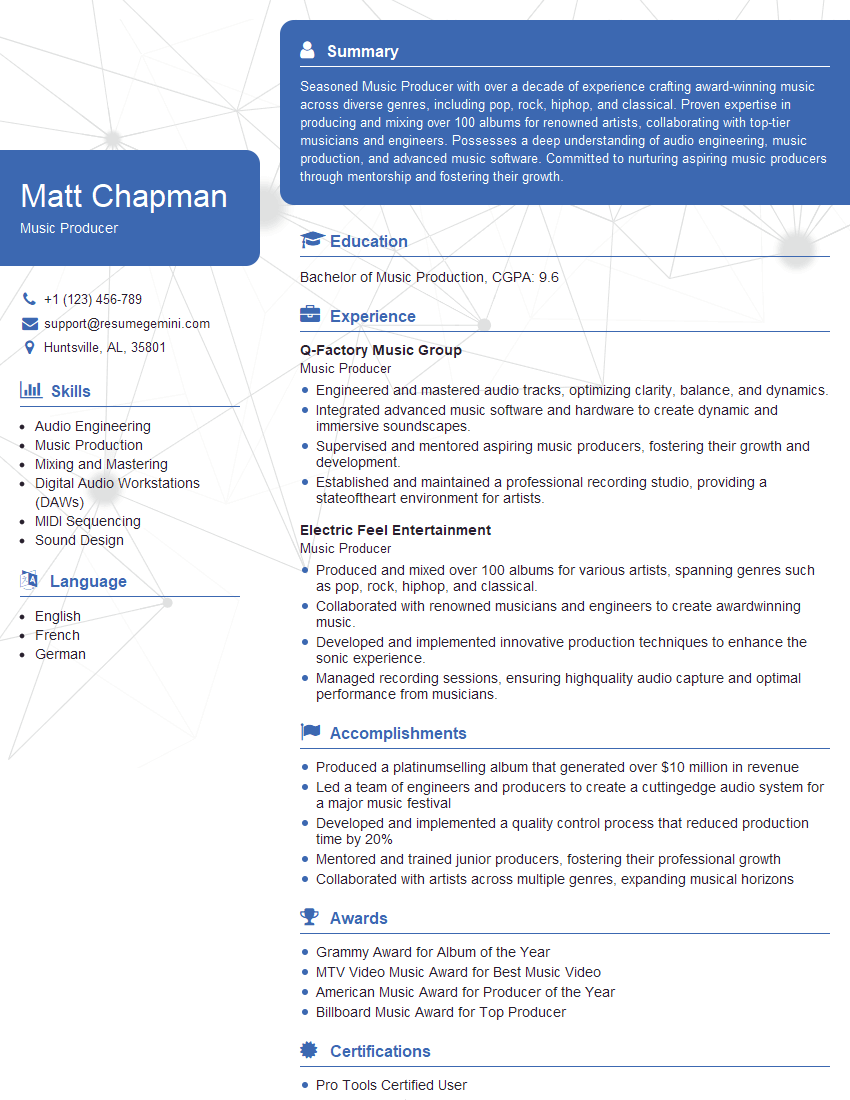
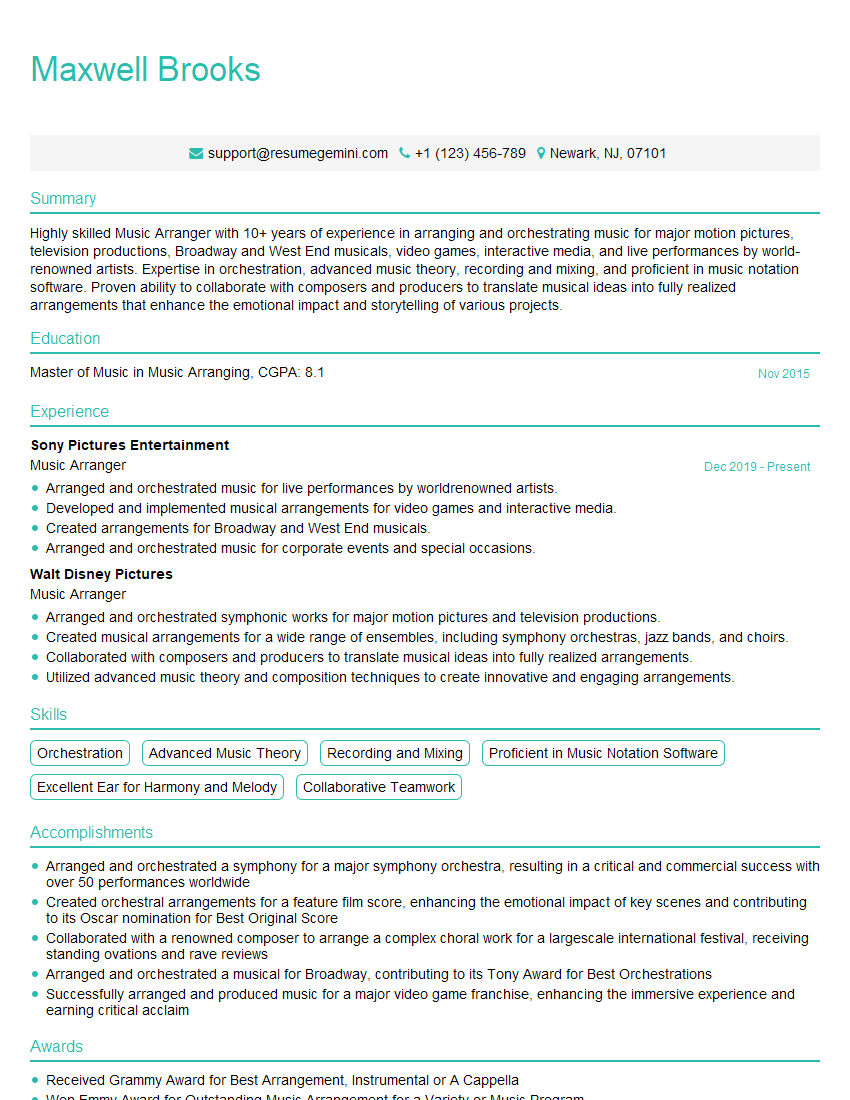
Mastering the art of commercial music arranging opens doors to exciting career opportunities in the dynamic music industry. A strong portfolio and a well-crafted resume are essential for showcasing your skills and experience. An ATS-friendly resume significantly improves your chances of getting noticed by potential employers. To create a compelling and effective resume, leverage the power of ResumeGemini. ResumeGemini provides a streamlined process for building professional resumes, and we offer examples of resumes specifically tailored to showcasing experience in arranging for commercial music, helping you present your skills and experience in the best possible light.
Explore more articles
Users Rating of Our Blogs
Share Your Experience
We value your feedback! Please rate our content and share your thoughts (optional).
What Readers Say About Our Blog
Very informative content, great job.
good