Cracking a skill-specific interview, like one for Experience in Channeling and Mediumship, requires understanding the nuances of the role. In this blog, we present the questions you’re most likely to encounter, along with insights into how to answer them effectively. Let’s ensure you’re ready to make a strong impression.
Questions Asked in Experience in Channeling and Mediumship Interview
Q 1. Describe your experience with channeling different entities.
Channeling involves acting as a conduit for a non-physical entity, whether a spirit guide, a deceased loved one, or a collective consciousness. My experience spans diverse entities, ranging from benevolent spirit guides offering wisdom and guidance to historical figures sharing insights into past events. Each entity possesses a unique energetic signature and communication style, requiring adaptability and sensitivity on my part. For example, one guide communicated through vivid imagery, while another preferred concise, direct messages. The key is maintaining a clear channel and recognizing the nuances in their expression. Over the years, I’ve developed the ability to discern the subtle differences in energy and communication patterns, leading to richer and more accurate transmissions.
I’ve channeled information relating to personal growth, spiritual understanding, past-life experiences, and even practical solutions to client challenges. The experience is deeply humbling and constantly reinforces the interconnectedness of all things.
Q 2. Explain your process for verifying the accuracy of channeled information.
Verifying channeled information is crucial for maintaining ethical and professional standards. My process involves a multi-layered approach. Firstly, I rely on intuitive discernment, cross-referencing the information with my own understanding and knowledge base. Does the information resonate with truth and universal principles? Is it consistent with what is already known about the entity being channeled? Does it offer practical advice, or promote harm? Secondly, I utilize external validation whenever possible. If the channeled information relates to a specific event or individual, I will seek independent confirmation through research or by contacting relevant individuals. For instance, if a spirit guide offers details about a past event, I’ll independently research historical records to validate the information’s accuracy. Thirdly, and perhaps most importantly, I always encourage clients to use their own discernment and intuition. Channeled information is a tool for guidance, not definitive truth. Ultimately, the client should be empowered to decide what resonates with their own truth.
Q 3. How do you maintain ethical boundaries while performing mediumship readings?
Maintaining ethical boundaries is paramount in mediumship. I adhere strictly to a code of conduct that prioritizes client autonomy and well-being. This includes never making promises I cannot keep, avoiding overly definitive or sensationalized claims, and respecting client confidentiality. I clearly state upfront that readings offer guidance and insights, not predictions. I refuse to engage in readings that exploit, manipulate, or cause harm. I also avoid making medical or financial decisions for clients. Instead, I encourage clients to consult qualified professionals for specific advice in these areas. Furthermore, I set clear boundaries regarding the time and scope of the reading to prevent exploitation and ensure a respectful exchange. Maintaining a professional distance, while maintaining empathy and compassion, is essential in creating a safe and trustworthy environment for clients.
Q 4. Describe a challenging experience with channeling and how you overcame it.
One of the most challenging experiences involved channeling a spirit struggling with unresolved grief and anger. The energy was intense, and at times overwhelming. The intense emotions clouded the clarity of the message. To overcome this, I employed grounding techniques such as deep breathing and visualization, centering myself in my own energy field. I also verbalized affirmations to protect myself and maintain my clarity. I gently guided the entity towards a more peaceful state, focusing on messages of love, forgiveness, and acceptance. It was a profoundly moving experience, highlighting the importance of compassion and emotional intelligence in channeling. It was a reminder that my role is not just to transmit information but also to create a safe and supportive space for all involved.
Q 5. What techniques do you use to connect with spirit guides or loved ones?
Connecting with spirit guides or loved ones involves creating a conducive environment for communication. This begins with preparation: grounding myself through meditation or mindful breathing to clear my own energy field and create a quiet, receptive space. I then visualize the connection, setting an intention to connect with a specific entity. I use guided meditation, and sometimes utilize specific crystals or aromatherapy to enhance the connection. I might employ visualization techniques, imagining a pathway of light connecting me to the spirit world. Listening attentively to subtle intuitive cues, such as feelings, images, or sounds, is vital during the process. The communication may manifest as thoughts, feelings, images, or words, requiring sensitivity and discernment to interpret the messages accurately. Developing trust in the process is key. Each connection is unique, and patience and persistent practice are crucial for strengthening the connection.
Q 6. How do you differentiate between intuition, imagination, and channeled communication?
Differentiating between intuition, imagination, and channeled communication requires careful discernment and self-awareness. Intuition is a gut feeling, a knowingness that comes from within, often without conscious reasoning. Imagination is the creative process of constructing mental images or scenarios. Channeled communication, however, involves receiving information from an external source. The key difference lies in the source of the information. I distinguish between them by observing the clarity, consistency, and quality of the information. Channeled messages often possess a level of detail or insight that surpasses my own knowledge or understanding. They might also convey information about a past, present, or future event beyond my personal experience. Intuition often guides me toward a course of action, but it is less detailed. Imagination, on the other hand, is freely formed and not tied to an external source. Over time, one develops an intuitive sense of the difference through experience and practice. It’s a subtle art, and self-reflection is crucial for ensuring accuracy.
Q 7. Explain your understanding of different energy fields and their influence on readings.
Understanding energy fields is crucial in channeling and mediumship. I view the human energy field as a complex system interacting with other energy fields, including those of spirits or guides. The subtle energies surrounding individuals can significantly influence a reading’s accuracy and clarity. For instance, strong emotions, either positive or negative, can disrupt the flow of energy, making it difficult to receive clear messages. I pay attention to the overall energetic environment – the ambiance of the room, the client’s aura, and any external disturbances that might interfere with the connection. Shielding techniques are used to maintain a clear and protected channel. This might involve visualization, specific affirmations, or the use of protective crystals. A skilled practitioner recognizes how environmental energies interact with the subtle energies of those involved in a reading. The ability to perceive and manage these energetic dynamics greatly enhances the accuracy and effectiveness of the session.
Q 8. How do you handle skeptical clients or those who doubt your abilities?
Skepticism is a natural and valid response. I approach skeptical clients with respect and understanding, acknowledging their right to question. Instead of trying to force belief, I focus on providing a safe and comfortable space for exploration. I might explain the process in simpler terms, focusing on what I *do* rather than asserting metaphysical claims. For example, I might say, ‘My work involves receiving and interpreting information intuitively; some people perceive this as coming from a spirit, while others may see it as accessing subconscious information.’ I might offer a shorter, less intensive session as a trial run, or focus on a specific area of their life they are curious about, making the experience less overwhelming. The goal is to foster trust through transparency and respect their intellectual boundaries.
For instance, I once had a client deeply skeptical of mediumship. Instead of launching into a reading, I started by asking about their current challenges. Through intuitive questioning, I offered insights that resonated deeply, even if they didn’t ascribe it to spirits. By the end of the session, their skepticism had softened considerably, not because I convinced them, but because they experienced the tangible value of the session.
Q 9. What methods do you employ to protect yourself energetically during a session?
Protecting myself energetically is paramount. I utilize several techniques. Before each session, I perform a grounding and centering exercise (detailed in the next answer). I also visualize a protective white light surrounding me, acting as a shield against negative energies or unwanted attachments. After each session, I cleanse my energetic field through visualization, often by imagining a waterfall washing away any lingering energy. I regularly engage in practices such as meditation, mindful movement (yoga or tai chi), or spending time in nature to maintain a strong energetic state. It’s like caring for a muscle – regular exercise strengthens resilience.
Additionally, I set clear intentions before each session, stating my desire to connect with positive energies and protect my own space. This acts as a mental anchor, ensuring I stay focused and protected. It’s a continuous process, not a one-time event.
Q 10. Describe your approach to grounding and centering before and after a session.
Grounding and centering are fundamental to my practice. Before a session, I find a quiet space and engage in deep breathing exercises, focusing on my breath entering and leaving my body. I may visualize roots extending from my body deep into the earth, grounding me. I also bring my awareness to my physical body, noticing sensations in my hands, feet, and spine. This helps me become fully present and connect with my physical form, anchoring my energy.
Centering involves focusing on my heart center, my intuition, and my purpose. I visualize a calm, centered space within myself, a sanctuary free from external distractions. After a session, I engage in similar practices, but with a specific focus on releasing any residual energy from the session. I might visualize the energy flowing out of me and into the earth, or into the light. This helps me return to a balanced and neutral state, preventing energetic burnout.
Q 11. How do you prepare for a client session to ensure accuracy and clarity?
Preparation is key to accurate and clear readings. I begin by setting a sacred space, physically and energetically. I ensure the environment is quiet and free from distractions. I avoid consuming caffeine or alcohol before a session to maintain clarity. If possible, I ask clients to provide any relevant information beforehand, but without imposing limitations on the spontaneous flow of information during the session itself.
I also prepare myself mentally and emotionally, ensuring I am grounded, centered, and receptive. This might involve spending some quiet time in meditation or nature prior to seeing the client. I always maintain a clear ethical framework, reminding myself of my commitment to truth and compassion. The goal is not only to deliver information accurately but also to do so in a compassionate and responsible manner. I treat every session as a sacred moment of connection and exploration.
Q 12. How do you deal with emotionally charged or difficult messages from spirits?
Dealing with emotionally charged or difficult messages requires sensitivity, compassion, and a strong energetic boundary. My priority is to convey the information with respect and clarity, while ensuring the client is not overwhelmed. I may use gentle language, offering support and understanding. Sometimes, it’s necessary to break the information down into smaller pieces or to take a pause to allow the client to process their emotions. I may encourage journaling, meditation, or talk therapy to help them integrate their experiences.
If I am personally affected by the information, I prioritize self-care after the session to avoid emotional carryover. This may involve spending time in nature, engaging in creative activities, or talking to a trusted colleague or mentor. Ultimately, my aim is to facilitate healing and understanding, even in challenging situations.
Q 13. What are the ethical considerations when working with clients dealing with grief and loss?
Ethical considerations are paramount when dealing with grief and loss. I never promise specific outcomes or offer guarantees. My role is to offer comfort, support, and connection with loved ones who have passed, not to manipulate or control emotions. I emphasize that the messages I receive are not definitive answers, but rather intuitive insights that can provide comfort and guidance. I respect the client’s grief process and avoid judgment. I emphasize the importance of seeking professional therapeutic support for coping with grief, clarifying that my role complements rather than replaces professional counselling.
Transparency is vital. I explain my process clearly and honestly, ensuring the client understands the limitations of my abilities. I am always mindful of avoiding causing further distress. I would never, for example, deliver a message that could be interpreted as blaming the deceased for the client’s pain or suggesting that their grief is invalid.
Q 14. How do you ensure the confidentiality and privacy of your client’s information?
Confidentiality and privacy are non-negotiable. I adhere to strict ethical guidelines regarding the protection of client information. I never share details about sessions with anyone without the client’s explicit consent. I maintain secure records of client information, using password-protected files and secure storage practices. In cases where potentially sensitive or legally relevant information emerges during a session (e.g., potential harm to self or others), I am prepared to act responsibly, while still maintaining client confidentiality to the greatest extent possible, in accordance with legal and ethical requirements. This often involves a thoughtful conversation with the client.
Before each session, I obtain informed consent, explaining my confidentiality practices and any limitations. Clients have the right to withdraw information at any time. This approach emphasizes my commitment to protecting their trust and personal information.
Q 15. Describe your experience working with different types of clients (e.g., grieving, seeking guidance).
My experience encompasses a wide range of clients, each with unique needs and circumstances. Grieving individuals often seek connection and reassurance, while those seeking guidance might be navigating life transitions, career choices, or relationship challenges. For example, I’ve worked with clients grieving the loss of a loved one, providing comfort through connecting them with the departed’s energy and receiving messages of love and peace. Others have sought clarity on career paths, and through channeling, I’ve helped them identify their strengths and passions, leading to more fulfilling career choices. Each session is tailored to the individual’s specific needs, creating a safe and supportive space for exploration and healing.
In working with grieving clients, my focus is on validating their emotions and providing a sense of closure. For those seeking guidance, I act as a facilitator, helping them tap into their intuition and inner wisdom. The common thread in all my work is empathy and a deep respect for the client’s journey.
Career Expert Tips:
- Ace those interviews! Prepare effectively by reviewing the Top 50 Most Common Interview Questions on ResumeGemini.
- Navigate your job search with confidence! Explore a wide range of Career Tips on ResumeGemini. Learn about common challenges and recommendations to overcome them.
- Craft the perfect resume! Master the Art of Resume Writing with ResumeGemini’s guide. Showcase your unique qualifications and achievements effectively.
- Don’t miss out on holiday savings! Build your dream resume with ResumeGemini’s ATS optimized templates.
Q 16. Explain your understanding of the various types of mediumship (e.g., trance, physical, mental).
Mediumship involves receiving and conveying messages from spirits or other entities. Different types of mediumship utilize various methods. In trance mediumship, the medium enters a trance-like state, allowing a spirit to communicate through them. This often involves altered speech patterns and a shift in personality. Physical mediumship involves physical phenomena, such as objects moving or sounds appearing, often attributed to spirit intervention. Finally, mental mediumship relies on receiving information telepathically, either through thoughts, images, or feelings transmitted by spirits. It is crucial to note that ethical considerations are paramount in all forms of mediumship, with a focus on accurate, compassionate, and responsible communication.
I primarily work with mental mediumship, focusing on receiving clear and concise messages. My training emphasizes ethical practices and the importance of validating information received with known facts. It is also essential to always remain grounded and aware, maintaining a professional and respectful demeanor throughout the process.
Q 17. How do you determine the source of information received during a channeling session?
Determining the source of information received during channeling requires a discerning approach. It’s a process of intuition, verification, and critical evaluation. I begin by paying close attention to the information’s nature – is it consistent with what I already know about the client or the subject matter? Do the details feel accurate and resonate with my intuition? I also cross-reference information whenever possible. If a spirit claims to be a specific person, for instance, I verify details that only that person would know. This process reduces the likelihood of misinterpreting information or attributing messages to the wrong source.
Furthermore, a strong sense of discernment and intuition are vital. Sometimes, the ‘feeling’ of the information can reveal the source. If the message is filled with love and compassion, for instance, it might suggest a benevolent source. Conversely, feelings of unease or negativity may indicate that the source is not aligned with higher spiritual principles. The process of source verification is an ongoing learning experience and requires constant refinement.
Q 18. How do you handle situations where you receive information that is unclear or ambiguous?
When faced with unclear or ambiguous information, my approach is one of cautious interpretation. I avoid making definitive statements or offering interpretations that may be misleading. Instead, I clearly communicate to the client that the information is unclear and requires further exploration. I might ask clarifying questions or guide the client towards introspection to gain a deeper understanding. Sometimes, clarity emerges with time and further reflection. Honesty and transparency are crucial in these situations. For example, if a spirit message is vague about a specific detail, I will avoid speculating and instead focus on the broader message or its emotional impact.
It’s vital to remember that not every question will have a clear and concise answer. Honesty about limitations allows the client to focus on what is certain and to accept uncertainties without making assumptions that lead to confusion or disappointment.
Q 19. Describe your approach to providing guidance based on channeled information.
My approach to providing guidance based on channeled information is holistic and focuses on empowering the client. I don’t offer directives; instead, I present the information as possibilities and insights. I encourage the client to reflect upon the information, discern its meaning in their own context, and integrate it into their decision-making process. The focus is on empowering them to utilize their own intuition and wisdom alongside the channeled insights.
For instance, if the channeled information suggests a career change, I would not tell the client to quit their job immediately. Instead, I would discuss the potential benefits and challenges of such a decision and encourage them to explore their options thoughtfully, considering their personal circumstances and goals.
Q 20. What strategies do you use to improve your channeling and mediumship abilities?
Improving my channeling and mediumship abilities is an ongoing process requiring consistent practice and self-reflection. This includes regular meditation and energy work to enhance clarity and sensitivity. I also engage in spiritual practices like prayer and mindfulness to maintain a grounded and focused state. Furthermore, I seek guidance from experienced mentors and colleagues, and participate in workshops and development circles to refine my skills and broaden my understanding.
Studying the psychology of communication and learning active listening techniques greatly benefits accurate interpretation and enhances my ability to communicate complex information effectively. Regular self-reflection and evaluation of my sessions allow me to identify areas for improvement and maintain ethical standards.
Q 21. How do you integrate your spiritual gifts into your professional practice?
Integrating my spiritual gifts into my professional practice involves maintaining a balance between my spiritual beliefs and the ethical responsibilities of my profession. This includes setting clear boundaries, ensuring client confidentiality, and avoiding making promises or guarantees. My spiritual practice informs my approach to empathy, compassion, and intuitive understanding, creating a more supportive and nurturing environment for my clients.
Transparency is also key. I openly discuss my approach with clients, ensuring they are comfortable and understand the process. Continuous learning and self-development are essential to maintain integrity and professionalism, ensuring my gifts are used responsibly and ethically.
Q 22. How do you handle situations where you receive conflicting messages from different spirits?
Conflicting messages from spirits are a common occurrence in channeling and mediumship. It’s crucial to approach these situations with discernment and a grounded perspective. I don’t interpret conflicting information as a flaw in the process but rather as an opportunity to delve deeper. Think of it like interviewing multiple witnesses to an event – their accounts might differ slightly, yet collectively they paint a clearer picture.
My approach involves several steps: First, I carefully note the discrepancies. Then, I enter a meditative state to clear my mind and allow for intuitive guidance. I might ask clarifying questions of the spirit guides, seeking further context or clarification. Often, what seems contradictory at first can be resolved by understanding the differing perspectives or timelines involved. For example, one spirit might offer guidance from a long-term perspective, while another provides a more immediate perspective. Finally, I prioritize messages that resonate with my own intuition and feel aligned with the client’s highest good. If clarity remains elusive, I might simply share the multiple perspectives with the client, allowing them to intuit the most appropriate path.
Q 23. Explain your understanding of psychic protection and shielding techniques.
Psychic protection and shielding are vital for maintaining well-being during channeling and mediumship sessions. Essentially, these techniques create a protective barrier between yourself and external energies, preventing negative influences from disrupting your session or impacting your emotional state. It’s like wearing protective gear in a potentially hazardous environment.
My preferred methods include visualization techniques – I imagine myself surrounded by a sphere of white light, acting as a protective shield. I also utilize grounding techniques to connect with the earth’s energy, anchoring my energy and preventing energy drain. Before a session, I might perform a simple cleansing ritual, such as smudging with sage or using crystals for protection. After a session, I always take time for grounding and releasing any residual energies. I also set clear intentions before each session, defining the energetic boundaries and the purpose of the connection.
Q 24. What resources do you utilize to enhance your knowledge and skillset in channeling and mediumship?
Continuous learning is essential in this field. I enhance my knowledge and skills through a multi-faceted approach. I regularly attend workshops and seminars presented by experienced mediums and channelers, learning new techniques and refining my existing ones. I also actively participate in online communities and forums dedicated to spiritual development, exchanging knowledge and experiences with fellow practitioners. Furthermore, I engage in extensive self-study through books, articles, and online courses focused on channeling, mediumship, spiritual psychology, and related fields. Regular meditation and spiritual practices further enhance my intuitive abilities and sensitivity.
Q 25. Describe your process for interpreting and delivering channeled information to clients.
Interpreting and delivering channeled information requires a delicate balance of accuracy and compassion. The process starts with entering a receptive state, allowing the spirit to communicate through me. I do not actively *interpret* the messages, but rather act as a clear channel, relaying the information as received. However, I do use my intuition to discern the emotional tone and intent behind the communication, ensuring the messages are conveyed with clarity and empathy.
For example, if a message involves grief, I might adjust my delivery to offer comfort and support. My focus is on translating the spiritual communication into easily understandable language, avoiding jargon and complex concepts unless appropriate for the client’s level of understanding. I often record the session to ensure accuracy and provide the client with a transcript afterward. I also emphasize that the channeled information is guidance, not absolute prophecy, and encourage clients to use their own discernment. I always leave space for questions and clarifications, fostering an open and collaborative environment.
Q 26. How do you maintain your own spiritual well-being while working as a medium or channeler?
Maintaining spiritual well-being is paramount, as channeling and mediumship can be energetically demanding. I prioritize self-care through a combination of practices. Regular meditation helps me maintain mental clarity and emotional balance. Spending time in nature reconnects me with the earth’s energy, grounding my energy and reducing stress. A healthy diet and regular exercise support physical vitality. Crucially, I set boundaries around my work, scheduling downtime and rest to prevent burnout. I also cultivate a supportive network of friends and fellow practitioners, creating a space for sharing experiences and receiving encouragement. It’s essential to remember that my spiritual practice is not just about serving others, but nurturing my own growth and well-being.
Q 27. Explain your understanding of ethical considerations related to charging for spiritual services.
Ethical considerations concerning payment for spiritual services are crucial. I believe in transparency and fairness. My pricing reflects the time, expertise, and energy invested in each session, while also considering the client’s financial capabilities. I avoid exploitative pricing and always clearly communicate my fee structure beforehand. If a client is unable to afford my services, I would consider offering a reduced rate or exploring alternative payment arrangements. I would never pressure a client into a purchase or service and always respect their decision if they choose not to proceed. Ultimately, my approach is rooted in integrity and a commitment to helping others with compassion.
Q 28. What are your professional boundaries and how do you communicate them to clients?
Maintaining professional boundaries is fundamental to my practice. I clearly communicate these boundaries from the outset of our interaction, outlining expectations regarding session duration, communication outside of sessions, and the nature of the services provided. I emphasize the importance of respecting each other’s personal space and time. I avoid providing unsolicited advice or making promises beyond my abilities. I also refuse to engage in any activity that feels unsafe or unethical. For example, I wouldn’t discuss a client’s private matters with anyone outside the session, and I would politely decline requests that go beyond my scope of practice. By upholding clear boundaries, I create a safe and respectful environment that allows for effective and meaningful spiritual guidance.
Key Topics to Learn for Experience in Channeling and Mediumship Interview
- Ethical Considerations in Channeling and Mediumship: Understanding boundaries, client confidentiality, and responsible practice. Explore the ethical frameworks guiding your work and how you navigate challenging situations.
- Developing and Refining Channeling Techniques: Discuss your preferred methods, how you cultivate a connection, and techniques for managing energy flow during a session. Highlight practical experiences and the evolution of your approach.
- Mediumship Accuracy and Validation: Explain your process for verifying information received and how you approach situations where information is unclear or challenging to interpret. Discuss strategies for ensuring accuracy and responsible communication of messages.
- Client Interaction and Communication: Detail your approach to building rapport with clients, setting expectations, and providing support before, during, and after a session. Demonstrate understanding of sensitive communication and how to manage diverse client needs.
- Spirit Communication and Interpretation: Describe your understanding of spirit communication, different types of communication styles, and your methods of interpreting messages from the spirit world. Discuss the nuances of receiving and transmitting information accurately.
- Personal Spiritual Development and Practice: Explain how your own spiritual journey has informed your practice. Discuss your commitment to continuous learning and self-reflection within your chosen field. Highlight your methods for maintaining grounding and managing your own energy.
- Problem-Solving and Crisis Management: Discuss how you’ve handled challenging situations during channeling or mediumship sessions. Explain your approach to managing unexpected events or emotionally charged circumstances, while maintaining professionalism and client well-being.
Next Steps
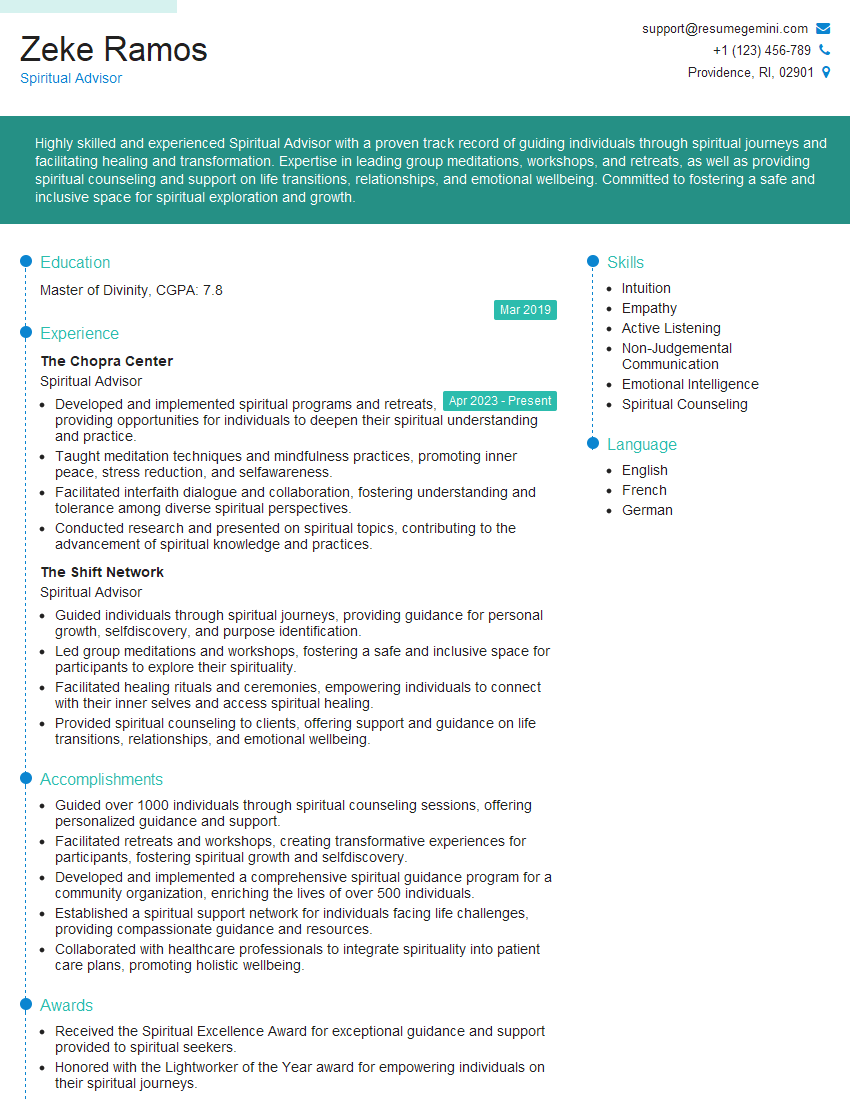
Mastering the art of channeling and mediumship is crucial for a rewarding and successful career. A strong resume is your key to unlocking exciting opportunities. Building an ATS-friendly resume is essential to getting your application noticed by potential employers. ResumeGemini is a trusted resource to help you create a professional and impactful resume that highlights your unique skills and experience. Examples of resumes tailored to Experience in Channeling and Mediumship are provided to guide you through the process. Take the next step in your career journey and craft a resume that showcases your exceptional abilities.
Explore more articles
Users Rating of Our Blogs
Share Your Experience
We value your feedback! Please rate our content and share your thoughts (optional).
What Readers Say About Our Blog
Very informative content, great job.
good