Are you ready to stand out in your next interview? Understanding and preparing for Experience in Developing and Implementing Social Media Strategies interview questions is a game-changer. In this blog, we’ve compiled key questions and expert advice to help you showcase your skills with confidence and precision. Let’s get started on your journey to acing the interview.
Questions Asked in Experience in Developing and Implementing Social Media Strategies Interview
Q 1. Describe your experience developing and implementing social media strategies.
Developing and implementing social media strategies is a multifaceted process that begins with a deep understanding of the client’s business goals and target audience. It’s not just about posting; it’s about crafting a narrative that resonates and drives results. My experience involves a systematic approach, starting with a comprehensive audit of existing social media presence (if any), followed by meticulous research to identify the optimal platforms and content strategies for reaching the target audience. This research informs the creation of a detailed social media strategy document, outlining goals, target audience personas, content pillars, and a detailed content calendar. Implementation involves content creation, scheduling, community management, engagement, and ongoing analysis and optimization. For example, I recently worked with a small bakery that wanted to increase local sales. We created a hyper-local strategy using Instagram and Facebook, focusing on visually appealing content showcasing their fresh products, running targeted ads to reach people within a 5-mile radius, and engaging with local community groups. The result was a 25% increase in foot traffic and sales within three months.
Q 2. What social media platforms are you most proficient in, and why?
I’m most proficient in Facebook, Instagram, and LinkedIn, although I have experience with TikTok, Twitter, and Pinterest as well. My proficiency stems from understanding the nuances of each platform’s audience and algorithm. Facebook excels at reaching broad audiences and driving website traffic through targeted ads. Instagram is ideal for visual storytelling and building brand awareness through high-quality imagery and video. LinkedIn is a powerful tool for B2B marketing and networking, particularly effective for connecting with professionals in specific industries. The choice of platform depends heavily on the target audience and business goals. For instance, a B2C company selling cosmetics would benefit most from Instagram and Facebook, while a SaaS company would find LinkedIn more fruitful.
Q 3. How do you measure the success of a social media campaign?
Measuring the success of a social media campaign requires a multi-faceted approach that goes beyond simple vanity metrics like likes and followers. I use a combination of quantitative and qualitative data to assess performance. Quantitative data includes metrics such as reach, engagement rate (likes, comments, shares), website clicks, conversions (e.g., sales, sign-ups), and cost-per-acquisition (CPA). Qualitative data involves analyzing customer sentiment through comments and direct messages, monitoring brand mentions, and tracking the overall tone of conversations around the brand. For example, a campaign might have high engagement but low conversions, indicating a need to optimize the call-to-action or landing page. Conversely, a campaign might have modest engagement but high conversions, showing effectiveness despite lower visibility.
Q 4. What key performance indicators (KPIs) do you typically track for social media?
The KPIs I typically track vary depending on the campaign objectives, but some common ones include:
- Reach: The number of unique users who saw your content.
- Engagement Rate: The percentage of your audience that interacted with your content (likes, comments, shares).
- Website Clicks: The number of clicks from social media to your website.
- Conversions: The number of desired actions taken by users (e.g., purchases, sign-ups).
- Brand Mentions: The number of times your brand is mentioned on social media.
- Sentiment Analysis: The overall positive or negative sentiment expressed towards your brand.
- Cost Per Acquisition (CPA): The cost of acquiring a customer through social media advertising.
Tracking these KPIs provides a comprehensive understanding of campaign effectiveness and allows for data-driven optimization.
Q 5. Explain your process for creating a social media content calendar.
My process for creating a social media content calendar begins with a thorough understanding of the campaign goals and target audience. I then brainstorm content ideas aligned with these goals and the identified audience preferences. This brainstorming often involves keyword research to ensure content aligns with what the audience is actively searching for. Next, I prioritize the content based on its potential impact and align it with relevant industry events or trends. Finally, I schedule the content using a social media management tool, ensuring a consistent and engaging flow across platforms. The calendar includes details such as content type (image, video, text), publishing date and time, platform, hashtags, and assigned team members for content creation. This calendar is a living document, reviewed and updated regularly to reflect performance data and changing circumstances.
Q 6. How do you identify and target your ideal audience on social media?
Identifying and targeting the ideal audience on social media requires a multi-pronged approach. I start by creating detailed buyer personas, which are semi-fictional representations of ideal customers, including their demographics, interests, online behavior, and pain points. This is followed by leveraging platform-specific tools such as Facebook Ads Manager and LinkedIn’s audience targeting options. These tools allow for highly specific targeting based on demographics, interests, behavior, and even connections. I also analyze existing social media data to understand the current audience and identify potential areas for improvement in targeting. For example, if we find that a specific type of content performs significantly better with a certain demographic, we can refine our targeting to reach more of that audience. Ongoing monitoring and adjustment are crucial to optimize targeting over time.
Q 7. How do you handle negative comments or feedback on social media?
Handling negative comments or feedback on social media requires a prompt, professional, and empathetic response. Ignoring negative comments is never a good strategy; it can damage your brand’s reputation. My approach involves acknowledging the user’s concerns and expressing empathy, even if I don’t agree with their perspective. I then try to offer a solution or explanation, depending on the nature of the complaint. It’s important to address the issue publicly, while also offering a private message for further discussion if appropriate. Transparency and a willingness to address concerns directly build trust and demonstrate a commitment to customer satisfaction. For example, if a customer complains about a damaged product, I would apologize, offer a replacement or refund, and thank them for bringing the issue to our attention. This demonstrates accountability and builds positive relationships, even in challenging situations.
Q 8. Describe your experience using social media analytics tools.
My experience with social media analytics tools is extensive. I’m proficient in using platforms like Google Analytics, Facebook Insights, Twitter Analytics, and Instagram Insights to track key performance indicators (KPIs). These tools provide invaluable data on audience demographics, post performance, reach, engagement rates (likes, comments, shares), website traffic driven from social media, and campaign effectiveness.
For instance, using Facebook Insights, I once identified that videos performing particularly well on Wednesdays and Fridays among a specific age demographic. This allowed us to optimize our content calendar and scheduling for maximum reach and engagement. Similarly, using Google Analytics, I can track website traffic originating from specific social media channels, helping determine which platforms are most effective for driving conversions. I also use these insights to refine targeting parameters in paid social media campaigns, ensuring optimal return on ad spend (ROAS).
Beyond basic metrics, I delve into advanced analytics to understand user behavior, identify trends, and inform strategic decision-making. This might include analyzing audience sentiment toward specific campaigns or products, understanding the effectiveness of different content formats (images, videos, stories), and identifying influencers who resonate most strongly with our target audience.
Q 9. What strategies do you use to increase engagement on social media?
Increasing social media engagement requires a multi-faceted strategy focusing on high-quality content, consistent posting, audience interaction, and data-driven optimization.
- High-Quality Content: This is paramount. Content should be visually appealing, relevant to the target audience, and offer value (information, entertainment, inspiration). I focus on diverse content formats – images, videos, stories, live streams – to keep the audience engaged.
- Consistent Posting Schedule: Regularly posting keeps your audience engaged and prevents your page from appearing inactive. The frequency and timing should be optimized based on audience behavior and platform-specific algorithms.
- Audience Interaction: Responding promptly to comments and messages fosters a sense of community and shows your audience you value their participation. Asking questions, running polls, and using interactive features like Instagram Stories quizzes can further increase engagement.
- Data-Driven Optimization: Analyzing social media analytics is crucial for understanding what resonates with your audience. This allows you to refine your content strategy, adjust your posting schedule, and experiment with different approaches to maximize engagement.
- Run Contests and Giveaways: Engaging contests can drastically boost engagement by encouraging users to like, share, and comment.
For example, in a recent campaign, we implemented a series of interactive polls on Instagram Stories asking users about their preferences for a new product line. This strategy led to a significant spike in engagement and valuable user feedback that informed our product development.
Q 10. How do you stay up-to-date with the latest social media trends and best practices?
Staying updated on social media trends and best practices is an ongoing process. I utilize a variety of methods to ensure I remain at the forefront of the industry.
- Following Industry Influencers and Publications: I follow key social media marketing experts, thought leaders, and industry publications on various platforms (LinkedIn, Twitter, etc.) to stay abreast of emerging trends, new features, and algorithm changes.
- Attending Webinars and Conferences: Participating in industry events provides valuable insights and networking opportunities, allowing me to learn from peers and experts.
- Utilizing Social Media Monitoring Tools: Dedicated tools can track trending topics, hashtags, and conversations relevant to our industry and target audience, enabling us to anticipate and adapt to changing trends.
- Continuous Learning: I actively seek out online courses, workshops, and certifications to deepen my expertise and learn about new technologies and strategies. I also read industry blogs, white papers and case studies.
For instance, I recently attended a conference focused on the evolving landscape of TikTok marketing, which provided actionable strategies for leveraging the platform’s unique features and reaching younger demographics.
Q 11. Describe your experience with paid social media advertising.
I have significant experience managing paid social media advertising campaigns across various platforms, including Facebook, Instagram, Twitter, and LinkedIn. My approach is data-driven, focusing on achieving specific objectives such as brand awareness, lead generation, or website traffic.
I’m proficient in creating and managing ad campaigns, targeting specific demographics, interests, and behaviors. I utilize A/B testing to optimize ad creatives, copy, and targeting parameters to maximize ROI. For example, when running a Facebook campaign to drive website traffic, I might A/B test different ad creatives, headlines, and calls-to-action to identify what resonates best with the target audience. This continuous optimization allows for improving campaign efficiency and reducing costs while achieving desired results.
I also leverage audience retargeting to re-engage users who have previously interacted with our brand or website. This approach helps nurture leads and increase conversion rates.
Q 12. How do you manage multiple social media accounts simultaneously?
Managing multiple social media accounts effectively requires a well-organized approach and the use of appropriate tools. I leverage social media management platforms like Hootsuite or Buffer to streamline my workflow. These platforms allow me to schedule posts across multiple accounts, monitor mentions and messages, and track performance metrics in one central dashboard.
Furthermore, I create content calendars that outline planned posts, themes, and objectives for each platform, ensuring consistent branding and messaging. This organized approach prevents overlap, redundancy and allows me to focus on the unique characteristics of each platform and tailor content to its specific audience.
For example, I might schedule a series of engaging stories for Instagram while planning longer-form content for LinkedIn, all within the same week, based on the established content calendar. This organized system ensures that all platforms receive appropriate attention without compromising efficiency.
Q 13. How do you collaborate with other teams (e.g., marketing, sales) on social media initiatives?
Collaboration is key to successful social media initiatives. I work closely with various teams, such as marketing, sales, and customer service, to ensure alignment and integration across all channels.
With the marketing team, I coordinate social media campaigns to amplify marketing initiatives and ensure consistent messaging. I share social media analytics and insights to help inform overall marketing strategy. With the sales team, I provide them with the leads generated through social media campaigns and ensure they have access to social media content that they can use in their sales outreach.
For example, we might develop a joint campaign where the social media team creates engaging content to drive traffic to a landing page where the sales team is running a lead generation campaign. Collaboration with customer service enables us to address customer issues promptly and efficiently via social media, building trust and improving brand reputation. Regular meetings and transparent communication are crucial to effective inter-team collaboration.
Q 14. What is your experience with social listening and brand monitoring?
Social listening and brand monitoring are crucial for understanding public perception and proactively addressing potential issues. I use tools like Brand24 or Talkwalker to monitor online conversations related to our brand, industry, competitors, and relevant keywords. This allows me to identify potential crises, track brand sentiment, and gain valuable insights into customer needs and preferences.
For example, by monitoring social media conversations, I might detect negative feedback about a specific product feature. This allows us to address the issue promptly, potentially preventing the problem from escalating. Furthermore, social listening can reveal valuable opportunities, such as identifying emerging trends or unmet customer needs that we can leverage in our social media strategy. This proactive approach ensures we are always adapting to changing customer expectations and maintaining a positive brand image.
Q 15. Describe a time you had to adapt your social media strategy due to unforeseen circumstances.
Adapting a social media strategy is crucial for success. Imagine you’ve planned a campaign around a product launch, but a major competitor releases a similar product a week earlier. This requires immediate pivoting. In one instance, we launched a campaign promoting a new sustainable clothing line. The initial strategy focused on aspirational lifestyle imagery. However, unexpectedly, a significant environmental disaster occurred during the campaign’s run. Using our crisis communication plan as a base, we quickly paused the scheduled aspirational posts and instead shifted to a more empathetic tone, highlighting our brand’s commitment to sustainability and offering support to affected communities. We repurposed existing content to focus on resilience and community support. We also engaged directly with comments and messages expressing concerns, showing our commitment to addressing these issues. This adjustment, though unplanned, increased customer trust and demonstrated our brand’s values in a challenging situation. This resulted in an increase in positive engagement and brand loyalty.
Career Expert Tips:
- Ace those interviews! Prepare effectively by reviewing the Top 50 Most Common Interview Questions on ResumeGemini.
- Navigate your job search with confidence! Explore a wide range of Career Tips on ResumeGemini. Learn about common challenges and recommendations to overcome them.
- Craft the perfect resume! Master the Art of Resume Writing with ResumeGemini’s guide. Showcase your unique qualifications and achievements effectively.
- Don’t miss out on holiday savings! Build your dream resume with ResumeGemini’s ATS optimized templates.
Q 16. How do you develop a social media budget and justify your spending?
Developing a social media budget requires a strategic approach. You need to consider your goals, target audience, chosen platforms, and the resources required to achieve your objectives. I begin by defining Key Performance Indicators (KPIs) – quantifiable metrics that demonstrate campaign success, like follower growth, engagement rate, or website traffic. Based on these KPIs, I allocate budget across different activities: content creation (photography, videography, design), paid advertising (Facebook Ads, Instagram Ads), social listening and analytics tools, and potential influencer collaborations. To justify spending, I create a detailed proposal outlining projected ROI (Return on Investment). This includes a cost-benefit analysis comparing the cost of various activities with their estimated return in terms of increased brand awareness, lead generation, or sales. I constantly monitor and analyze campaign performance to ensure budget is being efficiently used and to adjust the strategy as needed. For example, if organic reach on a platform is underperforming, we might shift resources towards paid advertising on that platform, and vice-versa.
Q 17. What is your experience with social media A/B testing?
A/B testing is integral to optimizing social media performance. It’s like conducting a scientific experiment to see what resonates best with your audience. We regularly employ A/B testing to compare different aspects of our campaigns, including: image/video variations, caption copy, call-to-action buttons, and even post scheduling. For instance, we might test two different ad creatives targeting the same demographic, measuring click-through rates and conversion rates to determine which performs better. Using platform-specific analytics dashboards and dedicated A/B testing tools, we collect data to identify statistically significant differences. This data-driven approach ensures we refine our strategies continuously and maximize our results. The insights gained inform future campaigns, allowing for more effective resource allocation and better overall campaign performance.
Q 18. Describe your experience with social media crisis management.
Social media crisis management is crucial for protecting a brand’s reputation. A proactive approach is key. We develop a detailed crisis communication plan, outlining steps to take in various scenarios (e.g., negative reviews, product recalls, online attacks). This plan includes pre-approved messaging templates, designated communication channels, and a team responsible for responding quickly and decisively. During a crisis, rapid response is paramount. In one instance, a false negative rumour about our product spread rapidly on Twitter. We immediately activated our crisis communication plan. We monitored the conversation, identified key influencers spreading misinformation, and responded to each tweet/comment with a factual and empathetic response. Simultaneously, we issued a press release clarifying the situation. We also collaborated with relevant influencers to help spread accurate information. This helped to quickly contain the spread of misinformation and limit negative impact on our brand reputation. Transparent and timely communication is vital in such situations.
Q 19. How do you ensure brand consistency across all social media platforms?
Maintaining brand consistency across platforms is essential for creating a cohesive brand identity. This involves creating a style guide that dictates visual elements (logo usage, color palettes, font choices), tone of voice, and messaging guidelines. We utilize a centralized content calendar to schedule posts across all platforms, ensuring a unified brand message. We also ensure that the content formats are suitable for each platform, optimizing for different audience preferences and engagement strategies (e.g., short-form videos on TikTok, longer-form articles on LinkedIn). Using social media management tools helps with scheduling and maintaining consistency in posting frequency. Regular audits of our social media presence help identify inconsistencies and areas for improvement. We always encourage feedback from the team to refine our approach to consistency and reinforce the brand voice across all touchpoints.
Q 20. Explain your understanding of different social media algorithms.
Understanding social media algorithms is essential for optimizing content reach and engagement. Each platform uses a different algorithm to determine which content to show users. These algorithms prioritize factors like user engagement (likes, comments, shares), content relevance (keywords, hashtags), and account activity (posting frequency, interaction). For example, Instagram’s algorithm favors content that receives high engagement early on after posting, while Facebook’s algorithm prioritizes content from accounts with which users frequently interact. Twitter’s algorithm is heavily influenced by real-time trending topics and keywords. Knowing these nuances helps tailor content to the specific platform’s algorithm. For example, on Instagram, we might prioritize visually appealing content with strong calls to action, while on LinkedIn, we’d focus on providing valuable industry insights and engaging in professional discussions. Regularly monitoring analytics and adapting our strategy based on platform-specific performance is also vital.
Q 21. How do you measure the ROI of social media marketing efforts?
Measuring the ROI of social media marketing requires a clear understanding of your objectives. We use a combination of quantitative and qualitative metrics. Quantitative metrics include website traffic driven from social media, lead generation (forms, email sign-ups), sales conversions attributed to social media campaigns, and cost-per-acquisition (CPA). Qualitative metrics such as brand awareness, customer engagement (comments, shares, mentions), and sentiment analysis (positive/negative brand mentions) provide a holistic understanding of the campaign’s impact. We utilize platform analytics (e.g., Facebook Insights, Instagram Analytics), and sometimes employ third-party analytics tools for a more comprehensive analysis. For example, we might track the number of website conversions originating from social media ads, comparing this to the cost of the ad campaign to calculate the ROI. By regularly monitoring and analyzing these metrics, we can make data-driven decisions to optimize campaigns and demonstrate the value of our social media efforts to stakeholders.
Q 22. What are some common mistakes to avoid when managing social media accounts?
Managing social media effectively requires avoiding several common pitfalls. Inconsistent posting is a major one; think of it like a conversation – if you only chime in occasionally, people will lose interest. Another critical mistake is neglecting audience engagement. Social media is a two-way street; responding to comments, messages, and reviews shows you value your audience.
- Ignoring analytics: Not tracking key metrics like reach, engagement, and conversions prevents you from understanding what works and what doesn’t. It’s like driving without a speedometer – you might get there, but inefficiently.
- Lack of a defined strategy: Jumping onto every platform without a clear goal or target audience is like throwing spaghetti at a wall and hoping some sticks. A well-defined strategy is crucial for success.
- Using the wrong tone of voice: Your brand’s voice should be consistent across all platforms and resonate with your target audience. A mismatch can lead to confusion and alienate potential customers.
- Failing to adapt to algorithm changes: Social media algorithms are constantly evolving. Ignoring these changes means your content may not reach your intended audience.
- Ignoring negative feedback: Negative comments and reviews are opportunities for improvement. Ignoring them shows a lack of responsiveness and can damage your brand’s reputation.
For example, I once worked with a client who was posting inconsistently and ignoring negative reviews. By implementing a consistent posting schedule and proactively addressing negative feedback, we significantly improved their brand reputation and customer engagement.
Q 23. Describe your experience with influencer marketing.
My experience with influencer marketing spans several successful campaigns. I’ve worked with micro-influencers (those with smaller, highly engaged followings) and macro-influencers (those with large followings). The key is selecting influencers whose audience aligns with your target market. It’s not just about follower count; it’s about audience engagement and authenticity.
In one campaign, we collaborated with a micro-influencer specializing in sustainable living to promote an eco-friendly product. The results were phenomenal – significantly higher engagement and conversions compared to traditional advertising. We meticulously tracked key performance indicators (KPIs) such as click-through rates, conversion rates, and overall brand mentions. This data informed our subsequent influencer collaborations, allowing us to refine our strategy and optimize our return on investment (ROI).
I also have experience with developing comprehensive influencer marketing strategies including campaign planning, influencer selection, contract negotiation, content creation, performance monitoring, and reporting. I leverage various tools for identifying and analyzing influencers, and ensure transparent and ethical collaboration.
Q 24. How do you use social media to build brand awareness and loyalty?
Building brand awareness and loyalty on social media requires a multi-faceted approach. It’s about consistently delivering high-quality content that resonates with your target audience and fosters a sense of community.
- Consistent branding: Maintain a consistent brand voice, visual identity, and messaging across all platforms. Think of it as building a strong personality that people can recognize and trust.
- Engaging content: Create a variety of content formats – videos, images, stories, live streams – to keep your audience interested and engaged. Consider using user-generated content (UGC) to build trust and social proof.
- Community building: Foster a sense of community by responding to comments and messages, running contests and giveaways, and creating interactive content like polls and Q&As.
- Storytelling: Share your brand’s story and connect with your audience on an emotional level. People buy from brands they trust and connect with.
- Running targeted advertising campaigns: Leverage social media advertising to reach a wider audience and increase brand awareness.
For example, a successful campaign I ran involved creating a series of behind-the-scenes videos that showcased the human side of the company. This significantly increased audience engagement and fostered a sense of loyalty.
Q 25. How do you leverage social media to generate leads and drive sales?
Generating leads and driving sales through social media requires a strategic approach focused on driving traffic to your website or landing pages. This involves using clear calls to action (CTAs) within your posts and utilizing social media advertising.
- Targeted advertising: Use social media advertising platforms to target specific demographics and interests to reach potential customers.
- Compelling content: Create engaging content that highlights the benefits of your product or service and motivates users to take action.
- Shoppable posts: Integrate e-commerce features into your posts to allow customers to purchase products directly through social media.
- Lead magnets: Offer valuable resources, such as ebooks or webinars, in exchange for contact information.
- Retargeting: Use retargeting ads to reach users who have previously interacted with your brand but haven’t made a purchase.
For example, I successfully implemented a social media campaign that used a combination of targeted ads and compelling visuals to drive traffic to a landing page offering a free trial of a software product. This resulted in a significant increase in leads and sales.
Q 26. What is your experience with using social media for customer service?
Social media is a powerful tool for customer service. Responding promptly and efficiently to customer inquiries and complaints on social media platforms demonstrates responsiveness and builds trust.
My experience involves establishing clear protocols for handling customer service inquiries on social media, ensuring consistent brand voice and tone, and tracking metrics such as response time and customer satisfaction. We always aim to resolve issues publicly where appropriate, demonstrating transparency and building confidence with other potential customers. A key aspect is empowering the customer service team with the necessary tools and training to handle diverse situations efficiently and effectively. This includes access to internal knowledge bases and established communication guidelines. A well-defined escalation path is crucial when dealing with complex issues requiring higher-level intervention.
For example, in a recent project, we implemented a social media monitoring system that alerted our customer service team to negative comments and reviews in real-time, allowing us to respond promptly and resolve issues before they escalated.
Q 27. What are your thoughts on the future of social media marketing?
The future of social media marketing is exciting and ever-evolving. I believe we’ll see an increased emphasis on personalization, authenticity, and the integration of emerging technologies.
- Increased Personalization: AI-powered tools will enable marketers to deliver highly personalized experiences to individual users.
- Focus on Authenticity: Consumers are increasingly wary of inauthentic marketing tactics. Transparency and authenticity will be critical for success.
- Integration of Emerging Technologies: Technologies like augmented reality (AR) and virtual reality (VR) will offer new ways to engage with customers.
- Growth of Short-Form Video: Platforms like TikTok and Instagram Reels demonstrate the continuing popularity of short-form video content. Marketers will need to adapt to this trend.
- The Metaverse and Web3: The metaverse presents exciting new opportunities for brands to engage with customers in immersive digital environments. Understanding and leveraging Web3 technologies will become increasingly important.
The key to success in the future of social media marketing will be adaptability and a willingness to embrace new technologies and strategies. Continuous learning and staying ahead of the curve will be essential for any social media marketer.
Key Topics to Learn for Experience in Developing and Implementing Social Media Strategies Interview
- Social Media Landscape Analysis: Understanding current trends, platform algorithms, and audience demographics. Practical application: Analyzing competitor strategies and identifying opportunities for your own campaigns.
- Strategy Development & Goal Setting: Defining clear, measurable, achievable, relevant, and time-bound (SMART) social media goals aligned with overall business objectives. Practical application: Creating a social media marketing plan with specific KPIs and target audience segmentation.
- Content Creation & Curation: Developing engaging content across various platforms (text, image, video) and utilizing effective storytelling techniques. Practical application: Creating a content calendar and managing a social media editorial process.
- Community Management & Engagement: Building and nurturing online communities, responding to comments and messages promptly and professionally, and fostering positive brand interactions. Practical application: Developing a crisis communication plan and managing online reputation.
- Social Media Advertising & Paid Campaigns: Planning, executing, and analyzing paid social media advertising campaigns across different platforms. Practical application: Utilizing different ad formats and targeting options to maximize ROI.
- Analytics & Reporting: Tracking key performance indicators (KPIs), analyzing data to measure campaign effectiveness, and providing data-driven recommendations for optimization. Practical application: Using analytics dashboards to track engagement, reach, and conversions.
- Social Listening & Brand Monitoring: Tracking brand mentions, conversations, and sentiment to understand public perception and identify potential issues or opportunities. Practical application: Using social listening tools to monitor brand reputation and identify emerging trends.
- Legal & Ethical Considerations: Understanding and adhering to relevant social media policies, guidelines, and regulations. Practical application: Ensuring compliance with advertising standards and data privacy laws.
Next Steps
Mastering the art of developing and implementing social media strategies is crucial for career advancement in today’s digital landscape. A strong understanding of these concepts will significantly boost your job prospects. To increase your chances of landing your dream role, focus on building an ATS-friendly resume that effectively showcases your skills and experience. ResumeGemini is a trusted resource that can help you craft a professional and impactful resume. We provide examples of resumes tailored to highlight experience in developing and implementing social media strategies to help you get started. Take the next step towards your career goals – build a compelling resume with ResumeGemini today!
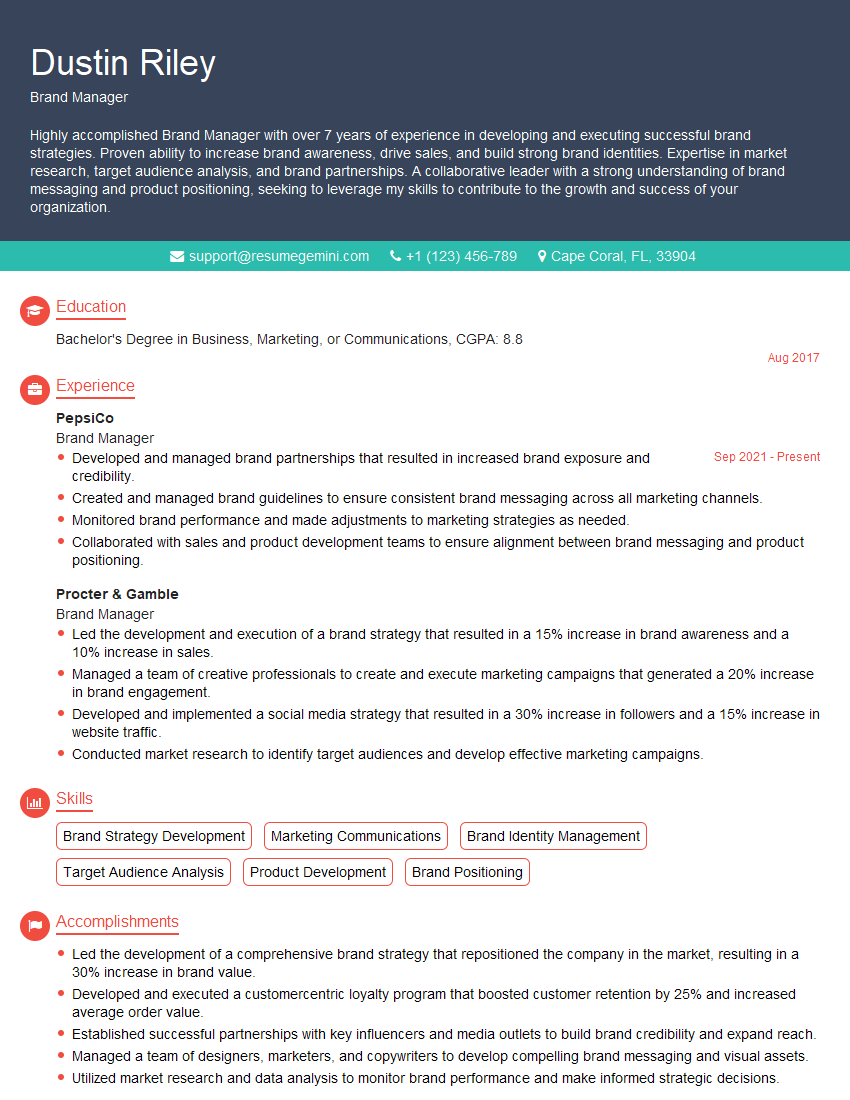
Brand Manager Resume Sample
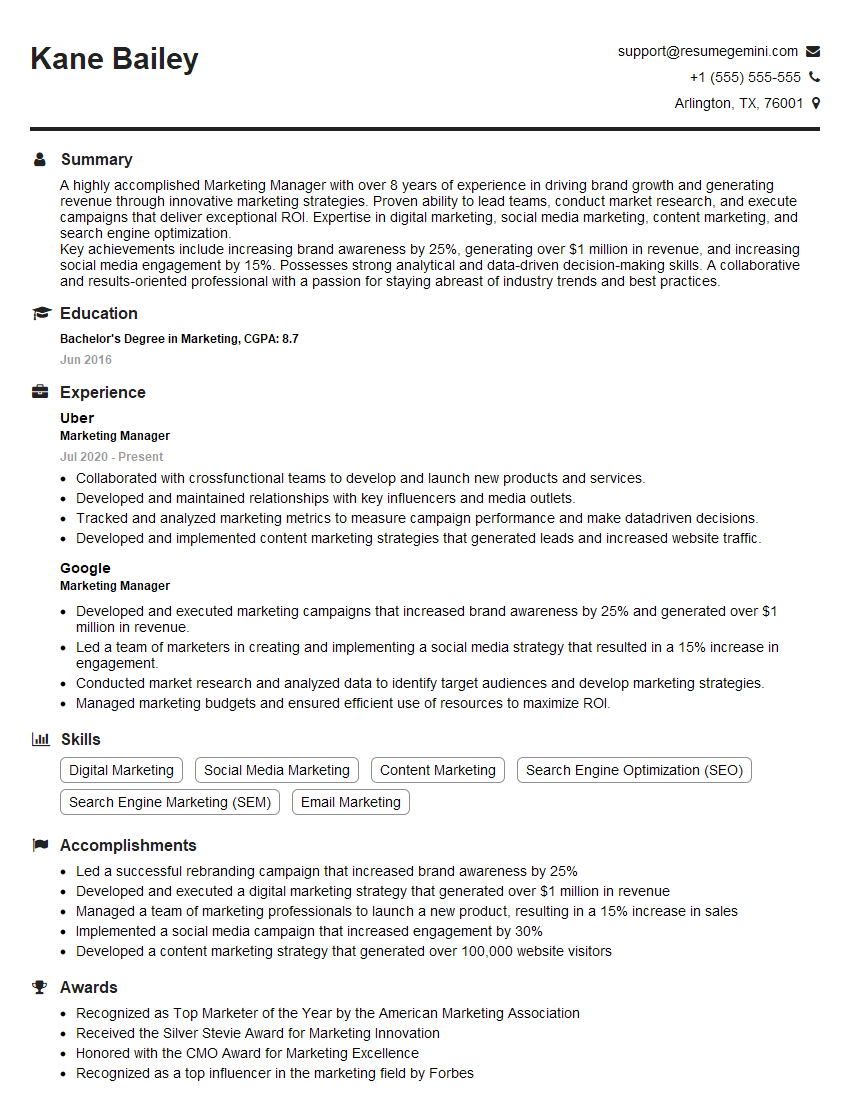
Marketing Manager Resume Sample

Marketing Communications Manager Resume Sample
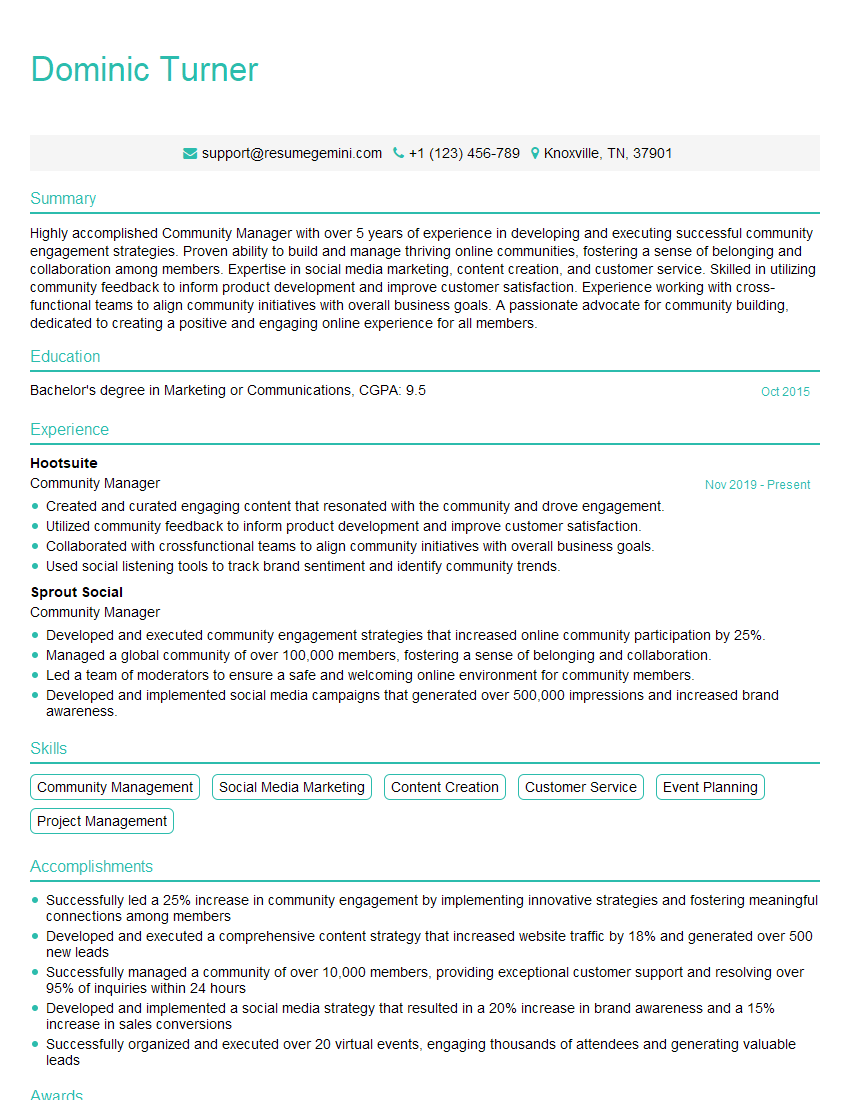
Community Manager Resume Sample

Social Media Manager Resume Sample
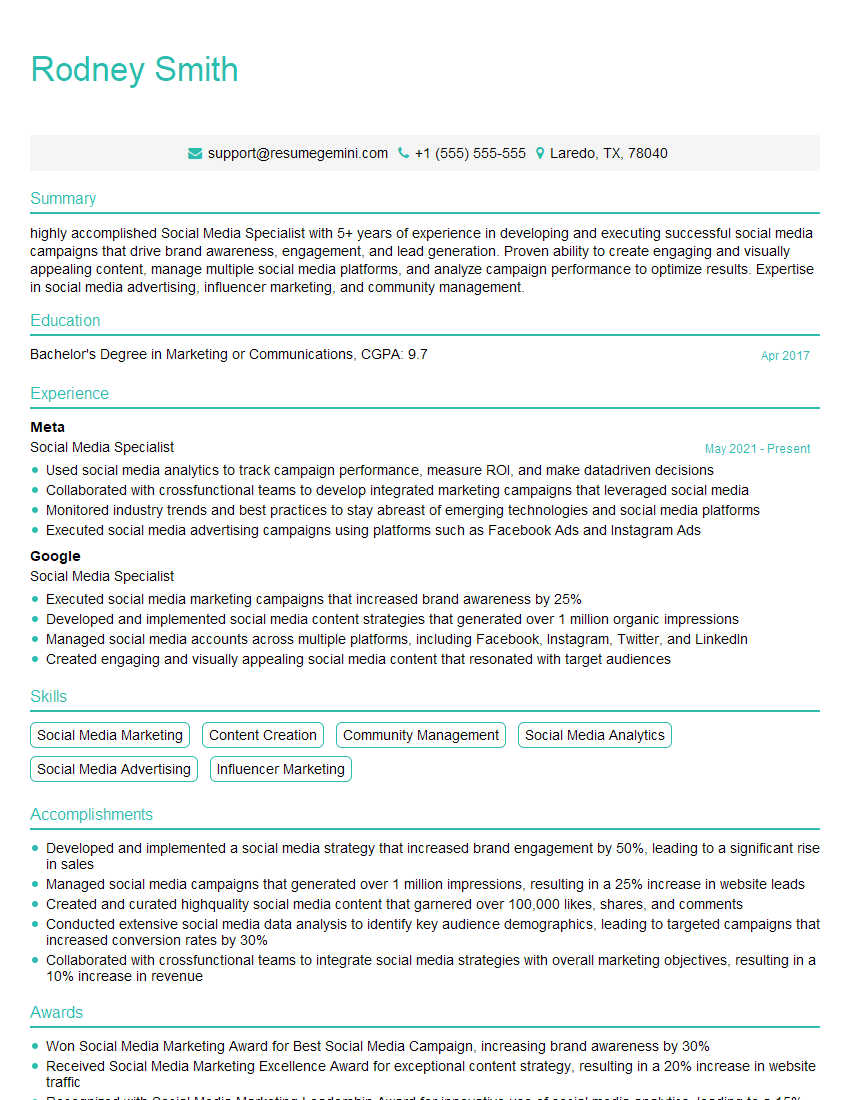
Social Media Specialist Resume Sample
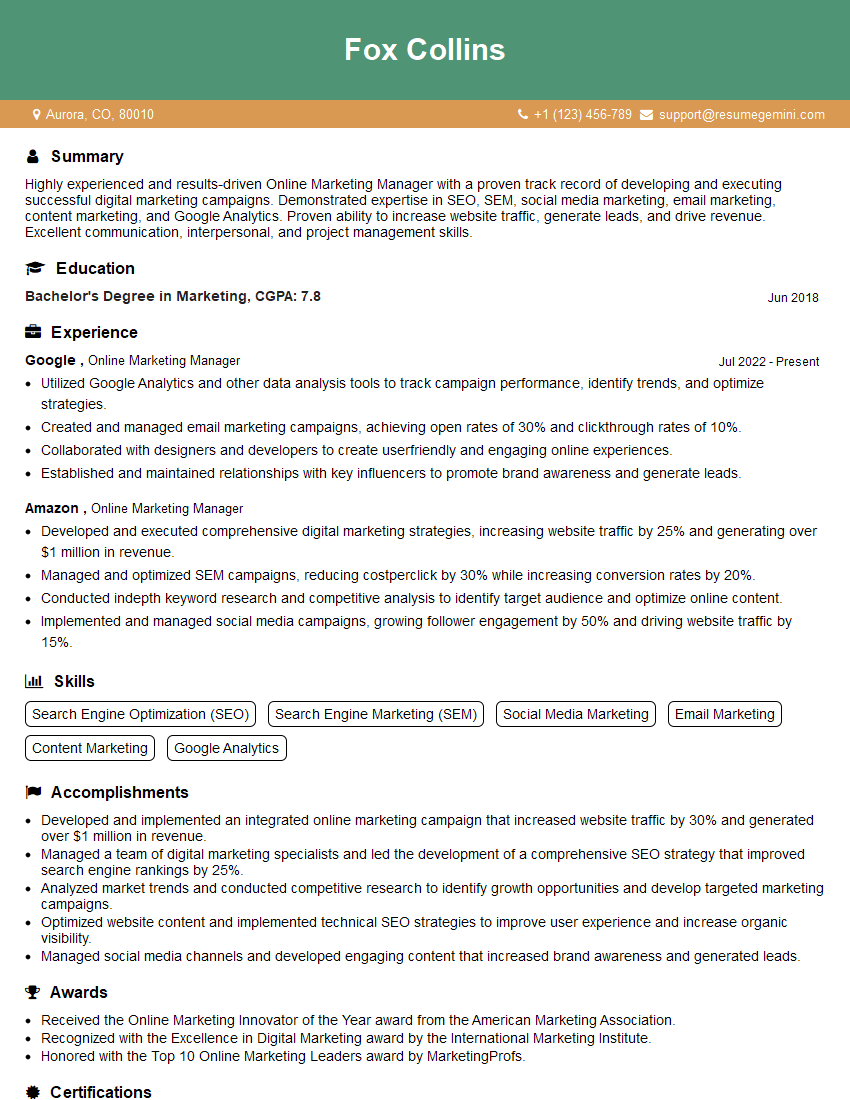
Online Marketing Manager Resume Sample
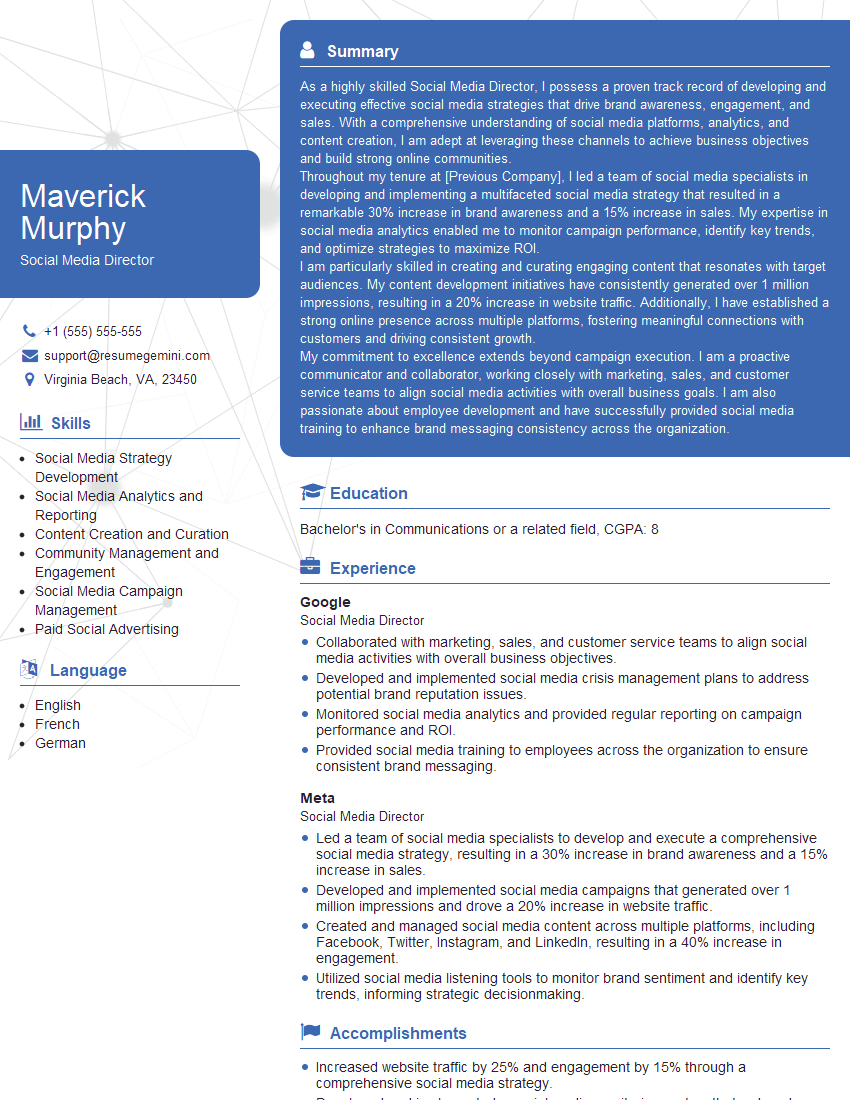
Social Media Director Resume Sample
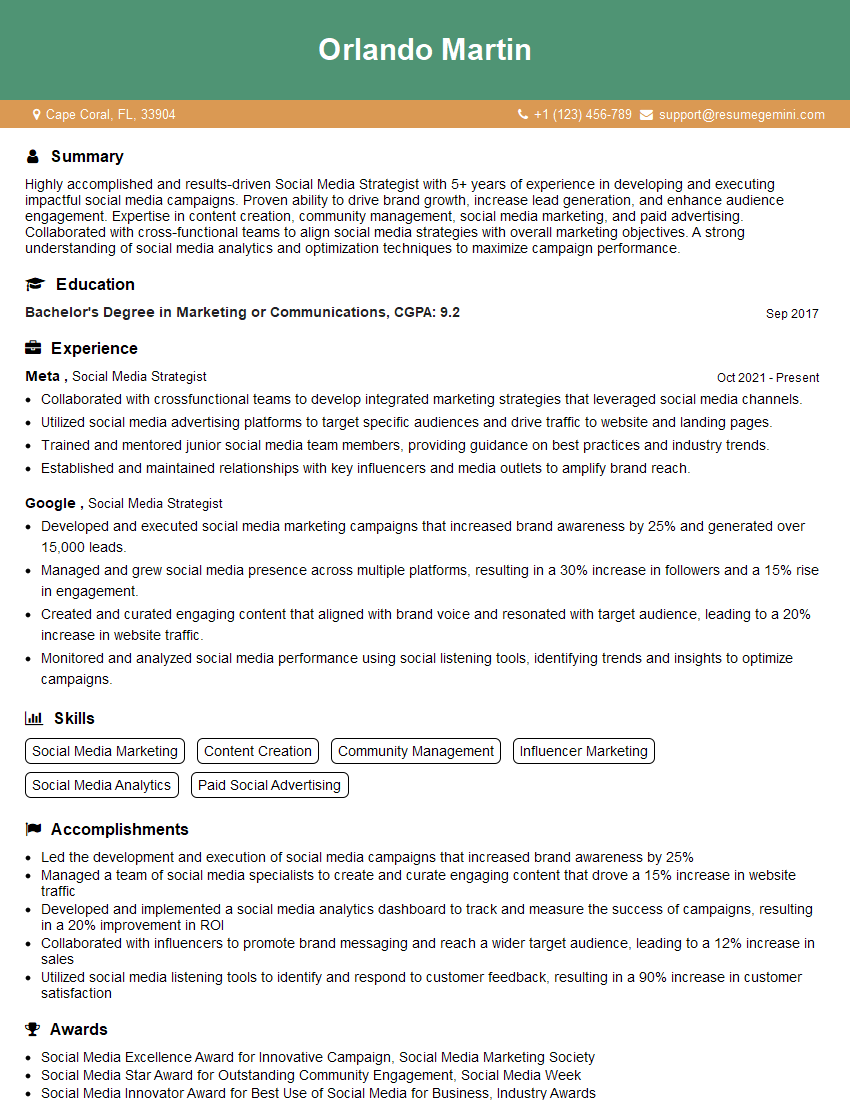
Social Media Strategist Resume Sample
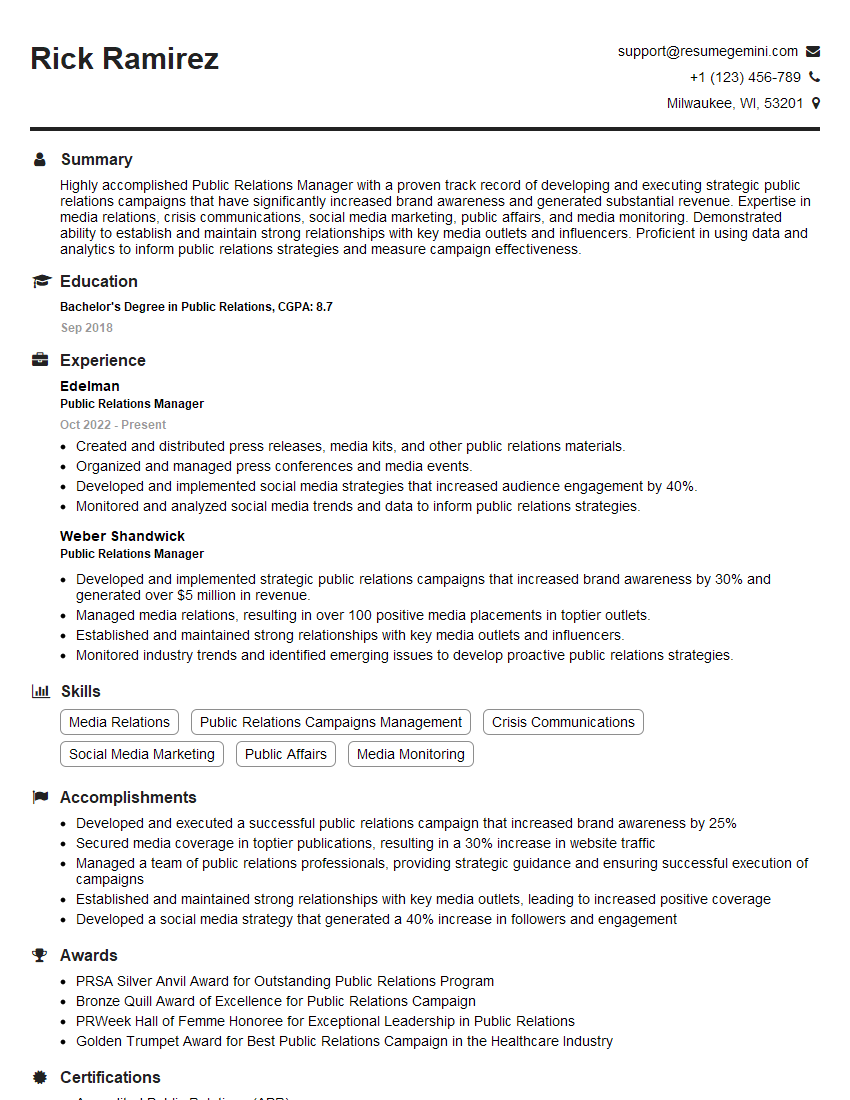
Public Relations Manager Resume Sample
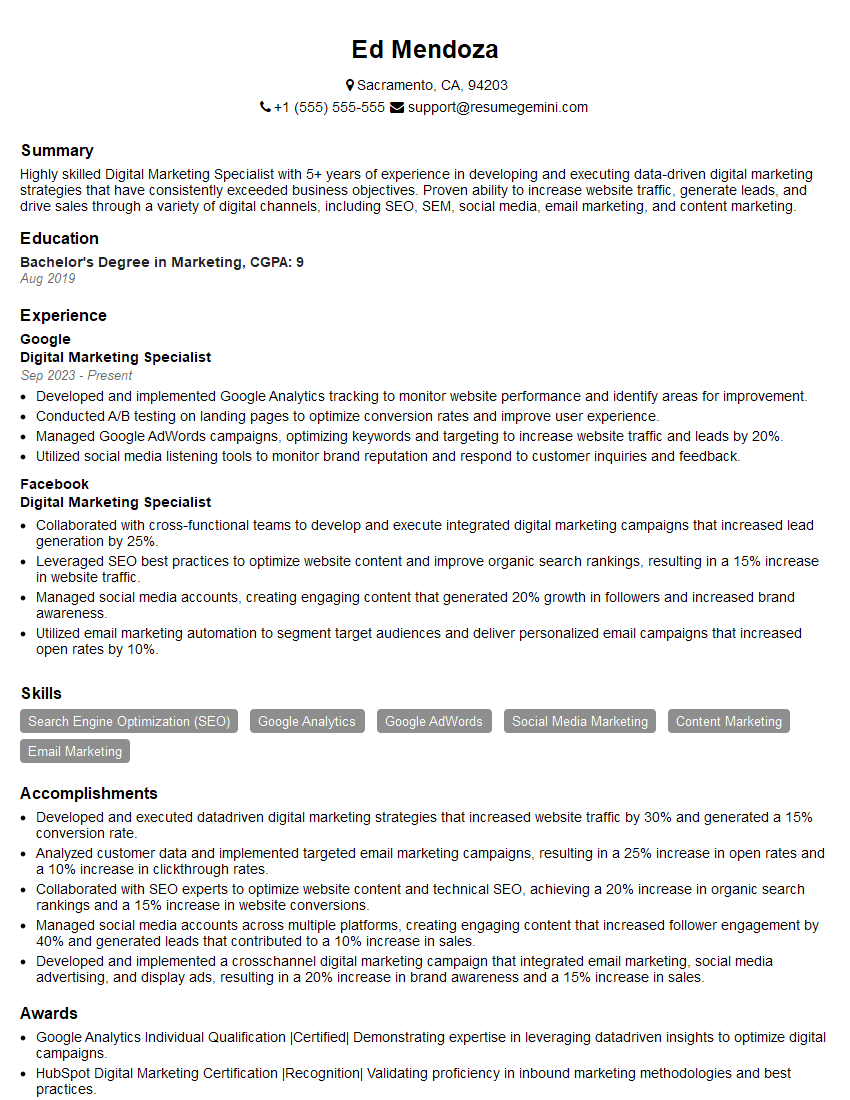
Digital Marketing Specialist Resume Sample

Content Creator Resume Sample
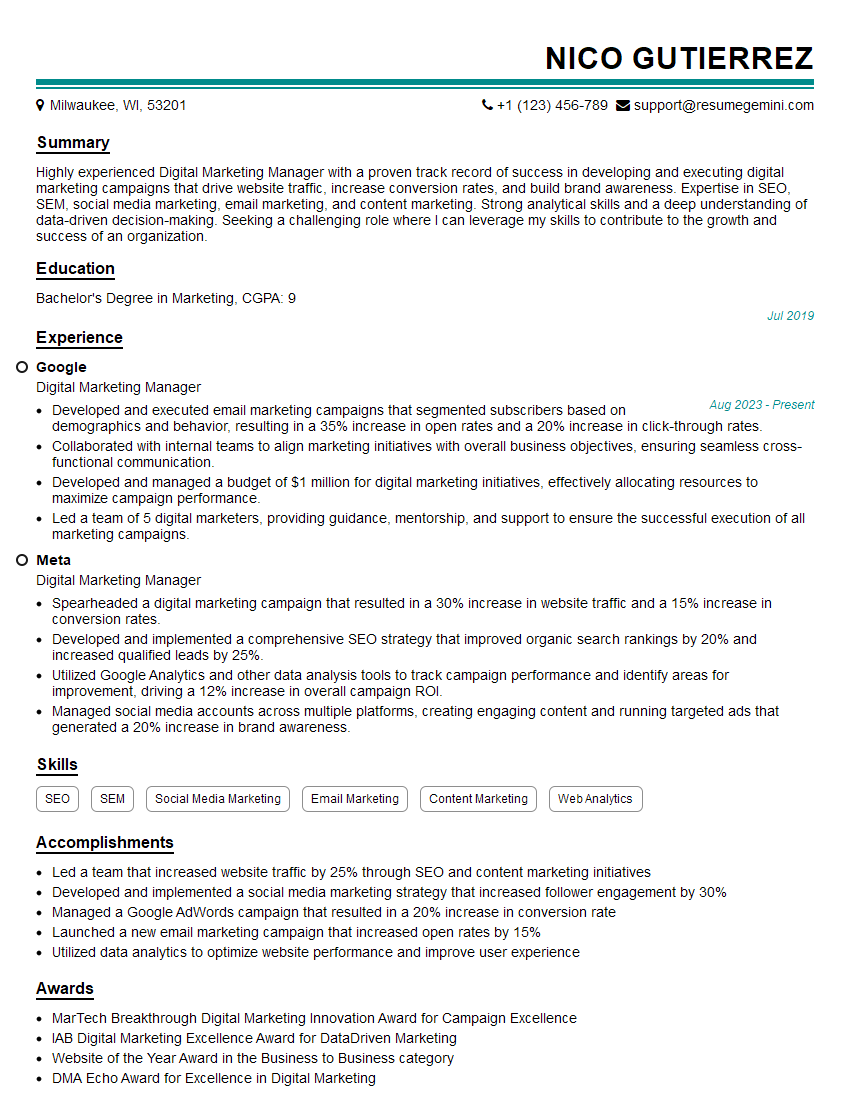
Digital Marketing Manager Resume Sample
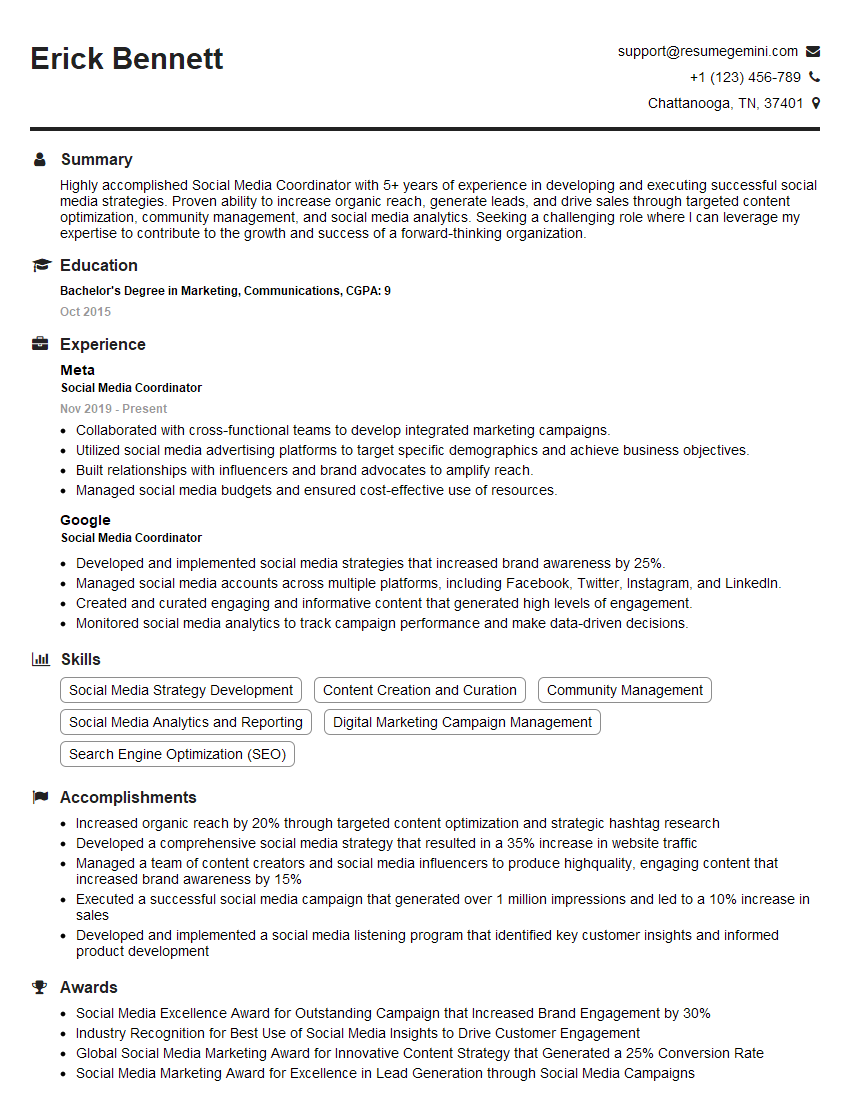
Social Media Coordinator Resume Sample
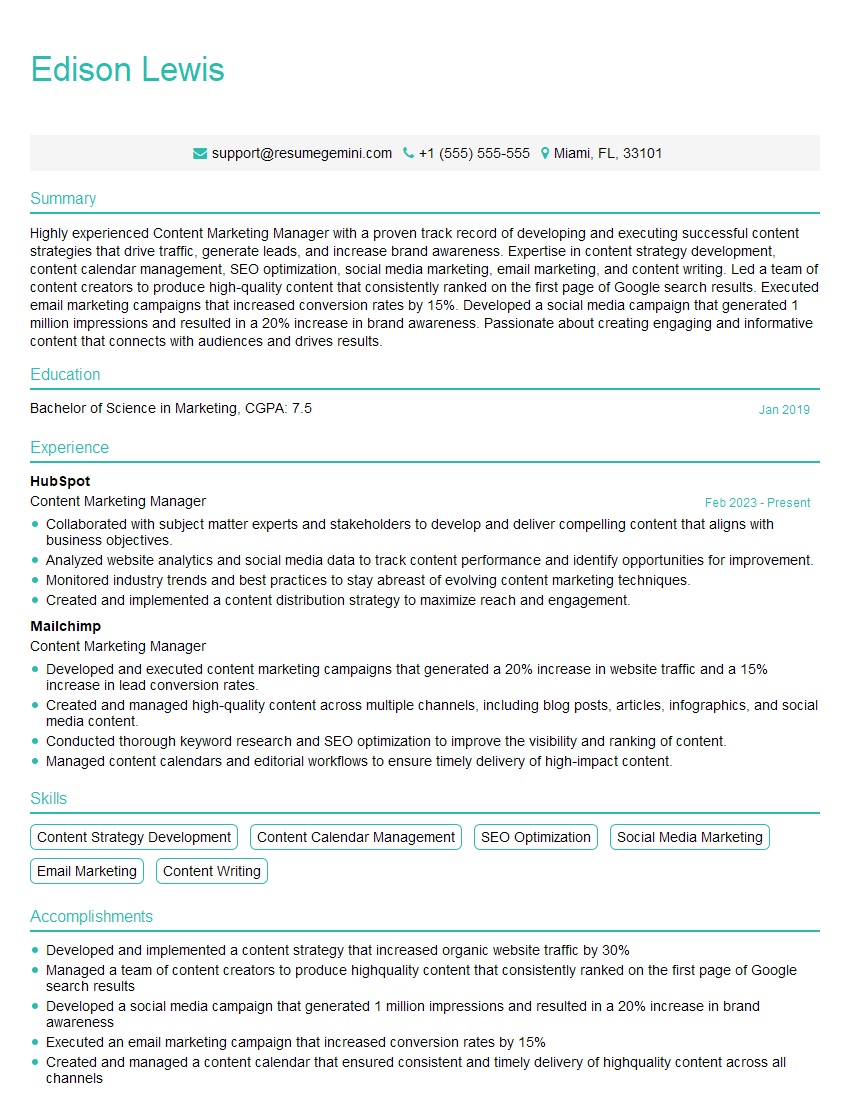
Content Marketing Manager Resume Sample
- Brand Manager
- Marketing Manager
- Marketing Communications Manager
- Community Manager
- Social Media Manager
- Social Media Specialist
- Online Marketing Manager
- Social Media Director
- Social Media Strategist
- Public Relations Manager
- Digital Marketing Specialist
- Content Creator
- Digital Marketing Manager
- Social Media Coordinator
- Content Marketing Manager
Explore more articles
Users Rating of Our Blogs
Share Your Experience
We value your feedback! Please rate our content and share your thoughts (optional).
What Readers Say About Our Blog
Hello,
we currently offer a complimentary backlink and URL indexing test for search engine optimization professionals.
You can get complimentary indexing credits to test how link discovery works in practice.
No credit card is required and there is no recurring fee.
You can find details here:
https://wikipedia-backlinks.com/indexing/
Regards
NICE RESPONSE TO Q & A
hi
The aim of this message is regarding an unclaimed deposit of a deceased nationale that bears the same name as you. You are not relate to him as there are millions of people answering the names across around the world. But i will use my position to influence the release of the deposit to you for our mutual benefit.
Respond for full details and how to claim the deposit. This is 100% risk free. Send hello to my email id: [email protected]
Luka Chachibaialuka
Hey interviewgemini.com, just wanted to follow up on my last email.
We just launched Call the Monster, an parenting app that lets you summon friendly ‘monsters’ kids actually listen to.
We’re also running a giveaway for everyone who downloads the app. Since it’s brand new, there aren’t many users yet, which means you’ve got a much better chance of winning some great prizes.
You can check it out here: https://bit.ly/callamonsterapp
Or follow us on Instagram: https://www.instagram.com/callamonsterapp
Thanks,
Ryan
CEO – Call the Monster App
Hey interviewgemini.com, I saw your website and love your approach.
I just want this to look like spam email, but want to share something important to you. We just launched Call the Monster, a parenting app that lets you summon friendly ‘monsters’ kids actually listen to.
Parents are loving it for calming chaos before bedtime. Thought you might want to try it: https://bit.ly/callamonsterapp or just follow our fun monster lore on Instagram: https://www.instagram.com/callamonsterapp
Thanks,
Ryan
CEO – Call A Monster APP
To the interviewgemini.com Owner.
Dear interviewgemini.com Webmaster!
Hi interviewgemini.com Webmaster!
Dear interviewgemini.com Webmaster!
excellent
Hello,
We found issues with your domain’s email setup that may be sending your messages to spam or blocking them completely. InboxShield Mini shows you how to fix it in minutes — no tech skills required.
Scan your domain now for details: https://inboxshield-mini.com/
— Adam @ InboxShield Mini
Reply STOP to unsubscribe
Hi, are you owner of interviewgemini.com? What if I told you I could help you find extra time in your schedule, reconnect with leads you didn’t even realize you missed, and bring in more “I want to work with you” conversations, without increasing your ad spend or hiring a full-time employee?
All with a flexible, budget-friendly service that could easily pay for itself. Sounds good?
Would it be nice to jump on a quick 10-minute call so I can show you exactly how we make this work?
Best,
Hapei
Marketing Director
Hey, I know you’re the owner of interviewgemini.com. I’ll be quick.
Fundraising for your business is tough and time-consuming. We make it easier by guaranteeing two private investor meetings each month, for six months. No demos, no pitch events – just direct introductions to active investors matched to your startup.
If youR17;re raising, this could help you build real momentum. Want me to send more info?
Hi, I represent an SEO company that specialises in getting you AI citations and higher rankings on Google. I’d like to offer you a 100% free SEO audit for your website. Would you be interested?
Hi, I represent an SEO company that specialises in getting you AI citations and higher rankings on Google. I’d like to offer you a 100% free SEO audit for your website. Would you be interested?
good