Interviews are more than just a Q&A session—they’re a chance to prove your worth. This blog dives into essential Experience in Embroidering on Apparel, Accessories, and Home Decor Items interview questions and expert tips to help you align your answers with what hiring managers are looking for. Start preparing to shine!
Questions Asked in Experience in Embroidering on Apparel, Accessories, and Home Decor Items Interview
Q 1. What types of embroidery machines have you operated?
Throughout my career, I’ve had extensive experience operating a variety of embroidery machines, from single-needle to multi-needle machines. This includes both industrial and domestic machines. For example, I’ve worked extensively with Tajima industrial machines, known for their precision and speed, particularly useful for high-volume apparel embroidery. I’m also proficient with Brother and Singer domestic machines, which are versatile and ideal for smaller projects and customized designs on home decor items. My experience extends to machines with various hoop sizes, allowing me to embroider on a wide range of items, from small patches to large tablecloths.
- Tajima TME series: Excellent for high-speed, intricate designs on apparel.
- Brother PR series: Versatile machines suitable for a broad range of projects and materials.
- Singer Futura CE-250: A dependable domestic machine perfect for smaller projects and beginners.
Q 2. Describe your experience with different embroidery stitches.
My expertise encompasses a wide array of embroidery stitches, each with its unique aesthetic and practical applications. I’m proficient in both basic and advanced stitches. Basic stitches like running stitch, satin stitch, and fill stitch form the foundation of many designs. More advanced techniques include chain stitch for decorative effects, outline stitch for precise borders, and free-motion embroidery for spontaneous artistic expression. I understand how different stitch densities and types affect the final look and durability of the embroidery. For example, a dense satin stitch provides a smooth, solid color block, while a less dense fill stitch might be used to create a textured effect or allow the fabric to show through.
- Satin Stitch: Creates smooth, solid fills of color, ideal for lettering and logos.
- Fill Stitch: Used to create textured areas or patterns, offering flexibility in density and design.
- Chain Stitch: Creates a decorative stitch often used for outlines and textural effects.
- Appliqué Stitch: Securely attaches fabric pieces to create dimensional designs.
Q 3. How do you troubleshoot common embroidery machine malfunctions?
Troubleshooting embroidery machine malfunctions requires a systematic approach. I start by identifying the problem, observing the machine’s behavior, and listening for unusual sounds. Common issues include thread breakage, needle breakage, hooping problems, and tension issues. My troubleshooting process follows these steps:
- Identify the Problem: What exactly is going wrong? Is the machine making noise? Is the thread breaking repeatedly?
- Check the Basics: Ensure correct thread tension, proper needle selection for the fabric, and correct hooping.
- Inspect the Needle and Thread: A bent or damaged needle is a common cause of breakage. Similarly, ensure the thread is properly wound and not frayed.
- Check Bobbin: Make sure the bobbin is correctly wound and inserted.
- Inspect the Hooping: Loose or uneven hooping can cause puckering and stitching errors.
- Clean the Machine: Lint and debris can interfere with machine operation. Regular cleaning is essential.
If the problem persists, I consult the machine’s manual and may contact a qualified technician for more advanced repairs.
Q 4. Explain your process for digitizing embroidery designs.
My digitizing process is meticulous and involves several key steps. It begins with the design concept. This could be a hand-drawn sketch, a logo, or a digital image. I then use specialized software (discussed below) to convert this into a stitch file that the embroidery machine can understand. This involves tracing the design, selecting appropriate stitch types, setting stitch density, and optimizing the design for the chosen fabric. I pay close attention to details like underlay stitches (to prevent puckering) and color changes. I always test the digitized design on a scrap fabric before working on the final product to ensure accuracy and quality. This ensures that I catch any errors early on and avoid wasted materials. For example, if I’m digitizing a logo, I need to ensure the fine details are accurately represented and the stitches are dense enough to provide sharp lines.
Q 5. What software are you proficient in for embroidery design?
I am proficient in several embroidery design software packages, including Wilcom EmbroideryStudio, Embird, and CorelDraw. Each program has its own strengths. Wilcom EmbroideryStudio is powerful and versatile, ideal for complex designs and industrial applications. Embird is user-friendly and suitable for both beginners and experienced users, offering a good balance of features and ease of use. CorelDraw is a vector graphics editor, frequently used for creating designs before converting them into stitch files in embroidery software. I choose the software based on the project’s complexity and my specific needs. For simple designs, Embird’s intuitive interface might suffice, whereas for intricate designs requiring precise control, Wilcom EmbroideryStudio is the preferred option. Knowing multiple programs provides flexibility and efficiency.
Q 6. How do you ensure the accuracy and quality of your embroidery work?
Ensuring accuracy and quality is paramount in my work. This begins with meticulous design digitization, as already described. Beyond this, I utilize several techniques: I always pre-wash fabrics to prevent shrinkage after embroidery. I pay close attention to color matching and thread selection, selecting high-quality threads for optimal results. I carefully inspect the hooping to avoid fabric puckering or distortion. During the embroidery process, I regularly monitor the stitching and make adjustments as needed, such as tension adjustments or minor design modifications. Finally, I carefully inspect the finished piece for any imperfections or inconsistencies before delivery. This multi-faceted approach minimizes errors and delivers consistent high-quality results. Imagine embroidering a delicate floral design on silk; attention to detail is crucial to prevent damage and maintain its elegance.
Q 7. Describe your experience with different embroidery fabrics.
My experience spans a wide range of fabrics suitable for embroidery. Each fabric presents unique challenges and requires a tailored approach. For instance, delicate fabrics like silk or chiffon require lighter weight stabilizers and lower stitch densities to avoid damage. Heavier fabrics, such as denim or canvas, can handle denser stitches and require appropriate stabilizers to prevent puckering. I’m familiar with various fabric types, including cotton, linen, polyester, silk, wool, and blends. Knowing the properties of each fabric, like its weave, thickness, and drape, allows me to optimize the embroidery process and select the appropriate needles, threads, and stabilizers. For example, when embroidering on a sweatshirt, I would use a tear-away stabilizer to support the fabric during embroidery and easily remove it afterwards.
- Cotton: A versatile and widely used fabric for embroidery.
- Linen: Provides a luxurious, slightly textured finish.
- Silk: Delicate and requires specialized care during embroidery.
- Denim: Sturdy and can handle denser stitches.
Q 8. How do you manage large embroidery production runs?
Managing large embroidery production runs requires a systematic approach. It’s like orchestrating a complex symphony – each instrument (machine, thread, fabric) must play its part perfectly to create a harmonious whole. I begin by carefully reviewing the order, understanding the design, quantity, and deadlines. Next, I break down the project into manageable phases: pre-production (preparing designs, sourcing materials, testing stitch-outs), production (running the machines, quality control), and post-production (finishing, packaging, shipping).
For efficiency, I utilize digital design software to streamline the process. I program the machines with optimized stitch settings for faster production, and I implement a robust quality control system – checking samples at various stages to ensure consistency and high quality. We use a Kanban system to track progress and identify potential bottlenecks, ensuring on-time delivery. For instance, when working on a large order of embroidered corporate logo polo shirts, we divided the work amongst several machines, each programmed with the specific design and color. Regular checks were performed, and any inconsistencies were promptly addressed.
Q 9. What are your skills in hooping and stabilizing fabrics for embroidery?
Hooping and stabilizing fabrics are crucial for achieving perfect embroidery. Think of it as setting a stage for a performance – the fabric needs to be taut and secure to prevent puckering or distortion during stitching. My skills encompass a wide range of techniques, from using standard hoops for lightweight fabrics to employing specialized techniques for difficult materials such as knits, fleece, or leather. For knits or stretchy fabrics, I use tear-away or wash-away stabilizers – these provide support during embroidery and are later removed. For thicker fabrics like leather or denim, I might use a cut-away stabilizer, which adds a durable backing.
I carefully select the correct hoop size and type based on the design and fabric. Accurate hooping ensures the design is centered and the fabric is perfectly tensioned to prevent wrinkles or distortions. I also understand the importance of pre-treating fabrics, which may include washing and pressing to prevent shrinkage or unevenness.
Q 10. How do you maintain and clean embroidery machines?
Maintaining and cleaning embroidery machines is essential for extending their lifespan and ensuring top-notch stitching. Regular maintenance is like changing the oil in a car – it prevents major problems and keeps the machine running smoothly. After each project, I remove lint and dust from the machine using a compressed air canister and a soft brush. I also clean the bobbin area, ensuring there’s no thread build-up. For more thorough cleaning, I follow the manufacturer’s instructions for lubrication and any necessary adjustments.
Lubrication of moving parts is key to preventing wear and tear, particularly the needle bar and hook assembly. We maintain a schedule of regular maintenance checks, including replacing worn needles and checking the timing of the machine. These preventative measures minimize downtime and ensure consistently high-quality stitches.
Q 11. Explain your understanding of color separation in embroidery.
Color separation in embroidery is the process of separating a design into different color layers to be stitched individually. It’s like creating a layered painting – each color layer is applied on top of the other to create the complete image. Understanding color separation is vital for efficient and effective embroidery. Digital embroidery software helps automate this, but manual adjustments might be necessary for optimal results. The software generates individual color sequences for each thread color and guides the machine, ensuring that each color is stitched independently and accurately.
For example, a complex logo may need five different thread colors. The software will separate the design into five layers, one for each color. Then, the machine is programmed to stitch each layer sequentially. This ensures that the colours don’t overlap incorrectly, resulting in a clean and sharp design. I pay close attention to color changes to minimize thread tails and maintain a professional finish.
Q 12. How do you handle complex embroidery designs with multiple colors?
Handling complex embroidery designs with multiple colors requires meticulous planning and execution. This is where a combination of technical skill and artistic sensibility shines. First, I thoroughly analyze the design file, identifying the colors and the stitch sequence for each. Then, I optimize the stitch order to minimize color changes, reducing thread tails and improving efficiency. Using the right stabilizer for the design is critical, particularly when many color changes are involved, to ensure crisp results and prevent pulling of the fabric.
For intricate designs, I might use several hoops, to ensure accurate positioning, and employ techniques like underlay stitching to add stability and create a more refined result. I always test stitch the design before production on a sample piece to identify any issues and make adjustments before working on a large-scale project. For instance, on a project involving floral patterns with multiple colors and gradients, I carefully mapped the sequence to reduce color changes and stitch overlapping areas effectively to avoid any inaccuracies.
Q 13. Describe your experience with various thread types and their applications.
My experience encompasses a wide range of thread types, each with unique characteristics and applications. Choosing the right thread is like choosing the right brush for painting – it significantly impacts the final outcome. Rayon threads are versatile, commonly used for their sheen and smooth finish; polyester threads are known for strength and durability, suitable for items exposed to repeated wear; metallic threads add a luxurious touch but require careful handling; and cotton threads offer a natural, rustic feel.
For apparel, I often choose rayon or polyester for their strength and colorfastness. For home décor items like towels, I may select a durable cotton thread. For delicate items, I’d opt for finer threads to avoid damage. I carefully select thread weight appropriate for the design and fabric, considering factors like stitch density and desired appearance.
Q 14. How do you create or modify embroidery patterns?
Creating and modifying embroidery patterns is a creative process that involves both artistic skill and technical expertise. I utilize digital embroidery design software to create and manipulate patterns, adjusting stitch density, color palettes, and adding or removing design elements. Software allows me to create new designs from scratch or modify existing ones by changing stitch types, adding embellishments, or altering the size and orientation of motifs. For example, I can easily convert a vector graphic into an embroidery design, optimizing it for stitch count and thread usage.
Modifying existing designs might involve scaling down a complex pattern for smaller items, changing the color scheme to match a client’s branding, or adding text to personalize an item. The software’s tools let me adjust stitch length, density, and direction to achieve different textural effects. I routinely utilize these tools for creating unique, customized embroidery designs for a diverse range of clients.
Q 15. What are your strategies for reducing embroidery waste?
Minimizing waste in embroidery is crucial for both environmental responsibility and economic efficiency. My strategies focus on meticulous planning and efficient execution. I start by carefully planning each design, ensuring optimal placement to avoid fabric scraps. This involves using design software to accurately size and position the artwork before transferring it to the fabric.
I also meticulously measure and cut fabric, pre-washing it to prevent shrinkage that could ruin a finished piece. Any leftover fabric scraps from larger projects are saved for smaller projects or practice pieces, minimizing the amount of material going to waste. Furthermore, I thoroughly inspect my embroidery machine for proper threading and tension to reduce the chances of broken needles or thread tangles that lead to waste. Regular machine maintenance is key!
Finally, I’m a strong proponent of digital design prototyping. By simulating the embroidery process on my computer, I can identify and correct potential errors before starting the actual stitching, saving both time and fabric. This process allows me to refine designs, ensuring a perfect result on the first try.
Career Expert Tips:
- Ace those interviews! Prepare effectively by reviewing the Top 50 Most Common Interview Questions on ResumeGemini.
- Navigate your job search with confidence! Explore a wide range of Career Tips on ResumeGemini. Learn about common challenges and recommendations to overcome them.
- Craft the perfect resume! Master the Art of Resume Writing with ResumeGemini’s guide. Showcase your unique qualifications and achievements effectively.
- Don’t miss out on holiday savings! Build your dream resume with ResumeGemini’s ATS optimized templates.
Q 16. Describe your experience with different types of embroidery hoops.
My experience spans several types of embroidery hoops, each with its unique advantages and drawbacks. I frequently use plastic hoops for their affordability and lightweight nature, making them ideal for smaller projects and when working with delicate fabrics. For larger projects or when added stability is crucial, I opt for wooden hoops, which offer better tension control and are less prone to warping.
I’ve also experimented with magnetic hoops, which offer quick setup and easy adjustments. These hoops are perfect when speed is prioritized. However, I find their suitability limited for thicker fabrics or projects needing tight tension.
Finally, I’ve used adjustable hoops that cater to various fabric sizes. This versatility is invaluable for adapting to a variety of projects and minimizes the need to buy numerous hoops for different sizes. The choice of hoop ultimately depends on the project’s specific requirements: fabric type, design size, and desired level of control.
Q 17. How do you handle customer requests or design modifications?
Handling customer requests and design modifications is a critical part of providing exceptional service. I begin by engaging in a thorough discussion to understand the client’s vision, clarifying their expectations concerning colors, placement, and any specific design elements. I then translate their ideas into a design mock-up using professional design software, allowing them to visualize the finished product before proceeding.
If modifications are needed, I actively collaborate with the client, suggesting adjustments that enhance the design’s aesthetic appeal or improve its technical feasibility. For example, I might recommend alternative colors to improve the design’s vibrancy or suggest minor design tweaks to ensure optimal stitching quality.
My aim is to exceed customer expectations and turn their vision into reality. Open communication and transparent collaboration are key to ensuring a positive and fruitful outcome for both parties. I always confirm design adjustments in writing before beginning the embroidery process to avoid any misunderstandings.
Q 18. How do you work with different types of embroidery files (e.g., DST, EXP)?
I’m proficient in working with various embroidery file formats, including DST, EXP, and others such as PES, JEF, and VIP. Each format has its own specifications and compatibility with different embroidery machines. My expertise lies in understanding these differences and selecting the appropriate file format for the machine I’m using.
I primarily use professional design software that allows me to import, edit, and convert between different embroidery file formats. For example, I can easily convert a DST file (common for Tajima machines) to an EXP file (used by many Barudan machines) should a client’s request require that change. This ensures seamless compatibility and avoids any issues related to file format incompatibility. I always double-check the file format compatibility before initiating the embroidery process to avoid wasted time and material.
Q 19. Explain your knowledge of embroidery density and its effects.
Embroidery density refers to the number of stitches per inch (SPI) or stitches per centimeter (SPC) within an embroidered design. It significantly affects the final product’s appearance, durability, and overall quality.
High density creates a more detailed, densely packed design that is less prone to fraying and looks more professional. However, excessively high density can lead to puckering, distortion, and increased stitching time. Low density results in a more open, less dense design, suitable for airy designs or when speed is prioritized. It may however, look less defined.
Determining the right density requires a good understanding of fabric type, thread type, and design complexity. Experimentation is crucial. I often create test samples to determine the optimal density for each project, ensuring the right balance between aesthetics, durability, and processing speed.
Q 20. Describe your experience with different types of embroidery underlay.
Embroidery underlay, or backing, is an essential component for creating high-quality embroidery, especially on knits and other stretchy fabrics. My experience includes using several types, each with unique characteristics.
Cut-away stabilizer is my most frequently used underlay. It provides excellent support during stitching and is completely removed after the process, leaving a clean finish. Tear-away stabilizer, on the other hand, is great for easy removal but its less durable and not ideal for projects needing high stability.
For projects requiring superior support or when working with fine fabrics, I use wash-away stabilizer. This dissolves completely with water after the stitching is complete. Choosing the correct stabilizer is critical for obtaining crisp, professional results; it depends on the project and fabric type.
Q 21. How do you ensure accurate placement of embroidery on garments?
Accurate placement of embroidery is paramount for achieving professional-looking results. My approach involves a multi-step process to ensure perfect placement every time.
First, I carefully measure and mark the garment to determine the precise location for the embroidery. I then use a combination of techniques like washable fabric markers and specialty tools to create clear guidelines for the design’s position. My software allows me to precisely position my design on a digital rendering of the garment before starting. Next, I carefully position the fabric and stabilizer on the embroidery machine, making sure it aligns with the markings.
Finally, a test stitch is executed to verify the placement before fully embroidering the design. This additional check prevents costly errors and guarantees precise embroidery on every garment.
Q 22. What is your experience with hand embroidery techniques?
My hand embroidery experience spans over 15 years, encompassing a wide range of techniques. I’m proficient in various stitches, including but not limited to running stitch, backstitch, satin stitch, French knots, chain stitch, and cross-stitch. I’ve worked with diverse fabrics, from delicate silks and linens to sturdy canvas and denim. For example, I once meticulously embroidered a detailed floral design onto a silk scarf using a combination of satin stitch and French knots to create a three-dimensional effect. Another project involved using backstitch to create precise lettering on a denim jacket. My skillset also extends to working with different threads, including cotton, silk, rayon, and metallic threads, allowing me to achieve a wide variety of textures and finishes.
- Running Stitch: Excellent for outlining and creating straight lines.
- Backstitch: Creates strong, defined lines, ideal for lettering and detailed work.
- Satin Stitch: Produces smooth, solid areas of color.
- French Knots: Add texture and dimension, perfect for creating small details.
Q 23. How do you adapt to different embroidery projects and requirements?
Adaptability is key in embroidery. I approach each project by carefully analyzing the design, fabric type, and desired outcome. For instance, when embroidering on delicate fabrics like silk, I’ll use a smaller needle and lighter threads to avoid damaging the material. Conversely, for thicker fabrics such as denim, I opt for heavier needles and threads to ensure the embroidery holds its shape. Understanding stitch tension is also crucial. I adjust the tension to create the desired effect; a looser tension for flowing designs and a tighter tension for more structured pieces. I also seamlessly integrate client feedback throughout the process, making necessary adjustments to ensure their vision is met. I frequently use digital design software to interpret or create designs and scale them appropriately.
Q 24. Explain your experience with quality control procedures in embroidery.
Quality control is paramount in my workflow. My process begins with meticulous fabric inspection for flaws or imperfections before starting the embroidery. During embroidery, I constantly monitor stitch consistency, thread tension, and the overall neatness of the work. Once the embroidery is complete, I thoroughly inspect the finished piece for any inconsistencies, loose threads, or imperfections. This includes examining the back of the fabric to ensure no knots are visible and that the stitching is secure. I meticulously document all quality checks, which are essential for tracking and improving my processes. I’ve found that a systematic approach to quality control not only ensures high-quality products but also enhances efficiency.
Q 25. Describe your problem-solving skills related to embroidery issues.
Problem-solving is integral to embroidery. I’ve encountered various challenges, from tangled threads to needle breakages. My approach involves a systematic troubleshooting process. For instance, if I encounter thread breakage, I first assess the type of thread and needle being used. If the thread is too thin for the fabric, I’ll switch to a thicker thread. If the needle is damaged, I’ll replace it. If the problem persists, I’ll reassess my stitching technique and make necessary adjustments. For more complex issues, such as uneven stitch tension, I’ll consult reference materials or seek feedback from experienced colleagues. Essentially, my problem-solving approach is based on careful observation, logical deduction, and a commitment to finding practical solutions. I am highly skilled in repair work as well, able to address and correct mistakes efficiently without compromising the overall quality of the piece.
Q 26. How do you stay updated on new trends and techniques in embroidery?
To stay updated, I actively engage with the embroidery community through various channels. I subscribe to embroidery magazines, attend workshops and conferences, and follow industry influencers and designers on social media platforms. I also explore online tutorials and resources, experimenting with new techniques and designs. This proactive approach keeps my skills sharp, exposes me to new ideas and technologies, and ensures I remain competitive in this ever-evolving field. I find that constantly learning and adapting is vital for maintaining a high level of expertise.
Q 27. What are your salary expectations?
My salary expectations are in the range of $50,000 to $70,000 per year, depending on the specific benefits package and responsibilities involved in the role. This is based on my experience, skillset, and the prevailing market rates for experienced embroiderers in my region.
Q 28. Are you available for overtime work?
Yes, I am available for overtime work, especially during peak seasons or for urgent projects. I understand that flexibility is often necessary in this field and I’m prepared to adapt my schedule as needed to meet project deadlines.
Key Topics to Learn for Experience in Embroidering on Apparel, Accessories, and Home Decor Items Interview
- Machine Embroidery Techniques: Understanding different embroidery machine types (e.g., single-head, multi-head), their functionalities, and limitations. Practical application includes discussing experience with specific machines and their maintenance.
- Design Software Proficiency: Familiarity with design software used for creating embroidery patterns (e.g., Wilcom, Tajima). Practical application includes showcasing your ability to translate designs into stitch files and optimize for different fabrics.
- Fabric and Thread Selection: Knowledge of various fabrics and their suitability for embroidery, including thread types, colors, and weights. Practical application includes discussing experience with troubleshooting issues related to fabric and thread interaction.
- Digitizing Techniques: Understanding the process of converting artwork into embroidery stitch files. Practical application includes describing your experience in digitizing, including complex designs and lettering styles.
- Production and Quality Control: Experience with managing embroidery production workflows, including quality control processes and troubleshooting issues. Practical application includes detailing your experience in meeting deadlines and managing production challenges.
- Embroidery on Different Materials: Demonstrating understanding and experience with embroidering on various materials – apparel (e.g., cotton, polyester, denim), accessories (e.g., leather, felt), and home décor items (e.g., towels, canvas).
- Problem-Solving and Troubleshooting: Ability to identify and resolve common embroidery issues such as thread breakage, puckering, and design distortions. This should highlight your analytical skills and experience in finding solutions.
Next Steps
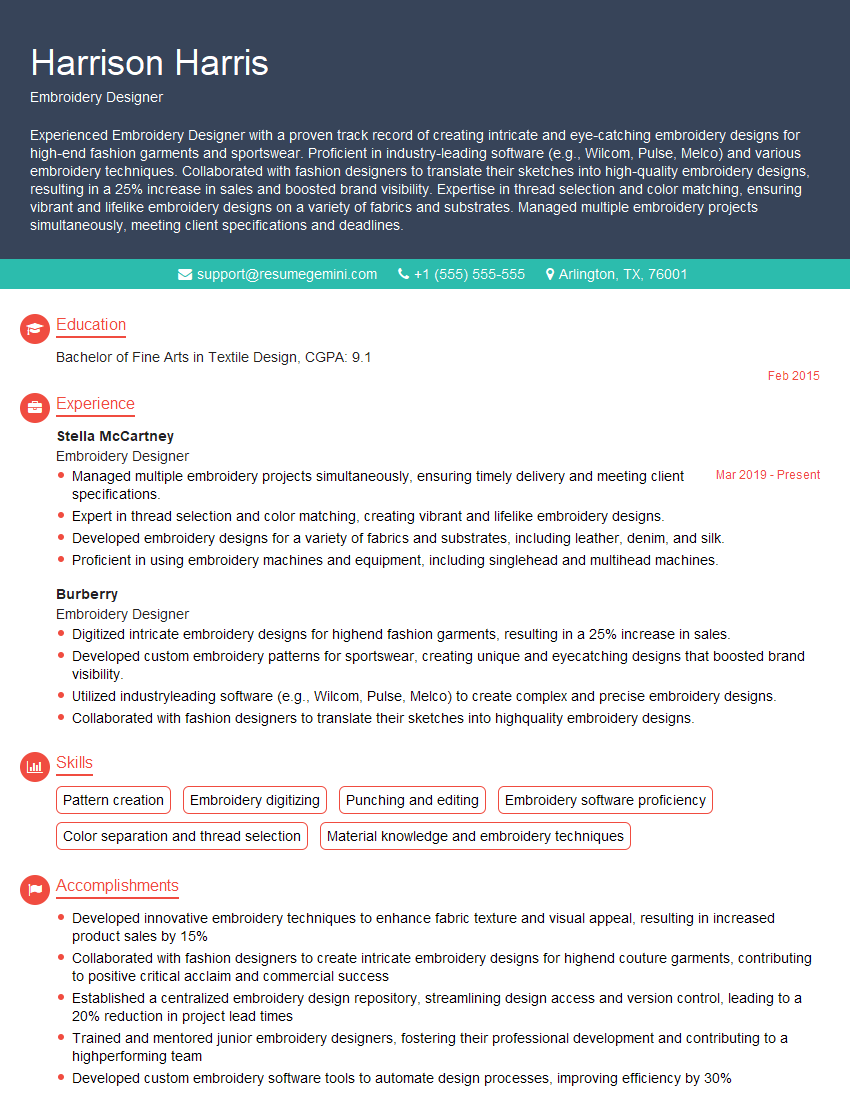
Mastering embroidery techniques across apparel, accessories, and home décor is crucial for career advancement in this field. A strong understanding of these areas will significantly improve your job prospects. To showcase your skills effectively, create an ATS-friendly resume that highlights your key accomplishments and expertise. We recommend using ResumeGemini, a trusted resource for building professional resumes, to create a compelling document that gets noticed. Examples of resumes tailored to Experience in Embroidering on Apparel, Accessories, and Home Decor Items are available to help you build your own.


Explore more articles
Users Rating of Our Blogs
Share Your Experience
We value your feedback! Please rate our content and share your thoughts (optional).
What Readers Say About Our Blog
Very informative content, great job.
good