The thought of an interview can be nerve-wracking, but the right preparation can make all the difference. Explore this comprehensive guide to Experience in leading choirs of various sizes interview questions and gain the confidence you need to showcase your abilities and secure the role.
Questions Asked in Experience in leading choirs of various sizes Interview
Q 1. Describe your experience conducting choirs of varying sizes (e.g., small chamber choir to large symphony chorus).
My experience spans conducting choirs ranging from intimate chamber ensembles of eight singers to large symphony choruses exceeding one hundred voices. Leading a smaller choir demands a deeply collaborative approach, focusing on individual nuances and intricate harmonies. Each singer’s contribution is paramount. Rehearsals are often intensely focused on detailed phrasing and blend, creating a tight, cohesive sound. In contrast, directing a larger chorus requires a broader perspective, employing different techniques for achieving a unified sound from a much larger group. Section work and clear visual cues become crucial to maintain clarity and balance. I adapt my conducting style, encompassing precise articulation for smaller groups and broader gestures for larger ones, ensuring the musical intention is clearly communicated regardless of size.
For example, with a chamber choir, I might spend considerable time on individual vocal lines, exploring subtle dynamics and expressive nuances. With a larger chorus, I’ll employ more sectional rehearsals to address balances and blend before bringing the full choir together.
Q 2. What rehearsal techniques do you employ to maintain focus and efficiency with diverse skill levels?
Maintaining focus and efficiency with diverse skill levels requires a multifaceted approach. I begin by creating a supportive and inclusive rehearsal environment. This fosters a sense of community where singers of all levels feel comfortable contributing. I use varied rehearsal techniques, including:
- Differentiated Instruction: I tailor exercises to address specific skill gaps. For instance, I might provide individual coaching to less experienced singers while challenging more advanced singers with more complex rhythmic patterns or sight-reading exercises.
- Strategic Grouping: I often divide the choir into smaller sections for focused work, allowing me to address specific challenges within each section before bringing the full choir together. This enables more targeted feedback and prevents less experienced singers from feeling overwhelmed.
- Positive Reinforcement: Focusing on achievements and progress encourages participation and builds confidence across skill levels. Regular positive feedback builds morale.
- Clear Goals and Expectations: I set clear objectives for each rehearsal, ensuring singers understand their role in achieving the overall musical goal. This allows for productive use of rehearsal time.
For example, in a rehearsal with a mixed-skill choir, I might start with a warm-up focusing on breath control and vocal placement applicable to all skill levels. Then, I’ll split the choir into sections for focused work on challenging passages. Finally, the full choir would rehearse the piece, integrating the improvements made during sectional work.
Q 3. How do you select repertoire appropriate for a choir’s skill level and vocal range?
Selecting repertoire is a crucial aspect of choral conducting. It’s a balancing act between musical ambition and the choir’s capabilities. I consider the choir’s vocal range, technical skills, and musical experience when making my choices.
- Vocal Range Assessment: I carefully analyze the vocal ranges required by each piece, ensuring it lies comfortably within the capabilities of the majority of the singers. Extending the range too far can lead to strain and fatigue.
- Technical Skill Analysis: I evaluate the technical demands of the piece, considering rhythmic complexity, intervallic leaps, and dynamic range. The piece must challenge singers appropriately without being overwhelming.
- Musical Experience Consideration: The repertoire should be appropriate for the choir’s level of musical experience. Starting with simpler pieces and gradually building complexity increases confidence and builds skill.
- Variety and Balance: I aim for a balanced program, offering a mixture of styles, periods, and emotional textures to keep the choir engaged and to showcase their versatility.
For example, a beginner choir might start with unison songs and simple two-part arrangements, gradually progressing to more complex three or four-part works. An advanced choir can handle more challenging works with complex harmonies, extended ranges, and demanding rhythmic patterns.
Q 4. Explain your approach to vocal technique and training within your rehearsals.
Vocal technique and training are integral parts of my rehearsal process. I focus on building a strong foundation in breath support, posture, resonance, and diction. I incorporate vocal exercises tailored to the choir’s needs, focusing on areas where improvement is needed. These exercises are typically integrated into the warm-up and throughout rehearsals to ensure consistent practice.
- Breathing Exercises: I use exercises that promote efficient and controlled breathing, improving breath support and stamina.
- Posture and Alignment: I emphasize proper posture and body alignment to enhance vocal resonance and prevent strain.
- Resonance Exercises: I employ exercises that help singers develop a full and resonant tone, improving vocal projection and clarity.
- Diction and Articulation: I work on diction and articulation drills to ensure singers produce clear and understandable vowels and consonants.
For example, I might begin a rehearsal with humming exercises to promote good breathing habits and then incorporate tongue trills to improve articulation. Throughout the rehearsal, I’ll offer individual guidance on vocal production, addressing any specific technical issues.
Q 5. How do you manage conflicts or disagreements among choir members?
Managing conflicts or disagreements requires a proactive and diplomatic approach. I strive to foster a respectful and collaborative environment where open communication is encouraged.
- Open Dialogue: I create opportunities for singers to express their concerns and perspectives in a safe and respectful manner. I often facilitate discussions rather than imposing solutions.
- Mediation: If a conflict arises, I act as a mediator, helping individuals understand each other’s viewpoints and find mutually acceptable solutions.
- Fairness and Consistency: I ensure that all choir members are treated fairly and consistently. This promotes a sense of equity and reduces the likelihood of conflict.
- Clear Expectations: Setting clear expectations regarding behavior and participation from the outset minimizes misunderstandings and potential conflicts.
For instance, if a disagreement arises about a particular musical interpretation, I’ll guide a discussion, encouraging singers to share their perspectives and explore different approaches to find a consensus that respects individual artistry and the overall musical integrity.
Q 6. Describe your experience working with accompanists and other musicians.
Collaboration with accompanists and other musicians is essential for a successful choral performance. I value open communication and mutual respect in these partnerships. Before rehearsals, I have detailed discussions with accompanists to ensure a shared understanding of the musical style, tempo, and dynamics. I work closely with them to clarify the balance between choir and accompaniment, ensuring the accompaniment supports and enhances the choral sound without overpowering it. During rehearsals, I provide clear instructions and feedback, adjusting the accompaniment as needed to ensure optimal blend and artistic expression.
For instance, I’ll often share my interpretation of a piece with the accompanist, discussing specific phrasing, dynamics and articulation. I might also work with them to refine the accompaniment to better suit the choir’s vocal capabilities and expressive needs.
Q 7. How do you assess the vocal capabilities of individual singers during auditions?
Assessing vocal capabilities during auditions requires a systematic approach. I assess several key aspects:
- Vocal Range and Tone Quality: I ask singers to sing scales and arpeggios to determine their vocal range and the quality of their tone. I listen for clarity, resonance, and evenness throughout their range.
- Sight-Reading Ability: I evaluate their sight-reading skills by having them read a short, unfamiliar piece. This assesses their ability to interpret musical notation quickly and accurately.
- Musicality and Expression: I listen for their musicality, phrasing, and expression. I assess their ability to convey emotion and meaning through their singing.
- Blending and Diction: I listen for their ability to blend with other voices and to articulate words clearly.
I might ask candidates to sing a prepared piece of their choice and an unfamiliar excerpt, to assess both their technical skills and musical preparation. I strive to create a relaxed environment where singers feel comfortable showcasing their abilities.
Q 8. What strategies do you utilize to foster a positive and collaborative rehearsal environment?
Creating a positive and collaborative rehearsal environment is paramount for a successful choir. It’s about building trust, fostering mutual respect, and making everyone feel valued. I achieve this through a multi-pronged approach.
Open Communication: I encourage open dialogue, actively listening to singers’ concerns and suggestions. Regular check-ins, both individually and as a group, help identify any issues early on.
Positive Reinforcement: Focusing on what’s working well is crucial. I regularly praise individual and group achievements, highlighting both technical proficiency and artistic expression. A simple ‘well done’ or specific feedback on a challenging passage can significantly boost morale.
Team Building Activities: Informal activities like warm-up games or social gatherings outside of rehearsals help build camaraderie and strengthen group cohesion. This can range from simple icebreakers to collaborative projects.
Clear Expectations: Setting clear goals and expectations from the outset ensures everyone is on the same page. This includes outlining rehearsal protocols, performance expectations, and participation guidelines.
Inclusivity and Respect: Creating a safe and inclusive space where every member feels comfortable expressing themselves is key. This involves promoting respect for diverse backgrounds and musical styles.
For instance, with a particularly challenging piece, I might divide the choir into smaller sections for focused work, followed by bringing them together for full rehearsals, ensuring everyone feels supported and part of the larger ensemble.
Q 9. How do you incorporate technology (e.g., recording software, notation programs) into your rehearsals?
Technology plays a vital role in enhancing rehearsals and performance quality. I use various technologies to improve efficiency and achieve artistic goals.
Recording Software: I utilize recording software like Audacity or Logic Pro to capture rehearsals. This allows singers to listen back and identify areas for improvement, providing valuable self-assessment opportunities. It also helps me track progress over time.
Notation Software: Programs like Sibelius or Finale are invaluable for creating and distributing scores, making annotations, and adapting arrangements. This ensures everyone has access to the same materials and reduces potential confusion.
Online Platforms: Platforms like Google Drive or Dropbox facilitate efficient sharing of scores, rehearsal schedules, and communication amongst choir members, irrespective of location.
Virtual Rehearsal Tools: Tools such as Zoom or Skype, while not ideal for the nuanced nature of choral singing, can be used for sectional rehearsals or addressing individual singers who cannot attend in-person rehearsals.
For example, after a rehearsal, I might share a recording of a specific section with a struggling singer, providing targeted feedback. Using notation software, I can easily mark problematic passages, highlighting phrasing or dynamics that need attention.
Q 10. What are your methods for teaching sight-reading and music theory to choir members?
Teaching sight-reading and music theory is an ongoing process, requiring a blend of practical application and theoretical understanding.
Sight-Reading: I start with simple exercises focusing on rhythm and melodic contour. Gradually, I increase complexity, introducing varied rhythmic patterns and harmonies. Regular sight-reading sessions, even for short passages, are vital. I break down complex pieces into smaller, manageable sections.
Music Theory: My approach to music theory is highly contextual. I integrate theoretical concepts directly into the rehearsal process. For instance, while working on a piece in a specific key, we’ll discuss the relevant scales, chords, and cadences. I use analogies and real-world examples to explain complex concepts.
Individualized Approach: Recognizing that learning styles vary, I tailor my approach to meet individual needs. Some singers benefit from visual aids, others from kinesthetic learning, while some prefer a more auditory approach.
Gamification: I incorporate games and puzzles into the learning process to make theory more engaging and less daunting. This can include quizzes or creating simple compositions based on learned concepts.
For example, when introducing a new piece, I might begin by having the choir sight-read a short section, focusing initially on rhythm before tackling the melody and harmony. Subsequently, I’d explain the harmonic progression within the piece, illustrating it on the whiteboard or using software.
Q 11. How do you handle performance anxiety within your choir?
Performance anxiety is a common challenge for singers. My approach is multifaceted and focuses on building confidence and managing stress.
Preparation: Thorough preparation is the best antidote to anxiety. The more confident singers feel about their musical skills, the less anxious they become.
Mindfulness and Relaxation Techniques: I encourage techniques like deep breathing exercises and mindfulness to manage pre-performance anxiety. I may incorporate these into rehearsals to familiarize singers with these techniques.
Positive Self-Talk: Helping singers develop positive self-talk strategies is critical. I emphasize focusing on their strengths and celebrating their accomplishments.
Performance Simulations: Rehearsals simulating performance conditions (lighting, stage presence) can help reduce anxiety associated with the actual performance setting.
Support and Encouragement: Creating a supportive environment where singers feel comfortable sharing their concerns is essential. Peer support and shared experiences can help alleviate anxiety.
If a singer expresses significant anxiety, I would work with them individually, developing personalized strategies to address their specific concerns. I might suggest seeking professional guidance if the anxiety is severe or persistent.
Q 12. Describe your experience preparing a choir for a major performance or competition.
Preparing for a major performance or competition demands meticulous planning and a strategic approach. My experience with the [Name of Choir] for the [Name of Competition/Performance] exemplifies this process.
Detailed Rehearsal Schedule: I developed a rigorous rehearsal schedule, incorporating both full choir rehearsals and sectional work. This involved prioritizing challenging sections and ensuring ample time for refinement.
Performance Specific Rehearsals: We held several dress rehearsals simulating the actual performance environment, paying close attention to stage dynamics, lighting, and sound.
Feedback and Refinement: Regular feedback sessions were implemented, providing constructive criticism and opportunities for singers to refine their individual and group performances.
Technical Aspects: Close collaboration with sound engineers and stage managers was key. We ensured proper microphone placement, lighting cues, and stage management protocols were in place.
Mental Preparation: We incorporated mental rehearsal techniques and focused on building confidence and teamwork.
The result was a polished and confident performance that showcased the choir’s technical skill and artistic expression. We received [mention specific achievement, e.g., first place, positive reviews]. This experience highlighted the importance of meticulous planning, effective communication, and a focus on both technical excellence and artistic interpretation.
Q 13. Explain your budget management skills relating to choir resources and expenses.
Effective budget management is crucial for maintaining a choir’s operational efficiency. My approach is grounded in transparency, planning, and efficient resource allocation.
Detailed Budgeting: I create detailed budgets outlining all anticipated expenses (e.g., sheet music, venue hire, travel costs, equipment) and potential revenue streams (e.g., fundraising events, ticket sales). I use spreadsheets or specialized budgeting software to track expenses and revenue.
Fundraising: I actively seek out fundraising opportunities such as grants, sponsorships, and benefit concerts to secure necessary funding.
Resource Management: I strive to use resources efficiently, minimizing waste and optimizing the cost of materials. This includes seeking out affordable venues or negotiating favorable deals with suppliers.
Transparent Accounting: I maintain meticulous financial records, providing regular updates and reports to the choir’s governing body or stakeholders.
Contingency Planning: I build contingency funds into the budget to account for unforeseen circumstances or unexpected expenses.
For instance, before undertaking a major project, I prepare a detailed budget breakdown, outlining all anticipated costs and potential funding sources. This ensures responsible fiscal management and prevents financial surprises.
Q 14. How do you adapt your rehearsal plans to accommodate unexpected absences or challenges?
Adaptability is key in managing unexpected absences or challenges. My approach involves proactive planning and a flexible rehearsal structure.
Contingency Plans: I always have backup plans in place, particularly for key roles within the choir. This might include pre-prepared arrangements or designated understudies.
Flexible Rehearsal Structure: My rehearsal plans incorporate modular elements allowing for adjustments based on attendance. For example, I might focus on specific sections or vocal parts when key members are absent.
Communication: Open communication with choir members is crucial in managing absences. I encourage singers to inform me in advance, and I provide updates on any necessary adjustments to rehearsal plans.
Problem-Solving: I adopt a proactive problem-solving approach, quickly identifying and addressing any challenges that arise. This includes finding creative solutions to overcome unforeseen obstacles.
Prioritization: I prioritize the most important aspects of the rehearsal plan, ensuring core elements are covered even if adjustments are necessary.
If a significant number of singers are absent due to illness, for example, I might shift the focus to individual practice or smaller group work, focusing on areas where independent practice can be most effective. I might also use this opportunity to cover theoretical concepts or review previously learned material.
Q 15. What are your strategies for recruiting and retaining choir members?
Recruiting and retaining choir members requires a multifaceted approach focusing on building a strong community and providing a rewarding experience. My strategy begins with effective outreach. This includes utilizing social media, partnering with local organizations and schools, and attending community events to showcase our choir’s talent and mission. I also emphasize clear and accessible communication, making sure prospective members understand our commitment to inclusivity and diverse skill levels. Retaining members involves fostering a positive and supportive environment where everyone feels valued and respected. This means creating opportunities for social interaction, both during and outside of rehearsals. Regular feedback sessions, both individual and group, help address concerns and improve individual performance. We also offer workshops and masterclasses to enhance skills and keep things engaging. Finally, I always strive to make rehearsals enjoyable and challenging in equal measure. For example, we often incorporate fun activities and social events alongside our rigorous practice sessions to build camaraderie and keep morale high.
Career Expert Tips:
- Ace those interviews! Prepare effectively by reviewing the Top 50 Most Common Interview Questions on ResumeGemini.
- Navigate your job search with confidence! Explore a wide range of Career Tips on ResumeGemini. Learn about common challenges and recommendations to overcome them.
- Craft the perfect resume! Master the Art of Resume Writing with ResumeGemini’s guide. Showcase your unique qualifications and achievements effectively.
- Don’t miss out on holiday savings! Build your dream resume with ResumeGemini’s ATS optimized templates.
Q 16. How do you balance artistic vision with the practical needs of the choir?
Balancing artistic vision with the practical needs of a choir is a constant juggling act. My approach involves transparent and collaborative communication. I start by clearly articulating my artistic goals for a piece or concert – the emotional impact I want to achieve, the specific musical elements I want to emphasize, etc. I then involve the choir members in the process, seeking their input and considering their capabilities and limitations. For example, if a piece is exceptionally challenging technically, I might work with the choir to break it down into smaller, manageable sections or suggest alternative arrangements that better suit the group’s skill set. This ensures that the artistic vision remains intact while also respecting the choir members’ abilities and preventing burnout. I also take practical considerations into account, such as scheduling rehearsals around members’ commitments and ensuring that everyone has access to the necessary resources, such as sheet music and appropriate performance venues.
Q 17. Describe your experience working with diverse musical styles and genres.
My experience encompasses a broad spectrum of musical styles and genres. I’ve led choirs performing everything from classical masterpieces by Bach and Handel to contemporary gospel and jazz arrangements, and even incorporating elements of world music. My approach is to thoroughly research each piece’s historical context and stylistic characteristics. I then work with the choir to understand the nuances of the music – the rhythm, harmony, and phrasing – and to develop an authentic interpretation that respects the composer’s intentions while reflecting the choir’s own unique voice. For instance, while performing a gospel piece, we focused on the energy and emotional expressiveness inherent in the style, utilizing techniques like call-and-response and rhythmic variations to enhance the impact. In contrast, when tackling a Baroque piece, we emphasized precision and historical accuracy in terms of phrasing and ornamentation. This diversity allows me to develop a flexible approach, ensuring that we always deliver a compelling performance regardless of the genre.
Q 18. How do you handle negative feedback or criticism regarding your choir’s performances?
Negative feedback, while sometimes difficult to hear, is an invaluable tool for growth. My approach to handling criticism is to listen actively and respectfully, regardless of its source. I encourage constructive criticism and actively seek out feedback, both positive and negative, from audience members, critics, and choir members themselves. I create a safe space for honest feedback, emphasizing the goal of improvement and growth rather than personal attack. I then analyze the criticism objectively, identifying patterns or recurring issues. For instance, if multiple reviewers mention a lack of clarity in a particular section of a piece, this indicates a need for targeted rehearsal focused on improving precision and articulation. Following the analysis, I develop a strategy for addressing the issues identified, and I communicate this strategy transparently to the choir members. This collaborative approach transforms critique into an opportunity for collective learning and improvement.
Q 19. Explain your methods for promoting and marketing the choir’s performances.
Promoting and marketing a choir’s performances involves a strategic blend of traditional and modern methods. I utilize social media platforms like Facebook, Instagram, and YouTube to share updates, behind-the-scenes glimpses of rehearsals, and promotional videos showcasing our choir’s talent. We build an email list to disseminate concert announcements directly to subscribers. We also leverage partnerships with local media outlets, such as newspapers and radio stations, to secure publicity. I design visually appealing posters and flyers, distributed in relevant locations within our community. Collaborating with community organizations and sponsoring businesses provides access to wider audiences. For example, we often partner with local businesses who offer discounts to attendees, and we create mutually beneficial partnerships that help us expand our reach. A comprehensive strategy ensures our performances reach a broad and engaged audience.
Q 20. What is your approach to teaching musical interpretation and expression?
Teaching musical interpretation and expression involves nurturing the choir members’ understanding of the music on a deeper emotional and intellectual level. I start by ensuring they have a firm grasp of the technical aspects – accurate pitch, rhythm, and diction. Then, I guide them to explore the emotional content of the music, encouraging them to connect with the text and the composer’s intent. This involves discussions about the historical context, the composer’s life, and the emotional arc of the piece. We employ various techniques to enhance expression, including phrasing exercises, dynamic contrasts, and vocal colorations. I encourage them to listen to recordings of renowned performers, paying attention to their phrasing, dynamics, and articulation. Finally, I emphasize the importance of authenticity and individual expression, encouraging each member to find their own voice within the ensemble. For instance, I may encourage singers to explore different vocal timbres or emotional nuances to achieve a more expressive performance. It’s a balance of technical precision and emotional freedom.
Q 21. How do you ensure the safety and well-being of your choir members during rehearsals and performances?
Ensuring the safety and well-being of choir members is paramount. We begin with a clear understanding and adherence to all health and safety guidelines – this includes having emergency plans in place for any unforeseen events. We provide a comfortable and well-ventilated rehearsal space, ensuring adequate seating and lighting. I prioritize proper vocal hygiene, educating members on techniques to protect their voices and avoid vocal strain. We encourage regular breaks during rehearsals to avoid fatigue, and I’m always mindful of the physical demands on the singers. Before performances, we thoroughly check the venue’s safety features and ensure any potential hazards are addressed. We also offer support to choir members who might be feeling stressed or anxious, providing a supportive and understanding environment. For example, we encourage open communication so members feel comfortable sharing any concerns and we often provide a quiet space for members to relax before performances.
Q 22. What experience do you have with score study and preparation?
Score study is the foundation of any successful choral performance. My approach involves a multi-stage process. First, I get a broad overview of the piece: its structure, key, tempo, and overall mood. Then, I delve into the details, analyzing individual vocal lines, harmonies, and rhythmic complexities. I identify potential challenges – difficult passages, awkward leaps, or unusual harmonies – and devise strategies to address them. Finally, I create a detailed plan for rehearsals, breaking down the piece into manageable sections and prioritizing areas that need the most attention. This often includes marking specific rehearsal points in the score, noting dynamic and phrasing nuances, and indicating potential interpretive choices.
For example, when preparing a complex Bach chorale, I might start by identifying the underlying harmonic structure to help singers understand the relationships between voices. Then, I’d focus on individual vocal lines, working with each section to ensure accurate intonation and phrasing before bringing them together for full rehearsals. This meticulous approach ensures that the choir is well-prepared and ready to interpret the music effectively.
Q 23. Describe your approach to conducting different musical styles (e.g., Baroque, Romantic, Contemporary).
Conducting different musical styles requires a nuanced approach. For Baroque music, I emphasize clarity of texture, articulation, and ornamentation, focusing on rhythmic precision and a sense of elegance. With Romantic music, the focus shifts to expressive phrasing, dynamic contrasts, and a broader emotional palette. This might involve exploring rubato (flexible tempo) and a more lyrical approach. Contemporary choral works demand a deeper understanding of the composer’s unique style and may require exploration of extended vocal techniques or unusual harmonies. In each case, my approach begins with a deep understanding of the style’s historical context and compositional techniques before adapting my conducting gestures and communication style accordingly. For example, with a contemporary piece that features unusual rhythmic patterns, I would provide the choir with clear rhythmic visualizations and potentially use a click track during rehearsals to ensure rhythmic accuracy.
Q 24. How do you effectively communicate musical intentions to your choir?
Effective communication is paramount. I believe in a multi-faceted approach. Firstly, I provide clear verbal explanations, breaking down complex musical concepts into manageable chunks, using analogies and metaphors to enhance understanding. For example, I might compare a dynamic crescendo to the gradual rising of the sun. Secondly, I demonstrate through modelling. I’ll sing or play sections, showing the choir the desired phrasing, articulation, and dynamics. Thirdly, I encourage active listening and feedback. I foster an environment where singers feel comfortable asking questions and expressing their interpretations. Finally, I use visual cues, ensuring my conducting gestures are clear, precise, and supportive of the music’s expressive intent. This combined approach ensures that musical intentions are not only understood but also embraced by the choir.
Q 25. What software or technology are you proficient with for music preparation and rehearsal management?
I am proficient in several software programs that enhance music preparation and rehearsal management. Finale and Sibelius are essential for score editing and annotation. Dorico is another excellent option that allows for flexible score editing and playback. For rehearsal management, I utilize Google Calendar and Sheets to schedule rehearsals, track attendance, and communicate announcements. Furthermore, I am comfortable using audio recording software such as Audacity to record rehearsals, enabling both singers and myself to analyze performances and identify areas for improvement. I also use cloud storage systems like Google Drive or Dropbox for sharing materials with the choir easily and efficiently.
Q 26. Describe a challenging situation you faced as a choir director and how you resolved it.
One challenging situation involved a significant number of absences in the choir during a crucial period leading up to a major performance. This threatened the balance and overall sound of the piece. My approach involved several strategies. First, I quickly assessed which parts were most vulnerable. Then, I worked closely with the singers present to reinforce their parts and encouraged them to be exceptionally mindful of their individual contribution. I adjusted rehearsal plans, prioritizing the most challenging sections and using smaller group rehearsals to focus on problem areas. I also created supplementary audio recordings of the missing parts, which singers could use for practice. Finally, I maintained open communication, reassuring the choir and keeping them motivated despite the difficulties. The performance was ultimately a success, demonstrating the resilience and teamwork developed through this challenge. It highlighted the importance of adaptability and proactive problem-solving in choral conducting.
Q 27. What are your long-term goals for your choral conducting career?
My long-term goals involve a continued commitment to artistic excellence and fostering a love for choral music. I aspire to lead renowned choirs, performing a diverse repertoire at prestigious venues. I also hope to contribute to the broader choral community through workshops, masterclasses, and perhaps composing original choral works. My ambition includes mentoring young conductors, fostering the next generation of choral leaders. Ultimately, I aim to leave a lasting impact on the world of choral music through artistry, mentorship, and innovation. This includes contributing to the field by conducting research on innovative choral rehearsal techniques.
Q 28. How do you stay current with developments in choral music and conducting techniques?
Staying current in choral music is an ongoing process. I regularly attend choral conducting conferences and workshops, allowing me to engage with leading conductors, learn new techniques, and explore innovative approaches to choral rehearsal. I subscribe to relevant journals and online publications, staying informed about new compositions and pedagogical developments. I also actively listen to recordings of diverse choirs and conductors, analyzing their interpretations and identifying innovative ideas. Finally, I maintain a network of colleagues with whom I exchange ideas and share experiences. This multifaceted approach allows me to continually refine my techniques and expand my knowledge, ensuring that my conducting reflects the current trends and best practices in the field.
Key Topics to Learn for Experience in leading choirs of various sizes Interview
- Understanding Vocal Techniques and Repertoire: Discuss your experience adapting repertoire and techniques to different choir sizes and vocal capabilities. Consider how you’ve addressed challenges in balancing sections or achieving tonal uniformity.
- Conducting and Score Interpretation: Explain your approach to conducting, encompassing baton technique, non-verbal communication, and effective score interpretation across varied musical styles and complexities. Highlight examples where you adapted your conducting style to specific choir needs.
- Rehearsal Techniques and Strategies: Describe your methods for efficient and engaging rehearsals, including section work, individual coaching, and addressing technical challenges. Showcase your ability to adapt your rehearsal techniques to accommodate different learning styles and experience levels within a choir.
- Vocal Health and Well-being: Discuss your knowledge of vocal health best practices and how you’ve incorporated these into your rehearsals and interactions with singers. Detail any strategies implemented to prevent vocal strain and promote a healthy singing environment.
- Program Planning and Administration: Illustrate your skills in planning concert programs, managing schedules, and handling administrative tasks, such as communication with singers, venue booking, and publicity. Highlight your experience in balancing artistic goals with logistical considerations.
- Teamwork and Collaboration: Explain how you foster collaboration and build a positive team dynamic within a choir. Provide examples of how you’ve addressed conflicts or disagreements among choir members and maintained a productive working environment.
- Performance Management and Feedback: Describe your methods for providing constructive feedback to singers, assessing their progress, and managing their performance on stage. Share examples of successful strategies for motivating singers and maximizing their potential.
Next Steps
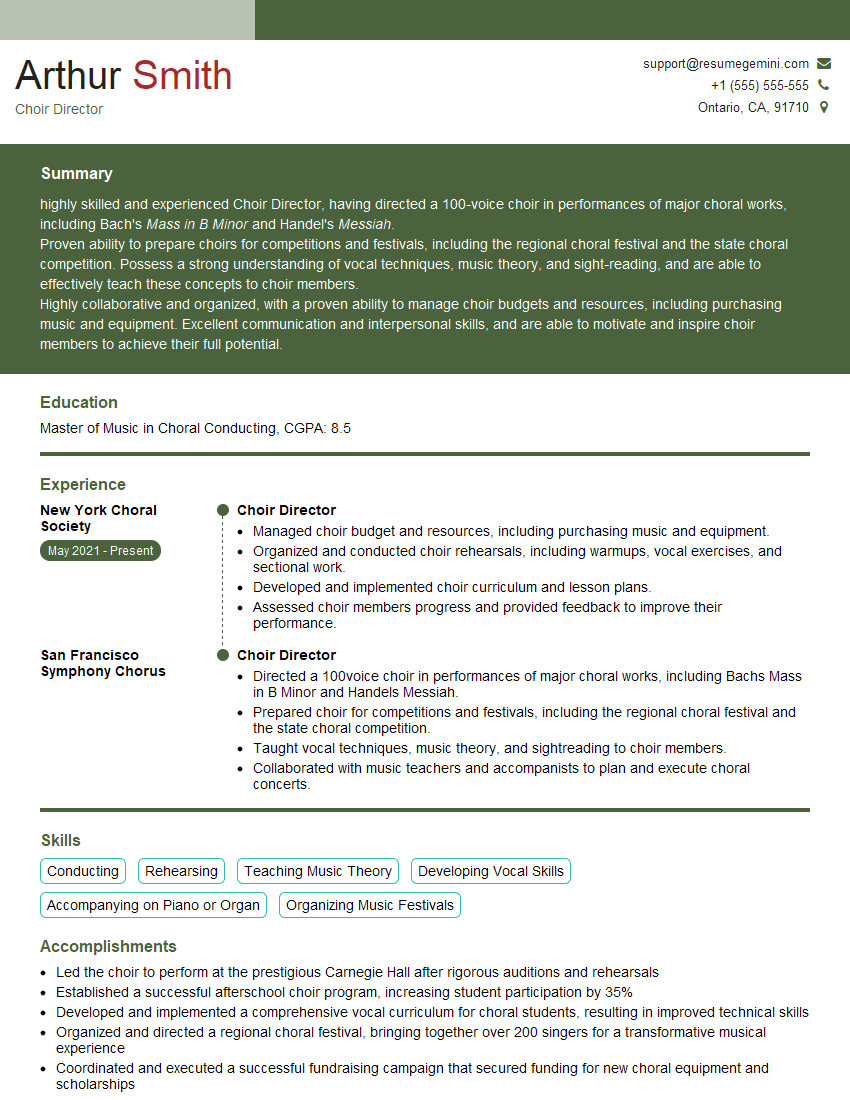
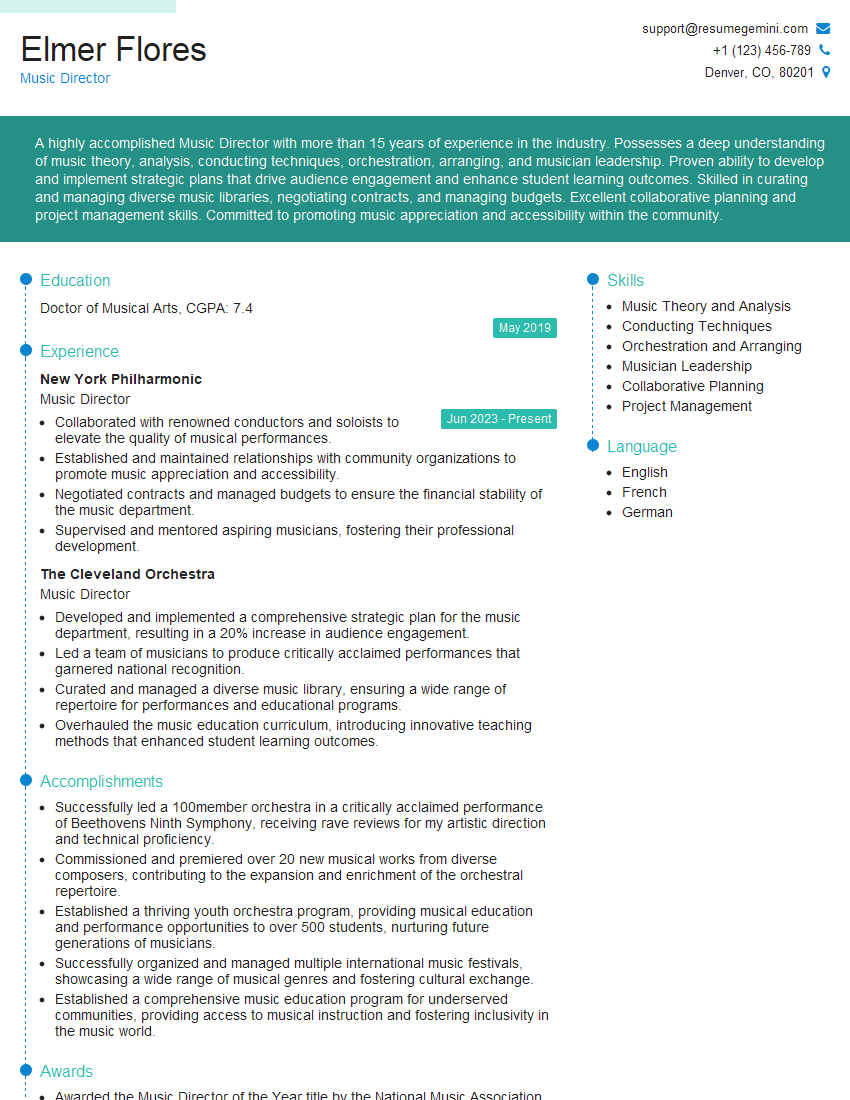
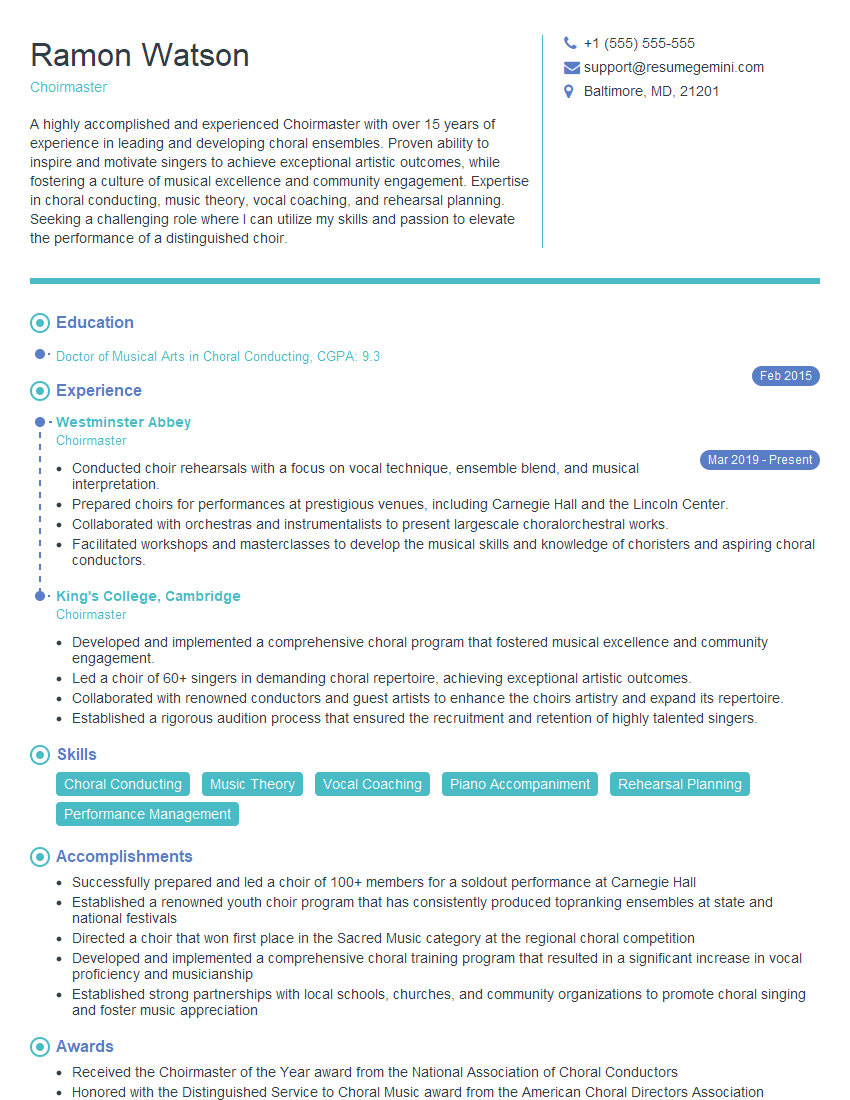
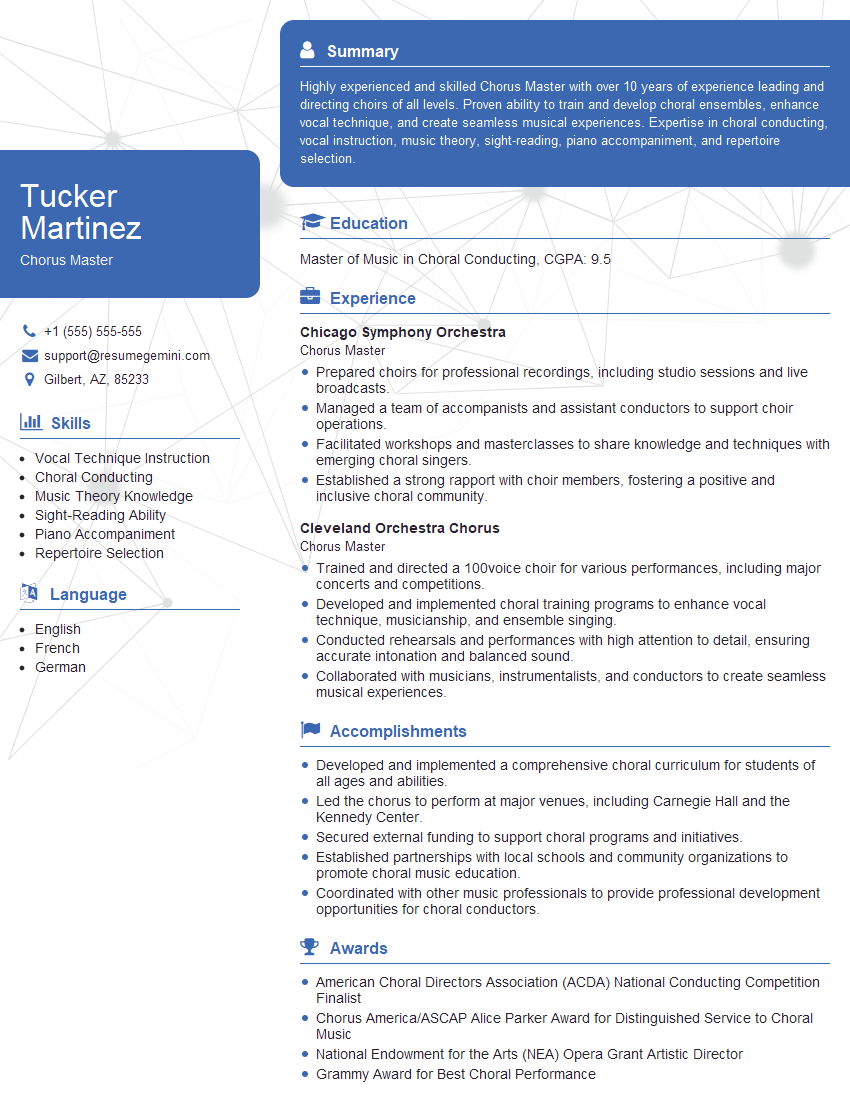
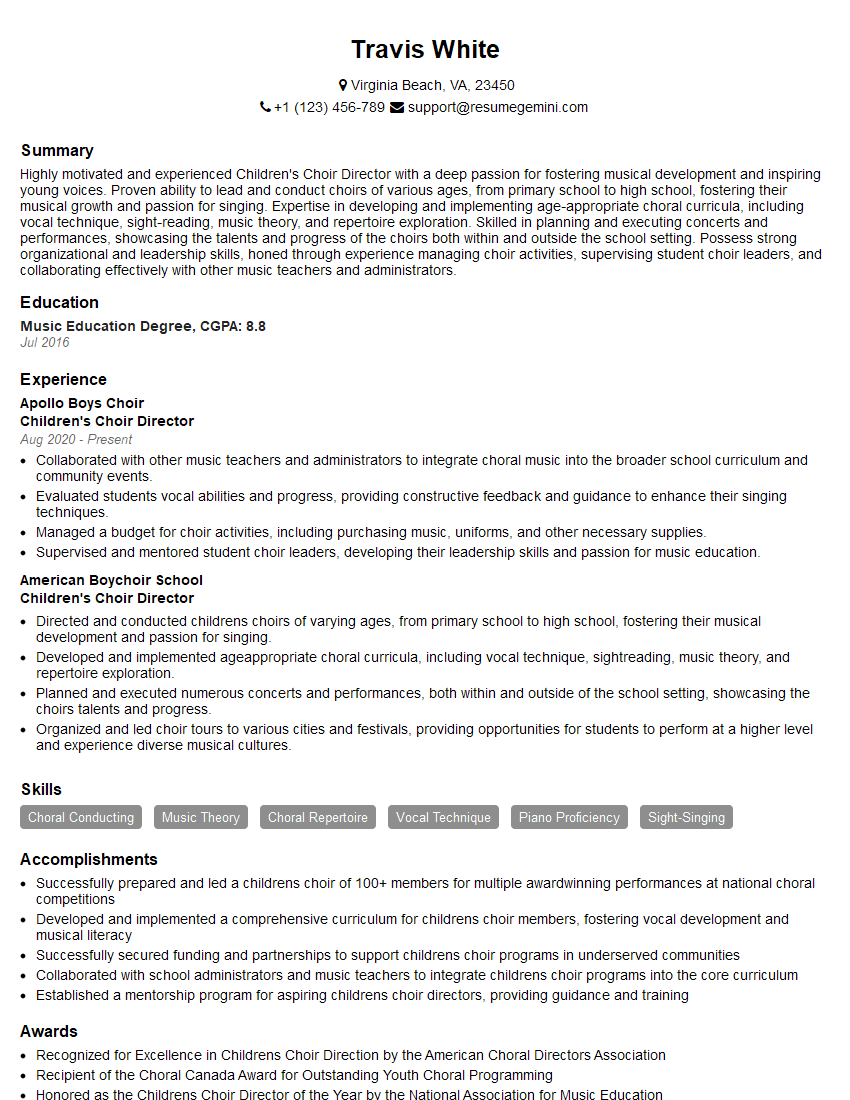
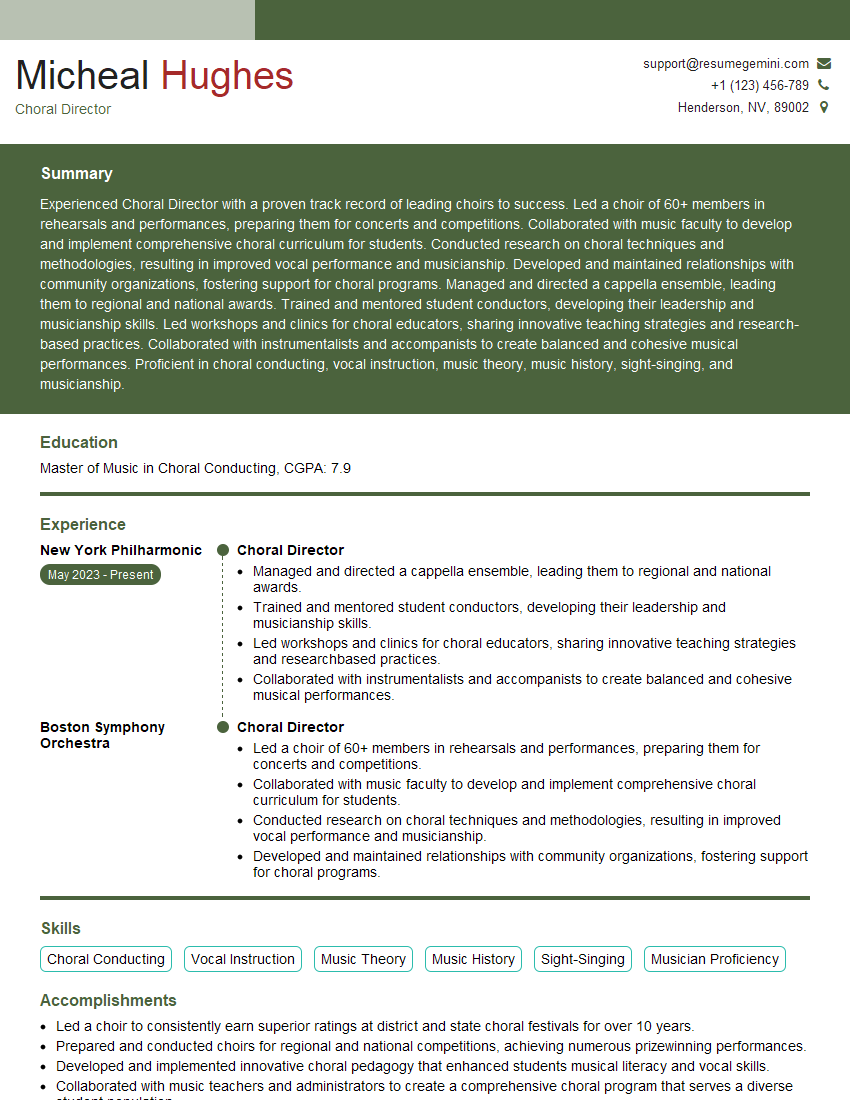
Mastering the art of leading choirs of various sizes is crucial for career advancement in choral music. It demonstrates leadership, adaptability, and a deep understanding of vocal artistry. To significantly increase your job prospects, create an ATS-friendly resume that effectively highlights your skills and experience. ResumeGemini is a trusted resource to help you build a professional and impactful resume that showcases your abilities. Examples of resumes tailored to experience in leading choirs of various sizes are available to guide you.
Explore more articles
Users Rating of Our Blogs
Share Your Experience
We value your feedback! Please rate our content and share your thoughts (optional).
What Readers Say About Our Blog
Very informative content, great job.
good