Are you ready to stand out in your next interview? Understanding and preparing for Experience in leading youth choirs interview questions is a game-changer. In this blog, we’ve compiled key questions and expert advice to help you showcase your skills with confidence and precision. Let’s get started on your journey to acing the interview.
Questions Asked in Experience in leading youth choirs Interview
Q 1. What is your experience managing rehearsal schedules and logistics for a youth choir?
Managing rehearsal schedules and logistics for a youth choir requires meticulous planning and clear communication. I begin by establishing a consistent rehearsal schedule that takes into account the singers’ academic commitments and other extracurricular activities. This often involves a collaborative process where I survey parents and students to determine the best days and times.
Next, I use a digital calendar (like Google Calendar or a dedicated choir management software) to create and share the schedule. This calendar isn’t just for rehearsal times; it also includes details like important dates for concerts, workshops, or fundraisers. Reminders and notifications are sent out regularly to minimise missed rehearsals. I also plan for potential conflicts, like school events or holidays, well in advance. For example, we might have shorter rehearsals or combine sessions to account for busy periods.
Finally, logistical aspects like securing rehearsal space, ensuring sufficient music stands and equipment, and arranging transportation for performances are all carefully managed. This often involves coordinating with parents and school administrators. For instance, if we have a larger concert, I’ll create a detailed logistics document outlining roles, responsibilities, and timelines for setup and tear-down.
Q 2. Describe your approach to selecting repertoire appropriate for a youth choir.
Selecting repertoire for a youth choir involves careful consideration of several factors: the singers’ vocal abilities, their musical maturity, their interests, and the overall goals of the choir. I begin by assessing the choir’s current skill level – considering their vocal range, technical proficiency, and sight-reading skills. For example, if the choir is relatively new, I’ll focus on pieces that are rhythmically straightforward and melodically accessible.
I then consider the emotional maturity of the singers. Pieces that are too complex emotionally or thematically might be challenging or inappropriate. I aim for a balance of well-known pieces to build confidence and unfamiliar pieces to challenge and expand their musical horizons. I also involve the singers in the selection process; I might present them with options and conduct a vote or have discussions about pieces they’d like to learn. This increases their investment and motivation. Finally, I ensure the chosen pieces offer a variety of styles and textures to keep the singers engaged.
Q 3. How do you handle discipline issues within a youth choir setting?
Handling discipline issues in a youth choir requires a proactive and positive approach. I believe in establishing clear expectations from the very beginning – setting rules for behavior and attendance, and clearly explaining the consequences of not adhering to them. This is discussed and agreed upon by the group. I emphasize respect for each other, the music, and the rehearsal space. Positive reinforcement plays a much bigger role than punitive measures. I frequently praise good behavior and effort.
When dealing with individual issues, I aim for private conversations rather than public reprimands. I try to understand the root cause of the behavior. Is the student tired? Are they struggling with the music? Is there a personal issue affecting their behavior? Addressing the underlying cause is often more effective than simply punishing the symptom. In the rare case of more serious or repeated issues, I involve parents to collaboratively address the problem.
Q 4. Explain your method for teaching vocal technique to young singers.
Teaching vocal technique to young singers involves a multifaceted approach combining practical exercises with clear explanations. I focus on foundational skills like posture, breathing, and vocal production. We start with simple breathing exercises, such as inhaling deeply and exhaling slowly, to help the singers understand proper breath control. Then, we progress to exercises that improve vocal resonance and tone quality. For instance, humming exercises on various vowels help to develop a richer sound.
I use a combination of individual instruction and group activities. Individual feedback allows for personalized coaching, while group exercises promote teamwork and learning from each other. I also make use of visual aids and analogies. For example, I might explain vocal resonance by comparing the vocal tract to a resonating chamber. I encourage the singers to record themselves to monitor their progress and identify areas for improvement. This self-reflection is crucial for their development.
Q 5. How do you assess the vocal capabilities of new choir members?
Assessing the vocal capabilities of new choir members is a crucial step in ensuring a balanced and effective choir. I usually begin with an informal audition where the prospective singer sings a short piece of their choice. This allows me to evaluate their vocal range, tone quality, and basic musicality. I don’t focus on technical perfection at this stage. Rather, I look for potential and enthusiasm.
In addition to the audition, I might engage the singer in simple vocal exercises to gauge their breath control, vocal flexibility and their understanding of basic musical concepts like pitch and rhythm. It’s also valuable to have a brief conversation with the singer to understand their musical background and aspirations. This helps to create a welcoming and comfortable atmosphere during the assessment. Ultimately, I aim to determine whether the singer can contribute positively to the ensemble.
Q 6. What strategies do you employ to maintain high levels of student engagement during rehearsals?
Maintaining high levels of student engagement during rehearsals involves creating a fun and stimulating learning environment. Variety is key; I avoid long stretches of monotonous exercises by incorporating a range of activities. This could include games, movement exercises, listening activities, and improvisation. For example, we might learn a new piece through call and response or play a rhythm game to improve their rhythmic accuracy.
I also emphasize the importance of the music we are learning, connecting it to their lives and experiences. I might share stories about the composers or historical context surrounding the piece to add depth and meaning to their performance. Regular feedback and encouragement is also vital. I celebrate successes, both big and small, to create a positive atmosphere where singers feel valued and appreciated. Finally, I allow for some flexibility and student input within the rehearsal structure.
Q 7. How do you foster a positive and inclusive environment in your youth choir?
Fostering a positive and inclusive environment is paramount in a youth choir. I strive to create a safe space where every singer feels valued, respected, and accepted, regardless of their background, experience, or skill level. This begins with establishing clear expectations for respectful behaviour and celebrating diversity. We often talk about the importance of kindness and collaboration.
I encourage active listening and participation from each singer. I use inclusive language, avoiding any jargon that might alienate members. I make a point of learning singers’ names and getting to know them personally. Team building activities, like social gatherings or informal get-togethers, strengthen the bonds among members. I also actively seek feedback from the singers on how I can make the choir a more inclusive space. By creating this kind of environment, all singers feel comfortable participating and reaching their full potential.
Q 8. What is your experience with conducting auditions for youth choirs?
Auditions for youth choirs are crucial for building a balanced and skilled ensemble. My approach prioritizes creating a welcoming and supportive environment to alleviate anxiety. I begin by clearly outlining the audition process, explaining what I’ll be assessing (tone quality, pitch accuracy, rhythmic precision, musicality, sight-reading ability). I then offer a warm-up exercise to help students relax and showcase their best. The audition itself involves singing a prepared piece, demonstrating sight-reading skills with a short, unfamiliar excerpt, and possibly a short vocal exercise to test range and control. I provide constructive feedback, regardless of the outcome, focusing on strengths and areas for improvement. This approach ensures fairness, identifies potential, and fosters positive relationships with each student.
For younger singers, I might adjust the complexity of the prepared piece and sight-reading excerpt. I always emphasize that the audition is an opportunity to share their musical talent and learn, not a judgment of their worth. For example, if a student struggles with sight-reading but demonstrates exceptional musicality and potential, I might offer them a spot in the choir with the understanding that we will work together to improve their sight-reading skills.
Q 9. Describe your approach to teaching sight-reading skills.
Sight-reading is a fundamental skill for any choir member. My approach is multi-faceted, incorporating rhythmic and melodic training. I start with fundamental rhythm exercises, using body percussion and clapping patterns, to internalize rhythmic values. Then, I introduce simple melodic exercises, initially using solfège (do-re-mi) to build aural recognition. Gradually, I introduce notation, connecting the notes on the staff to the sounds. I use a variety of methods, including games, interactive exercises, and gradually increasing the difficulty of the sight-reading pieces. I emphasize understanding the musical context—the key, time signature, and overall melodic direction—before attempting to sing.
A common strategy I utilize is ‘chunking,’ where we tackle small sections of the music at a time, mastering each phrase before moving on. We also use rhythm and melodic dictation exercises to enhance aural skills. Regular sight-reading exercises are integrated into every rehearsal, starting with short, simple pieces and progressively increasing the complexity. Regular, consistent practice is key. I often provide individualized support based on each student’s needs and progress.
Q 10. How do you adapt your teaching methods to accommodate different learning styles?
Recognizing that students learn in diverse ways is critical. I employ a variety of teaching methods to cater to visual, auditory, and kinesthetic learners. Visual learners benefit from clear notation, charts, and diagrams. I use color-coding to emphasize important aspects like phrasing and dynamics. Auditory learners respond well to listening exercises and aural training. I incorporate call-and-response techniques and use recordings to model proper vocal techniques. Kinesthetic learners thrive on movement and physical activities. I use hand gestures, body percussion, and movement exercises to reinforce rhythms and dynamics.
For example, when teaching a complex piece, I might provide a visual aid showing the overall structure and phrasing, use aural examples to highlight the melodic contour, and incorporate movement to represent the dynamics. I also encourage peer-teaching and collaborative learning, allowing students to learn from each other and to identify their individual learning styles. Regular assessments and feedback help me adjust my teaching approach to meet the unique needs of each student.
Q 11. What performance techniques do you utilize to enhance choir performances?
Enhancing choir performances involves a multifaceted approach combining vocal technique, musical interpretation, and stage presence. Vocal techniques encompass breath support, resonance, diction, and intonation. I use targeted exercises to improve these aspects. Musical interpretation involves conveying the composer’s intentions and emotions. We analyze the music’s structure, dynamics, and expressive markings, discussing the story the music tells. Stage presence includes posture, eye contact, and confident delivery. I guide students to perform with expression and connection to the music and audience. I incorporate performance practice techniques such as conducting gestures, breathing exercises, and choral warm-ups directly related to the performance repertoire.
For example, when preparing for a performance, we spend time focusing on expression, such as appropriate dynamics for particular sections of the music. We practice eye contact with the audience and develop stage choreography to enhance the visual aspect of the performance. I also might include recordings of professional performances for analysis and inspiration, illustrating superior vocal technique and interpretive skills.
Q 12. How do you incorporate technology into your youth choir program?
Technology plays a significant role in my youth choir program. I use digital audio workstations (DAWs) for recording rehearsals and performances, allowing for self-assessment and feedback. We utilize online platforms for sharing scores, recordings, and learning materials. Software such as GarageBand or Audacity enables students to record and listen back to their individual performances, promoting self-improvement. Interactive music software and apps provide additional learning opportunities and engagement. Online platforms can also help keep parents informed and facilitate communication.
For instance, students can record themselves singing a specific passage and email the recording to me for feedback. Or, we use a shared online folder to distribute sheet music, making it accessible to everyone. We also utilize virtual rehearsal platforms (when in-person is not possible), facilitating collaborative practice even when geographically separated. Furthermore, I use video platforms like YouTube to showcase exemplary choral performances, inspiring students and demonstrating high-quality singing.
Q 13. How do you promote collaboration and teamwork among choir members?
Collaboration and teamwork are essential in a choir. I foster this by encouraging peer-teaching, where students help each other learn difficult passages or techniques. We often work in smaller sections, building individual parts before combining them. I employ team-building activities and games that foster a sense of camaraderie and mutual support among choir members. I establish a positive and inclusive environment where students feel comfortable sharing their ideas and supporting each other. I emphasize the importance of each individual’s contribution to the overall success of the choir.
For example, I might divide the choir into smaller groups to rehearse sections of a piece, then have each group teach their section to the rest of the choir. We’ll also plan fun activities outside of rehearsals to strengthen team cohesion. This could be a social gathering, volunteering together, or attending a choral workshop. Creating a supportive culture where singers feel comfortable helping each other is paramount to achieving a cohesive and impressive final product.
Q 14. What is your experience working with parents/guardians of choir members?
Effective communication with parents/guardians is critical. I maintain open communication channels through regular emails, newsletters, and parent-teacher meetings. I share information about rehearsals, performances, and progress. I actively seek their feedback and input, creating a collaborative partnership. I aim to involve them in the program, potentially through helping with fundraising events or chaperoning trips. By keeping them informed and engaged, I build trust and cooperation, creating a supportive community around the choir.
For example, I might send out weekly emails with rehearsal updates and announcements, and have a formal parent meeting at the start and middle of each semester to discuss the choir’s progress and any concerns. I also ensure that any important decisions, such as selecting repertoire, are discussed with the parents, taking their suggestions into consideration. Creating a strong parent-teacher relationship increases engagement and improves the overall choir experience for both the students and their families.
Q 15. Describe your approach to conflict resolution within the choir.
Conflict resolution in a youth choir requires a multifaceted approach emphasizing communication, empathy, and fairness. My strategy begins with proactive measures to prevent conflict, such as establishing clear expectations and fostering a supportive environment where young singers feel comfortable expressing their concerns.
When conflict does arise, I employ a structured approach. First, I ensure I understand each individual’s perspective through active listening. This involves giving each person uninterrupted time to share their viewpoint without interruption or judgment. Second, I facilitate a collaborative dialogue, helping the involved parties identify the root of the disagreement and explore potential solutions together. The goal isn’t to assign blame but to find a mutually agreeable outcome. Third, I help them formulate a plan to prevent similar conflicts in the future. For example, if disagreements stem from scheduling conflicts during rehearsals, we might work together to create a more flexible rehearsal schedule or a system for efficient communication regarding absences.
Finally, I emphasize the importance of respecting each other’s contributions and valuing diversity of opinion. A choir is a team, and success relies on mutual support and understanding. This approach has helped me successfully navigate conflicts ranging from minor disagreements about rehearsal etiquette to more serious personality clashes among choir members.
Career Expert Tips:
- Ace those interviews! Prepare effectively by reviewing the Top 50 Most Common Interview Questions on ResumeGemini.
- Navigate your job search with confidence! Explore a wide range of Career Tips on ResumeGemini. Learn about common challenges and recommendations to overcome them.
- Craft the perfect resume! Master the Art of Resume Writing with ResumeGemini’s guide. Showcase your unique qualifications and achievements effectively.
- Don’t miss out on holiday savings! Build your dream resume with ResumeGemini’s ATS optimized templates.
Q 16. How do you evaluate the success of your youth choir program?
Evaluating the success of a youth choir program involves assessing its impact across multiple dimensions. It’s not just about the quality of performances, but also about the holistic development of the young singers.
- Musical Achievement: This is measured through the improvement in vocal technique, musicality, sight-reading skills, and overall performance quality, assessed through regular evaluations and concerts.
- Personal Growth: I track the development of self-confidence, teamwork skills, discipline, and time management abilities. This is often evaluated through observations during rehearsals, feedback from the singers themselves, and anecdotal evidence from parents.
- Community Engagement: A successful program fosters a strong sense of community among the singers and the wider community. This is assessed by the level of participation in community events, the engagement of parents and volunteers, and the overall positive impact on the community.
- Retention Rates: A high retention rate indicates a positive and engaging program that meets the needs of the singers. Analyzing the reasons for leaving can reveal areas for improvement.
Ultimately, success is defined by the positive and lasting impact the program has on the lives of the young singers, their families, and the community.
Q 17. What is your experience with budgeting and fundraising for a youth choir?
Budgeting and fundraising are crucial aspects of running a successful youth choir. My experience involves creating detailed budgets that encompass all aspects of the program, from rehearsal space rental and music scores to costumes, travel expenses for performances, and instructor fees.
Fundraising strategies are diverse and require a multi-pronged approach. I’ve successfully implemented various methods such as:
- Grant Applications: Seeking funding from local arts councils, foundations, and corporate sponsorships.
- Fundraising Events: Organizing concerts, bake sales, car washes, and other events to generate revenue.
- Crowdfunding: Utilizing online platforms to reach a wider audience of potential donors.
- Parent Contributions: Engaging parents in fundraising efforts through voluntary contributions or participation in fundraising events.
Careful financial management, transparent record-keeping, and consistent communication with stakeholders are essential for responsible fundraising and budget allocation.
Q 18. What is your experience with arranging and adapting choral music?
Arranging and adapting choral music is a skill honed through years of experience and a deep understanding of vocal ranges, textures, and musical styles. My approach involves careful consideration of the choir’s specific capabilities and the musical nuances of the piece.
This often involves:
- Vocal Range Adjustments: Transposing a piece to accommodate the vocal range of my youth choir. For instance, a piece originally written for adult voices might need to be transposed down to suit the younger singers.
- Simplification of Harmony: Reducing complex harmonies to simpler textures that are more manageable for younger singers without losing the essence of the composition.
- Rhythmic Adaptation: Adjusting the rhythmic complexity where necessary to facilitate ease of learning and performance.
- Adding Accompaniments: Creating or selecting appropriate accompaniments, such as piano or instrumental parts, to support the choir’s performance.
I always prioritize maintaining the artistic integrity of the original composition while making it accessible and enjoyable for the singers to perform.
Q 19. How do you build positive relationships with parents and community members?
Building positive relationships with parents and community members is crucial for the success and sustainability of any youth choir program. My approach involves proactive communication, consistent updates, and genuine appreciation for their support.
I maintain open communication channels through regular newsletters, emails, and parent meetings. This ensures that parents are informed about rehearsal schedules, performance details, and any significant developments within the choir. I actively encourage parent participation through volunteering opportunities, such as helping with costumes, transportation, or fundraising events. I also make a point of recognizing and appreciating their contributions. By valuing their input and actively involving them in the program’s success, I foster a collaborative and supportive community environment.
Furthermore, I actively seek opportunities to engage with the wider community through performances, workshops, and collaborations with local organizations. This helps raise awareness about the choir and strengthens the bonds between the choir and the community it serves.
Q 20. What is your experience with managing choir uniforms and equipment?
Managing choir uniforms and equipment requires meticulous organization and attention to detail. I maintain an inventory of all uniforms and equipment, including sizes, condition, and storage location. This involves creating a database or spreadsheet to easily track each item.
Regular inspections are crucial to identify any damage or wear and tear. This allows for timely repairs or replacements. I create a system for efficient distribution and collection of uniforms before and after performances and rehearsals. I also establish clear guidelines for the care and maintenance of uniforms and equipment to ensure their longevity. Finally, I ensure adequate storage space to protect the items from damage and maintain a clean and organized environment.
Q 21. Describe your experience with teaching music theory to young singers.
Teaching music theory to young singers requires a creative and engaging approach that balances theoretical concepts with practical application. I use a variety of methods to make learning fun and accessible.
My teaching incorporates:
- Hands-on Activities: Engaging activities such as composing simple melodies, creating rhythmic patterns, and exploring different musical textures. For example, using rhythm games and melodic dictation exercises.
- Visual Aids: Employing visual aids, such as diagrams, charts, and interactive software, to explain complex concepts in a clear and understandable way.
- Real-World Examples: Relating theoretical concepts to the songs the choir is learning, to help students see the practical applications of what they’re studying.
- Games and Competitions: Using game-based learning and friendly competitions to keep students engaged and motivated.
I tailor my approach to the age and understanding of the students, gradually introducing more complex concepts as they progress. For example, I might start with basic rhythm and melodic concepts and progressively introduce harmony, form, and musical analysis as their understanding develops.
Q 22. How do you incorporate diverse musical styles into your choir’s repertoire?
Incorporating diverse musical styles is crucial for keeping a youth choir engaged and expanding their musical horizons. It’s not just about exposure; it’s about fostering appreciation and understanding of different cultures and musical traditions. My approach involves a phased strategy:
Gradual Introduction: I begin by introducing styles familiar to the students, perhaps pop or gospel, before gradually incorporating more complex or unfamiliar genres like classical, world music, or even musical theatre. This prevents overwhelming them and allows for a smoother transition.
Thematic Programming: Sometimes, I’ll base a season’s repertoire around a theme, like ‘Music Around the World’ or ‘Celebrating Love.’ This provides a context for understanding the diverse styles and their historical and cultural significance. For instance, a section on African rhythms might include call-and-response songs alongside traditional choral pieces.
Student Input: I actively encourage student input and suggestions. If a student expresses interest in a particular style, I try to incorporate it, provided it’s appropriate for the choir’s skill level. This not only boosts their morale but also creates a sense of ownership and shared musical exploration.
Arranging and Adaptation: I often seek out arrangements that blend styles. For example, I might find a classical piece arranged with a contemporary pop feel, bridging the gap between traditional and modern sounds.
This multifaceted approach ensures a rich and varied musical experience, fostering both technical skills and a deep appreciation for the vast world of music.
Q 23. What is your preferred method for assessing student progress?
Assessing student progress is a continuous process, not a single event. My method combines formal and informal assessments to provide a holistic view of each singer’s development. I utilize:
Regular Rehearsals: Daily observation during rehearsals is invaluable. I pay attention to vocal technique, musicality, pitch accuracy, and overall engagement. I offer individual feedback and tailor my teaching to address specific needs.
Formal Assessments: Periodically, I conduct formal assessments, like individual vocal evaluations or sectional rehearsals focused on specific skills. These assessments provide a more structured evaluation of their progress.
Recordings and Self-Assessment: I encourage self-assessment through recording rehearsals or performances. This allows students to listen back and identify areas for improvement, fostering self-awareness and accountability.
Performance Opportunities: Performances – whether small informal concerts or larger competitions – provide a real-world context for assessing progress. They showcase the students’ ability to apply what they’ve learned in a high-pressure environment.
I maintain detailed records of each student’s progress, including notes from observations and formal assessments, allowing me to track improvement over time and identify any learning gaps that require extra attention. This data-driven approach ensures that my instruction is effective and tailored to the individual needs of each singer.
Q 24. How do you create a sense of community and belonging within the youth choir?
Building a strong sense of community and belonging is paramount to the success of a youth choir. It’s about fostering a supportive environment where every member feels valued and respected. My strategies include:
Team-Building Activities: We engage in regular team-building exercises outside of rehearsals, such as games, social gatherings, and outings. This helps to build rapport and create friendships.
Open Communication: I encourage open communication among the singers and between the singers and myself. I create a safe space where they feel comfortable expressing their thoughts and concerns.
Shared Goals and Responsibilities: We establish shared goals for the choir, such as preparing for a concert or competition. Assigning responsibilities, such as leading warm-ups or organizing fundraising events, promotes teamwork and shared ownership.
Mentorship Program: I implement a peer mentorship program, pairing more experienced singers with newer members. This provides support and guidance for new singers, helps the more experienced ones develop leadership skills, and strengthens the bonds within the group.
Celebrating Successes: We celebrate both large and small achievements, recognizing and appreciating the contributions of each individual singer. This reinforces positive feelings and a sense of accomplishment.
By creating a supportive and inclusive atmosphere, I cultivate a strong sense of community where each member feels valued and connected, making the choir experience both musically rewarding and personally enriching.
Q 25. What are your strategies for dealing with stage fright in young singers?
Stage fright is a common experience, especially for young singers. My strategies for addressing this involve a multifaceted approach focusing on preparation, practice, and positive reinforcement:
Preparation and Practice: Thorough preparation is key. The more confident singers are in their material, the less anxious they’ll feel on stage. This includes plenty of rehearsal time, focusing on both technical aspects and performance delivery.
Relaxation Techniques: I teach relaxation techniques, such as deep breathing exercises and mindfulness practices, to help manage anxiety before performances.
Positive Visualization: We use positive visualization techniques, where singers imagine themselves performing successfully. This helps to build confidence and reduce negative thoughts.
Gradual Exposure: I gradually increase the singers’ exposure to performance situations, starting with small, informal settings and progressively moving to larger venues. This helps them build experience and confidence over time.
Supportive Environment: I cultivate a supportive and encouraging environment where mistakes are viewed as learning opportunities, not failures. This helps singers feel comfortable taking risks and expressing themselves.
Positive Self-Talk: I encourage positive self-talk, helping singers replace negative thoughts with positive affirmations.
By addressing stage fright proactively and providing singers with the tools and support they need, I help them overcome their fears and enjoy the experience of performing.
Q 26. How do you balance the needs of individual singers with the needs of the ensemble?
Balancing the needs of individual singers with the needs of the ensemble requires a delicate balance of individualized attention and collective focus. I achieve this through:
Differentiated Instruction: I provide differentiated instruction, tailoring my teaching to the individual needs and skill levels of each singer. This involves offering individualized feedback and support, while simultaneously working towards collective goals.
Sectional Rehearsals: I utilize sectional rehearsals to address specific challenges within different vocal sections. This allows me to work with smaller groups, providing focused attention on individual needs while addressing the overall balance of the choir.
Open Communication: I foster open communication, creating a safe space for singers to express their concerns and needs. This enables me to understand individual challenges and address them appropriately.
Part Assignments: Carefully chosen part assignments consider individual strengths and vocal ranges, ensuring that each singer has a role that aligns with their abilities while contributing to the overall ensemble sound.
Collaborative Goal Setting: I involve singers in collaborative goal setting for rehearsals and performances. This helps everyone feel invested in the process and understand how their individual contributions impact the collective success.
This approach ensures that each singer feels supported and challenged, maximizing their potential while contributing to the overall success and harmony of the choir.
Q 27. What is your experience with preparing youth choirs for competitions or festivals?
Preparing youth choirs for competitions or festivals requires a rigorous and focused approach that goes beyond typical rehearsal practices. My experience includes:
Strategic Repertoire Selection: Careful selection of repertoire is crucial. I consider the choir’s skill level, the competition’s rules and judging criteria, and the choir’s overall strengths and weaknesses. We aim for pieces that showcase the choir’s capabilities while also offering an opportunity for growth.
Intensive Rehearsal Schedule: Preparation involves an intensive rehearsal schedule, incorporating focused work on musical details, technical precision, and performance presentation.
Performance Practice: We dedicate significant time to performance practice, simulating competition conditions to help singers manage pressure and refine their performance.
Feedback and Refinement: I provide regular feedback and guidance, encouraging self-assessment and continuous refinement based on performances and judges’ comments (in previous competitions).
Stage Presence and Presentation: We also work on stage presence and presentation skills, such as posture, diction, and audience engagement. A polished performance enhances the impact of the music.
Ultimately, success in competitions isn’t the sole focus; the true goal is to use the experience as a catalyst for growth and improvement, empowering singers to develop their skills and confidence.
Q 28. How do you maintain your own professional development as a youth choir director?
Maintaining professional development is essential for any youth choir director. My commitment to continuous learning involves:
Conferences and Workshops: I attend conferences and workshops focused on choral conducting, vocal pedagogy, and youth development. These events offer opportunities to learn new techniques, expand my knowledge, and network with other professionals.
Mentorship: I actively seek out mentorship opportunities with experienced choral conductors, learning from their expertise and insights.
Professional Organizations: I am a member of professional organizations related to choral music, staying updated on the latest trends and research.
Continuing Education Courses: I participate in continuing education courses to refine my skills in vocal techniques, conducting, and music education.
Self-Study and Research: I engage in independent self-study, reading books, articles, and scholarly journals on choral conducting and music education.
My continuous learning ensures that I remain at the forefront of best practices and provide the highest quality instruction and guidance to my students.
Key Topics to Learn for Experience in leading youth choirs Interview
- Musical Repertoire & Programming: Selecting appropriate and engaging music for different age groups and skill levels. Understanding copyright and licensing requirements.
- Rehearsal Techniques: Developing effective rehearsal plans, incorporating varied teaching methods (e.g., games, individual coaching, sectionals), and managing time efficiently.
- Vocal Technique & Development: Understanding basic vocal pedagogy, addressing common vocal issues in young singers, and fostering healthy vocal habits.
- Performance Skills & Stagecraft: Preparing youth choirs for successful performances, including stage presence, diction, and audience engagement. Managing stage logistics and technical aspects.
- Group Dynamics & Leadership: Building a positive and supportive choir environment, resolving conflicts effectively, fostering teamwork and collaboration amongst singers.
- Communication & Collaboration: Effectively communicating with young singers, parents, and other stakeholders. Working collaboratively with other staff members and musical directors.
- Assessment & Feedback: Providing constructive feedback to singers, assessing their progress, and identifying areas for improvement. Using various assessment tools (formal & informal).
- Administrative Tasks: Managing schedules, organizing rehearsals, handling administrative paperwork (e.g., attendance, communication), and potentially budgeting for choir activities.
Next Steps
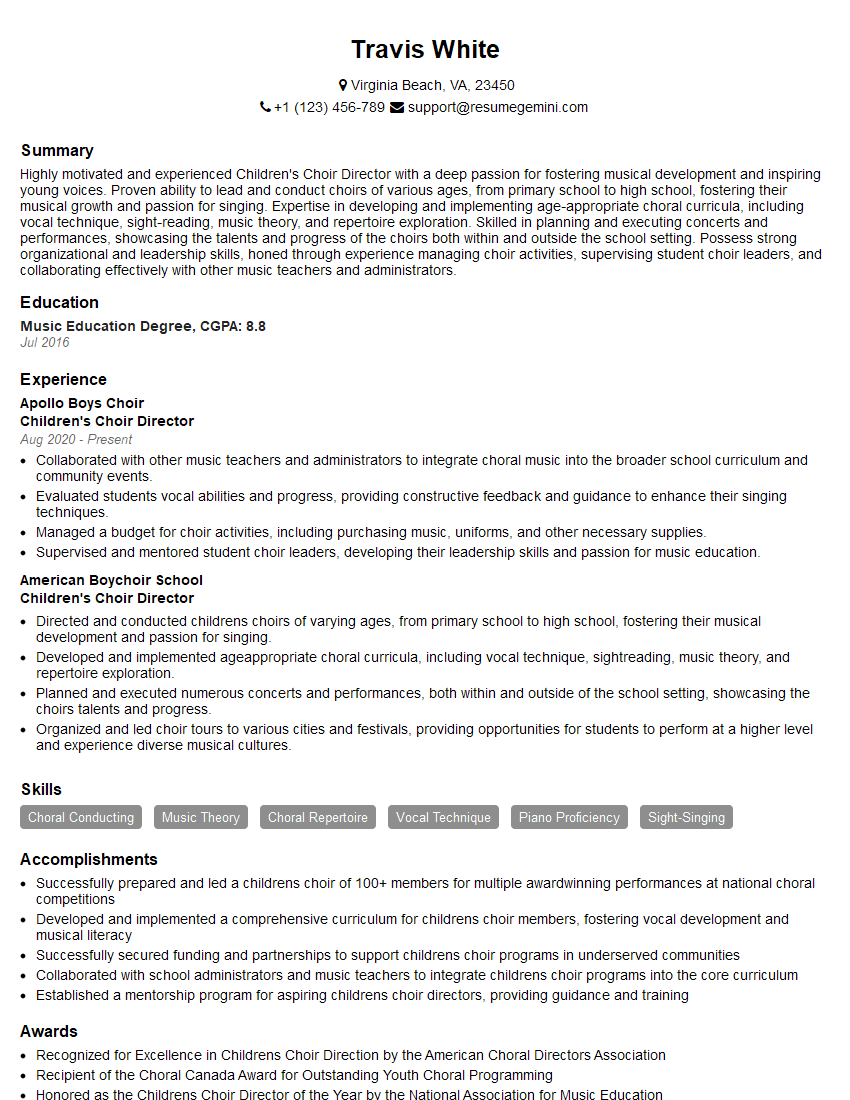
Mastering the art of leading youth choirs significantly enhances your career prospects in music education, arts administration, and community engagement. A well-crafted resume is crucial for showcasing your skills and experience to potential employers. Building an ATS-friendly resume increases your chances of getting your application noticed and shortlisted. ResumeGemini is a trusted resource that can help you create a professional and impactful resume, tailored to highlight your unique experience. We provide examples of resumes specifically tailored to showcasing experience in leading youth choirs to help you get started.
Explore more articles
Users Rating of Our Blogs
Share Your Experience
We value your feedback! Please rate our content and share your thoughts (optional).
What Readers Say About Our Blog
Very informative content, great job.
good