Preparation is the key to success in any interview. In this post, we’ll explore crucial Experience in Tarot and Oracle Card Reading interview questions and equip you with strategies to craft impactful answers. Whether you’re a beginner or a pro, these tips will elevate your preparation.
Questions Asked in Experience in Tarot and Oracle Card Reading Interview
Q 1. Explain the difference between Tarot and Oracle cards.
While both Tarot and Oracle cards offer guidance and insight, they differ significantly in their structure and approach. Tarot cards, typically consisting of 78 cards divided into the Major and Minor Arcana, tell a complex, archetypal story. Each card, with its rich symbolism and nuanced meaning, contributes to a narrative reflecting the querent’s situation. The Major Arcana depicts significant life lessons and journeys, while the Minor Arcana focuses on everyday challenges and opportunities. Oracle cards, on the other hand, are less structured. They vary widely in number and theme, often focusing on a specific topic like love, relationships, or career. Their interpretations are more direct and less narrative-driven, offering immediate answers and guidance rather than a complex unfolding story.
Think of it this way: Tarot is like a detailed novel, exploring the intricacies of a character’s journey, while Oracle cards are like a collection of wise proverbs, offering focused advice for immediate situations.
Q 2. Describe your preferred Tarot spread and why you choose it.
My preferred spread is the Celtic Cross. It’s a ten-card spread providing a comprehensive overview of a situation, encompassing past influences, present circumstances, challenges, hopes, and potential outcomes. I choose this spread because of its depth and complexity. It allows for a nuanced understanding of the querent’s situation, going beyond a simple yes/no answer to provide a detailed and insightful perspective. The Celtic Cross helps unpack the layers of a question, revealing interconnected aspects that might otherwise be missed in simpler spreads. For example, it clarifies the underlying causes of a problem (past influences), reveals present obstacles (challenges), and shows potential pathways towards resolution (future prospects). It’s a powerful tool for both personal reflection and professional guidance.
Q 3. How do you interpret the reversed meaning of a Tarot card?
Interpreting reversed cards in Tarot is a matter of ongoing discussion among readers, with no single, universally accepted method. However, my approach considers reversed cards as highlighting the shadow aspects of the upright card’s meaning. It doesn’t necessarily indicate negativity, but rather suggests an internal blockage or a situation that is either developing slowly or being blocked from its full potential. For instance, the reversed Empress might signify a lack of nurturing or self-care, rather than simply being ‘bad’. The reversed Strength could indicate a lack of control or inner conflict, as opposed to outright weakness. The key is to understand the card’s energy and how its reversed position impacts its expression. The context of the entire spread is crucial; a single reversed card rarely dictates the overall outcome.
Q 4. What is your approach to dealing with sensitive or emotional client situations?
When dealing with sensitive or emotional client situations, my approach prioritizes empathy and creating a safe space. I begin by actively listening to the client, allowing them to express themselves without interruption. I use validating language, reflecting their emotions and acknowledging their experiences. If the reading uncovers deeply painful or traumatic material, I offer support and suggest seeking professional help if needed. I emphasize that I am not a therapist and my role is to provide guidance and insight, not to diagnose or treat. The reading itself is framed within a broader context of self-care and personal growth, emphasizing the client’s inherent strength and resilience. I always prioritize the client’s well-being above all else.
Q 5. How do you maintain ethical boundaries in your readings?
Maintaining ethical boundaries in my readings involves several key practices: Firstly, I clearly state my limitations. I emphasize that I am offering guidance, not predictions, and that the client retains free will. Secondly, I avoid making promises or guarantees about the future. Thirdly, I refuse to provide readings on matters that could cause harm or be used for unethical purposes, such as attempting to manipulate others or engaging in harmful activities. Confidentiality is paramount; I never disclose client information to anyone without their explicit consent. Finally, I maintain a professional and respectful distance, avoiding the development of personal relationships with clients to ensure objectivity and prevent any potential conflicts of interest. Maintaining clear boundaries ensures the integrity and trust central to the reading process.
Q 6. Explain your understanding of different Tarot archetypes.
Understanding Tarot archetypes is fundamental to accurate interpretation. These are recurring symbolic figures representing universal themes and human experiences. For example, the Fool represents new beginnings and innocence, the Empress embodies nurturing and abundance, the Emperor signifies authority and structure, the Lovers represent choice and relationships, and the Hermit symbolizes introspection and solitude. Understanding these archetypes allows me to connect the card’s imagery to the querent’s personal experiences, offering richer and more resonant insights. Each archetype has positive and shadow aspects, depending on the card’s position and the surrounding cards in the spread. The strength of my interpretations hinges on correctly identifying and interpreting these archetypal energies within the context of the client’s query.
Q 7. Describe a challenging reading experience and how you navigated it.
One challenging reading involved a client grappling with a severe illness. The cards suggested a difficult path ahead, hinting at significant challenges and potential loss. My initial instinct was to soften the blow, but I realised that providing a false sense of hope would be unethical. Instead, I chose to validate the client’s fears and anxieties while highlighting the inherent strength and resilience shown through the cards, emphasizing their ability to cope with hardship and find strength during difficult times. I focused on practical strategies they could employ to navigate the situation, emphasising self-care and seeking appropriate medical support. The subsequent conversations emphasized the importance of hope and perseverance amidst challenging circumstances, ensuring that the reading became a source of strength and empowerment, rather than despair.
Q 8. How do you ensure accuracy and clarity in your readings?
Accuracy and clarity in tarot and oracle card readings are paramount. It’s not about predicting the future with absolute certainty, but rather providing insightful perspectives and potential pathways. I achieve this through a multi-faceted approach.
- Thorough Card Knowledge: I have dedicated years to studying various decks, understanding the symbolism, numerology, and astrological connections within each card. This deep understanding allows me to interpret the cards with nuance.
- Client Collaboration: The reading is a collaborative process. I encourage clients to ask questions, share their context, and clarify any points of confusion. Their input is crucial for tailoring the reading to their specific situation.
- Intuitive Interpretation: While card meanings provide a framework, intuition plays a vital role. I allow the energy of the cards and the client to guide my interpretation, often picking up on subtle cues and underlying themes beyond the literal card meanings.
- Ethical Considerations: I never offer definitive predictions but rather possibilities and potential outcomes. I emphasize personal responsibility and free will, reminding clients that they have the power to shape their own destinies. This approach fosters empowerment rather than dependence.
For example, if the Tower card appears, I wouldn’t simply say, ‘Disaster is coming!’ Instead, I would explore the potential for necessary upheaval, transformation, and the possibility of positive change arising from the chaos. The context of the surrounding cards and the client’s questions would inform this interpretation.
Q 9. What is your process for preparing for a reading?
Preparation is essential for a meaningful and insightful reading. My process includes:
- Space Clearing: I create a calm and sacred space, free from distractions. This might involve lighting candles, using incense, or playing calming music.
- Personal Grounding: I center myself through meditation or deep breathing, ensuring I’m emotionally and mentally prepared to connect with the client and the cards.
- Deck Selection: Depending on the client’s needs and the nature of their inquiry, I choose an appropriate deck. Some decks are better suited for relationship readings, while others excel at exploring career paths or spiritual growth.
- Intuition Check-in: I connect with my intuition to establish a clear energetic channel before beginning the reading. This ensures that the cards and I are aligned.
- Reviewing Previous Readings (If Applicable): If I’ve worked with the client before, I briefly review previous readings to gain context and understand their progress.
This preparation ensures that I’m not only professionally equipped but also energetically attuned to deliver the most accurate and beneficial reading.
Q 10. How do you handle a client who is skeptical of your abilities?
Skepticism is a valid response, and I approach it with respect and understanding. I never attempt to force belief.
- Empathetic Approach: I acknowledge their skepticism and create a safe space for them to express their concerns. I explain that tarot and oracle cards are tools for self-reflection and gaining perspective, not tools for fortune-telling.
- Focus on Insight, Not Prediction: I emphasize the potential for gaining valuable insights into their subconscious, identifying patterns, and exploring different possibilities. This shifts the focus from prediction to personal growth.
- Transparency and Honesty: I am upfront about my methods and interpretations, explaining how I arrive at my conclusions. This builds trust and encourages a more open dialogue.
- Small, Focused Readings: Sometimes, a short, focused reading can be more effective than a longer, more complex one for someone who is initially skeptical. It’s a way to demonstrate the potential of the cards in a less overwhelming manner.
For instance, I might offer a single-card reading addressing a specific question, allowing them to experience the insights firsthand before engaging in a more extensive reading.
Q 11. Explain your knowledge of different Oracle card decks.
My knowledge encompasses a wide range of oracle and tarot decks, each with its own unique symbolism and approach. I’m familiar with classic Rider-Waite-Smith tarot, as well as numerous other decks like the Thoth Tarot, the Shadowscapes Tarot, and many different oracle decks.
- Tarot Decks: I understand the different archetypes represented in the Major and Minor Arcana, their numerological significance, and the elemental associations. I can interpret them within diverse contexts and methodologies.
- Oracle Decks: Oracle decks often have a more fluid and less structured approach than tarot. I am familiar with decks focused on specific themes such as angels, fairies, animals, or specific spiritual paths. Each deck requires a unique understanding of its own symbolic language.
- Deck Selection: The choice of deck depends on the client’s needs and the nature of the question. A deck focused on relationships might be more appropriate for a relationship reading, while a deck emphasizing spiritual growth could be better for exploring a client’s spiritual journey.
I choose decks based on both my intuition and the client’s specific needs, ensuring that the deck resonates with the energy of the reading.
Q 12. How do you incorporate intuition into your readings?
Intuition is a crucial element in my readings. It’s the bridge between the conscious interpretation of the cards and the deeper, often unseen, aspects of the situation.
- Active Listening: I pay close attention to the client’s energy and body language, often picking up on nonverbal cues that inform my interpretation.
- Energetic Connection: I connect with the energy of the cards and the client, allowing intuition to guide me beyond the literal meanings of the cards.
- Trusting the Gut Feeling: Sometimes a card or a combination of cards might elicit a strong gut feeling or instinct. I trust this intuitive impulse and incorporate it into my interpretation, even if it deviates slightly from the conventional meanings.
- Symbolic Associations: I look beyond the specific card meanings and consider the overall story or theme emerging from the spread. My intuition often helps connect seemingly disparate cards, revealing a hidden narrative.
For example, a client might receive a card representing fear, and my intuition might lead me to explore the root cause of that fear, unveiling a hidden pattern or belief that contributes to the situation.
Q 13. Describe your method for cleansing and energizing your cards.
Cleansing and energizing my cards is a regular practice that maintains their vibrancy and ensures accurate readings. This is essential for maintaining the integrity of the cards as energetic tools.
- Smudging: I regularly smudge my cards with sage or palo santo smoke to clear away any lingering energies from previous readings.
- Moonlight Charging: Leaving the cards under the moonlight for a night is a gentle way to recharge their energy.
- Crystal Healing: Placing the cards on a selenite or amethyst crystal can help cleanse and energize them.
- Sound Healing: Using a singing bowl or tuning forks can also help clear and energize the cards.
- Intentional Setting: Before each reading, I hold the cards and set the intention for a clear and insightful reading, connecting with the energy of the deck.
This process helps to maintain the energetic purity of the cards and ensures they are ready to provide clear and accurate guidance for each reading.
Q 14. How do you handle a reading where you receive conflicting messages?
Conflicting messages in a reading are not uncommon, and they often highlight complex situations with multiple possibilities. It’s about understanding the nuances and finding the underlying themes.
- Contextual Analysis: I carefully examine the entire spread, paying attention to the position of each card and its relationship to the others. The context provides clues to understanding apparent contradictions.
- Identifying Underlying Themes: I look for common threads or recurring symbols that might connect seemingly opposing messages. This reveals deeper patterns or underlying themes that weren’t immediately apparent.
- Client’s Input: I engage the client in a discussion, exploring their own understanding of the situation and any possible interpretations of the conflicting messages. Their perspective is crucial in resolving these ambiguities.
- Time-Based Interpretations: Sometimes conflicting messages point to different potential outcomes depending on the client’s choices and actions. The cards might be showcasing different timelines or possible scenarios.
Rather than viewing conflicting messages as a failure of the reading, I see them as an opportunity for deeper exploration and a more nuanced understanding of the client’s situation. They often reveal hidden complexities and areas requiring attention.
Q 15. What resources do you use to enhance your knowledge of Tarot and Oracle cards?
Continuously enhancing my Tarot and Oracle card knowledge is paramount. I utilize a multifaceted approach, combining diverse resources for a well-rounded understanding.
- Classic Texts: I delve into foundational texts on Tarot symbolism, numerology, and Kabbalah, referencing authors like Rachel Pollack and Robert Place. These provide a rich historical and theoretical framework.
- Contemporary Authors and Courses: I regularly explore contemporary interpretations and innovative approaches through books, online courses, and workshops. This keeps my understanding current and exposes me to diverse perspectives.
- Community and Mentorship: Engaging with other experienced readers through online forums, in-person groups, and mentorship relationships provides invaluable insights and opportunities for peer learning and feedback. Discussing interpretations and challenges fosters growth.
- Personal Study and Journaling: I maintain a detailed journal documenting my readings, insights, and observations. This self-reflective practice is crucial for identifying patterns, refining my intuition, and deepening my understanding of the cards’ nuances.
- Deck-Specific Research: Different decks have unique artistic styles and interpretations; I dedicate time to understanding the specific symbolism and intentions behind each deck I work with.
This comprehensive strategy ensures my knowledge remains both academically sound and practically applicable, allowing for nuanced and insightful readings.
Career Expert Tips:
- Ace those interviews! Prepare effectively by reviewing the Top 50 Most Common Interview Questions on ResumeGemini.
- Navigate your job search with confidence! Explore a wide range of Career Tips on ResumeGemini. Learn about common challenges and recommendations to overcome them.
- Craft the perfect resume! Master the Art of Resume Writing with ResumeGemini’s guide. Showcase your unique qualifications and achievements effectively.
- Don’t miss out on holiday savings! Build your dream resume with ResumeGemini’s ATS optimized templates.
Q 16. How do you maintain your own spiritual well-being?
Maintaining my spiritual well-being is crucial, not only for my personal growth but also for the ethical and effective practice of Tarot and Oracle card readings. Neglecting this aspect can lead to burnout and inaccurate readings. I prioritize several key practices:
- Mindfulness and Meditation: Daily meditation helps me connect with my intuition and clear mental clutter, creating space for clearer insights during readings.
- Nature Connection: Spending time in nature is grounding and revitalizing. The quiet observation of natural beauty helps to restore balance and perspective.
- Creative Expression: Engaging in creative pursuits, such as painting or writing, allows me to process emotions and express my creativity in a healthy way.
- Self-Care Practices: I prioritize physical well-being through regular exercise, healthy eating, and sufficient rest. This ensures I’m physically and mentally equipped to provide accurate and empathetic readings.
- Setting Boundaries: It’s essential to set clear boundaries with clients and respect my own time and energy. This prevents emotional depletion and maintains a sustainable practice.
By consistently prioritizing these practices, I can offer readings from a place of centeredness and clarity, ensuring both my well-being and the quality of my services.
Q 17. Describe your experience with various reading styles (e.g., one-card, three-card, Celtic Cross).
My experience spans various reading styles, each offering unique insights. The choice of spread depends on the client’s question and the depth of exploration needed.
- One-Card Draw: This provides a concise answer to a straightforward question, offering a clear message or focus. For example, a ‘Wheel of Fortune’ card could suggest a significant change or turning point is imminent.
- Three-Card Spread (Past, Present, Future): This offers context by exploring the past influences, current situation, and potential future outcomes. This can illustrate how past actions shape the present and influence future possibilities. For example, a three-card spread might reveal past trauma (Past), current anxieties (Present), and eventual healing and self-acceptance (Future).
- Celtic Cross: This complex spread delves deeply into a situation, examining various aspects such as underlying issues, challenges, hopes, and external influences. It’s ideal for in-depth exploration of complex issues. The Celtic Cross can help unravel intricate relationship dynamics, career uncertainties, or spiritual journeys.
My proficiency in these, and other spreads, allows me to adapt my approach to best suit the client’s needs and the nature of their inquiry. The key is to ensure the selected style effectively addresses the question while providing meaningful and actionable guidance.
Q 18. How do you deal with clients who seek validation rather than guidance?
Addressing clients seeking validation rather than guidance requires sensitivity and skillful redirection. It’s crucial to approach this with empathy while maintaining professional boundaries.
My approach involves these steps:
- Active Listening: I begin by carefully listening to the client’s concerns, acknowledging their feelings, and validating their experiences without explicitly agreeing with their preconceived notions.
- Gentle Inquiry: I use open-ended questions to gently guide the conversation toward self-reflection and exploring alternative perspectives. This might involve asking, ‘What are some other possibilities you might consider?’ or ‘What steps might you take to feel more empowered in this situation?’
- Focus on Empowerment: The reading should focus on empowering the client to take ownership of their life and make informed choices, rather than confirming their existing beliefs. I emphasize the cards’ suggestions as possibilities, not certainties.
- Reframing the Question: If necessary, I collaboratively reframe the initial question to shift the focus from seeking external validation to exploring potential paths and solutions. For instance, instead of ‘Will he love me?’, I might guide the conversation toward, ‘What aspects of this relationship can I nurture, and what steps can I take to develop a more fulfilling connection?’
The goal is to transform a validation-seeking approach into a journey of self-discovery and empowerment, enabling clients to make informed decisions based on insightful guidance rather than wishful thinking.
Q 19. What is your pricing strategy for your services?
My pricing strategy is designed to reflect the value of my services while ensuring accessibility. I offer a tiered pricing system based on the type and length of the reading.
- Basic Readings: These offer shorter readings, focusing on a specific question. The price is lower, making it accessible for clients with budget constraints.
- In-Depth Readings: These involve more extensive spreads and deeper exploration of complex issues. A higher price reflects the increased time and energy investment.
- Packages: I offer discounted packages for multiple readings, encouraging clients to explore various aspects of their lives over time. This promotes a long-term relationship and deeper understanding.
My pricing is also influenced by my experience, the demand for my services, and the prevailing market rates in my region. Transparency is key; I clearly outline the services included in each price point.
Q 20. Explain your marketing strategy for attracting clients.
My marketing strategy prioritizes building trust and attracting clients who resonate with my approach. I employ a multi-channel strategy:
- Word-of-Mouth Referrals: Satisfied clients are my best advocates. I encourage referrals by providing excellent service and encouraging feedback.
- Online Presence: I maintain a professional website and social media profiles showcasing my expertise and client testimonials. Regular content about Tarot, self-reflection, and spiritual growth establishes me as a knowledgeable resource.
- Local Networking: I participate in relevant local events and workshops to connect with potential clients and build relationships within the community.
- Collaborations: Partnering with complementary businesses, such as wellness centers or yoga studios, expands my reach and allows for cross-promotion.
- Online Advertising: I may utilize targeted online advertising to reach individuals actively seeking Tarot readings or spiritual guidance.
A cohesive and consistent brand identity across all platforms is crucial for building trust and establishing credibility.
Q 21. How do you handle situations where you’re asked for predictions about the future?
While some clients seek predictions, my approach focuses on providing guidance and exploring potential outcomes rather than definitive predictions. The future is not set in stone; it’s a tapestry of possibilities shaped by choices and actions.
When asked about the future, I:
- Emphasize Potential Outcomes: I frame the cards’ message as potential pathways, highlighting possible trends and opportunities rather than fixed predictions. For example, instead of saying ‘You will find a new job next month,’ I might say, ‘The cards suggest an increase in career opportunities in the coming months. Your proactive steps towards job searching are likely to yield positive results.’
- Focus on Agency: I emphasize the client’s agency and free will in shaping their future. The cards offer insights, but the choices remain theirs.
- Provide Guidance, Not Prophecies: My role is to illuminate potential paths and offer guidance on navigating challenges; not to predict the future with certainty.
- Encourage Self-Reflection: I prompt clients to consider their own roles in shaping their future and to take ownership of their decisions.
This responsible approach avoids creating unrealistic expectations and empowers clients to make informed decisions based on insightful guidance, rather than relying on potentially misleading prophecies.
Q 22. Discuss your understanding of the different suits in Tarot (Wands, Cups, Swords, Pentacles).
The four suits in Tarot represent different aspects of life, offering a multifaceted perspective on a situation. Think of them as lenses through which we can view the querent’s (client’s) life.
- Wands: Represent fire, energy, passion, creativity, and willpower. They embody action, ambition, and the drive to manifest desires. A reading heavy in Wands might suggest a time of intense activity, perhaps a new project or a surge of creative inspiration. For example, a predominance of Wands in a career reading could indicate a period of rapid growth and entrepreneurial spirit.
- Cups: Symbolize water, emotions, relationships, intuition, and the heart. They explore feelings, connections, and emotional well-being. A reading dominated by Cups might suggest a focus on emotional matters, relationships, and the importance of nurturing connections. A client seeking guidance on a romantic relationship would likely see a strong Cup influence.
- Swords: Represent air, intellect, logic, communication, and conflict. They address challenges, decisions, and the need for clarity and assertive action. Readings heavy in Swords often indicate periods of intellectual struggle, difficult decisions, or conflict that requires clear thinking and decisive action. For example, a legal dispute might show many Swords cards.
- Pentacles: Represent earth, material world, finances, security, practicality, and stability. They delve into the tangible aspects of life – finances, career, possessions, and material comfort. A preponderance of Pentacles may suggest a focus on financial matters, career stability, or material possessions. A client considering a major purchase would likely see a strong Pentacle influence.
Understanding the interplay between these suits is crucial for a comprehensive reading. For instance, a combination of Wands (energy) and Pentacles (material resources) could suggest successful entrepreneurial endeavors.
Q 23. How do you maintain confidentiality with client information?
Confidentiality is paramount. I treat all client information as strictly private. I never discuss a reading with anyone else, including other readers. My notes are securely stored, and I maintain a professional and ethical distance to ensure the client’s privacy is fully protected. I make it explicitly clear to clients before the reading that their information will remain confidential and I obtain their informed consent. I also inform them of my data protection measures.
Q 24. How do you manage expectations regarding the accuracy of your readings?
Managing client expectations is key to a positive reading experience. I always emphasize that Tarot and Oracle cards are tools for self-reflection and gaining insight, not for predicting the future with absolute certainty. The cards offer probabilities and potential pathways, not definite outcomes. I explain that free will plays a significant role, and the cards illuminate possible choices and their potential consequences. I encourage clients to actively participate in interpreting the messages and to use the reading as a guide for conscious decision-making.
I often use metaphors to explain this. I might say: “Think of the cards as a map, they show you potential routes, but the final destination is yours to choose.”
Q 25. Describe your experience working with different types of clients (e.g., personal, corporate).
My experience spans both personal and corporate settings. In personal readings, the focus is often on relationships, career choices, or personal growth. I’ve helped individuals navigate relationship challenges, overcome anxieties, and make life-altering decisions. For example, I worked with a client struggling with a career change, and the cards guided her toward a path that aligned better with her values and skills.
In corporate settings, I’ve facilitated team-building exercises using Tarot metaphors to foster collaboration and understanding within teams. I’ve also been involved in strategic planning sessions, where the cards served as a creative tool to explore different possibilities and overcome obstacles. In these settings, the focus shifts from individual personal growth to organizational effectiveness and team dynamics.
Q 26. What is your approach to integrating Tarot or Oracle readings with other modalities (e.g., coaching, therapy)?
Integrating Tarot or Oracle readings with other modalities like coaching or therapy can provide a holistic approach to personal growth. I see the cards as a powerful tool to unlock deeper insights and facilitate self-discovery. In a coaching context, the cards can help identify limiting beliefs, uncover hidden strengths, and illuminate pathways to achieving goals. For instance, I might use the cards to visualize potential future scenarios in a career coaching session.
In a therapeutic setting, the cards can act as a catalyst for exploring emotions, identifying patterns, and fostering self-awareness. The process is always client-led, with the cards providing a non-judgmental space for exploration and self-expression. It is vital to remember ethical boundaries and understand the limitations of Tarot in a therapeutic context.
Q 27. How do you stay updated on the latest trends and developments in Tarot and Oracle card reading?
Staying updated involves continuous learning. I regularly attend workshops and conferences, participate in online communities with other readers, and engage with a variety of Tarot and Oracle books and publications. Exploring different decks and card systems broadens my understanding and allows me to approach readings from multiple perspectives. I also actively participate in professional development to sharpen my skills in client communication and therapeutic techniques.
Q 28. Describe a time you had to adapt your reading style to meet a client’s needs.
One client, highly analytical and skeptical, preferred a very structured and evidence-based approach. Initially, my typical intuitive style felt overwhelming to her. I adapted by focusing on specific card meanings and their potential interpretations, supporting each interpretation with examples from her life situation and emphasizing the aspects of the reading that aligned with her rational mindset. Instead of focusing solely on the intuitive flow, I provided a structured, more logical interpretation, which allowed her to engage with the reading more effectively. She found this approach exceptionally helpful and ultimately felt empowered by the process.
Key Topics to Learn for Experience in Tarot and Oracle Card Reading Interview
- Understanding Different Tarot and Oracle Card Decks: Familiarize yourself with various deck structures, symbolism, and interpretations. Consider the Rider-Waite-Smith system and its influence, as well as popular alternative decks.
- Spreads and Reading Techniques: Master different spread layouts (e.g., three-card, Celtic Cross) and develop proficiency in intuitive card interpretation, clarifying client questions, and delivering insightful readings.
- Ethical Considerations and Client Boundaries: Learn the importance of maintaining professional boundaries, respecting client confidentiality, and understanding your role as a guide, not a fortune teller. Practice ethical decision-making in diverse reading scenarios.
- Interpreting Archetypes and Symbolism: Develop a strong understanding of archetypal imagery and symbolic language within Tarot and Oracle cards. Practice identifying recurring themes and their relevance to client questions.
- Practical Application in Different Settings: Discuss your experience providing readings in various environments (e.g., private sessions, events, workshops). Highlight your ability to adapt your approach to diverse clientele and settings.
- Developing your Intuitive Skills: Articulate your methods for cultivating intuition and connecting with the energy of the cards. This could involve meditation, mindfulness, or other practices relevant to your approach.
- Addressing Client Concerns and Challenges: Showcase your ability to handle difficult situations, provide sensitive guidance, and offer support while remaining ethically responsible.
- Self-Care and Professional Development: Discuss your commitment to ongoing learning and self-care practices, essential for maintaining balance and providing effective readings. Mention any relevant courses, workshops, or continuing education undertaken.
Next Steps
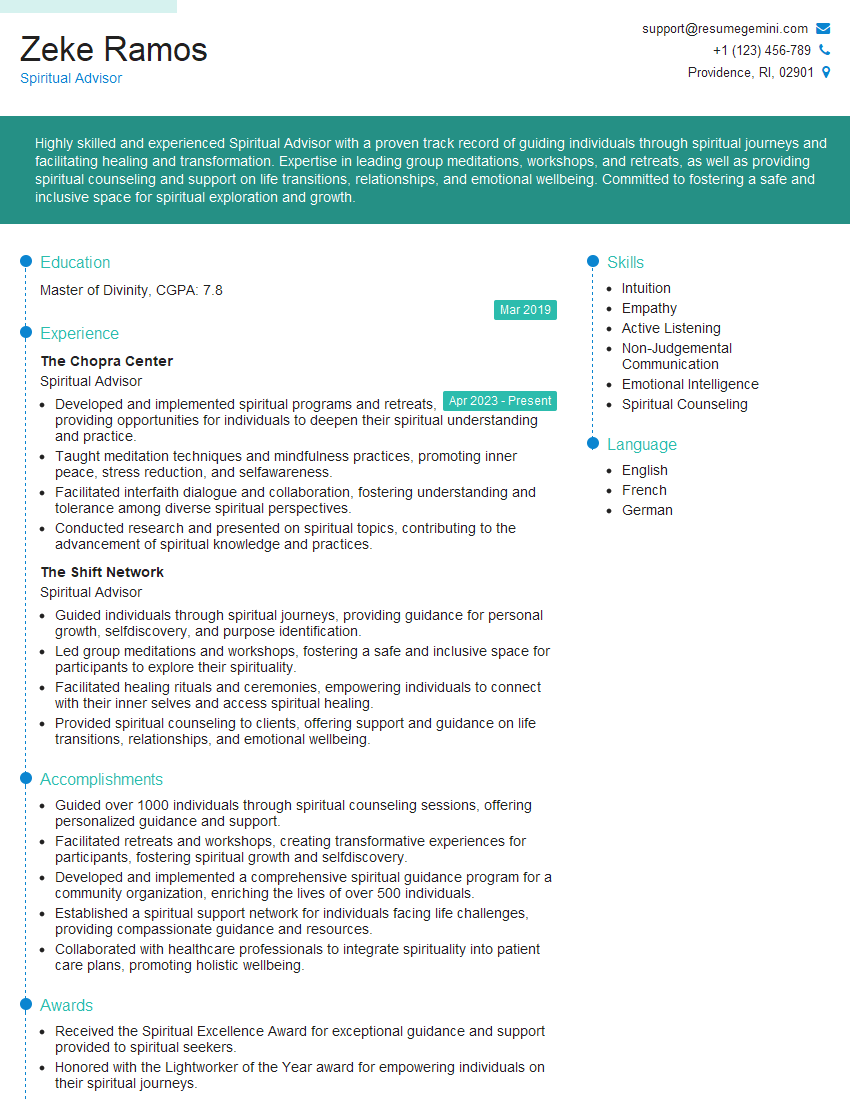
Mastering Tarot and Oracle card reading is a valuable skillset that opens doors to diverse career paths, from private practice to corporate wellness programs. To maximize your job prospects, creating a compelling and ATS-friendly resume is crucial. ResumeGemini is a trusted resource that can help you build a professional resume that effectively highlights your skills and experience. ResumeGemini provides examples of resumes tailored to the unique requirements of Experience in Tarot and Oracle Card Reading, ensuring your qualifications are presented in the most impactful way. Invest time in crafting a strong resume—it’s your first impression on potential employers.
Explore more articles
Users Rating of Our Blogs
Share Your Experience
We value your feedback! Please rate our content and share your thoughts (optional).
What Readers Say About Our Blog
Very informative content, great job.
good