Cracking a skill-specific interview, like one for Experience in writing songs for different vocal ranges and styles, requires understanding the nuances of the role. In this blog, we present the questions you’re most likely to encounter, along with insights into how to answer them effectively. Let’s ensure you’re ready to make a strong impression.
Questions Asked in Experience in writing songs for different vocal ranges and styles Interview
Q 1. Explain your process for adapting a song to suit different vocal ranges.
Adapting a song for different vocal ranges is a crucial aspect of songwriting. It’s not just about shifting the key; it’s about understanding the vocal tessitura (the comfortable range) of each vocalist and tailoring the melody, phrasing, and overall structure to suit their capabilities and strengths. My process involves several steps:
- Vocal Range Assessment: I start by identifying the singer’s comfortable range, both high and low notes. I’ll often ask for a recording or a live demonstration. Knowing their limitations is just as important as knowing their strengths.
- Key Transposition: The most straightforward adaptation is transposing the song to a key that comfortably sits within the vocalist’s range. Software like Logic Pro X or Sibelius makes this easy. For example, a song originally in C major might be transposed to D major or even G major for a higher-voiced singer, or A minor for a lower-voiced singer.
- Melodic Adjustment: Simple transposition might not suffice. Some notes might be outside the singer’s comfortable range, even in the new key. In those instances, I subtly adjust the melody, perhaps changing a high note to a more manageable one while retaining the musical phrasing and feel. This requires a deep understanding of music theory.
- Phrase Restructuring: Sometimes, the phrasing – how the melody is broken into smaller musical segments – needs adjustments. A long, high phrase might be broken into two shorter phrases for better breath control and vocal ease. This is particularly important for songs with extended notes or complex rhythms.
- Vocal Consideration: I also tailor the rhythm to accommodate the vocalist’s agility and vocal characteristics. A singer might be excellent at quick runs but struggle with sustained notes; a good song adjusts to these specifications.
For example, I once adapted a song originally written for a baritone to suit a soprano. This involved transposing the key significantly upwards, simplifying some melodic leaps, and re-phrasing several sections to accommodate the soprano’s vocal agility and breath support. The end result retained the song’s emotional essence while making it perfectly suitable for the soprano’s vocal abilities.
Q 2. Describe your experience writing songs for various musical genres.
My experience spans a wide range of musical genres, each requiring a unique approach to songwriting. I’ve written songs for:
- Pop: Pop songs often prioritize catchy melodies, relatable lyrics, and a strong, commercially viable structure. The vocal lines are usually designed to be accessible and singable by a wide audience, often emphasizing clear articulation and dynamic range.
- Folk: Folk music usually emphasizes storytelling and heartfelt lyrics. Vocal lines might be simpler, focusing on conveying emotion rather than intricate melodies. Acoustics guitars and simple instrumentation often set the tone.
- Jazz: Jazz songwriting frequently involves complex harmonies, improvisation, and a focus on skilled vocal delivery. I’ve written songs that incorporated scatting, rhythmic complexity and blues inflections.
- R&B: In R&B, I’ve focused on crafting soulful melodies, often with significant emphasis on rhythm, groove, and vocal ornamentation. There is more room for stylistic freedom and exploration of vocal textures.
- Classical: My foray into classical composition allowed me to work with extended vocal ranges, complex harmonies, and more formal musical structures.
The key is to understand the conventions of each genre and employ the suitable techniques. For instance, while a pop song might use simple harmonies and a straightforward structure, a jazz song could incorporate more complex chord progressions and improvisational elements.
Q 3. How do you incorporate vocal harmonies effectively into your songwriting?
Effective vocal harmonies enrich a song, adding depth and texture. My approach is to:
- Establish a Foundation: I start with a strong melody that serves as the basis for harmonies. The harmonies should complement the melody rather than overpower it.
- Harmony Selection: I use a variety of harmony types—thirds, fifths, octaves, and sevenths—to create interesting textures. The choice depends on the overall mood and style of the song. Close harmonies create intimacy while wider intervals create a sense of spaciousness.
- Part Writing: I carefully consider the vocal ranges of each harmony part, ensuring they’re comfortable for the singers. Each part should have its own melodic interest and not just be a simple repetition.
- Voicing and Arrangement: The way the harmonies are arranged—how they interact with each other and the melody—is crucial. I experiment with different voicings and arrangements to find the most effective sound. Sometimes, a countermelody will add even more depth.
- Dynamic Contrast: Introducing variations in dynamics — changes in volume—can greatly enhance the impact of harmonies. Some harmonies might be softer, some louder, building up to a powerful climax.
For example, in a recent project, I used close thirds and sixths to create a lush, intimate feel in the verses, then transitioned to wider intervals and octaves for a more powerful sound in the chorus. The careful layering of harmonies built the emotional impact of the song.
Q 4. What techniques do you employ to create memorable melodies across different vocal types?
Creating memorable melodies across different vocal types requires understanding the unique qualities of each voice type and tailoring the melody accordingly. I use several techniques:
- Consider Vocal Characteristics: A melody written for a bass voice will differ from one for a soprano. I consider factors like vocal weight, agility, and tessitura.
- Melodic Contour: The shape of the melody – its ups and downs – significantly influences memorability. A melody with a clear arc, with both ascent and descent, tends to be more memorable than a monotonous one.
- Intervallic Choices: The intervals (distances between notes) used in the melody also affect memorability. Smaller intervals are easier to sing, while larger intervals can add drama and excitement, but should be used judiciously.
- Rhythmic Variety: A melody that’s purely rhythmic can become monotonous. Combining different rhythmic patterns within the melody keeps it interesting.
- Repetition and Variation: Strategic repetition of melodic fragments, with slight variations, aids memorability. This is a common technique in pop music.
For instance, a melody for a powerful baritone might feature strong, stepwise motion with infrequent leaps, while a melody for a nimble soprano might incorporate more ornamentation and wider intervals.
Q 5. How do you ensure your lyrics are suitable for the chosen vocal range?
Ensuring lyrics are suitable for the chosen vocal range involves more than just fitting the words to the melody; it’s about considering the physical demands of singing the words. My approach includes:
- Syllable Count and Duration: I carefully count the syllables in each line and ensure they fit comfortably within the melodic phrasing. Long phrases might require fewer syllables, and short phrases might allow for more.
- Consonant Clusters: I avoid excessive consonant clusters (groups of consonants) as they can be difficult to pronounce while singing and may affect clarity. For instance, ‘strengths’ may be easier to replace with ‘power’ to improve vocal clarity.
- Vowel Sounds: The vowels used can impact the flow and ease of singing. I try to balance vowel sounds and avoid lengthy stretches of difficult vowel combinations.
- Stress and Emphasis: The placement of stress on certain words in the lyrics should align with the melody’s emphasis. I often adjust lyrics to suit the musical phrasing, and adjust the phrasing to better match the delivery of words.
For example, if I’m writing for a lower vocal range, I might choose words with fewer high vowels, or I may simplify complex phrasing to make it easier to pronounce.
Q 6. How do you account for vocal limitations when composing?
Accounting for vocal limitations is crucial in creating successful songs. This means understanding the singer’s strengths and weaknesses and writing the music to accentuate their strengths while minimizing the challenges posed by their limitations.
- Range Awareness: I avoid writing notes outside the singer’s comfortable range, or if unavoidable, I provide alternative phrasing and options. It’s far better to build a song around the vocalist’s capabilities rather than push them beyond their limits.
- Breath Control: I consider the singer’s breath control when constructing phrases. Long, sustained notes are only appropriate if the singer can comfortably sustain them. Phrasing should be designed to allow for natural breaks and breathing points.
- Agility and Technique: I understand the singer’s vocal agility and technique. Rapid runs and intricate vocalizations are only included if the singer has the necessary skill to execute them effectively. Often I’ll work closely with the singer to determine what their comfortable range of vocal agility is.
- Vocal Color and Tone: I’m always conscious of the singer’s vocal tone and color. I might adjust the melody to flatter their unique timbre. A song can be adapted to fit the vocalist’s overall sound.
For instance, if a singer struggles with high notes, I’ll avoid writing extensive passages in their upper register. Instead, I’ll focus on showcasing their lower register, where they are stronger, or I’ll creatively use vocal harmonies to supplement challenging notes.
Q 7. Describe your experience working with various vocalists.
Working with various vocalists has been a tremendously rewarding experience, providing invaluable insights into diverse vocal styles and techniques. Each vocalist brings a unique approach and vocal quality, demanding a tailored approach to songwriting.
- Collaboration: I believe in collaborative songwriting. I involve the vocalist in the process early on, understanding their strengths, preferences, and vocal capabilities. This allows for a piece that is both musically rewarding and vocally comfortable for them.
- Adaptability: I’ve learned to adapt my songwriting approach based on the individual singer’s style and abilities. A belter will require a different melodic approach than a vocalist known for their delicate phrasing.
- Understanding Vocal Textures: I’ve learned to appreciate the wide range of vocal textures and colours. Some voices are warm and resonant, others are bright and agile; my songwriting adapts to each unique quality.
- Learning and Growth: Each collaboration is a learning experience. It expands my understanding of vocal techniques and enhances my ability to write for different vocal types.
I’ve worked with everything from classically trained opera singers to soulful R&B vocalists. Each collaboration has shaped my approach, making me a more versatile and adaptable songwriter. The common thread is always mutual respect and a shared goal of creating exceptional music.
Q 8. How do you handle feedback from vocalists on your compositions?
Feedback from vocalists is crucial. I treat it as a collaborative process, not criticism. I listen actively, asking clarifying questions to understand their concerns. For instance, if a vocalist finds a phrase challenging, I might explore alternatives: simplifying the melody, adjusting the rhythm, or suggesting different phrasing. I value their input because they are the experts in their instrument. I aim for a balance between my artistic vision and the singer’s vocal capabilities.
My process involves documenting all feedback, noting the specific part of the song and the suggested changes. This record helps me analyze trends in the feedback and identify potential areas for improvement. I strive to find solutions that are mutually beneficial, ensuring both the musical integrity of the song and the vocalist’s comfort and expression.
Q 9. Discuss your approach to creating vocal arrangements that highlight the strengths of each singer.
Creating vocal arrangements that showcase each singer’s strengths begins with understanding their unique vocal qualities – range, timbre, strengths in specific registers (chest, head, mixed), and stylistic preferences. I conduct thorough discussions with each vocalist, often asking them to sing scales and riffs to identify their comfort zones and technical abilities. This enables me to tailor the vocal lines to best suit their capabilities.
For instance, if a vocalist excels in high notes, I’ll incorporate more soaring melodies in their sections. Conversely, if a vocalist has a rich, resonant low register, I’ll write passages to showcase this. I also consider blending voices; harmonizing sections can be especially effective in highlighting unique timbres, creating a rich textural tapestry.
Consider this example: A singer with a powerful belt voice might receive a powerful chorus melody, while a vocalist with a delicate tone would get a more nuanced verse line. The arrangement is a mosaic, each vocalist’s voice adding a unique colour to the overall picture.
Q 10. How do you choose the key and tempo of a song based on the vocalist’s capabilities?
Choosing the key and tempo involves a careful consideration of the vocalist’s range and comfort level. I begin by understanding their vocal range – the comfortable span between their highest and lowest notes. The key must be chosen so that the majority of the melody falls comfortably within this range, avoiding notes that strain or restrict the vocalist.
Tempo plays a significant role as well. A faster tempo might demand greater breath control and agility, while a slower tempo allows for more nuanced phrasing and emotional expression. The song’s overall mood also impacts tempo. I always prioritize comfort and vocal health, ensuring the chosen key and tempo don’t push the vocalist beyond their capabilities. A good rule of thumb is to err on the side of caution, starting slightly lower than what seems ideal to allow flexibility.
For example, if a vocalist’s comfortable range is from C3 to C5, I might avoid a key that pushes them into the very high or very low ends of their range, often opting for a key that keeps the melody primarily within the middle to upper-middle register.
Q 11. Explain your understanding of vocal tessitura and how it impacts your songwriting.
Vocal tessitura refers to the most comfortable range for a vocalist, the section of their range where their voice feels most natural and effortless. It’s not necessarily identical to their full range; it’s the area where they can produce tone with the least strain. Understanding tessitura is crucial for songwriting because writing melodies outside a vocalist’s tessitura can lead to vocal fatigue, strain, or even injury.
I always aim to keep the majority of the melody within the vocalist’s tessitura. I might strategically use notes outside their tessitura sparingly for emphasis or dramatic effect, but only for short periods. I visualize the tessitura as a sweet spot—an ideal zone where the vocalist can shine without undue vocal exertion. By focusing my compositions within this range, I create more expressive and effortless performance opportunities.
Q 12. Describe a time when you had to significantly revise a song to fit a specific vocal range.
I once wrote a song in a higher key, believing it would suit the song’s overall energy. However, the lead vocalist, a powerful but not exceptionally high-register singer, struggled to reach some of the higher notes consistently. While the original version sounded great to me, it wasn’t sustainable for the singer.
The solution required a significant revision. I lowered the key by a whole step, which immediately made the song more accessible. This involved adjusting several melodic passages and carefully re-harmonizing parts to maintain the song’s character. The revised version was significantly more comfortable for the vocalist, allowing for a more compelling and less strained performance. The result was that both the singer and the audience appreciated the song far more for its easier accessibility.
Q 13. How do you ensure your songs are both musically interesting and vocally accessible?
Balancing musical interest with vocal accessibility is a constant challenge. I approach this by thinking about melodic contour – the rise and fall of the melody. A melody that’s overly stepwise (moving only by small intervals) can be predictable, while a melody with large leaps can be difficult to sing and may not be pleasing to the ear. I search for a balance – incorporating some leaps for interest while maintaining singability.
I also pay close attention to rhythm. Intricate rhythms can be exciting, but excessive rhythmic complexity can strain a vocalist. Finding a balance between rhythmic interest and vocal comfort involves careful consideration of the melody and the singer’s capabilities. Ultimately, effective songwriting involves careful consideration of melody, harmony, rhythm, and the vocalist’s unique strengths to create a song that is both aesthetically pleasing and comfortably executable.
Q 14. How familiar are you with different vocal techniques (e.g., belting, head voice)?
I have a thorough understanding of various vocal techniques, including belting, head voice, mixed voice, and breath support. Knowing these techniques allows me to write parts that are both musically interesting and vocally achievable. For example, I wouldn’t write a high note requiring belting for a vocalist who doesn’t use that technique, instead, I’d opt for a more head-voiced approach or adjust the melody altogether.
My familiarity extends beyond simply knowing the names of the techniques; I understand their physical mechanics and how they affect vocal tone and quality. This understanding is crucial in creating melodies that are not only musically captivating but also physically achievable and safe for the vocalist. I also appreciate the stylistic nuances of each technique. I might choose a belting passage for a powerful, emotional climax or a softer head voice for intimacy and vulnerability.
Q 15. How do you use instrumentation to complement the vocal line?
Instrumentation is crucial for complementing a vocal line; it shouldn’t compete but enhance and support. Think of it as a conversation – the vocals are the lead, and the instruments are the supporting cast. I approach this by considering the vocal melody’s range, rhythm, and emotional content. For example, a soaring, powerful vocal melody might be complemented by strings building to a crescendo, while a delicate, intimate melody might be better served by sparse acoustic guitar or piano accompaniment.
Range: If a vocalist has a high range, I’ll avoid using instruments that occupy that same frequency space to prevent muddiness. I might use lower-register instruments like cello or bass to provide harmonic support. Conversely, a low vocal range might be enhanced with higher instruments like flute or strings to add brightness and texture.
Rhythm: The instrumentation can follow the vocal rhythm directly, mirroring the phrasing and accents, or it can create a counterpoint, adding rhythmic interest without distracting from the vocal line. A rhythmic guitar riff might complement a rhythmic vocal, while a more sustained instrumental part might underpin a more lyrical vocal.
Emotion: The instruments should evoke the same emotion as the vocal. A sad song might benefit from somber instrumentation like muted trumpets or cello, while a joyful song might use bright, upbeat instruments like horns or handclaps. Ultimately, it’s about creating a harmonious blend where each element supports and strengthens the other.
Career Expert Tips:
- Ace those interviews! Prepare effectively by reviewing the Top 50 Most Common Interview Questions on ResumeGemini.
- Navigate your job search with confidence! Explore a wide range of Career Tips on ResumeGemini. Learn about common challenges and recommendations to overcome them.
- Craft the perfect resume! Master the Art of Resume Writing with ResumeGemini’s guide. Showcase your unique qualifications and achievements effectively.
- Don’t miss out on holiday savings! Build your dream resume with ResumeGemini’s ATS optimized templates.
Q 16. How do you balance the needs of the vocalist with the overall musical structure of the song?
Balancing vocalist needs with overall song structure is a delicate art. I start by understanding the vocalist’s strengths and limitations – their range, tone, and vocal style. I’ll then write a melody and lyrics that suit their capabilities. This might involve adjusting the key, simplifying the phrasing, or writing in a style that highlights their strengths.
For example, if a vocalist struggles with high notes, I’ll avoid writing extended passages in their upper register. I’ll also consider the vocalist’s experience and comfort level. A less experienced vocalist might need simpler melodies and harmonies than a seasoned professional.
Simultaneously, I ensure the vocal line fits within the overall structure of the song. This involves crafting verses, choruses, and bridges that build upon each other dramatically and rhythmically. The vocal line becomes a key component of this structure, with its phrasing and dynamic variations helping to drive the song’s narrative forward.
Sometimes, this requires compromise. I may need to slightly alter a particularly challenging vocal line to better suit the song’s structure or the vocalist’s capabilities. The key is open communication and a willingness to collaborate.
Q 17. What software or tools do you use for arranging and composing music?
My primary tool is Logic Pro X, a powerful Digital Audio Workstation (DAW). It allows me to handle all aspects of composing, arranging, recording, and mixing. I also use various virtual instruments (VSTs) to create diverse soundscapes, ranging from realistic orchestral arrangements to synthesized textures. For notation, I sometimes use Sibelius, especially when collaborating with orchestral arrangers.
Beyond software, I rely heavily on high-quality studio monitors to ensure accurate sound reproduction during the entire process. I also use a variety of microphones depending on the vocal style and desired tone. Finally, a good pair of headphones is essential for detailed mixing and mastering.
Q 18. What is your preferred workflow for songwriting?
My workflow is iterative and often begins with a single melodic idea, lyric, or chord progression. I’ll explore these ideas using my DAW, experimenting with different instruments and arrangements. Sometimes I start with the melody, sometimes the lyrics, and other times it’s the chords that inspire the entire song. It really varies depending on the creative spark.
I typically move between composing and arranging, refining both the music and lyrics as the song takes shape. I’ll often record rough demos to get a better sense of the song’s flow and to identify areas that need further development. Collaboration with other musicians during this stage is often invaluable for fresh perspectives and feedback. Then comes the detailed production phase with arrangement, recording, mixing and mastering.
Q 19. How do you approach copyright and licensing issues related to your compositions?
Copyright and licensing are paramount. I register my compositions with the relevant copyright organizations (like ASCAP, BMI, or PRS) to protect my intellectual property. This establishes a clear record of my ownership. This protection extends to the musical composition, the lyrics, and any unique arrangements. I always get written agreements when licensing my work to others.
When licensing my songs, I carefully consider the intended use and negotiate fair compensation, making sure to clearly define the scope of the license – who can use the song, how it can be used, and for how long. It’s important to consult legal professionals with expertise in music copyright and licensing to ensure compliance and protect your rights.
Q 20. Describe your experience collaborating with other musicians or producers.
Collaboration is a vital part of my process. I’ve worked with various musicians and producers, including vocalists, instrumentalists, and engineers. These collaborations often involve co-writing, co-producing, or simply sharing expertise and feedback. I find that diverse perspectives can enrich the creative process and lead to innovative solutions. For example, working with a skilled guitarist might lead to an unexpected instrumental break that adds depth and texture to the song.
Successful collaborations rely on open communication, mutual respect, and a shared vision. I find that setting clear expectations early on, defining individual roles and responsibilities, and maintaining regular communication can prevent misunderstandings and conflicts.
Q 21. Describe your process for generating initial ideas and developing them into complete songs.
Idea generation is a multifaceted process. Sometimes, ideas come spontaneously – a melody might pop into my head while showering, or a lyric might be inspired by a conversation. Other times, I actively seek inspiration, listening to music, reading, or engaging in other creative activities. I keep a notebook and recording device handy to capture fleeting ideas.
Once I have an initial idea, I develop it through experimentation. I’ll try different chord progressions, melodies, rhythms, and lyrics, continually refining the song until it feels complete and cohesive. I might use different software tools to help in this exploration – creating different arrangement variations, experimenting with different instrumentation, and adjusting the tempo or key.
This process is often non-linear. I might work on the chorus before the verse, or switch back and forth between lyrics and music. The key is to allow the song to evolve organically, following the creative flow. Feedback from others is crucial in this phase, helping me identify areas that need improvement and refine the song’s overall impact.
Q 22. How do you evaluate the effectiveness of a song’s arrangement?
Evaluating a song’s arrangement effectiveness is multifaceted and involves considering its impact on the overall emotional arc and aesthetic appeal of the piece. It’s not just about the technical aspects; it’s about how well the arrangement complements the song’s core elements, such as the lyrics, melody, and the vocalist’s unique qualities.
- Emotional Impact: Does the arrangement enhance the song’s emotional journey? Does it build tension effectively, create moments of release, and ultimately leave the listener feeling satisfied? For instance, a ballad might build slowly with layered instrumentation, culminating in a powerful chorus, while an upbeat pop song might utilize a driving beat and catchy hooks.
- Balance and Clarity: Is the mix balanced? Can each instrument and vocal be heard clearly without muddiness? A well-arranged song ensures that all parts contribute without overwhelming each other.
- Creativity and Originality: Does the arrangement showcase unique ideas or textures? Does it feel fresh and compelling, or does it sound overly derivative?
- Suitability to the Style: Does the arrangement complement the genre and style of the song? A complex jazz arrangement would sound out of place on a simple folk song, and vice versa.
- Dynamic Range: Does the arrangement utilize dynamics effectively, contrasting quiet sections with loud ones to keep the listener engaged?
I personally evaluate arrangements by listening critically, identifying sections that work well and areas that could be improved. I often collaborate with producers and arrangers to refine the arrangement, making sure it effectively conveys the song’s message and artistic intent.
Q 23. What are some common challenges you encounter when writing for different vocal ranges, and how do you overcome them?
Writing for different vocal ranges presents unique challenges. A melody comfortable for a baritone might be impossible for a soprano, and vice-versa. The key is to understand the vocal capabilities and limitations of each range.
- Range and Tessitura: The most significant challenge is adapting the melodic contour to the singer’s comfortable range. Tessitura, the range where the vocalist feels most comfortable singing, needs careful consideration. For example, a melody written high for a soprano might require significant rewriting to suit an alto, possibly lowering the entire melody or rewriting certain sections to remain within their comfortable tessitura.
- Vocal Timbre: The vocal timbre, the unique quality of a voice, affects how a melody sits. A rich baritone voice might suit a low and resonant melody, while a bright soprano might need a lighter, more agile melody. I take the time to study the vocalist’s vocal strengths and find ways to leverage those traits in the melody.
- Vocal Agility: Some voices are more agile than others. A melody with wide leaps might be challenging for a less agile voice. I address this by adjusting the intervallic leaps, ensuring that the vocal line remains singable and natural.
I overcome these challenges through careful consideration of the vocalist’s capabilities during the compositional process. I often engage in direct communication with the vocalist to ensure that the final melody aligns with their vocal capabilities. I might record a basic demo of the melody and get feedback on the feel and comfort level.
Q 24. What is your approach to writing songs that are both emotionally resonant and technically proficient?
Balancing emotional resonance and technical proficiency is crucial in songwriting. A technically perfect song lacking emotional depth can feel sterile, while an emotionally powerful song with poor technical execution can sound amateurish. Both are essential for a captivating musical experience.
My approach involves a multi-step process:
- Emotional Core First: I begin by defining the emotional core of the song. What feeling or story am I trying to convey? What kind of mood or atmosphere should the song evoke? This establishes a strong foundation.
- Melodic and Harmonic Exploration: Once the emotional direction is clear, I experiment with melodies and harmonies that reflect that emotion. A melancholic song might use minor keys and descending melodies, while a joyful song could use major keys and uplifting melodic lines.
- Lyrical Crafting: Lyrics are vital for conveying the emotion. I focus on creating lyrics that resonate with the emotional core and complement the melody and harmony.
- Structural Integrity: The song’s structure (verse-chorus-bridge) should be carefully planned to effectively deliver the emotional arc. A song’s structure influences its emotional impact as much as the lyrics and melody do.
- Technical Refinement: Finally, I focus on refining the technical aspects – ensuring that the melody is singable, the harmony is functional, and the arrangement is well-balanced.
For example, in writing a ballad about loss, I might use a minor key, a slow tempo, and a simple, repetitive melodic line that enhances the sense of longing and sadness.
Q 25. How do you stay updated on current trends in music and songwriting?
Staying updated in the ever-evolving music industry is crucial. I employ a multi-pronged approach:
- Active Listening: I actively listen to a wide range of artists and genres, paying attention to both chart-topping hits and independent releases. This helps me understand evolving trends in production, instrumentation, and lyrical styles.
- Industry Publications and Blogs: I follow music blogs, magazines, and online publications dedicated to music analysis and trends. These sources often provide insights into emerging sounds and creative approaches.
- Live Music Attendance: Attending live concerts and festivals exposes me to artists’ performances and stagecraft, inspiring new ideas and approaches.
- Networking and Collaboration: I collaborate with other songwriters and producers, exchanging ideas and staying informed about current projects and trends.
- Online Courses and Workshops: Online resources like Masterclass or Coursera provide opportunities to deepen my knowledge of specific aspects of music production and songwriting.
Continuous learning and adaptation are paramount in the music industry. Staying curious and open to new ideas keeps my songwriting fresh and relevant.
Q 26. How do you adapt your songwriting style based on the desired mood or message of the song?
Adapting my songwriting style to suit a specific mood or message requires a conscious effort to control various elements.
- Key and Mode: Major keys generally evoke happiness and optimism, while minor keys often convey sadness or introspection. Mode (e.g., Dorian, Phrygian) adds further nuances to the emotional palette.
- Tempo and Rhythm: A fast tempo and driving rhythm usually translate to energy and excitement, while a slow tempo and gentle rhythm might evoke calmness or melancholy. The rhythmic patterns themselves can impact the emotional feel—a syncopated rhythm might feel more urgent or edgy.
- Instrumentation and Arrangement: The choice of instruments significantly impacts the mood. A string section can create a lush, romantic feel, whereas a distorted guitar might add grit and aggression. The arrangement’s structure and dynamics also play a key role.
- Melody and Harmony: The melodic contour—ascending or descending, stepwise or with wide leaps—affects the emotional impact. Harmonies can range from consonant and peaceful to dissonant and unsettling.
- Lyrics and Imagery: The language used and imagery evoked directly shape the song’s emotional and thematic content. Metaphors, similes, and figurative language can paint vivid pictures and create specific emotional responses.
For example, to create a song expressing anger, I would likely use a minor key, a fast tempo, distorted guitars, and lyrics with aggressive imagery.
Q 27. Describe a time you had to write a song under tight deadlines or with limited resources.
I once had to write a song for a commercial with a deadline of just three days. The client only provided a basic concept – a joyful tune for a children’s product – and a very limited budget meant no professional studio recording.
My solution was to prioritize efficiency and simplicity:
- Quick Brainstorming: I spent the first day brainstorming basic melodies, harmonies, and lyrical ideas. I prioritized simple, memorable melodies suitable for children.
- DIY Recording: I used my home recording equipment, focusing on a clean and clear sound rather than complex production. This minimized recording time.
- Minimal Instrumentation: To maintain simplicity, I limited instrumentation to acoustic guitar and vocals, focusing on crafting a catchy melody and lyrical hook. Less production meant a faster workflow.
- Prioritize Core Elements: I focused on getting the core elements of the song—melody, lyrics, basic harmony—right first, before adding any embellishments. This ensured that the song’s essence was captured even with the time constraint.
- Iterative Feedback: I sent the rough version to the client for feedback during the process, enabling rapid adjustments and revisions.
Though challenging, the experience highlighted the importance of flexibility, resourceful problem-solving, and effective communication when working under tight deadlines and with limited resources. The final product was well-received and demonstrated that a captivating song doesn’t necessarily require an extensive budget or an unlimited timeframe.
Q 28. How do you ensure the vocal melody is both singable and musically compelling?
Creating a vocal melody that’s both singable and musically compelling requires a delicate balance. A melody that’s too simple might be singable but uninspired, while a melody that’s too complex might be musically interesting but impossible to sing.
My approach integrates several considerations:
- Vocal Range and Tessitura: The melody must comfortably reside within the vocalist’s range, and ideally, within their tessitura for optimal comfort and expressiveness. I always start by understanding the singer’s strengths and limitations.
- Intervallic Jumps: Avoid large, jarring intervallic jumps, particularly for less agile voices. Preferably, use smaller intervals and stepwise motion to create a smooth and flowing melody.
- Phrasing and Rhythm: Incorporate natural phrasing, allowing the melody to breathe and reflect the rhythm and meaning of the lyrics. This creates a more lyrical and engaging experience.
- Musical Interest: Incorporate melodic motifs, repetition, variation, and other musical devices to create interest and memorability without sacrificing singability. A good melody will have a sense of direction and narrative.
- Vocal Style: Tailor the melody to the singer’s vocal style. A blues singer might require a more soulful and expressive melody compared to a pop singer who may need a more catchy and repetitive one.
- Collaboration: Working closely with the vocalist is crucial. I encourage singers to provide feedback during the melody creation process, ensuring that it feels natural and comfortable for them to perform. This iterative process optimizes the melody for both musicality and singability.
For example, I might begin with a simple, memorable phrase and then add variations or embellishments to maintain interest, always keeping the singer’s vocal capabilities in mind. The final melody should be both pleasing to the ear and effortless for the singer to execute.
Key Topics to Learn for Experience in writing songs for different vocal ranges and styles Interview
- Understanding Vocal Ranges: Learn the characteristics of different vocal ranges (soprano, alto, tenor, bass, baritone) and how they impact melody writing and harmonic choices.
- Vocal Style & Genre Matching: Explore the relationship between vocal styles (e.g., belting, breathy, operatic) and musical genres. Practice tailoring your songwriting approach to complement specific styles.
- Melody Construction for Different Ranges: Develop techniques for crafting melodies that are comfortable and expressive within various vocal ranges, avoiding awkward leaps or notes outside the singer’s capabilities.
- Harmonic Adaptation: Understand how to adjust chord progressions and voicings to best suit a particular vocal range and enhance the overall sonic experience.
- Lyrical Sensitivity: Practice writing lyrics that are both poetically compelling and vocally manageable for different voice types. Consider phrasing, syllable count, and breath support.
- Practical Application: Prepare examples of your work showcasing your ability to write songs for diverse vocal ranges and styles. Be ready to discuss your creative process and the decisions you made in each case.
- Problem-Solving: Be prepared to discuss challenges faced when writing for different vocalists and how you overcame them (e.g., adapting a melody for a lower register, simplifying complex harmonies).
- Collaboration & Communication: Discuss your experience collaborating with singers and how you effectively communicate your musical vision to achieve the desired outcome.
Next Steps
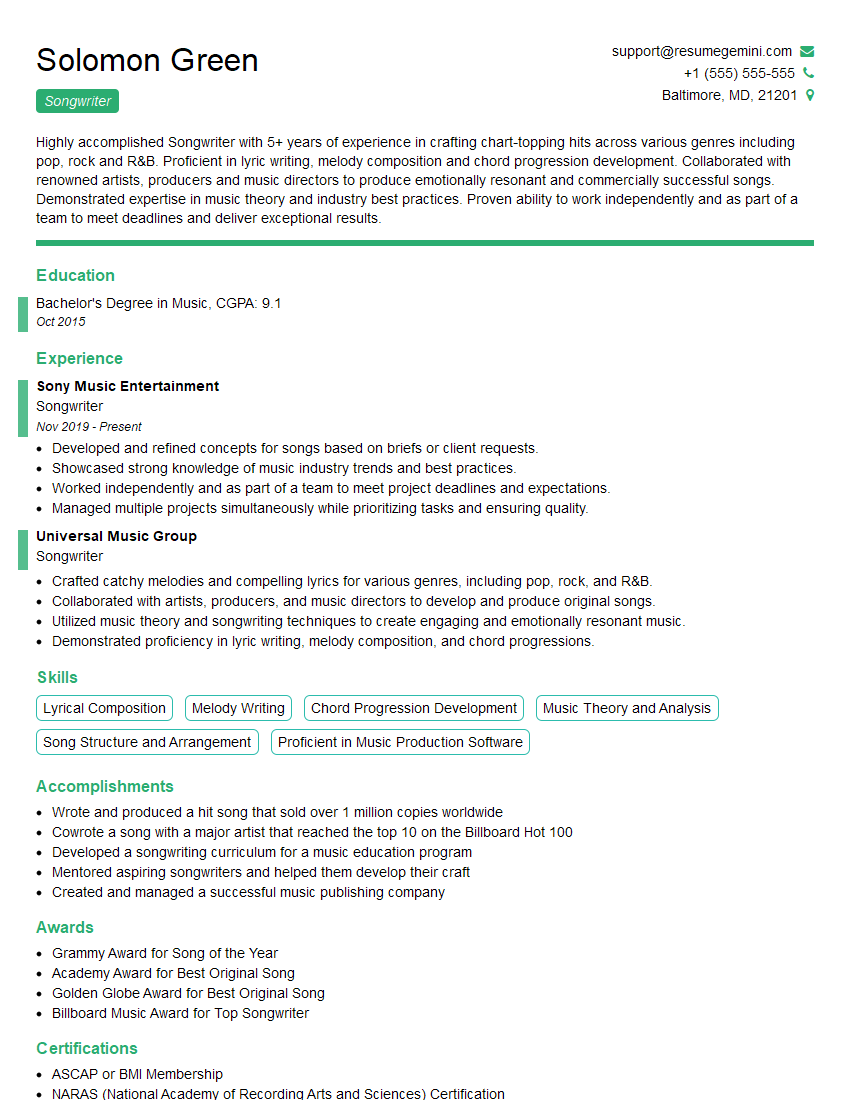
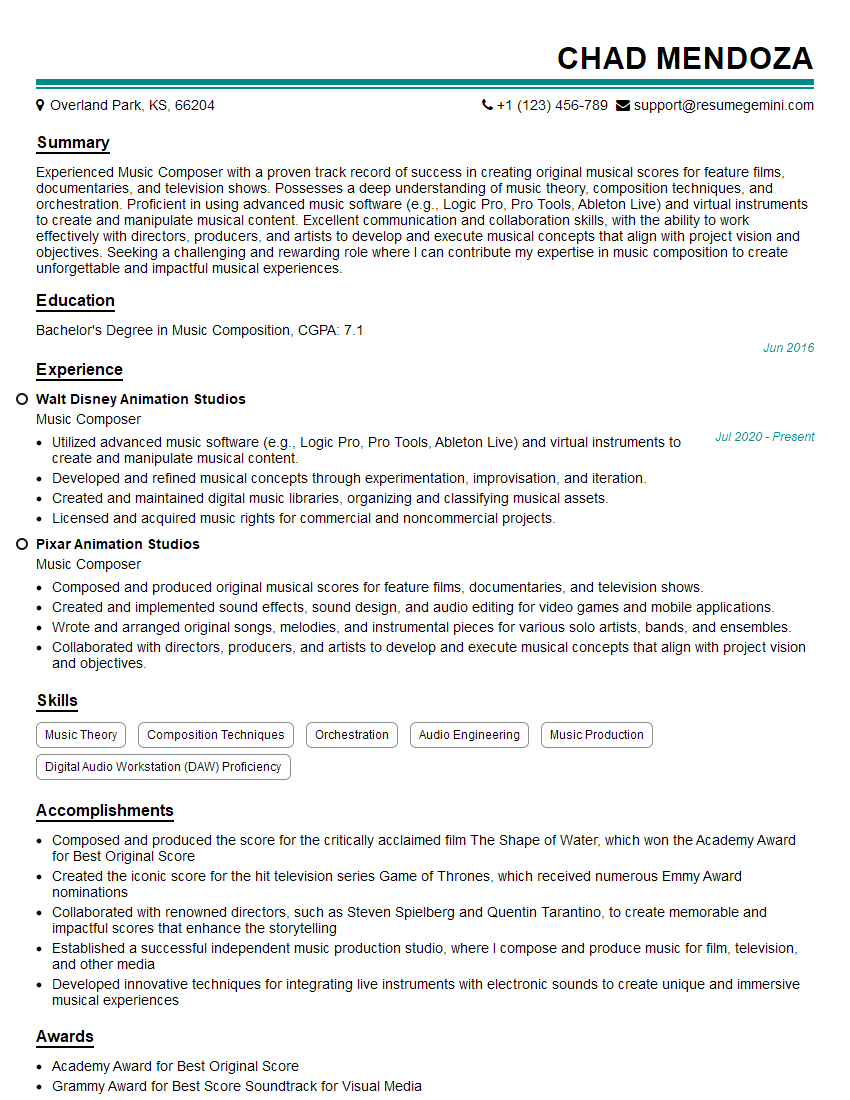
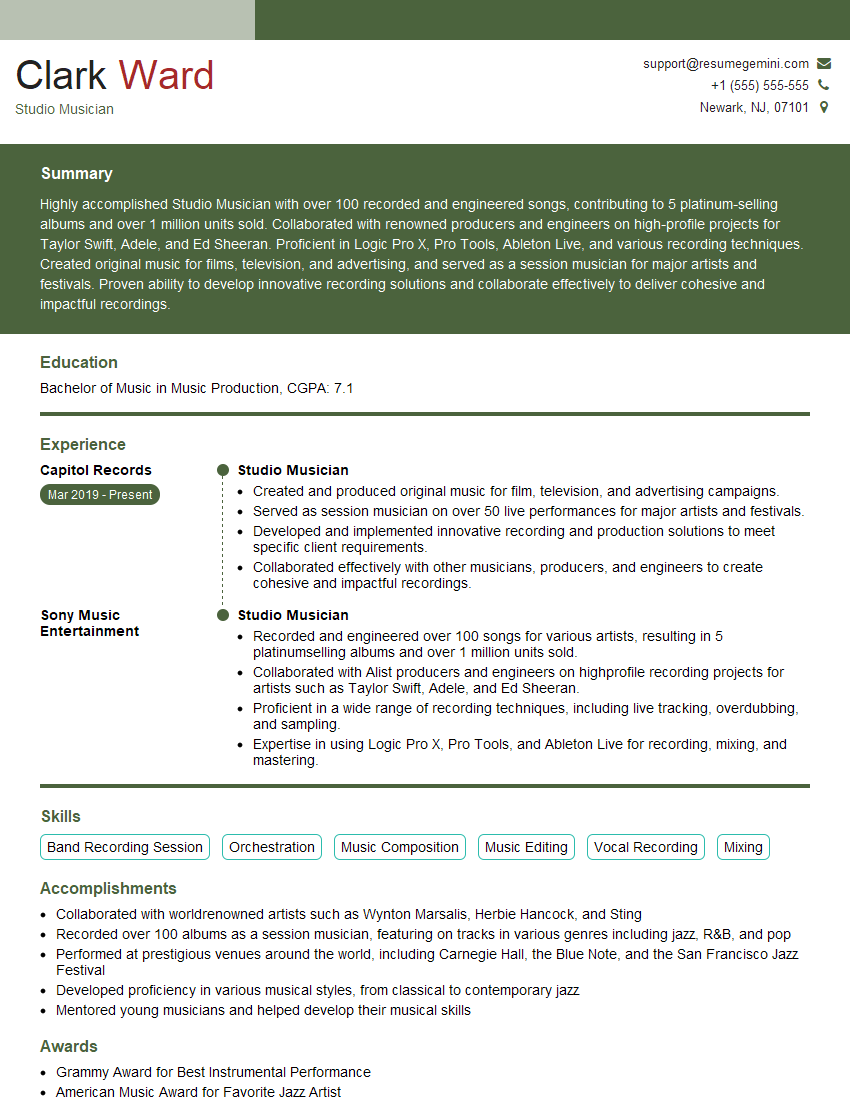
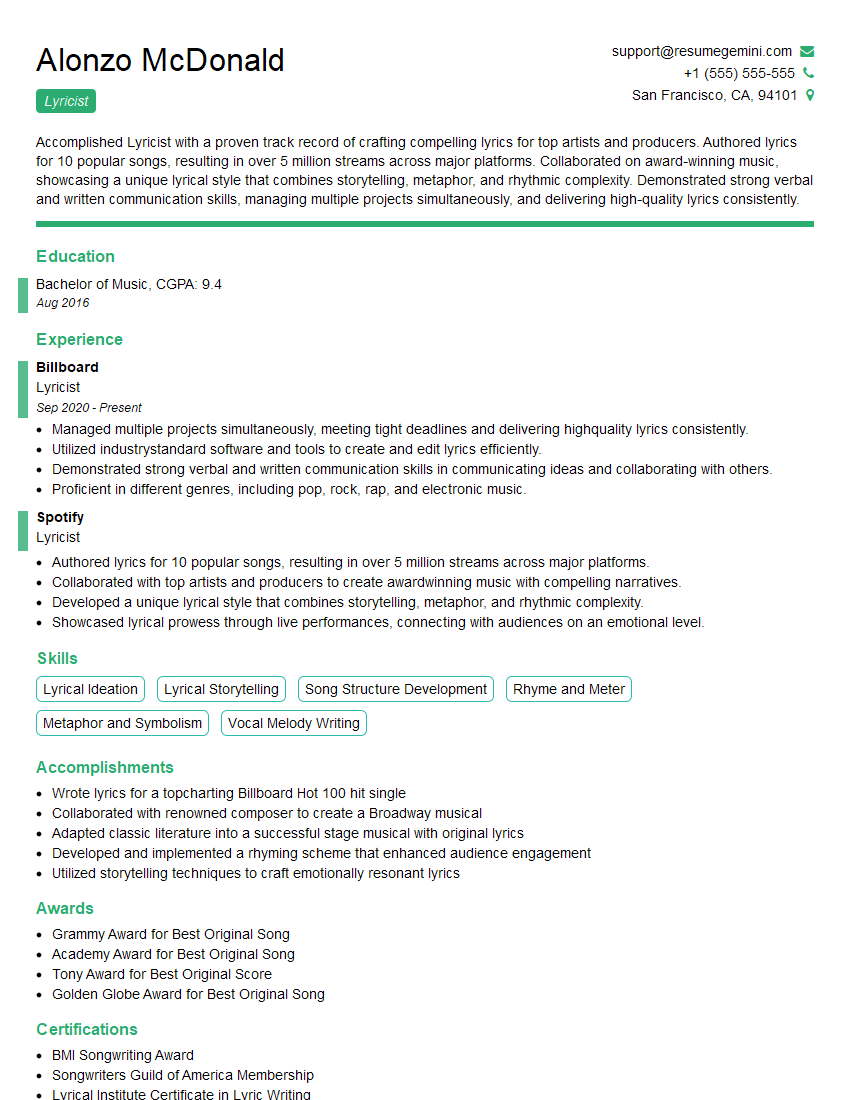
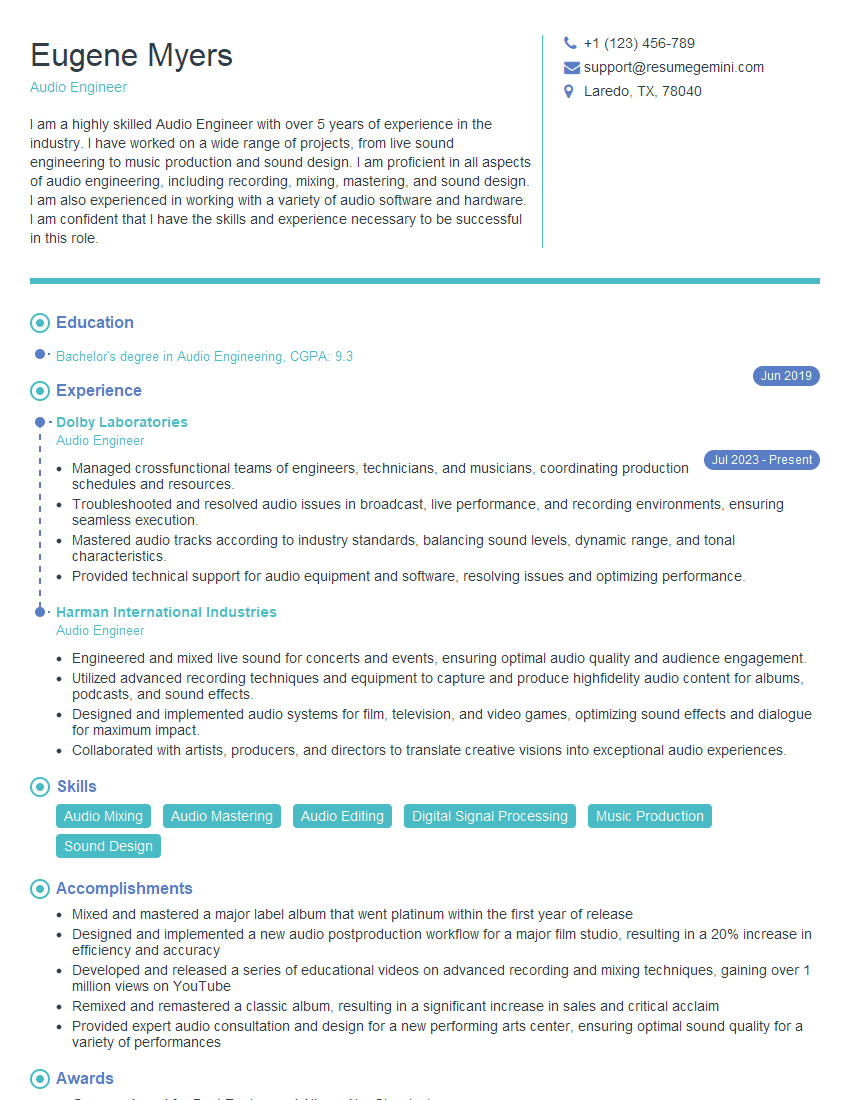
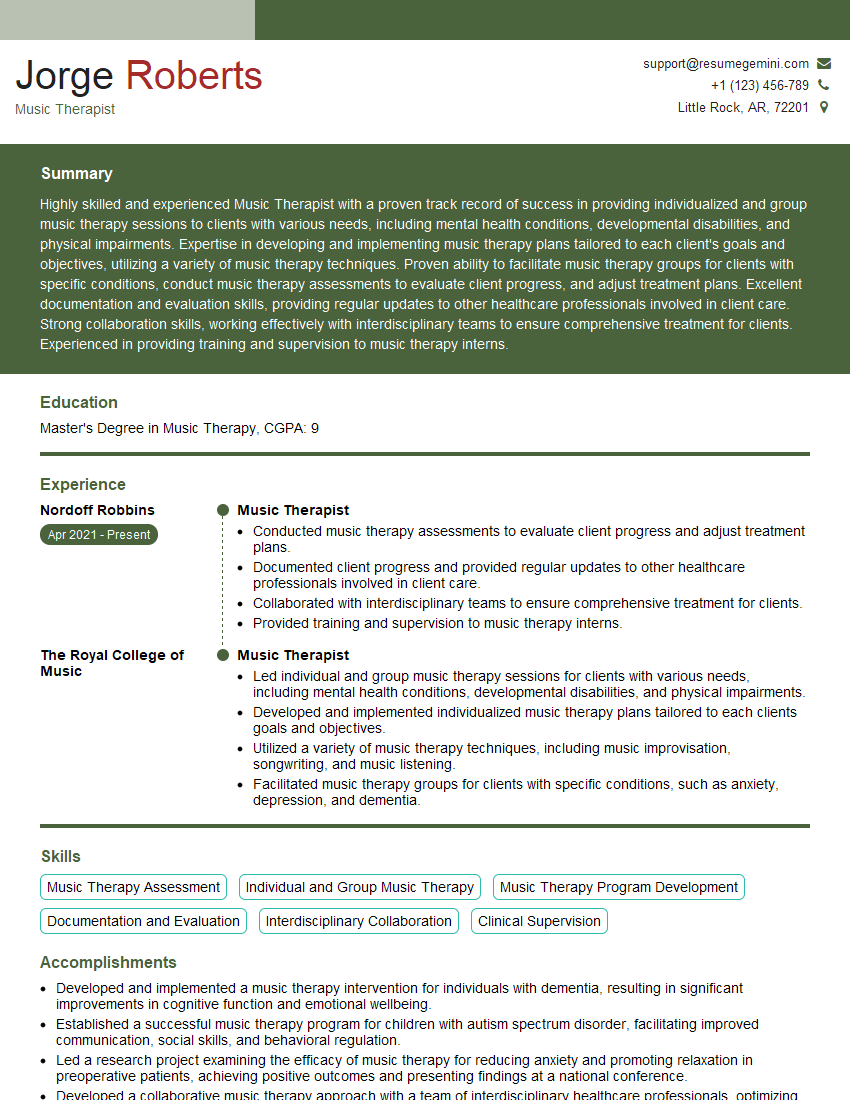
Mastering the art of songwriting for diverse vocal ranges and styles significantly enhances your marketability and opens doors to a wider range of opportunities. A strong, ATS-friendly resume is crucial for showcasing your skills effectively. Use ResumeGemini to create a professional resume that highlights your unique abilities and gets you noticed. ResumeGemini provides examples of resumes tailored to showcase experience in writing songs for different vocal ranges and styles, making the process simpler and more efficient. Invest the time in crafting a compelling narrative of your expertise – it’s an investment in your future career success.
Explore more articles
Users Rating of Our Blogs
Share Your Experience
We value your feedback! Please rate our content and share your thoughts (optional).
What Readers Say About Our Blog
Very informative content, great job.
good