Preparation is the key to success in any interview. In this post, we’ll explore crucial Experience with Buttonhole Reinforcement and Finishing Techniques interview questions and equip you with strategies to craft impactful answers. Whether you’re a beginner or a pro, these tips will elevate your preparation.
Questions Asked in Experience with Buttonhole Reinforcement and Finishing Techniques Interview
Q 1. Describe the different methods for reinforcing buttonholes.
Reinforcing buttonholes is crucial for durability. The goal is to prevent stretching and tearing, ensuring the buttonhole withstands repeated use. Several methods achieve this, each with its strengths and weaknesses:
- Bar Tacking: This involves creating multiple rows of dense stitching at each end of the buttonhole. It’s the most common and effective method, providing robust reinforcement. Think of it as anchoring the buttonhole to the fabric.
- Seam Binding: A strip of sturdy fabric, like twill tape, is stitched around the buttonhole’s edge before stitching the buttonhole itself. This adds extra layers of protection and prevents fraying.
- Interfacing: Applying a piece of fusible or sew-in interfacing behind the buttonhole area significantly strengthens the fabric. This is particularly helpful with delicate or lightweight materials.
- Reinforcing Stitching: Employing a denser stitch type, like a zig-zag or satin stitch, along the buttonhole’s edges can offer some reinforcement. However, it’s generally less effective than bar tacking or seam binding.
The best method depends on the fabric, the buttonhole type, and the desired level of reinforcement.
Q 2. What types of fabrics require specialized buttonhole reinforcement?
Certain fabrics are prone to stretching or fraying, requiring specialized buttonhole reinforcement. These include:
- Lightweight fabrics: Silk, chiffon, and voile require extra support to prevent the buttonhole from pulling out. Interfacing and seam binding are excellent choices.
- Knits: Knit fabrics have elasticity; reinforced buttonholes prevent stretching and distortion. Bar tacks are essential here.
- Woven fabrics with loose weaves: Linen and loosely woven cotton tend to fray easily. Seam binding provides a neat and durable finish, preventing fraying.
- Thick fabrics: Heavy denim or upholstery fabrics may need larger bar tacks or multiple layers of reinforcement to adequately secure the buttonhole.
Ignoring the fabric’s characteristics can lead to unsatisfactory results, necessitating careful consideration of the reinforcement technique.
Q 3. Explain the process of creating a bar tack on a buttonhole.
Creating a bar tack involves sewing multiple short, dense stitches at the buttonhole’s ends. This effectively locks the stitches together, providing strong reinforcement. Here’s the process:
- Position the needle at the buttonhole’s end.
- Sew several short stitches in one spot, overlapping slightly.
- Reverse the stitching, creating a dense cluster of stitches.
- Repeat steps 2 and 3 several times to build up a strong bar tack.
- Secure the threads by locking the stitch.
The number of stitches in a bar tack depends on the fabric’s weight and the buttonhole’s size. A larger buttonhole or heavier fabric might require a wider and denser bar tack.
Q 4. How do you prevent buttonholes from stretching or fraying?
Preventing buttonhole stretching and fraying requires a multi-pronged approach:
- Proper Reinforcement: As discussed earlier, robust reinforcement methods like bar tacking and seam binding are paramount.
- Appropriate Stitch Selection: Choose a stitch type that is suitable for the fabric. A zig-zag stitch can be effective for preventing fraying.
- Correct Tension: Proper tension ensures even stitching, preventing skipped stitches that can lead to fraying.
- Sharp Needles: A dull needle can cause skipped stitches and damage the fabric, leading to fraying. Use a needle appropriate for the fabric type.
- Fabric Preparation: Pre-treating the fabric with a stabilizer can reduce fraying, especially in delicate or loosely woven fabrics.
- Finishing Techniques: Neatly finishing the edges of the buttonhole, perhaps with a pinking shears or a serger, helps to prevent fraying.
Addressing these aspects proactively ensures buttonholes remain sturdy and presentable over time.
Q 5. What are the common causes of buttonhole defects and how do you rectify them?
Common buttonhole defects stem from several causes. Here are a few, along with their solutions:
- Uneven Stitching: Caused by inconsistent tension or a dull needle. Solution: Adjust tension, replace the needle.
- Skipped Stitches: Result from improper needle selection or tension. Solution: Use the correct needle type and adjust the tension.
- Fraying: Occurs due to lack of reinforcement or using a fabric prone to fraying. Solution: Implement appropriate reinforcement techniques, like seam binding or bar tacking; use fabric stabilizers.
- Stretching: Caused by insufficient reinforcement, especially in knit fabrics. Solution: Use bar tacks and consider using interfacing.
- Broken Stitches: Due to using a dull needle or incorrect needle for the fabric weight. Solution: Use a sharp needle appropriate for the fabric.
Careful planning, execution, and attention to detail are key to avoiding these defects.
Q 6. Discuss the importance of proper tension settings for buttonhole stitching.
Proper tension settings are critical for creating strong and aesthetically pleasing buttonholes. Incorrect tension leads to several problems:
- Loose Stitches: Low tension results in weak and easily damaged buttonholes.
- Tight Stitches: High tension can cause puckering, skipped stitches, and needle breakage.
- Uneven Stitching: Inconsistent tension creates an uneven appearance and weakens the buttonhole.
The optimal tension setting varies depending on the fabric weight and type of thread used. Experimentation on a scrap piece of fabric is crucial to find the perfect setting for your specific situation. This ensures strong, even stitches that provide maximum reinforcement without causing fabric damage.
Q 7. What are your preferred methods for finishing buttonholes?
My preferred buttonhole finishing methods depend on the project and fabric. However, I find these techniques particularly effective:
- Clean Finishing with Seam Ripper: Carefully removing any excess threads from the buttonhole gives a polished, professional look.
- Neat Edge Treatment: Using pinking shears to trim the buttonhole edges, especially on fabrics that fray easily, prevents unraveling.
- Whipped Stitches: For a truly luxurious finish, I often use a decorative whipped stitch around the buttonhole’s edge. It adds elegance and further reinforcement.
- Using a Buttonhole Foot: A buttonhole foot, paired with a suitable stitch on your sewing machine, will help create consistent and beautifully finished buttonholes.
The finishing technique should complement the overall garment, ensuring a harmonious and durable outcome. It’s the final touch that transforms a functional buttonhole into a beautiful detail.
Q 8. How do you choose the appropriate stitch length and type for different fabrics?
Choosing the right stitch length and type for buttonhole reinforcement depends heavily on the fabric’s weight, weave, and fiber content. Think of it like choosing the right tool for a job – a delicate silk blouse needs a different approach than a sturdy denim jacket.
- Lightweight fabrics (silk, chiffon): Require a short stitch length (10-12 stitches per inch) and a fine, flexible stitch type like a straight stitch or a very narrow zigzag. Too long a stitch will pull the fabric and damage the delicate fibers. A delicate zigzag adds a little more strength without being too bulky.
- Medium-weight fabrics (cotton, linen): Can tolerate a slightly longer stitch length (8-10 stitches per inch) and still benefit from a straight stitch or a slightly wider zigzag. This provides sufficient strength without excessive bulk.
- Heavyweight fabrics (denim, canvas): Need a longer stitch length (6-8 stitches per inch) and a strong stitch like a straight stitch. A wider zigzag can be used for added durability, but may need to be reinforced with additional hand stitching on very heavy fabrics.
Experimenting with stitch samples on scrap fabric before working on the garment is crucial to finding the optimal settings for each project.
Q 9. Explain the differences between hand-finished and machine-finished buttonholes.
Hand-finished and machine-finished buttonholes offer distinct advantages and disadvantages. Hand-finishing provides unparalleled control and customization, while machine-finishing offers speed and consistency.
- Hand-finished buttonholes: Offer superior durability and aesthetics, especially on delicate fabrics. The stitches are meticulously placed, ensuring a flawless, even finish. Techniques like bound buttonholes create incredibly strong and beautiful results. However, they are time-consuming.
- Machine-finished buttonholes: Are faster and generally consistent, making them ideal for mass production or when time is a factor. Modern machines offer a variety of stitch options for different fabric types. However, the stitching might be less robust and require additional reinforcement, especially on heavier fabrics. There’s less flexibility to create unique buttonhole shapes and styles.
The choice often depends on the garment’s requirements, the desired level of quality, and the available time and resources. A high-end tailor might always opt for hand-finishing, while a mass-production facility would primarily use machines.
Q 10. Describe your experience with different types of buttonhole stitches (e.g., keyhole, bound).
I have extensive experience with various buttonhole stitches, each suited to different fabrics and aesthetics.
- Keyhole buttonholes: Are worked from the center outwards, creating an elongated shape often used on tailored garments. Their strength lies in the overlapping stitches, making them resistant to wear and tear. The keyhole shape allows for easy button insertion.
- Bound buttonholes: Involve creating a fabric loop around a slit. This technique results in an exceptionally strong and durable buttonhole, often seen in high-quality garments. It’s particularly effective with heavier fabrics, offering clean, neat edges that resist fraying.
- Worked buttonholes: These are made using different decorative stitches like blanket stitch or buttonhole stitch. These stitches can be highly decorative and add an element of design to the garment. The stitch choice is dictated by the fabric and the desired aesthetic.
Selecting the appropriate stitch depends on the fabric weight, the desired aesthetic, and the garment’s overall design. For example, a keyhole buttonhole might be appropriate for a tailored blazer, while a bound buttonhole would suit a heavier winter coat.
Q 11. What are the benefits of using interfacing or stay tape in buttonhole reinforcement?
Interfacing and stay tape are essential for reinforcing buttonholes, providing stability and preventing stretching or distortion. Imagine trying to build a house without a strong foundation – it wouldn’t stand! These materials act as that foundation for buttonholes.
- Interfacing: Provides a stable base beneath the buttonhole, preventing it from stretching or tearing. It’s especially important for lightweight fabrics. Choosing the correct interfacing weight is critical – too stiff can cause puckering.
- Stay tape: Is a narrow strip of stiff fabric used to reinforce the buttonhole edges, particularly useful for curved buttonholes or those on lightweight, delicate fabrics. It prevents fraying and keeps the edges crisp.
The choice between interfacing and stay tape often depends on the fabric and buttonhole style. For example, a bound buttonhole might utilize stay tape, whereas a machine-made buttonhole on a medium weight fabric might only need interfacing.
Q 12. How do you assess the quality of a finished buttonhole?
Assessing the quality of a finished buttonhole involves a meticulous inspection focusing on several key aspects.
- Evenness of Stitches: Stitches should be consistently spaced and of uniform length. Inconsistent stitching indicates potential machine malfunctions or operator error.
- Clean Edges: The edges of the buttonhole should be neat and clean, with no fraying or loose threads. This indicates proper preparation and finishing techniques.
- Strength and Durability: The buttonhole should be strong enough to withstand repeated use. Gently tugging on the buttonhole should reveal no weaknesses or signs of tearing.
- Alignment and Symmetry: The buttonhole should be perfectly aligned and symmetrical, particularly important for tailored garments. Asymmetry indicates a lack of precision.
By carefully examining these aspects, you can ensure that the buttonhole meets professional standards and will provide long-lasting performance.
Q 13. Describe your experience with troubleshooting buttonhole problems on various sewing machines.
Troubleshooting buttonhole issues on sewing machines requires a systematic approach. I’ve encountered various problems, ranging from improper tension to faulty machine parts. My experience encompasses diagnosing the root cause and implementing effective solutions.
- Skipped stitches: This often points to improper needle/thread combination, incorrect tension, or a dull needle. I’d check each of these aspects, adjusting tension or changing the needle as needed.
- Uneven stitching: Could indicate inconsistent feed dogs, improper needle placement, or a damaged presser foot. A careful inspection of these parts is usually necessary.
- Buttonhole too tight/loose: Could be due to incorrect machine settings related to stitch length and width. Adjustment of the machine settings might resolve this issue.
A thorough understanding of your sewing machine’s manual and the ability to perform basic maintenance are essential skills for effectively troubleshooting buttonhole problems.
Q 14. How do you handle variations in fabric weight and thickness when reinforcing buttonholes?
Handling variations in fabric weight and thickness when reinforcing buttonholes requires adapting techniques to ensure durability and a neat finish. It’s a matter of balancing strength with aesthetics.
- Lightweight fabrics: Require delicate handling to avoid puckering or distortion. Using lightweight interfacing and finer needles is crucial. Adding stay tape at the edges provides additional support.
- Heavyweight fabrics: Might need longer stitches, stronger thread, and possibly additional hand-stitching to reinforce the buttonhole and prevent tearing. A heavier interfacing will also be necessary.
For example, a silk blouse might only require a narrow zigzag stitch with light interfacing, whereas a denim jacket would benefit from a straight stitch with heavier interfacing and possibly some hand stitching to reinforce the edges. Always test on a scrap piece to ensure optimal settings.
Q 15. What safety precautions do you take when operating sewing machines?
Safety is paramount when operating sewing machines. Before I even begin, I always ensure the area around my machine is clear of clutter, preventing accidental snags or trips. I never reach into the needle area while the machine is running, and I always use a needle threader to avoid pricking my fingers. This is particularly important when working with thicker fabrics or buttonhole reinforcement, where extra pressure might be applied. Additionally, I regularly inspect the machine’s cord for any damage and ensure that my work area is well-lit to avoid eye strain and accidents. Long hair should always be tied back, to avoid entanglement with moving parts. Think of it like driving a car – you wouldn’t drive without a seatbelt; sewing requires the same level of attention to safety.
Career Expert Tips:
- Ace those interviews! Prepare effectively by reviewing the Top 50 Most Common Interview Questions on ResumeGemini.
- Navigate your job search with confidence! Explore a wide range of Career Tips on ResumeGemini. Learn about common challenges and recommendations to overcome them.
- Craft the perfect resume! Master the Art of Resume Writing with ResumeGemini’s guide. Showcase your unique qualifications and achievements effectively.
- Don’t miss out on holiday savings! Build your dream resume with ResumeGemini’s ATS optimized templates.
Q 16. How do you maintain your sewing machine to ensure high-quality buttonhole production?
Maintaining my sewing machine is key to consistent, high-quality buttonhole production. Regular cleaning is essential. I use a soft brush to remove lint and dust from the bobbin area, feed dogs, and shuttle race. I oil the machine according to the manufacturer’s instructions, using high-quality sewing machine oil, focusing on moving parts. Lubrication prevents friction and ensures smooth operation, vital for precise buttonhole stitching. I also inspect the needle regularly for bends or damage; a dull or damaged needle can lead to skipped stitches and uneven buttonholes. Finally, I keep my machine in a stable, dust-free environment, minimizing wear and tear. Think of it like maintaining a car; regular servicing ensures it performs its best.
Q 17. Explain the role of thread selection in achieving a durable buttonhole.
Thread selection is crucial for achieving durable buttonholes. The thread’s strength and fiber type directly impact the buttonhole’s longevity. For buttonholes, I prefer high-quality, tightly twisted threads like polyester or mercerized cotton. These threads offer greater strength and resistance to wear and tear than thinner or loosely spun threads. The thread should also match the fabric’s weight and texture. A thicker fabric needs a thicker thread to provide adequate reinforcement. Using a thread too fine for a heavy fabric will result in weak stitching, prone to breakage. In addition to the main thread, a contrasting thread is sometimes used to enhance the visibility and quality of stitching, particularly when working with lighter fabrics.
Q 18. What is your experience with different buttonhole foot attachments?
I have extensive experience with various buttonhole foot attachments. I’m proficient with both automatic and manual buttonhole feet. Automatic buttonhole feet simplify the process by automatically adjusting the stitch length and width for consistent buttonholes, minimizing manual adjustments. However, I also have experience with manual buttonhole feet, which give me more control, allowing for customized buttonhole shapes and sizes, particularly useful when working with unusual button shapes or when precise alignment is crucial. Each foot type has its strengths and weaknesses. For example, the automatic foot is efficient for large production runs, while the manual foot allows for greater creativity and adaptation.
Q 19. How do you ensure consistent buttonhole size and placement?
Consistency in buttonhole size and placement is vital. I achieve this through a combination of techniques. First, I always use a template or marking tool to precisely mark the desired buttonhole location and size on the fabric. Second, I carefully follow the instructions for my chosen buttonhole foot, paying close attention to the settings for stitch length and width. Third, I consistently check the stitching quality during the process, making any necessary adjustments before completing the buttonhole. For complex designs, I frequently use a specialized buttonhole attachment that automatically creates perfectly sized and spaced buttonholes on the desired fabric.
Q 20. Describe your experience working with different types of buttons (e.g., shank, flat).
My experience encompasses working with various button types, including shank and flat buttons. Shank buttons are typically easier to attach as the shank provides space between the button and the fabric, preventing pressure on the buttonhole. With flat buttons, additional reinforcement is often needed to prevent the button from pulling through the fabric. I might use interfacing or a buttonhole stabilizer behind the buttonhole to add extra strength. The choice of reinforcement method depends on the fabric weight and the size and weight of the button. For example, a heavy coat might require more reinforcement than a lightweight blouse, regardless of the button type.
Q 21. How do you adapt your technique for reinforcing buttonholes on different garment types?
Adapting my techniques for different garment types is a crucial skill. For instance, reinforcing buttonholes on a delicate silk blouse requires a lighter touch and potentially different threads than reinforcing a buttonhole on a heavy denim jacket. With delicate fabrics, I may use a smaller stitch length and a finer needle to prevent damage. For heavier fabrics, a more robust stitch and a stronger thread are necessary. Additionally, the type of interfacing or stabilizer used would vary depending on the fabric’s texture and weight. The overall goal is to ensure the buttonhole is secure and durable without compromising the integrity of the garment. Understanding the properties of various fabrics, and applying that understanding to the selection of needles, thread, stitch lengths and techniques, are essential for success in this field.
Q 22. What are your experience with different types of fabrics and their impact on buttonhole construction?
Fabric choice significantly impacts buttonhole construction. Different fibers and weaves require adjustments in stitch density, thread type, and reinforcement techniques to ensure durability.
- Woven fabrics like cotton, linen, and silk generally hold stitches well, but delicate silks might require a lighter stitch density to prevent puckering.
- Knit fabrics (jersey, rib knit) are more prone to stretching and require careful consideration of stitch type and reinforcement to prevent the buttonhole from distorting over time. A zigzag stitch is often better suited for knits.
- Heavy fabrics such as denim or canvas demand stronger threads and possibly multiple rows of stitching for reinforcement.
- Stretch fabrics necessitate using a specialized stretch stitch and careful tension adjustment to accommodate the fabric’s elasticity.
For instance, I once worked on a project involving a high-end silk blouse. The buttonholes needed to be nearly invisible yet incredibly strong. We employed a fine-gauge needle, a silk thread matching the fabric, and a close, even stitch pattern with minimal reinforcement to achieve this. In contrast, on a pair of heavy-duty work pants, the buttonholes demanded a strong stitch, heavy-duty thread, and multiple rows of reinforcing stitches to withstand considerable stress.
Q 23. How do you ensure efficient and consistent production when finishing buttonholes?
Efficient and consistent buttonhole production relies on a combination of standardized procedures, well-maintained machinery, and skilled operators.
- Standardization: Creating detailed work instructions with clear visuals, precise measurements, and step-by-step processes ensures uniformity in each buttonhole. This includes specifying needle type, stitch length, thread tension, and the number of reinforcing stitches.
- Machine Maintenance: Regularly scheduled maintenance on sewing machines, including cleaning, lubrication, and needle changes, is crucial for optimal performance and stitch quality. A poorly maintained machine can lead to inconsistent stitches, skipped stitches, and broken needles, impacting productivity and quality.
- Operator Training: Thorough training for operators covers proper machine operation, fabric handling techniques, troubleshooting common issues, and quality control procedures. This minimizes errors and maximizes efficiency.
- Quality Checks: Incorporating regular quality checks throughout the production process helps to identify and correct defects early on, preventing large-scale issues. I typically use a checklist to ensure all steps are followed correctly.
In my previous role, we implemented a visual management system that included color-coded charts and a sample buttonhole for reference to promote consistency and reduce errors. This significantly improved our production efficiency and minimized rework.
Q 24. What are the key differences between industrial and domestic sewing machines for buttonhole construction?
Industrial and domestic sewing machines differ significantly in their capabilities and features relevant to buttonhole construction.
- Stitch Quality: Industrial machines generally offer superior stitch quality, precision, and consistency due to their heavier-duty construction and more advanced mechanisms. They also usually offer a wider range of stitch patterns.
- Speed and Efficiency: Industrial buttonhole machines are far faster than domestic models, increasing production speed substantially. They can automate parts of the process, such as stitching and cutting.
- Durability and Robustness: Industrial machines are built to withstand extended use in a high-production environment. They are more durable and less prone to breakdowns.
- Automation and Features: Industrial machines offer advanced features like automatic buttonhole length adjustment, automatic cutting, and programmable stitch patterns, unavailable on most domestic machines.
A domestic machine might be suitable for occasional small projects, while industrial machines are essential for mass production due to their speed, efficiency, and consistent quality. The difference is comparable to using a hand drill versus a power drill for large-scale construction; the industrial machine is a specialized tool for a specific job.
Q 25. Describe your understanding of quality control standards related to buttonholes.
Quality control standards for buttonholes typically focus on several key aspects:
- Stitch Quality: Consistent stitch length, even tension, no skipped or broken stitches, and proper stitch pattern are crucial.
- Buttonhole Size and Shape: Buttonholes should be uniform in size and shape, meeting precise specifications. Any variation in dimensions compromises the functionality and aesthetics.
- Reinforcement: Sufficient reinforcement is needed to prevent tearing or stretching. The number of reinforcing stitches, the stitch type, and the thread used should meet predetermined standards.
- Finishing: Buttonholes must be neatly finished, free from loose threads, and without any puckering or distortion.
- Functionality: The buttonhole must properly accommodate the button and allow for smooth and easy buttoning/unbuttoning.
These standards are often defined in detailed specifications or quality manuals, with visual aids for reference. Regular quality checks and operator training are essential to maintain consistent quality. Statistical Process Control (SPC) can be implemented for large-scale production to track key metrics and identify areas for improvement.
Q 26. How would you train a new employee on proper buttonhole reinforcement techniques?
Training a new employee on buttonhole reinforcement involves a phased approach.
- Introduction to Basic Concepts: Begin by explaining the importance of buttonhole reinforcement, the various techniques (e.g., bar tacks, zigzag stitching), and the relationship between fabric type and reinforcement methods.
- Hands-on Practice: Provide the trainee with sample fabrics and have them practice different reinforcement techniques under supervision, gradually increasing complexity. Start with simple fabrics before progressing to more challenging ones.
- Machine Operation: Demonstrate and allow practice on the specific sewing machines used, highlighting the importance of proper needle selection, thread tension adjustment, stitch length setting, and speed control.
- Quality Checks: Teach the trainee how to assess the quality of their work using a standardized checklist, focusing on stitch quality, buttonhole dimensions, and overall neatness.
- Troubleshooting: Explain common problems encountered during buttonhole construction, such as broken needles, skipped stitches, or fabric puckering, and provide practical solutions.
- Feedback and Evaluation: Regularly monitor and provide constructive feedback on the trainee’s performance. Conduct periodic evaluations to track progress and identify areas requiring further training.
Using a combination of visual aids, practical demonstrations, and hands-on practice is key for successful training. Regular testing and feedback ensure the trainee can consistently perform the task to the required standard of quality. I usually use a ‘train-the-trainer’ approach for more consistent and rapid skill transfer.
Q 27. Explain the importance of ergonomics in buttonhole production.
Ergonomics plays a vital role in buttonhole production, impacting operator well-being, productivity, and quality. Poor ergonomics can lead to repetitive strain injuries, fatigue, and reduced output.
- Workstation Setup: A properly adjusted workstation with comfortable seating, adequate lighting, and appropriate table height minimizes strain on the back, neck, and wrists.
- Machine Positioning: The sewing machine should be positioned to allow for proper posture and easy access to controls and fabric.
- Tool Selection: Using ergonomic tools and accessories, such as ergonomic scissors and comfortable needle threaders, can reduce hand fatigue.
- Work Practices: Encouraging regular breaks, rotating tasks, and proper lifting techniques helps prevent muscle strain and fatigue.
- Training: Training operators on proper posture, body mechanics, and safe work practices is essential to minimize the risk of injury.
Ignoring ergonomics can lead to increased employee turnover, higher healthcare costs, and lower production efficiency. Investing in ergonomic solutions and training programs not only benefits employees’ well-being, but also boosts productivity and reduces errors in the long run. It’s a business imperative and a humane approach to working conditions.
Q 28. What are your salary expectations?
My salary expectations are commensurate with my experience and skills in buttonhole reinforcement and finishing techniques, as well as the responsibilities associated with this role. Based on my research of industry standards and my proven track record, I am seeking a salary in the range of [Insert Salary Range] annually.
I am flexible and open to discussing this further, taking into account the complete compensation package including benefits.
Key Topics to Learn for Experience with Buttonhole Reinforcement and Finishing Techniques Interview
- Types of Buttonhole Reinforcement: Understanding various techniques like bar tacking, hand-stitching, and machine stitching for different fabric weights and garment types.
- Reinforcement Materials: Knowledge of suitable interfacings, threads, and other materials used for optimal buttonhole durability and appearance.
- Machine Operation & Settings: Proficiency in operating industrial sewing machines and adjusting stitch settings for various buttonhole types and fabrics. This includes understanding needle selection and tension adjustments.
- Finishing Techniques: Mastering techniques for clean buttonhole edges, including trimming, clipping, and preventing fraying. Understanding the importance of neatness and consistent finishing.
- Troubleshooting Common Issues: Identifying and resolving problems such as broken needles, skipped stitches, uneven buttonholes, and fabric puckering.
- Quality Control & Inspection: Developing a keen eye for detail to ensure buttonhole quality meets industry standards and client expectations. This includes understanding relevant quality control procedures.
- Different Buttonhole Styles: Familiarity with various buttonhole designs (e.g., keyhole, bound, welt) and their appropriate applications.
- Efficiency and Production Techniques: Understanding methods to maximize production speed and efficiency while maintaining high-quality buttonhole construction.
Next Steps
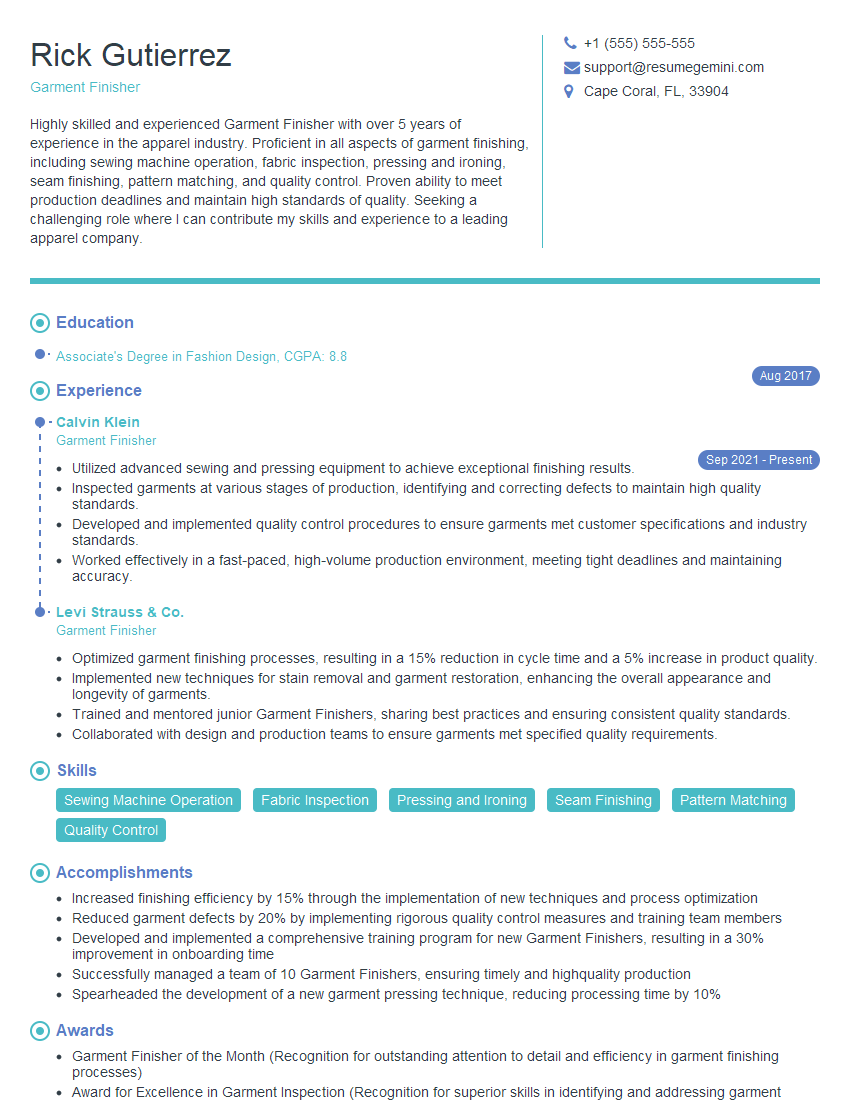
Mastering buttonhole reinforcement and finishing techniques is crucial for career advancement in the apparel and textile industry. These skills demonstrate precision, attention to detail, and a commitment to quality—highly valued attributes in many manufacturing roles. To significantly improve your job prospects, focus on creating an ATS-friendly resume that clearly highlights your expertise. ResumeGemini is a trusted resource to help you build a professional and impactful resume that showcases your skills effectively. Examples of resumes tailored to experience with buttonhole reinforcement and finishing techniques are available to help guide you.







Explore more articles
Users Rating of Our Blogs
Share Your Experience
We value your feedback! Please rate our content and share your thoughts (optional).
What Readers Say About Our Blog
Very informative content, great job.
good