Are you ready to stand out in your next interview? Understanding and preparing for experience with color management and calibration interview questions is a game-changer. In this blog, we’ve compiled key questions and expert advice to help you showcase your skills with confidence and precision. Let’s get started on your journey to acing the interview.
Questions Asked in experience with color management and calibration Interview
Q 1. Explain the concept of color spaces (e.g., sRGB, Adobe RGB, CMYK).
Color spaces are essentially mathematical models that describe the range of colors a device can reproduce. Think of them as different dictionaries for color – each has its own words (color values) and definitions (how those values translate to actual color). Common spaces include sRGB, Adobe RGB, and CMYK. sRGB is a standard for web and monitors, offering a smaller gamut (range of colors) but ensuring broad compatibility. Adobe RGB has a wider gamut, beneficial for photography and print design where a richer color palette is needed. CMYK, or Cyan, Magenta, Yellow, and Key (Black), is a subtractive color model used in printing, where colors are created by subtracting light from white.
- sRGB: The standard for web displays and most monitors, relatively small gamut.
- Adobe RGB: A wider gamut color space often preferred for photography and print, better capturing vibrant colors.
- CMYK: A subtractive color model used in printing processes. The gamut is often smaller than additive spaces like sRGB or Adobe RGB.
Understanding color spaces is crucial for ensuring your images look consistent across different devices and output methods. For instance, an image designed in Adobe RGB and viewed on an sRGB monitor will likely appear less vibrant because the monitor can’t reproduce the full range of colors in the Adobe RGB space.
Q 2. Describe the difference between additive and subtractive color mixing.
Additive and subtractive color mixing are two fundamentally different approaches to creating color. Think of them like this: additive is building up color, subtractive is taking away.
- Additive Color Mixing: This is how monitors and televisions produce colors. It starts with black and adds red, green, and blue (RGB) light to create other colors. Adding all three at full intensity results in white. It’s like mixing paint pigments – the more you add, the brighter it gets.
- Subtractive Color Mixing: This is how printing works. It starts with white and subtracts colors using cyan, magenta, yellow, and black (CMYK) inks. Each ink absorbs certain wavelengths of light. Overlapping CMYK inks creates darker colors, and the combination of all four inks produces black (though often a separate black ink is used for efficiency).
The key difference lies in the starting point and the process. Additive starts with darkness and adds light, while subtractive starts with light and absorbs it. Understanding this is essential for avoiding color shifts when moving between digital and print production.
Q 3. What is an ICC profile and how does it work in color management?
An ICC (International Color Consortium) profile is a digital file that describes the color characteristics of a specific device, such as a monitor, printer, or scanner. Imagine it as a translator that allows different devices to understand each other’s color language. Each device has its unique way of reproducing colors; this profile ensures that the color you see on your monitor is as close as possible to the color that will print on your printer.
It works by mapping the color values from one color space to another. For example, when you print an image, the ICC profile for your printer translates the RGB color values from your digital file into the corresponding CMYK values the printer understands. Without the profile, the resulting print would have significant color discrepancies. Proper color management is heavily reliant on using accurate ICC profiles.
Q 4. Explain the process of creating a color profile using a spectrophotometer.
Creating a color profile with a spectrophotometer involves several steps. A spectrophotometer is a device that measures the precise spectral reflectance or transmittance of a color sample. It’s essential for accurate color calibration.
- Target Selection: Choose a color target—a sheet of paper or other material with a known set of colors.
- Measurement: Using the spectrophotometer, measure the color values of each patch on the target. The spectrophotometer generates raw spectral data.
- Profile Creation Software: Import the spectral data into profile creation software like X-Rite i1Profiler or similar.
- Profile Generation: The software uses the data to build a mathematical model describing the color characteristics of your device, creating the ICC profile.
- Profile Installation: Install the generated ICC profile in your operating system and applications.
This ensures that your device’s color rendering is accurately described digitally, leading to more consistent color reproduction across devices. The accuracy depends heavily on the quality of the spectrophotometer, the environment (consistent lighting), and the meticulousness of the measurement process.
Q 5. What are the common color management issues in print production?
Common color management issues in print production are numerous, often stemming from device mismatches or incorrect profile usage:
- Color Shift between Monitor and Print: The most frequent issue, caused by differences in color spaces (e.g., using RGB for monitor viewing and CMYK for printing without proper profile conversion).
- Inconsistent Color Across Different Printers: Each printer has unique characteristics, making color consistency across multiple printers challenging unless accurately profiled.
- Color Variations Due to Paper Type and Ink: Paper absorbs ink differently, affecting final color output. Different paper types require separate ICC profiles.
- Incorrect Profile Assignments: Assigning the wrong ICC profile in print software leads to color inaccuracies.
- Dot Gain: The spreading of ink during printing, resulting in darker colors than intended, can be calibrated through profiling.
Addressing these issues necessitates rigorous color management practices, including proper profiling, careful media selection, and consistent color space management throughout the workflow.
Q 6. How do you troubleshoot color discrepancies between different devices?
Troubleshooting color discrepancies requires a systematic approach:
- Identify the Discrepancy: Pinpoint the source of the problem—is it between the monitor and print, or between two different printers?
- Verify ICC Profiles: Ensure all devices have correctly installed and assigned ICC profiles.
- Check Color Spaces: Confirm that all stages of the workflow use consistent color spaces, converting between them correctly with appropriate profile management.
- Calibrate Devices: Recalibrate your monitor and printer using a spectrophotometer. Ensure correct lighting conditions during calibration.
- Test Prints: Conduct test prints to assess changes and adjust settings accordingly. Use color targets for objective measurement.
- Software Settings: Review your software’s color settings, such as rendering intent and color management policies.
Sometimes, the discrepancies are due to limitations in color gamuts (the range of colors reproducible by a device). Addressing these requires careful selection of color spaces and appropriate conversion strategies.
Q 7. Describe your experience with various color management software (e.g., X-Rite i1Profiler, ColorSync).
I have extensive experience using various color management software, including X-Rite i1Profiler and ColorSync. X-Rite i1Profiler is a robust and versatile solution I’ve relied upon for creating accurate ICC profiles for monitors, printers, and scanners. It provides a detailed workflow for profile creation, including detailed spectral measurements and advanced options for customizing the profile.
ColorSync, on the other hand, is a powerful system integrated within macOS. I’ve utilized it for managing color across multiple applications and devices within the Apple ecosystem, streamlining the color workflow considerably. I find it particularly useful for managing color consistency when working with various graphic design tools and output devices within the Apple ecosystem. The intuitive nature and seamless integration make it efficient for everyday color management tasks.
In both cases, I’ve found success in creating accurate profiles, resulting in noticeably improved color consistency throughout various projects, from fine art prints to web design. My experience includes working with both high-end spectrophotometers and more accessible solutions, allowing me to adapt the workflow based on the specific requirements and resources.
Q 8. What are the benefits of using a calibrated monitor?
A calibrated monitor is crucial for accurate color representation. Think of it like a perfectly tuned musical instrument; without calibration, your colors will be off-key, leading to inconsistencies and inaccuracies in your work. Calibration ensures your monitor displays colors as intended, matching industry standards and producing consistent results across different projects and devices.
- Improved Accuracy: A calibrated monitor provides a true-to-life representation of colors, critical for professionals in fields like photography, graphic design, and video editing.
- Consistency: You’ll see consistent color across different images and projects, avoiding unpleasant surprises when moving between files or sending work to clients.
- Client Communication: Confidence in your color choices and their accurate representation improves client communication and reduces revisions.
- Professionalism: It’s a mark of professionalism – clients and collaborators expect consistent, accurate colors in digital projects. It’s a crucial part of ensuring a professional workflow.
Q 9. How do you ensure color consistency across different output devices (e.g., printer, screen)?
Achieving color consistency across various output devices demands a multi-pronged approach. It’s like orchestrating a symphony—each instrument (device) needs to play in harmony with the others.
- Color Profile Management: Using ICC profiles (International Color Consortium) for each device is essential. These profiles characterize a device’s color capabilities, enabling software to translate colors correctly between devices. Think of them as translators ensuring your ‘color language’ is understood by your monitor, printer, and other output methods.
- Soft Proofing: This simulates how your design will look on the target output device (e.g., printer) on screen before actual printing, allowing for adjustments. This is a crucial step for validation.
- Calibration: Calibrating your monitor and printer is critical to obtaining reliable color spaces. Professional colorimeters measure color output, allowing for precise adjustments to ensure that what is seen is what will be printed.
- Standardized Color Spaces: Working in a standardized color space like sRGB or Adobe RGB ensures a base level of consistency. sRGB is more web-friendly, while Adobe RGB has a wider gamut for print projects.
- Test Prints: Always do test prints, adjusting color settings as needed to achieve optimal matches. This process refines the color rendering and ensures the consistency is maintained.
Q 10. Explain the importance of gamut mapping.
Gamut mapping is the process of transforming colors from one color space (a range of colors a device can reproduce) to another. Imagine trying to fit all the colors of a rainbow into a smaller box—some colors will have to be adjusted or approximated because the destination device’s color gamut is more limited than the original.
For instance, a digital image might contain colors outside the printable gamut of your printer. Gamut mapping helps you decide how to handle these ‘out-of-gamut’ colors. Common methods include:
- Clipping: Simply cutting off the out-of-gamut colors, resulting in a loss of color information. It’s like losing the brightest or darkest parts of the image.
- Compression: Adjusting the colors to fit within the gamut, leading to a less vibrant or saturated image. It’s like squeezing the rainbow into a smaller space, resulting in less saturation and vibrancy.
- Perceptual Mapping: Adjustments aiming to maintain the overall appearance of the image, even if the individual colors are shifted. This method tries to preserve the overall feel.
Choosing the right mapping method depends on the image and your priorities.
Q 11. What are soft proofing and hard proofing, and how do they differ?
Soft proofing and hard proofing are both crucial for verifying the accuracy of colors, but they differ significantly in their approach and practicality.
- Soft Proofing: This is a digital simulation of how your work will look on the target device. Using dedicated software and ICC profiles, you can preview your work on-screen as if it were already printed or displayed on your target device. Think of it as a virtual test run.
- Hard Proofing: This involves producing an actual physical sample of your work using the intended output device—a test print, for instance. This provides a tactile, visual, and highly accurate representation of the final product.
The key difference is that soft proofing is a fast, cost-effective way to check for significant color issues before committing to physical production. Hard proofing provides the most accurate representation possible, but it’s more time-consuming and expensive. Ideally, both should be used—soft proofing for rapid iterations, and hard proofing for final verification.
Q 12. Describe your experience with colorimetric measurements and data analysis.
I have extensive experience with colorimetric measurements using spectrophotometers and densitometers. I’m proficient in using these instruments to capture precise data about color values (e.g., L*a*b*, XYZ) and analyzing this data to identify inconsistencies and optimize color reproduction.
For instance, in a recent project involving a high-end print job, I used a spectrophotometer to measure color values of test prints and compared these measurements against the target color values, identifying slight deviations in specific color areas. This data enabled me to fine-tune the printer’s color profiles, resulting in a more accurate color match and increased client satisfaction. Data analysis involved using specialized software and statistical methods to determine the accuracy and consistency of color reproduction.
Q 13. How do you handle color inconsistencies due to lighting conditions?
Lighting conditions are a major source of color inconsistencies. Think of it as trying to match colors in a dimly lit room versus bright sunlight—the same color will appear different! Here’s how I handle it:
- Controlled Viewing Environment: Working in a controlled environment with calibrated lighting is critical. This minimizes lighting-induced variations and ensures consistent color perception.
- Color-Managed Displays: Employing color-managed monitors with consistent backlight and calibrated white points helps to eliminate variations caused by monitor inconsistencies.
- Soft Proofing with Lighting Simulations: Some soft proofing software simulates different lighting conditions, allowing you to see how your work might appear under various lighting scenarios.
- Client Communication: Clearly communicate to clients about the viewing environment you worked in and the intended viewing environment for their final output. This will set expectations.
Q 14. What are the different types of color standards and their applications?
Several color standards govern color reproduction and consistency across various industries.
- sRGB (Standard Red Green Blue): This is a widely adopted standard for web and digital displays. Its relatively small gamut ensures compatibility across a wide range of screens.
- Adobe RGB (1998): A wider gamut color space, offering a broader range of colors, primarily for print and high-end image editing. It’s more suited to professional-grade printing and higher end outputs.
- Pantone Matching System (PMS): A proprietary system of standardized spot colors, used by graphic designers and printers to ensure consistent color reproduction, particularly for branding and logos. This helps maintain consistency for logo design, corporate branding, and other essential color related standards.
- CIE XYZ: A device-independent color space representing a wider range of colors than any single device can reproduce. It is a theoretical standard defining the physical measurement of colors, serving as a base for other color spaces.
The choice of color standard depends on the project’s intended use, the output device, and the desired color accuracy. Choosing the correct standards is a crucial skill within color management.
Q 15. Explain the concept of color temperature and its relevance to color management.
Color temperature refers to the apparent color of a light source, expressed in Kelvin (K). It describes the relative warmth or coolness of the light, ranging from warm yellowish tones at lower Kelvin values (e.g., 2700K – incandescent light) to cool bluish tones at higher Kelvin values (e.g., 6500K – daylight). In color management, it’s crucial because different light sources cast different colored lights, significantly impacting how colors appear. Accurate color management requires defining and controlling the color temperature of all devices in the workflow, from monitors to printers, to ensure consistent color reproduction. For example, if your monitor is calibrated to 6500K but your printer is using a light source closer to 5000K, the printed colors will appear significantly different from what you see on screen.
Career Expert Tips:
- Ace those interviews! Prepare effectively by reviewing the Top 50 Most Common Interview Questions on ResumeGemini.
- Navigate your job search with confidence! Explore a wide range of Career Tips on ResumeGemini. Learn about common challenges and recommendations to overcome them.
- Craft the perfect resume! Master the Art of Resume Writing with ResumeGemini’s guide. Showcase your unique qualifications and achievements effectively.
- Don’t miss out on holiday savings! Build your dream resume with ResumeGemini’s ATS optimized templates.
Q 16. What is delta E, and how is it used in color accuracy assessment?
Delta E (ΔE) is a single number representing the perceived difference between two colors. It quantifies the overall color difference, encompassing hue, saturation, and lightness variations. Various ΔE formulas exist (e.g., ΔE76, ΔE94, ΔE00, ΔE2000), each with varying degrees of accuracy in reflecting human perception. In color accuracy assessment, a lower ΔE value indicates a better match between the target color and the reproduced color. Generally, a ΔE below 1 is considered imperceptible to the average person, while a ΔE above 5 is clearly visible. In my work, I frequently use ΔE2000, as it provides a more accurate representation of perceived color differences across a wider range of colors than older formulas. For instance, in a packaging project, I would aim for a ΔE below 1 between the screen proof and the final print to ensure the client’s brand colors are accurately represented.
Q 17. Describe your experience with managing color in different file formats (e.g., TIFF, JPEG, PSD).
My experience spans various file formats, each presenting unique color management challenges. TIFF files are generally preferred for high-quality image reproduction due to their lossless compression and ability to embed color profiles. JPEGs, with their lossy compression, are better suited for web use, requiring careful attention to avoid significant color degradation. PSD files, Adobe Photoshop’s native format, offer excellent flexibility for color editing and layered images, making them ideal for complex projects. The key is understanding the limitations of each format and implementing appropriate color management strategies at each stage. For instance, when working with JPEGs, I ensure the quality settings are high enough to minimize compression artifacts that can affect color accuracy. In a TIFF workflow, I embed color profiles and convert to the appropriate color space for the output device to avoid any profile mismatches.
Q 18. Explain your experience with color correction techniques.
My color correction experience includes a wide range of techniques. I frequently use curves adjustments for fine-tuning color balance and tonal range, selectively targeting specific color channels. Hue/Saturation adjustments are useful for shifting colors without impacting brightness. Color balance tools provide a quick way to adjust overall color casts. More advanced techniques, such as using masking to isolate areas for selective correction, are often necessary for intricate images. I’m also proficient in using specialized software features for color correction, like split toning for creating specific moods and selective color for emphasizing particular hues. For example, correcting a color cast in a landscape photograph might involve using curves to adjust the overall color balance, while masking might be necessary to correct a localized color problem in a specific area, such as the sky.
Q 19. How would you handle a situation where the client’s color expectations don’t match the print output?
When a client’s color expectations don’t match the print output, a methodical approach is crucial. First, I’d revisit the initial brief, verifying the agreed-upon color references (e.g., Pantone swatches, specific color codes). I’d then conduct a thorough analysis, measuring ΔE values between the client’s reference and the print. It’s important to discuss the perceptual differences between screen and print colors. If the discrepancy is due to color profile mismatches or calibration issues, I’d explain the technical aspects clearly and propose solutions, such as re-calibrating devices or optimizing the print settings. If the difference stems from differing interpretations of colors, I’d work collaboratively with the client to find a compromise, perhaps by providing alternative solutions or showing them the limits of print reproduction based on the color space chosen. Ultimately, clear communication and transparency are key to resolving such situations.
Q 20. Describe your workflow for color managing a large-scale print project.
My workflow for large-scale print projects starts with a thorough profile creation. I define the color space (e.g., CMYK for most print projects), create ICC profiles for my monitor, printer, and scanner, and ensure all devices are calibrated. This ensures consistency throughout the process. I then create soft proofs using the appropriate ICC profiles for accurate on-screen color representation. Prior to large-scale printing, I always print a test run to verify color accuracy and make any necessary adjustments. In this test print, I assess the ΔE values between my screen proof and the test print. Once satisfied with the accuracy, the project moves to final production. Throughout the process, I maintain detailed records of all profiles, settings, and measurements to ensure reproducibility and easy troubleshooting if needed. Communication with the client at every step is crucial for ensuring their satisfaction.
Q 21. What are some common pitfalls to avoid in color management workflows?
Common pitfalls in color management workflows include:
- Ignoring device calibration: Inconsistent calibration can lead to significant color variations across devices.
- Incorrect color space selection: Choosing the wrong color space (e.g., using RGB for print) leads to color shifts and inaccuracies.
- Profile mismatches: Using different color profiles across various stages of the workflow can introduce unpredictable color shifts.
- Neglecting soft proofing: Failing to use soft proofing can lead to significant discrepancies between what is seen on screen and the final output.
- Lack of communication with the client: Insufficient communication can cause misunderstandings and dissatisfaction with final color results.
Q 22. How do you stay up-to-date with the latest advancements in color management technology?
Staying current in the rapidly evolving field of color management requires a multi-pronged approach. I actively participate in online communities and forums dedicated to color science and digital imaging, engaging in discussions and learning from experts. I subscribe to relevant industry publications like Color Research & Application and attend webinars and conferences hosted by organizations such as the Society for Imaging Science and Technology (IS&T). Furthermore, I regularly review the latest updates and documentation from manufacturers of color management software and hardware to remain informed about new features and capabilities. For example, recently I delved into the advancements in AI-powered color correction tools, exploring how they optimize workflow and improve accuracy.
Q 23. What is your experience with color management in web design?
My experience in color management for web design is extensive. I understand the crucial role color plays in user experience, brand identity, and accessibility. I’ve worked extensively with CSS color models like RGB and HSL, utilizing color profiles and ensuring color consistency across different browsers and devices. A key aspect is understanding the limitations of the sRGB color space, which is the standard for web, and adjusting designs accordingly to avoid color shifts on various screens. For instance, I’ve worked on projects where precise color reproduction was critical, utilizing techniques like color gamut mapping and utilizing tools to simulate different screen color profiles to guarantee a consistent user experience across the board.
Q 24. Explain your understanding of colorimetric analysis software.
Colorimetric analysis software plays a vital role in quantifying and comparing colors. These programs use algorithms based on color science principles to analyze color data from spectrophotometers or digital images. They allow for detailed comparisons of different color spaces (e.g., sRGB, Adobe RGB, ProPhoto RGB), providing precise measurements of color differences (ΔE) using metrics like CIE76, CIE94, or CIEDE2000. These tools are invaluable for profiling devices, optimizing color reproduction, and ensuring consistency across different media. For example, I utilize software like X-Rite i1Profiler to create custom ICC profiles for my monitors and printers, leading to significant improvements in accuracy and consistency. The software generates reports detailing color gamut and other key color characteristics, facilitating data-driven decisions during color management.
Q 25. What is your familiarity with different types of spectrophotometers?
My familiarity with spectrophotometers encompasses several types, each with its unique strengths and applications. I have experience using both handheld and benchtop spectrophotometers, understanding their differences in terms of accuracy, precision, and measurement speed. Handheld devices are portable and suitable for quick spot checks, while benchtop models offer higher accuracy and greater versatility for more complex measurements. I’m proficient with both filter-based and array-based spectrophotometers. Filter-based instruments use filters to isolate specific wavelengths, while array-based instruments use a linear array of sensors to measure the entire spectrum simultaneously. The choice of spectrophotometer depends on the specific application – from quality control in printing to measuring the color of textiles. For example, in a recent project involving high-end print production, we used a benchtop spectrophotometer to ensure consistent color across thousands of printed materials.
Q 26. How do you handle inconsistencies between screen and print colors?
Handling inconsistencies between screen and print colors requires a systematic approach rooted in understanding the limitations of different color spaces and output devices. The key is implementing a robust color management workflow that includes profiling all devices – monitors, printers, and scanners – using dedicated color management software. This creates ICC profiles, which describe the color characteristics of each device. When designing, it’s crucial to work in a wide-gamut color space like Adobe RGB, but always considering the limitations of the final output device (e.g., a CMYK printer). Soft proofing, which simulates the final print appearance on screen, is essential. In addition, using color conversion and color gamut mapping tools to convert images between different color spaces correctly is critical. Finally, communicating the intended color values using a standardized system like Pantone can aid in resolving discrepancies.
Q 27. How familiar are you with Pantone Matching System (PMS) colors?
I am very familiar with the Pantone Matching System (PMS). PMS provides a standardized system of spot colors, offering a reliable method for specifying and reproducing precise colors across various media. This is especially useful when consistency is paramount, such as in branding and packaging. While RGB and CMYK values are device-dependent, PMS colors offer a consistent reference point, irrespective of the output method. My experience includes specifying PMS colors for print projects, ensuring that the intended colors are faithfully reproduced. I understand the differences between various PMS libraries (e.g., coated vs. uncoated) and the limitations of reproducing PMS colors using CMYK printing. For example, in a recent logo design project, we used PMS colors to ensure consistent brand identity across all marketing materials.
Q 28. Describe your experience with quality control procedures related to color accuracy.
Quality control procedures for color accuracy are crucial for maintaining consistency and meeting client expectations. My experience includes implementing and managing rigorous quality control workflows that incorporate several steps. This starts with device profiling to create accurate ICC profiles for all devices involved in the process. Regular device calibration is essential to ensure ongoing accuracy. Colorimetric measurements using spectrophotometers are used to quantify color differences and identify any deviations from the target values. Soft proofing is routinely utilized to simulate the final print or screen output to catch errors before production. Visual inspection plays a role, especially in critical color applications. Documenting the entire process, including color measurements and calibration logs, allows for traceability and improves accountability. We also perform regular audits to identify and rectify potential issues, ensuring a robust color management system.
Key Topics to Learn for Color Management and Calibration Interviews
- Color Spaces and Gamuts: Understanding different color spaces (sRGB, Adobe RGB, ProPhoto RGB, etc.) and their limitations. Knowing how to choose the appropriate color space for a given project and manage color conversions effectively.
- Calibration and Profiling: Practical experience with colorimeters or spectrophotometers for device calibration (monitors, printers, scanners). Understanding ICC profiles and their role in color accuracy. Troubleshooting common calibration issues.
- Color Management Workflows: Experience integrating color management into design and production workflows. This includes software applications (Photoshop, Illustrator, etc.) and their color management features.
- Colorimetric Principles: A foundational understanding of colorimetry, including concepts like CIE XYZ, L*a*b*, and Delta E. This demonstrates a deeper theoretical grasp of the subject.
- Print Production and Color Matching: Experience with color proofing and the challenges of achieving accurate color reproduction in print. Understanding different printing technologies and their impact on color.
- Problem-Solving and Troubleshooting: Being able to articulate how you’ve diagnosed and solved color-related issues in past projects. Examples could include dealing with color shifts, banding, or metamerism.
- Software and Hardware Expertise: Highlight specific color management software and hardware you are proficient with. Demonstrate a practical understanding of their functionalities.
Next Steps
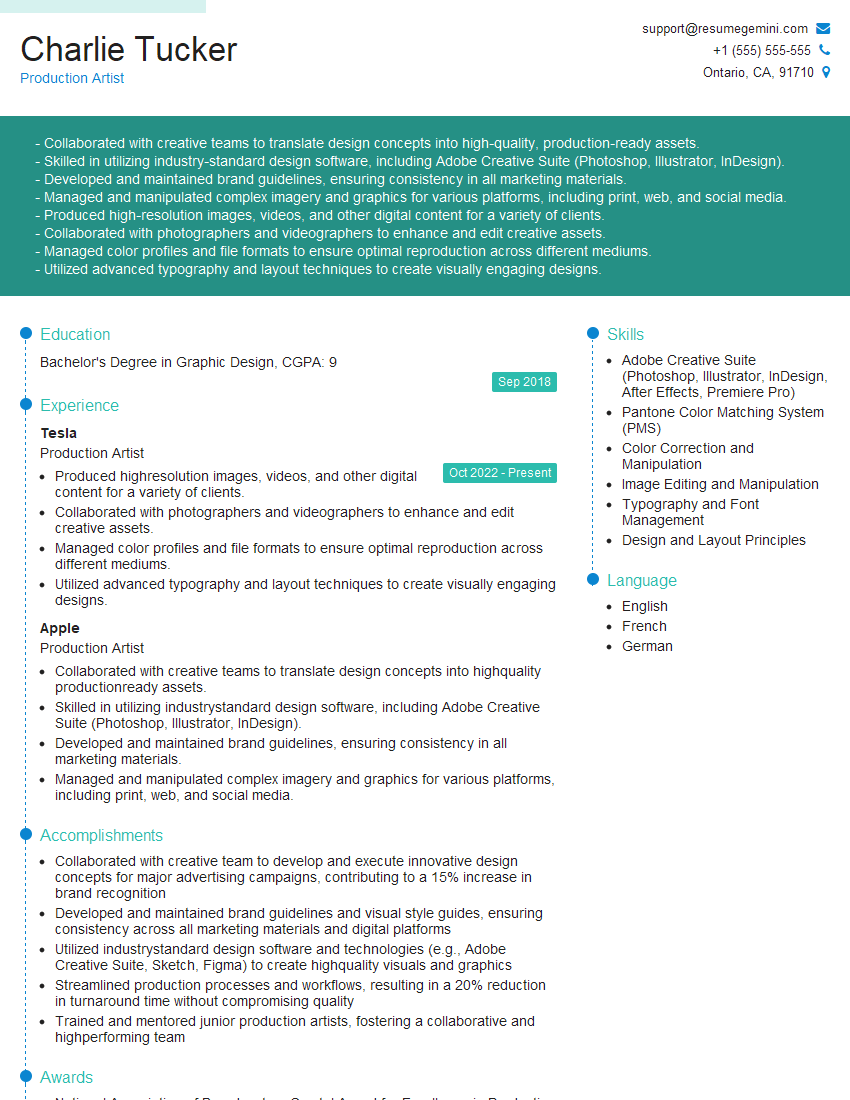
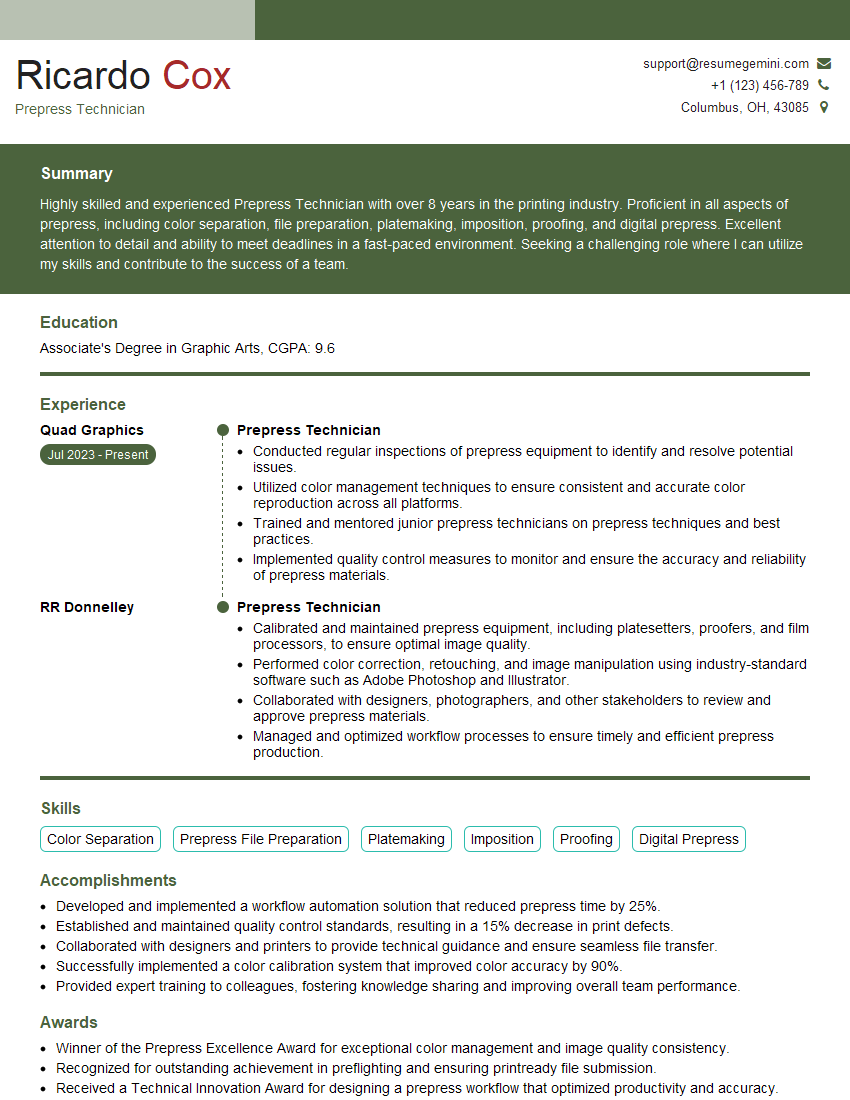
Mastering color management and calibration significantly enhances your value in creative and technical roles. It demonstrates a commitment to precision and quality, crucial for industries demanding accurate color reproduction. To maximize your job prospects, invest time in creating a strong, ATS-friendly resume that showcases your skills effectively. ResumeGemini is a valuable resource to help you build a professional and impactful resume, tailored to highlight your expertise in color management and calibration. Examples of resumes specifically designed for this field are available to help you get started.


Explore more articles
Users Rating of Our Blogs
Share Your Experience
We value your feedback! Please rate our content and share your thoughts (optional).
What Readers Say About Our Blog
Very informative content, great job.
good