The right preparation can turn an interview into an opportunity to showcase your expertise. This guide to Experience with Digital Content Platforms interview questions is your ultimate resource, providing key insights and tips to help you ace your responses and stand out as a top candidate.
Questions Asked in Experience with Digital Content Platforms Interview
Q 1. Explain your experience with content management systems (CMS) like WordPress, Drupal, or Sitecore.
My experience with Content Management Systems (CMS) spans several platforms, including WordPress, Drupal, and Sitecore. Each offers unique strengths, and my selection depends heavily on project needs. WordPress, known for its ease of use and extensive plugin ecosystem, is ideal for smaller projects or blogs needing quick setup and customization. I’ve used it extensively for building and managing client websites, leveraging plugins for SEO optimization, e-commerce integration, and advanced analytics. Drupal, a more robust and complex system, is better suited for larger, enterprise-level websites requiring advanced functionalities and scalability. I’ve worked on several projects utilizing Drupal’s robust theming and content modeling capabilities to create highly customized and complex websites. Finally, Sitecore is a powerful enterprise CMS excelling in personalization and content management for large organizations. My experience with Sitecore involved working on complex projects that required sophisticated content delivery and user experience management, leveraging its advanced features for personalization and A/B testing. In all cases, my approach emphasizes user-friendly interfaces, efficient workflows, and ensuring content is easily accessible and manageable by both technical and non-technical users.
For example, on a recent WordPress project, I implemented a custom plugin to integrate with a third-party marketing automation platform, streamlining the lead generation process. In contrast, a Drupal project involved developing a custom content type to manage complex product specifications, significantly improving content organization and retrieval. With Sitecore, I focused on implementing personalized content recommendations to improve user engagement and conversion rates.
Q 2. Describe your process for creating a content strategy for a new product launch.
Creating a content strategy for a new product launch requires a multifaceted approach. It begins with a deep understanding of the target audience, their needs, and pain points. This involves market research, competitor analysis, and identifying key audience segments. Next, I define clear goals, focusing on metrics like brand awareness, lead generation, and sales. Then, I create a content calendar outlining the types of content, publishing dates, and channels (blog, social media, email marketing, etc.). This calendar acts as a roadmap, ensuring consistent and relevant messaging across all platforms. The core message should be consistent across all content pieces, but the format and approach should be tailored for the specific platform and audience. For example, a social media post will differ significantly from a blog post or a video. Throughout the process, I emphasize creating high-quality, valuable content that resonates with the target audience. Finally, I incorporate strategies for monitoring performance, analyzing results, and making necessary adjustments throughout the campaign.
For instance, during a recent product launch, we used a combination of blog posts explaining the product’s benefits, short explainer videos for social media, and email sequences nurturing leads generated through the campaign. We tracked engagement metrics on each platform, refining our strategy based on real-time feedback.
Q 3. How do you measure the success of a content marketing campaign?
Measuring the success of a content marketing campaign requires a blend of qualitative and quantitative metrics. Quantitative metrics provide hard data, such as website traffic, conversion rates, lead generation numbers, and social media engagement (likes, shares, comments). These metrics are crucial for assessing the impact of the campaign in terms of reach and influence. Qualitative metrics, on the other hand, focus on understanding the audience’s perception of the content. This can be measured through user feedback, surveys, and sentiment analysis of online conversations. For example, a high click-through rate indicates compelling content, while negative comments on social media highlight areas for improvement. A holistic approach combining both quantitative and qualitative data provides a comprehensive picture of the campaign’s effectiveness. This allows for data-driven decision-making and continuous improvement. Key Performance Indicators (KPIs) should be clearly defined at the outset of the campaign to provide a benchmark for success.
Q 4. What are some key SEO best practices you utilize in your content creation?
My SEO best practices involve a holistic approach that prioritizes both on-page and off-page optimization. On-page optimization focuses on optimizing the content itself. This involves using relevant keywords naturally within the text, optimizing meta descriptions, creating high-quality, engaging content, and ensuring the site is well-structured and easy to navigate. Off-page optimization focuses on building the website’s authority and relevance through backlinking and other external factors. I focus on building high-quality backlinks from reputable and relevant websites. I also utilize schema markup to enhance search engine understanding of the content. Keyword research is a crucial step, using tools like SEMrush or Ahrefs to identify relevant keywords with sufficient search volume and low competition. Technical SEO is also crucial, ensuring website speed, mobile responsiveness, and proper indexing by search engines. Regular monitoring of search engine rankings and analytics helps track progress and identify areas for improvement. I avoid black hat SEO techniques that could harm the website’s ranking.
Q 5. How do you ensure content consistency across multiple platforms?
Ensuring content consistency across multiple platforms requires a well-defined style guide and a centralized content repository. The style guide outlines branding guidelines, tone of voice, and writing style, ensuring a unified message across all channels. A centralized repository, such as a CMS or a content management system, facilitates easy access and management of content assets. Version control systems are essential for tracking changes and preventing inconsistencies. Regular collaboration and communication among team members are also vital. For example, using a shared document to track updates, or using project management software to keep track of changes and deadlines, ensures all channels are aligned. Finally, utilizing templates and pre-approved content components reduces the risk of discrepancies. A robust approval workflow can help to ensure that brand and style guidelines are consistently followed.
Q 6. Explain your experience with content repurposing and syndication.
Content repurposing and syndication are essential strategies for maximizing the value of existing content. Repurposing involves transforming existing content into different formats. For example, a blog post can be turned into a series of social media posts, an infographic, or a short video. Syndication involves distributing the content across multiple platforms, increasing its reach and visibility. This could involve publishing the blog post on other relevant websites or platforms, leveraging guest posting opportunities. Careful consideration of the target audience for each platform is critical to ensure that the message remains relevant and impactful. Proper attribution and linking back to the original source is crucial for both repurposing and syndication, to maintain brand credibility and avoid copyright infringement. Tracking performance metrics across all platforms is essential to assess the effectiveness of repurposing and syndication efforts.
For instance, I recently repurposed a long-form blog post into a series of shorter, engaging posts for LinkedIn and Twitter, achieving a significantly wider reach. Syndication of the blog post on a partner website resulted in increased brand visibility and referral traffic.
Q 7. Describe a time you had to manage conflicting priorities in content creation.
I once faced conflicting priorities during a major website redesign project. We were under tight deadlines to launch the new site, while simultaneously needing to produce a large volume of content for the new platform. This created a conflict between the technical aspects of the redesign and the content creation timeline. To resolve this, I implemented a phased approach, prioritizing critical content for the initial launch, while scheduling the remaining content for subsequent releases. I held daily stand-up meetings with the development and content teams to ensure everyone was aware of priorities and potential roadblocks. I created a detailed project plan with clearly defined milestones and responsibilities. Utilizing agile project management techniques, we prioritized tasks based on their impact and feasibility, and we used a Kanban board to visualize the workflow. This helped us to stay on track and effectively manage resources despite conflicting deadlines. Open communication and flexible adaptation proved key to successfully navigating this challenging situation.
Q 8. How do you handle negative feedback or criticism on published content?
Negative feedback, while initially challenging, is invaluable for content improvement and audience understanding. My approach involves a three-step process: Analyze, Respond, and Adapt.
Analyze: I carefully examine the feedback, identifying recurring themes and specific criticisms. Is the feedback constructive? Is it targeting a specific aspect of the content (e.g., accuracy, clarity, tone)? I look for patterns that indicate larger issues. For example, multiple complaints about confusing terminology might highlight a need for simpler language.
Respond: I acknowledge the feedback publicly (where appropriate), thanking the commenter for their input. This shows respect and encourages further engagement. If the feedback is valid, I apologize and explain the steps to rectify the issue. For example, I might say, “Thank you for pointing out the inaccuracy in the date; we’ve corrected it in the updated version.”
Adapt: Based on my analysis, I modify the content to address the concerns. This might include rewriting sections, adding clarifying information, or making visual adjustments. I also use the feedback to inform future content creation, avoiding similar issues in subsequent publications.
For instance, if consistent negative feedback highlights a lack of engagement, I might incorporate interactive elements or change the content format for better user experience.
Q 9. How familiar are you with content analytics tools like Google Analytics?
I’m highly proficient with Google Analytics and similar content analytics tools. I regularly use them to track key performance indicators (KPIs) such as website traffic, bounce rate, time on page, and conversion rates. My familiarity extends beyond simply viewing the data; I’m adept at interpreting it to understand user behavior and identify areas for improvement.
For example, a high bounce rate on a specific blog post might suggest poor headline optimization or an unclear introduction. Conversely, high time-on-page coupled with low conversion rates could signal engaging content but a weak call-to-action. I leverage this data to inform strategic content adjustments and measure the effectiveness of those changes.
Beyond basic metrics, I analyze audience demographics, geographic locations, and device usage to further segment my audience and tailor content accordingly. This granular analysis informs the creation of more targeted and effective campaigns.
Q 10. Explain your experience with A/B testing for content optimization.
A/B testing is a crucial component of my content optimization strategy. It involves creating two versions of a piece of content (A and B) that differ in a single element (e.g., headline, image, call-to-action) and comparing their performance. This allows for data-driven decision-making, optimizing content for maximum impact.
My process typically involves:
- Defining a clear objective: What are we trying to improve? (e.g., click-through rate, conversion rate).
- Identifying variables to test: Which elements will be varied in the A/B tests?
- Creating variations: Developing multiple versions of the content with the chosen variations.
- Implementing the test: Using a platform to distribute the variations to different segments of the audience.
- Analyzing results: Evaluating the performance metrics of each variation and determining the winner.
- Implementing changes: Applying the learnings from the test to the final content.
For example, I might A/B test two headlines for a blog post, one focused on benefits and the other on curiosity. The data would then show which headline generates more clicks and engagement.
Q 11. How do you ensure the accessibility of your digital content?
Ensuring digital content accessibility is paramount. My approach adheres to WCAG (Web Content Accessibility Guidelines) standards to make content usable by people with disabilities. This includes:
- Alternative text for images: Providing descriptive alt text for all images, ensuring they are understandable by screen readers.
- Proper heading structure: Using appropriate heading levels (H1-H6) to create a logical structure and improve navigation for screen readers and users.
- Color contrast: Maintaining sufficient color contrast between text and background to ensure readability for users with visual impairments.
- Keyboard navigation: Designing content that is fully navigable using only a keyboard.
- Captioning and transcripts: Providing captions for videos and transcripts for audio content to support users with hearing impairments.
I regularly use accessibility checkers and tools to evaluate content before publication and ensure compliance with guidelines. It’s not just about legal compliance; it’s about ensuring inclusivity and creating a positive user experience for everyone.
Q 12. Describe your process for content review and approval.
My content review and approval process is a multi-stage workflow that emphasizes collaboration and quality control. It usually involves:
- Initial draft review: The content creator reviews their work for accuracy, clarity, and adherence to brand guidelines.
- Editor review: An editor reviews the content for grammar, style, and overall coherence.
- Subject matter expert (SME) review: If necessary, an SME verifies the accuracy of the factual information.
- Legal review: The content is reviewed for compliance with legal and regulatory requirements.
- Final approval: A designated individual gives final approval for publication.
This multi-layered approach ensures that the published content is accurate, well-written, and compliant with all relevant standards. Collaboration tools and version control systems are used to streamline this process and track changes efficiently.
Q 13. What are some common content marketing challenges you have encountered?
Creating engaging and effective content marketing involves overcoming several common challenges. Some of the most prevalent I’ve faced include:
- Generating consistent, high-quality content: Maintaining a regular content calendar while ensuring the quality and relevance of each piece can be demanding.
- Measuring and demonstrating ROI: Proving the value of content marketing efforts can be challenging, requiring careful tracking and analysis of KPIs.
- Adapting to algorithmic changes: Search engine algorithms and social media platforms are constantly evolving, requiring continuous adaptation of content strategies.
- Staying ahead of trends: Keeping up with the latest digital marketing trends and best practices requires constant learning and experimentation.
- Building and engaging an audience: Attracting, retaining, and growing a loyal audience requires consistent effort and creativity.
Overcoming these challenges requires a strategic approach that combines data-driven insights, effective content planning, and continuous learning and adaptation.
Q 14. How do you stay updated on the latest trends in digital content and technology?
Staying current in the fast-paced world of digital content and technology is crucial. My strategy involves a multi-faceted approach:
- Following industry publications and influencers: I regularly read industry blogs, newsletters, and publications such as Content Marketing Institute, MarketingProfs, and Neil Patel’s blog to stay informed about the latest trends and best practices.
- Attending industry conferences and webinars: Participating in industry events allows for networking and learning from leading experts.
- Experimenting with new tools and technologies: I actively test new platforms, software, and tools to explore their capabilities and potential applications.
- Engaging with online communities: Participating in online forums and groups helps to exchange ideas and learn from other professionals.
- Continuous learning through online courses and certifications: I consistently pursue additional education through online courses and certifications to enhance my skills and knowledge.
This combination of active learning and hands-on experimentation keeps me at the forefront of the industry and enables me to deliver innovative and effective content solutions.
Q 15. Describe your experience with content localization or translation.
Content localization goes beyond simple translation; it’s about adapting content to resonate with a specific target audience, considering cultural nuances, regional preferences, and even technical requirements. I’ve extensively worked on localizing website content, marketing materials, and software interfaces. For instance, a simple color might have different cultural connotations—red signifies luck in some cultures and misfortune in others. My experience includes managing translation teams, ensuring consistent terminology, and employing translation management systems (TMS) like SDL Trados Studio to streamline the process. I’ve also been involved in quality assurance, reviewing localized content for accuracy and cultural appropriateness before release.
In one project, we localized a SaaS platform for the Japanese market. This involved not only translating the text but also adjusting the user interface layout to align with Japanese reading habits (right-to-left) and incorporating culturally appropriate imagery. We also had to account for differences in date and number formatting.
Career Expert Tips:
- Ace those interviews! Prepare effectively by reviewing the Top 50 Most Common Interview Questions on ResumeGemini.
- Navigate your job search with confidence! Explore a wide range of Career Tips on ResumeGemini. Learn about common challenges and recommendations to overcome them.
- Craft the perfect resume! Master the Art of Resume Writing with ResumeGemini’s guide. Showcase your unique qualifications and achievements effectively.
- Don’t miss out on holiday savings! Build your dream resume with ResumeGemini’s ATS optimized templates.
Q 16. How do you manage content version control?
Effective content version control is crucial for collaborative projects. I’ve primarily used Git, a distributed version control system, for managing content across various digital platforms. This allows multiple team members to work on the same content simultaneously without overwriting each other’s changes. We typically create separate branches for different features or updates, allowing for parallel development and thorough testing before merging changes into the main branch.
For instance, if we’re updating a blog post, one team member might work on revising the text in a separate branch, while another works on updating the images in another branch. Once both are complete and tested, the changes are merged into the main branch and deployed. This approach ensures a clear history of changes, allows for easy rollback if necessary, and improves collaboration efficiency.
git checkout -b new-feature #Create a new branch
git add . #Stage changes
git commit -m "Updated blog post" #Commit changes
git push origin new-feature #Push changes to remote repository
git checkout main #Switch back to main branch
git merge new-feature #Merge new branch into main
Q 17. Explain your understanding of content lifecycle management.
Content lifecycle management (CLM) encompasses the entire journey of a piece of content, from its inception to its eventual archiving or retirement. This includes planning, creation, review, approval, publication, distribution, analysis, and finally, archival. Think of it as a structured workflow designed to ensure consistency, quality, and efficiency across the entire content process. I’ve used CLM systems and methodologies to manage various content types, including blog posts, website copy, social media updates, and marketing emails. These systems often involve content calendars, workflows for approval and publication, and analytics dashboards to track performance.
In a previous role, we implemented a CLM system that used a centralized repository for all content assets, automated workflows for approval processes, and integrated analytics to track the performance of each content piece. This allowed us to better understand which content resonated with our audience, enabling data-driven content strategy adjustments.
Q 18. Describe your experience with content automation tools.
I have experience with several content automation tools, focusing on improving efficiency and scale. These tools range from marketing automation platforms like HubSpot and Marketo for scheduling social media posts and email campaigns, to content creation tools like Jasper and Copy.ai for generating draft content. I’ve also worked with CMS systems like WordPress that offer automation capabilities for tasks like image resizing and metadata generation. The choice of tool depends heavily on the specific needs of the project and the content type. The key benefit of these tools is streamlining repetitive tasks, freeing up time for more strategic work.
For instance, using HubSpot, we automated a series of welcome emails for new subscribers, personalizing the content based on their initial engagement. This eliminated manual work and ensured consistent messaging.
Q 19. How do you ensure the quality and accuracy of the content you produce?
Ensuring content quality and accuracy is paramount. My approach is multi-faceted and starts with clear content briefs and style guides. This defines the target audience, desired tone, and key messaging. Then, a rigorous review process is employed, including multiple rounds of editing, fact-checking, and proofreading. We often utilize tools like Grammarly and Hemingway Editor for style and grammar checks. For specialized content, subject matter experts are consulted to ensure accuracy and technical correctness. Finally, user testing and A/B testing are used to validate the effectiveness of the content and identify areas for improvement.
In one case, we implemented a three-stage review process for all blog posts: first by the author, then by an editor, and finally by a subject matter expert. This rigorous approach significantly reduced the number of errors and ensured the content was both accurate and engaging.
Q 20. What is your experience with content syndication strategies?
Content syndication involves strategically distributing your content across multiple platforms to reach a wider audience. My experience includes using a variety of strategies, from guest blogging on relevant websites to repurposing content into different formats (e.g., turning a blog post into an infographic or short video). We analyze the target audience for each platform and tailor the content accordingly. Measuring the performance of each syndication channel is essential to understand which strategies are most effective. Effective syndication can dramatically increase brand visibility and reach.
For example, we repurposed a successful blog post on cybersecurity best practices into a series of short, engaging videos for platforms like YouTube and TikTok. This allowed us to reach a wider audience with different content consumption preferences.
Q 21. How do you collaborate with other teams (e.g., design, marketing) to create effective digital content?
Collaboration is key to effective digital content creation. I prioritize open communication and clear role definitions. We use project management tools like Asana or Trello to track progress, manage tasks, and ensure everyone is aligned. Regular meetings are held to discuss progress, address challenges, and make necessary adjustments. I focus on actively listening to the input of other teams—design, marketing, development—and incorporate their expertise into the final product. A collaborative approach ensures a cohesive and effective end result. A successful project relies on clear communication and mutual understanding of each team’s role and responsibilities.
For a recent campaign, we used a collaborative design sprint, bringing together designers, marketers, and content writers to brainstorm ideas, create wireframes, and refine the content strategy before starting production. This collaborative process significantly improved the campaign’s effectiveness and overall impact.
Q 22. Describe your approach to creating user-friendly and engaging content.
Creating user-friendly and engaging content starts with a deep understanding of the target audience. I begin by conducting thorough user research, utilizing techniques like surveys, interviews, and analyzing existing data to define their needs, pain points, and preferences. This informs every step of the content creation process.
My approach is iterative. I develop a content strategy focusing on clarity, conciseness, and a compelling narrative. This involves:
- Clear Value Proposition: Each piece of content must offer clear value to the user – whether it’s solving a problem, providing information, or entertaining them.
- Compelling Storytelling: I weave narratives that resonate with the audience, using relatable examples and a conversational tone. I avoid jargon and technical terms unless absolutely necessary, and then I define them clearly.
- Visually Appealing Design: Content needs to be visually engaging. I incorporate high-quality images, videos, and interactive elements to break up text and enhance readability.
- Optimized for various devices: Content must be responsive and adapt to different screen sizes (desktops, tablets, mobile phones).
- User testing and feedback loops: I always test content with target users and incorporate their feedback to improve engagement and usability.
For example, when creating content for a financial literacy website, I would avoid complex financial jargon and instead use simple language and real-world examples to explain complex concepts. I would incorporate interactive elements like calculators and quizzes to enhance engagement and knowledge retention.
Q 23. How familiar are you with different content formats (e.g., blog posts, videos, infographics)?
I’m highly familiar with a wide range of content formats and adept at choosing the most effective format for a given message and audience. My experience spans:
- Blog posts: Ideal for in-depth explanations, thought leadership, and SEO optimization.
- Videos: Excellent for tutorials, product demos, and conveying emotion. I’m proficient in scripting, filming, editing, and optimizing videos for different platforms.
- Infographics: Perfect for presenting data visually, summarizing complex information, and making it easily digestible.
- Ebooks and White Papers: Suitable for delivering comprehensive information on a specific topic, often used as lead magnets.
- Social Media Posts: I understand the nuances of different social media platforms and tailor content to each platform’s specific audience and style.
- Interactive Content: Quizzes, polls, and calculators significantly improve audience engagement and data collection.
- Podcasts: A powerful medium for audio-based storytelling and interviews.
The choice of format is always strategic. For instance, a complex technical topic might be best explained in a blog post or whitepaper, while a product launch might be best showcased through a video.
Q 24. Describe your experience with content personalization or targeting.
I have extensive experience with content personalization and targeting. This involves tailoring content to specific user segments based on their demographics, behavior, and preferences.
My approach typically involves:
- Segmentation: Dividing the audience into distinct groups based on shared characteristics (e.g., age, location, interests, past behavior).
- Personalized Recommendations: Using data to suggest relevant content to individual users. This can be implemented through recommendation engines or personalized email campaigns.
- Dynamic Content: Creating content that changes based on the user’s profile or context. For example, a website might display different offers or product recommendations based on the user’s location or browsing history.
- A/B Testing: Testing different versions of personalized content to determine which performs best.
For example, I worked on a project where we segmented users of an e-commerce platform based on their purchase history. We then created personalized email campaigns recommending products related to their past purchases, resulting in a significant increase in conversion rates. We used a platform that allowed for dynamic content insertion, where the email content automatically adjusted based on the user’s previous purchases and browsing activity.
Q 25. Explain how you measure content engagement metrics.
Measuring content engagement involves tracking key metrics that indicate how users interact with the content. My approach is multifaceted and uses a combination of quantitative and qualitative data.
Key metrics include:
- Page Views/Video Views: The number of times a page or video is viewed.
- Time on Page/Video: How long users spend on a page or watching a video.
- Bounce Rate: The percentage of users who leave a page after viewing only one page.
- Click-Through Rate (CTR): The percentage of users who click on a link or call to action.
- Conversion Rate: The percentage of users who complete a desired action (e.g., making a purchase, signing up for a newsletter).
- Social Shares: The number of times content is shared on social media.
- Comments and Feedback: Qualitative data gathered from user comments and feedback forms providing insights into user sentiment and understanding.
I utilize analytics platforms like Google Analytics to track these metrics and interpret the data to understand content performance. This informs future content strategy adjustments, ensuring continuous improvement.
Q 26. What’s your preferred method for content ideation?
My preferred method for content ideation is a combination of data-driven approaches and creative brainstorming. I don’t rely on a single method; instead, I use a multi-pronged strategy.
My process usually involves:
- Keyword Research: Identifying relevant keywords and topics that align with the target audience’s interests and search queries.
- Competitor Analysis: Examining the content strategies of competitors to identify gaps and opportunities.
- Audience Feedback: Analyzing user feedback, comments, and surveys to identify topics and formats that resonate with the audience.
- Brainstorming Sessions: Conducting collaborative brainstorming sessions with team members to generate creative ideas.
- Content Audits: Reviewing existing content to identify areas for improvement or repurposing.
- Trend Monitoring: Staying up-to-date on industry trends and emerging topics through relevant publications and social media.
For example, a recent content ideation session for a client in the health and wellness industry resulted in a series of short, engaging videos demonstrating simple exercises and healthy recipes. This was based on keyword research indicating high search volume for these topics and audience feedback suggesting a need for practical, easily accessible information.
Q 27. How do you handle urgent content requests or deadlines?
Handling urgent content requests requires a structured approach to prioritize tasks effectively and meet deadlines. My strategy involves:
- Prioritization: Assessing the urgency and importance of each request. I use a prioritization matrix to determine which tasks need immediate attention.
- Resource Allocation: Determining the resources (time, personnel, tools) required to complete the task efficiently.
- Clear Communication: Openly communicating with stakeholders about timelines, potential challenges, and any necessary adjustments.
- Efficient Workflow: Employing efficient workflows, such as agile methodologies, to manage the project and track progress.
- Delegation (if applicable): Assigning tasks to team members based on their skills and availability.
- Contingency Planning: Having a backup plan in place to mitigate any unforeseen delays or issues.
For example, I once had to create a series of social media posts announcing a product launch within 24 hours. By prioritizing tasks, delegating certain elements to my team, and utilizing pre-designed templates, I successfully met the deadline without compromising the quality of the content.
Q 28. Describe a time you had to adapt your content strategy based on performance data.
In a previous role, we launched a blog series focusing on in-depth technical articles. Initial performance data showed low engagement, high bounce rates, and poor time-on-page metrics, indicating the content wasn’t resonating with the target audience.
After analyzing the data, we realized several issues:
- Content was too technical: The language used was too complex for the majority of our audience.
- Lack of visual appeal: The articles were text-heavy with minimal visuals.
- Poor SEO optimization: The articles lacked sufficient keyword optimization.
We adapted our strategy by:
- Simplifying the language: We rewrote the articles using simpler language and more relatable examples.
- Adding visual elements: We incorporated more images, infographics, and videos to make the content more engaging.
- Improving SEO: We optimized the articles for relevant keywords to improve their search engine ranking.
- A/B Testing: We A/B tested different headlines and introductions to optimize click-through rates.
The changes resulted in a significant improvement in engagement metrics. Bounce rates decreased, time-on-page increased, and the number of social shares and comments grew substantially. This highlighted the importance of data-driven decision making in content strategy.
Key Topics to Learn for Experience with Digital Content Platforms Interview
- Content Strategy & Planning: Understanding the process of developing and implementing content strategies aligned with business goals. Think about audience segmentation, content calendars, and key performance indicators (KPIs).
- Content Creation & Curation: Discuss your experience in creating various types of digital content (blog posts, social media updates, videos, infographics) and curating content from other sources. Highlight your skills in adapting content for different platforms.
- Content Management Systems (CMS): Demonstrate familiarity with popular CMS platforms like WordPress, Drupal, or Contentful. Be prepared to discuss your experience with content creation, editing, workflow, and publishing within these systems.
- SEO & Content Optimization: Explain your understanding of search engine optimization (SEO) best practices and how you apply them to improve content visibility and ranking. Discuss keyword research, on-page optimization, and technical SEO.
- Content Analytics & Reporting: Showcase your ability to track and analyze content performance using tools like Google Analytics. Discuss how you interpret data to inform content strategy and make data-driven decisions.
- Social Media Management: Describe your experience managing social media accounts, creating engaging content, and engaging with audiences across different platforms. Highlight your understanding of social media analytics and best practices.
- Content Distribution & Promotion: Discuss your experience in distributing and promoting content through various channels, including email marketing, paid advertising, and influencer outreach.
- Collaboration & Teamwork: Highlight your ability to collaborate effectively with designers, developers, marketers, and other stakeholders in the content creation process.
- Problem-Solving & Adaptability: Be ready to discuss how you’ve overcome challenges related to content creation, distribution, or performance. Showcase your adaptability to new technologies and changing trends.
Next Steps
Mastering Experience with Digital Content Platforms is crucial for career advancement in today’s digital landscape. It opens doors to exciting roles with greater responsibility and higher earning potential. To maximize your job prospects, creating a strong, ATS-friendly resume is essential. ResumeGemini is a trusted resource that can help you build a professional and impactful resume that showcases your skills and experience effectively. Examples of resumes tailored to Experience with Digital Content Platforms are available to help guide you. Invest the time to create a compelling resume—it’s your first impression with potential employers.
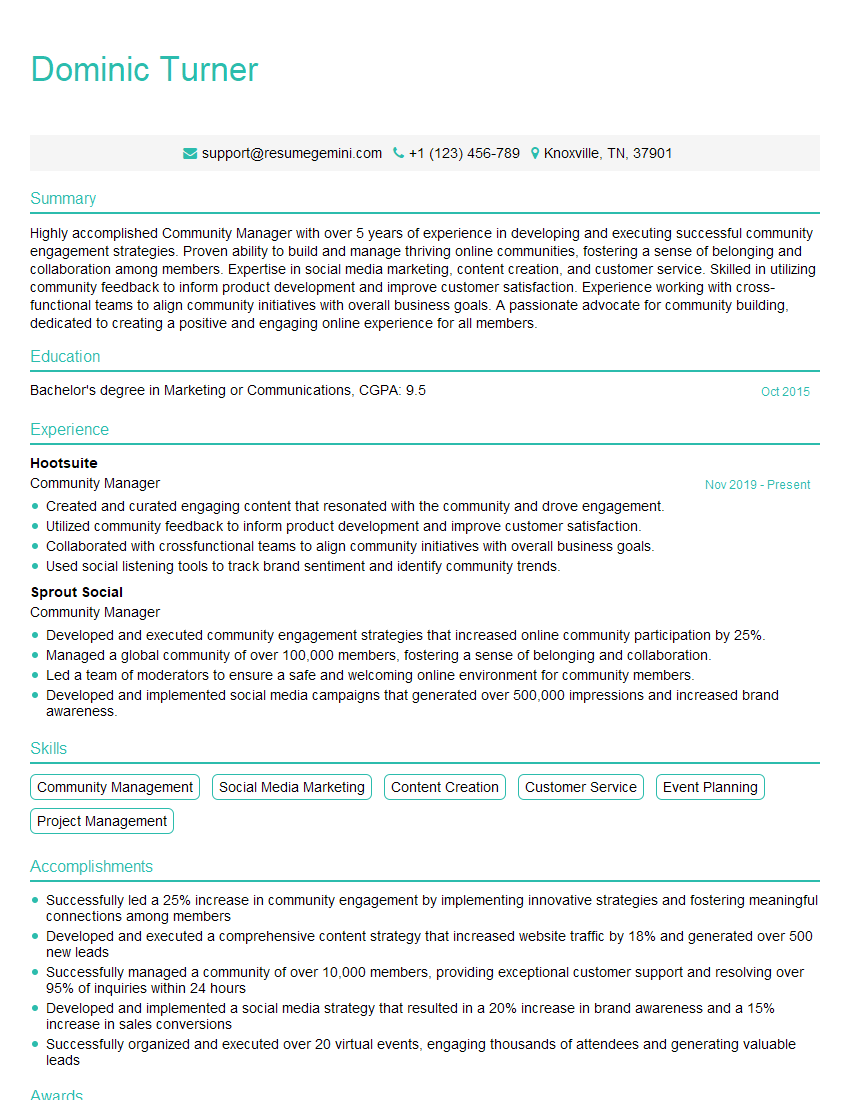
Community Manager Resume Sample

Social Media Manager Resume Sample

Information Architect Resume Sample
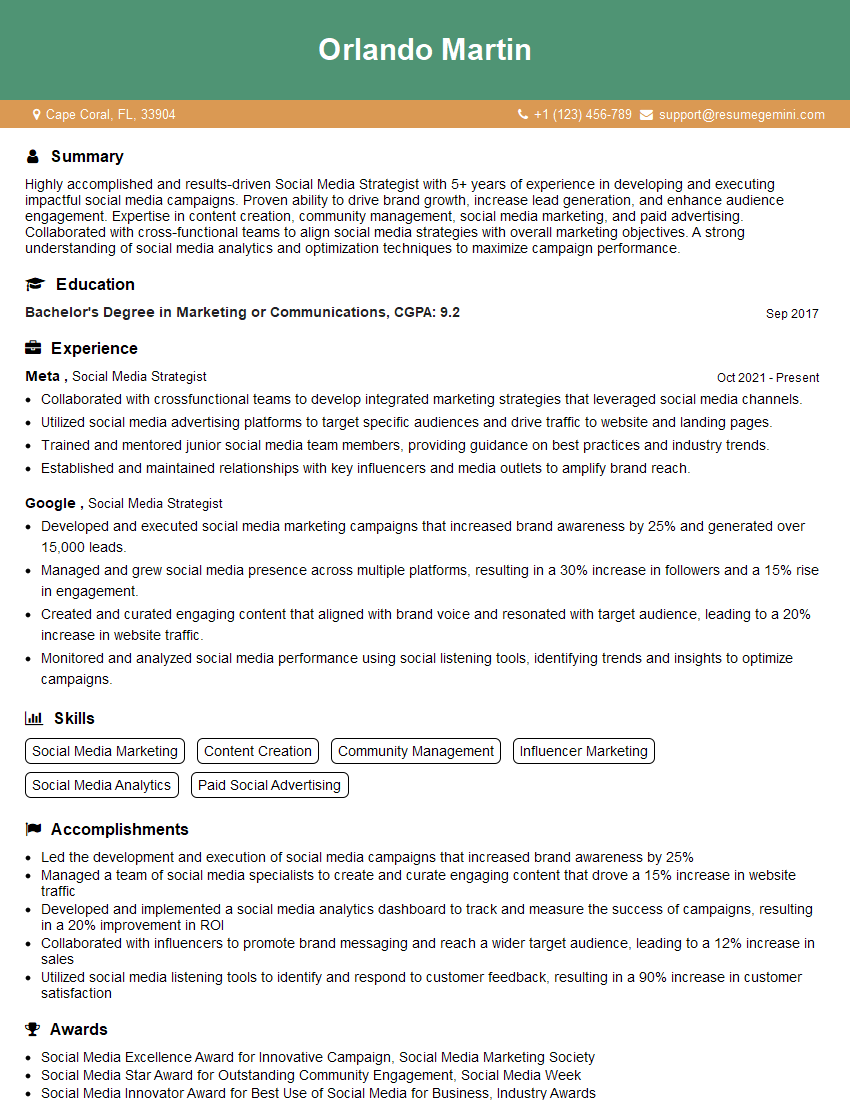
Social Media Strategist Resume Sample

Content Strategist Resume Sample
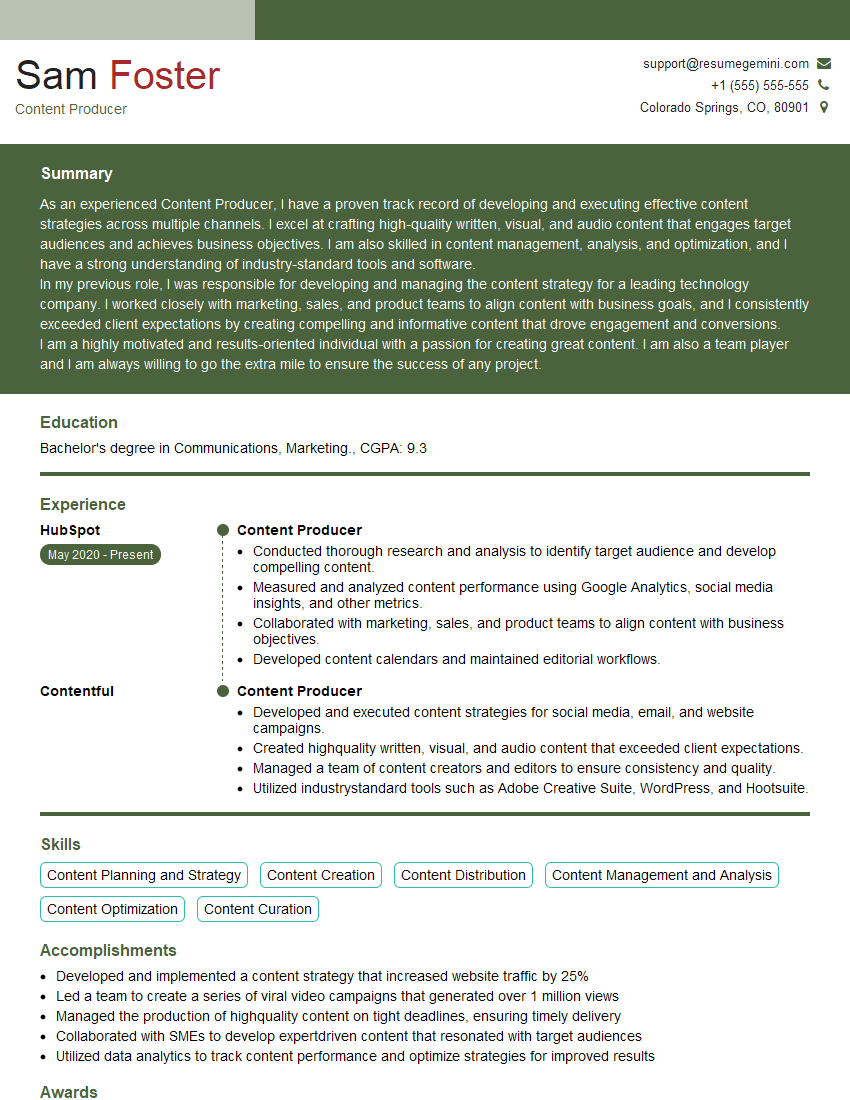
Content Producer Resume Sample

Technical Writer Resume Sample
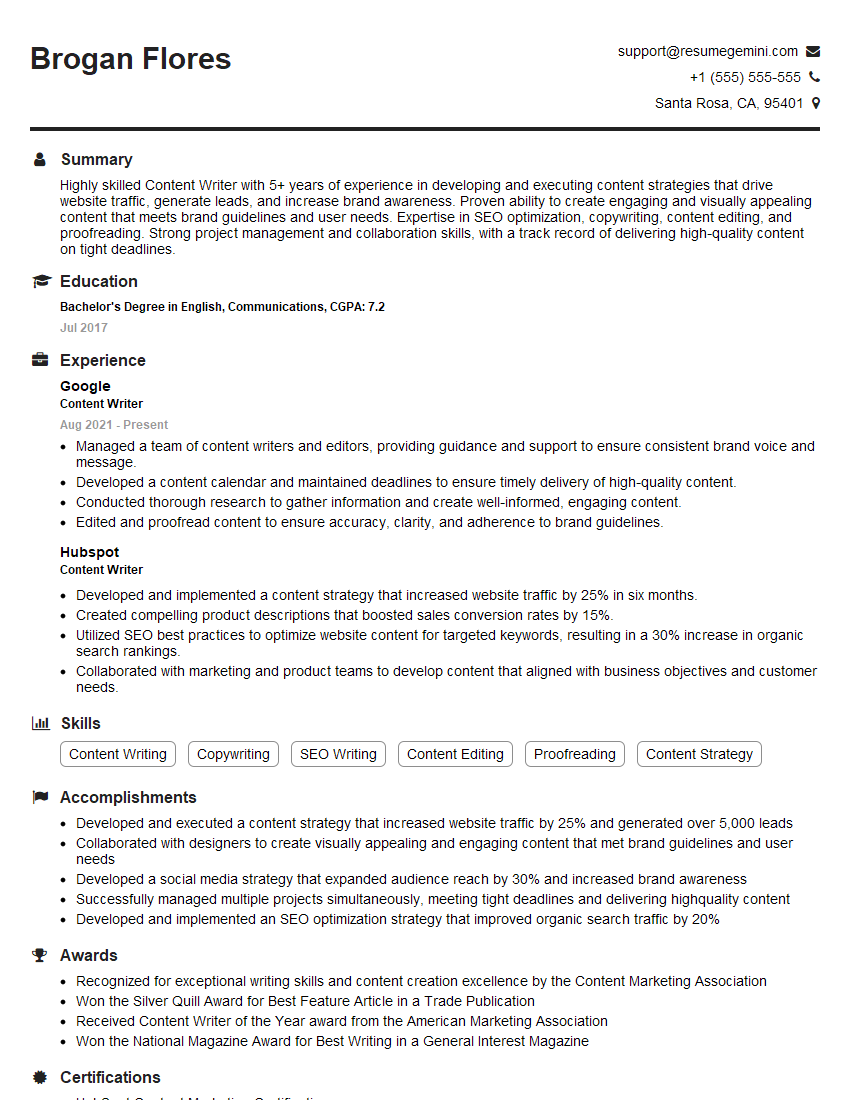
Content Writer Resume Sample
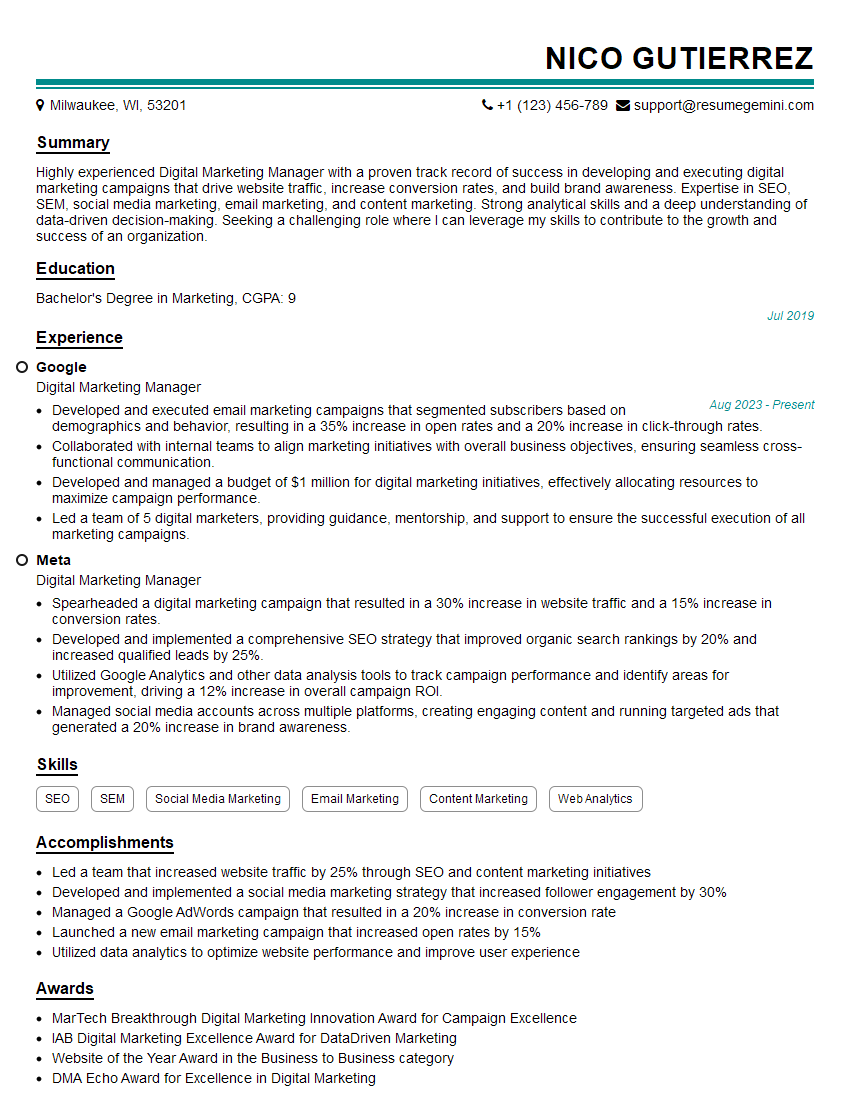
Digital Marketing Manager Resume Sample
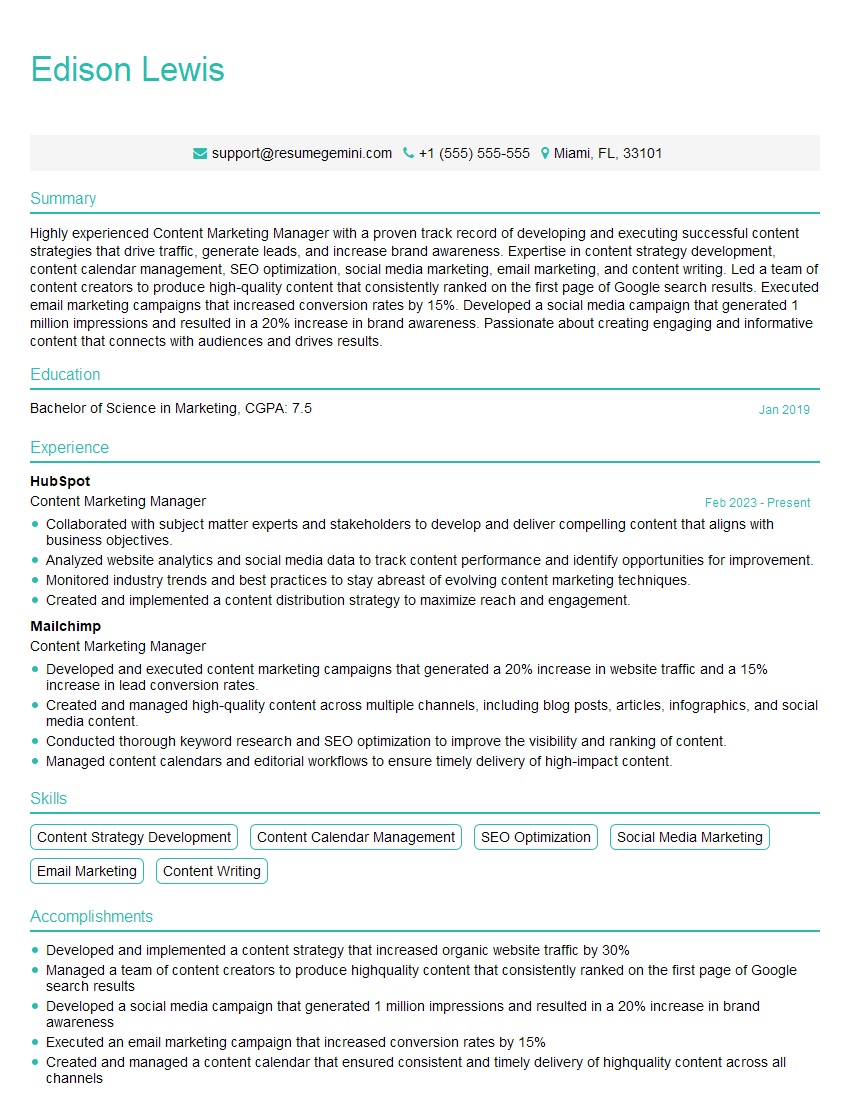
Content Marketing Manager Resume Sample
Explore more articles
Users Rating of Our Blogs
Share Your Experience
We value your feedback! Please rate our content and share your thoughts (optional).
What Readers Say About Our Blog
Very informative content, great job.
good