Interviews are more than just a Q&A session—they’re a chance to prove your worth. This blog dives into essential Experience with Glass Bending interview questions and expert tips to help you align your answers with what hiring managers are looking for. Start preparing to shine!
Questions Asked in Experience with Glass Bending Interview
Q 1. Describe the different methods of glass bending.
Glass bending, or glass forming, encompasses several methods, all relying on manipulating the glass’s viscosity through heat. The primary techniques are:
- Heat Bending: This involves heating the glass to its softening point and then forming it using molds or gravity. This is the most common method and is further broken down into techniques using different heating methods (e.g., furnaces, radiant heaters).
- Flame Bending: A localized heating method using a torch or flame to soften small sections of glass, allowing for precise shaping and intricate designs. It’s ideal for smaller pieces and artistic applications.
- Vacuum Forming: A specialized technique where heated glass is shaped using vacuum pressure against a mold. This method allows for complex curves and uniform thickness.
- Pressing: While not strictly ‘bending’, pressing involves using a mold and high pressure to shape hot glass. This is often used for creating flat or curved pieces with consistent shapes.
The choice of method depends heavily on factors such as the desired shape, the size of the glass piece, and the required level of precision.
Q 2. Explain the principles of heat bending glass.
Heat bending relies on the principle that glass, when heated to its annealing point (around 600-650°C for soda-lime glass, but varying widely depending on the glass type), becomes malleable. At this temperature, its viscosity decreases significantly, allowing it to deform under gravity or when shaped against a mold. The process generally involves these steps:
- Heating: The glass is uniformly heated in a controlled environment (furnace or kiln) to reach its softening point. The temperature must be carefully controlled to avoid thermal stress.
- Forming: Once softened, the glass is manipulated to the desired shape. This might involve using gravity, a mold, or a combination of both.
- Cooling (Annealing): This is the crucial step. The glass is gradually cooled in a controlled manner (annealing) to relieve internal stresses built up during heating and shaping. Rapid cooling can lead to cracking or shattering.
Think of it like working with taffy – you heat it until it’s soft enough to mold, then carefully shape it and let it cool slowly to prevent breakage. Failure to anneal properly is a common source of problems in heat bending.
Q 3. What are the safety precautions involved in glass bending?
Safety is paramount in glass bending. The high temperatures involved and the potential for sharp glass fragments necessitate stringent safety measures:
- Eye protection: Safety glasses or face shields are mandatory to protect against flying debris or intense heat radiation.
- Heat-resistant gloves and clothing: Protective clothing is essential to prevent burns and skin damage.
- Proper ventilation: Adequate ventilation is necessary to remove harmful fumes, especially when working with certain types of glass.
- Handling hot glass with caution: Always use appropriate tools like tongs or heat-resistant gloves when handling hot glass.
- Proper furnace operation and maintenance: Following the manufacturer’s safety guidelines for the furnace is critical. Regular maintenance is also important to ensure safe operation.
- Emergency procedures: Having a well-defined emergency plan in place is essential to handle accidents or injuries.
A clear understanding of the potential hazards and consistent adherence to safety protocols are critical to preventing accidents.
Q 4. How do you determine the appropriate temperature for glass bending?
Determining the correct temperature is crucial for successful glass bending. It depends on several factors:
- Type of glass: Different glass compositions have different softening points. Borosilicate glass, for example, requires a higher temperature than soda-lime glass.
- Thickness of glass: Thicker glass requires higher temperatures and longer heating times to reach the softening point.
- Desired shape: Complex shapes often require more precise temperature control.
- Furnace type: Different furnaces may have varying temperature distributions and heating rates.
I typically use a combination of pyrometers (for accurate temperature measurement) and experience to determine the appropriate temperature. Starting with a lower temperature and gradually increasing it while observing the glass’s behavior is a common practice. Trial runs with samples are invaluable in refining the temperature profile for a specific job.
Q 5. What types of glass are best suited for bending?
Not all glass is equally suited for bending. The best types generally possess a good balance of strength, thermal stability, and workability at the bending temperature.
- Soda-lime glass: This is the most common type used for bending due to its relatively low cost and ease of working. However, its thermal shock resistance is lower compared to some other types.
- Borosilicate glass (e.g., Pyrex): This glass has excellent thermal shock resistance, making it suitable for applications requiring rapid temperature changes. However, it requires a higher bending temperature.
- Tempered glass: While extremely strong, tempered glass is unsuitable for bending because it shatters unpredictably when reheated.
The selection depends on the specific application and performance requirements. For instance, a high-end oven door might use borosilicate glass for its heat resistance, while a decorative art piece could use soda-lime glass for its ease of shaping.
Q 6. Describe your experience with different types of glass bending furnaces or kilns.
My experience spans various types of glass bending furnaces and kilns, from small benchtop units for artistic work to large industrial furnaces capable of handling significant glass volumes. I’ve worked with:
- Electrically heated furnaces: These offer precise temperature control and uniform heating but are generally more expensive to operate.
- Gas-fired furnaces: These are cost-effective for large-scale production but require careful monitoring and maintenance to ensure consistent temperature distribution.
- Radiant heating systems: These systems use infrared radiation to heat the glass, offering localized control and are particularly useful for flame bending or smaller projects.
The choice of equipment significantly influences the efficiency and quality of the bending process. For example, working with a large gas-fired furnace demands a thorough understanding of the burner configuration and airflow to avoid thermal gradients that could lead to uneven bending.
Q 7. How do you ensure the quality and consistency of bent glass?
Ensuring consistent quality in bent glass involves careful attention to every stage of the process.
- Precise temperature control: Using accurate pyrometers and well-maintained furnaces is critical for consistent heating.
- Proper mold design and use: Molds should be designed for the specific glass and shape, ensuring consistent contact and pressure.
- Controlled cooling (annealing): A slow, even cooling rate is vital to relieve internal stresses and prevent cracking.
- Quality inspection: Regular inspection of the finished pieces for defects, such as bubbles, stress marks, or imperfections in shape, is crucial for quality assurance.
- Process documentation: Detailed records of the bending process, including temperature profiles and cooling schedules, are essential for consistency and troubleshooting.
In my experience, establishing standardized operating procedures and rigorous quality control measures are essential for producing consistently high-quality bent glass. This not only ensures customer satisfaction but also minimizes material waste and production delays.
Q 8. What are the common defects found in bent glass, and how do you prevent them?
Common defects in bent glass often stem from inconsistencies during the heating and forming process. These include things like surface cracking (often due to uneven heating or stress), internal stresses leading to delayed fracture (think of a tiny crack that propagates later), waviness (uneven bending radius), and residual stresses which can weaken the glass over time. Prevention involves meticulous control of the entire bending process. This starts with carefully selecting the glass type (certain types are more amenable to bending), precise temperature control during the heating phase using sophisticated sensors and feedback loops, ensuring uniform heating through techniques like using multiple radiant heaters strategically positioned to avoid hot spots, using proper bending molds designed to distribute stress evenly, and implementing slow, controlled cooling cycles to minimize residual stresses. For instance, a poorly designed mold with sharp corners could easily lead to stress concentration and cracking. Similarly, rapid cooling can trap stresses within the glass causing spontaneous breakage days or weeks later.
- Surface Cracking Prevention: Employing even heating, using appropriate mold designs, and controlled cooling rates.
- Internal Stress Prevention: Carefully selecting glass type, precise temperature control, and slow, controlled cooling.
- Waviness Prevention: Precision in mold design and manufacturing, and consistently maintained heating and bending parameters.
Q 9. Explain your experience with different bending molds and techniques.
My experience encompasses a variety of bending molds, from simple gravity molds for less complex curves to sophisticated, computer-numerically controlled (CNC) molds capable of producing intricate shapes. I’ve worked extensively with both ceramic and steel molds, each having its own advantages and limitations. Ceramic molds, while more brittle, can handle higher temperatures, allowing for more flexibility in glass types and shapes. Steel molds, conversely, offer better durability and precision but might require more careful temperature control to avoid warping. As for techniques, I’m proficient in both the traditional roller bending method and the more modern air bending method. Roller bending is excellent for simpler curves where multiple rollers are used to shape the heated glass, while air bending employs air pressure within the mold to achieve the desired curve—offering greater control for complex shapes. For example, on a recent automotive project requiring a highly curved windshield, air bending proved superior for achieving the precise radius and smooth surface finish necessary.
Q 10. How do you measure and control the bending radius of glass?
Measuring and controlling the bending radius is critical. We use a combination of techniques, beginning with precise CAD modeling to design the desired shape. This model dictates the mold design. During the bending process, we utilize optical measurement systems to monitor the radius in real-time, ensuring adherence to specifications. These systems employ laser sensors or cameras to measure the curvature of the glass as it’s being bent. We also employ strategically placed thermocouples within the mold to monitor temperature distribution. This ensures not only the correct radius but also the avoidance of stress concentrations. Slight deviations can be addressed during the process through adjustments to temperature and bending pressure. Post-bending, a final inspection with high precision measuring equipment is essential to confirm that the radius falls within tolerance. Inaccurate control can result in parts being out of specification, requiring costly rework or rejection.
Q 11. How do you handle and store bent glass to prevent breakage?
Handling and storing bent glass requires meticulous care to prevent breakage. Immediately after bending and cooling, the glass needs careful handling to avoid impact or stress. We use specialized handling equipment like suction cups and padded carriers. Storage is equally important; bent glass is stored on padded racks in a controlled environment, protected from temperature fluctuations and impacts. This helps to minimize the risk of stress-induced cracking. We also maintain detailed records of each piece, including bending parameters and post-bending inspection data. This allows us to better understand the behavior of the glass and fine-tune handling and storage practices to further minimize risks. Imagine handling a piece of highly curved, thin glass – even a small bump could cause cracking. So, the right equipment and environment are paramount.
Q 12. Describe your experience with troubleshooting glass bending equipment.
Troubleshooting glass bending equipment involves a systematic approach. It often begins with identifying the symptom – for example, inconsistent heating, inaccurate bending radius, or equipment malfunction. I start by checking the simplest things first: sensor calibration, gas flow rates (if using gas heating), and the proper functionality of control systems. I’ve had to troubleshoot everything from faulty thermocouples to issues with the control software in CNC-operated bending machines. In cases of more complex problems, I rely on diagnostic tools and my understanding of the equipment’s mechanics and the bending process itself. Documenting the troubleshooting process, along with corrective actions, allows us to avoid repeat problems and optimize the maintenance schedule for the equipment.
Q 13. What are the limitations of glass bending?
Glass bending, while versatile, has limitations. The thickness of the glass significantly impacts the minimum bending radius achievable – thinner glass is easier to bend but can be more prone to cracking. The type of glass also matters; some glass compositions are more amenable to bending than others. Complex shapes present challenges in terms of achieving uniform stress distribution and preventing warping. Extremely sharp bends are often difficult to achieve without cracking or other defects. Finally, the size of the glass sheet also affects the process; bending large sheets requires specialized equipment and expertise. Understanding these limitations is crucial for selecting the appropriate glass type and bending technique for a given project.
Q 14. How do you adapt glass bending techniques for different applications (e.g., automotive, architectural)?
Adapting glass bending techniques to different applications necessitates a tailored approach. For automotive applications, the focus is on precision, achieving tight tolerances, and ensuring structural integrity for windshields and other components. High-quality, high-strength glass is often employed, and bending techniques must be refined to avoid stress concentrations. In architectural applications, the emphasis often shifts to aesthetics and larger scale, where the ability to produce large, curved panels with minimal defects is key. The type of glass (e.g., laminated safety glass) may also change depending on the application’s safety requirements. Ultimately, this necessitates a thorough understanding of the specific requirements for each application and adapting the equipment, glass selection, and bending process accordingly.
Q 15. Describe your experience with automated glass bending systems.
My experience with automated glass bending systems spans over a decade, encompassing various technologies from older, less precise systems to the latest state-of-the-art machinery. I’ve worked extensively with both CNC-controlled bending machines and those utilizing advanced robotics for precise handling and placement. I’m proficient in operating, maintaining, and troubleshooting these systems, including understanding the intricacies of their control software and mechanical components. For example, I once diagnosed a recurring issue in a robotic arm’s calibration on a high-volume production line, saving the company significant downtime and reducing scrap. My expertise extends to optimizing these systems for various glass types and thicknesses, achieving consistent results and maximizing efficiency. This includes familiarity with different heating methods, like infrared and convection, and their impact on the bending process.
- Experience with various heating techniques (infrared, convection, etc.)
- Proficiency in CNC and robotic control systems
- Deep understanding of system calibration and maintenance
- Optimization of automated bending processes for throughput and quality
Career Expert Tips:
- Ace those interviews! Prepare effectively by reviewing the Top 50 Most Common Interview Questions on ResumeGemini.
- Navigate your job search with confidence! Explore a wide range of Career Tips on ResumeGemini. Learn about common challenges and recommendations to overcome them.
- Craft the perfect resume! Master the Art of Resume Writing with ResumeGemini’s guide. Showcase your unique qualifications and achievements effectively.
- Don’t miss out on holiday savings! Build your dream resume with ResumeGemini’s ATS optimized templates.
Q 16. How do you calculate the stress and strain in bent glass?
Calculating stress and strain in bent glass involves a combination of theoretical calculations and practical considerations. We use finite element analysis (FEA) software extensively. The process begins with defining the glass’s geometry, material properties (Young’s modulus, Poisson’s ratio), and the applied bending forces or moments. The FEA software then models the glass as a mesh of interconnected elements, calculating the stress and strain distribution throughout the structure under these loads. Critical areas to watch are the inner and outer surfaces of the bend where tensile and compressive stresses are highest. It’s crucial to ensure that the calculated stresses remain below the glass’s ultimate strength to avoid breakage. Think of it like bending a metal rod – too much force, and it snaps. Similarly, exceeding the glass’s stress limit leads to cracking or failure. Safety factors are applied to account for uncertainties and variations in glass properties.
In simpler terms, imagine a ruler. Bending it creates tension on the outer curve and compression on the inner curve. The FEA software quantifies this mathematically, predicting the precise stress and strain at each point along the bent glass.
Q 17. What software or tools do you use to design and simulate glass bending?
For design and simulation of glass bending, I predominantly use industry-standard software such as ANSYS, Abaqus, and Autodesk Inventor. These tools offer robust FEA capabilities, allowing for accurate prediction of stress, strain, and deflection under various loading conditions. Beyond FEA, we also use CAD software like SolidWorks to create detailed 3D models of the glass and its supporting structures. These models are critical for ensuring the bent glass fits seamlessly into its final application. For example, we use Inventor to design custom tooling and jigs for the bending process. This allows for very precise control over the final shape and dimensions. We also employ dedicated glass bending simulation software that incorporates specific material models and thermal effects for a more accurate outcome.
Q 18. How do you ensure the dimensional accuracy of bent glass?
Ensuring the dimensional accuracy of bent glass requires a multifaceted approach that starts even before the bending process itself. It begins with precise measurements of the raw glass sheets, ensuring uniformity in thickness and surface quality. The design phase, using software like those mentioned earlier, is crucial in defining the exact dimensions and curvature needed. During the bending process itself, careful control of temperature and pressure is paramount. Precisely calibrated tooling and fixtures are used to maintain consistent bending radii and angles. After bending, dimensional checks are performed using high-precision measuring tools, including optical scanners and CMM (Coordinate Measuring Machines). Any deviations from the design specifications trigger adjustments to the process parameters or tooling. For instance, if we detect consistent inconsistencies in one dimension, we might re-calibrate the bending machine’s rollers or adjust the heating profile.
Q 19. Explain your experience with quality control procedures for bent glass.
Quality control in bent glass production is stringent and starts from raw material inspection. We check for flaws like scratches, inclusions, and variations in thickness. During the bending process, continuous monitoring of temperature and pressure ensures consistent results. Post-bending, rigorous inspection involves visual checks for cracks, chips, or deviations in curvature. Dimensional accuracy is verified using precise measurement equipment. Sampling is employed, whereby a percentage of the finished pieces undergo destructive testing to verify the strength and durability. We meticulously document all quality checks and testing results. A failure at any stage triggers investigation into the root cause to prevent recurrence, this could range from recalibrating equipment to adjusting material sourcing.
Q 20. What are the environmental considerations in glass bending?
Environmental considerations in glass bending are significant. The high temperatures involved in the bending process lead to energy consumption and potential greenhouse gas emissions. Therefore, we prioritize energy-efficient heating systems and optimize the bending process to minimize energy waste. The process also generates particulate matter, necessitating proper ventilation and filtration systems to maintain a safe working environment and minimize air pollution. The disposal of waste materials must adhere to local environmental regulations. We utilize sustainable practices where possible, like recycling broken glass and using recycled materials when appropriate, and always strive to minimize our environmental footprint. For example, we have implemented a system to recapture heat from the bending process and reuse it for preheating, which reduces energy needs.
Q 21. How do you handle different types of glass compositions?
Handling different types of glass compositions requires adapting the bending parameters. Each glass type has unique thermal and mechanical properties; soda-lime, borosilicate, and tempered glass all require different temperatures and bending pressures to achieve the desired result without causing stress cracks or breakage. Our knowledge of these properties is key to setting the correct parameters in our machinery. This involves carefully selecting the heating rate, dwell time at peak temperature, and cooling rates to avoid thermal shock. For example, borosilicate glass, known for its higher thermal resistance, can tolerate more rapid temperature changes than soda-lime glass. Understanding this, we can optimize the process to ensure minimal deformation and high-quality bends. Furthermore, we adapt our quality control procedures to suit the specific characteristics of each type of glass.
Q 22. Describe your experience with various annealing processes for bent glass.
Annealing is a crucial post-bending process for glass, relieving internal stresses built up during the heating and forming stages. Improper annealing can lead to cracking or spontaneous shattering. I have extensive experience with several methods:
Air Cooling: This is the simplest method, where the bent glass is allowed to cool slowly in ambient air. It’s suitable for smaller pieces and less complex shapes but can be slow and less precise in stress reduction.
Convection Annealing: This utilizes fans to circulate air around the glass, accelerating the cooling process and providing more uniform temperature distribution. It’s faster than air cooling and suitable for a broader range of sizes and shapes.
Controlled Atmosphere Annealing: This offers the most precise control. The glass is placed in a furnace with a carefully controlled atmosphere (often nitrogen) and cooling schedule to minimize stress. This is essential for large, complex, or high-precision bent glass components. It allows for very fine tuning of the cooling rate.
Electric Annealing Furnaces: These furnaces provide precise and repeatable temperature control, offering excellent consistency and repeatability across batches. This is crucial for high-volume production.
My experience encompasses selecting the appropriate annealing method based on glass type, shape complexity, and desired final product specifications. I’ve worked with both automated and manual annealing systems, consistently achieving optimal stress relief and minimizing breakage.
Q 23. What are the different types of glass bending molds?
Glass bending molds are critical for achieving the desired shape and quality. They come in various types, each with its strengths and weaknesses:
Cast Iron Molds: Durable and relatively inexpensive, but can be heavy and difficult to maintain. Ideal for high-volume production of simple shapes.
Steel Molds: Offer superior heat transfer properties compared to cast iron, enabling faster bending cycles. More expensive than cast iron but provide better surface finish.
Ceramic Molds: Excellent for high-temperature applications and complex shapes, providing exceptional dimensional accuracy. More fragile and require careful handling.
CNC-machined Molds: Offer precise control over mold geometry, enabling the creation of highly complex and intricate shapes. Relatively expensive but essential for advanced applications.
Flexible Molds: Used for free-form bending, providing flexibility in design but demanding precise material selection and control of bending parameters.
The choice of mold material depends heavily on the glass type, desired shape, and production volume. For instance, complex curved architectural glass often requires a CNC-machined steel or ceramic mold, while simpler shapes might utilize cast iron molds.
Q 24. How do you maintain and clean glass bending equipment?
Maintaining and cleaning glass bending equipment is crucial for safety, efficiency, and product quality. My routine includes:
Regular Inspection: Checking for any damage, wear, or loose components on a daily basis before commencing operations.
Cleaning after each use: Removing any glass fragments, debris, or residue from molds, rollers, and other components using appropriate tools and cleaning agents. This prevents cross-contamination and ensures consistent product quality.
Lubrication: Applying appropriate lubricants to moving parts to reduce friction, wear, and ensure smooth operation. This also helps prevent damage and extends the lifespan of equipment.
Preventative Maintenance: Regularly scheduled maintenance checks and servicing according to manufacturer recommendations, including replacing worn parts and performing calibrations.
Safety Checks: Verifying safety features, such as emergency stops and safety guards, are functioning correctly before each use.
A clean and well-maintained system is critical for minimizing downtime and ensuring safe operation. It also directly translates to higher quality finished products and reduced risk of defects.
Q 25. Describe a time you had to troubleshoot a problem during glass bending.
During a large-scale architectural glass bending project, we encountered consistent cracking in the final product despite maintaining seemingly correct parameters. After a thorough investigation, we discovered subtle variations in the thickness of the glass sheets. These variations were not initially identified during quality control but became critical during the high-temperature bending process, leading to stress concentrations and cracking.
Our troubleshooting involved:
Careful analysis of the cracked pieces: Identifying the precise location and pattern of cracks.
Review of the glass supplier’s specifications: Verifying the uniformity of the glass sheets.
Implementing stricter quality control measures: Employing more precise thickness measurements for incoming glass.
Adjusting the bending process parameters: Modifying temperature profiles and dwell times based on the identified thickness variations.
By systematically investigating the problem and implementing corrective actions, we were able to eliminate the cracking and successfully complete the project. This incident highlighted the importance of rigorous quality control and the need for a flexible approach to troubleshooting.
Q 26. What are the different types of safety equipment used in glass bending?
Safety is paramount in glass bending. We utilize various safety equipment:
Heat-resistant gloves and clothing: Protecting against burns from hot glass and equipment.
Safety glasses and face shields: Protecting against flying debris and glass fragments.
Hearing protection: Mitigating noise levels from machinery.
Steel-toe boots: Protecting feet from falling objects.
Respirators: Protecting against dust and fumes during cleaning and maintenance.
Emergency eye wash stations and showers: Providing immediate first aid in case of accidents.
Regular safety training is conducted to ensure all personnel are familiar with the risks and appropriate safety protocols.
Q 27. How do you ensure the safety of yourself and others during glass bending operations?
Ensuring safety is an ongoing process. We adhere to strict protocols:
Risk assessments: Identifying potential hazards before starting any operation.
Lockout/Tagout procedures: Disconnecting power sources and securing equipment before maintenance.
Proper handling of glass: Using appropriate lifting techniques and avoiding sharp edges.
Regular safety training and drills: Keeping personnel updated on safety procedures and emergency response.
Clear communication: Maintaining open communication among team members to identify and address potential hazards.
Adherence to all relevant safety regulations and standards: Ensuring compliance with industry best practices.
A proactive safety culture is vital, emphasizing personal responsibility and collective vigilance. Safety is not just a set of rules, but a shared commitment that permeates every aspect of our operations.
Q 28. What are your long-term career goals related to glass bending?
My long-term career goals involve further developing my expertise in advanced glass bending techniques, particularly in the area of sustainable and innovative glass applications. I am interested in exploring new materials and processes that allow for more complex shapes, improved efficiency, and reduced environmental impact. I aspire to contribute to the advancement of glass bending technology through research, development, and mentorship, ultimately helping to push the boundaries of what is possible in this field.
I am also keen on contributing to the development of safer and more efficient glass bending processes through innovations in equipment design and automated systems. My ultimate aim is to become a recognized leader in the field, contributing to both the technical advancement and the safety of glass bending practices worldwide.
Key Topics to Learn for Your Glass Bending Interview
- Glass Properties and Selection: Understanding different glass types (annealed, tempered, etc.), their thermal properties, and suitability for various bending techniques.
- Bending Techniques: Familiarity with different glass bending methods such as flame bending, slumping, and gravity bending. Understanding the advantages and limitations of each.
- Safety Procedures and Regulations: Knowledge of safety protocols related to handling hot glass, using specialized equipment, and adhering to industry safety standards.
- Kiln Operation and Control: Understanding kiln temperature control, firing schedules, and the impact of various parameters on the final glass shape and quality.
- Mold Design and Fabrication: Knowledge of designing and creating molds for various bending applications, including material selection and fabrication techniques.
- Troubleshooting and Quality Control: Ability to identify and resolve common issues during the glass bending process, ensuring consistent product quality and minimizing waste.
- Post-Processing Techniques: Understanding techniques like annealing, grinding, and polishing to achieve the desired final product finish.
- Project Management and Collaboration: Experience working on glass bending projects from design to completion, collaborating effectively with a team.
Next Steps: Level Up Your Glass Bending Career
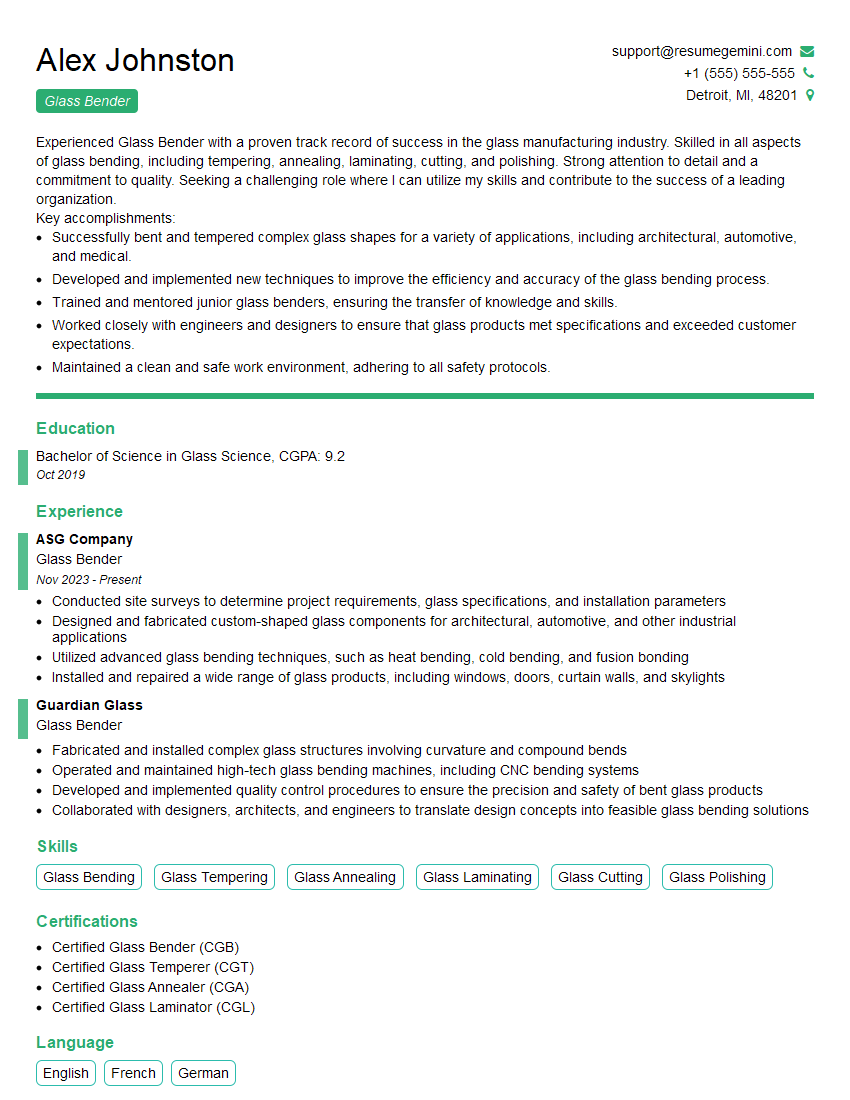
Mastering glass bending techniques opens doors to exciting opportunities in diverse industries, from architectural design to high-end art glass creation. To maximize your job prospects, it’s crucial to present your skills effectively. Creating an ATS-friendly resume is key to getting your application noticed by recruiters. We encourage you to leverage the power of ResumeGemini to build a compelling and professional resume that highlights your expertise in glass bending. ResumeGemini provides numerous examples of resumes tailored to glass bending professionals, helping you showcase your unique skills and experience to potential employers.
Explore more articles
Users Rating of Our Blogs
Share Your Experience
We value your feedback! Please rate our content and share your thoughts (optional).
What Readers Say About Our Blog
Very informative content, great job.
good