Preparation is the key to success in any interview. In this post, we’ll explore crucial Experience with Prepress Software interview questions and equip you with strategies to craft impactful answers. Whether you’re a beginner or a pro, these tips will elevate your preparation.
Questions Asked in Experience with Prepress Software Interview
Q 1. Explain the process of creating a PDF/X-1a compliant file.
Creating a PDF/X-1a compliant file is crucial for ensuring consistent color and accurate reproduction in print. PDF/X-1a is a standard that dictates specific parameters to prevent issues during the printing process. Think of it like a recipe – following it ensures the final product turns out as expected.
The process involves several key steps:
- Color Mode: Convert your document to CMYK color mode. PDF/X-1a doesn’t support RGB or other color spaces directly. This is vital because printers use CMYK inks.
- Embedded Profiles: Embed an ICC (International Color Consortium) profile. This profile defines the color characteristics of your document, allowing the printer to accurately interpret and reproduce your colors. Imagine the profile as a translator ensuring your printer understands your ‘color language’.
- Fonts: Embed all fonts used in the document. This prevents font substitution, which can lead to text mismatches or formatting errors. Missing fonts are a common source of prepress problems.
- Image Resolution: Ensure images are at the appropriate resolution for print (generally 300 dpi). Low-resolution images will appear blurry or pixelated in the final print.
- Transparency: Flatten any transparency effects. PDF/X-1a doesn’t always handle transparency well, so flattening ensures a consistent and predictable output. You want to avoid unexpected results.
- Output Intent: Specify the output intent for printing – this tells the printer how the colors should be interpreted and rendered based on the selected ICC profile.
- PDF Export: Export the document as a PDF/X-1a compliant file using your prepress software (Adobe Acrobat Pro is commonly used for this).
Ignoring these steps can lead to mismatched colors, missing fonts, and other issues that delay the printing process and potentially lead to costly reprints.
Q 2. Describe your experience with color management and profiles (e.g., ICC profiles).
Color management is the cornerstone of successful print production. ICC profiles are the key. They act like a digital fingerprint for a specific device (scanner, monitor, printer), describing how it reproduces color. Without proper color management, the colors you see on your screen will likely differ significantly from the final printed piece.
My experience encompasses a wide range of color management techniques, from creating custom ICC profiles for specific printers to troubleshooting color discrepancies between different devices. I’m proficient in using software like Adobe Photoshop and Acrobat to assign, convert, and manage color profiles. For example, I’ve successfully resolved a client’s color issue where their vibrant logo appeared dull in print by accurately profiling their printer and ensuring correct color space conversion from RGB to CMYK. This involved carefully selecting the right ICC profile and managing the color conversion process to minimize color shifts. Proper color management avoids costly reprints and ensures consistent branding.
Q 3. What software are you proficient in for image editing and prepress tasks (e.g., Adobe Photoshop, Illustrator, InDesign)?
I’m highly proficient in Adobe Creative Suite, specifically Photoshop, Illustrator, and InDesign. These are the industry-standard tools for image editing and prepress preparation.
- Photoshop: I leverage Photoshop for image retouching, color correction, resolution adjustments, and preparing images for print. This includes ensuring proper image format and resolution.
- Illustrator: I use Illustrator for creating and manipulating vector graphics, ensuring crisp and scalable artwork for print. This is crucial for logos and other design elements.
- InDesign: My expertise extends to InDesign for page layout, typography, and creating the final prepress-ready document. This involves careful attention to details such as bleed and margins.
Beyond the Adobe suite, I’ve also worked with other prepress software like Pitstop Pro for preflighting and correcting PDF files to ensure that they are ready for printing and that they meet print-ready standards. This has saved me time and reduced potential printing errors.
Q 4. How do you handle trapping and its importance in print production?
Trapping is a crucial technique in print production to prevent gaps between colors, especially in areas where different colors meet. Imagine two colored shapes, very close together. Without trapping, a tiny white gap could appear between them during printing. Trapping compensates for this by slightly overlapping the colors.
There are different trapping methods, such as spread trapping (where one color extends slightly into the other) and choke trapping (where one color is reduced to prevent a gap). The choice of trapping method depends on the printing process and the design. I’m experienced in setting up trapping using both software-based solutions (integrated in some prepress software) and manual trapping techniques where I control the amount of overlap for each color. Proper trapping ensures a clean, professional look, preventing unsightly gaps between colors. Overlooking trapping can make the final print look unprofessional. It’s a detail that adds to high quality final output.
Q 5. Explain your experience with imposition software.
Imposition software is essential for arranging pages of a document in the correct order for printing. Think of it as planning how the pages will be placed on a printing sheet to minimize waste and ensure efficient printing. I’ve worked extensively with imposition software such as Imposition, and others, to create imposition plans for various printing formats, including brochures, books, and business cards. This includes defining the number of pages, sheet size, and orientation to get the most efficient use of paper. Imposition is crucial for efficient print workflow and waste reduction. Without it, you could waste a considerable amount of paper and time.
My experience extends to using imposition software to create efficient imposition plans that minimizes paper waste while ensuring the correct page order and alignment. For example, I’ve optimized imposition plans for large book projects, leading to significant cost savings for the client by reducing paper waste, which ultimately reduced overall printing cost.
Q 6. What is your experience with color separation and its relevance to different printing methods?
Color separation is the process of separating a full-color image into individual color plates (typically CMYK – Cyan, Magenta, Yellow, and Black). This is crucial for offset printing, where each color is printed separately. In digital printing this step might be handled by the printer directly.
The relevance to different printing methods varies. Offset printing requires color separation to create individual plates for each color. Digital printing often handles color separation internally. My experience includes creating color separations for offset printing, ensuring accurate color registration and minimizing dot gain (the spreading of ink during printing). The understanding of color separation is crucial for predicting final print output. Incorrect color separation will lead to inaccurate colors and poor print quality.
Q 7. Describe your understanding of different printing processes (e.g., offset, digital).
I have a thorough understanding of various printing processes, including offset and digital printing. Offset printing is a high-volume, cost-effective process ideal for large print runs. It involves transferring ink from a plate to a blanket cylinder and then to the paper. Digital printing, on the other hand, is ideal for smaller runs and personalized printing. It prints directly from a digital file onto the paper, eliminating the need for plates.
My experience allows me to select the appropriate printing method based on project requirements, quantity, budget, and desired quality. For example, I’d recommend offset for a large-scale book printing project, benefiting from its cost-effectiveness. However, for a smaller print run of personalized business cards, digital printing would be more appropriate due to its flexibility and faster turnaround time. Understanding the strengths and limitations of each process allows me to guide clients towards the most efficient and cost-effective solutions.
Q 8. How do you ensure the quality and accuracy of prepress files?
Ensuring the quality and accuracy of prepress files is paramount to a successful print job. It involves a multi-faceted approach, beginning even before the files arrive. We need to establish clear communication with clients regarding file specifications, including color profiles (e.g., CMYK, Pantone), resolution requirements, and bleed settings. This upfront clarity prevents costly mistakes later.
Once the files are received, a thorough preflight check is crucial. This automated process utilizes software like Acrobat Pro or preflight tools within applications like Adobe InDesign or QuarkXPress. These tools identify potential problems such as missing fonts, low-resolution images, incorrect color spaces, and overset text. Think of it as a comprehensive spell-check and grammar-check for your print file, catching errors before they go to press.
Manual inspection is also vital. This involves carefully reviewing each element of the design—checking for accurate color reproduction, sharp images, and the correct positioning of all elements. We use color calibrated monitors and proofing systems to ensure onscreen representation matches the final printed result.
Finally, we create digital proofs, often PDF/X-1a compliant, for client approval. This ensures the client sees exactly what will be printed, giving them the opportunity to catch any remaining issues before the plates are made. This layered approach—preflighting, manual inspection, and client approval—minimizes errors and ensures print quality.
Q 9. Explain your experience with proofreading and quality control procedures.
Proofreading and quality control are integral to my workflow. It’s not just about catching typos; it’s about ensuring the visual integrity and accuracy of the final product. My experience encompasses both automated and manual checks. For instance, I consistently use automated preflight tools to identify potential issues like missing links and low-resolution images, as mentioned earlier.
Manual proofreading involves meticulously checking for typographical errors, grammatical inconsistencies, and ensuring the correct usage of fonts and styles. I also examine the overall design layout, checking for any inconsistencies in spacing, alignment, or image placement. This often involves comparing the digital file against the client’s provided artwork or brief.
For quality control, I implement a checklist approach covering aspects like color accuracy, image sharpness, proper bleeds and margins, and font consistency. This helps maintain a standardized approach and reduces the chances of human error. I’ve found that creating detailed notes during the quality control process is beneficial, which allows for easy tracking and problem-solving should any issue arise.
In my previous role, a client had mistakenly provided a logo in RGB instead of CMYK. My thorough quality control process caught this early, preventing a significant color shift in the final print and saving a costly reprint.
Q 10. How do you manage and organize large volumes of prepress files?
Managing large volumes of prepress files requires a robust organizational system. I typically utilize a combination of techniques for efficient file management. This starts with a clearly defined naming convention, using a logical structure that identifies the client, project, and file type (e.g., ClientName_ProjectName_Filetype_Version). This immediately ensures easy searchability and reduces confusion.
Secondly, I rely heavily on well-structured folder systems, organized by client and project, often mirroring the client’s own project structure where possible. A cloud-based storage solution, such as Dropbox or Google Drive, is often used for easy collaboration and backup, ensuring files are readily available and secure. Version control is also crucial; I use versioning systems (such as numbering file versions) to track changes and easily revert to previous versions if necessary.
Finally, metadata tagging within the file system itself and using a dedicated Digital Asset Management (DAM) system (where appropriate) can prove invaluable for large-scale projects. This allows for rapid searching and retrieval of files based on specific criteria, significantly streamlining the workflow.
Q 11. Describe your experience with workflow automation software.
My experience with workflow automation software spans several platforms. I’ve worked extensively with MIS (Management Information Systems) software, such as those from companies like EFI, to streamline the entire prepress process. These systems integrate different software applications, automating tasks like job submission, file processing, color management, and proofing. This automation significantly reduces manual intervention, minimizes errors, and speeds up production.
For example, I’ve implemented systems where client files are automatically pre-flighted upon upload, flagging potential problems and alerting the appropriate team members. Automated imposition and plate creation software is another key aspect—reducing the time spent on these repetitive tasks and ensuring consistency across jobs.
I’m also familiar with scripting and automation tools within Adobe Creative Suite and other prepress applications, allowing for the creation of custom automated workflows tailored to specific client requirements or recurring tasks. For example, I created a script that automatically converts all images in a project folder to the correct color profile and resolution, saving significant time on large projects.
Q 12. What is your experience with different file formats used in prepress (e.g., TIFF, EPS, JPEG)?
My experience with various file formats used in prepress is extensive. I’m proficient in handling the most common formats, including:
- TIFF (Tagged Image File Format): A lossless format ideal for high-quality images, especially for print. Understanding the various compression options (e.g., LZW, PackBits) is essential for balancing file size and image quality.
- EPS (Encapsulated PostScript): A versatile vector-based format that’s often used for logos and illustrations. Proper embedding of fonts and handling of clipping paths are critical for accurate reproduction.
- JPEG (Joint Photographic Experts Group): A lossy format commonly used for photographs, but not ideal for high-quality print reproduction due to potential compression artifacts. Careful selection of the JPEG quality setting is vital.
- PDF (Portable Document Format): A crucial format for digital proofs and final artwork submission, particularly PDF/X-1a, which is designed for print-ready files and ensures consistent color across different platforms.
I understand the strengths and weaknesses of each format and choose the appropriate format depending on the project requirements and the desired quality level. In situations requiring specific color profiles or high resolution, I would opt for TIFF or EPS. However, for web images that are smaller and do not require high quality printing, JPEG could suffice.
Q 13. How do you resolve prepress-related issues and troubleshoot problems?
Troubleshooting prepress issues requires a systematic approach. My process usually involves the following steps:
- Identify the problem: Accurately diagnosing the issue is the first step. This often involves reviewing error messages, checking the preflight report, and examining the files carefully.
- Isolate the cause: Once the problem is identified, the next step is to determine its root cause. Is it a font issue, a low-resolution image, a problem with the color profile, or a software glitch? This might require experimenting and testing different settings.
- Implement a solution: The solution may involve replacing a low-resolution image, correcting a color profile, re-embedding fonts, adjusting settings within the design software, or seeking assistance from software developers.
- Test the solution: Before proceeding, it’s important to test the solution to ensure it has resolved the problem and hasn’t introduced new ones.
- Document the process: Once the issue is resolved, I always document the steps taken to solve the problem. This will be invaluable if similar problems arise in the future.
For example, I once encountered an issue where a client’s PDF file had embedded fonts that were not compatible with our printing equipment. Through careful investigation, I identified the problematic fonts, replaced them with compatible alternatives, and successfully completed the print job without delays.
Q 14. Describe your experience with plate making or CTP processes.
My experience with plate making and CTP (Computer-to-Plate) processes is substantial. I’ve worked with various CTP systems, including those from companies like Heidelberg and Kodak. I understand the importance of accurate color profiles, resolution settings, and plate preparation for optimal printing results.
The process begins with preparing the digital files for plate output. This includes ensuring the files are in the correct format (e.g., PDF/X-1a), have the correct color space (CMYK), and meet the required resolution. I understand the nuances of different plate types (e.g., thermal, violet) and their impact on print quality and longevity.
I’m experienced in troubleshooting issues that arise during plate making, such as plate defects, registration problems, or color inconsistencies. This involves understanding the different aspects of the CTP workflow, from the RIP (Raster Image Processor) settings to the plate exposure and processing parameters. I’m proficient in maintaining and calibrating CTP equipment to ensure high quality and consistent results. For instance, regularly checking the laser power and ensuring consistent plate exposure times are critical for reliable plate production.
Q 15. How do you handle client communication regarding prepress file requirements?
Effective client communication is paramount in prepress. I begin by proactively providing clients with a detailed prepress specification document. This document outlines all necessary file requirements, including resolution, color mode (CMYK or RGB), file formats (PDF/X-1a, for example), bleed and margin specifications, and font embedding guidelines. I use clear, non-technical language where possible, explaining complex concepts with relatable analogies. For instance, I explain bleeds by comparing them to the extra fabric on a shirt’s sleeve that gets sewn under for a clean finish. I also maintain open communication channels – email, phone, and even video conferencing – ensuring prompt responses to any client queries and clarifying any ambiguities about their files. If I identify potential problems, like insufficient resolution or incorrect color profiles, I address them immediately, suggesting solutions and providing alternative options to ensure the final product meets the client’s expectations.
For instance, I recently worked with a client who submitted files with insufficient bleed. Instead of simply rejecting the files, I explained the consequences of insufficient bleed in a clear and straightforward manner, offering a solution to either resubmit the files correctly or allow me to make the necessary corrections for a small fee. This proactive communication saved both the client’s time and the project’s deadline.
Career Expert Tips:
- Ace those interviews! Prepare effectively by reviewing the Top 50 Most Common Interview Questions on ResumeGemini.
- Navigate your job search with confidence! Explore a wide range of Career Tips on ResumeGemini. Learn about common challenges and recommendations to overcome them.
- Craft the perfect resume! Master the Art of Resume Writing with ResumeGemini’s guide. Showcase your unique qualifications and achievements effectively.
- Don’t miss out on holiday savings! Build your dream resume with ResumeGemini’s ATS optimized templates.
Q 16. What is your understanding of bleeds and margins in print design?
Bleeds and margins are crucial elements in print design that prevent unsightly white borders from appearing in the final printed piece. The bleed refers to the area extending beyond the final trim size. This extra area is necessary to accommodate slight variations in the printing and cutting processes. If a design element extends to the very edge of the intended trim size, without bleed, it could be partially cut off during finishing. Think of it as insurance to ensure your design reaches the edges cleanly.
Margins, on the other hand, represent the safe area within the bleed. This is the space where critical design elements such as text and important images should reside. This area ensures that the vital aspects of the design are not accidentally trimmed off during the finishing stage. Typically, a margin of at least 0.125 inches (3mm) is recommended. I always clearly communicate bleed and margin requirements to my clients to avoid costly reprints.
For example, a business card design would usually have a 0.125-inch bleed on all sides, with critical design elements placed within a 0.25-inch margin.
Q 17. Explain your experience with Pantone Matching System (PMS).
The Pantone Matching System (PMS) is a standardized color reproduction system used widely in the printing industry. It’s essential for ensuring color consistency across different printing processes and locations. My experience with PMS involves using Pantone color books and software to specify and verify colors in design files. This includes converting RGB or CMYK colors to their PMS equivalents, when required by the client. I understand the limitations of PMS – it’s not always perfectly reproducible across all substrates and printing methods – and communicate these limitations upfront with clients, managing expectations accordingly. I often incorporate color proofs into the workflow to ensure the client approves the PMS colors before the final print job goes to press.
For example, if a client requires a specific shade of blue, I’d find the corresponding PMS number in the Pantone Color Bridge Guide and specify it in the design file. This prevents discrepancies between the client’s vision and the final product.
Q 18. How familiar are you with print finishing techniques and their implications on prepress?
Print finishing techniques significantly impact prepress preparation. My experience encompasses a wide range of finishing options, including die-cutting, embossing, foil stamping, UV coating, and lamination. Each finishing technique requires specific considerations in prepress. For example, die-cutting requires creating precise die lines in the design file, ensuring that the elements are positioned correctly to avoid cutting unwanted areas. Embossing necessitates creating a separate embossing plate, and so needs special attention to the design elements and vector file format. UV coating and lamination may require adjustments to the color profile, depending on the type of coating used. Understanding these implications allows me to effectively prepare files for accurate and efficient printing and finishing, avoiding costly mistakes or delays.
For instance, when preparing files for die-cutting, I meticulously check the placement of die lines, making sure there are enough tolerances between design elements and cut lines to avoid issues with misalignment or accidental cuts. I always maintain clear communication with the finishing department to ensure everyone understands the file preparation and specifications.
Q 19. Explain your process for ensuring font embedding and consistency across different platforms.
Ensuring font embedding and consistency is vital for preventing font substitution errors and maintaining design integrity across platforms. My process involves using professional font management tools and thoroughly checking the fonts used in the design before sending the files to print. For the final output, I employ techniques like embedding fonts within the PDF/X files or providing clients with a separate font package containing all the necessary fonts to ensure the design renders correctly in various operating systems. I always outline these requirements in the prepress specification document to avoid any last-minute problems. In addition, I verify that all fonts are licensed appropriately for the intended use.
For example, I always prefer OpenType fonts, which provide better cross-platform compatibility, and I create PDF/X-1a files, a format that embeds fonts securely. If the client has a preference, I’ll ensure that my procedures accommodate that.
Q 20. Describe your experience with preflighting software and its uses.
Preflighting software is an essential part of my prepress workflow. I use it extensively to identify and correct potential issues in design files *before* they reach the printer. This includes checking for color profiles, missing fonts, image resolution, bleed and margin issues, and other potential problems. I typically use [mention specific preflighting software, e.g., PitStop Pro, Preflight, etc.] which provide automated checks for these potential problems. By proactively identifying and resolving these issues, I prevent costly errors, production delays, and ultimately, client dissatisfaction. The software’s ability to generate reports provides a detailed record of the preflighting process, which can be valuable for troubleshooting and quality control.
For example, during a recent project, preflighting software detected a low-resolution image that would have resulted in a blurry print. The software’s report pinpointed the image and its resolution, enabling me to address the issue proactively before it became a problem.
Q 21. What is your experience with managing digital asset libraries?
Managing digital asset libraries is crucial for efficient workflow and preventing file version control issues. I have experience using various digital asset management (DAM) systems [mention specific systems if any, e.g., Adobe Experience Manager, Bynder, etc.], organizing files according to a clear and consistent naming convention. This makes finding and retrieving specific files quick and easy. I also implement version control systems, ensuring that everyone involved in the project is using the latest version of files. This minimizes the risk of errors and ensures that all stakeholders are working from a single source of truth. Metadata tagging is crucial for searchability and easy retrieval. I use descriptive keywords to facilitate efficient file searching. Regular backups and archiving strategies are also part of my routine to ensure data security and recoverability.
In a recent project, the use of a DAM system allowed us to easily manage over 1000 files with multiple versions and ensure everyone used the approved final versions, streamlining our process and preventing possible production delays.
Q 22. How do you handle the conversion of raster and vector images for print?
Converting raster and vector images for print requires a deep understanding of image formats and resolution. Raster images, like JPEGs and TIFFs, are made of pixels, while vector images, like PDFs and AI files, are made of mathematical equations defining lines and curves. The key is to choose the right format and resolution for optimal print quality.
For raster images, I focus on resolution. A low-resolution image (e.g., 72 dpi) will appear blurry when printed, whereas a high-resolution image (e.g., 300 dpi or higher) will be sharp and clear. I often use image editing software like Adobe Photoshop to upscale or downscale images, always ensuring I maintain sufficient resolution for the intended print size. For example, if an image is destined for a large-format poster, I would need significantly higher resolution than for a business card.
Vector images are generally preferred for print because they can be scaled to any size without losing quality. However, they might contain embedded raster images which need to be checked and optimized as mentioned above. Often, I’ll work with vector editing software like Adobe Illustrator to optimize these vector files and ensure they are print-ready, checking for fonts and embedded raster images. The process always involves checking the color profiles and converting to the appropriate color space (like CMYK) for print.
Q 23. Describe your experience with imposition software and different imposition techniques.
Imposition software is crucial for arranging pages for printing on sheets, ensuring efficient use of paper and streamlining the process. My experience spans several leading programs like Imposition Pro and others integrated into prepress workflows. I’m proficient in various imposition techniques:
- Gang Printing: Efficiently printing multiple jobs on a single sheet. I carefully plan this to minimize waste and maximize output. For example, I might impose 8 different business cards onto a single sheet.
- Sheetwise Imposition: Arranging pages in a way that, when the sheet is printed and folded, the pages appear in the correct order. I often use imposition software to create different imposition schemes based on the page count and the type of finishing that is required.
- Signature Imposition: This is more complex and typically used for books or magazines. It involves arranging pages that will be printed on large sheets, then folded and bound together to form a book signature. It is important to maintain correct page order.
I always prioritize efficient sheet layout to minimize material costs and optimize printing time. My experience includes working with different sheet sizes, paper weights, and printing methods which makes me able to deal with even the most challenging imposition tasks.
Q 24. Explain your understanding of resolution and its effect on image quality in print.
Resolution, measured in dots per inch (dpi), directly impacts print quality. It refers to the number of individual dots of ink used to represent an image. A higher resolution means more detail and a sharper image; lower resolution leads to a blurry or pixelated result.
For print, 300 dpi is generally considered the minimum acceptable resolution for high-quality results. Images with lower resolution will appear significantly softer and lose detail. On the other hand, images with excessively high resolution (e.g., 600 dpi) may not yield a noticeable improvement in quality and can significantly increase file sizes and processing time. I always try to strike a balance between high quality and manageable file size, considering the specific print method and the final product.
For example, a photograph for a magazine needs at least 300 dpi; however, a line drawing may look perfectly fine at a lower resolution because it’s not dependent on minute tonal details.
Q 25. How do you handle the challenges of working with different color spaces?
Color spaces are crucial in prepress. Different devices (monitors, printers) use different color models. The most common color spaces are RGB (for screens) and CMYK (for print). Mismanaging color spaces can lead to significant discrepancies between what is seen on screen and what is printed.
My approach involves a thorough understanding of color management profiles. I utilize ICC profiles to accurately transform colors between color spaces. For example, when I receive an image in RGB, I use software tools to convert it to CMYK, applying appropriate ICC profiles to maintain color accuracy. This ensures that what I see on my calibrated monitor closely matches the final printed output.
Furthermore, I meticulously check the color gamut. CMYK has a smaller gamut than RGB, meaning some colors visible on screen might not be reproducible in print. I address this by adjusting colors to stay within the printable gamut, or by choosing alternative colors that are closer to the CMYK gamut. Soft proofing is essential in this process to avoid any surprises.
Q 26. What is your experience with automated quality control checks?
Automated quality control (QC) checks are vital for maintaining efficiency and accuracy in prepress. I’m experienced with using software tools that perform automated checks for various issues:
- Resolution Checks: Ensuring all images meet the minimum resolution requirements for print.
- Color Space Checks: Verifying that all images are in the correct color space (CMYK for print).
- Font Checks: Detecting missing or incorrect fonts, preventing issues during output.
- Trap Checks: Checking the overlap of colors to prevent gaps between colors during printing, particularly important in process printing.
- Preflight Checks: Using preflight tools to perform a comprehensive check for potential problems that could interrupt the printing process.
Automated QC not only saves time but also reduces the chance of human error, which is particularly important in a high-volume production setting. I always review the automated QC report and do a manual final check before sending jobs to print.
Q 27. Describe your experience with working in a fast-paced, deadline-driven environment.
I thrive in fast-paced, deadline-driven environments. My experience includes working on numerous high-priority projects with tight turnaround times. I’m adept at prioritizing tasks, managing multiple projects simultaneously, and working efficiently under pressure. In fact, I find that working under pressure is highly motivating and helps me to develop effective time management and problem-solving skills.
My approach involves meticulous planning and organization. I create detailed schedules, break down large tasks into smaller manageable steps, and use project management tools to track progress. I’m also proactive in communicating potential issues or delays to relevant stakeholders. Open communication is key in these situations.
For example, I once managed to successfully complete a complex print job involving multiple revisions and changes well within a tight deadline of 24 hours by efficiently prioritizing tasks and maintaining close communication with the design team and the printer.
Q 28. Explain your approach to problem-solving in a prepress context.
My approach to problem-solving in a prepress context is systematic and methodical. I follow these steps:
- Identify the problem: Clearly define the issue, gathering all relevant information. What is not working? What are the symptoms?
- Analyze the cause: Investigate the root cause. Is it a software issue? A file error? A missing font? A color profile problem?
- Develop solutions: Brainstorm multiple solutions. I utilize my experience and knowledge to determine the most effective and efficient solution.
- Implement the solution: Test the solution thoroughly before applying it to the entire project.
- Evaluate the results: Check if the solution effectively resolves the problem. If not, iterate through the steps until the issue is resolved.
I always document my problem-solving process, which is helpful for future reference and for training junior team members. For example, recently I encountered an issue with a PDF file not printing correctly. By systematically investigating the file structure, I discovered a problem with an embedded font. I was able to resolve the problem quickly by replacing the problematic font with a compatible one.
Key Topics to Learn for Experience with Prepress Software Interview
- Color Management: Understanding color profiles (CMYK, RGB, Pantone), color conversion, and proofing methods. Practical application: Explain how you’ve ensured consistent color across different print mediums.
- File Preparation & Pre-flighting: Knowledge of file formats (PDF, TIFF, JPEG), resolution requirements, and pre-flighting software for error detection. Practical application: Describe your process for identifying and resolving potential print issues before sending files to press.
- Image Editing & Retouching: Basic image manipulation techniques for print, including resolution adjustments, color correction, and removing artifacts. Practical application: Explain how you’ve optimized images for print reproduction, balancing quality and file size.
- Imposition & Trapping: Understanding imposition software and techniques for arranging pages for printing. Knowledge of trapping methods to prevent color misregistration. Practical application: Describe your experience with setting up imposition schemes and applying trapping techniques for various print jobs.
- Proofing & Quality Control: Experience with different types of proofing (soft, hard, contract), understanding print standards, and quality control processes. Practical application: Detail your experience in reviewing proofs for accuracy and identifying any potential errors.
- Software Proficiency: Demonstrate a strong understanding of industry-standard prepress software (e.g., Adobe Acrobat, Photoshop, InDesign, QuarkXPress). Practical application: Be prepared to discuss your experience with specific features and functionalities within these programs.
- Problem-Solving & Troubleshooting: Ability to diagnose and resolve prepress issues, such as color discrepancies, file format errors, or trapping problems. Practical application: Share examples of how you’ve successfully overcome challenges during a prepress workflow.
Next Steps
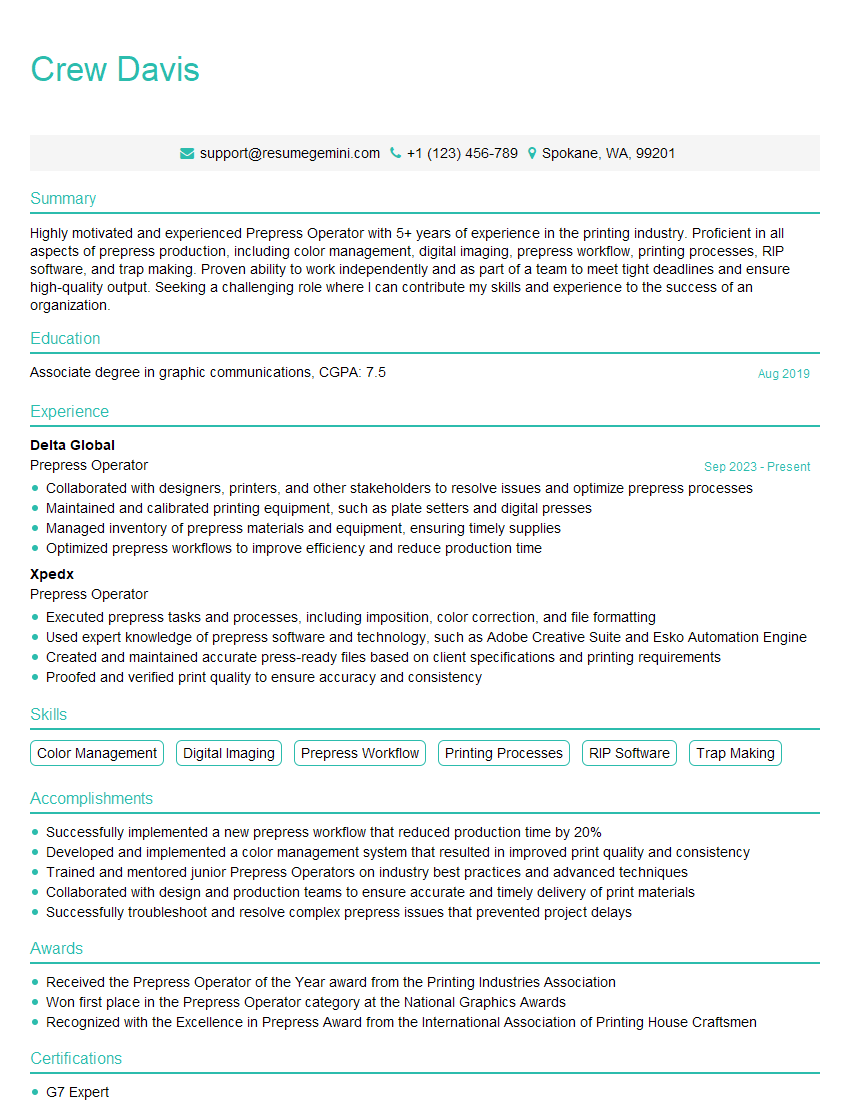
Mastering prepress software is crucial for a successful career in print production and related fields. It opens doors to diverse roles and demonstrates valuable technical skills highly sought after by employers. To maximize your job prospects, focus on crafting an ATS-friendly resume that highlights your key skills and accomplishments. ResumeGemini is a trusted resource for building professional, impactful resumes. We provide examples of resumes tailored to prepress software experience to help you present your qualifications effectively and land your dream job.


Explore more articles
Users Rating of Our Blogs
Share Your Experience
We value your feedback! Please rate our content and share your thoughts (optional).
What Readers Say About Our Blog
good