Interviews are opportunities to demonstrate your expertise, and this guide is here to help you shine. Explore the essential Experience with value engineering interview questions that employers frequently ask, paired with strategies for crafting responses that set you apart from the competition.
Questions Asked in Experience with value engineering Interview
Q 1. Explain the difference between value engineering and value analysis.
While often used interchangeably, value engineering (VE) and value analysis (VA) have subtle yet important distinctions. Think of it like this: Value analysis is the process, and value engineering is the result.
Value analysis is a systematic method for identifying and eliminating unnecessary costs without sacrificing quality or performance. It’s a proactive approach, typically employed during the design phase of a project. VA involves scrutinizing every aspect of a product or process to determine its essential functions and identify opportunities for improvement.
Value engineering, on the other hand, is the outcome of value analysis. It encompasses the specific changes, improvements, and cost reductions implemented based on the findings of the value analysis process. It’s the tangible result – a better, cheaper, or more efficient product or system.
For example, during the VA phase of designing a building, we might analyze the specification for exterior cladding. The VE outcome might be switching from expensive granite to a more cost-effective but equally durable composite material, resulting in significant savings without compromising the building’s aesthetics or structural integrity.
Q 2. Describe your experience with various value engineering methodologies.
My experience encompasses a wide range of value engineering methodologies, including:
- Function Analysis System Technique (FAST): I’ve used FAST to break down complex systems into their basic functions, allowing us to identify potential areas for simplification or substitution. This is particularly useful when dealing with intricate assemblies or processes.
- Value Engineering Job Plan (VEJP): This structured approach provides a roadmap for conducting VE studies, ensuring a comprehensive and methodical examination of a project. I find VEJP very useful in larger, more complex projects where coordination among team members is crucial.
- Brainstorming and Nominal Group Technique (NGT): These collaborative methods are essential for generating creative solutions and fostering diverse perspectives within a team. I frequently use them to uncover innovative cost-saving ideas that might not emerge through individual analysis.
- Design-to-Cost (DTC): I have applied DTC principles across multiple projects, working within predetermined cost targets and using innovative design solutions to meet those targets without compromising functionality or performance.
The choice of methodology depends heavily on the project’s complexity, timeline, and team dynamics. I’m adept at adapting my approach to suit the specific circumstances.
Q 3. How do you identify potential areas for cost reduction in a project?
Identifying cost reduction opportunities requires a systematic approach. I typically start by:
- Understanding the project’s scope and objectives: This lays the foundation for evaluating which aspects are most critical and which can be optimized without compromising functionality.
- Analyzing project documentation: This includes reviewing drawings, specifications, and cost estimates to identify potential areas for improvement. I often look for over-engineered components or unnecessary complexities.
- Conducting site visits and observations: This provides a real-world perspective and allows for a better understanding of the project’s constraints and potential challenges. Sometimes, practical issues aren’t apparent from just reviewing documents.
- Engaging stakeholders: Including contractors, engineers, and end-users in the process provides diverse perspectives and often reveals hidden cost drivers.
- Benchmarking against similar projects: Comparing our project to comparable ones can highlight cost discrepancies and best practices, indicating areas where we can improve efficiency and cut costs.
Through this multi-faceted approach, I build a comprehensive picture of the project, enabling me to strategically identify areas ripe for cost reduction without compromising quality.
Q 4. What are some common value engineering techniques you’ve used?
My toolbox includes several common value engineering techniques:
- Substitution: Replacing expensive materials or components with less costly alternatives that maintain performance. For instance, substituting aluminum for steel in certain applications.
- Simplification: Streamlining designs and processes to eliminate unnecessary steps or complexities. This could involve reducing the number of parts in an assembly or simplifying a manufacturing process.
- Standardization: Utilizing standard components and materials wherever possible to reduce manufacturing costs and lead times. This is particularly effective in high-volume projects.
- Elimination: Removing unnecessary features or components without affecting the overall functionality. This could involve removing a decorative element that doesn’t add significant value.
- Modification: Adapting existing designs or processes to improve efficiency and reduce costs. This might involve changing the manufacturing process to use more efficient machinery.
I often combine these techniques to achieve significant cost savings. The best approach often involves a multi-pronged strategy that takes advantage of several of these methods simultaneously.
Q 5. How do you prioritize value engineering opportunities?
Prioritizing value engineering opportunities requires a structured approach that considers both cost savings and potential impact. I typically employ a multi-criteria decision analysis (MCDA) framework, considering factors such as:
- Cost savings potential: The magnitude of cost reduction that each opportunity offers.
- Implementation feasibility: How easily and quickly the opportunity can be implemented.
- Risk mitigation: The potential risks associated with implementing the opportunity and strategies to mitigate those risks.
- Impact on project schedule: The potential delays or disruptions that might result from implementing the opportunity.
- Impact on project quality: The potential effect on the overall quality or performance of the project.
By assigning weights to each criterion based on the project’s specific context, I can objectively rank and prioritize value engineering opportunities, ensuring that the most impactful and feasible options are addressed first. This ensures the most significant return on investment for the VE effort.
Q 6. Describe a time you successfully implemented a value engineering solution.
In a recent project involving the construction of a large industrial facility, the initial design specified a complex HVAC system with multiple zones and custom-designed components. Through a thorough value analysis, we discovered that a simpler, standardized HVAC system could achieve the same level of performance at a significantly lower cost.
Using a combination of simplification and standardization techniques, we proposed replacing the custom-designed components with readily available, off-the-shelf units. This reduced the manufacturing time, installation complexity, and overall cost by approximately 15%. Furthermore, the reduced complexity simplified maintenance and reduced potential downtime.
The success of this implementation stemmed from effective stakeholder collaboration, meticulous analysis, and a willingness to explore unconventional solutions. The client was initially hesitant about departing from the original design, but the comprehensive analysis and cost savings projections convinced them of the viability of the proposed solution.
Q 7. How do you measure the effectiveness of your value engineering efforts?
Measuring the effectiveness of value engineering efforts requires a robust approach that goes beyond simple cost savings. I track several key metrics:
- Cost savings achieved: The total reduction in project costs attributable to the implemented VE solutions.
- Return on investment (ROI): The ratio of cost savings to the cost of conducting the VE study. A high ROI indicates a successful VE effort.
- Schedule impact: Any positive or negative impact on the project schedule caused by the implementation of VE solutions.
- Quality impact: Any impact on the quality or performance of the project due to VE implementations. We want to ensure that cost savings do not come at the expense of quality.
- Stakeholder satisfaction: The level of satisfaction among project stakeholders with the outcome of the VE process. This includes client satisfaction, contractor satisfaction, and team satisfaction.
By tracking these metrics, I can objectively evaluate the success of each VE initiative and refine my approach for future projects. Furthermore, presenting this data to clients demonstrates the tangible value delivered through the VE process.
Q 8. How do you handle disagreements with stakeholders regarding value engineering proposals?
Disagreements in value engineering are inevitable, as stakeholders often have different priorities. My approach focuses on collaboration and data-driven decision-making. I begin by actively listening to understand the concerns behind the objections. Then, I present the value engineering proposal clearly, highlighting the potential cost savings, improved functionality, or risk mitigation. This often involves quantifying the benefits using metrics like ROI (Return on Investment) or payback periods. If the disagreement persists, I facilitate a structured discussion, perhaps using a decision matrix, to weigh the pros and cons objectively. Finally, I document all viewpoints and decisions transparently to ensure everyone is aligned and understands the rationale behind the final choice. For instance, in a recent project involving a hospital building, a stakeholder initially resisted a proposed change in ventilation system. By presenting a detailed analysis showing equivalent air quality at significantly reduced energy costs (backed by lifecycle costing calculations), we were able to reach a consensus.
Q 9. Explain your understanding of Life Cycle Costing (LCC).
Life Cycle Costing (LCC) is a method used to analyze the total cost of ownership of an asset or system over its entire lifespan. It goes beyond initial capital costs to encompass all expenses and revenues associated with the asset, including operation, maintenance, repairs, replacements, and disposal. This holistic approach allows for informed decision-making by considering the long-term implications of different design choices. For example, a seemingly cheaper initial investment might have higher long-term maintenance costs, making it less economical in the long run. LCC involves several steps: defining the system’s boundaries, identifying all cost components, estimating the duration of each cost component, and applying appropriate discount rates to future costs. Software tools and spreadsheets are often used to perform these calculations and visualize the results. A clear understanding of LCC is critical for effective value engineering, as it helps identify opportunities to minimize costs over the asset’s lifecycle while maintaining or even improving its functionality.
Q 10. How do you integrate value engineering into the project lifecycle?
Integrating value engineering effectively requires a proactive and iterative approach throughout the project lifecycle. It shouldn’t be a one-off activity but rather an ongoing process. Ideally, value engineering workshops should be held during the early conceptual design phase to identify potential cost savings and alternative solutions. This involves brainstorming sessions with all relevant stakeholders. During the design development phase, the findings are incorporated into the design, and further value engineering opportunities may be uncovered. During construction, value engineering can still identify minor cost-saving measures without impacting quality. In the final stages, the post-project review allows for evaluating the effectiveness of value engineering efforts and learning for future projects. For example, in a recent highway project, we conducted value engineering sessions during the initial planning stages, leading to significant cost savings by selecting alternative materials and construction methods.
Q 11. How do you communicate technical value engineering concepts to non-technical audiences?
Communicating technical concepts to non-technical audiences requires clear, concise, and relatable language. I avoid jargon and technical terms whenever possible, opting instead for simple analogies and visual aids. For instance, instead of explaining complex engineering calculations, I might use a simple bar graph to compare the costs and benefits of different options. Storytelling can also be a powerful tool, allowing me to illustrate the impact of value engineering through real-world examples. Furthermore, using interactive presentations and visual demonstrations can keep the audience engaged and make complex information easier to understand. For example, when presenting value engineering proposals to a city council, I would use infographics to show the projected cost savings and improved community benefits rather than focusing on intricate technical details.
Q 12. Describe your experience with value engineering in different project phases.
My experience with value engineering spans various project phases. In the conceptual design phase, I focus on identifying high-level cost drivers and exploring alternative solutions. This often involves brainstorming sessions and the use of cost estimation tools. During the design development phase, I refine the design based on the findings from the earlier phase, ensuring that the cost-effective solutions are technically feasible and meet project requirements. During the construction phase, I monitor the implementation of the value engineering changes and address any unforeseen issues. Finally, during the post-project review, I evaluate the overall success of the value engineering efforts and identify areas for improvement in future projects. For instance, in a recent building renovation project, early value engineering led to the selection of more cost-effective materials without compromising the project’s aesthetic appeal.
Q 13. What software or tools do you use to support value engineering activities?
Several software and tools support my value engineering activities. Spreadsheet software (like Microsoft Excel or Google Sheets) is crucial for cost estimation and analysis, particularly for LCC calculations. Project management software (like MS Project or Primavera P6) helps track progress and manage tasks. Design software (AutoCAD, Revit, etc.) facilitates exploring different design options and analyzing their cost implications. Specialized value engineering software is also available, offering features such as cost modeling and sensitivity analysis. In addition, I use collaboration platforms (like Microsoft Teams or Slack) to facilitate communication and knowledge sharing among stakeholders. The choice of tools depends on the project’s size, complexity, and specific requirements. For example, for large-scale infrastructure projects, dedicated cost estimation and scheduling software becomes essential.
Q 14. How do you manage risks associated with value engineering changes?
Value engineering changes inherently involve risks, which need to be proactively managed. This begins with a thorough risk assessment identifying potential issues, such as unforeseen technical challenges or delays in implementation. A robust risk mitigation plan should outline strategies to address these risks. This might involve contingency planning, conducting thorough testing, or securing approvals from relevant stakeholders. Regular monitoring and communication are essential to track progress and address any emerging risks promptly. A clear change management process is necessary to document all changes, obtain approvals, and ensure that the changes are implemented smoothly. For example, in a recent project, we anticipated potential supply chain disruptions by securing alternative material suppliers, mitigating the risk of project delays due to material shortages.
Q 15. How do you ensure that value engineering initiatives maintain project quality and safety?
Maintaining project quality and safety during value engineering is paramount. It’s not about cutting corners; it’s about finding smarter ways to achieve the same or better results. We achieve this through a rigorous process:
- Thorough Risk Assessment: Before any change, we conduct a detailed risk assessment, identifying potential impacts on quality, safety, and compliance. For example, if we’re considering a cheaper material, we’ll carefully analyze its strength, durability, and fire resistance compared to the original specification.
- Detailed Analysis and Documentation: Every proposed change is meticulously documented, including its rationale, potential benefits, and associated risks. This documentation serves as a transparent record for review and approval.
- Multidisciplinary Review: The proposed changes are reviewed by a cross-functional team comprising engineers, safety experts, and project managers. This ensures a holistic perspective and identification of potential issues before implementation.
- Rigorous Testing and Validation: Where necessary, we implement thorough testing and validation to ensure that the changes don’t compromise quality or safety. This might involve material testing, simulations, or pilot projects.
- Compliance Adherence: All value engineering changes must comply with relevant codes, standards, and regulations. This is crucial to prevent legal issues and ensure the project’s long-term viability.
In essence, we approach value engineering as an optimization process, not a cost-cutting exercise. Safety and quality are never compromised.
Career Expert Tips:
- Ace those interviews! Prepare effectively by reviewing the Top 50 Most Common Interview Questions on ResumeGemini.
- Navigate your job search with confidence! Explore a wide range of Career Tips on ResumeGemini. Learn about common challenges and recommendations to overcome them.
- Craft the perfect resume! Master the Art of Resume Writing with ResumeGemini’s guide. Showcase your unique qualifications and achievements effectively.
- Don’t miss out on holiday savings! Build your dream resume with ResumeGemini’s ATS optimized templates.
Q 16. What are some common challenges in implementing value engineering, and how do you overcome them?
Implementing value engineering presents several challenges. Here are some common ones and how I address them:
- Resistance to Change: People can be hesitant to adopt new approaches. I overcome this by clearly communicating the benefits, involving stakeholders early in the process, and presenting data-driven justifications for proposed changes.
- Lack of Information: Insufficient data can hinder effective value engineering. I address this by conducting thorough research, gathering data from various sources, and utilizing advanced analytics to make informed decisions.
- Time Constraints: Value engineering often happens under tight deadlines. To overcome this, I use streamlined processes, prioritize changes based on potential impact, and work collaboratively with the team to ensure timely execution.
- Scope Creep: Uncontrolled changes can derail a project. I prevent this by establishing clear boundaries for the value engineering effort, utilizing a formal change management process, and adhering to a well-defined scope.
- Unrealistic Expectations: Sometimes, expectations of cost savings are unrealistic. I manage this by clearly communicating the potential and limitations of value engineering, setting realistic targets, and demonstrating the value proposition through detailed analysis.
Effective communication, collaboration, and a structured approach are key to overcoming these challenges.
Q 17. How do you stay updated on the latest trends and best practices in value engineering?
Staying current in value engineering requires continuous learning. My strategies include:
- Professional Organizations: Active membership in organizations like the Society of American Value Engineers (SAVE) provides access to resources, conferences, and networking opportunities.
- Industry Publications and Journals: I regularly read publications focusing on construction management, engineering, and cost-reduction techniques to stay informed about best practices and emerging trends.
- Conferences and Workshops: Attending industry conferences and workshops allows me to learn from experts and network with peers.
- Online Courses and Webinars: Numerous online platforms offer courses and webinars on advanced value engineering techniques.
- Mentorship and Peer Learning: I actively seek mentorship from experienced professionals and collaborate with colleagues to share knowledge and best practices.
A commitment to lifelong learning is essential in this ever-evolving field.
Q 18. Describe your experience working collaboratively with cross-functional teams on value engineering projects.
Collaboration is the cornerstone of successful value engineering. I have extensive experience working with cross-functional teams, including engineers, architects, contractors, and procurement specialists. My approach emphasizes:
- Open Communication: Establishing clear communication channels and fostering a culture of open dialogue is crucial. Regular meetings, progress reports, and feedback sessions are vital.
- Shared Understanding: Ensuring everyone understands the project goals, constraints, and the value engineering process is key. This often involves training and workshops.
- Constructive Conflict Resolution: Disagreements are inevitable. I facilitate constructive discussions, encouraging diverse perspectives and finding mutually agreeable solutions.
- Shared Ownership: I strive to create a sense of shared ownership by involving all stakeholders in the decision-making process.
- Effective Facilitation: In my experience, guiding brainstorming sessions, leading workshops, and facilitating decision-making processes are crucial skills for successful collaboration.
For instance, on a recent project, I facilitated a workshop involving engineers, architects, and contractors to identify cost-saving opportunities in a building’s structural design. This collaborative approach resulted in significant cost reductions without compromising quality.
Q 19. How do you handle situations where a proposed value engineering change negatively impacts project schedule?
When a value engineering change impacts the project schedule, a careful evaluation and mitigation strategy are necessary. The approach involves:
- Assessing the Impact: Quantify the schedule impact – how much delay is expected?
- Exploring Mitigation Strategies: Can the delay be minimized through adjustments to other project phases, overtime, or additional resources?
- Cost-Benefit Analysis: Weigh the cost savings from the value engineering change against the costs associated with the schedule delay. This includes potential penalties for late completion.
- Stakeholder Communication: Clearly communicate the situation and proposed mitigation strategies to all relevant stakeholders.
- Contingency Planning: Develop a contingency plan to address unforeseen issues that may arise from schedule adjustments.
Ultimately, the decision of whether to proceed with the change will depend on the balance between cost savings and schedule impacts, factoring in risk and overall project objectives.
Q 20. How do you balance cost savings with functional requirements during value engineering?
Balancing cost savings with functional requirements is the core challenge in value engineering. It’s a delicate balancing act, requiring a structured approach:
- Prioritization Matrix: I use a prioritization matrix that weighs the relative importance of different functional requirements against their cost. This helps to identify areas where cost savings can be achieved without significantly compromising functionality.
- Functional Analysis: A thorough functional analysis helps identify which functions are essential and which can be modified or eliminated without impacting the overall project goals.
- Creative Solutions: Brainstorming sessions and creative problem-solving are used to explore alternative solutions that maintain functionality while reducing costs. For instance, exploring alternative materials, construction methods, or designs.
- Trade-off Analysis: I use a trade-off analysis to evaluate the cost versus performance of different alternatives and find the optimal balance.
- Sensitivity Analysis: This helps to assess the impact of potential changes on overall project performance and identify the most sensitive areas that may require more attention.
For example, in a building project, we might explore using a less expensive but equally effective insulation material, or optimizing the HVAC system for energy efficiency, ultimately saving costs while retaining functionality.
Q 21. What is your experience with different types of value engineering studies (e.g., preliminary, detailed)?
My experience encompasses various types of value engineering studies:
- Preliminary Value Engineering (VE): This is often conducted in the early stages of a project. It focuses on high-level concepts and broad cost-saving opportunities. It typically involves brainstorming sessions and the identification of potential areas for further investigation.
- Detailed Value Engineering (VE): This involves in-depth analysis of specific areas identified during the preliminary phase. It might include detailed cost estimates, material analysis, and potential design modifications. It’s more focused and detailed than preliminary VE.
- Post-Construction Value Engineering: This occurs after project completion, examining the costs and performance against initial estimates and goals. This provides insights for future projects and helps develop best practices.
The approach differs depending on the project phase and the available information. For example, during preliminary VE, we might focus on broad concepts, whereas detailed VE will dive into specific specifications and design elements. Post-construction VE, focuses on lessons learned and evaluating the project’s overall value.
Q 22. How familiar are you with the principles of Lean and Six Sigma in the context of value engineering?
Lean and Six Sigma are powerful methodologies that significantly enhance value engineering. Lean principles, focused on eliminating waste and maximizing value from the customer’s perspective, are perfectly aligned with value engineering’s core goal of delivering maximum functionality at the lowest cost. Think of it like streamlining a recipe – keeping only the essential ingredients to achieve the desired taste while minimizing unnecessary additions.
Six Sigma, with its emphasis on reducing variation and improving process capability, helps ensure the value engineering solutions we implement are robust and reliable. By minimizing defects and inconsistencies, we can confidently predict and maintain the cost savings and performance improvements achieved. Imagine baking that streamlined recipe consistently, producing the same high-quality result every time.
In practice, I’ve used Lean tools like Value Stream Mapping to identify wasteful steps in a manufacturing process, and Six Sigma’s DMAIC (Define, Measure, Analyze, Improve, Control) methodology to systematically implement and monitor cost-reduction initiatives. This combined approach ensures that not only are we finding cost savings but that those savings are sustainable and measurable.
Q 23. Describe your experience with value engineering in different industries.
My value engineering experience spans diverse industries, including construction, manufacturing, and software development. In construction, I’ve worked on optimizing building designs to reduce material costs without compromising structural integrity or aesthetic appeal. For example, we substituted a less expensive but equally durable type of concrete for a high-rise building foundation, resulting in significant savings.
In manufacturing, I’ve helped streamline production processes by identifying and eliminating bottlenecks. This often involves analyzing material flow, optimizing equipment utilization, and proposing alternative manufacturing techniques. One project involved redesigning a packaging system, reducing material usage by 15% and improving packaging speed by 20%.
Finally, in software development, my focus has been on optimizing the development lifecycle, reducing development time and resource allocation without compromising functionality. This frequently involves identifying areas where code can be simplified or reused, leading to both shorter development times and lower maintenance costs.
Q 24. Can you give an example of a creative value engineering solution you implemented?
During a project constructing a large-scale data center, the initial design called for expensive, custom-designed server racks. This significantly impacted the project budget. Through a collaborative value engineering workshop, we identified a readily available, off-the-shelf rack system that met all the functional requirements. It was initially dismissed due to its appearance differing slightly from the original design, but we successfully demonstrated that this difference was inconsequential to overall functionality.
This change resulted in a 25% reduction in the cost of the server rack system without sacrificing functionality, security, or maintainability. The creative solution lay not in inventing a new system, but in critically evaluating existing, readily available options and demonstrating their suitability, challenging pre-conceived notions about what was “acceptable”. This highlights the importance of open-mindedness and collaborative brainstorming in value engineering.
Q 25. How do you document and track value engineering changes throughout a project?
I utilize a combination of digital and physical documentation to ensure meticulous tracking of value engineering changes throughout a project. We maintain a centralized digital repository, often a shared project management platform, to store all value engineering proposals, analyses, and approved changes. This platform allows for version control and easy access for all stakeholders.
Physically, we create detailed reports for each change, including cost-benefit analyses, design drawings (where applicable), and minutes from relevant meetings. This documentation ensures transparency and supports future audits or modifications. Crucially, the tracking system includes a clear process for approvals, ensuring that all changes are formally authorized by the appropriate decision-makers. This minimizes the risk of discrepancies and ensures that everyone is informed of the project’s evolving design and budget.
Q 26. What is your approach to presenting value engineering findings to senior management?
Presenting value engineering findings to senior management requires a clear, concise, and visually compelling presentation. I start by highlighting the initial project goals and constraints. Then, I present a clear comparison between the original plan and the proposed value-engineered solution. This comparison emphasizes the cost savings while highlighting that functionality and performance are either maintained or improved.
Visual aids such as charts, graphs, and tables are essential to effectively communicate the quantitative impact of our recommendations. Moreover, I always include a risk assessment for each recommended change, outlining potential challenges and mitigation strategies. Finally, I present a clear action plan with timelines and responsibilities assigned to ensure seamless implementation of the approved value engineering solutions.
Q 27. How do you ensure that value engineering solutions are sustainable in the long term?
The sustainability of value engineering solutions is paramount. We achieve this through rigorous testing, thorough documentation, and stakeholder engagement. Thorough testing ensures that the implemented changes meet performance and reliability requirements. This might involve prototyping, simulations, or pilot runs, depending on the context of the project.
Comprehensive documentation, as discussed earlier, ensures that future modifications or maintenance can be carried out effectively. Finally, engaging stakeholders throughout the process helps build ownership and buy-in, increasing the likelihood of the solution being maintained and not easily reversed due to lack of understanding or support. This collaborative approach fosters a culture of continuous improvement, embedding sustainability into the project’s lifecycle.
Q 28. Describe your experience in conducting value engineering workshops or brainstorming sessions.
I have extensive experience facilitating value engineering workshops and brainstorming sessions. My approach involves creating a structured yet flexible environment that encourages open communication and creative thinking. The process typically begins with clearly defining the project scope, objectives, and constraints. Then, I engage participants using various techniques, such as brainwriting, nominal group technique, and multi-voting, to generate a wide range of ideas.
I emphasize collaboration and critical thinking by fostering an environment where participants feel comfortable challenging assumptions and exploring unconventional solutions. After generating ideas, we conduct a rigorous evaluation process, assessing each suggestion based on cost, functionality, feasibility, and risk. Finally, I document all ideas and decisions, making sure all participants are informed and aligned on the selected course of action.
Key Topics to Learn for Experience with Value Engineering Interviews
- Value Engineering Principles: Understanding fundamental concepts like function analysis, value analysis, and the value equation. This includes knowing how to identify and quantify value.
- Cost Reduction Strategies: Exploring various techniques for lowering costs without compromising functionality or quality. Practical examples should include experience with specific cost reduction methodologies.
- Life Cycle Cost Analysis (LCCA): Mastering the application of LCCA to evaluate long-term cost implications of design choices and material selections. Be prepared to discuss case studies.
- Collaboration and Communication: Highlighting experience in working effectively with cross-functional teams, including engineers, architects, contractors, and clients to achieve value engineering goals.
- Value Engineering Documentation and Reporting: Demonstrating proficiency in creating clear and concise reports, presentations, and proposals to communicate value engineering findings and recommendations.
- Software and Tools: Familiarity with relevant software and tools used in value engineering analysis (mention specific software if applicable, but avoid being overly specific). Understanding data analysis techniques will be crucial.
- Problem-Solving Approach: Showcasing your ability to identify, analyze, and solve complex problems related to cost optimization and value improvement. Prepare examples that demonstrate your analytical skills.
- Case Studies and Examples: Prepare specific examples from your experience where you successfully implemented value engineering techniques, highlighting quantifiable results and impact.
Next Steps
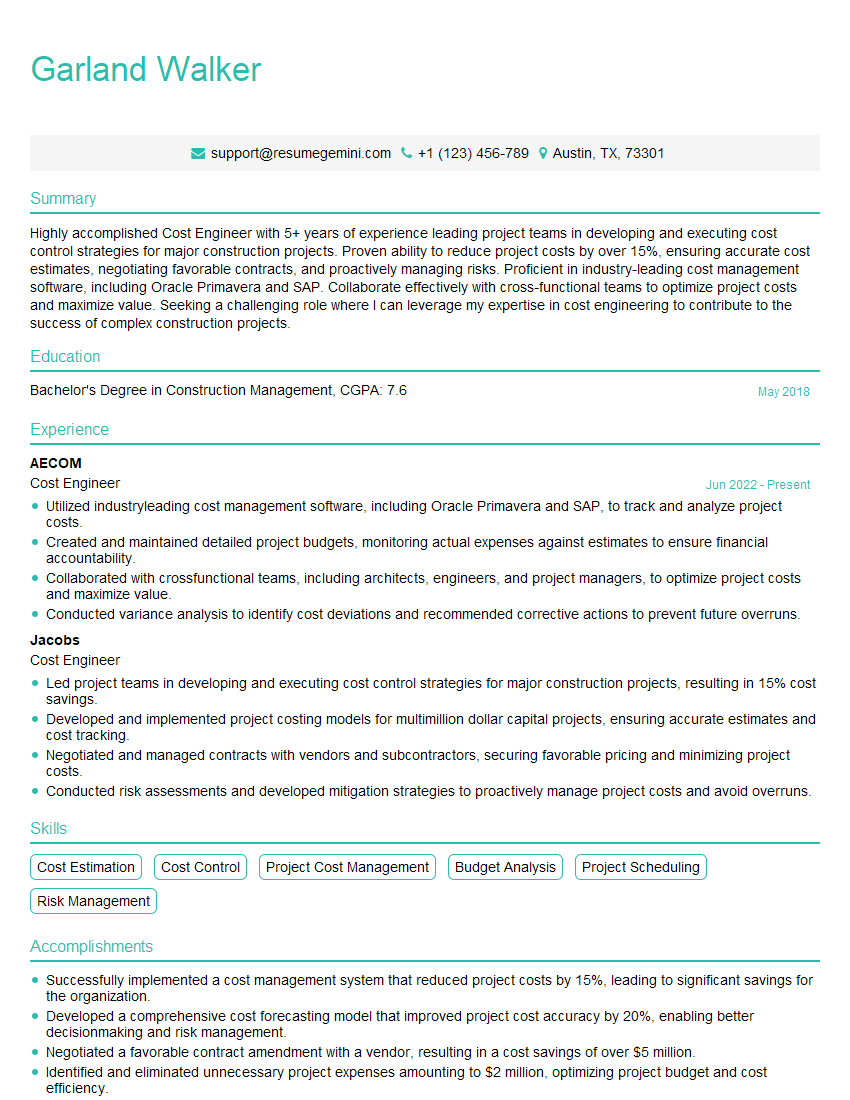
Mastering value engineering significantly enhances your career prospects, opening doors to higher-paying roles and leadership opportunities within engineering and construction. A strong resume is crucial for showcasing your skills and experience to potential employers. Creating an ATS-friendly resume increases your chances of getting your application noticed. We encourage you to utilize ResumeGemini to build a professional and impactful resume that highlights your value engineering expertise. Examples of resumes tailored to value engineering experience are available to help you create your best application.
Explore more articles
Users Rating of Our Blogs
Share Your Experience
We value your feedback! Please rate our content and share your thoughts (optional).
What Readers Say About Our Blog
Very informative content, great job.
good