The thought of an interview can be nerve-wracking, but the right preparation can make all the difference. Explore this comprehensive guide to Expertise in Arranging for a Variety of Musical Styles and Ensembles interview questions and gain the confidence you need to showcase your abilities and secure the role.
Questions Asked in Expertise in Arranging for a Variety of Musical Styles and Ensembles Interview
Q 1. Describe your experience arranging for different instrumental ensembles.
My experience spans a wide range of instrumental ensembles, from small chamber groups to large orchestras, jazz combos, and even marching bands. I’ve arranged for string quartets, woodwind quintets, brass bands, big bands, and various combinations thereof. This diverse experience has honed my ability to understand the unique timbral and technical capabilities of each instrument family and how to best leverage them in an arrangement.
For example, arranging for a string quartet requires a deep understanding of counterpoint and voicing, ensuring each part is both melodically interesting and technically feasible. In contrast, arranging for a big band necessitates familiarity with jazz harmony, rhythm, and the individual roles of each section (saxophones, trumpets, trombones, rhythm section). I approach each ensemble with a thorough understanding of its strengths and limitations, tailoring the arrangement accordingly.
Q 2. How do you adapt arrangements for various musical styles (e.g., jazz, classical, pop)?
Adapting arrangements across musical styles involves a fundamental shift in harmonic language, rhythmic feel, and overall instrumentation. For instance, a classical arrangement might prioritize intricate counterpoint and balanced textures, whereas a pop arrangement might favor strong melodic hooks, repetitive rhythmic patterns, and a driving groove.
- Classical: Emphasis on counterpoint, formal structure, and orchestral textures. I might use extended techniques sparingly, focusing on clean articulation and precise intonation.
- Jazz: Focus on improvisation, blues scales, swing rhythms, and use of call-and-response patterns. Instrumentation might include a rhythm section (piano, bass, drums) and horns.
- Pop: Prioritizes catchy melodies, simple harmonies, and strong rhythmic drive. Instrumentation often includes a variety of electronic instruments, along with guitars, bass, drums, and vocals.
To illustrate, I recently adapted a classical piano piece for a jazz combo. This involved reharmonizing sections using jazz chords, incorporating swing rhythms, and adding improvisational sections for the soloists. The process demanded a deep understanding of both classical and jazz styles to successfully bridge the gap between the two.
Q 3. Explain your process for scoring music for film or video games.
Scoring for film or video games requires a nuanced understanding of narrative and visual storytelling. My process begins with a close analysis of the script or game footage to understand the emotional arc and pacing of the scene. I then create a musical score that reflects these aspects, using music to enhance the audience’s emotional response.
The process typically involves:
- Analyzing the visuals/script: Identifying key moments, emotional shifts, and pacing.
- Sketching musical ideas: Developing thematic material and experimenting with different instrumentation.
- Creating a detailed score: Notating the music with precise tempo, dynamics, and articulations.
- Review and revision: Collaborating with the director or game designer to ensure the music aligns with the overall vision.
For example, a tense scene might call for dissonant harmonies and a fast tempo, whereas a romantic scene could utilize lush strings and a slower tempo. The choice of instrumentation is crucial as well; a small ensemble might be appropriate for intimate moments, while a full orchestra could be used for grand, epic sequences.
Q 4. How do you balance artistic vision with practical considerations (e.g., budget, time constraints) in your arrangements?
Balancing artistic vision with practical constraints is a constant challenge, but crucial for successful project completion. My approach involves prioritizing clear communication with clients and finding creative solutions to potential conflicts.
For instance, if a client has a limited budget, I might suggest using a smaller ensemble or simplifying certain sections of the arrangement without compromising the overall musical impact. Similarly, if time constraints are tight, I might streamline the composition process by focusing on core elements and leaving room for subtle additions later.
Open communication with the client is key. I find that presenting various options with different levels of complexity and cost early in the process leads to mutual understanding and realistic expectations.
Q 5. What software and tools do you use for music arrangement and notation?
I utilize a variety of software and tools for music arrangement and notation. My primary software is Sibelius, which offers powerful tools for composing, editing, and printing scores. I also use Logic Pro X for audio editing and virtual instrumentation, especially when creating demos or mockups of arrangements. Other tools I frequently employ include Finale, Cubase, and various VST plugins for sound design and virtual instruments.
Example Sibelius score snippet: (This is a placeholder; Sibelius scores are complex and cannot be accurately represented in a code snippet)
Q 6. How do you handle feedback and revisions on your arrangements?
I consider feedback an integral part of the creative process. I actively encourage open communication and collaboration with clients throughout the arrangement process. I treat feedback as constructive criticism, aiming to understand the concerns and making necessary adjustments to refine the arrangement to the client’s satisfaction.
My approach involves:
- Active listening: Carefully considering all feedback points.
- Clear communication: Discussing potential solutions and compromises.
- Iterative revisions: Making incremental changes and seeking further feedback.
I strive to create a collaborative environment where clients feel comfortable expressing their thoughts and concerns. The goal is to achieve a final arrangement that both fulfills the artistic vision and meets the client’s specific needs.
Q 7. Describe your experience working with musicians and vocalists.
Working with musicians and vocalists is a highly collaborative process. I place a strong emphasis on clear communication and mutual respect. Before a recording session, I provide the musicians with detailed scores and recordings, including any specific instructions or stylistic preferences. During the session, I offer guidance and support, ensuring everyone feels comfortable and prepared.
My experience includes working with both professional and amateur musicians, and I’ve found that tailoring my communication style to suit each individual or group leads to more positive and productive collaborations. I value input from the musicians; often, their interpretations bring fresh perspectives and inspire me to refine my arrangements.
Q 8. Explain your understanding of music theory and its relevance to arrangement.
Music theory is the foundation upon which all musical arrangements are built. It’s the grammar and vocabulary of music, encompassing elements like melody, harmony, rhythm, and form. Understanding music theory allows arrangers to manipulate these elements consciously and creatively to achieve specific emotional and sonic effects. For example, knowing how different chords function within a key allows an arranger to craft compelling progressions that build tension and release. Similarly, understanding melodic contour and phrasing informs the creation of memorable and expressive melodies.
Its relevance to arrangement is paramount. Without a strong grasp of music theory, an arranger would struggle to create balanced and aesthetically pleasing arrangements. It’s like trying to write a novel without understanding grammar – you might have a great story, but it will be difficult for the audience to understand and appreciate.
Q 9. How do you create compelling harmonic progressions and melodic lines?
Creating compelling harmonic progressions and melodic lines involves a blend of theoretical knowledge and intuitive creativity. For harmonies, I often start by establishing a tonal center (the key) and then explore secondary dominants, borrowed chords, and modal interchange to add color and interest. For instance, using a secondary dominant (e.g., V/V) before a V chord creates a stronger sense of resolution. I also consider the context – a ballad might use smoother progressions, while a rock song might employ more unexpected and dissonant harmonies.
Melodic lines are crafted with consideration of both musical phrasing and the instrument or voice it’s intended for. I strive for melodies that are memorable, singable (if applicable), and that reflect the emotional character of the music. Often, I’ll sketch out several melodic ideas before settling on the one that best serves the arrangement’s purpose. I might also utilize techniques like sequence and variation to create interest and cohesion within a melody.
Q 10. How do you maintain a consistent style and sound throughout a large arrangement?
Maintaining a consistent style and sound across a large arrangement is crucial for coherence. This is achieved through careful planning and consistent application of several key techniques.
- Establishing a sonic palette: Early on, I define the overall sound, including instrumentation, timbre, and dynamic range. This palette informs all subsequent compositional decisions.
- Consistent rhythmic patterns: Repeating or subtly varying rhythmic motifs helps unify different sections of the arrangement. Using a signature rhythmic feel can create a sense of identity for the piece.
- Harmonious use of dynamics and textures: Careful control of dynamics and instrumentation keeps the arrangement from feeling disjointed. Dynamic contrast can enhance emotional impact, but it should feel natural and motivated.
- Motif development: Repeating and transforming melodic and rhythmic ideas throughout the arrangement helps build a sense of unity and structure, preventing the piece from sounding fragmented.
For example, in arranging a piece for a large orchestra, maintaining consistent phrasing and articulation across different instrumental sections is crucial. Using consistent tempo markings and dynamic indications is crucial for maintaining a unified feel throughout the piece.
Q 11. What are your favorite musical arrangements and why?
Some of my favorite arrangements include Gil Evans’s work with Miles Davis, particularly Sketches of Spain. The sheer brilliance of his orchestrations, his ability to blend jazz improvisation with classical orchestral textures, is simply breathtaking. The way he builds tension and release through dynamic shifts and instrumental layering is masterfully done. Another example would be the arrangements by Vince Guaraldi for the Peanuts specials— simple yet deeply evocative and emotionally resonant.
What I admire in these arrangements is their ability to be both innovative and accessible. They are technically complex but never sound overly contrived. They perfectly serve the music’s emotional content, enhancing and supporting the original material without overshadowing it.
Q 12. Describe your experience with different types of musical notation software.
I’m proficient in several music notation software packages, including Sibelius, Finale, and Dorico. Each has its strengths and weaknesses. Sibelius, for example, excels in its intuitive interface and its powerful scoring capabilities, particularly for larger orchestral works. Finale is known for its robust playback engine and its extensive library of sounds. Dorico stands out with its advanced features for handling complex scores and its efficient workflow.
My choice of software depends on the specific project. For a large orchestral score, I might prefer Sibelius or Dorico for their ability to handle complex layering and notation conventions. For smaller projects or those requiring detailed audio editing, Finale’s playback engine and audio capabilities might be more suitable. The ability to adapt to different software is crucial for remaining efficient and versatile.
Q 13. How do you approach arranging for specific vocal ranges and instrumental capabilities?
Arranging for specific vocal ranges and instrumental capabilities requires careful consideration of each instrument’s unique sonic qualities and technical limitations. For vocals, I always start with the vocal range of the intended singer(s) and tailor the melody to comfortably sit within that range. This might involve transposing the melody or adjusting the tessitura (the overall range where the melody tends to sit) to maximize vocal comfort and expressiveness.
For instruments, I need to understand their range, technical capabilities, and typical articulations. For instance, I wouldn’t write a passage requiring extremely fast runs for a trombone, nor would I write a high-register passage for a bassoon. Understanding the unique characteristics of each instrument allows me to write idiomatically, ensuring the arrangement is both playable and sounds authentic.
Q 14. Explain your process for creating a dynamic and engaging arrangement.
Creating a dynamic and engaging arrangement is a multi-stage process. It begins with a deep understanding of the source material and the desired emotional impact. I then develop a structural plan, dividing the arrangement into sections (introduction, verses, chorus, bridge, etc.) Each section’s function and mood is carefully considered.
Next, I focus on creating compelling melodic and harmonic ideas, employing techniques like variation, sequence, and counterpoint to maintain interest. I then incorporate rhythmic variation to create a sense of momentum and energy, using different rhythmic patterns and groove feels in different sections. Finally, the use of dynamics, texture, and instrumentation is essential to maintain listener engagement. Strategic use of rests, fades, and crescendos adds dramatic impact and prevents the arrangement from becoming monotonous. Throughout this process, I consistently review and refine the arrangement, ensuring a cohesive and emotionally satisfying result.
Q 15. How do you manage multiple projects and deadlines simultaneously?
Managing multiple projects with diverse deadlines requires a structured approach. I utilize project management software to track tasks, deadlines, and progress for each arrangement. This allows me to visualize the workload and prioritize tasks based on urgency and importance. I break down large projects into smaller, manageable milestones with clear deliverables, which makes progress easier to monitor and prevents feeling overwhelmed. For example, if I’m working on a symphony arrangement and a jazz quartet arrangement simultaneously, I might dedicate mornings to one and afternoons to the other, ensuring dedicated focus blocks for each. Regular time blocking and consistent review of my schedule are key to effective multitasking.
Furthermore, effective communication with clients is crucial. Openly discussing potential delays or adjustments to timelines allows for realistic expectations and prevents conflicts down the line. Regular check-ins help maintain transparency and allow for collaborative problem-solving.
Career Expert Tips:
- Ace those interviews! Prepare effectively by reviewing the Top 50 Most Common Interview Questions on ResumeGemini.
- Navigate your job search with confidence! Explore a wide range of Career Tips on ResumeGemini. Learn about common challenges and recommendations to overcome them.
- Craft the perfect resume! Master the Art of Resume Writing with ResumeGemini’s guide. Showcase your unique qualifications and achievements effectively.
- Don’t miss out on holiday savings! Build your dream resume with ResumeGemini’s ATS optimized templates.
Q 16. What are some common challenges you face in the arrangement process, and how do you overcome them?
One common challenge is balancing the artistic vision with the technical limitations of the ensemble. For instance, a complex orchestral arrangement might need simplification for a smaller string quartet, requiring careful consideration of voicing and instrumentation. I overcome this by creatively adapting the musical material, sometimes re-harmonizing sections or simplifying melodic lines while preserving the overall character of the piece. Another challenge is achieving a cohesive sound across different instrumental sections. This requires careful attention to dynamics, timbre, and rhythmic interplay. I use techniques like counterpoint, layering, and careful orchestration to ensure a pleasing sonic balance.
A frequent issue is meeting client expectations while adhering to my artistic integrity. Sometimes, a client’s vision might differ from my initial interpretation. In these cases, I engage in thorough discussions to find a compromise that respects both perspectives. Transparent communication and a willingness to explore different approaches are essential to resolving these creative differences.
Q 17. How do you ensure the final arrangement is well-balanced and sonically pleasing?
Achieving a well-balanced and sonically pleasing arrangement involves a multi-faceted approach. First, I meticulously analyze the harmonic structure of the piece, ensuring a smooth flow between sections and avoiding jarring transitions. Careful consideration of voicing – distributing melodic lines effectively across different instrumental sections – is crucial for clarity and balance. Dynamic contrast is equally vital; I avoid excessive uniformity by strategically deploying pianissimo and fortissimo passages to create interest and emotional depth.
I often employ techniques like rhythmic variation and counterpoint to avoid monotony. For example, I might add rhythmic complexities in one section to create a contrast to a more lyrical section. I also utilize sonic layering – adding instrumental textures subtly – to enrich the overall sound without muddying it. Ultimately, the goal is to create a cohesive and engaging soundscape that enhances the musical message.
Q 18. How familiar are you with different audio mixing and mastering techniques?
I possess extensive experience in audio mixing and mastering techniques, utilizing both analog and digital workflows. My understanding encompasses equalization (EQ) to shape the frequency response of instruments, compression to control dynamics, and reverb and delay to create spatial effects. I’m proficient with various Digital Audio Workstations (DAWs) like Pro Tools, Logic Pro X, and Ableton Live. I understand the principles of phase alignment, stereo imaging, and mastering techniques like loudness maximization and dynamic range control.
For example, when mixing a string quartet recording, I would carefully EQ each instrument to ensure clarity and balance. I’d utilize compression to manage dynamic fluctuations, ensuring a consistent level throughout the piece. I might then apply subtle reverb to create a sense of space and depth. Mastering would then involve maximizing the overall loudness and ensuring consistency across different playback systems.
Q 19. How do you incorporate specific cultural influences into your arrangements?
Incorporating cultural influences is central to creating authentic and engaging arrangements. My approach involves thorough research into the specific musical traditions I aim to represent. This includes studying traditional instruments, rhythmic patterns, melodic contours, and harmonic structures. For example, when arranging a piece with flamenco influences, I might incorporate characteristic rhythmic patterns such as the *zapateado*, use instruments like the guitar and castanets, and employ ornamentation techniques typical of the style. I carefully research the historical context and cultural significance to avoid misrepresentation or appropriation.
I’ve had the opportunity to work on projects incorporating elements of various styles including klezmer music (Eastern European Jewish), West African rhythms, and South American folk melodies. Understanding the nuance and context behind these styles is key to successful integration.
Q 20. How do you work effectively with composers and other collaborators?
Effective collaboration with composers and other musicians hinges on clear communication, mutual respect, and a shared understanding of the artistic goals. I typically initiate the process with a detailed discussion to understand the composer’s vision, their preferred stylistic elements, and any specific requirements. I present drafts and revisions for feedback, actively incorporating their suggestions and addressing any concerns. I am adept at adapting my arrangements to accommodate collaborators’ strengths and preferences while ensuring overall artistic cohesion.
Regular meetings, email updates, and transparent communication of progress are vital for maintaining a positive working relationship. I view myself not just as an arranger, but as a facilitator, ensuring the project reflects a collaborative effort that respects everyone’s creative input.
Q 21. What is your understanding of copyright and intellectual property concerning musical arrangements?
I have a thorough understanding of copyright and intellectual property law as it pertains to musical arrangements. I am aware that while the underlying melody and harmony of a composition are protected by copyright, arrangements are considered derivative works. This means that creating an arrangement of an existing composition requires securing the necessary permissions and licenses from the copyright holder. Failing to obtain these permissions can lead to legal ramifications. I always obtain written permission before undertaking any arrangement project and ensure the agreements clearly define the scope of rights granted.
Furthermore, I understand the differences between mechanical licenses (for recordings) and performance licenses (for live performances). I diligently ensure all legal aspects are handled correctly, maintaining meticulous records of permissions and agreements throughout the arrangement process.
Q 22. Describe your experience with different types of rhythmic structures and their application to arrangement.
Rhythmic structures are the backbone of any musical piece. My experience encompasses a wide range, from simple, straightforward 4/4 time signatures common in pop music to complex, polyrhythmic structures found in Afro-Cuban or West African music. Understanding these structures is crucial for effective arrangement. For instance, a simple swing feel in jazz requires a nuanced approach to note placement, subtly altering the perceived rhythm. In contrast, arranging a piece with interwoven 6/8 and 3/4 time signatures demands a deep understanding of rhythmic interplay and how to create a cohesive and engaging listening experience. I frequently use rhythmic displacement and syncopation to add interest and dynamism, while always considering the overall groove and feel of the piece. For example, I might add a rhythmic counterpoint in the percussion section that subtly interacts with the main melody, creating a sense of rhythmic tension and release.
In a recent project arranging a piece for a string quartet, the original composition had a very straightforward rhythmic profile. To enhance its emotional impact, I introduced subtle rhythmic variations and syncopations in the inner voices, enriching the texture and creating a more dynamic and engaging listening experience without sacrificing the original character of the piece.
Q 23. How do you use counterpoint and other compositional techniques to enhance the musical texture of an arrangement?
Counterpoint, the art of combining independent melodic lines, is a powerful tool in my arrangement arsenal. I use it to create richer textures, add harmonic interest, and build musical tension. Other compositional techniques I frequently employ include imitation, canon, and fugue, adapting their complexity to suit the specific style and instrumentation. For example, a simple imitative counterpoint might be effective in a folk arrangement, while a more complex fugue might be appropriate for a Baroque-style piece. The choice depends heavily on the style and the desired emotional impact.
In a recent project arranging a piece for a brass quintet, I employed counterpoint to create a dramatic interplay between the different instrumental voices. The trumpet and trombone carried the main melodic lines, while the horn, euphonium, and tuba provided a rich counterpoint that built tension and released it at key moments. This careful layering of melodic lines helped to create a dynamic and emotionally engaging performance.
Q 24. How do you select the appropriate instrumentation to best represent the style and mood of the piece?
Instrumentation is paramount in conveying the style and mood of a piece. The choice of instruments significantly impacts the timbre, dynamic range, and overall sonic character. For a romantic piece, I might choose a string orchestra for its warmth and expressiveness. A piece with a driving, energetic feel might call for a rock band, or perhaps a brass band for a powerful and bright sound. For a more intimate or reflective piece, a smaller ensemble like a woodwind quintet might be more appropriate.
Consider a piece aiming for a melancholic, bluesy atmosphere. Using a solo saxophone with a sparse piano accompaniment would create a very different effect compared to using a full big band arrangement. The latter might suggest a more upbeat, celebratory mood.
My approach involves careful consideration of the musical style, emotional content, and the technical capabilities of the chosen instruments. I always strive to highlight the unique sonic qualities of each instrument to create a cohesive and evocative soundscape.
Q 25. How do you ensure your arrangements are both effective and expressive?
Balancing effectiveness and expressiveness is a key challenge in arrangement. Effectiveness refers to clarity, coherence, and technical feasibility for the performers. Expressiveness involves evoking emotion and conveying the artistic intent. I achieve this balance by carefully considering the interplay of melody, harmony, rhythm, and dynamics. A clear melodic line is essential, but equally important is the supporting harmonic structure and rhythmic variations that add depth and emotion. Dynamic contrast can elevate the expressive power of the arrangement, adding a sense of drama and excitement.
For example, in arranging a classical piece for a modern jazz ensemble, I ensure the essential melodic and harmonic structures are preserved while adding improvisational sections, rhythmic variations, and harmonies that maintain the expressiveness of the original piece while fitting the jazz idiom. This careful integration of existing structure with stylistic freedom is central to my process.
Q 26. Describe your experience with transcribing music for arrangement purposes.
Transcription is a fundamental skill for an arranger. I have extensive experience transcribing music from various sources, including scores, recordings, and live performances. This involves accurately notating the melody, harmony, rhythm, and dynamics. The process requires a keen ear, a strong understanding of music theory, and proficiency in music notation software. Different styles present unique challenges. Transcribing a complex orchestral piece requires a different approach than transcribing a simple folk song. Accuracy is paramount, as errors in transcription can significantly impact the quality of the final arrangement.
Recently, I transcribed a live performance of a traditional Irish jig for a string orchestra arrangement. This involved carefully listening to the nuances of the performance, capturing the improvisational elements, and translating them into a written score that could be performed by a string orchestra.
Q 27. How do you approach the task of simplifying complex musical passages for easier performance?
Simplifying complex passages for easier performance is a common task in arrangement. This often involves reducing the range of notes, simplifying the rhythmic complexity, and re-voicing certain sections. The goal is to make the music accessible without sacrificing its essence. This requires a deep understanding of musical structure and the ability to identify essential elements from non-essential ones. I often utilize techniques like octave reduction, chord simplification, and reharmonization to streamline the music while maintaining its overall character.
For instance, in arranging a highly chromatic passage for a beginner piano student, I might simplify the harmony by using simpler triads instead of complex seventh chords and reduce the range of the melody to make it more comfortable to play. The simplified version will still evoke the character and mood of the original passage while being accessible to the performer.
Q 28. How do you evaluate the effectiveness of your arrangements?
Evaluating the effectiveness of my arrangements involves several steps. Firstly, I review the arrangement from a purely theoretical standpoint, checking for clarity, coherence, and structural integrity. Next, I seek feedback from the performers, considering their suggestions and addressing any technical challenges. Finally, and most importantly, I listen to the final performance and assess the overall impact and expressiveness of the arrangement. Does it achieve its artistic goals? Is it engaging and satisfying for the listener? This iterative process allows me to continuously improve my craft and refine my approach to arrangement.
I often record multiple versions of an arrangement, testing out different instrumentation, rhythmic patterns, and dynamics to see what works best. This empirical approach ensures that the final product is well-polished and emotionally resonant.
Key Topics to Learn for Expertise in Arranging for a Variety of Musical Styles and Ensembles Interview
- Understanding Musical Styles: Deep dive into the harmonic, rhythmic, and melodic characteristics of diverse genres (classical, jazz, pop, rock, world music, etc.). Be prepared to discuss the nuances of each style and how they influence your arranging process.
- Instrumentation and Orchestration: Demonstrate a thorough understanding of various instruments, their ranges, timbres, and expressive capabilities. Practice analyzing scores and discussing optimal instrument choices for different musical textures and effects.
- Harmony and Voice Leading: Master the principles of voice leading, chord progressions, and counterpoint. Be ready to explain your approach to creating interesting and effective harmonic structures within different stylistic frameworks.
- Rhythm and Meter: Showcase your ability to manipulate rhythm and meter to create dynamic and engaging arrangements. Discuss your strategies for syncopation, rhythmic interplay, and creating rhythmic interest across different instrumental sections.
- Form and Structure: Demonstrate a clear understanding of musical form (e.g., sonata form, verse-chorus, theme and variations) and how to adapt these structures to diverse musical styles. Explain how you create compelling musical narratives through arrangement.
- Practical Application: Be prepared to discuss specific arranging projects, highlighting your problem-solving approaches and the creative decisions you made. Discuss challenges faced and how you overcame them.
- Software Proficiency: Showcase your expertise in music notation software (Sibelius, Finale, Dorico, etc.) and Digital Audio Workstations (DAWs) such as Logic Pro X, Ableton Live, or Pro Tools. Discuss your workflow and efficiency in these programs.
- Aural Skills: Highlight your ability to analyze music aurally, transcribe melodies and harmonies, and identify stylistic elements by ear. This demonstrates a deep understanding of music beyond the written page.
Next Steps
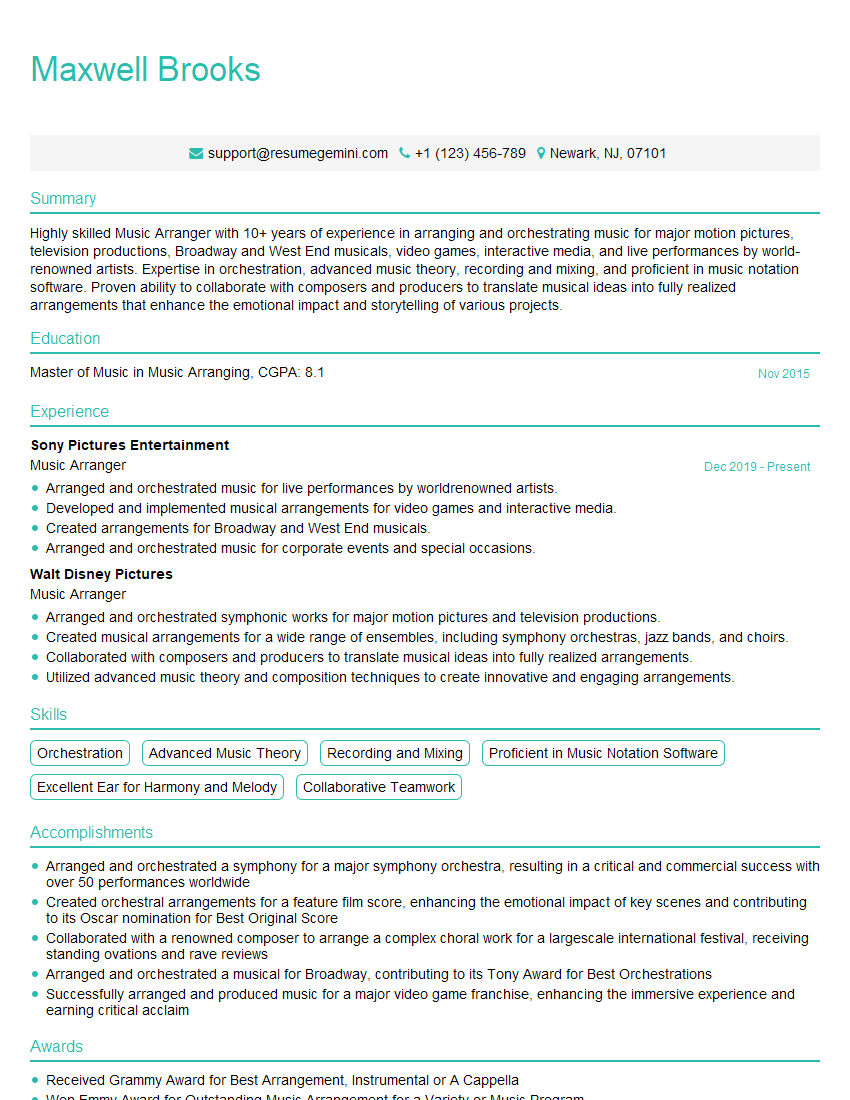
Mastering expertise in arranging for a variety of musical styles and ensembles is crucial for career advancement in the music industry. It opens doors to diverse opportunities, from composing for film and television to working with various artists and ensembles. To maximize your job prospects, create a strong, ATS-friendly resume that clearly showcases your skills and experience. ResumeGemini is a trusted resource to help you build a professional and impactful resume that highlights your unique abilities. Examples of resumes tailored to showcasing Expertise in Arranging for a Variety of Musical Styles and Ensembles are available to help you get started.
Explore more articles
Users Rating of Our Blogs
Share Your Experience
We value your feedback! Please rate our content and share your thoughts (optional).
What Readers Say About Our Blog
Very informative content, great job.
good