The right preparation can turn an interview into an opportunity to showcase your expertise. This guide to Expertise in creating and preparing photographic plates interview questions is your ultimate resource, providing key insights and tips to help you ace your responses and stand out as a top candidate.
Questions Asked in Expertise in creating and preparing photographic plates Interview
Q 1. Explain the different types of photographic plates and their applications.
Photographic plates, the predecessors to modern film, come in various types, each tailored to specific applications. The key difference lies in the emulsion’s sensitivity and grain size.
- Lantern Plates: These were typically glass plates coated with a relatively slow, fine-grained emulsion. Their primary use was for creating high-quality transparencies for projection, particularly popular in the early days of photography for showcasing images on screens. The fine grain ensured sharp detail.
- Process Plates: These plates were designed for processes like collotype or photogravure printing. They were less about direct image capture and more about providing a high-resolution image for reproduction onto other mediums. The emulsion’s properties were crucial for achieving fine detail needed in these printing processes.
- Negative Plates: Used for creating negatives from which positive prints could be made. These often had a wider range of speed and grain size options, depending on the desired application. Faster plates were used in low light conditions, while slower, fine-grained plates were preferred when maximum image detail was needed.
- Dry Plates: Unlike wet collodion plates (which required immediate processing), dry plates could be stored and used later, offering greater convenience to photographers. This was a major advancement in photographic technology. Their emulsions were designed for stability during storage.
The choice of plate type depended heavily on the intended use – sharpness, speed, and printing method all played a role in selection.
Q 2. Describe the process of cleaning and preparing a glass plate for coating.
Cleaning and preparing a glass plate is crucial for a uniform and defect-free coating. Any dust or grease will create imperfections in the final image. The process is meticulous and involves several steps:
- Washing: Thoroughly wash the plates in warm soapy water, ensuring to remove all fingerprints and debris. A soft sponge or brush is recommended to avoid scratching the glass.
- Rinsing: Rinse the plates thoroughly with clean water to remove any soap residue. This step is critical to avoid contamination of the emulsion.
- Alcohol Rinse (Optional): For extra cleanliness, a final rinse with distilled alcohol can remove any remaining traces of water or other contaminants. This is particularly important in environments with high humidity.
- Drying: Allow the plates to air dry completely, or carefully dry them with a lint-free cloth. Dust particles settling on a damp plate will ruin the emulsion.
- Inspection: Before coating, inspect the plates under a bright light to ensure they are completely clean and free from dust or scratches. Even tiny imperfections will show up in the final image.
This preparation is analogous to preparing a canvas before painting – a smooth, clean surface is essential for a high-quality result.
Q 3. What are the key factors to consider when selecting a photographic emulsion?
Choosing the right photographic emulsion is critical; it dictates the final image quality. Key factors include:
- Sensitivity (Speed): Measured in ISO (International Standards Organization) ratings, it determines how sensitive the emulsion is to light. Faster emulsions require shorter exposure times, ideal for low-light situations, but often have larger grain size. Slower emulsions are better for fine detail but necessitate longer exposure times.
- Grain Size: This affects image sharpness and detail. Fine-grained emulsions yield sharper images with better resolution, while coarse-grained emulsions are faster but produce grainier images.
- Contrast: This refers to the difference between the darkest and lightest parts of the image. High-contrast emulsions produce images with strong tonal separation, ideal for high-key or low-key imagery. Low-contrast emulsions offer smoother tonal transitions.
- Spectral Sensitivity: Emulsions can be made sensitive to different wavelengths of light. Orthochromatic emulsions are sensitive to most visible light, while panchromatic emulsions are sensitive to the entire visible spectrum, giving more natural color rendition in black-and-white photography.
Balancing these factors is essential – there’s often a trade-off between speed, grain, and contrast. A photographer’s specific needs determine the best emulsion choice.
Q 4. How do you ensure uniform coating of the emulsion on the plate?
Uniform coating is paramount. An uneven coating leads to variations in density and image quality across the plate. Techniques for achieving uniformity include:
- Proper Mixing: The emulsion must be thoroughly and gently mixed before coating to ensure an even distribution of silver halide crystals.
- Coating Machine (Ideal): A specialized coating machine ensures consistent thickness and even distribution. This is the professional standard.
- Hand Coating (Requires Skill): If hand-coating, the plate must be held at a consistent angle and moved at a uniform speed to achieve an even layer. Practice is crucial to develop the right technique.
- Proper Viscosity: The emulsion’s viscosity (thickness) is important. Too thick and it will be uneven; too thin and it will be too weak.
- Controlled Environment: Dust-free environment and controlled temperature and humidity prevent irregularities and ensure consistent emulsion drying.
Think of it like applying paint to a wall – a steady hand and the right tools are crucial for a smooth, even finish.
Q 5. Explain the process of developing a photographic plate.
Developing a photographic plate is the process of converting the latent image (invisible silver halide crystals exposed to light) into a visible image. This typically involves:
- Developing: The plate is immersed in a developer solution, which reduces the exposed silver halide crystals to metallic silver, forming the negative image.
- Stopping Bath: After developing, a stop bath (typically a weak acid solution) is used to neutralize the developer and stop the development process.
- Fixing: A fixer solution (usually sodium thiosulfate or hypo) dissolves away the unexposed silver halide crystals, making the image permanent and light-insensitive.
- Washing: The plate is thoroughly washed to remove any remaining chemicals, preventing fading and discoloration.
- Drying: The plate is then carefully dried to prevent water spots or other damage.
This process is analogous to bringing a hidden message to light – the developer reveals the image that was previously invisible.
Q 6. Describe the different types of developers used for photographic plates.
Various developers are available, each with different characteristics. Common types include:
- Hydroquinone Developers: These provide high contrast and detail, creating deep blacks and sharp whites. They’re generally slow-acting.
- Metol (Elon) Developers: These are faster-acting developers that produce good detail and less contrast than hydroquinone, yielding softer images.
- Combined Developers: Many developers combine hydroquinone and metol to balance contrast and speed. This is a common approach in creating versatile developers.
- Other Developers: Other developing agents exist, but these three are historically significant and form the basis for most developer formulations.
The choice of developer depends on the desired image characteristics and the type of plate used. Experimentation is encouraged to find the best developer for specific needs.
Q 7. What are the common problems encountered during plate preparation and how are they addressed?
Several problems can occur during plate preparation and development:
- Uneven Coating: This results from improper mixing, application technique, or environmental factors. Re-coat the plate or use a coating machine to ensure a uniform layer.
- Dust or Debris: These appear as spots or blemishes on the final image. Meticulous cleaning is crucial to prevent this.
- Scratches: Scratches on the glass plate result in lines or imperfections. Handle the plates with care and use proper cleaning techniques.
- Development Problems: Uneven development, excessive fogging (overall graying), or poor contrast can result from problems with the developer, temperature, or time. Proper technique and fresh chemicals are essential.
- Fixing Problems: Inadequate fixing leaves the image light-sensitive and prone to fading. Using a fresh fixer and sufficient fixing time are crucial.
Troubleshooting involves careful analysis of each step to pinpoint the source of the problem and correct it. Experience helps in recognizing and solving these issues.
Q 8. How do you control the contrast and density of a photographic plate?
Controlling contrast and density on a photographic plate is a delicate balance achieved through careful manipulation of exposure time, developer concentration, and development time. Think of it like baking a cake – too much time in the oven (exposure) makes it overly brown (dense), while too little leaves it pale (low density). Similarly, a strong developer (high concentration) will boost contrast and density, creating a dramatic image with stark blacks and whites. A weaker developer will result in a softer, less contrasty image.
Exposure: Longer exposure times lead to greater density. Experimentation is key here; test shots with varying exposure durations are vital to finding the sweet spot for your subject and lighting conditions.
Developer Concentration: Using a more concentrated developer increases both contrast and density, while a diluted developer reduces both. Always follow the manufacturer’s instructions carefully, as over-concentrated developers can lead to unpredictable results, including staining and uneven development.
Development Time: Longer development times increase density and, to a lesser extent, contrast. Close monitoring during development is crucial. The ideal development time is dependent on the developer, temperature, and the desired outcome, often requiring a series of test strips to determine the optimal parameters.
For instance, when photographing a landscape with delicate cloud details and strong shadows, a lower contrast and slightly lower density might be desired. Conversely, a portrait requiring a strong emphasis on the subject might benefit from higher contrast and higher density.
Q 9. Explain the importance of proper storage and handling of photographic plates.
Proper storage and handling of photographic plates are paramount to preventing degradation and ensuring optimal results. Photographic plates are highly sensitive to light, humidity, and temperature fluctuations. Imagine them as delicate film negatives; any mishandling can significantly impact their quality and longevity.
Storage: Plates should be stored in a cool, dry, and dark environment. Ideally, a light-tight container, such as a metal box lined with acid-free archival paper, is recommended. Temperature should be kept relatively constant to prevent condensation and warping.
Handling: Always handle plates by their edges, avoiding fingerprints or scratches on the emulsion surface. Use clean, cotton gloves to prevent contamination. Never stack plates directly on top of one another; interleave them with archival paper to prevent damage. Avoid exposing them to extreme temperatures or direct sunlight.
Neglecting proper storage can lead to various problems, including: fogging (a general veil of darkness across the image), chemical staining, and physical damage, all of which compromise the quality and potential of the photographic plates. By employing these storage and handling practices, one ensures their plates remain in pristine condition for years to come.
Q 10. What safety precautions are necessary when working with photographic chemicals?
Working with photographic chemicals requires strict adherence to safety protocols. Many chemicals used in photographic processing are hazardous, posing risks of skin irritation, eye damage, and even inhalation hazards. It’s crucial to view this work with the same respect one would handle any other potentially dangerous chemicals or materials.
Personal Protective Equipment (PPE): Always wear appropriate PPE, including: gloves (nitrile or similar, chemically resistant gloves are recommended), eye protection (safety goggles), and a lab coat to protect your clothing. In some cases, a respirator might be necessary depending on the chemicals and ventilation of your workspace.
Ventilation: Ensure adequate ventilation in the darkroom to prevent the buildup of harmful fumes. Consider a dedicated exhaust system, especially when working with larger quantities of chemicals.
Chemical Handling: Follow the manufacturer’s safety instructions meticulously. Always add chemicals to water, not water to chemicals, to prevent splashing and exothermic reactions. Dispose of used chemicals properly, following all local regulations and guidelines. Never mix chemicals arbitrarily; always refer to manufacturer’s guidelines.
Emergency Procedures: Know the location of safety equipment, such as eyewash stations and emergency showers. Have a plan in place in case of accidents or spills.
Failure to follow these safety procedures could result in serious health consequences. Prioritizing safety ensures both your health and the integrity of your work.
Q 11. How do you troubleshoot issues with uneven development or fogging?
Uneven development or fogging are common issues in photographic plate processing, often stemming from several possible causes. Systematic troubleshooting is vital in pinpointing the root cause.
Uneven Development: This manifests as areas of varying density across the plate. Possible causes include:
- Insufficient agitation: Inadequate agitation during development prevents even chemical distribution across the emulsion.
- Temperature variations: Fluctuations in the developer temperature can lead to uneven development.
- Contaminated chemicals: Impurities in the developer or other chemicals can cause uneven results.
- Scratches or damage: Physical damage to the emulsion can hinder chemical access.
Fogging: A veil of darkness obscuring image detail, this often indicates:
- Light leaks: Light exposure during any stage of the process, even brief exposure, can lead to fogging.
- Old or improperly stored chemicals: Degraded chemicals can contribute to fogging.
- Excessive temperature: High temperatures can accelerate development and increase fog.
- Contaminated equipment: Dirty trays or tanks can introduce impurities.
Troubleshooting Steps: Begin by examining the plate closely for signs of physical damage. Then, review your process: were chemicals properly mixed, stored, and handled? Was agitation consistent? If the problem persists, experiment with fresh chemicals and test strips to rule out chemical degradation.
Q 12. Describe the process of fixing a photographic plate.
Fixing a photographic plate is a crucial step that removes unexposed silver halide crystals from the emulsion, rendering the image permanent and resistant to further light exposure. Think of it as setting the image, preventing further change or fading.
The process typically involves immersing the developed plate in a fixing bath for a specific duration, determined by the fixer’s strength and temperature. Adequate agitation ensures that the fixer reaches all areas of the plate uniformly. After fixing, the plate is thoroughly washed to remove any residual fixer chemicals.
Step-by-Step Process:
- Prepare the fixer bath: Prepare the fixing solution according to the manufacturer’s instructions.
- Immerse the plate: Gently immerse the developed plate into the fixer bath, ensuring complete submersion.
- Agitate gently: Gently agitate the plate to ensure even fixer distribution.
- Monitor the clearing: Observe the plate until the milky appearance of the unexposed silver halides disappears completely; this indicates complete fixing.
- Rinse thoroughly: Thoroughly rinse the plate under running water to remove any residual fixer.
- Final wash: Give the plate a final wash in a hypo-clearing agent to remove lingering thiosulfate.
- Drying: Allow the plate to dry slowly, avoiding dust contamination.
Incomplete fixing can lead to fading and image instability over time, whereas over-fixing can damage the emulsion. Proper time and attention to detail are crucial here.
Q 13. What are the different types of fixers used for photographic plates?
Several types of fixers are used for photographic plates, each with its own characteristics and advantages. The most common is sodium thiosulfate (hypo), either in a plain or acidic formulation.
Sodium Thiosulfate (Hypo): This is the most widely used fixer, known for its effectiveness in removing unexposed silver halides. However, plain hypo solutions can cause swelling of the emulsion and are prone to leaving residual thiosulfate in the emulsion, resulting in fading over time.
Acidic Fixers: Acidic fixers, containing an acid such as acetic acid or sulfamic acid, mitigate the disadvantages of plain hypo. The acid hardens the gelatin emulsion, making it less susceptible to scratching and degradation, and also accelerates the fixing process. They are also much less prone to leaving residual thiosulfate.
Rapid Fixers: These are often formulated with additives that accelerate the fixing process, reducing overall processing time. However, rapid fixers might not always provide the same level of archival stability as slower, traditional fixers.
The choice of fixer depends on various factors, including the type of emulsion, the desired archival stability, and processing time constraints. Always consult the manufacturer’s instructions for specific recommendations.
Q 14. How do you assess the quality of a prepared photographic plate?
Assessing the quality of a prepared photographic plate involves several steps, aimed at identifying any defects that might compromise its performance or the final image. A high-quality plate should be free from defects and ready to provide an excellent image.
Visual Inspection: Carefully examine the plate under a low-intensity light source. Look for any scratches, dust particles, or other physical imperfections on the emulsion surface. Check for any irregularities in the emulsion thickness or any signs of discoloration or staining.
Sensitivity Test: Expose a small section of the plate to a known light source for a controlled period. Develop the exposed section according to your standard procedure. Assess the resulting density and contrast, comparing it to known results from plates of similar type and batch to determine the sensitivity, ensuring it meets your expectations.
Fog Test: Store a portion of the plate in complete darkness for a set period (e.g., 24 hours). Develop this unexposed portion; any significant density indicates excessive fog, indicating a problem with the plate’s storage or preparation.
By employing these simple assessment techniques, one can ensure the plates are up to par, minimizing waste and maximizing the quality of the final images obtained.
Q 15. What are the different methods for sensitizing photographic plates?
Sensitizing photographic plates involves coating a glass or other suitable substrate with a light-sensitive emulsion. Historically, this was primarily done using silver halide crystals (like silver bromide or silver iodide) suspended in gelatin. The gelatin acts as a binder, holding the crystals in place and allowing for even distribution across the plate. There are several methods, varying slightly in their approach to achieving this even coating and sensitivity:
Colloidal Coating: This is the most common method. A carefully prepared emulsion of silver halide crystals in gelatin is applied to the plate using a coating machine. This ensures an even, uniform layer.
Flow Coating: A simpler, less controlled method where the emulsion is poured onto the plate and allowed to flow evenly. This is less precise than colloidal coating and results in variations in emulsion thickness.
Spin Coating: The plate is spun at high speed while the emulsion is dispensed at the center. Centrifugal force spreads the emulsion thinly and uniformly. This is used for specialized applications requiring very thin, even layers.
The choice of method depends on factors like the desired plate quality, production scale, and required precision.
Career Expert Tips:
- Ace those interviews! Prepare effectively by reviewing the Top 50 Most Common Interview Questions on ResumeGemini.
- Navigate your job search with confidence! Explore a wide range of Career Tips on ResumeGemini. Learn about common challenges and recommendations to overcome them.
- Craft the perfect resume! Master the Art of Resume Writing with ResumeGemini’s guide. Showcase your unique qualifications and achievements effectively.
- Don’t miss out on holiday savings! Build your dream resume with ResumeGemini’s ATS optimized templates.
Q 16. Explain the concept of spectral sensitivity in photographic plates.
Spectral sensitivity refers to the range of wavelengths of light to which a photographic plate is sensitive. Different silver halide crystals and additional dyes (spectral sensitizers) can be added to the emulsion to broaden or narrow this sensitivity.
For example, a plate sensitized only with silver bromide will primarily be sensitive to blue and ultraviolet light. This is called orthochromatic film. Adding dyes like erythrosine extends the sensitivity to green, and others can extend it further into the yellow, orange, and red regions of the spectrum—resulting in panchromatic film. This is crucial; early photographers struggled with accurate color representation because plates were only sensitive to a limited range of wavelengths. Imagine trying to photograph a red flower with an orthochromatic plate – it would appear almost black!
Controlling spectral sensitivity is paramount in various applications. For astronomical photography, plates sensitive to specific wavelengths help isolate details in celestial objects based on their emission spectra. In forensic photography, adjusting spectral sensitivity allows for the enhancement of specific details obscured by other factors.
Q 17. How does temperature affect the development process of photographic plates?
Temperature significantly impacts the development process of photographic plates. The development reaction is chemical and, like all chemical reactions, its rate is temperature-dependent.
Higher temperatures generally accelerate the development process, leading to faster development times but potentially increased graininess and reduced image sharpness. The emulsion might also become overly softened leading to scratches or damage.
Lower temperatures slow down development, resulting in longer processing times. However, this can lead to finer grain and potentially improved image clarity. The developing solution might also become less active, slowing the development to the extent that it doesn’t work at all. Keeping the developer at a consistent, specified temperature within the recommended range ensures predictable and optimal results.
Maintaining a stable, controlled temperature (often around 68°F or 20°C) during development is vital for consistent image quality.
Q 18. What is the role of different photographic chemicals in the development process?
The development process relies on a combination of chemicals, each playing a crucial role:
Developer: This is the heart of the process. It reduces exposed silver halide crystals to metallic silver, forming the visible image. Common developers include metol, hydroquinone, and phenidone. Each has its own properties affecting contrast and speed of development.
Stop Bath: This solution neutralizes the developer, stopping the development process abruptly and preventing further unwanted reactions. A common stop bath is dilute acetic acid.
Fixer: This dissolves the unexposed silver halide crystals, preventing them from reacting with light and darkening the image over time. Sodium thiosulfate (hypo) is a widely used fixer.
Washing Agent: Thorough washing after fixing is crucial to remove residual chemicals that could potentially damage the plate or lead to fading over time. Water is the main washing agent.
The precise composition and concentration of these chemicals are crucial for optimal results. Improper mixing or outdated chemicals can significantly affect the final image quality.
Q 19. Describe the process of drying a photographic plate.
Drying a photographic plate is the final step in the process and is crucial for preserving the image. Improper drying can lead to various issues including staining, damage to the emulsion, and sticking.
Traditionally, plates were dried in a dust-free environment by hanging them vertically in a well-ventilated darkroom. This slow, natural drying method allows the gelatin to contract gently, minimizing the risk of cracking or damage. Modern techniques might include using gentle, controlled airflow to speed up the drying process, using controlled humidity to reduce static issues. The key is to avoid rapid drying, which can create stress on the emulsion and lead to cracking, and to prevent dust or debris from settling on the wet plate.
Q 20. How do you dispose of used photographic chemicals responsibly?
Responsible disposal of used photographic chemicals is essential for environmental protection and personal safety. Many photographic chemicals are toxic or hazardous. Never pour them down the drain or into the trash.
The best approach is to contact local hazardous waste disposal facilities. They are equipped to handle these chemicals safely and in accordance with regulations. Some facilities may even accept used fixer and developer separately for reclamation or recycling, reducing the environmental impact. Many chemical suppliers will offer guidance on safe handling and disposal of their products. Always consult the product’s Safety Data Sheet (SDS) for detailed disposal instructions.
Q 21. What are the different types of photographic plate defects and their causes?
Photographic plates, despite careful preparation and handling, can be susceptible to various defects. Understanding these defects and their causes is crucial for quality control.
Halation: This is a blurring effect around bright areas in the image caused by light scattering within the emulsion layer. It can be reduced by using anti-halation coatings.
Fogging: This results in a general graying of the image due to factors such as light leaks, improper storage, or chemical contamination.
Scratches and Marks: These can be introduced during handling, coating, or processing.
Uneven Density: Inconsistent development or uneven emulsion coating leads to variations in the darkness of different areas of the image.
Tree Rings: These are circular patterns related to emulsion drying.
Careful attention to each step of the process, from preparing the emulsion to developing and drying the plate, minimizes the likelihood of these defects and improves overall image quality. Identifying the source of the defect allows for corrective action in subsequent work.
Q 22. Explain the relationship between exposure time and plate density.
Exposure time and plate density are intrinsically linked. Density, in the context of a photographic plate, refers to the darkness or opacity of the resulting image. A longer exposure time allows more light to reach the light-sensitive emulsion on the plate, resulting in a greater degree of silver halide reduction and thus, a higher density—a darker image. Conversely, a shorter exposure time leads to less silver halide reduction and a lower density—a lighter image. Think of it like painting: the longer you expose a section to paint (light), the more intense the color (density) will become.
This relationship isn’t linear, however. The response of the emulsion isn’t always proportional to the exposure time. It follows a characteristic curve, often described with an ‘H&D curve’ (Hurter-Driffield curve), showing the relationship between log exposure and density. This curve demonstrates that there are areas of higher and lower sensitivity within the emulsion’s response to light.
Q 23. Describe the impact of different lighting conditions on plate development.
Lighting conditions profoundly affect plate development. The intensity and color temperature of the light source directly influence the exposure time required and the overall quality of the final image. Bright sunlight, for example, requires significantly shorter exposure times to prevent overexposure, potentially leading to loss of detail in highlights. Conversely, low-light conditions necessitate longer exposures, increasing the risk of underexposure and loss of detail in shadows. Moreover, different light sources have different spectral outputs. Daylight is richer in blue tones than tungsten light, impacting how colors are rendered on the plate.
For instance, during outdoor portraiture on a sunny day, I’d use a significantly faster shutter speed than I would shooting a dimly lit interior scene. Moreover, the color cast of the light (blue sky vs. warm indoor lighting) needs to be considered, and sometimes color filters are used to compensate for these variances during exposure. This careful control of exposure is crucial for achieving a well-balanced, aesthetically pleasing final image.
Q 24. How does the age of the emulsion affect the quality of the plate?
The age of the emulsion significantly impacts plate quality. Emulsions degrade over time, losing their light sensitivity and resulting in a reduction in image quality. This degradation is accelerated by exposure to heat, humidity, and radiation. An aged emulsion may yield images that are significantly less sharp, exhibit increased fogging (a general graying of the image), and display reduced contrast and dynamic range. In essence, the silver halide crystals within the emulsion become less reactive to light, leading to a weaker, less defined image.
I’ve experienced this firsthand with some antique collodion plates I’ve worked with. While their historical significance is undeniable, obtaining satisfactory results often requires careful adjustment of exposure and development times, and even then, the results may be compromised due to emulsion age. Therefore, using fresh, high-quality emulsions is paramount for consistently achieving optimal results.
Q 25. Describe your experience with specific types of photographic plates (e.g., glass, metal).
My experience encompasses both glass and metal photographic plates. Glass plates, traditionally used in the wet plate collodion process, offer excellent dimensional stability and surface smoothness, contributing to superior image sharpness. However, they are inherently fragile and require careful handling. Metal plates, particularly those made of aluminum or stainless steel, are more durable and resistant to breakage but can sometimes exhibit a slightly less uniform surface compared to glass. The choice between glass and metal depends on the specific needs of the project, balancing the need for superior image quality with practical considerations like ease of handling and archival storage.
For instance, when working on large-format landscape photography where image sharpness is paramount, glass plates are my preferred choice. In situations where portability and durability are more critical, like on-location architectural photography, I might opt for metal plates.
Q 26. What are the key differences between wet plate collodion and other photographic processes?
Wet plate collodion stands apart from other photographic processes due to its unique ‘wet’ nature. The emulsion is applied directly to the plate and sensitized immediately before exposure, requiring development within minutes. This contrasts sharply with dry-plate processes, where a pre-coated, stable emulsion can be stored and used later. This immediacy is both a challenge and a unique aspect of wet plate collodion, resulting in a one-of-a-kind workflow with a distinct aesthetic.
Unlike gelatin-silver printing, which typically involves a negative-positive process, wet plate collodion often produces a direct positive image on the plate itself, yielding high contrast and a rich tonal quality that is highly valued for its unique artistic character. The process is more demanding, requiring precise timing and a deep understanding of chemistry and photographic principles, but the results are unmatched in their characteristic look and feel.
Q 27. How would you adapt your techniques for preparing plates for different photographic processes?
Adapting techniques for different photographic processes involves understanding the specific chemistry and requirements of each method. For example, the collodion process requires the careful preparation and coating of a glass or metal plate with a light-sensitive collodion emulsion. Gelatin silver processes, on the other hand, utilize pre-coated plates or sheets of photographic paper. The development, fixing, and toning procedures also vary significantly between these processes. Even within the wet plate collodion process, the type of collodion, the chemicals used in the sensitizing bath, and the development process may be adjusted to alter the final image character.
I approach each process with a deep understanding of the underlying chemical reactions and the influence of factors like temperature, humidity, and exposure time. My experience enables me to fine-tune each step to get optimal results, whether creating a high-contrast wet-plate collodion portrait or a finely detailed gelatin silver print. This includes careful adjustments to chemical concentrations, development times, and exposure settings.
Q 28. Describe a situation where you had to troubleshoot a problem during plate preparation and how you resolved it.
During a large-format wet plate collodion shoot, I encountered a problem with excessive fogging on my plates. The images were washed out and lacked contrast. Initially, I suspected a problem with the collodion emulsion itself, but after carefully checking the batch, I realized the issue was with my darkroom setup. A small, unnoticed leak in a light-proof bag allowed a faint amount of ambient light to reach the plates before and during exposure.
To solve the problem, I meticulously checked all seals and seams of the light-proof bag, ensuring a completely light-tight environment. I also implemented a double-checking procedure before each exposure to eliminate any potential light leaks. This thorough troubleshooting, combined with a more rigorous darkroom inspection protocol, resolved the fogging issue, and I was able to produce high-quality images for the project.
Key Topics to Learn for Expertise in creating and preparing photographic plates Interview
- Plate Materials and Properties: Understanding the characteristics of different photographic plate materials (e.g., glass, metal), their sensitivity to light, and how these impact image quality and longevity. Consider factors like grain size, resolution, and spectral sensitivity.
- Plate Preparation Techniques: Mastering the practical skills involved in cleaning, coating, and sensitizing photographic plates. This includes understanding different coating methods, drying techniques, and the importance of a clean, dust-free environment.
- Exposure and Development Processes: Deep knowledge of exposure times, development chemicals, and techniques for optimal image development. This includes troubleshooting common issues like uneven development or fogging.
- Image Quality and Assessment: Developing a keen eye for evaluating image quality, identifying defects, and understanding the factors that contribute to sharp, clear images. This involves analyzing contrast, density, and resolution.
- Historical and Artistic Context: Familiarizing yourself with the history of photographic plates and their significance in the development of photography as an art form and scientific tool. Understanding different plate types and their applications throughout history.
- Troubleshooting and Problem Solving: Developing the ability to identify and resolve common issues encountered during plate preparation and processing. This includes understanding the causes of various defects and implementing corrective measures.
- Health and Safety: Understanding and adhering to proper safety procedures when handling chemicals and equipment used in photographic plate preparation and processing.
Next Steps
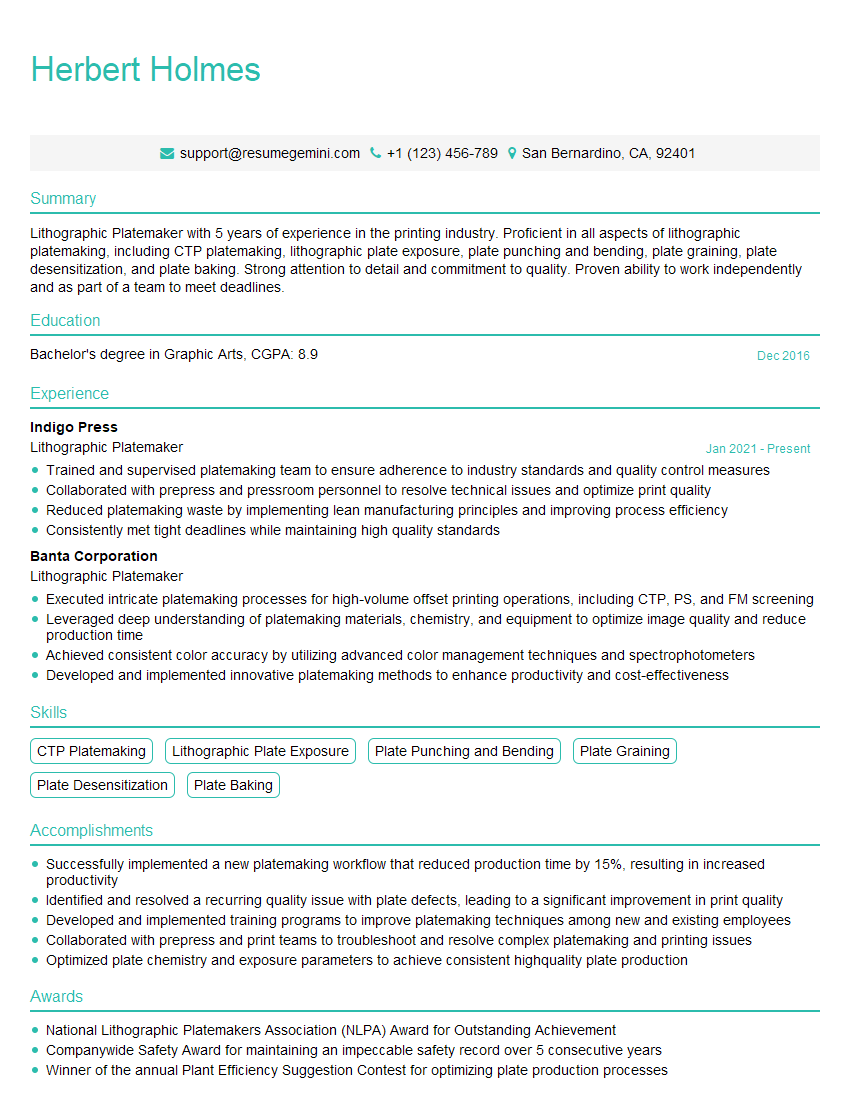
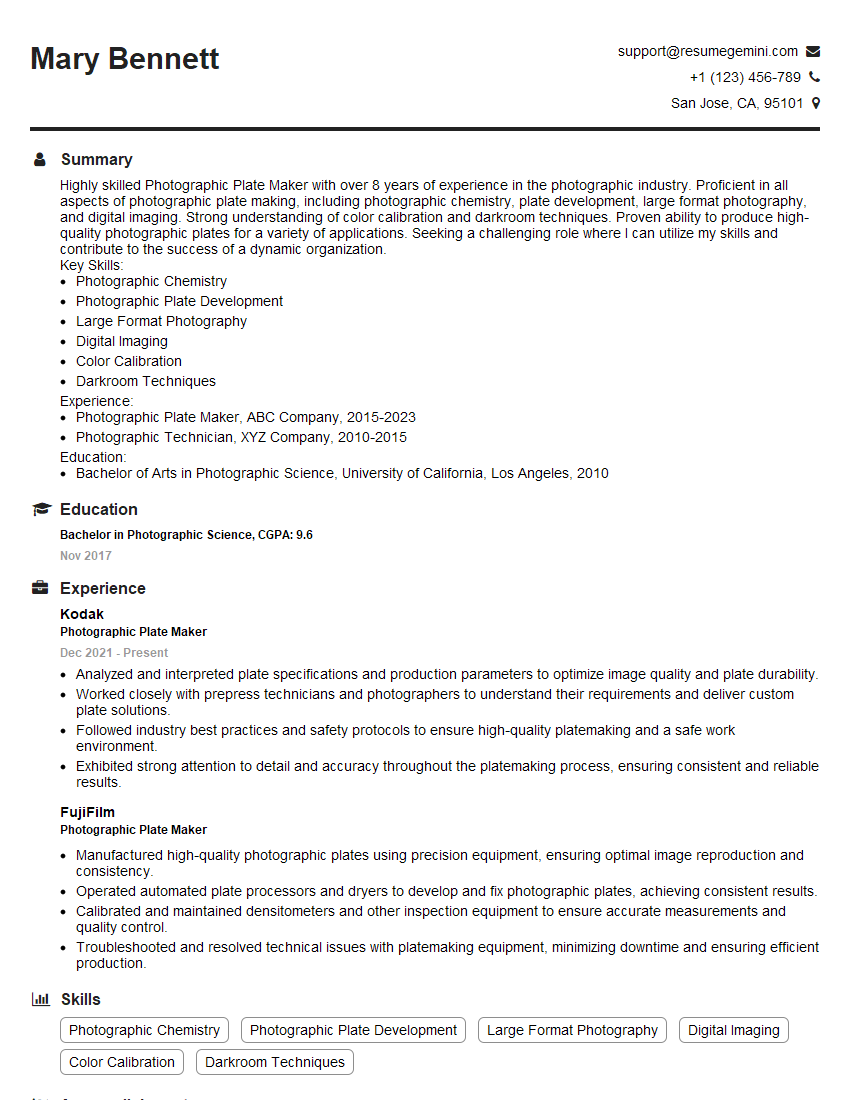
Mastering expertise in creating and preparing photographic plates opens doors to exciting career opportunities in fields like historical preservation, art restoration, scientific imaging, and specialized photography. To maximize your job prospects, crafting a strong, ATS-friendly resume is crucial. ResumeGemini is a trusted resource that can help you build a professional resume that highlights your unique skills and experience. Examples of resumes tailored to expertise in creating and preparing photographic plates are available to further guide you in showcasing your qualifications effectively.
Explore more articles
Users Rating of Our Blogs
Share Your Experience
We value your feedback! Please rate our content and share your thoughts (optional).
What Readers Say About Our Blog
Very informative content, great job.
good