Cracking a skill-specific interview, like one for Expertise in preconstruction planning and cost estimation, requires understanding the nuances of the role. In this blog, we present the questions you’re most likely to encounter, along with insights into how to answer them effectively. Let’s ensure you’re ready to make a strong impression.
Questions Asked in Expertise in preconstruction planning and cost estimation Interview
Q 1. Explain your experience with different cost estimating methods (e.g., parametric, detailed, unit pricing).
Cost estimating employs various methods, each with its strengths and weaknesses. Parametric estimating uses historical data and statistical models to predict costs based on project attributes like size and complexity. Think of it like using a formula – input project specifics, and the model outputs a cost estimate. This is great for early-stage estimations when detailed information is scarce. For example, estimating the cost of a multi-family residential building using square footage as the primary parameter. Detailed estimating, on the other hand, is a meticulous, bottom-up approach. It involves breaking down the project into individual components, estimating the cost of each, and summing them up. This method is much more accurate but time-consuming and requires detailed blueprints and specifications. Imagine meticulously pricing every single nail, piece of lumber, and labor hour involved in building a deck. Finally, unit pricing uses pre-determined costs per unit of work (e.g., cost per square foot of concrete). This method is quick and straightforward, but requires careful selection of appropriate unit rates to ensure accuracy, reflecting local material and labor costs.
Q 2. Describe your process for developing a comprehensive preconstruction schedule.
Developing a preconstruction schedule requires a structured approach. I typically start with a clear definition of project scope, objectives, and milestones. Then, I utilize a Work Breakdown Structure (WBS) to break down the project into smaller, manageable tasks. This WBS forms the basis for scheduling. Next, I sequence these tasks logically, identifying dependencies and critical paths. I consider factors like resource availability (labor, equipment, materials) and potential delays to establish realistic durations for each task. Throughout this process, I leverage critical path method (CPM) techniques to identify the longest sequence of tasks that determines the overall project duration. Finally, the schedule is reviewed with the client and the project team, and revisions are made to ensure alignment with budget and expectations. This iterative process ensures the schedule is robust, realistic, and adaptable to changes.
Q 3. How do you identify and mitigate potential risks during the preconstruction phase?
Risk identification and mitigation are crucial. My approach involves a proactive risk assessment process. This involves brainstorming sessions with the project team to identify potential risks across all aspects – design, permitting, construction, and financing. We categorize these risks by likelihood and impact, using a matrix to prioritize them. For each significant risk, we develop a mitigation strategy. This could involve contingency planning (budgeting for unexpected costs), insurance, alternative construction methods, or simply thorough due diligence to avoid the risk altogether. For example, if there’s a risk of soil instability, we might include geotechnical investigation early on, and possibly incorporate foundation solutions that account for potential issues. Regular monitoring and reporting throughout the preconstruction phase ensure that we’re consistently addressing emerging risks.
Q 4. What software programs are you proficient in for cost estimating and scheduling?
I’m proficient in several software programs vital for cost estimating and scheduling. For cost estimating, I use programs like RSMeans, which offers extensive databases of construction costs, and also utilize spreadsheets for detailed cost breakdowns and analysis. For scheduling, I’m experienced with Primavera P6 and Microsoft Project, both powerful tools for creating, managing, and updating project schedules. I also have experience using BIM (Building Information Modeling) software to integrate cost and schedule data within the digital model, improving accuracy and collaboration.
Q 5. Explain your experience with value engineering and how you’ve implemented it.
Value engineering is a systematic approach to enhancing project value while maintaining or even reducing costs. I’ve implemented value engineering in various projects by engaging early and collaborative discussions with the design team and the client. This involved analyzing the project design to identify areas where costs could be reduced without sacrificing quality or functionality. For example, in one project, we substituted a more expensive cladding material with a cost-effective alternative that still met the aesthetic and performance requirements. In another instance, we optimized the structural design to reduce material quantities while maintaining structural integrity. The outcome is a more efficient design that meets the client’s needs within the budget constraints, while adding value.
Q 6. How do you handle changes in scope during the preconstruction phase?
Scope changes during preconstruction are managed through a formal change control process. Any proposed change, no matter how minor, is documented, assessed for impact on cost and schedule, and then reviewed and approved by relevant stakeholders. This process typically involves a change order request, which clearly outlines the proposed modification, the reasons for the change, the associated costs, and the updated schedule. Once approved, the change is incorporated into the project documents, budget, and schedule. Transparency and clear communication throughout the process are key to managing scope changes effectively and maintaining a strong client relationship.
Q 7. Describe a challenging cost estimating project and how you overcame the obstacles.
One particularly challenging project involved estimating the cost of renovating a historic building. The major obstacle was the uncertainty surrounding the extent of hidden damage behind existing finishes. To overcome this, we employed a phased approach to estimating. We started with an initial, high-level estimate based on visible conditions, then conducted a more thorough investigation, including exploratory demolition in select areas. This provided a more accurate assessment of the existing conditions, allowing for a more refined estimate. We also incorporated a contingency buffer into the estimate to account for the inherent uncertainty of working with a historic structure. Through open communication with the client and transparent reporting of our findings, we successfully navigated the challenges and delivered a reliable cost estimate.
Q 8. How do you ensure accuracy in your cost estimates?
Accuracy in cost estimating is paramount. It’s not just about getting a number; it’s about building confidence in that number. We achieve this through a multi-faceted approach that begins with a thorough understanding of the project scope. This involves detailed analysis of the design documents, specifications, and site conditions. We then break down the project into its individual components—site work, structural, MEP (Mechanical, Electrical, Plumbing), finishes, etc.—creating a detailed breakdown structure (WBS).
Each component is estimated independently using various methods, such as unit pricing (for example, cost per square foot of flooring), quantity takeoff from drawings, and historical data from similar projects. We use robust estimating software to manage quantities and costs, allowing for easy updates and scenario analysis. Regular quality checks and peer reviews are crucial to catch errors and inconsistencies. Finally, we factor in a contingency to account for unforeseen circumstances and cost overruns. This might be a percentage of the total cost, or a specific amount allocated to high-risk areas. Think of it like an insurance policy for the project’s budget.
For example, on a recent school renovation project, we used a combination of unit pricing for standard finishes and detailed quantity takeoffs for specialized HVAC systems. The peer review highlighted a potential cost overrun in the electrical work, which we were able to address proactively by exploring alternative solutions.
Q 9. How do you collaborate with architects, engineers, and subcontractors during preconstruction?
Collaboration is the lifeblood of successful preconstruction. We establish clear communication channels from the outset, involving architects, engineers, and subcontractors in regular meetings and workshops. We utilize collaborative software platforms to share documents, track progress, and manage revisions. This fosters transparency and prevents misunderstandings that often lead to cost overruns.
With architects, we focus on value engineering—identifying areas where design changes can reduce costs without sacrificing quality. With engineers, we discuss constructability and potential challenges early on. This early input minimizes costly revisions later in the process. Subcontractors are invaluable sources of information regarding pricing and availability of materials and labor. We actively solicit bids from multiple subcontractors to ensure competitive pricing and choose those with a proven track record.
For instance, on a recent high-rise project, our early collaboration with structural engineers allowed us to identify a more efficient foundation design, saving the client significant costs. Engaging subcontractors early in the process allowed us to refine the budget based on real-time material and labor costs.
Q 10. What is your experience with building information modeling (BIM) in preconstruction?
Building Information Modeling (BIM) has revolutionized preconstruction. We utilize BIM extensively for 4D (time) and 5D (cost) modeling. This allows us to create a detailed digital representation of the project, enabling us to identify clashes between different disciplines (for example, MEP and structural), optimize construction sequencing, and develop more accurate cost estimates.
BIM software helps in quantity takeoffs, generating accurate material quantities directly from the model. It also aids in clash detection, identifying potential conflicts between different building systems early on, minimizing costly rework during construction. Furthermore, we use BIM to develop 4D simulations, which visualize the construction process over time. This helps us to refine scheduling and identify potential delays, influencing our overall cost estimates.
In a recent hospital project, BIM helped us identify a clash between ductwork and structural columns. Addressing this virtually saved considerable time and money during construction. The 5D model provided a visual representation of the budget, allowing stakeholders to easily understand cost breakdowns and the impact of design changes.
Q 11. How do you create and manage a project budget?
Project budget creation and management involves a systematic approach. Starting with the initial cost estimate, we develop a detailed budget that aligns with the project scope and schedule. The budget is typically organized using a Work Breakdown Structure (WBS), breaking down the project into smaller, manageable components with assigned costs.
We use specialized budget management software to track expenses against the budget throughout the project lifecycle. This includes tracking actual costs incurred against the budgeted amounts, highlighting potential variances. Regular budget reviews are essential, and any significant deviations from the plan are thoroughly investigated and addressed proactively. We use earned value management (EVM) techniques to monitor progress and identify potential risks. EVM measures progress based on completed work and compares it to the schedule and budget, offering early warnings of potential issues.
For example, on a recent commercial building project, we utilized a cloud-based budget management tool that allowed all stakeholders access to real-time budget information. This transparency helped us quickly identify a cost overrun in the foundation work, allowing us to adjust the budget accordingly and implement cost-saving measures.
Q 12. How do you analyze and present cost data to stakeholders?
Presenting cost data effectively requires clarity and visual aids. We utilize various methods to communicate cost information to stakeholders, tailoring our approach to the audience’s understanding.
We use clear and concise reports that include summaries of key cost figures, detailed breakdowns of costs by category, and visual representations like charts and graphs. We avoid technical jargon whenever possible and use simple language to explain complex concepts. Presentations often incorporate visual aids, such as bar charts showing cost distribution across different project phases, or pie charts depicting the percentage breakdown of costs. We also provide sensitivity analyses, showing the impact of potential changes in scope or material costs.
For example, during a recent presentation to a client, we used a simple bar chart to demonstrate the relative costs of different building materials, allowing them to make informed decisions about cost-effective alternatives. We then used a sensitivity analysis to show the impact of potential increases in labor costs on the overall project budget.
Q 13. Describe your understanding of different contract types and their impact on cost estimating.
Understanding different contract types is critical for accurate cost estimating. The choice of contract directly impacts the level of risk and responsibility borne by the owner and the contractor. Different contract types affect the way we approach cost estimating, influencing the level of detail and contingency required.
- Lump Sum: In a lump-sum contract, a fixed price is agreed upon upfront. This requires a very detailed estimate with a robust contingency to account for any unforeseen circumstances.
- Cost Plus Fee: In a cost-plus contract, the contractor is reimbursed for actual costs incurred, plus a predetermined fee or percentage markup. This approach requires meticulous cost tracking and management throughout the project. The contingency needs to be smaller.
- Unit Price: In a unit price contract, costs are based on the quantities of work performed, with a pre-agreed price per unit. This approach is suitable for projects with well-defined quantities and requires accurate quantity takeoffs. The contingency is also adjusted based on uncertainty in the quantities.
For instance, a lump-sum contract for a custom home requires a very thorough estimate, factoring in all potential risks. A cost-plus contract for a research facility might allow for greater flexibility in design changes, but it requires stringent cost tracking.
Q 14. What is your experience with contingency planning in cost estimating?
Contingency planning is an integral part of responsible cost estimating. It involves identifying and mitigating potential risks that could impact the project budget. We employ a systematic approach, starting with a thorough risk assessment, identifying potential problems, and quantifying their potential impact.
We consider various factors, including market fluctuations in material prices, potential labor shortages, unforeseen site conditions, and design changes. The contingency amount is determined based on the level of risk associated with each factor and the overall project complexity. This contingency is not simply an arbitrary percentage; it’s a carefully calculated buffer to absorb unforeseen costs. We use probability analysis and historical data to inform our contingency calculations. This ensures a realistic budget that considers potential uncertainties.
In a recent infrastructure project, we identified a high risk of encountering unexpected underground utilities. We allocated a significant contingency to cover potential delays and cost overruns associated with relocating these utilities, thus protecting the project from significant financial setbacks.
Q 15. How do you account for unforeseen costs and delays in your estimates?
Unforeseen costs and delays are an inherent risk in construction. We mitigate this through a multi-pronged approach. First, we conduct thorough site investigations, involving geotechnical surveys and environmental assessments, to identify potential hidden issues early on. This helps us avoid costly surprises later. Second, we build contingency into our estimates. This isn’t a random percentage; it’s calculated based on the project’s complexity, historical data on similar projects, and the specific risks identified during the planning phase. For instance, a project in a densely populated urban area might require a higher contingency than one in a rural setting. Third, we utilize parametric estimating techniques, which leverage historical data and statistical analysis to predict potential cost overruns and delays. Finally, we regularly review and update our estimates throughout the preconstruction process, incorporating new information and adjusting the contingency as needed. Think of it like an insurance policy – you hope you don’t need it, but it’s crucial to have in place.
Career Expert Tips:
- Ace those interviews! Prepare effectively by reviewing the Top 50 Most Common Interview Questions on ResumeGemini.
- Navigate your job search with confidence! Explore a wide range of Career Tips on ResumeGemini. Learn about common challenges and recommendations to overcome them.
- Craft the perfect resume! Master the Art of Resume Writing with ResumeGemini’s guide. Showcase your unique qualifications and achievements effectively.
- Don’t miss out on holiday savings! Build your dream resume with ResumeGemini’s ATS optimized templates.
Q 16. What are your strategies for managing the time and resources in preconstruction?
Effective time and resource management in preconstruction is crucial. We employ several strategies. Firstly, we create a detailed preconstruction schedule using tools like Microsoft Project or Primavera P6. This schedule outlines key milestones, deliverables, and resource allocation. We use critical path analysis to identify tasks that are most critical to the overall project timeline and focus on ensuring their timely completion. Secondly, we establish clear roles and responsibilities within the team. Each team member understands their tasks and deadlines. Thirdly, we leverage technology. Collaborative platforms like BIM 360 allow for real-time updates and communication, enhancing transparency and accountability. Finally, we regularly monitor progress against the schedule and resource allocation, making adjustments as needed through change orders and progress meetings. This proactive approach allows us to identify potential issues early and take corrective action, avoiding significant delays and cost overruns. Imagine a well-orchestrated orchestra; each musician (team member) plays their part in perfect harmony to produce a beautiful symphony (successful project).
Q 17. How do you ensure effective communication and collaboration amongst the preconstruction team?
Communication and collaboration are paramount. We establish a clear communication plan at the outset, outlining how and when information will be shared. This often involves regular team meetings, both in-person and virtual, using tools like video conferencing. We also utilize a central document repository accessible to all team members, ensuring everyone works from the same information. We promote open communication, encouraging team members to raise concerns or issues without hesitation. Transparency is key; we keep all stakeholders informed of the project’s progress and any potential challenges. Furthermore, we foster a culture of collaboration where team members feel comfortable sharing ideas and working together to find solutions. We’ve found that a collaborative, transparent approach prevents misunderstandings and improves decision-making significantly. It’s less about individual brilliance and more about collective intelligence.
Q 18. Explain your experience with different bidding strategies.
My experience encompasses various bidding strategies, each with its own strengths and weaknesses. We frequently use competitive bidding, where multiple subcontractors submit bids for the same work. This fosters price competition but requires careful evaluation of bids to ensure quality doesn’t suffer. We also employ negotiated bidding, where we work directly with selected subcontractors to agree on price and terms. This is suitable for complex or specialized work requiring a higher level of collaboration. In some instances, we utilize a combination of these approaches, using competitive bidding for standard work and negotiated bidding for specialized items. The choice of bidding strategy depends on several factors, including project scope, complexity, timeline, and market conditions. Each project requires a tailored strategy to achieve optimal results. For example, on a high-profile project with a tight deadline, negotiated bidding with pre-qualified subcontractors may be preferred over a lengthy competitive bidding process.
Q 19. How do you develop and maintain strong relationships with subcontractors?
Developing and maintaining strong relationships with subcontractors is essential for project success. This involves fair and transparent dealings, prompt payment, and open communication. We treat subcontractors as partners, not just vendors. We choose subcontractors based on their experience, reputation, and capacity. We engage them early in the preconstruction process, involving them in design reviews and value engineering exercises. This collaborative approach allows them to provide valuable input and identify potential issues early on. We build trust through consistent communication, providing them with clear instructions and expectations. We address any concerns promptly and fairly, and we recognize their contributions to the project’s success. A strong relationship isn’t just about price; it’s about mutual respect and trust, which can be invaluable when challenges arise.
Q 20. How do you ensure your cost estimates comply with relevant regulations and standards?
Compliance is paramount. We ensure our cost estimates adhere to all relevant regulations and standards, including local building codes, environmental regulations, and industry best practices. We involve legal and regulatory experts as needed to ensure compliance. We maintain detailed records of all cost estimations and the basis for those estimates, which helps in auditing and ensures transparency. We conduct regular internal reviews to identify and rectify any potential compliance issues. We are committed to ethical and legal conduct, and we believe that compliance is not just a matter of avoiding penalties, but of ensuring the safety and well-being of everyone involved in the project.
Q 21. What is your experience with life-cycle cost analysis?
Life-cycle cost analysis (LCCA) is a critical aspect of our preconstruction planning. LCCA considers the total cost of ownership of a building over its entire lifespan, including initial construction costs, operating costs (energy, maintenance), and end-of-life costs (demolition). We use LCCA to evaluate different design options and materials, selecting those that offer the lowest total cost over the building’s lifetime. For example, we might compare the initial cost of a high-efficiency HVAC system to a less efficient system. While the initial cost might be higher, the lower operating costs over the building’s lifetime could make it the more economical choice. LCCA is not just about saving money; it’s also about making environmentally responsible decisions by selecting sustainable materials and technologies that reduce long-term environmental impact. It’s a holistic approach that considers the long-term consequences of decisions made during the initial design and construction phase.
Q 22. Describe your experience using different takeoff methods.
Takeoff, in preconstruction, is the process of quantifying the materials and labor required for a construction project. I’ve extensive experience with various methods, each with its strengths and weaknesses.
Manual Takeoff: This traditional method involves using blueprints and a scale ruler to measure quantities. It’s precise but time-consuming, best suited for smaller, simpler projects. For example, I used this method on a small residential renovation project where the detailed drawings allowed for accurate manual measurements.
Digital Takeoff (Software-based): I’m proficient in using software like Autodesk Quantity Takeoff, On-Screen Takeoff, and others. These tools drastically improve efficiency by allowing digital measurement directly on the plans. For example, on a large commercial building project, using digital takeoff reduced our measurement time by over 50% compared to manual methods. The software also allows for automated calculations and reporting, minimizing errors.
Hybrid Approach: Often, a combination of manual and digital methods is the most effective. This allows leveraging the precision of manual methods for complex details while utilizing the speed and efficiency of digital tools for the bulk of the quantities. I successfully employed this hybrid approach on a hospital expansion project, meticulously hand-measuring intricate medical equipment installations while using software for the standard structural elements.
Q 23. How do you handle discrepancies between the initial cost estimate and actual costs?
Discrepancies between estimated and actual costs are inevitable in construction. My approach focuses on proactive management and thorough investigation.
Variance Analysis: I meticulously analyze the cost variances, identifying the specific items or activities that contributed to the difference. This involves comparing the original estimate to the actual costs, line by line. For instance, a significant variance in concrete costs might be traced back to unforeseen site conditions requiring extra excavation or adjustments to the design.
Change Order Management: Changes to the scope of work are a primary cause of cost overruns. I ensure rigorous change order documentation and approval processes to minimize surprises. For example, if a client requests a change in flooring material, a thorough cost analysis is completed and documented in a change order before any work begins.
Risk Assessment and Mitigation: I conduct thorough risk assessments during the initial stages of the project to identify potential cost drivers and develop mitigation strategies. This could include contingency budgeting for unexpected site conditions or including allowances for material price fluctuations. For example, on a project in an area prone to heavy rains, we included a contingency for potential weather delays.
Lessons Learned: After each project, I conduct a post-project review to identify areas for improvement in cost estimating and control. This involves documenting the causes of variances, so similar issues can be avoided on future projects.
Q 24. Describe your experience with constructability reviews.
Constructability reviews are crucial for identifying potential design flaws or challenges early in the project lifecycle. My experience includes leading and participating in numerous constructability reviews across diverse project types.
Team Collaboration: I facilitate meetings bringing together architects, engineers, subcontractors, and construction managers to review plans and identify potential problems. A collaborative environment is key, fostering open communication and diverse perspectives.
Methodology: We systematically go through the plans, identifying potential issues related to sequencing, accessibility, safety, material handling, and other logistical concerns. For example, we might identify a design element that would make it difficult to install MEP (Mechanical, Electrical, Plumbing) systems, leading to potential delays and cost overruns.
Value Engineering: Constructability reviews often uncover opportunities for value engineering—finding ways to improve the design while reducing costs or enhancing quality. This might involve suggesting alternative materials, construction methods, or sequencing.
Documentation: All identified issues and proposed solutions are documented, creating an action plan for the design team to address these concerns before construction begins.
Q 25. What key performance indicators (KPIs) do you track in preconstruction?
Tracking Key Performance Indicators (KPIs) is essential for monitoring progress and ensuring the preconstruction process stays on track. The specific KPIs will vary depending on project complexity and client needs. However, some of my core KPIs include:
Estimate Completion Rate: Percentage of the estimate completed within the allocated time.
Bid-to-Award Ratio: Number of bids submitted vs. number of projects awarded.
Accuracy of Estimates: Measured by comparing the initial estimates to the final actual costs.
Preconstruction Lead Time: Time from project initiation to completion of preconstruction activities.
Client Satisfaction: Feedback from clients regarding the preconstruction process and communication.
By regularly monitoring these KPIs, we identify potential issues early on, allowing for timely interventions and adjustments to the process.
Q 26. How do you incorporate sustainability considerations into your cost estimates?
Sustainability is increasingly crucial in construction, impacting both project costs and long-term operational expenses. I integrate sustainability considerations into cost estimates through a multi-faceted approach:
Material Selection: Incorporating the costs of sustainable materials such as recycled content, locally sourced products, and materials with lower embodied carbon. This often requires researching available options and comparing their cost-effectiveness.
Energy Efficiency: Assessing the cost implications of energy-efficient design features, including high-performance building envelopes, renewable energy sources, and energy-efficient equipment. For example, analyzing the increased upfront cost of solar panels versus long-term energy savings.
Waste Management: Factoring in the costs associated with waste reduction, recycling, and disposal in the initial estimate. This includes budgeting for waste management plans and potentially incorporating incentives for minimizing waste generation.
LEED Certification (or equivalent): If the project is targeting LEED certification, I incorporate the costs associated with obtaining certification, such as documentation, testing, and third-party reviews.
By comprehensively considering these factors, we can create cost estimates that accurately reflect the financial implications of sustainable design and construction practices.
Q 27. Explain your experience with different project delivery methods (e.g., design-bid-build, design-build).
I have extensive experience with various project delivery methods, understanding their unique implications for preconstruction and cost estimating:
Design-Bid-Build: In this traditional method, design and construction are separate phases. Preconstruction focuses heavily on accurate cost estimation and bidding, requiring detailed drawings and specifications before the bidding process begins. The risk of cost overruns is higher if the design isn’t fully developed before construction starts. I’ve managed several projects under this model, focusing on thorough quantity takeoffs and risk assessments to avoid surprises during the construction phase.
Design-Build: This method integrates design and construction under a single contract. Preconstruction involves collaborative design and cost estimating, allowing for more flexibility and value engineering. Risk is often shared between the design and construction team. I’ve successfully implemented this method on multiple projects, streamlining the preconstruction process and promoting effective communication between the design and construction teams.
Construction Manager at Risk (CMAR): This approach involves a construction manager who works collaboratively with the design team throughout the process and assumes a financial risk for construction costs. Preconstruction involves early cost estimations and risk management, allowing for greater control and efficiency. I find this model to be highly effective in optimizing budgets and timelines.
Understanding the nuances of each delivery method allows me to tailor my preconstruction strategies for optimal outcomes.
Q 28. How do you leverage technology to improve efficiency in preconstruction and cost estimation?
Technology plays a vital role in enhancing efficiency in preconstruction and cost estimation. I leverage several technologies to improve accuracy and speed:
Building Information Modeling (BIM): BIM software provides a 3D model of the project, allowing for more accurate quantity takeoffs and better visualization of the project. We use BIM to identify potential clashes and constructability issues before construction begins, saving time and money.
Cloud-based Collaboration Platforms: Cloud platforms like PlanGrid or Procore facilitate real-time collaboration among project teams, ensuring everyone has access to the latest drawings, specifications, and cost estimates. This significantly improves communication and reduces errors caused by outdated information.
Artificial Intelligence (AI) and Machine Learning (ML): AI and ML are increasingly used to automate tasks like quantity takeoff and cost estimation. While these technologies are still developing, they hold great potential for improving accuracy and reducing time spent on repetitive tasks. I’m actively exploring and implementing these new advancements when appropriate to the project’s complexity and budget.
Data Analytics: Data analytics tools help in analyzing historical project data to identify trends, improve estimating accuracy, and optimize project planning. We use data analytics to assess the impact of different factors on project costs and schedule, allowing for more informed decision-making.
By embracing technological advancements, I ensure that our preconstruction processes are efficient, accurate, and well-suited for the complexities of modern construction.
Key Topics to Learn for Expertise in Preconstruction Planning and Cost Estimation Interviews
- Preconstruction Planning Processes: Understanding the phases of preconstruction, from initial feasibility studies and conceptual design to detailed design development and value engineering. This includes mastering scheduling techniques and risk management strategies.
- Cost Estimation Methodologies: Proficiency in various cost estimation techniques, such as parametric estimating, unit cost estimating, and bottom-up estimating. Understanding the strengths and limitations of each method and their appropriate applications is crucial.
- Estimating Software & Tools: Familiarity with industry-standard software used for cost estimation and project scheduling. Demonstrate your ability to leverage technology for accurate and efficient cost control.
- Budget Development & Control: Knowing how to develop realistic budgets, track expenses, and manage potential cost overruns. Highlight your experience in forecasting and contingency planning.
- Risk Management in Preconstruction: Show your understanding of identifying, assessing, and mitigating potential risks that could impact project cost and schedule. This includes understanding insurance implications and risk transfer strategies.
- Contract Negotiation & Administration: Demonstrate your knowledge of different contract types and your ability to negotiate favorable terms while protecting the client’s interests. Understanding bid processes and proposal preparation is essential.
- Collaboration & Communication: Highlight your experience working effectively with architects, engineers, contractors, and clients to ensure a smooth and efficient preconstruction process. Effective communication is key.
- Technology and BIM Integration: Understanding how Building Information Modeling (BIM) impacts preconstruction planning and cost estimation, particularly in terms of accuracy and efficiency.
- Value Engineering and Optimization: Demonstrate your ability to identify cost-saving opportunities without compromising project quality or functionality. This includes showcasing creativity and problem-solving skills.
Next Steps
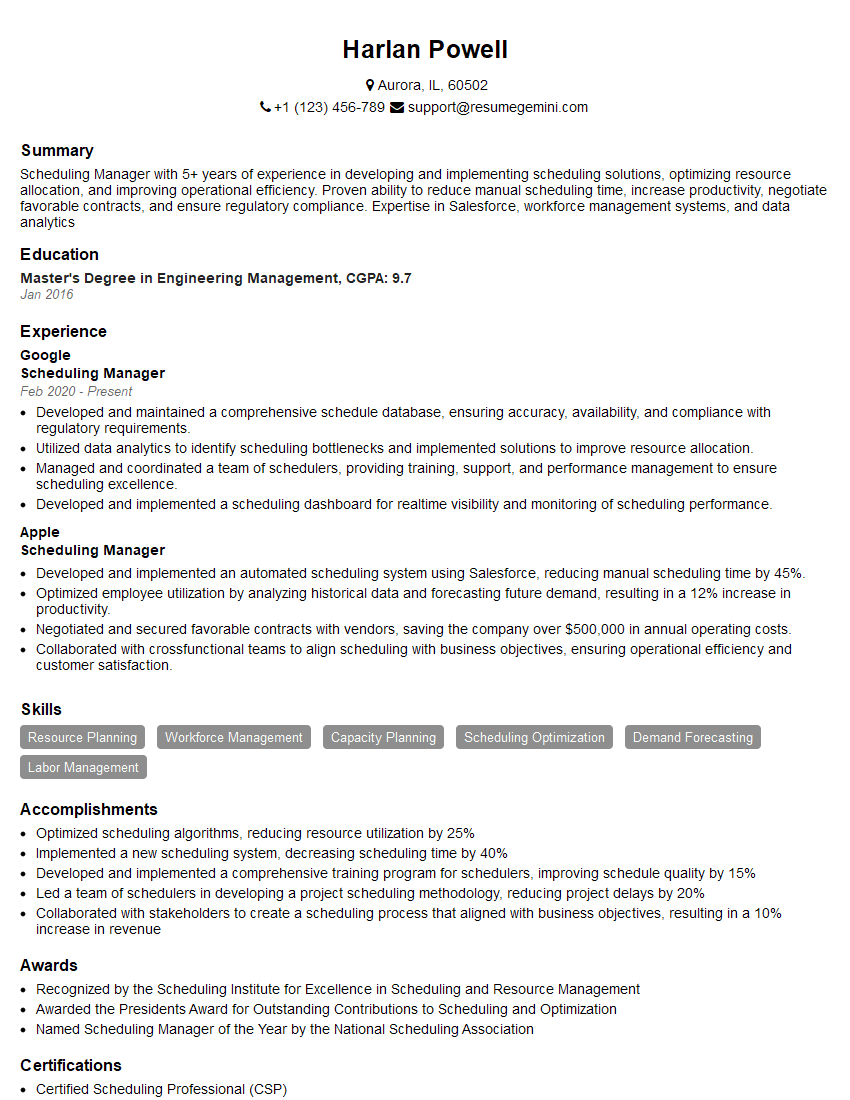
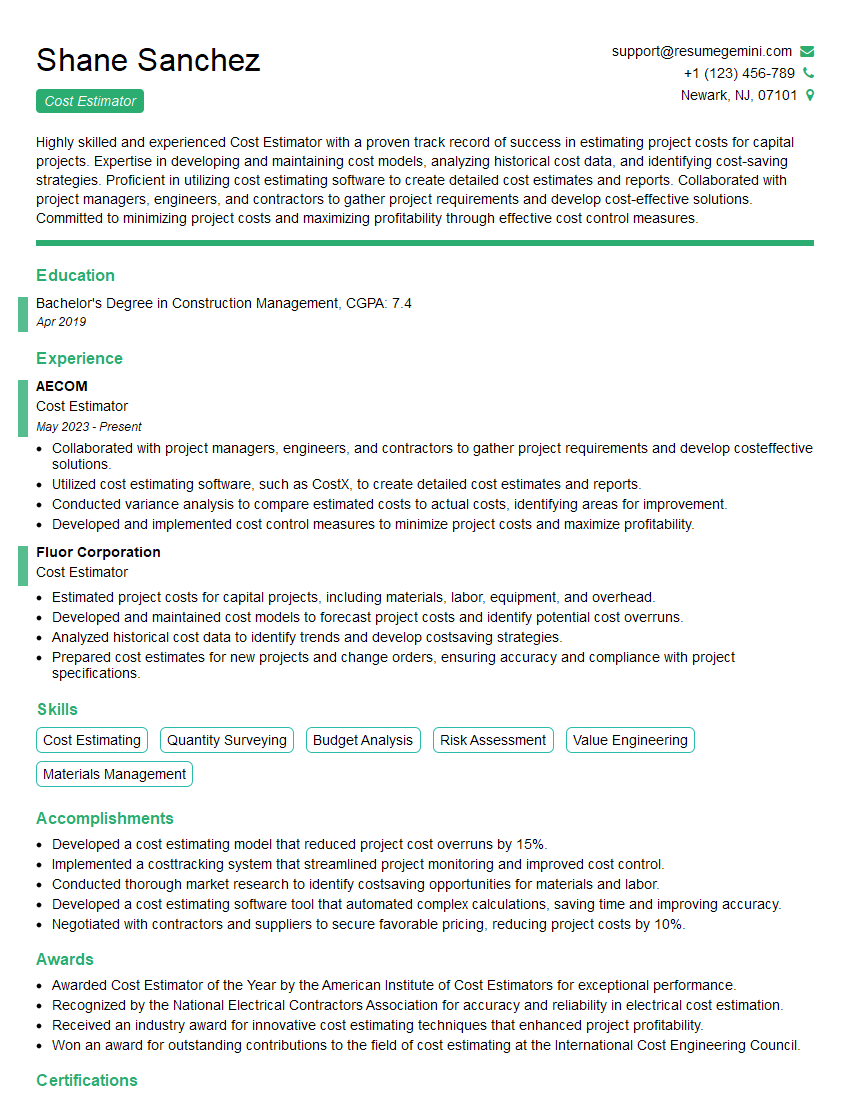
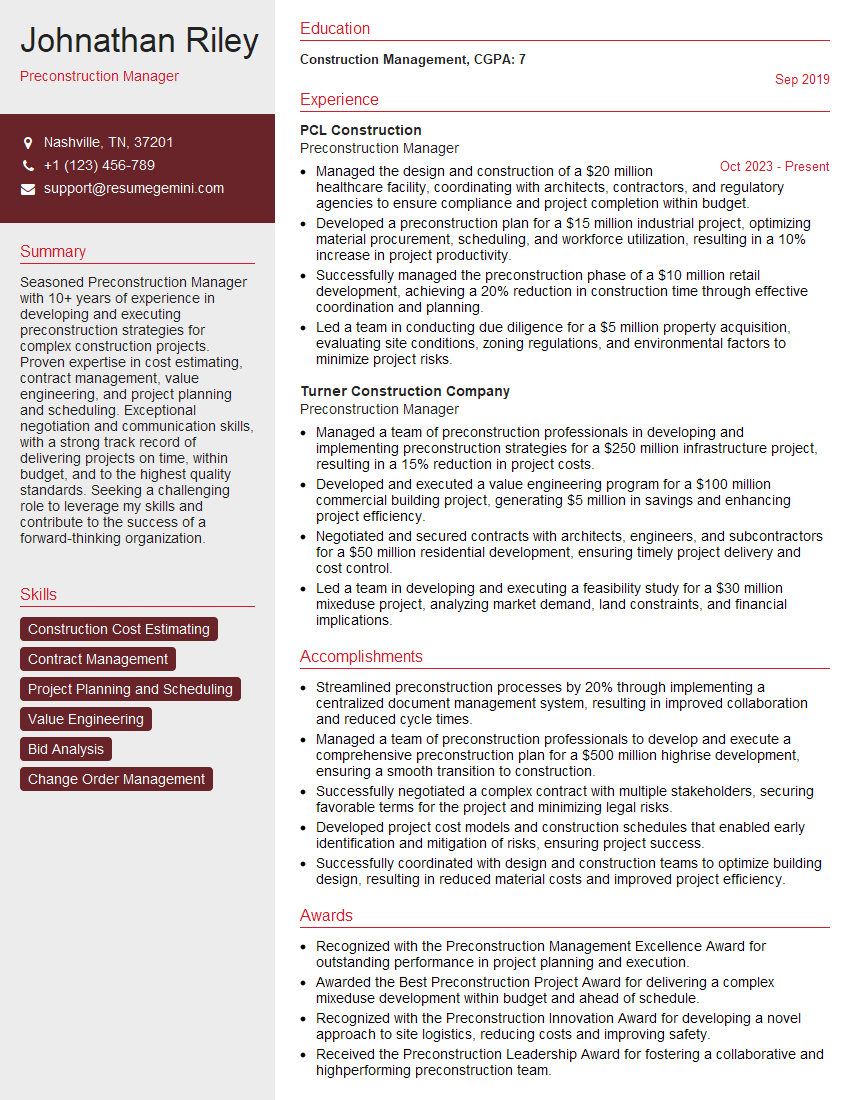
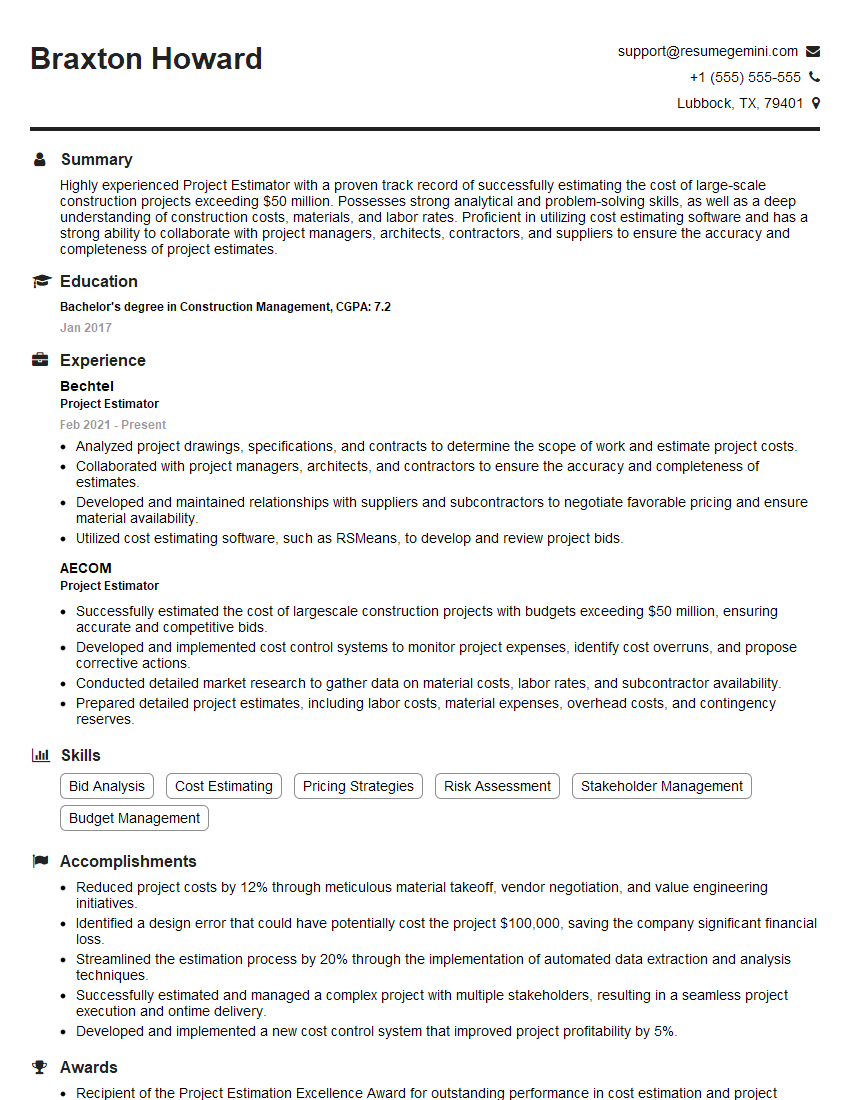
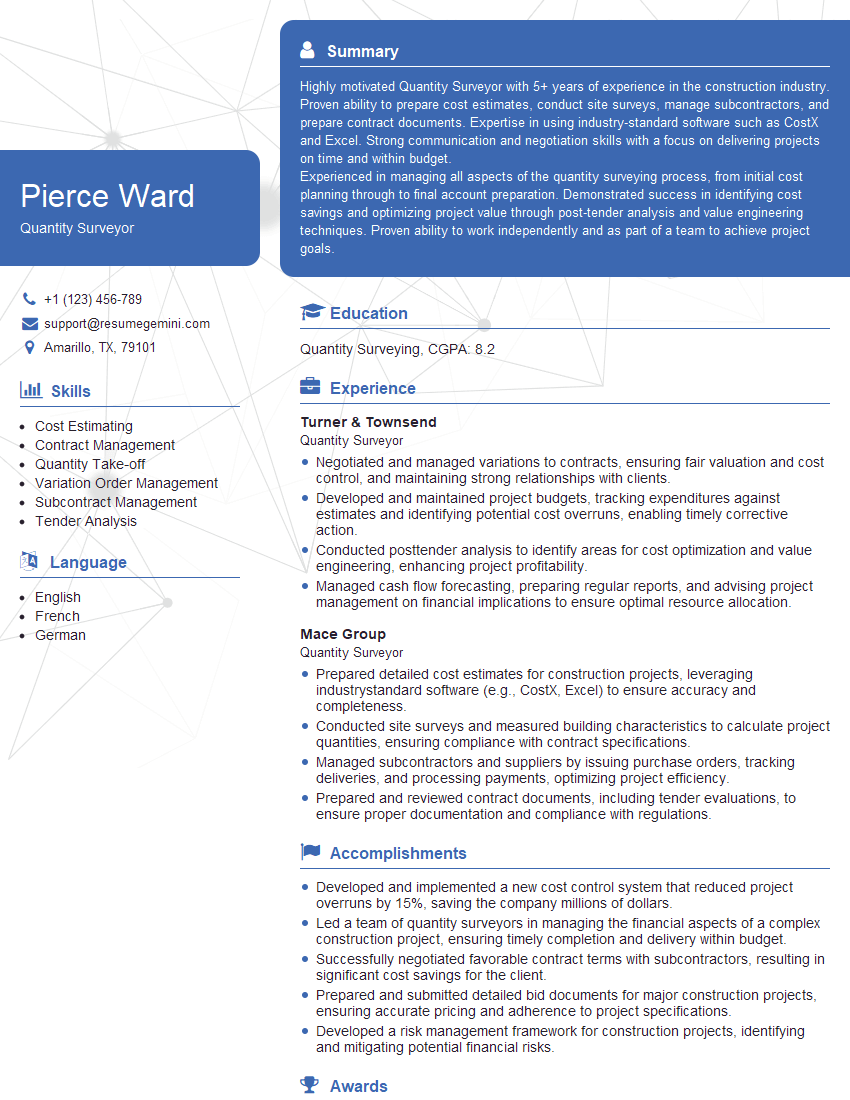
Mastering preconstruction planning and cost estimation is vital for career advancement in the construction industry. It opens doors to leadership roles and higher earning potential. To maximize your job prospects, it’s essential to create a compelling and ATS-friendly resume that showcases your skills and experience effectively. ResumeGemini is a trusted resource to help you build a professional resume that stands out. We provide examples of resumes tailored to expertise in preconstruction planning and cost estimation to help guide you. Take the next step towards your dream career – build a winning resume today!
Explore more articles
Users Rating of Our Blogs
Share Your Experience
We value your feedback! Please rate our content and share your thoughts (optional).
What Readers Say About Our Blog
Very informative content, great job.
good