Every successful interview starts with knowing what to expect. In this blog, we’ll take you through the top Fabric grain identification interview questions, breaking them down with expert tips to help you deliver impactful answers. Step into your next interview fully prepared and ready to succeed.
Questions Asked in Fabric grain identification Interview
Q 1. Define fabric grain and its importance in garment construction.
Fabric grain refers to the direction of the yarns in a woven fabric. It’s essentially the orientation of the warp (lengthwise) and weft (crosswise) yarns. Understanding and utilizing fabric grain correctly is paramount in garment construction because it directly impacts the garment’s fit, drape, and overall quality. Imagine trying to build a house with misaligned bricks – it wouldn’t stand properly! Similarly, using fabric off-grain will lead to distortions and a poorly fitting garment.
Q 2. Explain the difference between lengthwise grain, crosswise grain, and bias.
The three main grain lines are:
- Lengthwise Grain (Warp): This runs parallel to the selvage (the finished edges of the fabric). It’s the strongest direction in a woven fabric because the warp yarns are usually stronger and more tightly spaced. Think of it as the fabric’s spine, providing stability.
- Crosswise Grain (Weft): This runs perpendicular to the selvage and is generally less strong than the lengthwise grain. It’s more prone to stretching.
- Bias: This is any direction at a 45-degree angle to both the lengthwise and crosswise grains. The bias is the most stretchy and drapey direction in the fabric. It’s often used for details that need to curve or stretch, like fitted sleeves or necklines.
Visualizing it: Imagine a grid. The lengthwise grain is the vertical lines, the crosswise is the horizontal, and the bias is the diagonal.
Q 3. How do you identify the grain line on a fabric swatch?
Identifying the grain line is crucial. Here’s how:
- Selvages: The selvages are your primary guide. The lengthwise grain runs parallel to them.
- Straight of Grain: If the selvages aren’t present, carefully smooth out the fabric and look for the direction of the yarns. The warp yarns (lengthwise) are generally more uniform and tighter than the weft yarns.
- Pulling Test (Less Reliable): Gently pull the fabric in different directions. The direction with the least give indicates the lengthwise grain. This method should be used cautiously as it can distort the fabric.
Remember, always check multiple points across the fabric swatch, especially with less structured fabrics, to ensure consistency.
Q 4. Describe the methods used to detect fabric grain distortion.
Grain distortion, when the yarns are not running straight, can be detected through various methods:
- Visual Inspection: Carefully examine the fabric, paying close attention to the alignment of the warp and weft yarns. Look for skewing or unevenness.
- Pulling Test: Gently pull the fabric in various directions. Uneven stretching indicates grain distortion.
- Square Test: Cut a square from the fabric and measure its sides. If the sides aren’t equal after stretching, it indicates grain distortion.
- Selvage Alignment: Check if the selvages are parallel and straight. Uneven or wavy selvages can point to fabric distortion.
Experienced cutters often develop a keen eye for identifying grain distortion even without formal testing.
Q 5. What are the consequences of using fabric off-grain?
Using off-grain fabric has several detrimental effects:
- Distorted Garment Shape: The garment won’t hang or fit properly. It might be twisted, uneven, or excessively baggy in some areas.
- Uneven Drape: The fabric won’t fall smoothly; it might pull or bunch in unexpected places.
- Reduced Durability: The stress isn’t distributed evenly across the fabric, leading to weak points and premature wear.
- Poor Seam Appearance: Seams may not lie flat and can look unprofessional.
Imagine a beautifully tailored suit suddenly looking sloppy – that’s the impact of off-grain fabric!
Q 6. How does fabric grain affect pattern placement and cutting?
Fabric grain is fundamental to pattern placement and cutting. Patterns are designed to be cut with the grain lines aligned correctly. This ensures that the finished garment fits well and hangs properly.
- Grainline Symbols: Pattern pieces usually include grain line markings indicating the direction of the lengthwise grain. These markings MUST be aligned with the fabric’s lengthwise grain during cutting.
- Pattern Alignment: Incorrect alignment can lead to significant fitting issues and distortion. For example, a dress might be twisted or a skirt could hang unevenly.
- Stretching and Distortion: Cutting across the grain or on the bias will result in more stretch, which must be accounted for in the pattern.
Always double-check your grain line alignment before cutting – it’s an essential step for quality garment construction.
Q 7. Explain how fabric grain influences garment drape and fit.
Fabric grain significantly influences how a garment drapes and fits. The lengthwise grain is the least stretchy, providing structure and stability. The crosswise grain has more give. The bias is the most stretchy and drapey.
- Structure vs. Drape: Garments requiring structure, such as jackets or trousers, should primarily use the lengthwise grain. Garments emphasizing drape, such as flowing skirts or scarves, may incorporate the bias.
- Fit and Shape: Cutting off-grain will affect the fit of any garment. The most apparent results are usually seen in areas where the body conforms to the fabric (waist, hips, bust). The garment might pull in unexpected places or be unflattering.
- Fabric Weight: Heavier fabrics often show the effects of off-grain placement more dramatically than lighter fabrics. So, attention to grain alignment is particularly important when using heavyweight textiles.
A well-cut garment made with careful attention to fabric grain will always look and feel better, regardless of the pattern or style.
Q 8. Describe the visual indicators of correct and incorrect grain.
Identifying correct grain in fabric is crucial for garment construction and overall quality. Correct grain means the lengthwise (warp) yarns run parallel to the selvage edges, creating a stable and consistent drape. Incorrect grain, also known as ‘off-grain,’ means these yarns are skewed, leading to distorted shapes and discomfort during wear.
- Correct Grain: Imagine perfectly aligned soldiers marching in a straight line. That’s how the warp yarns should look in correctly-grained fabric. The fabric hangs smoothly and evenly, and its structural integrity remains consistent. Selvages are parallel and straight.
- Incorrect Grain: Now picture those soldiers marching at a slight angle—that’s off-grain. The fabric will appear twisted or skewed. Selvages may not be parallel, and the drape will be uneven, possibly resulting in a garment that pulls or twists.
Think of a simple example: a skirt made with off-grain fabric might twist around the wearer’s legs because the fabric itself is not straight.
Q 9. How do you measure the grain line on a fabric sample?
Measuring grain line involves checking the alignment of the warp yarns relative to the selvage. The simplest method is visual inspection using a straight edge like a ruler or a long, clear plastic template. Place the ruler against the selvage, and observe the warp yarns. Ideally, they should run perfectly parallel to the ruler.
For more precise measurements, you can use a specialized tool called a grain line tool or even a fabric square with marked lines. Some tools have a laser pointer for greater accuracy. If there’s any deviation, you carefully measure the angle of the skew using a protractor. This angle represents the degree of off-grainness, which is critical for determining how to correct the issue.
For example, a measurement of 5 degrees off-grain would indicate a significant deviation requiring more substantial corrective measures during cutting and construction.
Q 10. What are the common causes of off-grain fabric?
Off-grain fabric is a common problem arising from several factors during manufacturing. It’s rarely intentional; rather, it’s a result of errors in the production process.
- Weaving and Knitting Errors: Uneven tension during weaving or knitting can cause warp and weft yarns to misalign, leading to skewing. Incorrect settings on the machinery are a primary culprit.
- Fabric Finishing: Processes like scouring, bleaching, dyeing, and drying can cause shrinkage at uneven rates, distorting the grain. Inconsistent heat or moisture can be particularly problematic.
- Fabric Handling and Storage: Improper handling of fabric rolls or bolts, such as rough stacking, can cause distortion. Incorrect storage, where rolls are subjected to uneven pressure or dampness, can also introduce off-grain issues.
- Poor Quality Control: Inadequate quality checks during production allow faulty fabric to pass through. Regular inspections are key to mitigating this issue.
Q 11. How do you address off-grain fabric during the production process?
Addressing off-grain fabric during production requires careful planning and execution. The approach depends on the severity of the skew.
- Grainline Correction: For minor off-grain issues, careful cutting and pattern placement can sometimes compensate. This involves aligning the pattern pieces carefully with the grain line, even if it means having to shift it slightly from the ideal position.
- Pre-Cutting Adjustments: In more severe cases, the fabric may need to be straightened before cutting. This could involve techniques like pulling and steaming, done with careful consideration of fabric type to avoid further damage. This process aims to realign the yarns by reducing stress and allowing them to settle into a more natural state.
- Pattern Grading: Pattern graders might need to slightly adjust the pattern pieces to account for the off-grain and minimize distortions in the final garment. This is a skilled technique requiring experience and precision.
- Rejection: If the off-grain is extreme and uncorrectable, the fabric must be rejected to avoid producing defective garments.
The choice of technique is a judgment call depending on the fabric’s properties, the severity of off-grain, and the garment’s design. It often requires a collaborative effort between pattern makers, cutters, and quality control personnel.
Q 12. What tools or equipment are used for accurate grain identification?
Accurate grain identification relies on a combination of tools and techniques:
- Straight Edge (Ruler or Template): A basic but crucial tool for visually assessing warp yarn alignment.
- Grain Line Tool:Specialized tools with markings or even laser pointers that help determine grain line more precisely.
- Fabric Square: Fabric squares with marked lines can be used for verifying grain alignment and measuring deviation.
- Protractor: Used to quantify the angle of skew in off-grain fabric.
- Measuring Tape: Essential for measuring fabric lengths and verifying correct cut orientations.
- Magnifying Glass: Helps examine fabric structures closely, especially beneficial for finely woven or knit fabrics.
Beyond tools, a keen eye, experience, and understanding of different fabric types are equally crucial for accurate grain identification.
Q 13. How does fabric grain affect the durability and longevity of a garment?
Fabric grain significantly affects garment durability and longevity. Correct grain ensures:
- Dimensional Stability: Garments maintain their shape and size better over time and after repeated washing.
- Improved Drape: Fabric hangs properly, reducing distortion and wrinkling.
- Enhanced Strength: The fabric’s structural integrity is maintained, preventing undue stress on seams and edges.
- Reduced Wear and Tear: Even stress distribution lessens the likelihood of premature wear in areas like shoulders, elbows, and knees.
Conversely, off-grain fabric can lead to:
- Distortion: Garments may twist, stretch unevenly, or lose their shape.
- Increased Wrinkling: Off-grain fabrics are more prone to wrinkling and creasing.
- Premature Wear: Uneven stress results in faster wear, particularly at seams and stress points.
- Loss of Shape: The garment loses its intended shape and fit more quickly.
Proper grain alignment extends the garment’s lifespan and maintains its quality.
Q 14. Explain how different fabric types (e.g., woven, knit) present unique grain identification challenges.
Different fabric types pose unique challenges to grain identification:
- Woven Fabrics: Relatively straightforward. Warp and weft yarns are easily discernible, and alignment with the selvage is usually clear. However, complex weaves can sometimes make it challenging to distinguish warp and weft, requiring more detailed observation.
- Knit Fabrics: More challenging. The lack of distinct warp and weft yarns makes visual assessment trickier. Grain identification relies more on the overall fabric behavior and its tendency to stretch and distort. You might examine the vertical and horizontal stretch properties to infer the grain.
- Non-Woven Fabrics: Identifying grain can be the most difficult. Because they lack a defined structure of interwoven yarns, the concept of ‘grain’ is somewhat relative. You would typically observe the fabric’s overall behavior under tension and alignment of any visible structural elements.
Experience and a deep understanding of fabric construction are essential for navigating these challenges effectively.
Q 15. Describe your experience with using grain lines to correct pattern pieces.
Correcting pattern pieces using grain lines is crucial for achieving a well-fitting and aesthetically pleasing garment. The grain lines – warp (lengthwise) and weft (crosswise) – dictate the fabric’s stretch and drape. Misaligned grain can lead to twisting, pulling, and uneven hang. To correct this, I first identify the true grain using the selvedge (finished edge) as a reference. If the pattern piece is off-grain, I carefully adjust its placement on the fabric, ensuring the grainline arrows on the pattern match the fabric’s warp and weft. This might involve rotating the piece, cutting a new piece, or making small adjustments to the seam allowances. I often use tailor’s tacks to temporarily mark the new positioning and double-check before cutting. For example, if a sleeve cap is off-grain, I’d meticulously realign it to prevent the sleeve from twisting on the arm. In complex cases, I might even need to re-grade the pattern piece for optimal fit and drape after adjusting the grain.
Career Expert Tips:
- Ace those interviews! Prepare effectively by reviewing the Top 50 Most Common Interview Questions on ResumeGemini.
- Navigate your job search with confidence! Explore a wide range of Career Tips on ResumeGemini. Learn about common challenges and recommendations to overcome them.
- Craft the perfect resume! Master the Art of Resume Writing with ResumeGemini’s guide. Showcase your unique qualifications and achievements effectively.
- Don’t miss out on holiday savings! Build your dream resume with ResumeGemini’s ATS optimized templates.
Q 16. How do you communicate grain issues to other members of a production team?
Communicating grain issues effectively involves clear, concise language and visual aids. I avoid technical jargon and instead use simple, descriptive terms. For example, instead of saying ‘the weft is skewed,’ I might say ‘the fabric is slightly twisted across the width.’ I’ll use visual aids, like highlighting the problematic area on the fabric or making a quick sketch illustrating the misalignment. This is especially helpful when working with team members less familiar with fabric construction. During production meetings, I’ll demonstrate the issue, propose solutions, and document them in the production notes, ensuring everyone understands the necessary corrections. I also emphasize the potential impact of ignoring grain issues, such as customer dissatisfaction and production delays, to garner their immediate attention and cooperation.
Q 17. What are the quality control standards for fabric grain in your experience?
Quality control standards for fabric grain vary depending on the fabric type and garment’s intended use. However, some general principles always apply. First, the selvedges should be parallel and straight. Secondly, the warp and weft threads should be relatively perpendicular to each other, ideally at a 90-degree angle. Any significant deviation, such as obvious skewness or diagonal grain, is unacceptable for high-quality garments. We use measuring tools, including rulers and squares, to verify grain alignment during the inspection process. For delicate fabrics, a gentle stretching test helps to identify hidden grain issues. We establish tolerance levels based on industry standards and the specific fabric type; for example, a looser tolerance might be allowed for loosely woven fabrics, while stricter tolerances are applied to structured fabrics like denim. Documentation is crucial, as we record any grain-related imperfections and their resolution, ensuring traceability and preventing recurrence.
Q 18. Explain the relationship between fabric grain and shrinkage.
Fabric grain and shrinkage are intimately linked. Shrinkage occurs because of the relaxation of fibers, and the direction of shrinkage is heavily influenced by the fabric’s grain. Typically, woven fabrics shrink more along the weft (crosswise) than the warp (lengthwise) because the weft yarns are less tightly controlled during weaving. This is why it’s essential to preshrink fabrics before cutting and construction. Knowing the grain direction helps anticipate and mitigate shrinkage problems. For example, if a fabric shrinks more in the weft direction, I might adjust the pattern pieces to account for this differential shrinkage, ensuring a better fit after washing. Ignoring this can result in a garment that is significantly smaller, shorter, or distorted after the first wash.
Q 19. How does fabric construction influence its grain?
Fabric construction significantly influences its grain. The way yarns are interlaced directly impacts the stability and behavior of the fabric. Woven fabrics, made by interlacing warp and weft yarns, usually exhibit a clearer grain structure, with warp and weft running at approximately 90 degrees. Knit fabrics, constructed by looping yarns together, tend to have more stretch and less defined grain. The yarn type and its twist also play a role; tightly twisted yarns can lead to a more stable fabric with a better defined grain, while loosely twisted yarns may result in a more drapey fabric with potentially less consistent grain. Even the weaving or knitting techniques can affect the grain, resulting in variations in alignment and stability. A tightly woven fabric will naturally have a more defined and consistent grain compared to a loosely constructed one.
Q 20. Can you explain the significance of straight-of-grain in pattern making?
The straight-of-grain, which refers to the warp direction, is paramount in pattern making. Cutting pattern pieces along the straight-of-grain ensures that the garment hangs and drapes correctly. If a pattern piece is cut off-grain, the garment might twist, stretch unevenly, or hang awkwardly. For example, cutting a skirt panel on the bias (diagonally) will result in more stretch and drape, while cutting it on the straight-of-grain provides stability and a cleaner silhouette. The grainline markings on commercial patterns indicate the ideal orientation of the fabric for each piece, helping to achieve the designer’s intended fit and drape. Understanding and adhering to the straight-of-grain is fundamental for achieving professional results in garment construction.
Q 21. Describe a situation where you had to resolve a problem related to fabric grain.
I once encountered a significant grain problem with a batch of silk charmeuse intended for evening gowns. The fabric arrived with a noticeable skew in the weft, which wasn’t readily apparent until we started cutting the pattern pieces. This meant the neckline and sleeves of the gowns would twist. I immediately stopped production and examined the whole batch meticulously. We confirmed the grain issue by measuring the angle between the warp and weft across multiple sections. My solution involved communicating the issue to the fabric supplier, negotiating a replacement, and implementing stricter incoming quality control checks to prevent such incidents. In the meantime, we developed a grain-correction plan for the existing fabric, which involved carefully manipulating and re-cutting the pattern pieces, which was very time-consuming, but ensured high quality for the already-cut fabric. It was a valuable lesson emphasizing the importance of thorough fabric inspection before mass production and the cost-effectiveness of preventing such problems upfront.
Q 22. How do you handle inconsistencies in grain direction within a single fabric roll?
Inconsistencies in grain direction within a single fabric roll are a common challenge, often stemming from issues during the weaving or knitting process. These inconsistencies can manifest as slight variations in the lengthwise (warp) or crosswise (weft) grain, or even more dramatic skewing. My approach involves a multi-step process. First, I visually inspect the entire roll, noting areas of obvious distortion. I then use a fabric grain tester or a simple straight edge and square to systematically check the grain at various points across the roll. I record these findings to map the inconsistencies.
For minor inconsistencies, I might strategically plan the cutting layout to minimize waste and place affected areas in less critical garment sections. For more severe inconsistencies, the affected portion of the roll may need to be rejected. In certain cases, I might consult with the fabric supplier or the production team to explore the cause of the issue and prevent its recurrence. Imagine trying to build a house with crooked planks – the result would be unstable. The same applies to garments; consistent grain is crucial.
Q 23. What are the key differences between identifying grain in woven and knit fabrics?
Identifying grain in woven and knit fabrics differs significantly due to their fundamental construction methods. Woven fabrics, created by interlacing warp and weft yarns, have a more clearly defined grain. The warp yarns run lengthwise, and the weft yarns run crosswise. The selvedges (the finished edges of the fabric) are usually parallel to the warp yarns, providing a reliable reference point. Identifying the grain is relatively straightforward; just align a straight edge parallel to the selvedge.
Knit fabrics, however, lack a distinct warp and weft. The yarns are looped together in a variety of ways, leading to more flexibility and less defined grain. In knit fabrics, the ‘grain’ is often determined by the direction of the most stable stretch. To identify this, I’d gently stretch the fabric in different directions. The direction with the least stretch is generally considered the ‘grain’. This can be more subjective than with woven fabrics and may require experience. Think of a loosely knitted sweater versus a tightly woven shirt; the difference in grain definition is quite noticeable.
Q 24. Discuss the impact of fabric grain on garment stability and comfort.
Fabric grain significantly impacts both garment stability and comfort. Correct grain alignment is essential for a garment’s shape retention. If a garment is cut on the bias (at an angle to the grain), it’s more likely to stretch and distort out of shape after wearing or washing. This is especially problematic for items like skirts and trousers. Imagine a skirt hanging unevenly; that’s a classic example of misaligned grain.
Comfort is also influenced by grain. Cutting on the grain ensures that the fabric drapes naturally, allowing for better movement and avoiding pulling or restriction. The direction of the grain can also influence the fabric’s hand (texture and feel). For example, a fabric might feel smoother when handled along its lengthwise grain compared to its crosswise grain. An understanding of fabric grain is important to ensure both the aesthetics and wearer comfort are optimized.
Q 25. Explain how you would train a new employee on fabric grain identification.
Training a new employee on fabric grain identification starts with a thorough introduction to fabric construction. I’d begin by explaining the difference between woven and knit fabrics, emphasizing how this impacts grain definition. We would then focus on practical exercises. I’d provide various fabric samples, woven and knit, and guide them through the process of identifying the grain using a straight edge and square for woven fabrics and by stretching and feeling for the knit fabrics. This involves explaining the significance of the selvedge in woven fabrics and the importance of finding the direction of least stretch in knits.
I would also include exercises on identifying off-grain fabrics, explaining how to recognize various types of grain distortions, such as skewing or bias. Visual aids, such as diagrams and samples with highlighted grain lines, would greatly improve understanding. Once the basics are understood, I’d involve them in real-world scenarios like marking patterns on fabric and identifying areas for adjusting cutting layout to account for grain inconsistencies.
Q 26. What methods do you use to prevent fabric grain issues during the cutting process?
Preventing fabric grain issues during the cutting process involves a proactive and methodical approach. Firstly, thorough inspection of the fabric roll before cutting is essential to identify any significant grain irregularities. Pre-cutting alignment is crucial. Accurate pattern layout ensures that the grain line is correctly aligned with the pattern pieces. This typically involves aligning pattern pieces parallel to the selvedge for woven fabrics.
For large-scale cutting, automated spreading machines can help maintain consistent grain alignment across the fabric. Throughout the process, careful monitoring by experienced personnel helps detect and correct any emerging issues promptly. Regular maintenance of cutting equipment, ensuring sharp blades and accurate alignment of the cutting table, contributes to precise cutting and grain control. A small error in the beginning can amplify during the process, so precision is key.
Q 27. How do you identify and resolve grain issues in a finished garment?
Identifying grain issues in a finished garment often requires a keen eye for detail. A garment with misaligned grain may exhibit uneven hanging, distorted shapes, or puckering. The first step is a visual inspection, checking for asymmetry, uneven drape, or pulling at certain areas. I then check seams and pattern details to confirm whether the misalignment is consistent throughout.
Resolving these issues in a finished garment is challenging, often requiring significant alterations. Minor adjustments can sometimes be made through careful pressing and reshaping, but more severe issues may necessitate partial or complete re-construction. The best approach is prevention during the initial cutting process, but when issues arise, careful assessment and professional alterations are critical for salvaging the garment.
Q 28. How does your understanding of fabric grain contribute to efficient production?
My understanding of fabric grain is crucial for efficient production. Correct grain identification and handling directly impact fabric yield. Efficient cutting, avoiding significant waste of materials, comes from accurately aligning patterns with the grain. Preventing errors due to misaligned grain saves considerable time and resources by minimizing the need for rework and alterations. This translates into direct cost savings and increased production throughput.
Furthermore, mastering fabric grain knowledge reduces defects and increases customer satisfaction. Garments made with properly aligned grain are less prone to defects, leading to higher quality and better consumer acceptance. My expertise means less time spent on corrections, more time on creating, and happier customers – a recipe for successful production.
Key Topics to Learn for Fabric Grain Identification Interview
- Understanding Grain Lines: Learn to identify warp and weft yarns, differentiating between true bias, crosswise grain, and lengthwise grain. Practice identifying these visually and through touch.
- Fabric Construction & Grain: Explore the relationship between fabric construction (knit, woven, non-woven) and how it influences grain. Understand how different construction methods impact drape, stability, and the visibility of grain lines.
- Identifying Grain Issues: Learn to recognize common grain distortions like off-grain, skewed grain, and bowing. Understand the causes and consequences of these imperfections in garment construction and product quality.
- Practical Application: Practice identifying grain on various fabric types (cottons, silks, wools, synthetics). Consider how grain identification impacts pattern placement, cutting, and sewing techniques.
- Problem-Solving: Develop your ability to troubleshoot garment construction problems related to incorrect grain alignment. This includes understanding the impact on fit, drape, and overall appearance.
- Industry Standards & Terminology: Familiarize yourself with industry-standard terminology and best practices related to fabric grain identification and handling.
- Advanced Concepts (Optional): For more advanced roles, research topics such as fabric shrinkage, grain control during pre-production, and the use of specialized tools for grain identification.
Next Steps
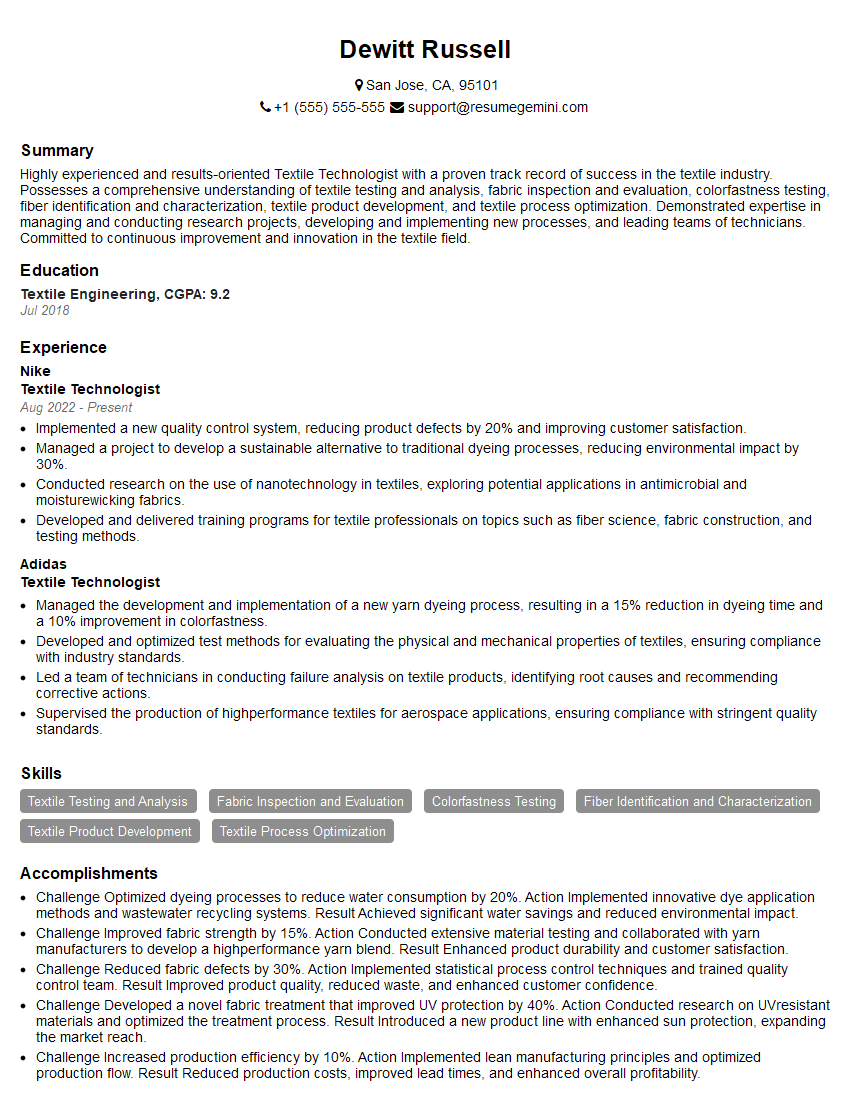
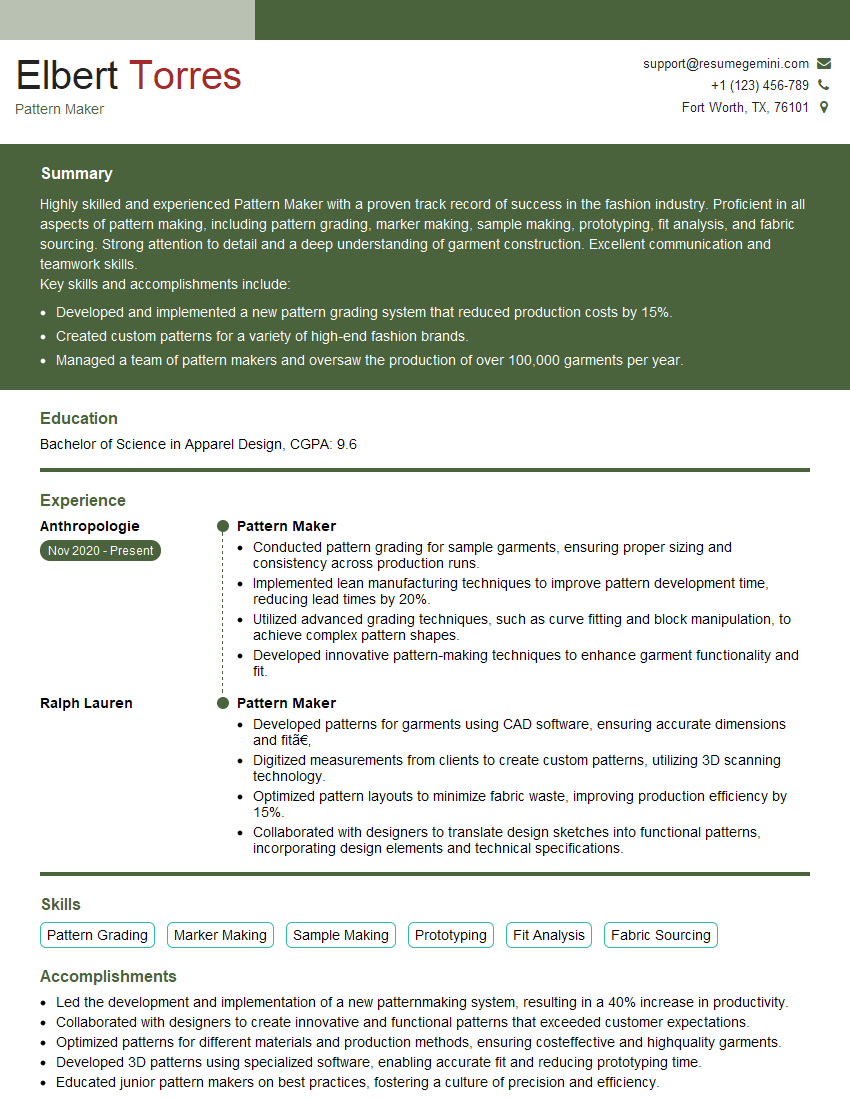
Mastering fabric grain identification is crucial for success in the textile and apparel industries, showcasing your attention to detail and technical proficiency. This skill is highly valued, leading to increased opportunities and career advancement. To maximize your job prospects, create an ATS-friendly resume that highlights your expertise. ResumeGemini is a trusted resource that can help you build a compelling and effective resume, ensuring your skills and experience shine. Examples of resumes tailored to fabric grain identification expertise are available to help guide you.






Explore more articles
Users Rating of Our Blogs
Share Your Experience
We value your feedback! Please rate our content and share your thoughts (optional).
What Readers Say About Our Blog
Very informative content, great job.
good