Preparation is the key to success in any interview. In this post, we’ll explore crucial Fabric Seaming interview questions and equip you with strategies to craft impactful answers. Whether you’re a beginner or a pro, these tips will elevate your preparation.
Questions Asked in Fabric Seaming Interview
Q 1. Describe your experience with different types of sewing machines.
My experience with sewing machines spans a wide range, from basic domestic machines to industrial models. I’m proficient with both straight stitch and specialized machines like overlockers (sergers), coverstitch machines, and even some computerized models. I understand the nuances of each machine type, including their stitch capabilities, needle selection, tension adjustments, and maintenance. For instance, while a domestic machine is great for smaller projects and precise work, an industrial machine’s speed and durability are crucial for large-scale production. My experience includes troubleshooting various machine malfunctions, from simple needle jams to more complex mechanical issues. I’ve also worked extensively with different presser feet, adapting my technique based on the fabric and desired stitch.
For example, using a walking foot on a domestic machine is invaluable when working with multiple layers of thick fabric, preventing slippage. Similarly, using a specialized rolled hem foot on an overlocker ensures a consistent, professional-looking finish for delicate fabrics. This practical experience allows me to select and effectively use the most appropriate machine for any given sewing task.
Q 2. What are the common seam types used in garment construction?
Garment construction employs a variety of seam types, each chosen for its strength, appearance, and suitability to the fabric and garment style. Common seam types include:
- French Seam: Encloses raw edges completely for a very neat, durable, and high-quality finish, particularly useful for lightweight fabrics.
- Flat-Felled Seam: Extremely strong and durable; often used in high-stress areas or outerwear. One seam allowance is enclosed within the other.
- Seam Allowance: This is simply the distance between the stitching line and the raw fabric edge. Consistent seam allowance is vital for professional results.
- Overlocked Seam (Serged Seam): Uses a serger (overlocker) to stitch and finish the seam simultaneously, preventing raveling. Great for lightweight to medium-weight fabrics.
- Bound Seam: A neat and clean finish that often uses bias tape or another fabric strip to encapsulate the seam allowance, ideal for both functionality and visual appeal.
- Mock Flat-Felled Seam: A cleaner and less bulky version of the flat-felled seam, suitable for lighter weight garments and fabrics.
The choice of seam depends on the garment’s intended use, the fabric’s properties, and the desired aesthetic.
Q 3. Explain the importance of proper seam finishing techniques.
Proper seam finishing is paramount in garment construction. Unfinished seams ravel, fray, and look unprofessional. More importantly, they significantly reduce the garment’s durability and longevity. Seam finishing techniques reinforce seams, prevent unraveling, and create a clean, polished look. Think of it as building a house – you wouldn’t skip the foundation! Here are some significant reasons why proper seam finishing is critical:
- Durability: Prevents fraying and extends the garment’s lifespan.
- Appearance: Creates a professional, high-quality finish. Unfinished seams are instantly noticeable and detracts from the overall aesthetic.
- Comfort: Prevents irritation caused by rough or unfinished edges.
Techniques like serging, zig-zag stitching, pinking, and binding enhance the longevity and appearance of garments, turning a simple seam into a detail of quality craftsmanship.
Q 4. How do you identify and correct common seam defects?
Identifying and correcting seam defects requires a keen eye and understanding of sewing techniques. Common defects include:
- Uneven Seam Allowance: Use of seam guides, consistent machine settings, and careful measuring prevent this.
- Puckering: Often caused by improper tension, fabric stretching, or improper seam allowance. Adjust machine tension and ensure even fabric feeding.
- Stitching Errors: Skipped stitches, broken threads, or inconsistent stitch length indicate potential machine maintenance issues or user error. This can be resolved by checking the needle, thread, and machine settings.
- Distorted Seams: Can result from improper pressing or handling of fabric. Correct pressing techniques are crucial.
Corrective measures depend on the specific defect. Sometimes, simply re-sewing the seam is sufficient. In other cases, more extensive repairs may be needed, possibly involving unpicking and re-assembling sections of the garment. Prevention is always better than cure, so focusing on technique and attention to detail during the sewing process is key.
Q 5. What are your preferred methods for ensuring consistent seam allowance?
Maintaining consistent seam allowance is crucial for achieving professional results. My preferred methods involve:
- Using Seam Guides on the Sewing Machine: Many machines have adjustable guides that allow you to set a precise seam allowance, ensuring consistency throughout the project.
- Using a Seam Gauge or Ruler: Regularly checking the seam allowance with a tool provides a double-check for accuracy.
- Marking Seam Allowances: Before sewing, I mark the seam allowance on the fabric using tailor’s chalk or a fabric pen. This serves as a visual reference while sewing.
- Pressing: Precise pressing after sewing helps maintain the seam allowance and create crisp, even seams.
These methods, when used in combination, ensure consistent seam allowances, making the garments look and fit better.
Q 6. How do you handle different fabric types during seaming?
Handling different fabric types during seaming requires adjusting techniques based on their properties. For instance:
- Lightweight Fabrics (Silk, Chiffon): Require delicate handling, careful needle selection (fine needles), and minimal pressure to prevent damage.
- Medium-Weight Fabrics (Cotton, Linen): Generally easier to work with, but attention to tension and pressing is essential.
- Heavyweight Fabrics (Denim, Canvas): May require stronger needles, slower stitching speed, and possibly a walking foot to prevent slippage.
- Stretch Fabrics: Often require specialized needles and stitches designed for stretch fabrics to prevent seam breakage.
- Knits: Use a ballpoint needle to prevent snagging the fabric and consider overlocking seams for a neat finish.
Understanding fabric behavior and adapting techniques accordingly is crucial for achieving high-quality results.
Q 7. Describe your experience with high-speed sewing machines.
My experience with high-speed sewing machines includes extensive work on industrial models. These machines offer significant speed advantages, particularly in mass production, but they require a different skill set and approach than domestic machines. Key considerations include:
- Safety: High-speed machines demand a high level of awareness and adherence to safety protocols to prevent injury.
- Maintenance: Regular maintenance and lubrication are critical to ensure optimal performance and prevent breakdowns. A well-maintained machine minimizes downtime.
- Thread Management: Proper thread tension, consistent thread supply, and efficient thread path management are essential to prevent breakage and achieve consistent stitching.
- Precision and Control: While speed is a key advantage, maintaining precision and control at high speeds requires significant skill and experience.
Working with high-speed machines has improved my efficiency and proficiency in large-scale garment production. The speed and power of these machines are incredibly efficient for mass production, however the precision and consistency required is paramount.
Q 8. What safety precautions do you follow while operating sewing machines?
Safety is paramount when operating sewing machines. Before I even switch the machine on, I ensure the area around it is clear of obstructions and clutter. This prevents accidental snags or trips. I always keep my hands away from moving parts, especially the needle and presser foot. Think of it like this: you wouldn’t stick your hand into a blender while it’s running! I use a fingertip guard when handling sharp fabrics to prevent accidental needle pricks. Furthermore, I always unplug the machine when changing needles, making adjustments, or cleaning it. Regularly checking the power cord for any damage is another crucial step. And finally, I wear appropriate safety glasses to protect my eyes from flying debris or needle breakage. Maintaining a safe and organized workspace is key to injury prevention.
Q 9. How do you maintain sewing machines to ensure optimal performance?
Maintaining my sewing machines is crucial for optimal performance and longevity. Regular cleaning is essential. I use a soft brush and compressed air to remove lint and dust from the bobbin case, feed dogs, and other hard-to-reach areas. Think of it like regularly servicing your car – preventing minor issues from turning into major problems. I lubricate the moving parts with a high-quality sewing machine oil, following the manufacturer’s recommendations. This reduces friction and ensures smooth operation. I also check the tension regularly. Incorrect tension can lead to skipped stitches or broken threads. Periodically, I replace the needle, even if it looks fine, as dull needles can cause damage to fabric and the machine itself. Finally, I thoroughly inspect the machine after every project for any signs of damage or wear and tear.
Q 10. Explain your understanding of stitch types and their applications.
Stitch types are fundamental to fabric seaming. Different stitches offer varying strengths and aesthetic qualities. A straight stitch is the workhorse, used for most seams. It’s strong and versatile, ideal for straight seams and joining fabrics. Then there’s the zigzag stitch, often employed for finishing raw edges, preventing fraying and adding elasticity. Its ability to stretch makes it perfect for areas that need flexibility like armholes and curved seams. The overlock stitch or serger stitch, typically performed with a specialized machine, creates a neat, finished edge while simultaneously sewing the seams together, preventing unraveling and improving durability. Then we have decorative stitches, used for added design elements, like topstitching or embroidery. In a professional setting, choosing the right stitch type is crucial to the garment’s durability and aesthetic appeal. For instance, I would use a strong, straight stitch for jeans, but opt for a more flexible zigzag stitch for a stretch fabric like Lycra.
Q 11. How do you troubleshoot common sewing machine problems?
Troubleshooting is a critical skill. If my machine is skipping stitches, I first check the needle for bends or damage. Then I check the thread tension – is it too tight or too loose? Next, I examine the bobbin for proper winding and placement. If the machine is making noise or not feeding fabric properly, I inspect the feed dogs for obstructions. I also check the presser foot for proper engagement. If the problem persists, I’ll systematically check the different components, ensuring the belts are not slipping and the motor is functioning correctly. A logical approach, combined with my knowledge of the machine’s mechanics, allows me to resolve most issues quickly. Sometimes a simple cleaning is all it takes to bring the machine back to life. If a more serious problem arises, I’ll consult the machine’s manual or contact a repair professional.
Q 12. How do you ensure the quality of seams in mass production?
Ensuring consistent seam quality in mass production requires a multi-faceted approach. First, I’d implement strict quality control measures at every stage of production. Regular checks are crucial—from fabric inspection before cutting to seam examination after sewing. Using consistent materials and accurately calibrated machines is essential. Employee training is paramount: skilled operators are less likely to produce faulty seams. Clear and precise instructions to prevent errors. And finally, I’d establish a system for recording and analyzing quality data – this helps identify recurring problems and allows us to continuously improve our processes. Tracking metrics such as stitch density and seam strength provides valuable insight. Implementing these strategies dramatically reduces errors, ultimately leading to increased efficiency and profitability.
Q 13. Describe your experience with different seam finishing techniques (e.g., serging, overlocking).
I have extensive experience with various seam finishing techniques. Serging (or overlocking) is my go-to for many fabrics because it encloses the raw edges, preventing fraying and improving the garment’s overall durability. It’s especially useful for knit fabrics and other materials prone to unraveling. Zigzag stitching is another common method, offering a simpler and faster alternative to serging, though it might not provide the same level of durability. Pinking shears create a serrated edge that helps reduce fraying, mainly used for less-visible seams or fabrics that don’t require robust finishing. The choice of technique depends on the fabric type, the garment’s intended use, and aesthetic considerations. For example, a high-end garment would likely benefit from a neat serged finish, whereas a more casual item might suffice with a simpler zigzag.
Q 14. How do you determine the appropriate stitch length and tension for different fabrics?
Determining the appropriate stitch length and tension is crucial for creating high-quality seams. The fabric type dictates these settings. For instance, delicate fabrics like silk require a shorter stitch length and lower tension to avoid damaging the material. Sturdy fabrics like denim, on the other hand, can handle longer stitches and higher tension for increased durability. The stitch length controls the seam’s density; longer stitches create looser seams suitable for less-stressed areas, while shorter stitches produce tighter, stronger seams suitable for high-stress points. Tension regulates the balance between the upper and lower threads. Improper tension can lead to puckering, skipped stitches, or weak seams. Experimentation on a scrap piece of the same fabric is always recommended to find the optimal settings before working on the final piece. This ensures that the finished garment will have professionally finished seams.
Q 15. What are your methods for efficient seam pressing and finishing?
Efficient seam pressing and finishing is crucial for a garment’s overall quality and appearance. It involves more than just ironing; it’s about shaping the seam to lie flat and smoothly integrate with the garment’s design. My method begins with using the right tools – a well-maintained iron with a professional steam iron, a tailor’s ham (a padded form), and a press cloth to prevent shine.
I always press seams open unless the design specifically calls for a pressed seam allowance (e.g., a French seam which is pressed to one side). For open seams, I place the seam allowance to one side on the pressing ham for even heat distribution. The pressing ham helps shape curved areas, creating a smooth, even finish. For seams that need to be pressed closed, such as those on a dart, I use a pressing cloth to protect the fabric and carefully press to maintain crisp folds.
After pressing, I carefully inspect the seams for any puckering or unevenness. Any imperfections are corrected with a point presser to further refine the final look. I always tailor my technique to the fabric; delicate fabrics require lower heat and gentler pressure than sturdy ones. For example, silk requires a low heat and a silk pressing cloth to prevent scorching, whereas denim can withstand higher heat and more pressure for a crisp finish.
Career Expert Tips:
- Ace those interviews! Prepare effectively by reviewing the Top 50 Most Common Interview Questions on ResumeGemini.
- Navigate your job search with confidence! Explore a wide range of Career Tips on ResumeGemini. Learn about common challenges and recommendations to overcome them.
- Craft the perfect resume! Master the Art of Resume Writing with ResumeGemini’s guide. Showcase your unique qualifications and achievements effectively.
- Don’t miss out on holiday savings! Build your dream resume with ResumeGemini’s ATS optimized templates.
Q 16. How do you handle challenging fabrics, such as stretch fabrics or leather?
Working with challenging fabrics like stretch fabrics and leather requires specialized techniques and equipment. For stretch fabrics, like Lycra or spandex, I use a walking foot on my sewing machine to prevent slippage and ensure even feeding. Pressing requires care to avoid stretching the fabric; a light touch and a tailor’s clapper are essential to set the seam without distorting the stretch properties. Sometimes, I use a special interfacing to add stability to the seam allowance.
Leather, on the other hand, requires specialized needles and thread that are strong enough for the thick material. A walking foot or roller foot is helpful to control feed, and I use a lower machine speed. I avoid excessive heat when pressing leather, preferring to gently smooth it with a clapper. In some cases, I use specialized adhesives to reinforce the seams instead of relying solely on stitching. I frequently test on a scrap piece before proceeding on the final product to assess the effect of the chosen needle, thread, and pressing techniques.
Q 17. Describe your experience with pattern marking and cutting for seaming.
Pattern marking and cutting are fundamental to accurate seaming. My process starts with accurately transferring pattern markings onto the fabric, using tracing wheels and tailor’s chalk or specialized markers appropriate for the fabric type. It’s vital to use the correct method for the fabric to ensure the markings remain clear but do not damage the material. This is particularly important when working with delicate fabrics or materials with distinct grain lines.
After marking, I carefully cut the fabric using sharp shears to ensure precise edges. Proper cutting technique is paramount as even small discrepancies can affect the overall fit and alignment of the garment. For layered fabrics or delicate designs, I use a rotary cutter to make sure the layers are perfectly aligned and smoothly cut. I always double-check my cutting before moving to the next step, avoiding potential costly errors. For complex patterns, I may even make a test version first.
Q 18. Explain your understanding of different seam construction methods (e.g., flatlock, French seam).
Seam construction methods vary depending on the fabric, garment type, and desired finish. A French seam, for instance, encloses the raw edges completely, making it ideal for sheer fabrics or lingerie. It involves sewing a narrow seam, then turning it inside out and stitching another seam, completely concealing the raw edges.
A flatlock seam, on the other hand, is a decorative and durable seam often used in sportswear. It creates a clean, flat finish by stitching together the two layers of fabric with the edges overlapping. It’s known for its strength and stretch properties. Other common methods include serged seams (overlocked), offering a neat, clean finish; bound seams, which are piped with bias binding; and simple seam allowances pressed open or closed, based on the project needs.
Q 19. How do you manage time effectively in a fast-paced production environment?
Time management in a fast-paced environment relies heavily on organization and prioritization. I use techniques such as creating detailed production schedules, breaking down large tasks into smaller, manageable steps, and utilizing checklists to track my progress. This enables me to accurately estimate the time required for each task. Furthermore, I continuously monitor my workload, identifying potential bottlenecks and adjusting my approach accordingly.
Proactive communication with my team and supervisors is vital. If I anticipate delays or encounter challenges, I promptly communicate these issues to avoid impacting the overall production timeline. I also prioritize efficiency by streamlining my workflows. For example, I may batch similar tasks together to reduce setup time and maximize output. I am a firm believer in continuous improvement – constantly looking for ways to refine my processes to save time and improve quality.
Q 20. Describe your experience with quality control procedures for seams.
Quality control for seams is a critical aspect of my work. My quality control process begins during the cutting and sewing stages. I regularly check the alignment of seams, the consistency of stitching, and the integrity of the seam finish. This includes checking for any missed stitches, puckering, or uneven seam allowances. I use standardized measuring tools to ensure all seams meet the specifications provided.
After the garments are completed, I perform a final inspection, carefully examining all seams for defects. Any imperfections, regardless of how small, are noted and addressed immediately. This rigorous process helps to ensure that every garment meets the required quality standards. I also maintain detailed records of my quality checks and promptly report any recurring issues to help improve our manufacturing process. This system minimizes product defects and contributes to producing high-quality garments consistently.
Q 21. How do you work with a team to ensure efficient seaming operations?
Collaboration is key to efficient seaming operations. I actively communicate with my team members to ensure everyone is aware of their tasks, deadlines, and any potential challenges. This includes regular team meetings to discuss progress, resolve conflicts and brainstorm solutions to improve our processes. I believe in a collaborative atmosphere where everyone feels empowered to contribute their expertise and share their ideas.
I actively participate in cross-training and knowledge-sharing sessions. This not only enhances individual skillsets but also fosters a sense of camaraderie and mutual support. By assisting colleagues, I am also able to gain a deeper understanding of different stages in the production process. When faced with a difficult task or an unfamiliar technique, I am not afraid to ask for assistance, knowing that my colleagues will readily share their knowledge.
Q 22. How do you adapt to changes in production requirements or schedules?
Adapting to changes in production is crucial in the fast-paced world of garment manufacturing. My approach is threefold: communication, prioritization, and flexibility. First, I ensure clear and consistent communication with the production team and supervisors. This allows me to understand the nature and impact of any schedule changes or revised requirements early on. Second, I prioritize tasks based on urgency and impact, focusing on meeting critical deadlines while minimizing disruption to the overall production flow. Finally, I remain flexible and adaptable, willing to adjust my workflow and techniques as needed to accommodate the new parameters. For example, if a rush order requires a different seam type, I’ll quickly familiarize myself with the new technique and ensure the team is equally prepared.
Q 23. What are your strategies for maintaining consistency in seam quality throughout a production run?
Maintaining consistent seam quality is paramount for brand reputation and customer satisfaction. My strategies revolve around standardized procedures, regular quality checks, and continuous improvement. We establish clear, documented procedures for each seam type, specifying needle size, stitch length, thread tension, and other critical parameters. These procedures are shared with the entire team and regularly reviewed. Throughout the production run, we conduct frequent quality checks, using both visual inspection and specialized equipment where necessary. Any inconsistencies are immediately addressed, and corrective actions are implemented. Data from these checks informs continuous improvement efforts, allowing us to fine-tune our processes and further enhance seam quality.
Q 24. How do you handle fabric waste reduction during seaming?
Fabric waste reduction is a key concern, both economically and environmentally. My approach focuses on efficient pattern design, precise cutting, and creative seam management. We optimize our patterns to minimize fabric waste, employing nesting techniques to maximize fabric utilization. Precise cutting techniques, using laser or computer-guided cutters whenever possible, help prevent unnecessary material loss. In the seaming process itself, we prioritize techniques that minimize fabric trimming, such as using sergers for clean, finished edges that reduce the need for subsequent trimming and waste. We also implement a system for collecting and repurposing fabric scraps for smaller projects.
Q 25. Describe a time you had to troubleshoot a complex seam issue.
During a recent production run of a high-end outerwear line, we encountered a persistent issue with seam puckering on a complex double-needle topstitching detail. Initially, we suspected the thread tension, but adjustments didn’t resolve the problem. We systematically investigated other factors, including needle type, stitch length, fabric pre-treatment, and even the presser foot pressure. Ultimately, we discovered the root cause was a slight variation in the fabric’s weave density in a specific batch. By implementing a pre-seaming inspection step to identify and address this variance, we successfully eliminated the puckering and maintained consistent quality.
Q 26. What are your experience with different types of needle, thread, and other related seaming accessories?
My experience with various seaming accessories is extensive. I am proficient with a wide range of needles, from fine sharps for delicate fabrics to heavy-duty needles for durable materials. I understand the importance of selecting the right needle based on fabric type and seam construction. My thread expertise encompasses various fiber types, from natural fibers like cotton and silk to synthetic options like polyester and nylon. I’m familiar with different thread weights and finishes to optimize stitch quality and durability. I’m also experienced with various presser feet, sergers, overlock machines, and other specialized equipment, allowing me to select the most appropriate tools for different seaming techniques.
Q 27. How do you stay updated on new sewing techniques and technologies?
Staying updated on industry advancements is vital. I actively participate in industry conferences and workshops, attending seminars and presentations on new technologies and techniques. I subscribe to relevant trade publications and online resources, and I regularly review the latest research and best practices in the field. Moreover, I maintain a network of colleagues and mentors, engaging in discussions and exchanging knowledge to remain at the forefront of industry developments.
Q 28. What are your salary expectations for this role?
Based on my experience and skills, and considering the specifics of this role and the compensation offered by comparable positions in this market, my salary expectations are in the range of [Insert Salary Range Here]. I am open to discussing this further and aligning my expectations with the company’s compensation structure.
Key Topics to Learn for Your Fabric Seaming Interview
- Seam Types and Selection: Understanding various seam types (e.g., French seams, flat felled seams, overlocked seams) and their appropriate applications based on fabric type, garment style, and desired durability.
- Seam Finishing Techniques: Mastering techniques like serging, zigzag stitching, pinking, and bound seams to prevent fraying and enhance the professional finish of garments.
- Stitch Selection and Properties: Knowing the characteristics of different stitches (e.g., straight stitch, backstitch, zigzag stitch) and their suitability for different fabrics and seam types.
- Seam Construction and Precision: Developing consistent techniques for accurate seam alignment, even stitching, and proper seam allowance management.
- Troubleshooting Common Seam Issues: Identifying and resolving problems like puckering, skipped stitches, uneven seams, and fabric distortion.
- Industrial Sewing Machine Operation: Familiarity with industrial sewing machines, their settings, and maintenance, including troubleshooting basic mechanical issues.
- Quality Control and Inspection: Understanding industry standards for seam quality and the ability to identify and correct imperfections.
- Safety Procedures and Ergonomics: Adherence to safety regulations and best practices for maintaining a safe and ergonomic workspace while sewing.
- Fabric Properties and Their Impact on Seaming: Understanding how different fabric types (e.g., knits, wovens, stretch fabrics) influence seam construction and finishing choices.
- Advanced Seaming Techniques (if applicable): Explore advanced techniques relevant to the specific job description, such as topstitching, blind stitching, or specialized seam finishes for particular garments.
Next Steps
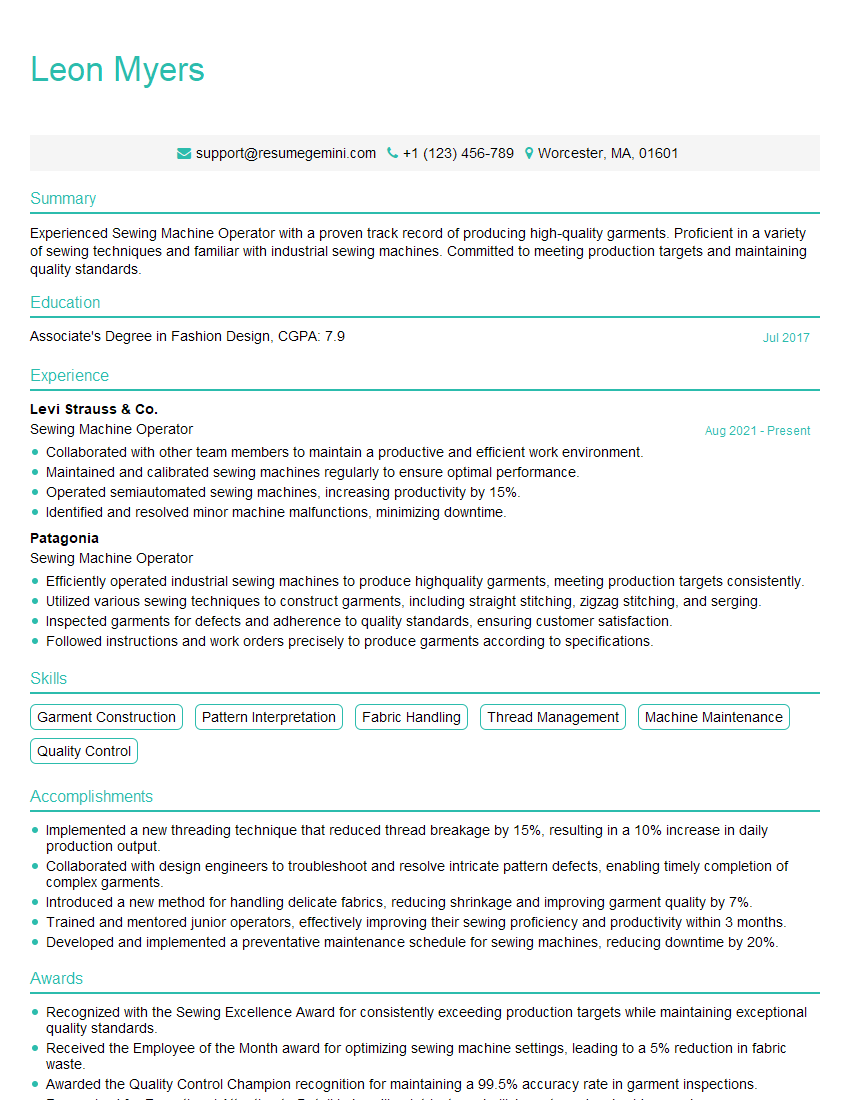
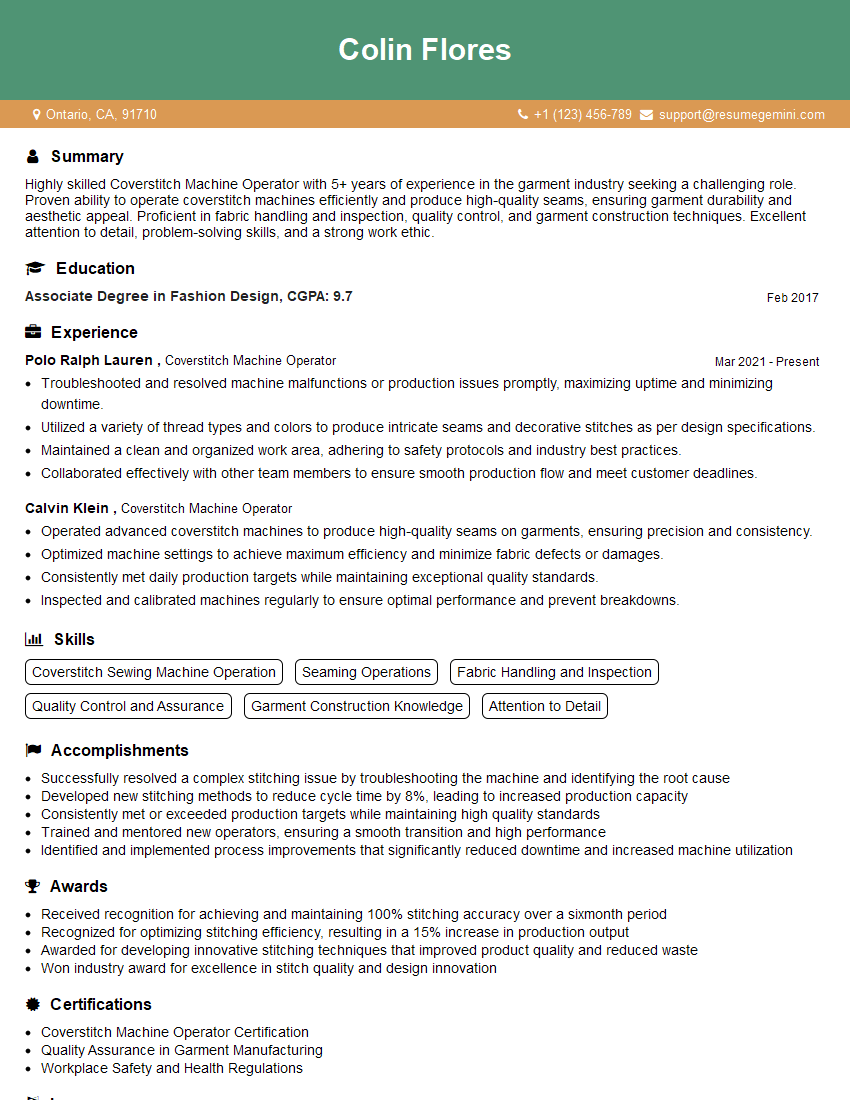
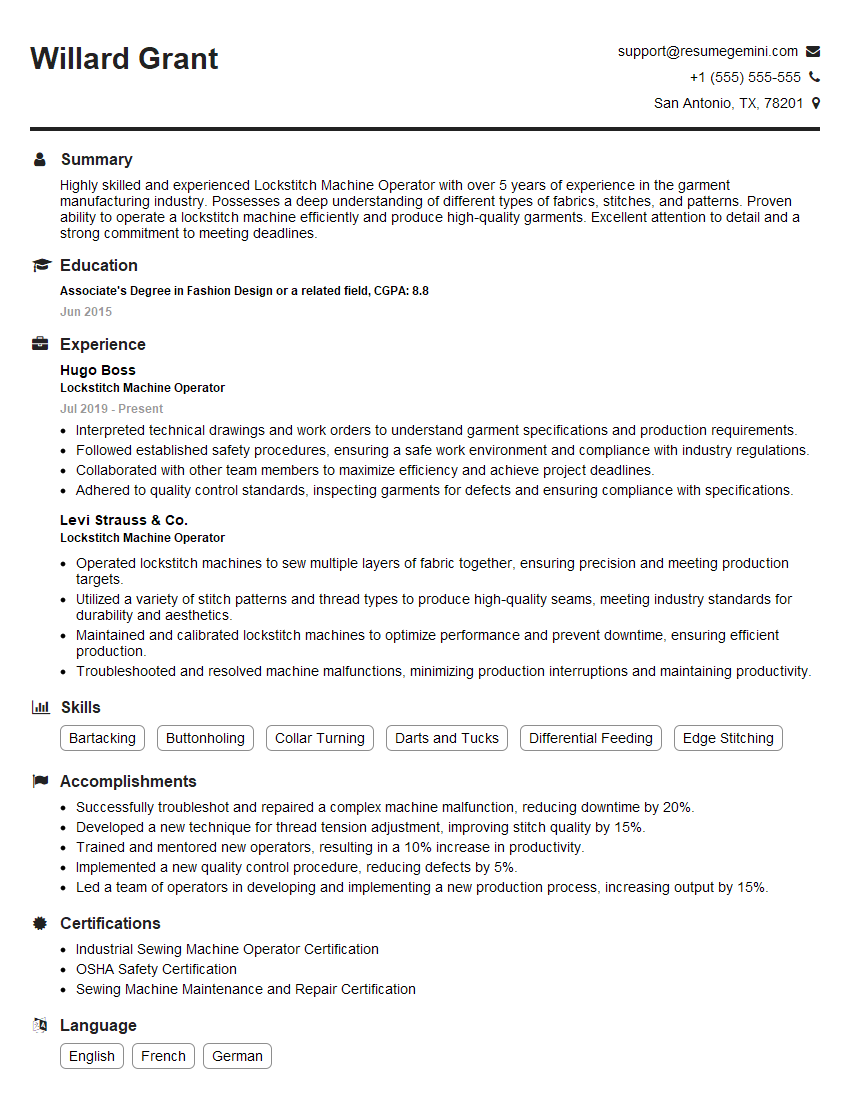
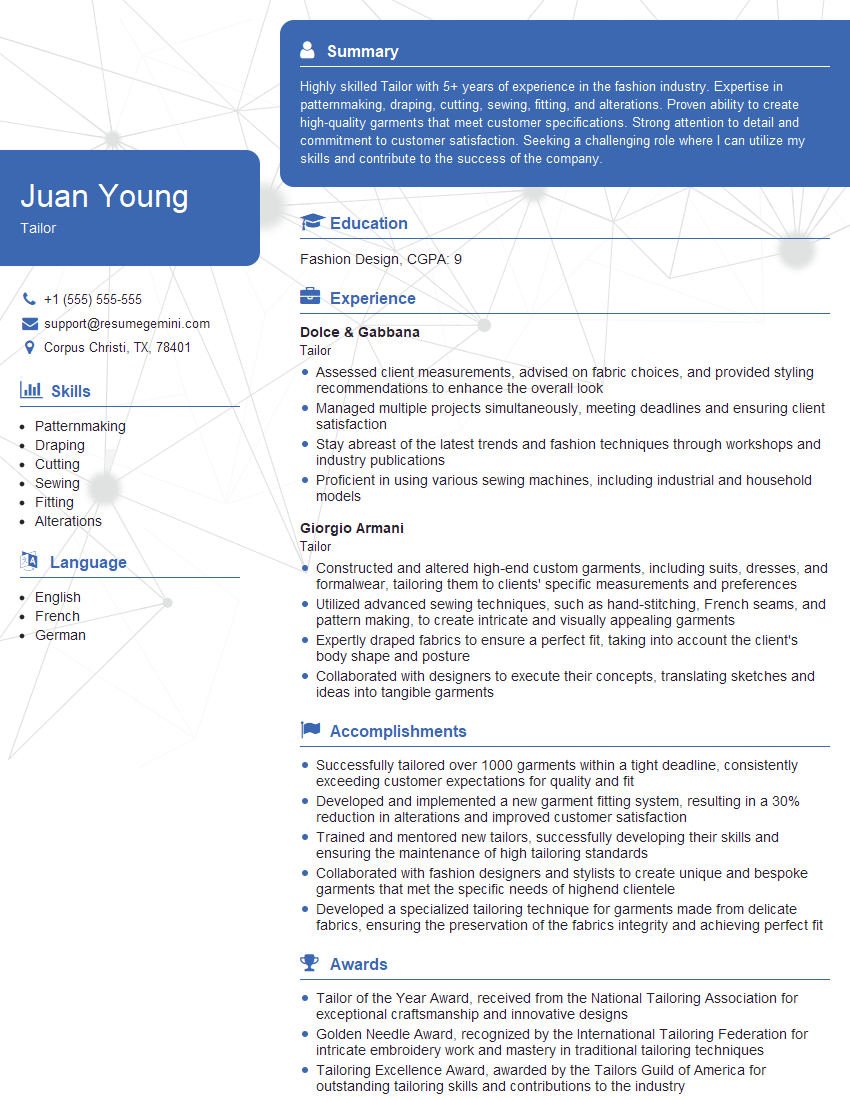
Mastering fabric seaming is crucial for career advancement in the apparel and textile industry. Proficiency in various seam types and techniques demonstrates your skill and attention to detail, leading to greater opportunities and higher earning potential. To maximize your job prospects, create an ATS-friendly resume that highlights your relevant skills and experience. ResumeGemini is a trusted resource to help you build a professional and impactful resume. We provide examples of resumes tailored to Fabric Seaming positions to help you get started. Take the next step towards your dream career today!


Explore more articles
Users Rating of Our Blogs
Share Your Experience
We value your feedback! Please rate our content and share your thoughts (optional).
What Readers Say About Our Blog
Very informative content, great job.
good