Interviews are more than just a Q&A session—they’re a chance to prove your worth. This blog dives into essential Fabric Spreading and Cutting interview questions and expert tips to help you align your answers with what hiring managers are looking for. Start preparing to shine!
Questions Asked in Fabric Spreading and Cutting Interview
Q 1. Explain the process of fabric spreading, including different spreading methods.
Fabric spreading is the crucial first step in garment manufacturing, preparing the fabric for cutting. It involves laying out fabric layers evenly and smoothly to create a consistent material base for pattern cutting. The goal is to minimize fabric waste and ensure accurate cutting. Different spreading methods cater to various fabric types and production scales.
- Manual Spreading: This traditional method involves hand-feeding fabric onto a spreading table. It’s suitable for small-scale operations or delicate fabrics requiring careful handling. Think of a tailor meticulously laying out fabric for a bespoke suit.
- Semi-Automatic Spreading: These machines use a roller system to assist in feeding fabric, reducing physical strain but still requiring some manual adjustment. This is an economical option for medium-sized businesses aiming for increased efficiency.
- Automatic Spreading: These sophisticated machines automate the entire process, precisely laying out multiple fabric layers with consistent tension and minimal labor. They are essential for high-volume production runs where efficiency and accuracy are paramount. Imagine the automated lines in a large-scale clothing factory.
Q 2. Describe various types of cutting equipment and their applications.
Cutting equipment choices depend on the production volume, fabric type, and desired precision. Here are some examples:
- Band Knives: These are long, continuous knives mounted on a rotating band, ideal for cutting multiple layers of fabric quickly and efficiently. Excellent for high-volume production lines processing consistent fabric types.
- Circular Knives: These rotary blades cut through fabric in a circular motion, perfect for intricate shapes and smaller cutting jobs. They offer precision, but may not be as efficient for large-scale projects.
- Die Cutting: This method uses a hardened steel die to cut multiple layers of fabric simultaneously with exceptional accuracy. Primarily used for complex shapes or when extreme precision is required, as seen in the production of high-end fashion or technical apparel.
- Laser Cutting: This cutting-edge technology uses lasers for precise, clean cuts, particularly suitable for delicate fabrics and complex designs. However, the initial investment is high and usually only cost-effective for high-end production or specialized applications.
- Water Jet Cutting: Utilizes a high-pressure water jet to cut fabrics, minimizing fraying and ideal for various materials, but less efficient for mass-production due to the longer cutting times compared to other methods.
Q 3. How do you ensure accurate and efficient fabric utilization during spreading?
Accurate and efficient fabric utilization is key to minimizing waste and maximizing profitability. Several strategies contribute:
- Optimized Spreading Patterns: Employing nesting software to arrange patterns efficiently on the fabric minimizes waste. This software helps to maximize the use of fabric length by arranging patterns in an intelligent way.
- Precise Measurement and Marking: Accurate measurements and markings during spreading and cutting ensure that there’s minimal fabric wasted due to incorrect cutting. This involves regular calibration and maintenance of cutting equipment to guarantee the accuracy of the cuts.
- Consistent Fabric Tension: Maintaining consistent fabric tension prevents distortion and ensures that the cut pieces will be the correct size and shape. This will also help prevent the fabric from being pulled or stretched during cutting.
- Experienced Personnel: A skilled spreading team ensures proper handling and efficient layout, minimizing errors and waste. Training staff in best practices related to fabric handling and machine operation is important to avoid errors.
- Regular Quality Checks: Implementing quality control checks at various stages of the process, including both spreading and cutting, to identify and correct any issues promptly is crucial to prevent waste and errors.
Q 4. What are the common challenges in fabric spreading and how do you address them?
Challenges in fabric spreading are often related to fabric properties, equipment limitations, and human error.
- Fabric Shrinkage and Stretch: Uneven shrinkage or stretch during spreading can lead to inaccurate cuts. Solutions include pre-shrinking fabric and using specialized spreading machines with tension control.
- Fabric Defects: Dealing with defects like holes, stains, and inconsistencies in weave requires careful inspection and pattern placement to avoid wasting fabric. Implementing robust quality control checks at the initial stages of fabric selection is crucial.
- Equipment Malfunctions: Maintaining cutting and spreading equipment is essential for accuracy and efficiency. Regular maintenance and calibrations are needed to ensure the machines are performing optimally.
- Operator Skill and Training: Proper training for spreading and cutting operators is crucial to prevent errors, ensure consistency, and optimize fabric usage. Training programs should cover machine operation, fabric handling and defect identification techniques.
Q 5. Explain the importance of maintaining consistent fabric tension during spreading.
Maintaining consistent fabric tension during spreading is crucial for accurate cutting and preventing distortion. Uneven tension can lead to inaccurate garment sizes, inconsistent patterns, and increased waste.
Think of it like stretching a canvas before painting – if the canvas is unevenly stretched, the painting won’t be accurate. Similarly, inconsistent fabric tension results in distorted cut pieces. Consistent tension ensures that the fabric is spread evenly and that the pattern pieces will be the correct size and shape after cutting. This is achieved through proper machine settings, skilled operation, and regular equipment maintenance. In automatic spreaders, sensors and feedback mechanisms maintain the desired tension, while in manual operations, skilled operators ensure an even spread.
Q 6. How do you identify and handle fabric defects during spreading and cutting?
Identifying and handling fabric defects is a critical aspect of efficient spreading and cutting. This involves careful inspection during spreading.
- Visual Inspection: Thoroughly inspect the fabric for flaws like holes, stains, discoloration, and weaving irregularities. This often involves using specialized lighting to better detect minor defects.
- Defect Mapping: Documenting the location and nature of defects allows for strategic pattern placement to minimize or eliminate waste.
- Sorting and Segregation: Separate defective fabric sections from usable ones. This makes for more efficient cutting and prevents defects from affecting multiple garments.
- Alternative Pattern Placement: Adjust the pattern layout to avoid using the defective sections where possible.
- Communication and Documentation: Detailed communication between spreading and cutting teams ensures that defects are properly handled and accounted for. Accurate recording of defective areas minimizes potential issues down the production line.
Q 7. Describe your experience with different types of cutting knives and blades.
My experience encompasses various cutting knives and blades, each suited to specific needs.
- Straight Knives: These are versatile and commonly used for straight cuts and offer good control for smaller cutting jobs. They are often used for manual cutting or for cutting smaller quantities of fabric.
- Rotary Knives: Ideal for high-speed cutting of multiple fabric layers. The sharpness and durability are important factors to consider here. Regular sharpening is critical to maintain accuracy and efficiency.
- Oscillating Knives: Used for more intricate cuts and offer a smoother, more precise cut compared to straight blades. This type of blade is useful when cutting curved or irregular shapes.
- Specialized Blades: Some fabrics require specific blade types. For instance, delicate fabrics might need thinner blades to avoid damage, whereas heavier materials might need stronger blades to ensure clean cuts.
The selection of the right knife depends on factors such as fabric type, cutting speed, desired quality, and the overall budget. Regular maintenance, including sharpening and replacement, is key to maintaining optimal cutting performance and minimizing fabric damage.
Q 8. How do you ensure the accuracy of cutting patterns?
Accuracy in pattern cutting is paramount for consistent garment quality. We ensure accuracy through a multi-pronged approach. First, we meticulously check the digital pattern pieces for any errors before plotting them. This involves verifying dimensions, seam allowances, and grading (size variations). Next, we use high-precision cutting equipment, regularly calibrated to guarantee the cutting blades are sharp and the machinery is functioning correctly. For example, we might use a laser cutting system for intricate designs or a high-speed automated cutter for bulk production. Finally, we implement a rigorous quality control system including random sampling and inspection of cut pieces to verify that they match the digital pattern. Any discrepancies are immediately addressed and the root cause identified and corrected. Imagine baking a cake – an inaccurate measurement can ruin the final product; likewise, an inaccurate pattern will result in ill-fitting garments.
Q 9. Explain the role of markers in fabric cutting.
Markers are essentially blueprints for cutting. They are large sheets of paper or digital layouts that show how multiple pattern pieces are arranged on the fabric to minimize waste. They specify the position, orientation, and number of each pattern piece needed for a particular garment size and style. Efficient markers are crucial for maximizing fabric yield. They consider factors like fabric width, grain direction (the lengthwise and crosswise threads), and pattern piece shapes. Think of it like a jigsaw puzzle where you need to fit all pieces efficiently to form a complete picture—in this case, the finished garment. The layout within a marker directly impacts the cost of production as fabric wastage has a direct impact on profitability.
Q 10. How do you optimize cutting layouts for minimal fabric waste?
Optimizing cutting layouts is a critical aspect of cost-effective production. We utilize specialized software that employs nesting algorithms to automatically arrange pattern pieces on the fabric. These algorithms intelligently arrange pieces to minimize fabric waste, taking into account factors such as fabric width, grain line, and pattern piece orientation. Manual marker making is also used for smaller jobs and specialized fabrics to tailor the layout and account for special considerations such as fabric flaws. Furthermore, we regularly review and refine our cutting layouts to improve efficiency. For instance, we might experiment with different marker orientations or utilize different nesting strategies to find the most effective arrangement for different pattern shapes and fabric types. This often involves a combination of automated software and skilled human input to fine-tune the results. The goal is to get as many pieces cut as possible while reducing scrap and minimizing waste. Every percentage point saved translates to significant cost savings in large production runs.
Q 11. What is your experience with computerized cutting systems?
My experience with computerized cutting systems is extensive. I’m proficient in operating and maintaining various automated cutting machines, from simple single-ply cutters to complex multi-ply systems that can handle large rolls of fabric simultaneously. I’m familiar with different software used for generating and optimizing markers, including the use of CAD/CAM software for design and production. These systems drastically improve efficiency and precision, reducing human error and increasing production output. Specifically, I have experience with Gerber AccuMark and Lectra systems, both of which are industry-leading solutions. I’m also adept at troubleshooting equipment malfunctions and ensuring the system is consistently calibrated for optimal performance. Computerized systems allow for faster turnaround times and more consistent quality compared to manual methods.
Q 12. Describe your experience with manual cutting techniques.
While automated systems are efficient for large-scale projects, I possess a deep understanding of manual cutting techniques. This knowledge is invaluable for smaller batches, specialized fabrics requiring delicate handling (like silks or delicate lace), or when dealing with intricate designs that may be difficult to automate. I’m skilled in using various hand tools, including shears, rotary cutters, and cutting wheels, and I understand the importance of proper blade maintenance and techniques for ensuring clean, accurate cuts. My experience includes working with both single-ply and multi-ply layering techniques, optimizing for fabric type and pattern complexity. Manual cutting demands a high level of skill and precision, and I’m confident in my ability to execute precise cuts consistently, even for complex patterns. It’s a more hands-on approach that builds a better connection to the material and requires a sharp eye for detail.
Q 13. How do you maintain quality control throughout the spreading and cutting process?
Quality control is integrated into every stage of the process, starting with fabric inspection upon arrival. We check for defects, color consistency, and correct fabric type. Throughout spreading, we monitor for evenness and consistent tension to avoid distortion. During cutting, regular checks are done to ensure the blades are sharp and the cutting machines are functioning properly. Post-cutting, we perform random inspections of cut pieces to verify that they conform to the pattern specifications, checking for accurate dimensions and clean cuts. Any defects are immediately documented and the root cause identified. Finally, we maintain detailed records of all materials, processes, and inspections, enabling traceability and helping identify and resolve recurring issues. This meticulous approach helps ensure consistent quality, minimizes waste, and prevents costly rework further down the line. It’s all about proactive problem-solving.
Q 14. How do you handle large-scale cutting projects?
Handling large-scale cutting projects requires careful planning and coordination. This involves efficient marker making to optimize fabric utilization, using high-speed automated cutting systems for increased throughput, and employing well-trained personnel who work in a coordinated manner to ensure productivity and quality control. Effective communication and collaboration between the cutting team and other departments (production planning, logistics) is crucial. We frequently use production planning software to schedule jobs, allocate resources, and track progress. For example, large projects might be broken down into smaller, manageable batches, each with its own marker and cutting plan. Regular progress reports and quality checks are essential to keep the project on track and identify and correct any potential issues promptly. Careful management of fabric inventory and waste disposal is also a significant aspect of handling large scale projects effectively and sustainably.
Q 15. Explain your experience with different fabric types and their handling requirements.
My experience encompasses a wide range of fabrics, from delicate silks and chiffons to heavy-duty denim and leather. Understanding a fabric’s properties is paramount for efficient spreading and cutting. For instance, delicate fabrics like silk require careful handling to prevent snags or stretching. This means using specialized spreading techniques, potentially with a softer spreading surface and slower machine speeds. Conversely, heavier fabrics like denim require robust machinery and potentially different cutting methods to ensure clean cuts and minimize fraying.
- Silk/Chiffon: Requires gentle spreading, low tension, and sharp, fine-toothed blades to avoid damage. We often use a smooth, non-porous spreading surface.
- Woven cotton: More forgiving than silk; allows for slightly higher tension during spreading and standard cutting techniques.
- Denim: Demands robust spreading and cutting tools, including heavier-duty blades and possibly multiple layers of cutting. Pre-cutting adjustments for shrinkage are crucial.
- Leather: Unique requirements; precise measurements and specialized blades are needed to avoid damaging the material. Often requires pattern modifications to account for the inherent inconsistencies of the material.
I always consult the fabric’s care instructions and conduct small-scale tests to determine the optimal spreading and cutting parameters before proceeding with large-scale production runs.
Career Expert Tips:
- Ace those interviews! Prepare effectively by reviewing the Top 50 Most Common Interview Questions on ResumeGemini.
- Navigate your job search with confidence! Explore a wide range of Career Tips on ResumeGemini. Learn about common challenges and recommendations to overcome them.
- Craft the perfect resume! Master the Art of Resume Writing with ResumeGemini’s guide. Showcase your unique qualifications and achievements effectively.
- Don’t miss out on holiday savings! Build your dream resume with ResumeGemini’s ATS optimized templates.
Q 16. How do you manage time effectively during peak production periods?
Managing time effectively during peak production is all about strategic planning and efficient execution. It’s like orchestrating a complex symphony! I leverage several strategies, including:
- Prioritized Production Schedule: We meticulously plan the cutting sequence based on order urgency and fabric type to optimize machine utilization and minimize downtime.
- Cross-Training and Teamwork: Cross-training team members allows for flexibility and quick response to unexpected challenges or surges in demand.
- Regular Maintenance: Proactive machine maintenance reduces unexpected breakdowns that disrupt schedules.
- Continuous Improvement: Regularly analyzing production data allows us to identify bottlenecks and implement improvement strategies. For example, if a particular cutting process is consistently taking longer than expected, we investigate the cause and seek efficient solutions.
- Visual Management Tools: Kanban boards or similar systems help visualize workflow and identify potential issues proactively.
For example, during a particularly busy holiday season, we implemented a colour-coded system for orders based on priority. This allowed us to easily see which orders needed immediate attention and adjust our workflow to manage the increased demand.
Q 17. How do you prioritize tasks in a fast-paced cutting room environment?
Prioritization in a fast-paced cutting room relies on a combination of factors. It’s not just about speed, but also accuracy and efficiency. I use a combination of methods:
- Order Urgency: Orders with tight deadlines always take precedence.
- Material Availability: We prioritize orders with readily available fabric to avoid delays.
- Production Complexity: Orders requiring intricate cutting patterns or specialized techniques might be prioritized differently to ensure accurate execution.
- Resource Allocation: We consider the availability of cutting machines, personnel and tools when making decisions.
I often use a combination of visual management systems like Kanban boards, as mentioned earlier, combined with a prioritized order list created from the planning stage. This ensures everyone in the team understands what needs to be done first.
Q 18. How do you work effectively as part of a team in the cutting room?
Effective teamwork is the backbone of a successful cutting room. I foster a collaborative environment built on open communication, mutual respect, and shared goals. This includes:
- Clear Communication: Regular team meetings and consistent updates keep everyone informed about daily tasks and changes in priorities.
- Collaborative Problem-Solving: Encouraging input from all team members leads to creative and practical solutions to challenges.
- Mutual Support: Team members support each other to meet deadlines and maintain a positive work environment. For example, if one team member falls behind, others may help to ensure timely completion.
- Skill Sharing and Training: Cross-training opportunities help to improve the efficiency of the team as a whole. This is especially important during peak times.
Imagine a well-oiled machine – each part working smoothly and in synchronization to produce a flawless outcome. That’s the kind of teamwork I strive to create.
Q 19. Describe your problem-solving approach in relation to cutting room issues.
My approach to problem-solving is systematic and data-driven. I follow a structured process:
- Identify the Problem: Clearly define the issue and gather all relevant information.
- Analyze the Root Cause: Investigate the underlying causes of the problem to ensure a lasting solution.
- Develop Solutions: Brainstorm multiple solutions, considering their feasibility and potential impact.
- Implement the Solution: Select the most effective solution and implement it carefully.
- Evaluate the Results: Monitor the outcome and make adjustments as needed.
For example, if we experience an increase in fabric waste, I would investigate factors like blade sharpness, spreading accuracy, and pattern efficiency. We may implement new cutting techniques or update our equipment to mitigate waste.
Q 20. How do you ensure safety standards are met in the cutting room?
Safety is my top priority. We maintain a safe cutting room environment through strict adherence to safety protocols and regular training. This includes:
- Regular Machine Inspections: Daily checks ensure all machinery is functioning correctly and safely.
- Proper Training: All team members receive thorough training on safe operating procedures for all equipment.
- Personal Protective Equipment (PPE): We enforce the use of appropriate safety gear such as cut-resistant gloves, safety glasses, and hearing protection.
- Clean and Organized Workspace: A clutter-free workspace minimizes tripping hazards and ensures efficient workflow.
- Emergency Procedures: We have established clear emergency procedures and conduct regular drills to ensure readiness in case of accidents.
Safety isn’t just a checklist; it’s a culture we actively cultivate. We believe that a safe work environment is an efficient and productive work environment.
Q 21. What are the key performance indicators (KPIs) you track in a cutting room?
Key Performance Indicators (KPIs) are crucial for monitoring and improving the cutting room’s efficiency and productivity. The specific KPIs we track include:
- Cutting Efficiency: Measured by the number of garments cut per hour or per machine.
- Fabric Waste: Percentage of fabric lost during the cutting process; a crucial indicator of efficiency and cost-effectiveness.
- Defect Rate: The percentage of cut pieces with defects that require rework or rejection.
- Machine Downtime: Time lost due to machine breakdowns or maintenance; helps identify areas for improvement in maintenance scheduling.
- Production Lead Time: Time taken to complete an order from start to finish.
- Labor Costs: Cost of labor per unit of production.
By regularly monitoring these KPIs, we can identify areas for improvement, optimize processes, and increase overall productivity. For example, if the defect rate increases, we might review cutting techniques, blade sharpness, or even the quality of incoming materials.
Q 22. Explain your understanding of fabric grain and its importance in cutting.
Fabric grain refers to the direction of the warp and weft yarns in a woven fabric. The warp yarns run lengthwise, while the weft yarns run across the width. Understanding fabric grain is crucial because it directly impacts the drape, stability, and overall appearance of the finished garment. Cutting against the grain can lead to distortion, stretching, and an unprofessional finish.
Imagine trying to build a house with bricks laid haphazardly – it wouldn’t stand! Similarly, cutting fabric without considering the grain leads to undesirable results. For example, cutting a skirt panel on the bias (at a 45-degree angle to the grain) will create a softer drape, but if you were to cut a structured bodice panel on the bias, it would lose its shape completely. Always align the cutting pattern pieces with the fabric grain as indicated on the pattern.
- Straight Grain: Parallel to the warp yarns. Provides the most stability.
- Cross Grain: Parallel to the weft yarns. Offers less stability than the straight grain.
- Bias Grain: At a 45-degree angle to the warp and weft yarns. Creates a diagonal stretch and a softer drape.
Q 23. Describe your experience with ply spreading and its challenges.
Ply spreading involves layering multiple layers of fabric together for efficient cutting. My experience includes working with various fabric types and ply counts, from delicate silks to heavy denim. The key challenges involve ensuring consistent layer alignment and tension to avoid slippage, wrinkles, and fabric distortion which will affect the precision of the cut pieces. Maintaining even tension across the entire spread is paramount. Using the correct spreading equipment and techniques for the fabric type is vital. For instance, delicate fabrics need gentler spreading methods compared to robust materials.
One significant challenge is dealing with fabric variations. Differences in fabric weight, texture, and even minor inconsistencies in manufacturing can affect evenness. Careful attention during spreading is key, and sometimes it requires adjusting the spreading technique mid-process. For example, with heavily textured fabrics, you might need to use more pins to prevent shifting, while lightweight, slippery fabrics may require slower spreading speeds and more frequent checks for consistent alignment.
Q 24. How do you interpret cutting instructions and technical specifications?
Interpreting cutting instructions and technical specifications is fundamental to accurate cutting. This involves a thorough understanding of the marker, which is a plan showing how pattern pieces are arranged on the fabric spread. It includes information such as:
- Marker Layout: The arrangement of pattern pieces, showing their orientation, size, and position relative to the grain line.
- Cutting sequence: The order in which pattern pieces are cut to minimize fabric waste and errors.
- Notches and markings: These are crucial for assembling garment parts correctly, and should be precisely transferred to the fabric during the cutting process.
- Fabric type and quantity: This is essential for selecting the appropriate spreading and cutting techniques.
- Tolerances: This accounts for slight variations in fabric shrinkage and cutting precision.
I always meticulously check all specifications against the actual fabric spread before commencing cutting to ensure consistency and avoid mistakes.
Q 25. Explain the process of maintaining and troubleshooting cutting equipment.
Maintaining and troubleshooting cutting equipment is crucial for efficient and accurate operation. This includes regular cleaning, lubrication, and adjustments. For example, maintaining the sharpness of cutting blades is critical for clean, precise cuts. Dull blades can lead to frayed edges and inaccurate sizing. I also regularly check and calibrate spreading machines to ensure consistent fabric feed and tension. Troubleshooting involves identifying the source of problems – is it a faulty blade, a clogged spreader mechanism, or a malfunctioning control system?
A systematic approach is essential for troubleshooting. I usually begin by visually inspecting the equipment, checking for obvious problems like loose connections or damage. If the issue persists, I consult the equipment’s maintenance manual and might need to contact a qualified technician for more complex repairs. Preventive maintenance is key—regular checks prevent costly repairs and downtime. This includes recording maintenance schedules and promptly addressing any issues.
Q 26. How do you train new employees on proper spreading and cutting techniques?
Training new employees involves a structured approach, starting with a comprehensive overview of fabric types, grain lines, and cutting terminology. I then demonstrate proper spreading techniques, emphasizing consistent tension and alignment. Hands-on practice is crucial, allowing trainees to practice under supervision. I provide feedback, highlighting areas for improvement. For example, I would show them how to properly handle different fabrics, and also what adjustments to make based on the weight, stretch, and texture of each material.
Safety is a key aspect of my training. This includes proper handling of cutting equipment, use of safety glasses, and maintaining a clean and organized work area. Regular assessment allows me to track their progress, ensuring they understand each step of the process and can perform it accurately and safely. Finally, continued mentorship and support are provided as they develop their expertise.
Q 27. How do you stay updated with the latest advancements in fabric spreading and cutting technology?
Staying updated with advancements in fabric spreading and cutting technology is a continuous process. I achieve this through several methods:
- Industry publications and journals: Reading industry-specific publications keeps me informed about new equipment and techniques.
- Trade shows and conferences: Attending these events provides direct exposure to the latest innovations and networking opportunities with other professionals.
- Online resources and webinars: Numerous online resources, including manufacturer websites and educational platforms, provide valuable information on new technology and best practices.
- Manufacturer training programs: Participating in training programs offered by equipment manufacturers helps me improve my skills and gain in-depth knowledge of specific technologies.
By consistently engaging with these resources, I can ensure that my knowledge and skills remain current and relevant.
Q 28. Describe a time you had to solve a complex problem related to fabric spreading or cutting.
In one instance, we encountered significant challenges with a new, highly textured fabric that was prone to slippage during spreading. Standard spreading methods resulted in misaligned layers and wasted fabric. The initial approach using traditional spreading techniques proved ineffective. We were facing a considerable production delay.
To solve the problem, I implemented a multi-pronged approach:
- We tested different spreading techniques: including experimenting with a slower spreading speed, increased use of pins, and a technique of partially spreading before completely aligning the entire spread.
- We adjusted machine settings: Modifying the spreading machine’s tension and speed settings helped mitigate the slippage.
- We assessed the fabric: This highlighted the need for a different approach to handling the fabric and made us consider the specific material’s properties, such as stretch and weight.
Through careful testing and collaboration, we ultimately found a successful combination of techniques, significantly reducing slippage and improving accuracy. This experience reinforced the importance of adaptability and problem-solving skills in this field.
Key Topics to Learn for Your Fabric Spreading and Cutting Interview
- Fabric Properties and Handling: Understanding different fabric types (knits, wovens, etc.), their drape, and appropriate handling techniques for optimal spreading and cutting.
- Spreading Techniques: Mastering various spreading methods (single, double, multiple layers), considering factors like fabric width, pattern layout, and minimizing waste.
- Marker Making and Pattern Layout: Understanding the principles of efficient marker making, including nesting patterns to optimize fabric utilization and reduce material costs. Familiarity with different marker making software is a plus.
- Cutting Techniques: Proficiency in using various cutting tools (manual and automated), ensuring precision and minimizing fabric damage. Understanding quality control checks during the cutting process.
- Quality Control and Waste Reduction: Implementing strategies to identify and minimize fabric defects, ensuring consistent quality throughout the cutting process and actively reducing waste.
- Safety Procedures and Best Practices: Adherence to safety regulations and best practices in the cutting room environment to ensure a safe and efficient workflow. Understanding the proper use and maintenance of machinery.
- Production Planning and Efficiency: Understanding the relationship between cutting and overall production timelines, contributing to optimized workflows and meeting deadlines.
- Troubleshooting and Problem Solving: Ability to identify and resolve issues that may arise during spreading and cutting, such as fabric defects, machine malfunctions, or pattern discrepancies.
Next Steps
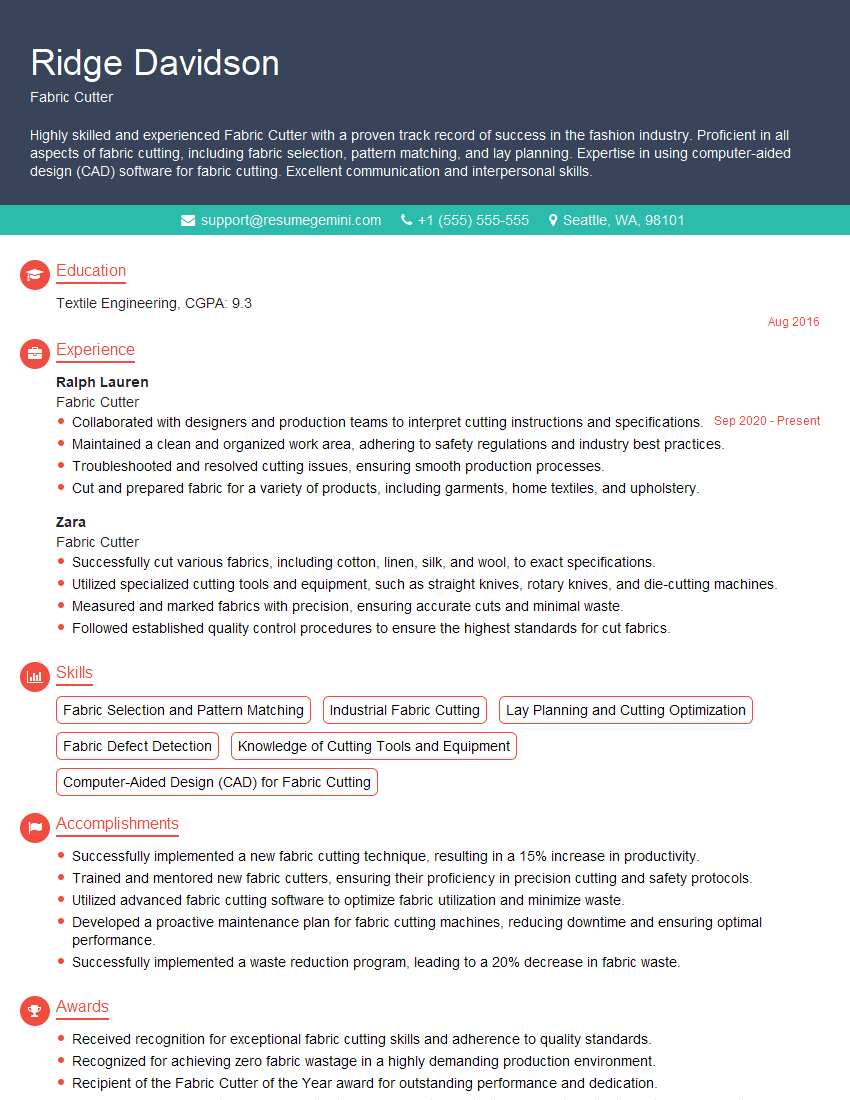
Mastering fabric spreading and cutting is crucial for career advancement in the apparel manufacturing industry. It demonstrates a strong foundation in technical skills and contributes significantly to efficient and cost-effective production. To enhance your job prospects, creating a strong, ATS-friendly resume is essential. ResumeGemini can help you build a professional and impactful resume tailored to the specific requirements of Fabric Spreading and Cutting roles. ResumeGemini provides examples of resumes specifically designed for this field, ensuring your qualifications shine through to potential employers.



Explore more articles
Users Rating of Our Blogs
Share Your Experience
We value your feedback! Please rate our content and share your thoughts (optional).
What Readers Say About Our Blog
Very informative content, great job.
good