Interviews are opportunities to demonstrate your expertise, and this guide is here to help you shine. Explore the essential Facies Analysis interview questions that employers frequently ask, paired with strategies for crafting responses that set you apart from the competition.
Questions Asked in Facies Analysis Interview
Q 1. Describe the different types of facies and their characteristics.
Facies are distinct bodies of rock that differ from adjacent units in terms of lithology, sedimentary structures, and fossil content. They represent different depositional environments and processes. Think of them as fingerprints of the past environmental conditions. There’s a huge variety, but we can broadly categorize them.
- Sandstone Facies: These are characterized by sand-sized grains, often displaying cross-bedding (indicating currents), ripples (indicating shallow water flow), or planar bedding (indicating less energetic environments). Sub-types include fluvial sandstones (river deposits), eolian sandstones (desert dunes), and shallow marine sandstones (beach or nearshore environments).
- Shale Facies: These are dominated by fine-grained clay and silt particles, often laminated (showing thin layers) and may contain fossils indicating quiet, low-energy environments like deep lakes or deep marine settings. They can be quite organic-rich if deposited in anoxic conditions.
- Carbonate Facies: These are composed predominantly of calcium carbonate (CaCO3), often formed in shallow marine environments. Characteristics include various types of skeletal grains (fossils), ooids (small, spherical grains), or intraclasts (broken fragments of carbonate rock). Reefs are a classic example of a carbonate facies, characterized by diverse organisms and complex structures.
- Conglomerate Facies: These consist of large, rounded clasts (pebbles, cobbles, and boulders) cemented together. They typically indicate high-energy depositional environments like alluvial fans (fan-shaped deposits at the base of mountains) or braided rivers.
The specific characteristics of a facies help us understand the conditions under which it formed—water depth, energy, sediment source, and biological activity.
Q 2. Explain the process of facies analysis, from data acquisition to interpretation.
Facies analysis is a systematic process that integrates multiple datasets to reconstruct past depositional environments. It starts with data acquisition, which typically includes:
- Well logs: These provide continuous measurements of subsurface properties (e.g., gamma ray, resistivity, density) along the borehole.
- Core data: Physical samples of the rock are examined for lithology, sedimentary structures, and fossil content.
- Seismic data: Reflects subsurface rock layers and their geometry, providing a large-scale perspective.
- Outcrop studies: Observations of exposed rock layers help to ground truth and calibrate well and seismic data.
Next comes data interpretation and analysis. We use well logs to identify lithological changes and correlate them across different wells. Core data provides detailed information on sedimentary structures and fossils. Seismic data allows us to map the extent and geometry of different facies. By integrating these data, we can create facies models, which illustrate the spatial distribution of different facies and their relationships to each other.
Finally, we interpret the facies model to understand the depositional history and predict subsurface reservoir properties. This could involve creating a 3D model showing the distribution of different rock types, understanding reservoir connectivity, and identifying potential hydrocarbon traps.
Q 3. How do you use well logs to identify and interpret facies?
Well logs are essential tools in facies identification. Different log responses reflect different rock properties, and these properties are directly related to facies. For example:
- Gamma ray log: High gamma ray values typically indicate shale-rich facies, while low values suggest sandstones or carbonates.
- Resistivity log: High resistivity indicates a porous and permeable reservoir rock (e.g., sandstone) saturated with hydrocarbons. Low resistivity is characteristic of shale or water-saturated sandstone.
- Density log: Provides information on the bulk density of the rock, which is related to lithology. Densities can be used to distinguish between different rock types.
- Neutron porosity log: Measures the porosity of the rock. High porosity is characteristic of some sandstones and carbonates, important for reservoir characterization.
By analyzing these logs together, we can identify changes in lithology and porosity, which are crucial for delineating facies boundaries. We often use cross-plots of log data to visually identify different facies. For example, a cross-plot of gamma ray vs. neutron porosity can help separate shale from different types of sandstones.
It’s important to note that well log interpretation often requires careful calibration with core data and other geological information. There are software packages like Petrel and Kingdom that can help in the visualization and analysis of well log data and the construction of facies models.
Q 4. Describe the different methods used for facies correlation.
Facies correlation aims to establish the lateral and vertical continuity of facies bodies across an area. This is crucial for building accurate subsurface models. Several methods exist:
- Lithological Correlation: Comparing the lithological characteristics (grain size, mineralogy) of cores and well logs across different wells to establish equivalent units.
- Biostratigraphic Correlation: Using fossil assemblages to correlate units based on their age and depositional environment. The presence or absence of certain fossils is important.
- Sequence Stratigraphic Correlation: Correlation is based on recognizing surfaces that represent changes in sea level or other significant depositional events (e.g., unconformities). This provides a chronostratigraphic framework.
- Log-based Correlation: Analyzing well log patterns (e.g., gamma ray, resistivity) to identify similar sequences across wells. This often involves using advanced techniques like pattern recognition or neural networks.
- Seismic Correlation: Identifying reflection patterns on seismic data to correlate large-scale geological units across wider areas.
The choice of method depends on the data availability and the scale of the study. Often, a combination of methods is used for robust correlation.
Q 5. What are the challenges in facies analysis, and how do you overcome them?
Facies analysis presents several challenges:
- Data Scarcity: Well data and core samples are often sparsely distributed, leading to uncertainties in facies interpretation and correlation.
- Data Resolution: The resolution of well logs and seismic data might not be sufficient to resolve thin or complex facies changes.
- Ambiguity in Interpretation: Similar log responses can result from different facies, leading to ambiguity in interpretation.
- Diagenesis: Post-depositional alteration can modify the original characteristics of facies, making their interpretation difficult.
To overcome these challenges, we employ several strategies:
- Integrating multiple data types: Combining well logs, core data, seismic data, and outcrop studies enhances interpretation confidence.
- Statistical and geostatistical methods: These are used to quantify uncertainties and build probabilistic models.
- Advanced interpretation techniques: Using techniques like neural networks or machine learning can improve the accuracy of facies identification.
- Calibration with outcrop analogues: Studying exposed rock sections helps validate interpretations and understand the processes involved in facies formation.
Careful planning, rigorous data analysis, and a good understanding of the geological context are crucial for successful facies analysis.
Q 6. Explain the relationship between facies and depositional environments.
Facies and depositional environments are intimately linked. The type of facies present in a rock sequence directly reflects the environment in which it was deposited. Different environments have different energy levels, sediment supply, and biological activity, all of which influence the characteristics of the resulting facies.
For example:
- Fluvial environments (rivers): Tend to produce sandstone and conglomerate facies with characteristics like cross-bedding and channel forms.
- Deltaic environments: Show a variety of facies, including sandstones, shales, and coals, reflecting the interplay of fluvial, marine, and lacustrine processes.
- Marine environments: Range from shallow marine sandstones (beach, nearshore) to deeper marine shales, with carbonate facies commonly found in shallower, warmer waters.
- Aeolian environments (deserts): Typically characterized by well-sorted sandstones with large-scale cross-bedding, indicative of wind-blown sand.
By analyzing the facies, we can reconstruct the paleogeography, understanding the distribution of different environments and how they changed over time. This is essential for understanding the geological history of a basin and its potential for hydrocarbon resources.
Q 7. How do you interpret core data to identify facies?
Core data is invaluable for detailed facies identification. Direct observation of the rock allows us to describe lithology, sedimentary structures, and fossil content with great precision. The steps involved are:
- Visual Description: Careful examination of the core to describe the rock type (e.g., sandstone, shale, carbonate), grain size, sorting, color, and cementation.
- Sedimentary Structure Analysis: Identifying structures like bedding, cross-bedding, ripple marks, bioturbation (burrowing by organisms), and other features. These structures are key indicators of depositional processes and environments.
- Fossil Identification: Identifying and classifying fossils present in the core. Certain fossils are indicative of specific environments (e.g., shallow marine, deep marine). The diversity and abundance of fossils can also provide important environmental information.
- Petrographic Analysis: Thin sections of the core are examined under a microscope to determine the mineralogy and texture in detail. This helps in understanding the composition and diagenetic history of the rock.
- Geochemical Analysis: Various geochemical tests can provide further information on the origin and evolution of the facies. For example, stable isotopes can help determine the depositional environment (e.g., marine vs. freshwater).
By integrating all this information, we can create a detailed facies description, which is essential for understanding the depositional history and correlating the core data with other subsurface data.
Q 8. How do you use seismic data in facies analysis?
Seismic data provides a crucial, large-scale view of subsurface geology, complementing well-log data in facies analysis. We use seismic attributes – such as amplitude, frequency, and reflectivity – to map out potential facies distributions. For example, high-amplitude reflections might indicate a massive sandstone reservoir, while low-amplitude reflections could point to shale. Seismic stratigraphy, the interpretation of seismic data in a stratigraphic context, helps us identify major depositional sequences and their internal architecture, guiding our facies interpretations at a broader scale. Think of it as providing the ‘big picture’ before we zoom in with well logs and core data. We often integrate seismic data with other data types in a process called ‘seismic-to-well tie,’ ensuring accurate correlation between seismic interpretations and well observations.
For instance, in a fluvial system, seismic could highlight channel-fill sands as strong reflectors within a sequence of weaker shale reflectors. By analyzing changes in seismic attributes along a seismic section, we can map the spatial extent of these channel sands and infer their depositional environments.
Q 9. Explain the concept of sequence stratigraphy and its role in facies analysis.
Sequence stratigraphy is a powerful framework for understanding the relationship between sedimentary strata and their depositional environments. It explains how sedimentary rocks are arranged in response to relative sea-level changes and related changes in accommodation space (the space available for sediment accumulation). In facies analysis, this framework is essential because it provides a hierarchical organization of sedimentary units, allowing us to better understand the stacking patterns and spatial relationships of various facies. For example, understanding the systems tract (e.g., highstand, transgressive) within a sequence helps us predict the types of facies we expect to find.
Imagine building a sandcastle on the beach. The sequence stratigraphy would describe the overall structure of the sandcastle as a function of tides – a high tide resulting in a wider base of the castle and a low tide limiting its height. In this analogy, different layers of the sandcastle are comparable to facies, formed under varying conditions of tide (sea level) and accumulation. This framework helps to organize our facies interpretations, predict facies distribution based on sequence architecture, and improve reservoir modeling.
Q 10. Describe the different types of sedimentary structures and their significance in facies analysis.
Sedimentary structures are features within sedimentary rocks that reflect the processes of sediment deposition and post-depositional modification. These structures provide crucial clues about the depositional environment and help us classify facies. Some key types include:
- Beds and bedding planes: Indicate changes in depositional processes. Thick beds suggest high-energy environments, while thin beds suggest low-energy conditions.
- Cross-bedding: Characterized by inclined layers within a bed, indicating sediment transport by currents (e.g., rivers, dunes, underwater currents).
- Graded bedding: Progressive fining or coarsening of grain size within a single bed, often related to waning flow energy.
- Ripple marks: Small-scale bedforms created by currents or waves, indicating flow direction and environment.
- Bioturbation: The disruption of sediment layers by burrowing organisms; provides evidence of biological activity.
For example, the presence of cross-bedding in a sandstone indicates deposition within a river channel or a dune field, whereas mud cracks suggest deposition in an environment that experienced periodic drying. By carefully analyzing the variety and distribution of sedimentary structures, we can reconstruct the depositional history and classify facies.
Q 11. How do you incorporate petrophysical data into your facies analysis workflow?
Petrophysical data, such as porosity, permeability, water saturation, and density, are essential for quantifying reservoir properties and integrating them into our facies analysis workflow. We use these data to define quantitative relationships between petrophysical properties and facies. For example, a high porosity and permeability sandstone would likely be classified as a reservoir-quality facies, whereas a low porosity and permeability shale would be classified as a non-reservoir facies.
We often use techniques such as cluster analysis or neural networks to group wells based on their petrophysical characteristics, establishing correlations between these properties and facies defined through core descriptions and logs. This helps in developing predictive models to estimate reservoir properties in uncored intervals, building a robust understanding of reservoir heterogeneity. For instance, we might identify a distinct cluster of wells with high porosity, low water saturation, and high permeability, linking it to a specific sand facies with excellent reservoir potential.
Q 12. What are the key differences between different facies classification schemes?
Several facies classification schemes exist, each with strengths and weaknesses depending on the geological setting and objectives. Some key differences include:
- Lithological-based classifications: These schemes emphasize the composition of rocks, such as sandstone, shale, and limestone. These are relatively simple but might not capture the full range of depositional environments or subtle changes within a lithological type.
- Environmental-based classifications: This approach focuses on the depositional processes and environments, such as fluvial, deltaic, or marine. It is more insightful but requires thorough understanding of depositional systems. This will offer more information on the reservoir’s potential and how it was formed.
- Genetic classifications:These emphasize the genetic relationship between different facies, linking them to specific sedimentary processes and geological events. They require a deep understanding of the formation and evolution of sedimentary basins.
The choice of classification scheme depends on the specific geological setting and the goals of the study. For instance, a reservoir characterization study might favor a genetic classification to understand reservoir heterogeneity and connectivity, whereas a regional stratigraphic study might favor an environmental classification to understand basin evolution.
Q 13. How do you handle uncertainty and ambiguity in facies interpretation?
Uncertainty and ambiguity are inherent in facies analysis due to the complex and often incomplete nature of subsurface data. To handle these issues, we employ several strategies:
- Multiple data integration: Combining data from various sources (seismic, well logs, cores, etc.) reduces reliance on any single data type and enhances confidence in interpretation.
- Probabilistic methods: Using probabilistic models to quantify uncertainty in facies predictions, representing our understanding as probability distributions rather than deterministic values. This will help you estimate the degree of error in your interpretations.
- Sensitivity analysis: Evaluating the impact of varying input parameters (e.g., cut-offs in cluster analysis) on the results to identify those most sensitive to uncertainty. This analysis will let you know which areas of the interpretation could have the biggest variability.
- Geostatistical modeling: Incorporating spatial correlations between data points to generate more realistic facies models. By using statistical methods, you will ensure that you have the best model based on the data.
For example, instead of assigning a single facies to a given location, we might assign probabilities to several possible facies based on the available evidence. This approach acknowledges the uncertainties involved and provides a more robust and realistic representation of the subsurface.
Q 14. Explain the use of statistical methods in facies analysis.
Statistical methods play a vital role in facies analysis, enabling objective and quantitative analysis of large datasets. Some commonly used methods include:
- Cluster analysis: Grouping wells or data points based on similarity in petrophysical or other properties. This helps define facies clusters with distinct characteristics.
- Principal component analysis (PCA): Reducing the dimensionality of a dataset while retaining most of the information. This simplifies the analysis and visualization of complex datasets.
- Discriminant function analysis (DFA): Finding linear combinations of variables that best separate different facies. This helps in predicting facies based on easily measurable properties.
- Markov chain modeling: Modeling the spatial transition probabilities between facies to simulate realistic facies distributions. This considers the spatial correlation between facies.
These methods are particularly useful for handling large datasets and for making objective decisions on facies classifications. For example, cluster analysis using well logs can group wells into distinct clusters representing different facies, even in the absence of core data.
Q 15. How do you present your facies analysis results effectively?
Effective presentation of facies analysis results hinges on clarity, visual appeal, and a logical flow of information. I typically employ a multi-pronged approach.
Summary Table: A concise table summarizing key facies, their proportions, and associated reservoir properties (porosity, permeability, hydrocarbon saturation) is crucial for quick understanding.
Facies Maps: Creating detailed maps showing the spatial distribution of facies is essential. These can be generated using various techniques like kriging or indicator kriging, depending on the data and required accuracy. Color schemes should be intuitive and clearly labeled.
Cross-sections: Detailed cross-sections illustrate the vertical and lateral relationships between facies, highlighting key architectural elements. These are particularly useful for understanding depositional processes and reservoir connectivity.
3D Models: For complex projects, 3D visualization of facies distribution is invaluable. This allows stakeholders to easily understand the subsurface architecture and its implications for reservoir management. Software like Petrel or Kingdom can be used to achieve this.
Interpretation Report: A comprehensive report details the methodology, results, and interpretations, including uncertainty analysis and limitations of the study. It includes a geological narrative connecting the facies to the depositional environment and its influence on reservoir properties.
I always tailor the presentation to the audience. For a technical audience, detailed explanations and uncertainty quantification are emphasized. For a management audience, the focus is on key findings and their implications for decision-making.
Career Expert Tips:
- Ace those interviews! Prepare effectively by reviewing the Top 50 Most Common Interview Questions on ResumeGemini.
- Navigate your job search with confidence! Explore a wide range of Career Tips on ResumeGemini. Learn about common challenges and recommendations to overcome them.
- Craft the perfect resume! Master the Art of Resume Writing with ResumeGemini’s guide. Showcase your unique qualifications and achievements effectively.
- Don’t miss out on holiday savings! Build your dream resume with ResumeGemini’s ATS optimized templates.
Q 16. Describe your experience with different facies analysis software packages.
My experience spans several widely-used facies analysis software packages. I’m proficient in Petrel, Kingdom, and Schlumberger’s Irap RMS. Each software has strengths and weaknesses, and my choice depends on the project’s specific needs and available data.
Petrel: Excellent for large-scale projects, providing comprehensive tools for well log analysis, seismic interpretation, reservoir modeling, and facies modeling. Its strengths lie in its integrated workflow and powerful visualization capabilities. I often use Petrel’s geostatistical tools for creating facies probability maps.
Kingdom: A strong alternative to Petrel, particularly useful for its robust seismic interpretation and attribute analysis capabilities. I utilize Kingdom to integrate seismic data into facies analysis workflows, especially for identifying subtle stratigraphic features.
Irap RMS: This software excels in advanced geostatistical modeling and uncertainty quantification. I leverage Irap RMS when high precision in facies modeling and reservoir characterization is critical, especially when dealing with complex geological settings and limited data.
Beyond these commercial packages, I have experience with open-source tools like Python with libraries like Scikit-learn and Pandas, which allow for custom scripting and automation of specific tasks in the facies analysis workflow.
Q 17. How do you integrate facies analysis with other geological disciplines?
Facies analysis is not an isolated discipline; it’s intrinsically linked to other geological fields. Effective integration is key to a robust subsurface understanding.
Structural Geology: Understanding fault patterns and their impact on facies distribution is crucial. Faults can compartmentalize reservoirs, altering permeability and fluid flow. I incorporate structural maps and interpretations to constrain facies models.
Stratigraphy: Facies analysis is the foundation of sequence stratigraphy. Identifying key surfaces and depositional sequences informs reservoir architecture and helps predict reservoir connectivity. I use stratigraphic principles to guide my facies interpretations and model building.
Sedimentology: Sedimentological data, including core descriptions, thin sections, and grain size analysis, provide critical input for facies classification and interpretation. This ground-truthing data helps validate facies models and refine interpretations.
Geophysics: Seismic data, particularly 3D seismic, helps map the spatial distribution of facies at a larger scale than what can be achieved with well data alone. Seismic attributes can be used to identify subtle changes in lithology and delineate facies boundaries. I use seismic data to constrain and validate my facies models.
Reservoir Engineering: Facies analysis directly impacts reservoir simulation by defining the permeability and porosity fields. Accurate facies models are essential for accurate predictions of fluid flow and reservoir performance.
The integration of these disciplines involves iterative collaboration and data exchange, ensuring a holistic understanding of the reservoir.
Q 18. How do you address data gaps in facies analysis?
Data gaps are inherent in subsurface exploration, and addressing them requires a strategic approach.
Geostatistical Methods: Techniques like kriging, co-kriging, and sequential indicator simulation are used to interpolate data between wells and extrapolate knowledge to un-sampled areas. The choice of method depends on data distribution and spatial correlation.
Analogue Studies: Comparing the study area to similar geological settings with better data availability can provide valuable insights and constrain interpretations. This involves identifying analogous basins or fields with similar depositional environments and applying that knowledge to the area with data gaps.
Seismic Interpretation: Seismic data, even with limitations, often provides valuable information on the subsurface architecture. Attributes derived from seismic data can help infer facies distributions in areas with sparse well data. I frequently use seismic inversion to help create a more complete image of the subsurface.
Uncertainty Quantification: Recognizing and quantifying the uncertainty associated with the interpolated and extrapolated data is crucial for transparent and reliable interpretations. I often incorporate stochastic methods into my workflow to evaluate the variability of potential outcomes.
Addressing data gaps is a balance between utilizing available information to create the most plausible model while acknowledging and communicating the uncertainties associated with the interpretation.
Q 19. Describe your approach to quality control in facies analysis.
Quality control in facies analysis is critical for ensuring the reliability of results. My QC process is multi-faceted and implemented throughout the workflow.
Data Validation: Thorough validation of all input data, including well logs, core descriptions, and seismic data, is crucial. This involves checking for errors, inconsistencies, and outliers. I often implement automated checks and cross-validation between different datasets.
Independent Verification: Whenever possible, I seek independent verification of interpretations by having another geologist review my analysis and results. A fresh perspective can often identify overlooked issues or biases.
Sensitivity Analysis: I perform sensitivity analyses to evaluate how changes in input parameters (e.g., log calibrations, geostatistical parameters) affect the final facies model. This helps assess the robustness of the results and the influence of uncertainties.
Cross-validation: Comparing predictions of the model with independent datasets not used in the model construction is essential to validate its accuracy and predictive capabilities.
Documentation: Meticulous documentation of the entire workflow, including data sources, processing steps, and interpretations, is essential for traceability and reproducibility. This is crucial for future reference and audits.
Quality control is an iterative process, not a single step, aiming to ensure high confidence in the facies interpretations and their applications.
Q 20. What is your experience with reservoir modeling and its relationship to facies analysis?
Reservoir modeling and facies analysis are inextricably linked. Facies analysis provides the essential geological framework for reservoir modeling, defining the spatial distribution of reservoir properties.
Property Modeling: Facies are assigned key reservoir properties such as porosity, permeability, and hydrocarbon saturation. These properties, often derived from well log data and core analysis, are used to populate the reservoir model.
Flow Simulation: The facies model dictates the flow pathways in the reservoir. Accurate representation of facies distribution is crucial for simulating fluid flow and predicting reservoir performance. This influences decisions regarding well placement and production strategies.
Uncertainty Assessment: Facies models inherently involve uncertainties, which propagate into the reservoir simulation. Quantifying this uncertainty is vital for evaluating risk and making informed decisions.
Model Calibration and Validation: Reservoir models are calibrated and validated against production data to ensure accuracy. The quality of the facies model directly impacts the accuracy and reliability of the reservoir simulation.
In essence, the facies model serves as the geological foundation upon which the reservoir model is built. A high-quality facies analysis directly leads to more accurate and reliable reservoir simulations.
Q 21. Describe a challenging facies analysis project you worked on and how you solved it.
One challenging project involved analyzing a fluvial reservoir with highly variable facies and limited well control. The reservoir was characterized by complex channel geometries, frequent avulsion events, and significant lateral and vertical heterogeneity. The challenge lay in accurately predicting facies distribution in areas with sparse well data.
My approach was multifaceted:
High-Resolution Seismic Interpretation: We utilized advanced seismic attributes like spectral decomposition and coherence to delineate channel features and identify subtle changes in lithology between wells. This helped improve our understanding of the channel architecture and constrain facies distribution.
Geostatistical Modeling with Multiple Point Statistics (MPS): Standard geostatistical methods failed to capture the complex spatial relationships of the channel architecture. MPS methods proved to be more effective in reproducing the observed heterogeneity and realistically modeling channel geometries.
Analogue Data Integration: We integrated analogue data from outcrops with similar sedimentary environments to further constrain the facies model. This helped improve our understanding of channel architecture and depositional processes.
Uncertainty Analysis: We performed a comprehensive uncertainty analysis to quantify the uncertainty associated with the facies model, acknowledging the limitations of data and methodologies. We presented multiple realistic realizations of the reservoir model to highlight this uncertainty.
This combined approach allowed us to develop a more realistic and reliable facies model despite the data limitations. The improved facies model resulted in more accurate reservoir simulation and a more robust prediction of reservoir performance.
Q 22. How do you determine the scale of analysis appropriate for a given project?
Choosing the appropriate scale for facies analysis is crucial for a successful project. It depends on the project’s goals, the available data, and the geological complexity of the area. Think of it like choosing the right lens for a microscope – you wouldn’t use a low-power lens to examine cell structures, just as you wouldn’t use a very high-resolution analysis to interpret a large-scale regional stratigraphy.
- Macro-scale: This focuses on large-scale regional patterns, often using seismic data and well logs to interpret major depositional systems (e.g., a large deltaic complex). The scale might be kilometers to tens of kilometers.
- Meso-scale: This level examines individual stratigraphic units within a larger system, often using detailed core descriptions, well logs, and outcrop data. The scale typically ranges from meters to kilometers. This is where we often identify specific facies associations.
- Micro-scale: This is the most detailed level, focusing on individual sedimentary structures within a specific bed, employing thin sections, and detailed core photography. The scale is centimeters to meters, revealing crucial information on depositional processes and environments.
For example, a project aiming to assess hydrocarbon reservoir potential in a large basin would likely start with a macro-scale analysis to define major stratigraphic units. Following this, a meso-scale analysis would focus on individual reservoir units within those larger formations to determine heterogeneity. Finally, a micro-scale analysis might be used to characterize pore-throat geometry within a specific reservoir facies for enhanced reservoir simulation.
Q 23. What are the limitations of facies analysis?
Facies analysis, while powerful, does have limitations. Primarily, these limitations stem from the destructive nature of geological processes and the incomplete nature of the geological record.
- Diagenetic alteration: Primary sedimentary features can be significantly modified by diagenesis (post-depositional changes), making original facies interpretation challenging. For example, dolomitization can completely obliterate original sedimentary structures.
- Incomplete preservation: Erosion and tectonic deformation can remove parts of the stratigraphic record, leaving gaps in the understanding of depositional history. Imagine trying to reconstruct a jigsaw puzzle with missing pieces.
- Ambiguity of some sedimentary structures: Some sedimentary structures can form in multiple environments, making unequivocal facies interpretation difficult. For example, cross-bedding can occur in both fluvial and aeolian environments.
- Scale limitations: As discussed earlier, the scale of analysis can greatly influence the conclusions, and a limitation might be the difficulty in correlating interpretations across multiple scales.
- Data limitations: The reliability of facies analysis is directly proportional to the quality and quantity of available data. Sparse well control or poor-quality core can significantly hinder interpretation.
It’s essential to acknowledge these limitations when presenting interpretations and to incorporate uncertainty into the analysis. Integrating multiple datasets and utilizing various analytical techniques can help mitigate these limitations to a certain degree.
Q 24. How do you differentiate between primary and secondary sedimentary features?
Differentiating primary and secondary sedimentary features is fundamental to facies analysis. Primary features are those formed during deposition, reflecting the depositional environment, while secondary features are formed after deposition, often due to diagenetic processes or post-depositional modification.
- Primary features include sedimentary structures like bedding planes, cross-bedding, ripple marks, bioturbation (if preserved from early alteration), and the grain size distribution. These provide direct insights into the energy conditions and depositional environment.
- Secondary features include cementation, dissolution, dolomitization, fracturing, and stylolite formation. These features can overprint or even destroy primary sedimentary features, complicating interpretation. For example, extensive cementation might obscure original porosity and permeability, impacting reservoir quality assessment.
Imagine a sandcastle: The initial building of the sandcastle with its various towers and walls represents primary features. The erosion of the sandcastle by waves or rain, along with any subsequent modifications, are the secondary features. Understanding both is crucial to knowing the entire history of the structure.
Q 25. What is your understanding of diagenesis and its impact on facies interpretation?
Diagenesis encompasses all physical, chemical, and biological changes that affect sediments after their initial deposition. It plays a crucial role in facies interpretation because it significantly alters primary sedimentary features, impacting reservoir characteristics.
For instance, compaction reduces porosity and permeability, while cementation fills pore spaces, reducing reservoir quality. Dissolution can enhance porosity, but it can also destroy primary sedimentary structures, making facies identification challenging. Dolomitization, the replacement of calcite by dolomite, is another significant diagenetic process that impacts porosity and permeability and can obscure original sedimentary textures. Understanding the diagenetic history of a reservoir is therefore crucial for accurate facies interpretation and reservoir characterization.
To address the impact of diagenesis, we utilize various techniques, including petrographic analysis of thin sections, geochemical analysis, and modeling of diagenetic processes. These analyses allow us to unravel the diagenetic history and to correct for the impact of post-depositional changes on the primary sedimentary features.
Q 26. How do you incorporate geological history into your facies analysis?
Incorporating geological history into facies analysis is essential for a complete and accurate interpretation. It provides a framework for understanding the sequence of events that led to the formation of the observed sedimentary features. This involves understanding the tectonic setting, the relative sea-level changes, the sediment source areas, and the climatic conditions.
For example, analyzing a sequence of facies might reveal a transgressive-regressive cycle (rise and fall of sea level), which could be further supported by dating techniques and regional tectonic history. Understanding this provides a contextual framework for interpreting individual facies and their spatial relationships. By building a detailed chronostratigraphic framework, we can place facies in their proper geological time and understand their evolutionary sequence, avoiding misinterpretations due to focusing solely on the present-day expression of the facies.
We use various methods to reconstruct geological history including biostratigraphy (using fossils), chemostratigraphy (using geochemical signatures), cyclostratigraphy (using cyclical sedimentary patterns), and sequence stratigraphy. The integration of these approaches provides a robust framework for understanding the depositional history and interpreting the observed facies in their proper geological context.
Q 27. Discuss the role of facies analysis in reservoir management.
Facies analysis plays a critical role in reservoir management, providing the foundation for understanding reservoir architecture, heterogeneity, and fluid flow patterns. This informs decisions related to drilling, completion, production optimization, and enhanced oil recovery (EOR) strategies.
- Reservoir characterization: Facies analysis helps delineate reservoir zones, identifying high-permeability channels and low-permeability barriers. This is crucial for optimizing well placement and completion strategies.
- Predicting reservoir performance: Understanding the spatial distribution of different facies helps predict reservoir performance, guiding production forecasts and reserve estimations.
- EOR strategy optimization: Knowledge of facies distribution is fundamental to designing effective EOR strategies, such as waterflooding or CO2 injection. Understanding the permeability distribution and connectivity within different facies guides the optimization of injection patterns.
- Uncertainty reduction: Detailed facies modeling reduces uncertainty in reservoir simulation, leading to more accurate predictions of reservoir performance and improved decision-making.
For example, in a fluvial sandstone reservoir, identifying high-permeability channel sandstones and low-permeability floodplain mudstones is critical for optimizing well placement, focusing drilling efforts on areas of higher hydrocarbon productivity. The understanding of facies distribution also helps in designing the optimal pattern for water injection in a waterflood project.
Q 28. Explain your understanding of the application of facies analysis in unconventional reservoirs.
Facies analysis in unconventional reservoirs, such as shale gas and tight oil reservoirs, presents unique challenges and opportunities. The focus shifts from understanding large-scale reservoir architecture to characterizing the complex pore network at a much smaller scale.
While traditional facies analysis techniques are still valuable, they need to be adapted to account for the low permeability and nanoscale pore structures of these reservoirs. The focus often shifts to understanding the distribution of organic matter, the nature of fracturing, and the relationship between these factors and hydrocarbon production.
Techniques such as core analysis, thin section petrography, scanning electron microscopy (SEM), and geochemistry become particularly important for characterizing the pore network and identifying potential flow pathways. The interpretation of well logs also requires specialized expertise, incorporating advanced log analysis techniques to infer rock properties from indirect measurements. Understanding the interplay between depositional facies, diagenesis, and fracturing is crucial for optimizing well placement and stimulation strategies in unconventional reservoirs.
For instance, identifying high-organic-matter facies within a shale gas reservoir is crucial for targeting zones with higher hydrocarbon potential. Further, understanding the distribution and connectivity of natural fractures can guide the placement of hydraulic fractures to maximize production.
Key Topics to Learn for Facies Analysis Interview
- Sedimentary Facies and their Characteristics: Understanding different sedimentary environments (e.g., fluvial, marine, deltaic) and their corresponding facies associations. This includes recognizing key sedimentary structures and textures.
- Facies Associations and Stratigraphic Analysis: Interpreting vertical and lateral facies changes to reconstruct depositional environments and understand the geological history of a basin. This involves applying principles of stratigraphy and sequence stratigraphy.
- Facies Models and their Applications: Utilizing established facies models to predict subsurface reservoir properties and guide exploration and production strategies. This includes understanding the limitations and uncertainties associated with facies models.
- Data Interpretation and Analysis: Proficiently interpreting well logs (e.g., gamma ray, resistivity, porosity), core descriptions, and seismic data to identify and map facies. This involves developing strong data integration skills.
- Facies Modeling and Simulation: Understanding the principles and techniques used to create 3D geological models incorporating facies information. This can include experience with relevant software.
- Reservoir Characterization and Prediction: Applying facies analysis to improve reservoir characterization, particularly focusing on permeability, porosity, and hydrocarbon saturation predictions.
- Problem-Solving and Critical Thinking: Demonstrating the ability to analyze complex geological datasets, identify patterns, and formulate logical conclusions. This involves being able to justify interpretations and address uncertainties.
Next Steps
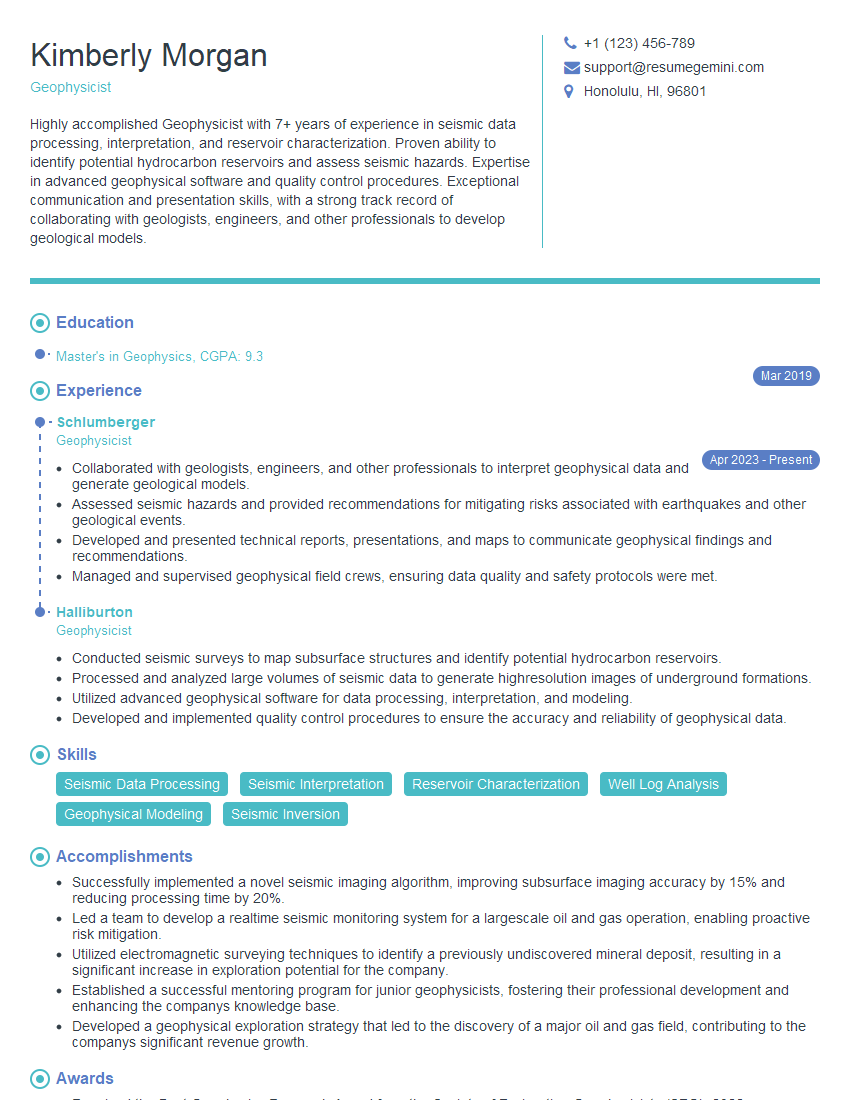
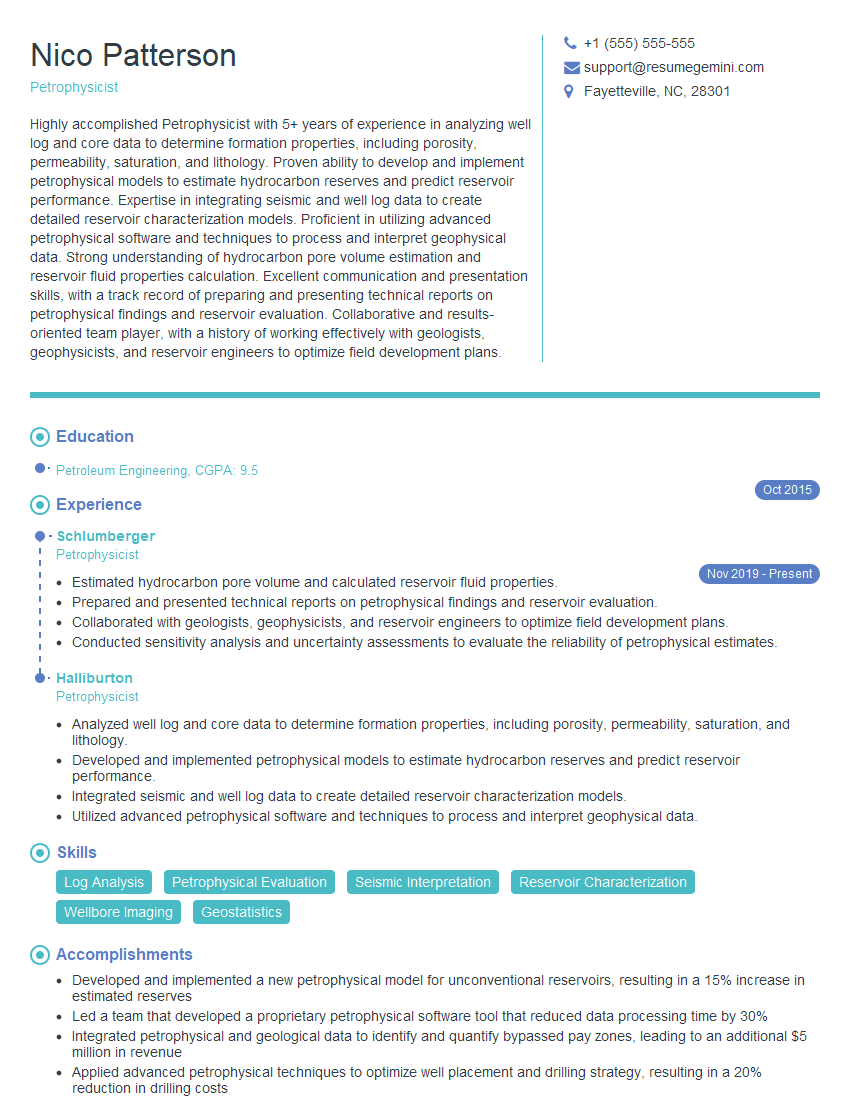
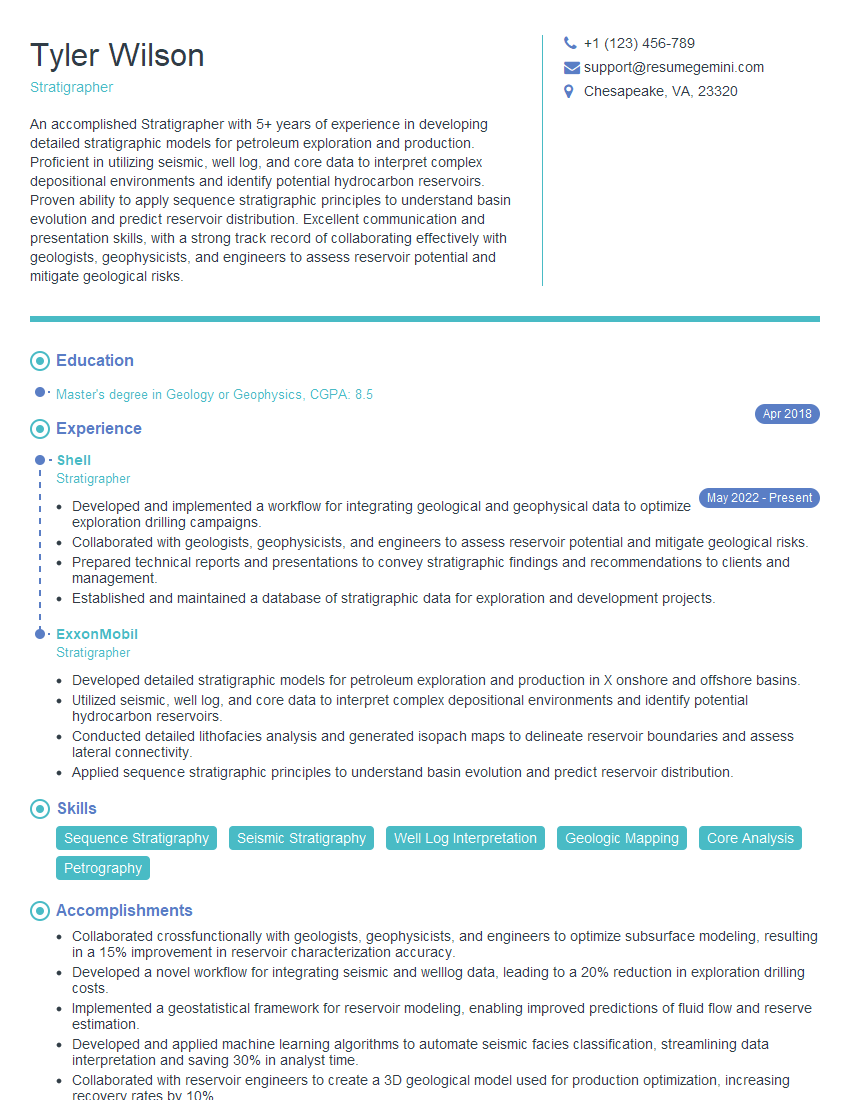
Mastering Facies Analysis opens doors to exciting career opportunities in the energy sector and beyond, offering roles with significant responsibility and impact. To maximize your job prospects, a well-crafted, ATS-friendly resume is crucial. ResumeGemini can help you create a powerful resume that showcases your skills and experience effectively. We provide examples of resumes tailored to Facies Analysis to guide you in building a compelling application. Take the next step towards your dream job – leverage ResumeGemini to build a resume that gets noticed.





Explore more articles
Users Rating of Our Blogs
Share Your Experience
We value your feedback! Please rate our content and share your thoughts (optional).
What Readers Say About Our Blog
good