The right preparation can turn an interview into an opportunity to showcase your expertise. This guide to Fall Protection and Prevention interview questions is your ultimate resource, providing key insights and tips to help you ace your responses and stand out as a top candidate.
Questions Asked in Fall Protection and Prevention Interview
Q 1. What are the main types of fall protection systems?
Fall protection systems are designed to prevent workers from falling from heights or to minimize the impact of a fall. They are broadly categorized into several main types:
- Guardrail Systems: These are engineered barriers that prevent falls from occurring in the first place. Think of them as a physical fence around an elevated work area. They typically consist of top rails, mid rails, and toe boards.
- Personal Fall Arrest Systems (PFAS): These systems are designed to arrest a fall after it has begun, minimizing the impact on the worker. They involve a harness, an anchor point, and a connecting device.
- Fall Restraint Systems: These systems prevent a worker from reaching a fall hazard in the first place. They use a lanyard or lifeline that restricts movement within a safe area, preventing access to the edge.
- Safety Net Systems: These are nets placed below an elevated work area to catch a falling worker. They are often used for tasks with a high probability of a fall.
- Positioning Systems: These systems allow a worker to maintain a stable position during work at heights. They include specialized harnesses and lanyards that hold the worker in place without restricting movement.
The best system depends heavily on the specific work environment and the hazards present. A thorough risk assessment is crucial for choosing the right system.
Q 2. Explain the hierarchy of fall protection.
The hierarchy of fall protection prioritizes preventing falls in the first place, then minimizing the consequences if a fall does occur. It’s a layered approach:
- Elimination: The most preferred method. This involves completely removing the fall hazard, such as redesigning a work process to eliminate the need for working at heights.
- Substitution: Replacing a hazardous task with a safer alternative. For example, using a scissor lift instead of a ladder.
- Engineering Controls: Implementing physical barriers or safeguards to prevent falls, like guardrail systems, or using safety nets.
- Administrative Controls: Implementing procedures and training to minimize the risk of falls. This includes worker training, work permits, and regular inspections.
- Personal Protective Equipment (PPE): The last line of defense. This includes PFAS, which should only be used when other control measures are not feasible or sufficient.
This hierarchy underscores a commitment to risk mitigation, moving from the most effective and proactive measures to the least preferred (PPE) only when other options are exhausted.
Q 3. Describe the components of a personal fall arrest system (PFAS).
A Personal Fall Arrest System (PFAS) typically consists of several key components, all working together to protect the worker:
- Full Body Harness: A properly fitted harness that distributes the forces of a fall across the body, preventing injury. It should be inspected regularly for damage.
- Anchor Point: A secure point of attachment that can withstand the forces of a fall. This should be independently certified and capable of supporting at least 5,000 lbs.
- Connector(s): These connect the harness to the anchor point. This can include shock-absorbing lanyards, self-retracting lifelines (SRLs), or other fall arrest devices. These components play a vital role in managing the energy of a fall.
- Other components (depending on the PFAS): These might include a deceleration device to reduce the impact force and a lifeline to connect multiple workers.
Each component is essential; failure of any one part can compromise the entire system’s effectiveness.
Q 4. What are the limitations of a PFAS?
While PFAS are crucial for fall protection, they have limitations:
- Swing Falls: PFAS can’t prevent uncontrolled swinging during a fall, which can result in collisions with obstacles or additional injuries.
- Fall Clearance: Sufficient clearance below the worker is crucial. The system’s stopping distance must be accounted for to avoid impact with the ground or other objects.
- Harness Fit and Wear: An improperly fitted harness significantly reduces the system’s effectiveness and can cause discomfort and injury. Regular inspections are critical.
- Anchor Point Strength: The anchor point must be strong enough and properly installed to hold the force of a fall. Failure of the anchor point can lead to catastrophic consequences.
- Limitations on Use: PFAS are intended to arrest a fall, not prevent it entirely. They are only effective when other preventative measures are deemed inadequate.
Understanding these limitations is critical for selecting and using a PFAS safely and effectively.
Q 5. How do you inspect and maintain fall protection equipment?
Regular inspection and maintenance are crucial for ensuring the effectiveness of fall protection equipment. A thorough inspection should be conducted before each use and at regular intervals specified by the manufacturer.
- Visual Inspection: Look for any signs of wear and tear, cuts, abrasions, fraying, or corrosion on all components (harness, lanyard, lifeline, anchor point). Check for any damage to stitching and webbing.
- Functional Testing: Where applicable, test the functionality of self-retracting lifelines and other mechanisms. Ensure that all locking mechanisms work properly.
- Documentation: Keep detailed records of all inspections, including any identified defects and the actions taken. This documentation can be crucial in accident investigations.
- Retirement Criteria: Follow the manufacturer’s guidelines for retiring damaged or expired equipment. Never compromise on safety by using damaged equipment.
- Training: Personnel involved in the inspection and maintenance should have adequate training to identify defects and ensure proper handling of the equipment.
Regular maintenance, including cleaning and storage, will extend the lifespan of your fall protection equipment.
Q 6. What are the regulations and standards related to fall protection in your area?
Fall protection regulations and standards vary by location. However, many jurisdictions adopt or reference standards developed by organizations like OSHA (Occupational Safety and Health Administration) or ANSI (American National Standards Institute). It’s crucial to consult the relevant regulations in your specific area for detailed requirements. These regulations typically cover:
- Training requirements for workers
- Requirements for fall protection systems
- Inspection and maintenance protocols
- Permit-required confined space entry procedures
- Record-keeping requirements
Failing to comply with these regulations can lead to significant fines and legal consequences. Staying up-to-date on the applicable regulations is critical for ensuring workplace safety.
Q 7. Explain the difference between anchor points and tie-off points.
While both anchor points and tie-off points are used in fall protection systems, there’s a crucial distinction:
- Anchor Point: This is a structurally sound point that is permanently attached to a building or structure. It’s designed to support the forces of a fall and must be independently certified and inspected. Think of it as the primary attachment point.
- Tie-Off Point: This is a connection point from the anchor point to the worker’s harness. It can be part of the anchor point structure or a separate component connected to it. This includes the lanyard, self-retracting lifeline (SRL), or other connecting devices.
In essence, the anchor point is the structural foundation, while the tie-off point is the connection between the foundation and the worker. Both must be equally strong and appropriately used.
Q 8. How do you select the appropriate fall protection system for a specific task?
Selecting the right fall protection system is crucial for ensuring worker safety. It’s not a one-size-fits-all approach; the choice depends entirely on the specific work environment and task. Think of it like choosing the right tool for a job – you wouldn’t use a hammer to screw in a screw.
- Assess the hazard: What are the potential fall risks? How high is the fall distance? What are the surrounding surfaces? Are there any environmental factors to consider (e.g., wind, rain)?
- Identify the worker’s task: What movements will the worker be making? Will they need mobility? How much weight are they carrying?
- Choose the appropriate system: Based on the hazard and task, select a system that meets or exceeds OSHA standards. Examples include harness systems with anchor points, guardrails, safety nets, and personal fall arrest systems (PFAS).
- Consider worker comfort and mobility: The system should allow for safe movement and prevent interference with the task. A bulky or uncomfortable harness will reduce worker efficiency and may even compromise safety.
- Verify compatibility: Ensure all components are compatible (e.g., the harness, lanyard, and anchor point). Inspect for damage before each use.
Example: For a worker installing solar panels on a roof, a full-body harness with a shock-absorbing lanyard connected to a roof anchor point would be appropriate. For working at a fixed height on a scaffold, guardrails might suffice. Each situation demands a tailored approach.
Q 9. What are the critical aspects of fall protection training?
Effective fall protection training is paramount; it’s not just about knowing how to use equipment but understanding why it’s necessary. Imagine teaching someone to drive without explaining traffic laws – risky, right?
- Hazard Recognition: Trainees must be able to identify potential fall hazards in various work environments.
- Equipment Selection and Use: Proper selection of equipment based on the specific task and the knowledge of how to inspect, don, and use the equipment correctly is essential.
- Rescue Procedures: Training should include both self-rescue techniques and understanding how to assist a fallen coworker. This often involves understanding the limitations of equipment and seeking professional help when necessary.
- Emergency Response: Trainees need to know what to do in an emergency situation, including calling for help and providing basic first aid.
- Regulations and Compliance: Training must cover relevant OSHA standards and company-specific safety policies.
- Practical Application: Hands-on training is crucial, allowing trainees to practice using the equipment in simulated scenarios.
Example: A good training program would include a demonstration of how to correctly connect a harness to an anchor point, followed by practical exercises where trainees perform the task under supervision.
Q 10. How do you assess and mitigate fall hazards in a workplace?
Assessing and mitigating fall hazards involves a systematic approach. Think of it like a detective solving a crime – you need to gather evidence, analyze it, and then formulate a plan of action.
- Walkthrough Inspection: Visually inspect the worksite for potential fall hazards. Look for unprotected edges, holes, uneven surfaces, and other tripping hazards.
- Hazard Identification: Identify the specific hazards and the level of risk associated with them (high, medium, low).
- Risk Assessment: Determine the likelihood and severity of a fall incident occurring.
- Engineering Controls: Implement engineering solutions whenever possible. Examples include guardrails, safety nets, and the use of scaffolding with appropriate fall protection.
- Administrative Controls: Implement administrative controls, such as restricting access to hazardous areas, providing adequate training, and establishing safe work practices.
- Personal Protective Equipment (PPE): Use PPE such as harnesses, lanyards, and safety helmets as a last resort, when engineering and administrative controls are not sufficient.
- Documentation: Maintain detailed records of your assessment, including the identified hazards, mitigation measures implemented, and any corrective actions taken.
Example: If a worker is exposed to a 10-foot fall hazard on a rooftop, guardrails would be the preferred solution. If this isn’t feasible, a personal fall arrest system would be necessary.
Q 11. Describe the process of conducting a fall hazard assessment.
Conducting a fall hazard assessment requires a meticulous approach, combining observation, documentation, and analysis.
- Planning and Preparation: Define the scope of the assessment, including the areas to be inspected and the personnel involved.
- Site Inspection: Systematically inspect all areas where a fall hazard might exist. Take photos and detailed notes. Look for things like heights, unprotected edges, slippery surfaces, and lack of proper guarding.
- Hazard Identification and Categorization: Identify each potential fall hazard and classify it based on its severity and likelihood of occurrence. Consider using a standardized risk assessment matrix.
- Risk Evaluation: Evaluate the risks associated with each hazard. Consider the potential consequences of a fall, including injury severity and potential downtime.
- Control Measures: Identify and implement control measures to mitigate the identified hazards. These measures could involve engineering controls (e.g., guardrails), administrative controls (e.g., work permits), or personal protective equipment (PPE) such as fall arrest systems.
- Documentation: Document the entire assessment process, including identified hazards, risk assessments, control measures implemented, and any recommendations for further action.
Example: A fall hazard assessment for a construction site would involve inspecting scaffolding, roof edges, open floor openings, and working at heights in order to evaluate compliance with OSHA regulations.
Q 12. What are the rescue plans in case of a fall incident?
Rescue plans are critical and must be established *before* an incident occurs. They must be specific to the worksite and the types of fall protection used.
- Emergency Response Plan: This plan should outline procedures for reporting a fall incident, providing first aid, and contacting emergency services.
- Rescue Procedures: The plan should detail the steps for rescuing a fallen worker, considering the height of the fall, the location of the incident, and the type of fall protection in use. This may involve using a rescue harness and specialized equipment.
- Training: All personnel involved in rescue operations must receive thorough training on rescue techniques and the use of rescue equipment.
- Equipment: Appropriate rescue equipment, such as rescue harnesses, ropes, and retrieval systems, must be readily available and properly maintained.
- Regular Drills: Regular drills are essential to ensure that the rescue plan is effective and that all personnel are familiar with the procedures.
Example: A rescue plan for a worker who falls from a roof might involve using a rope and harness system to lower the worker to the ground safely. It might also include the immediate securing of the work area to prevent further falls.
Q 13. Explain the importance of regular fall protection inspections.
Regular inspections are vital for ensuring the continued effectiveness and safety of fall protection systems. Think of it as regular car maintenance – preventative measures save time and prevent larger issues.
- Identify Damage: Regular inspections can reveal damage or wear and tear that could compromise the system’s integrity before it leads to an accident.
- Prevent Accidents: Early detection of problems allows for timely repairs or replacements, reducing the risk of falls.
- Compliance: Regular inspections demonstrate compliance with OSHA regulations and company safety policies.
- Extend Equipment Life: Proper maintenance through regular inspections can extend the lifespan of the equipment, saving money in the long run.
- Documentation: Maintaining detailed inspection records demonstrates compliance and allows for tracking of equipment maintenance.
Example: A weekly inspection of a harness should include checking for fraying of straps, damage to buckles, and any signs of wear and tear. Any issues should be noted and addressed promptly.
Q 14. What are the signs of damaged or worn fall protection equipment?
Recognizing damaged or worn fall protection equipment is crucial to prevent accidents. It’s like noticing a flat tire before driving; a small issue can prevent a major problem.
- Harness: Look for cuts, tears, abrasions, or excessive wear on straps and stitching. Check buckles and other connecting hardware for damage or corrosion.
- Lanyards: Inspect for cuts, fraying, burns, or excessive wear. Check for proper stitching and stitching integrity.
- Anchor Points: Check for signs of damage, corrosion, or deformation. Ensure that anchor points are securely installed and properly rated.
- Self-Retracting Lifelines (SRLs): Inspect for damage to the housing, the braking mechanism, and the lifeline itself. Check for smooth operation and proper retraction.
- Other Equipment: Examine all other components of the system (e.g., connectors, shock absorbers) for any signs of damage, wear, or deterioration.
Example: A frayed lanyard is a clear indication of damage and should be immediately replaced. Similarly, a corroded anchor point is a serious hazard and needs immediate attention.
Q 15. How do you handle an emergency situation involving a fall?
Responding to a fall emergency requires immediate action and a calm, coordinated approach. The first step is always to ensure the safety of everyone involved, including the fallen worker and bystanders. Do not approach the victim until the scene is secured.
Immediate Actions:
- Call for emergency medical services (EMS) immediately. Provide them with the precise location and a description of the situation.
- Assess the scene for hazards. Is there ongoing danger of further falls? Are there electrical hazards or unstable structures? Secure the area to prevent further incidents.
- Provide first aid, if qualified. Only attempt first aid if you are trained and comfortable doing so. Focus on stabilizing the victim and preventing further injury.
- Do not move the victim unless absolutely necessary. Moving an injured person incorrectly can cause further harm. Wait for qualified medical personnel.
- Preserve the scene. Do not disturb the environment until the investigators arrive. This is crucial for determining the cause of the fall and preventing future incidents.
Post-Incident Procedures:
- Cooperate fully with the investigation. This will help to identify the root cause of the accident and prevent similar incidents in the future.
- Document everything. Write down detailed notes of the event, including witness accounts, and maintain accurate records of any first aid administered.
- Review fall protection procedures. Analyze the incident to pinpoint weaknesses in existing safety procedures and implement corrective actions.
Example: Imagine a worker falls from a scaffold. The immediate response would involve calling 911, securing the area (perhaps by halting work and warning others), assessing the worker’s injuries (without moving them), and then working with EMS personnel to get the victim to safety.
Career Expert Tips:
- Ace those interviews! Prepare effectively by reviewing the Top 50 Most Common Interview Questions on ResumeGemini.
- Navigate your job search with confidence! Explore a wide range of Career Tips on ResumeGemini. Learn about common challenges and recommendations to overcome them.
- Craft the perfect resume! Master the Art of Resume Writing with ResumeGemini’s guide. Showcase your unique qualifications and achievements effectively.
- Don’t miss out on holiday savings! Build your dream resume with ResumeGemini’s ATS optimized templates.
Q 16. What are the common causes of falls in the workplace?
Falls in the workplace are frequently caused by a combination of factors, often stemming from human error or inadequate safety measures. These can be broadly categorized as:
- Environmental Hazards: Slippery surfaces (wet floors, oil spills, ice), uneven or unstable walking surfaces, inadequate lighting, cluttered work areas, and holes or gaps in floors or platforms.
- Equipment Failures: Defective ladders, scaffolds, or other fall protection equipment; improperly maintained equipment; lack of proper anchoring points.
- Human Factors: Lack of training or awareness of fall hazards, rushing or hurrying, fatigue, distractions (cell phones, loud noises), improper use of personal protective equipment (PPE), ignoring safety procedures.
- Inadequate Fall Protection: Absence of guardrails, safety nets, or personal fall arrest systems (PFAS) where needed; incorrect installation or use of fall protection equipment.
Example: A worker might fall because of a wet floor (environmental hazard) if they are rushing to finish a task (human factor) and aren’t wearing appropriate slip-resistant footwear (lack of PPE).
Q 17. How do you communicate fall protection procedures to workers?
Effective communication is critical for ensuring workers understand and follow fall protection procedures. This involves a multi-pronged approach:
- Comprehensive Training: Provide initial and recurring training on fall hazards, fall protection equipment, and safe work practices. This should be interactive, practical (hands-on exercises), and tailored to the specific tasks and environment.
- Clear and Concise Instructions: Use simple, easy-to-understand language. Avoid technical jargon. Provide both written and visual aids (diagrams, videos) to supplement verbal instruction.
- Demonstrations and Practical Exercises: Show workers how to properly use and inspect fall protection equipment. Allow them to practice these procedures under supervision.
- Regular Inspections and Audits: Regularly check that workers are using the correct equipment and following procedures. Conduct safety meetings to review procedures and address any concerns.
- Feedback Mechanisms: Create a safe space for workers to report safety concerns without fear of reprisal. This might include anonymous reporting systems or regular safety meetings.
- Multi-lingual Support: For diverse workforces, provide materials and training in all necessary languages.
Example: A construction company might use a combination of classroom lectures, video demonstrations of proper harness usage, and hands-on practice sessions to train its workers on fall protection.
Q 18. What are the employer’s responsibilities regarding fall protection?
Employers have a legal and moral responsibility to provide a safe working environment, free from fall hazards. This includes:
- Providing and Maintaining Fall Protection Equipment: Supplying appropriate fall protection systems (guardrails, safety nets, PFAS), ensuring regular inspection and maintenance of equipment, and promptly replacing damaged or worn-out equipment.
- Developing and Implementing a Fall Protection Plan: Creating a written plan that outlines procedures for identifying and controlling fall hazards, selecting appropriate PPE, and responding to falls.
- Providing Training and Supervision: Ensuring all employees receive adequate training on fall hazards and the proper use of fall protection equipment. Supervisors should regularly monitor worker compliance.
- Complying with OSHA Regulations: Adhering to all applicable OSHA standards and regulations related to fall protection.
- Conducting Regular Inspections: Regularly inspect work sites to identify and correct fall hazards. This should be documented.
- Investigating Accidents: Conducting thorough investigations of all fall-related incidents to determine the cause and implement corrective actions.
Example: An employer must provide and maintain properly functioning safety harnesses and lanyards for workers who work at heights.
Q 19. What are the employee’s responsibilities regarding fall protection?
Employees also bear significant responsibility for their own safety and the safety of their coworkers. This includes:
- Using Fall Protection Equipment Properly: Correctly using and wearing all provided fall protection equipment, as trained.
- Following Safety Procedures: Adhering to all established fall protection procedures and instructions from supervisors.
- Reporting Hazards: Immediately reporting any unsafe conditions or damaged equipment to their supervisor.
- Participating in Training: Actively participating in all fall protection training programs and seeking clarification when needed.
- Understanding Limitations: Recognizing their own physical limitations and avoiding tasks that exceed their capabilities.
- Maintaining Personal Protective Equipment: Ensuring their personal protective equipment (PPE) is in good condition and properly maintained.
Example: A worker must inspect their harness before each use, and immediately report any damage or malfunction.
Q 20. Explain the concept of confined space entry and its relation to fall protection.
Confined space entry is the process of entering an enclosed or partially enclosed space that is large enough for a person to enter and work, but has limited or restricted means of entry and exit. Fall protection is critically important within confined spaces because many such spaces, such as tanks, pits, or trenches, present a significant risk of falls from heights, even if the entrance isn’t high off the ground.
The Relationship:
Falls within confined spaces can be even more dangerous than falls in open areas because of limited access for rescue and the potential for additional hazards (e.g., oxygen deficiency, toxic gases). Therefore, fall protection measures are often essential, including:
- Harness and Lanyard Systems: To prevent falls from an elevated surface within the confined space.
- Guardrails or Barriers: Around openings within the confined space.
- Elevated Platforms: To avoid the need for working at heights within the confined space, if feasible.
- Rescue Plans: Having a detailed rescue plan in place for any worker who might fall within the confined space.
Example: A worker entering a large tank to clean it might need to use a harness and lanyard attached to a lifeline for fall protection, even if the entrance to the tank is only a few feet off the ground. A fall within the tank could result in serious injury or death due to limited accessibility.
Q 21. How do you ensure compliance with OSHA regulations regarding fall protection?
Ensuring compliance with OSHA regulations regarding fall protection is crucial for maintaining a safe workplace and avoiding penalties. This involves:
- Regular Inspections: Conducting regular inspections of work sites and equipment to identify and correct any fall hazards. Maintain detailed records of these inspections.
- Training and Documentation: Providing adequate fall protection training to all employees and maintaining records of this training. This must include documentation that employees understand the procedures and have demonstrated proficiency in using the equipment.
- Proper Equipment Selection and Use: Selecting and using appropriate fall protection equipment for specific tasks and ensuring all equipment is properly inspected and maintained.
- Emergency Response Plan: Developing and implementing an emergency response plan for fall incidents, including procedures for rescue and first aid.
- Incident Investigation and Reporting: Thoroughly investigating all fall-related incidents and reporting them as required by OSHA. Use the findings to improve safety procedures.
- Staying Updated on Regulations: Keeping abreast of any changes or updates to OSHA regulations and standards related to fall protection.
Example: Regular inspections of scaffolding and guardrails, ensuring workers are using harnesses correctly, documenting training, and immediately reporting any incidents are all crucial aspects of compliance. Failure to comply can result in significant fines and legal repercussions.
Q 22. Describe different types of anchorage points and their applications.
Anchorage points are the critical connection points in a fall protection system, providing a secure attachment for lifelines, lanyards, and other fall arrest equipment. The strength and suitability of the anchorage point are paramount to the safety of the worker. Different types cater to various work environments and needs.
Structural Anchorage Points: These are integrated into the building’s structure, such as built-in eyebolts, embedded anchors, or structural steel members. They are typically the strongest and most reliable option, but their location may be limited. Example: A permanently installed eyebolt on a rooftop.
Roof Anchorage Points: Specifically designed for roof applications, these can be temporary or permanent. They might include specialized brackets that clamp onto roof structures or freestanding anchors. Example: A temporary anchor system secured to the ridge beam of a sloped roof.
Mobile Anchorage Points: These are portable and can be moved as needed. They might include specialized stands or brackets that can be attached to various structures. They must be properly secured and rated for the intended load. Example: A mobile anchor positioned on a scaffold for working at height.
Overhead Anchorage Points: These are found in industrial settings like warehouses or factories. They might be integrated into the ceiling structure or part of a specialized overhead beam system designed specifically for fall protection. Example: An overhead beam with multiple anchor points in a manufacturing facility.
Selecting the appropriate anchorage point requires careful consideration of the work environment, the weight of the worker and equipment, and the potential fall distance. Always consult with a qualified professional to ensure the anchorage point is correctly installed and rated for the specific application.
Q 23. What are the safety considerations when working near overhead hazards?
Working near overhead hazards requires meticulous planning and stringent safety protocols. The primary goal is to eliminate or control the hazard entirely, if possible. If elimination isn’t feasible, then control measures must be implemented.
Hazard Identification and Assessment: A thorough risk assessment is crucial to identify all potential overhead hazards, including falling objects, electrical lines, and unstable structures. This assessment helps determine the appropriate control measures.
Engineering Controls: These are the preferred method of controlling hazards. This might include erecting barriers, covering or removing the hazard, or improving the stability of the overhead structure.
Administrative Controls: These involve procedures and training. For example, establishing a designated safe work area, implementing lockout/tagout procedures for energized equipment, and providing thorough training to workers on the specific hazards and control measures.
Personal Protective Equipment (PPE): When engineering and administrative controls are insufficient, PPE like hard hats, safety glasses, and fall protection systems are essential. Appropriate PPE selection is critical; a hard hat is suitable for falling objects but insufficient protection against electrical hazards.
Warning Systems: Clear warning signs and communication procedures can alert workers to potential overhead hazards. This could include barricades, warning lights, or designated spotters to monitor the work area.
Failing to adequately address overhead hazards can lead to serious injuries or fatalities. A proactive, layered approach – prioritizing hazard elimination and implementing multiple control measures – is critical for worker safety.
Q 24. Explain the importance of proper body harness fitting and usage.
Proper body harness fitting and usage are vital to the effectiveness and safety of a fall protection system. A poorly fitting harness can cause discomfort, restrict movement, and even fail during a fall, potentially resulting in serious injury or death.
Proper Fitting: The harness should fit snugly but not restrict movement. All straps should be adjusted correctly, ensuring a comfortable and secure fit. Leg straps should be snug enough to prevent the harness from riding up during a fall. The dorsal D-ring (the main connection point) should be positioned between the shoulder blades.
Correct Donning and Doffing: Workers must be trained on the correct procedure for putting on (donning) and taking off (doffing) the harness. This includes inspecting the harness for damage before each use.
Regular Inspection: Harnesses should be regularly inspected for wear and tear, damage, and proper functioning of all buckles and straps. Damaged harnesses should be immediately removed from service.
Training and Education: Workers should receive comprehensive training on proper harness fitting, usage, and inspection. This training should be regularly refreshed.
Compliance with Standards: The harness must meet the relevant safety standards (e.g., ANSI Z359). Choosing a harness approved for the specific application is essential.
Imagine a poorly fitting harness during a fall. The harness might loosen or ride up, leading to a serious injury. Proper fitting and usage are non-negotiable aspects of fall protection, ensuring the harness performs its life-saving function effectively.
Q 25. What are the limitations of using guardrails as the sole fall protection?
Guardrails are an excellent fall protection measure, but they are not a standalone solution for all situations. Relying solely on guardrails can leave workers vulnerable in specific circumstances.
Limited Coverage: Guardrails protect only against falls from edges and openings. They do not protect against falls from heights where there is no edge or opening, such as falls through a roof.
Potential for Failure: Guardrails can be damaged or weakened, compromising their effectiveness. Regular inspection and maintenance are essential, but even then, unforeseen events can cause failure.
Lack of Protection Against Swing Falls: If a worker falls beyond the guardrails, they are at risk of a swing fall, increasing the severity of the injury. A fall arrest system is necessary to mitigate the risk of such a fall.
Not Suitable for All Tasks: Some tasks may require workers to work outside the protected area of guardrails, necessitating additional fall protection measures like personal fall arrest systems.
Imagine a scenario where a worker needs to perform maintenance work on equipment extending beyond the guardrail. In this case, guardrails alone are insufficient. A complete fall protection plan needs to address all potential fall hazards, and guardrails, when combined with other fall protection measures, provide the best protection.
Q 26. Describe the different types of safety nets and their applications.
Safety nets provide a crucial layer of fall protection in specific situations. They are designed to catch a falling worker, preventing a fall to a lower level. Different types cater to various applications.
Mesh Safety Nets: These are the most common type, typically made of strong, woven netting. They are suitable for various applications, including construction, demolition, and industrial settings. The mesh size is critical and must meet relevant safety standards to prevent falls through the net.
Bridged Safety Nets: These are used where a gap exists between two structures, creating a net to catch falls between them. They are commonly used in construction sites to protect workers from falls between buildings or elevated platforms.
Suspended Safety Nets: These are suspended from above and used in high-rise constructions or industrial settings where the potential for falls from a significant height is high. A robust anchor system is crucial to prevent the net from collapsing.
The proper installation and maintenance of safety nets are crucial. Regular inspections must be conducted to ensure the nets are undamaged and capable of supporting the weight of a falling worker. The distance between the net and the ground needs to be optimized to minimise injury in the event of a fall. Nets are not a replacement for all fall protection but provide an additional layer of safety in situations where other measures are not fully effective.
Q 27. How do you manage fall protection in challenging weather conditions?
Challenging weather conditions significantly impact fall protection effectiveness. Extreme temperatures, high winds, rain, and snow can compromise equipment performance and worker safety.
Extreme Temperatures: Extreme heat can weaken equipment and cause workers to overheat and become fatigued, increasing the risk of falls. Cold temperatures can stiffen materials and make equipment less effective. Proper planning and precautions need to be taken for extreme temperatures, possibly delaying work until safer conditions.
High Winds: Strong winds can affect the stability of scaffolding, access equipment, and other structures. Work should be suspended when wind speeds exceed the manufacturer’s recommendations for equipment and PPE. This can also compromise the integrity of safety nets.
Rain and Snow: These conditions can create slippery surfaces, increasing the risk of slips and falls. They can also reduce visibility and make equipment more difficult to use. Workers may need to use additional safety measures to account for slippery surfaces and reduced visibility.
Lightning: Work should be suspended immediately when lightning is present. Workers should seek shelter and avoid elevated positions.
Equipment Considerations: Choosing weather-resistant equipment and PPE is essential. Equipment should be inspected regularly for signs of damage or deterioration caused by the elements.
A proactive approach to weather is essential for safe work. Regular weather monitoring, contingency planning, and the ability to stop work when conditions become unsafe are critical aspects of maintaining safety during challenging weather conditions.
Q 28. Explain the role of a competent person in overseeing fall protection
A competent person is a crucial role in fall protection. They are responsible for identifying, assessing, and controlling fall hazards. They must possess the necessary knowledge, training, and experience to ensure a safe work environment.
Hazard Identification and Risk Assessment: The competent person conducts thorough inspections to identify potential fall hazards. This involves evaluating work areas, equipment, and procedures to assess the risks of falls.
Selection and Implementation of Fall Protection Systems: Based on the risk assessment, they select appropriate fall protection systems and ensure they are correctly installed and used according to manufacturer’s specifications.
Worker Training and Supervision: They provide training to workers on safe work practices, proper use of fall protection equipment, and emergency procedures. They also supervise workers to ensure compliance with safety rules and procedures.
Inspection and Maintenance: The competent person is responsible for regularly inspecting fall protection equipment and ensuring it is maintained in good working order. Damaged or defective equipment must be removed from service immediately.
Record Keeping and Documentation: They maintain accurate records of inspections, training, and incidents related to fall protection. This documentation is crucial for demonstrating compliance with safety regulations.
Think of the competent person as the safety manager for fall protection, responsible for the overall safety of the work environment. They bridge the gap between regulations, practical applications, and worker training to ensure the best chance of safe work at height.
Key Topics to Learn for Fall Protection and Prevention Interview
- Fall Protection Regulations and Standards: Understand OSHA regulations, ANSI standards, and industry best practices related to fall protection. Be prepared to discuss specific standards and their practical implications.
- Personal Protective Equipment (PPE): Demonstrate knowledge of various fall protection equipment, including harnesses, lanyards, lifelines, anchors, and fall arrest systems. Discuss proper selection, inspection, and use of this equipment.
- Fall Hazard Identification and Assessment: Explain your approach to identifying potential fall hazards in various work environments. Discuss risk assessment methodologies and the creation of effective fall protection plans.
- Fall Protection System Selection and Implementation: Be prepared to discuss different fall protection systems (guardrails, safety nets, personal fall arrest systems) and their appropriate applications. Understand the limitations of each system.
- Rescue and Emergency Procedures: Demonstrate knowledge of emergency procedures in the event of a fall. Discuss rescue techniques and the importance of having a comprehensive rescue plan.
- Training and Competency: Explain the importance of proper training and competency for workers involved in fall protection. Discuss how to ensure workers are properly trained and competent to perform their tasks safely.
- Incident Investigation and Reporting: Discuss the process of investigating fall-related incidents, identifying root causes, and implementing corrective actions to prevent future incidents. Understand reporting requirements.
- Practical Application & Problem-Solving: Be ready to discuss real-world scenarios and how you would apply your knowledge of fall protection to mitigate risks in various work situations (e.g., roofing, construction, etc.).
Next Steps
Mastering Fall Protection and Prevention is crucial for career advancement in many safety-critical industries. A strong understanding of these concepts demonstrates your commitment to safety and your ability to protect workers. To maximize your job prospects, create an ATS-friendly resume that highlights your skills and experience effectively. ResumeGemini is a trusted resource that can help you build a professional and impactful resume. Examples of resumes tailored to Fall Protection and Prevention are available to help you get started.
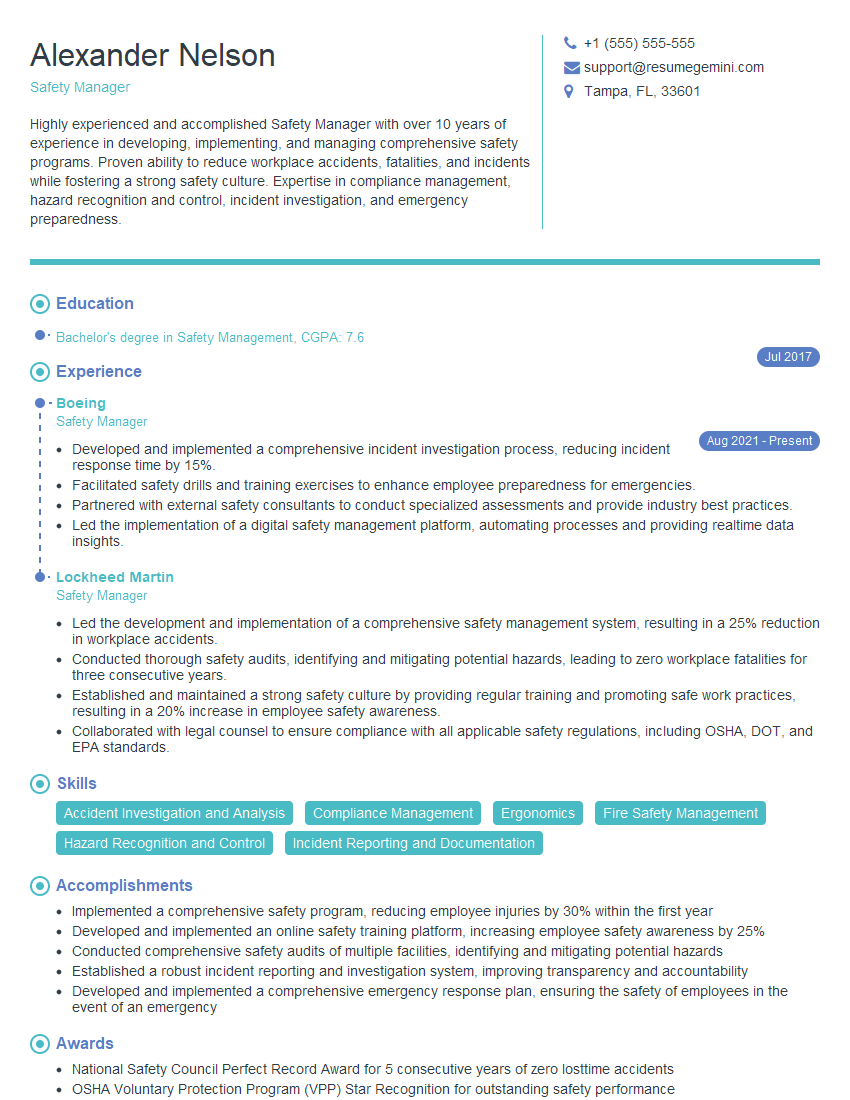
Safety Manager Resume Sample
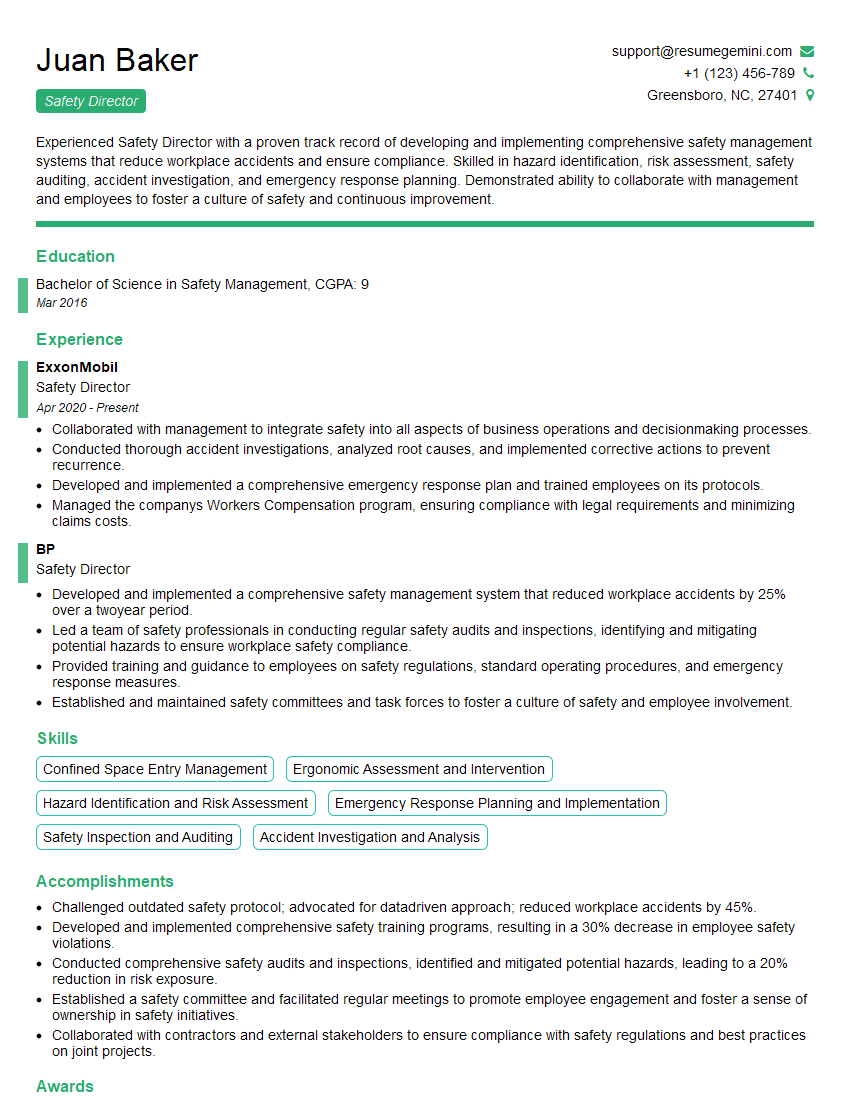
Safety Director Resume Sample

Environmental Health and Safety Manager Resume Sample

Compliance Officer Resume Sample
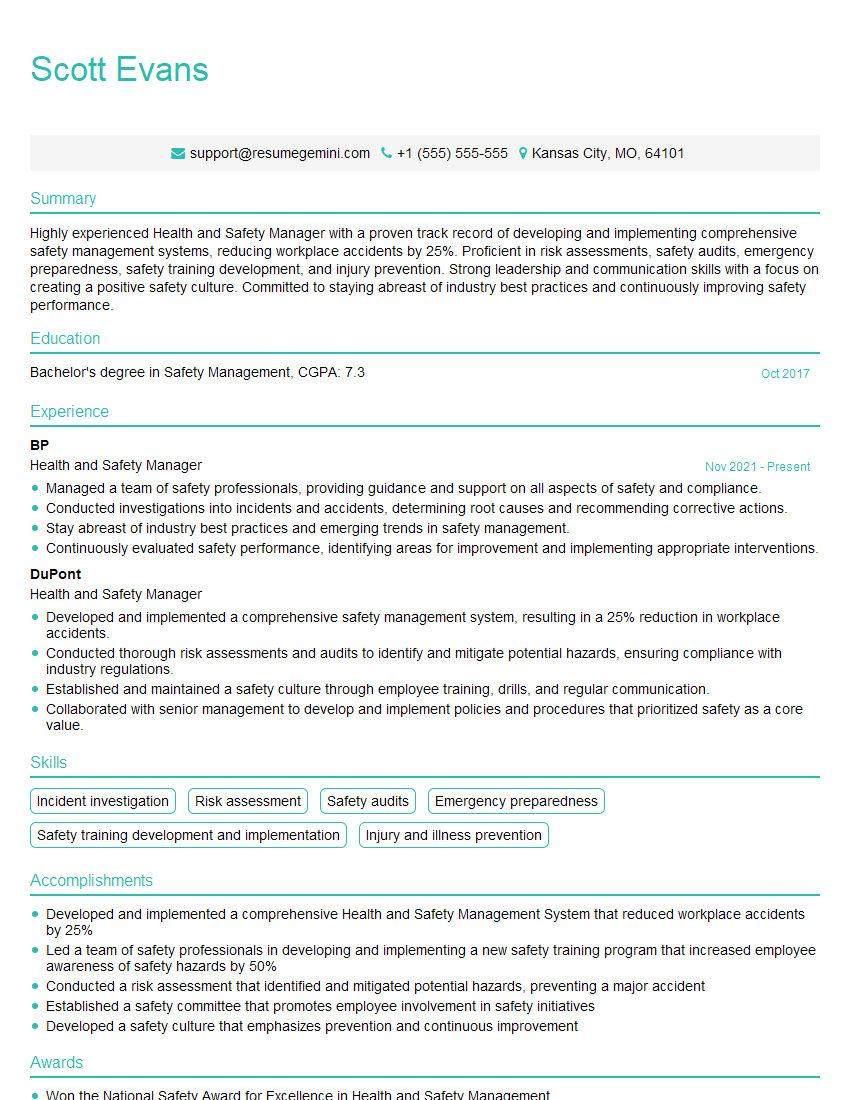
Health and Safety Manager Resume Sample
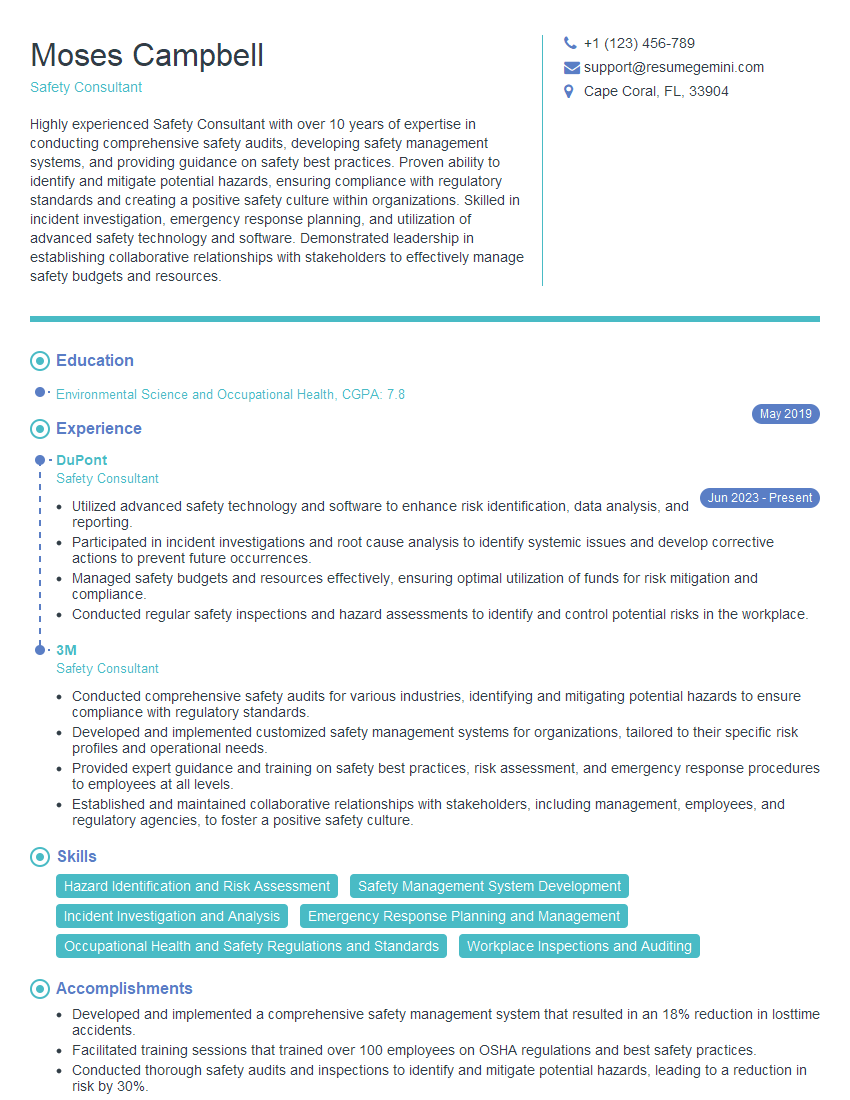
Safety Consultant Resume Sample
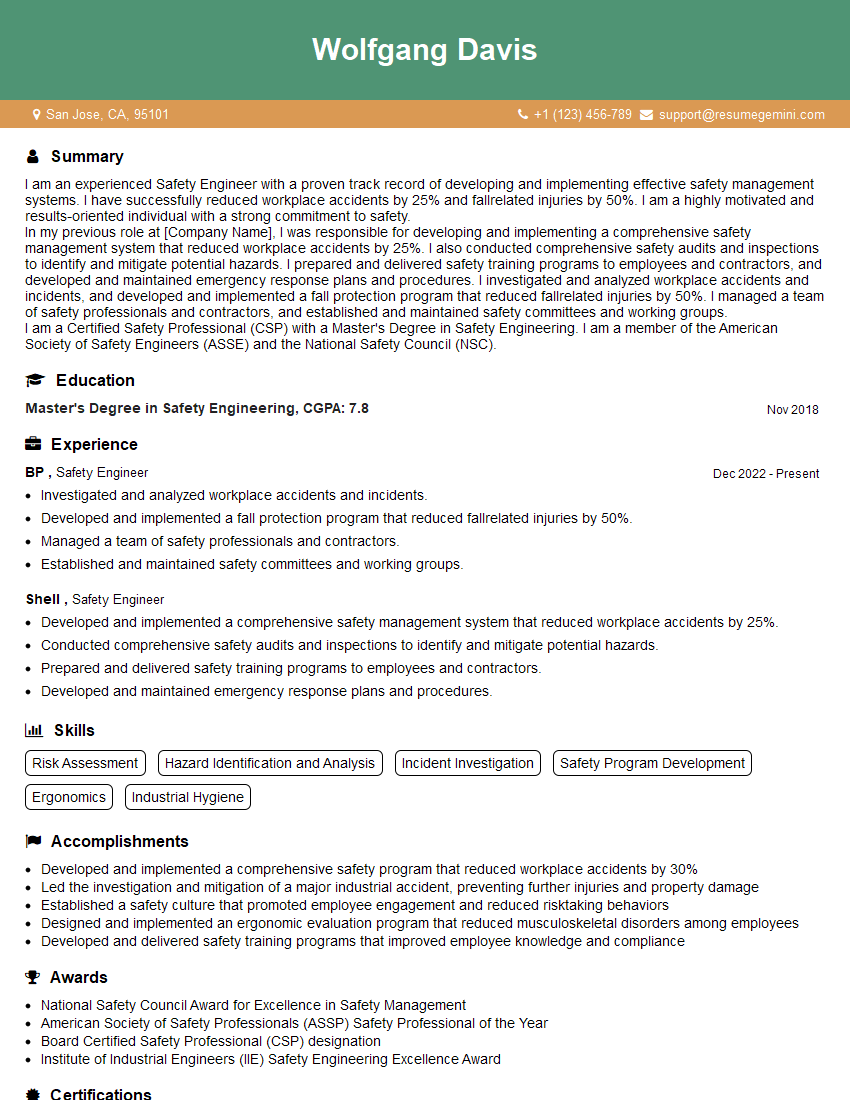
Safety Engineer Resume Sample
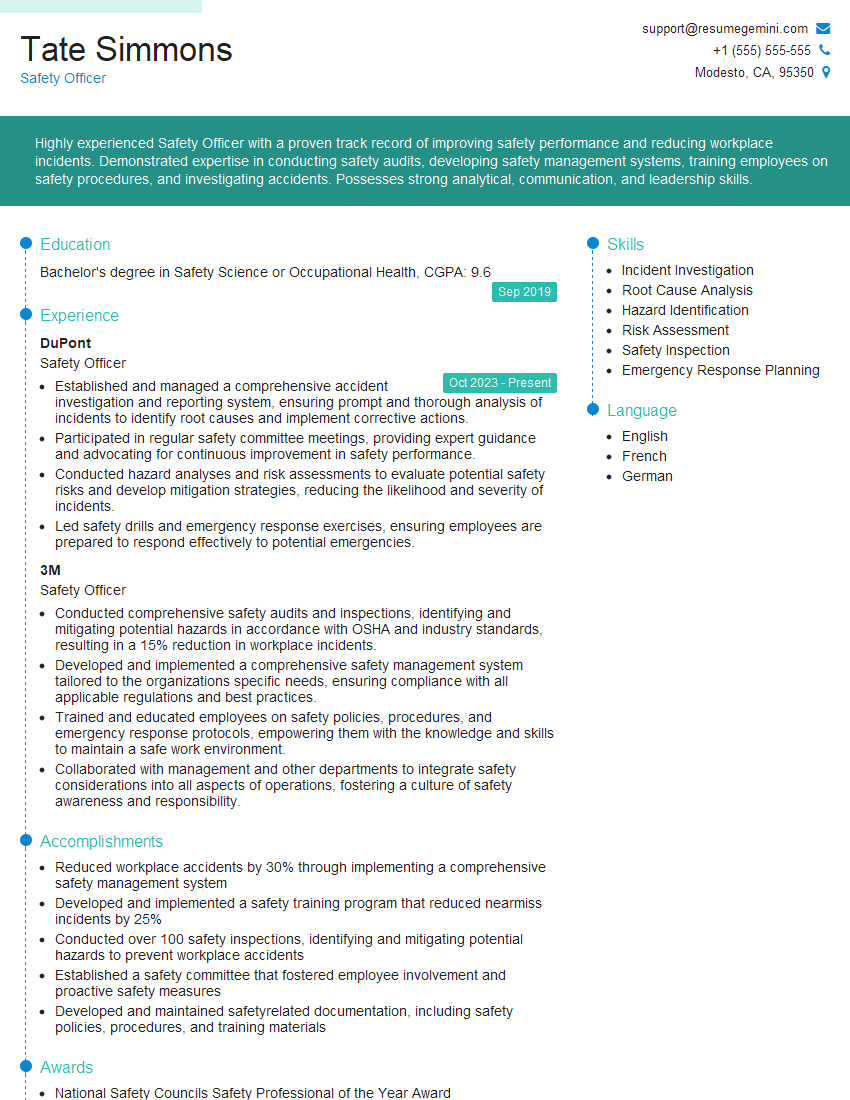
Safety Officer Resume Sample
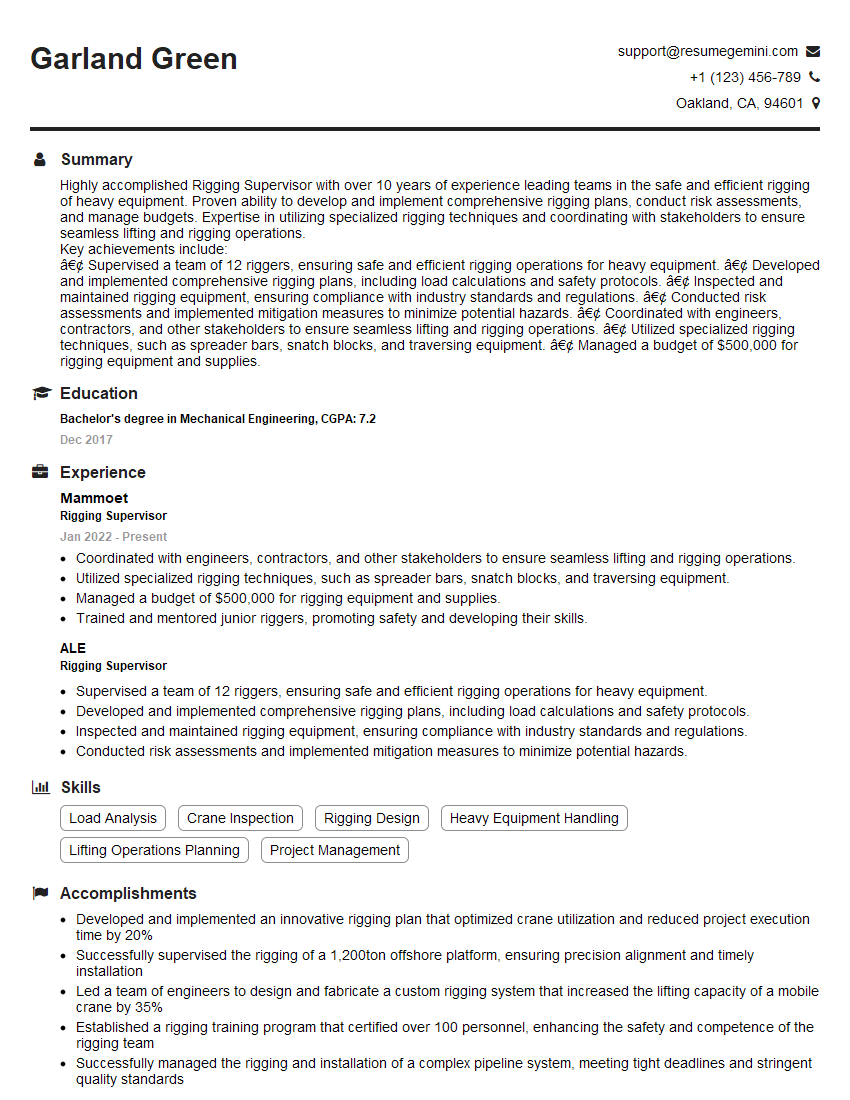
Rigging Supervisor Resume Sample
Explore more articles
Users Rating of Our Blogs
Share Your Experience
We value your feedback! Please rate our content and share your thoughts (optional).
What Readers Say About Our Blog
Very informative content, great job.
good