The thought of an interview can be nerve-wracking, but the right preparation can make all the difference. Explore this comprehensive guide to Familiarity with Intelligence Databases interview questions and gain the confidence you need to showcase your abilities and secure the role.
Questions Asked in Familiarity with Intelligence Databases Interview
Q 1. Explain the difference between structured and unstructured data within intelligence databases.
Intelligence databases contain a mix of structured and unstructured data. Think of it like a filing cabinet: structured data is neatly organized in folders with labeled files (e.g., a database table with fields for name, date of birth, address), while unstructured data is like a pile of unsorted papers – documents, emails, images, audio recordings – lacking a predefined format.
Structured data is easily searchable and analyzed because it conforms to a specific schema. For example, a database storing information on terrorist organizations might have structured fields for group name, leadership, operational areas, and known associates. This allows for precise queries, like finding all groups operating in a specific region.
Unstructured data presents challenges. Imagine needing to analyze thousands of intercepted phone calls or social media posts. These lack a standardized structure, requiring advanced techniques like Natural Language Processing (NLP) to extract meaningful information and categorize them. Tools like sentiment analysis might be used to gauge the emotional tone of communications, helping uncover hidden threats or alliances.
Q 2. Describe your experience with various database management systems (DBMS) relevant to intelligence work.
My experience spans several DBMS relevant to intelligence work. I’ve extensively used relational databases like Oracle and PostgreSQL for managing structured data, particularly for storing and querying large datasets of intelligence reports, personnel information, and operational details. These systems offer robust data integrity, security features, and efficient query processing essential for sensitive intelligence data.
Furthermore, I’m proficient with NoSQL databases such as MongoDB and Cassandra, crucial for handling the semi-structured and unstructured data, such as social media feeds, intercepted communications, and sensor data. NoSQL’s flexibility in schema design allows for efficient storage and retrieval of diverse data types. For example, MongoDB’s document-oriented model is ideal for storing complex intelligence reports with varying data structures.
Finally, I’ve worked with graph databases like Neo4j to model relationships between entities, a powerful tool for uncovering connections within complex networks of individuals or organizations. Visualizing relationships between suspects, their associates, and locations helps identify key players and potential threats.
Q 3. How would you handle conflicting or incomplete data within an intelligence database?
Conflicting or incomplete data is a major challenge in intelligence work. My approach involves a multi-step process:
- Identification: Utilizing data quality checks and anomaly detection algorithms to pinpoint inconsistencies and missing values.
- Investigation: Tracing back to the source of the data to verify its accuracy and completeness. This often involves cross-referencing with other intelligence sources and verifying data provenance.
- Resolution: Depending on the nature of the conflict, I might employ techniques like data fusion (combining multiple sources to derive a more accurate value), imputation (filling in missing values based on statistical methods), or flagging the data with a confidence score to reflect its uncertainty. In cases of irreconcilable conflicts, I document the discrepancies with justification for the selected approach.
- Documentation: Maintaining a comprehensive audit trail of all data modifications and decisions made regarding conflicting or incomplete information. Transparency is crucial for ensuring data quality and accountability.
For instance, if two sources provide conflicting information about an individual’s location, I’d investigate the credibility of each source, considering factors like the source’s track record, the method of information gathering, and any supporting evidence. The outcome might be to choose the most credible source, or perhaps to highlight the uncertainty in the individual’s location based on the conflicting reports.
Q 4. What methods do you use for data cleansing and preprocessing in the context of intelligence analysis?
Data cleansing and preprocessing are critical before analysis. My methods include:
- Data cleaning: This involves handling missing values, removing duplicates, and correcting inconsistencies or errors. For example, standardizing date formats or correcting typos in names.
- Data transformation: This step might involve converting data types (e.g., converting text to numerical values for statistical analysis), scaling or normalizing data, and creating new features from existing ones (feature engineering). For instance, calculating the average frequency of communication between individuals to infer the strength of their relationship.
- Data reduction: This reduces data volume while preserving important information. Techniques like dimensionality reduction (Principal Component Analysis) can be used to reduce the number of variables while maintaining variance, making analysis more efficient.
- Data enrichment: Adding contextual information from external sources to enhance the analysis. For example, enriching data about a suspect with information about their social media activity or known associates.
In practice, this process is iterative. I might need to revisit previous steps as I identify new inconsistencies or patterns during the analysis.
Q 5. Explain your understanding of data normalization and its importance in intelligence databases.
Data normalization is a crucial step in database design that minimizes redundancy and improves data integrity. Think of it as organizing your bookshelf – instead of having multiple copies of the same book, you have one copy in a designated spot, and other books are placed logically.
In databases, normalization involves breaking down large tables into smaller, more manageable ones and defining relationships between them. This reduces data duplication, improves data consistency, and simplifies data updates. For example, instead of storing an individual’s address within every record where they are mentioned, normalization would create a separate address table, and then link it through a unique identifier. This avoids storing redundant address information.
The importance in intelligence databases is substantial: it ensures consistency across various intelligence reports and reduces errors caused by data redundancy. Updating information becomes easier and less prone to errors. It also improves query efficiency by reducing the size of tables.
Q 6. How do you ensure data integrity and security within an intelligence database?
Data integrity and security are paramount in intelligence databases. My approach is multifaceted:
- Access control: Implementing strict access control mechanisms, based on the principle of least privilege, ensuring that only authorized personnel can access sensitive information.
- Data encryption: Encrypting data both at rest and in transit to protect against unauthorized access or disclosure. This includes using strong encryption algorithms and key management practices.
- Regular audits: Conducting regular security audits to identify and address potential vulnerabilities. This involves reviewing access logs, system configurations, and security policies.
- Data validation: Implementing data validation rules to prevent invalid or inconsistent data from entering the database. This can be achieved via input validation, constraints, and triggers.
- Redundancy and backups: Implementing redundant systems and regular backups to ensure data availability and recoverability in case of system failures or security breaches.
These measures work in concert to protect the confidentiality, integrity, and availability of sensitive intelligence information.
Q 7. Describe your experience with querying and retrieving data from large intelligence databases.
Querying and retrieving data from large intelligence databases requires proficiency in SQL and other query languages. My experience includes crafting efficient queries optimized for speed and performance. This involves understanding database indexing strategies, query optimization techniques (e.g., using joins effectively, avoiding full table scans), and utilizing database features such as materialized views or caching to improve retrieval times.
For complex queries involving unstructured data, I leverage tools and techniques such as NLP, regular expressions, and full-text search capabilities. For example, searching for specific keywords or patterns within a large corpus of intercepted communications would require these advanced techniques. Visualizing data using appropriate tools such as dashboards is equally important for rapid identification of trends and patterns.
I’m also experienced in using specialized tools for data analysis and visualization that can handle the sheer volume and complexity of intelligence data. These tools often incorporate advanced analytics capabilities for pattern recognition and anomaly detection, which enhances the effectiveness of data retrieval and analysis.
Q 8. What techniques do you employ for data mining and pattern recognition within intelligence data?
Data mining and pattern recognition in intelligence are crucial for uncovering hidden connections and predicting future events. I employ a variety of techniques, combining both supervised and unsupervised learning methods. Supervised learning, for example, might involve training a model to identify specific types of terrorist financing based on labeled historical data. This could use algorithms like Support Vector Machines (SVMs) or Random Forests. Unsupervised learning, on the other hand, helps discover unknown patterns. Techniques like clustering algorithms (k-means, DBSCAN) can group similar entities together, revealing previously unknown relationships between individuals, organizations, or events. For instance, clustering communication records might reveal previously undetected networks of individuals involved in illicit activities. Furthermore, association rule mining (Apriori algorithm) can identify frequent itemsets, uncovering relationships like co-occurrence of certain keywords or locations in intelligence reports, indicating potential threats or collaborations. Finally, anomaly detection techniques, such as One-Class SVM, are vital for identifying unusual activities that deviate from established patterns, which may be indicative of suspicious behavior.
The process typically involves cleaning and pre-processing the data, selecting appropriate algorithms based on the data type and the desired outcome, training the model, evaluating its performance, and finally deploying it for real-time analysis and prediction. Regular model retraining is crucial to adapt to evolving patterns and maintain accuracy.
Q 9. How familiar are you with data visualization tools and their application to intelligence analysis?
Data visualization is indispensable for intelligence analysis; it transforms complex datasets into easily understandable visuals, facilitating quicker insights and better communication of findings. I’m proficient in using several tools, including Tableau, Power BI, and Gephi. Tableau and Power BI excel at creating interactive dashboards for monitoring key metrics and exploring large datasets. For example, I’ve used Tableau to create interactive maps displaying the geographic distribution of cyberattacks, revealing patterns and hotspots for improved resource allocation. Gephi, on the other hand, is particularly useful for visualizing networks and relationships between entities, making it ideal for uncovering hidden connections within complex organizations or terrorist cells. Imagine visualizing communication links between suspected individuals, instantly revealing the structure and key players within a criminal network. I’m also familiar with more specialized tools designed for intelligence analysis that provide enhanced security and data handling capabilities.
Q 10. Explain your experience with data warehousing and its role in intelligence operations.
Data warehousing is fundamental to effective intelligence operations. It provides a centralized repository for integrating data from diverse sources, enabling comprehensive analysis and informed decision-making. My experience includes designing and implementing data warehouses using technologies like Snowflake and Amazon Redshift. In one project, we integrated data from various sources—social media, financial transactions, and open-source intelligence—into a single data warehouse to analyze and predict potential terrorist activities. The data warehouse facilitated the creation of comprehensive profiles of individuals and organizations, uncovering critical linkages that were previously hidden in disparate datasets. The structure of the warehouse, typically based on a star schema or snowflake schema, is designed to optimize query performance and facilitate efficient data retrieval for analysis. Effective data governance and security measures, including access control and data encryption, are critical components of any intelligence data warehouse.
Q 11. Describe your experience with different data formats (e.g., XML, JSON, CSV) commonly used in intelligence.
I have extensive experience working with various data formats commonly used in intelligence gathering, including XML, JSON, and CSV. XML’s hierarchical structure is suitable for representing complex, structured data, often found in intelligence reports and sensor data. JSON’s lightweight nature makes it ideal for exchanging data between systems and APIs, particularly for real-time data streams from social media or other online sources. CSV is commonly used for simple, tabular data, ideal for quick data analysis or importing into spreadsheets. My experience includes writing scripts and using tools to convert data between different formats as needed. For example, I have processed large XML files containing geospatial data into a more manageable CSV format for analysis using geospatial visualization tools, or transformed JSON data from social media into a database-ready format. Understanding these formats and their appropriate uses is crucial for efficient data processing and analysis within an intelligence context.
Q 12. How would you design a database schema for a specific intelligence-gathering requirement?
Designing a database schema for a specific intelligence-gathering requirement begins with clearly defining the requirements. For instance, let’s say the requirement is to track individuals involved in a potential cyber threat. The schema would need to accommodate various data points: personal information (name, aliases, DOB, addresses), digital footprint (IP addresses, email addresses, online handles), communications (phone logs, chat logs), financial transactions, and affiliations with organizations. I would design a relational database with normalized tables to reduce redundancy and improve data integrity. This would involve several tables: a Person table with a unique identifier for each person; a Communication table linking individuals via communication methods; a FinancialTransaction table linked to individuals and potentially organizations; and an Organization table to track affiliations. Relationships between tables would be established using foreign keys to ensure data consistency. Data types would be carefully selected based on the nature of the data, and appropriate indexes would be added to optimize query performance. Security considerations are paramount, requiring robust access controls and encryption to protect sensitive information. The schema would also need to consider future expansion, allowing for the addition of new data fields without disrupting the existing structure.
Q 13. Explain your understanding of relational database principles.
Relational database principles form the bedrock of structured data management. My understanding encompasses ACID properties (Atomicity, Consistency, Isolation, Durability), ensuring data integrity and reliability. I’m proficient in using SQL for querying and managing data within relational databases. I understand normalization techniques, which are crucial for eliminating redundancy and improving data efficiency. For example, understanding 1NF, 2NF, and 3NF allows for effective database design that minimizes data anomalies. I’m familiar with different database management systems (DBMS) like PostgreSQL, MySQL, and Oracle, each suited to specific use cases. Furthermore, I understand concepts like indexing, joins (inner, outer, left, right), and subqueries, which are crucial for efficient data retrieval. In the context of intelligence, these principles enable the creation of robust and scalable databases for storing and managing large volumes of structured information effectively and securely.
Q 14. What are your experiences with NoSQL databases in an intelligence context?
NoSQL databases offer advantages for handling unstructured or semi-structured data frequently encountered in intelligence gathering, particularly large volumes of social media data or sensor readings. My experience includes working with MongoDB and Cassandra. MongoDB’s flexibility in handling documents makes it suitable for storing diverse data types without rigid schemas. For example, storing social media posts with varying content and formats would be better suited to MongoDB than a traditional relational database. Cassandra’s distributed architecture and high availability make it ideal for handling large-scale, high-velocity data streams. In a scenario involving real-time analysis of cyber threats, Cassandra would ensure continuous availability and rapid processing of incoming data. However, it’s important to note that NoSQL databases often lack the ACID properties of relational databases, requiring careful consideration of data integrity and consistency when choosing them for a specific application. The choice between relational and NoSQL databases depends on the specific intelligence needs and the nature of the data being collected and analyzed.
Q 15. How do you ensure the ethical handling and use of intelligence data?
Ethical handling of intelligence data is paramount. It requires a multi-faceted approach encompassing legal compliance, adherence to organizational policies, and a strong ethical compass. This begins with clearly defined data handling protocols, ensuring data is collected and used only for legitimate purposes, with appropriate authorization and oversight. For instance, we must strictly adhere to privacy laws like GDPR or CCPA, ensuring data minimization and anonymization where possible. Furthermore, a robust system of accountability is vital – a clear chain of responsibility for data access and usage, coupled with regular audits to detect and prevent misuse. We also need to consider the potential impact of data analysis on individuals and communities, mitigating biases and ensuring fairness. Think of it like a doctor’s oath – we are entrusted with sensitive information and must act responsibly and with the highest integrity.
- Data Minimization: Collecting only the data necessary for the specific intelligence task.
- Purpose Limitation: Using data only for the purpose it was collected for.
- Accountability: Establishing clear lines of responsibility for data handling.
- Transparency: Maintaining open communication about data collection and usage practices.
Career Expert Tips:
- Ace those interviews! Prepare effectively by reviewing the Top 50 Most Common Interview Questions on ResumeGemini.
- Navigate your job search with confidence! Explore a wide range of Career Tips on ResumeGemini. Learn about common challenges and recommendations to overcome them.
- Craft the perfect resume! Master the Art of Resume Writing with ResumeGemini’s guide. Showcase your unique qualifications and achievements effectively.
- Don’t miss out on holiday savings! Build your dream resume with ResumeGemini’s ATS optimized templates.
Q 16. Describe your experience with data encryption and security protocols within intelligence databases.
My experience with data encryption and security protocols is extensive. I’ve worked with various encryption algorithms, including AES-256 and RSA, to protect data at rest and in transit. This includes implementing robust key management systems to ensure confidentiality and prevent unauthorized access. I’m proficient in securing databases using methods such as database encryption, access control lists (ACLs), and intrusion detection systems (IDS). For example, I’ve implemented multi-factor authentication (MFA) to enhance security and regularly conduct penetration testing to identify and address vulnerabilities. I’m also familiar with secure coding practices to prevent SQL injection and other common database attacks. The use of VPNs and secure communication channels is also routine for me. One specific example involves securing a highly sensitive database using a combination of AES-256 encryption, role-based access control, and regular security audits. This ensured that only authorized personnel could access specific datasets based on their security clearance.
Example: Implementing AES-256 encryption on a database, using a key management system for secure key storage and rotation.Q 17. What is your experience with data governance and compliance related to intelligence information?
Data governance and compliance are critical aspects of working with intelligence information. I have a deep understanding of relevant regulations and best practices, including those governing the handling of classified information. My experience includes developing and implementing data governance policies, ensuring adherence to data retention schedules, and conducting regular audits to verify compliance. This involves managing data lifecycles, from creation to archival and destruction, in accordance with legal and security requirements. For example, I’ve worked on projects requiring adherence to specific national security directives and international data privacy laws. The implementation of a robust data governance framework includes clear policies, roles, responsibilities, and processes, to not only ensure legal compliance but also protect against data breaches and misuse.
- Policy Development: Creating and implementing data governance policies aligned with legal and security requirements.
- Data Classification: Categorizing data based on sensitivity and security level.
- Audit and Compliance: Conducting regular audits to ensure adherence to policies and regulations.
Q 18. How do you handle sensitive and classified data within a database environment?
Handling sensitive and classified data requires meticulous attention to detail and adherence to strict security protocols. I’ve worked extensively with various classification levels, implementing robust access control mechanisms to ensure that only authorized personnel with appropriate clearances can access specific data. This includes using strong authentication methods, encryption, and data loss prevention (DLP) tools. For example, in a previous role, I managed a database containing top-secret information, requiring the implementation of a highly secure environment including physical security measures, multi-factor authentication, and rigorous access logging. Furthermore, regular security training for personnel is crucial to ensure everyone understands their responsibilities. Imagine it as a highly secured vault, with multiple locks, access logs, and surveillance to prevent unauthorized entry and data leaks.
- Access Control: Implementing strict access controls based on security clearances and need-to-know basis.
- Data Encryption: Employing strong encryption algorithms to protect data both in transit and at rest.
- Data Loss Prevention (DLP): Implementing tools to prevent unauthorized data transfer and exfiltration.
Q 19. Explain your experience with data aggregation and fusion from multiple sources.
Data aggregation and fusion from multiple sources are crucial for building a comprehensive intelligence picture. My experience includes integrating data from various sources – structured databases, unstructured text, social media feeds, sensor data – using ETL (Extract, Transform, Load) processes. I’m proficient in using various tools and technologies for data cleaning, transformation, and integration. I’ve applied techniques like data deduplication and normalization to improve data quality and consistency. For instance, in a project involving fusion of data from multiple intelligence agencies, I developed a data integration pipeline that harmonized data formats, cleaned inconsistent information, and built a unified view. The goal is always to ensure accuracy, consistency and minimize bias inherent in various sources. Think of it like assembling a jigsaw puzzle – each piece of information from a different source adds to the larger picture.
- ETL Processes: Designing and implementing ETL processes to extract, transform, and load data from multiple sources.
- Data Cleaning and Transformation: Implementing data quality checks, deduplication, and normalization techniques.
- Data Fusion Techniques: Applying appropriate data fusion techniques to combine data from heterogeneous sources.
Q 20. How familiar are you with different data analysis methodologies relevant to intelligence?
My familiarity with data analysis methodologies relevant to intelligence is broad. I’m proficient in various techniques, including link analysis, social network analysis, statistical modeling, and machine learning. For example, I’ve used link analysis to identify relationships between individuals or organizations involved in criminal activity. I’ve also applied social network analysis to understand the structure and dynamics of terrorist groups. Statistical modeling helps us predict future trends or assess risks, while machine learning techniques can be used for anomaly detection and pattern recognition. Each methodology helps uncover insights, providing different perspectives on the data. Choosing the right tool depends heavily on the specific questions we are trying to answer.
- Link Analysis: Identifying relationships between entities in a dataset.
- Social Network Analysis: Analyzing the structure and dynamics of social networks.
- Statistical Modeling: Developing models to predict future trends or assess risk.
- Machine Learning: Applying machine learning algorithms to detect anomalies and patterns.
Q 21. What are your experiences with using statistical methods in analyzing intelligence data?
Statistical methods are indispensable for analyzing intelligence data. I have extensive experience using statistical techniques to analyze large datasets, identify trends, and draw meaningful conclusions. This includes using techniques like regression analysis, hypothesis testing, and time series analysis to predict future events or assess risks. For example, I’ve used regression analysis to model the relationship between various factors and the likelihood of a specific event occurring. I’ve also employed time series analysis to predict future trends based on historical data. Statistical significance testing allows us to validate our findings and reduce the risk of drawing incorrect conclusions. The application of statistical rigor is essential to ensuring that the conclusions drawn from intelligence data are accurate and reliable.
- Regression Analysis: Modeling the relationship between variables.
- Hypothesis Testing: Testing the validity of hypotheses.
- Time Series Analysis: Analyzing data collected over time.
Q 22. Explain your understanding of predictive modeling and its applications to intelligence analysis.
Predictive modeling uses historical data and statistical algorithms to forecast future events. In intelligence analysis, this translates to anticipating threats, identifying potential targets, or predicting the success of a particular operation. Think of it like a sophisticated weather forecast, but instead of rain, we’re predicting the likelihood of terrorist attacks or the movement of illicit goods.
For example, we might analyze past terrorist attacks, considering factors like location, timing, and perpetrator profiles to predict future attack locations. This involves using algorithms like regression analysis, decision trees, or neural networks, fed with data from various sources such as social media, financial transactions, and intelligence reports. The output might be a probability map highlighting areas with a higher likelihood of future attacks, allowing for proactive resource allocation and preventative measures.
Another application is predicting the trajectory of a specific individual or group. By analyzing their past communications, movements, and financial transactions, we can build a model to forecast their likely future actions, enabling targeted interventions or surveillance strategies. The key is to understand the limitations – predictive models are not crystal balls. The accuracy depends heavily on the quality and completeness of the data used.
Q 23. How would you address a data breach incident within an intelligence database?
A data breach in an intelligence database is a critical incident requiring immediate and decisive action. My approach would follow a structured protocol, prioritizing containment, damage assessment, and recovery.
1. Containment: The first step is to immediately isolate the affected system from the network to prevent further data exfiltration. This involves disabling network access and potentially shutting down the database entirely. Simultaneously, we need to initiate a forensic investigation to identify the breach’s source, scope, and method.
2. Damage Assessment: This involves determining what data has been compromised, identifying the affected individuals or systems, and assessing the potential damage. This might involve analyzing logs, conducting network scans, and collaborating with cybersecurity specialists.
3. Recovery: Once containment and assessment are complete, we can begin the recovery phase. This includes restoring data from backups (assuming they are current and secure), implementing security patches to address vulnerabilities, and updating security protocols to prevent future incidents. We would also need to notify relevant stakeholders, possibly law enforcement, and undertake any necessary legal or regulatory reporting.
4. Remediation: Finally, a thorough review of existing security protocols and procedures is crucial to identify weaknesses and implement improvements. This may involve staff training, system upgrades, and an overall strengthening of the security posture.
Q 24. Describe your experience with data backup and recovery procedures.
Robust data backup and recovery procedures are fundamental to maintaining the integrity and availability of an intelligence database. My experience encompasses implementing and managing both on-site and off-site backups using various methodologies.
I’ve worked with both full and incremental backup strategies. Full backups provide a complete copy of the database, while incremental backups capture only the changes since the last backup, saving storage space and time. A 3-2-1 backup strategy is essential—three copies of data, on two different media, with one copy stored offsite. This protects against data loss due to hardware failure, natural disasters, or malicious attacks.
Beyond simply creating backups, I have experience verifying the integrity and recoverability of the backups through regular test restores. This ensures that the backups are functioning correctly and that we can restore the database in a timely manner in case of a failure. Furthermore, I’m familiar with different backup technologies, including cloud-based solutions, tape libraries, and network attached storage (NAS), choosing the best solution based on factors such as cost, security requirements, and recovery time objectives (RTOs).
Q 25. What is your experience with database performance tuning and optimization?
Database performance tuning and optimization are crucial for ensuring the efficient operation of an intelligence database, especially when dealing with large datasets and complex queries. My experience includes several techniques to improve database performance.
Query Optimization: This involves analyzing slow-running queries and identifying bottlenecks. Techniques include rewriting queries for better efficiency, adding indexes to improve data retrieval, and using query caching to reduce the processing load. Tools like database explain plans help to identify inefficient query patterns.
Schema Design: Properly designed database schemas are essential for performance. This involves creating efficient table structures, establishing appropriate relationships between tables, and ensuring data normalization to reduce redundancy.
Hardware Upgrades: In some cases, performance improvements may require upgrading hardware such as increasing RAM, adding faster storage (SSDs), or improving network connectivity.
Indexing Strategies: I have experience selecting the appropriate indexing strategy, considering factors such as query patterns and data distribution. Over-indexing can actually slow down performance, so a careful approach is necessary.
Monitoring and Analysis: Using database monitoring tools to track performance metrics (query execution time, disk I/O, CPU usage) is critical for identifying performance issues proactively. Regular analysis of these metrics enables preventative tuning.
Q 26. How would you approach a problem involving data inconsistency or redundancy in an intelligence database?
Data inconsistency and redundancy are significant problems in any database, but especially problematic in intelligence databases where accurate, reliable information is paramount. Addressing these issues requires a multifaceted approach.
Data Cleaning: The first step is to identify and correct inconsistent or redundant data. This often involves using data profiling tools to identify inconsistencies, duplicate records, and missing values. Data cleansing techniques might include deduplication, standardization, and data imputation (filling in missing values).
Data Normalization: Implementing data normalization techniques, such as first, second, or third normal form, can help reduce data redundancy and improve data integrity. This involves restructuring tables to minimize data redundancy and improve data consistency.
Data Validation Rules: Implementing data validation rules during data entry can prevent inconsistencies and redundancies from entering the database in the first place. This might involve checks for data types, ranges, or uniqueness constraints.
Regular Data Audits: Conducting regular data audits is important to monitor data quality and identify any emerging inconsistencies or redundancies. These audits should include manual checks and automated data quality checks.
Data Governance Policies: Establishing clear data governance policies can help prevent data inconsistency and redundancy in the future. This involves defining roles, responsibilities, and processes for managing data quality throughout the database lifecycle.
Q 27. Describe your experience with using scripting languages (e.g., Python, SQL) for database manipulation.
I have extensive experience using scripting languages like Python and SQL for database manipulation and analysis. These languages are essential for automating tasks, extracting insights, and managing data within intelligence databases.
SQL: I use SQL extensively for querying, updating, and managing data directly within the database. For example, I’ve used SQL to create complex queries to extract specific information from large datasets, update records based on certain criteria, and generate reports.
Example: SELECT * FROM agents WHERE country = 'Russia' AND status = 'active';
This query retrieves all active agents from Russia.
Python: Python provides a powerful scripting environment to interact with databases, automating tasks that would be tedious to perform manually. I utilize Python libraries like Pandas and SQLAlchemy to connect to databases, extract data, perform data cleaning and transformation, and create visualizations.
Example: import pandas as pd; df = pd.read_sql_query('SELECT * FROM agents', connection);
This Python code snippet uses the Pandas library to read data from a SQL database into a Pandas DataFrame for further analysis and manipulation.
My expertise encompasses both procedural and object-oriented programming techniques in Python, enabling me to build sophisticated data processing pipelines for efficient data analysis and management within the intelligence context.
Key Topics to Learn for Familiarity with Intelligence Databases Interview
- Data Structures and Models: Understanding relational and NoSQL databases, data warehousing, and the specific structures used to store intelligence data (e.g., geospatial data, temporal data, unstructured text).
- Data Querying and Analysis: Mastering SQL and other query languages relevant to the specific database systems used in intelligence work. Practical application includes formulating efficient queries to extract actionable insights from large datasets.
- Data Mining and Pattern Recognition: Familiarization with techniques to identify trends, anomalies, and relationships within intelligence data. This includes understanding the limitations and biases inherent in data analysis.
- Data Security and Privacy: Understanding data encryption, access control, and compliance with relevant regulations (e.g., handling classified information). Practical application includes implementing secure data handling practices.
- Data Visualization and Reporting: Ability to effectively present complex data insights through clear and concise visualizations and reports. This includes choosing appropriate visualization methods for different types of data.
- Ethical Considerations: Understanding the ethical implications of using intelligence databases, including bias in data, potential for misuse, and the importance of responsible data handling.
- Specific Database Systems: Researching and understanding the specific database systems commonly used in the intelligence field (mentioning specific systems is avoided to encourage independent research).
Next Steps
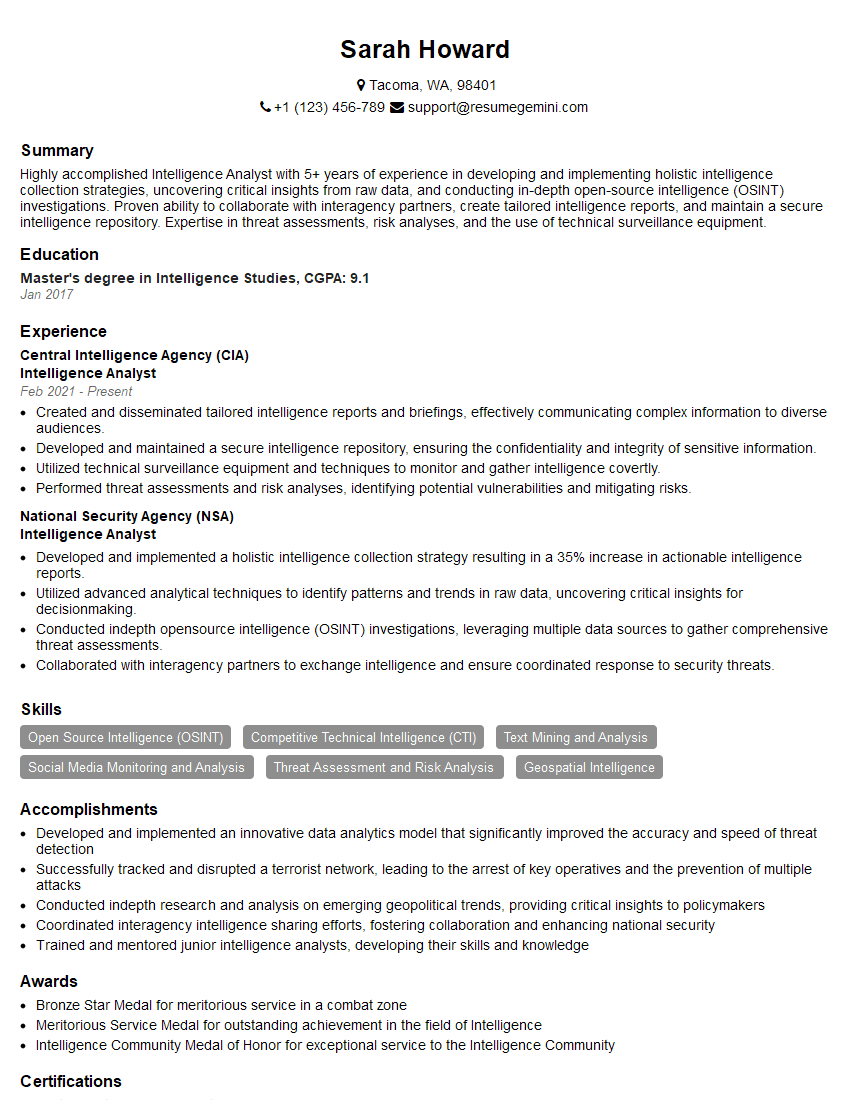
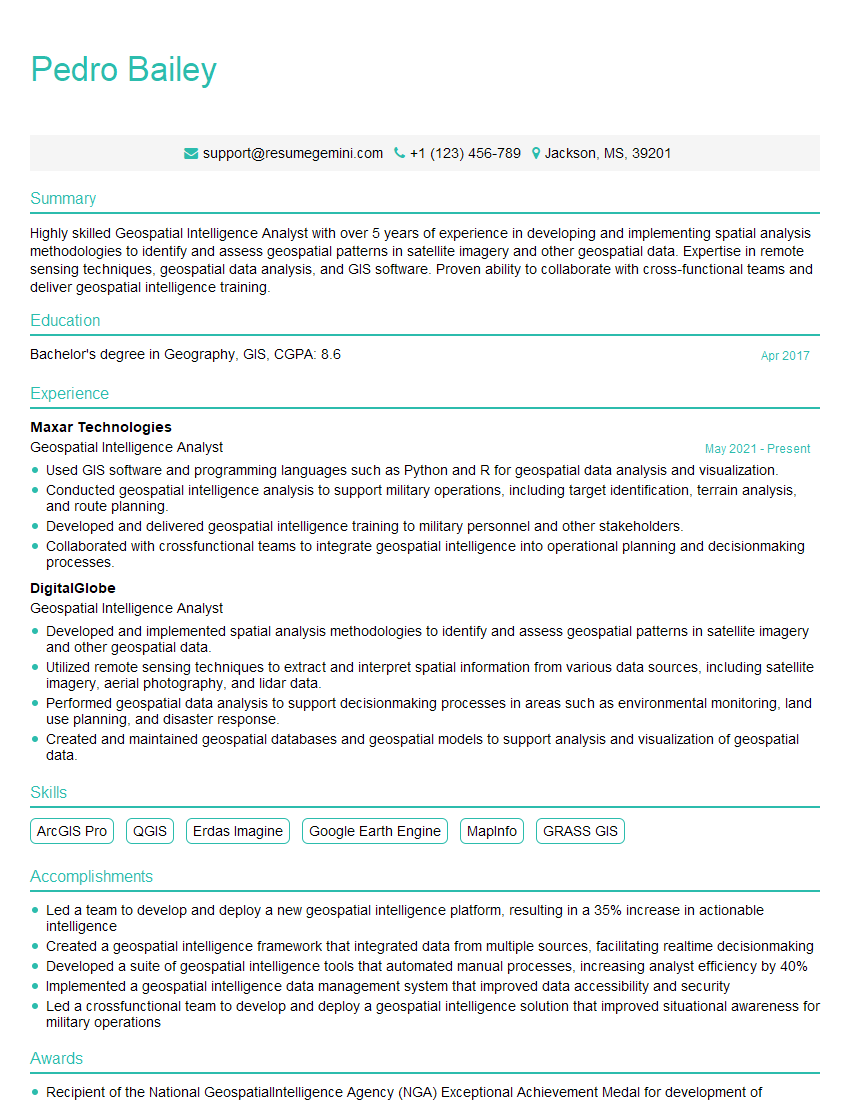
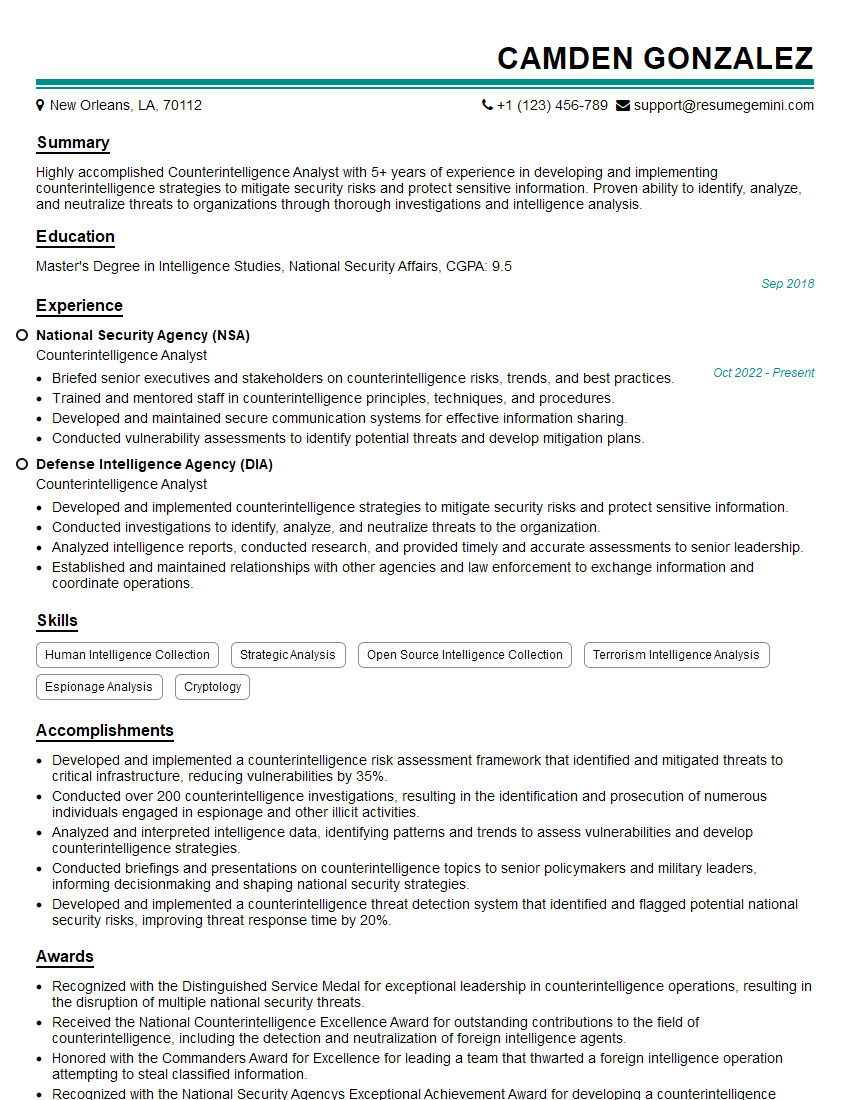
Mastering Familiarity with Intelligence Databases is crucial for career advancement in this dynamic field. A strong understanding of these concepts will significantly enhance your analytical skills and decision-making abilities, leading to greater opportunities. To make your application stand out, creating an ATS-friendly resume is essential. This ensures your skills and experience are effectively highlighted to recruiters. ResumeGemini is a trusted resource that can help you build a professional and impactful resume. Examples of resumes tailored to showcasing expertise in Familiarity with Intelligence Databases are available to help guide your resume creation process.
Explore more articles
Users Rating of Our Blogs
Share Your Experience
We value your feedback! Please rate our content and share your thoughts (optional).
What Readers Say About Our Blog
Very informative content, great job.
good