Interviews are more than just a Q&A session—they’re a chance to prove your worth. This blog dives into essential Fashion Writing and Editing interview questions and expert tips to help you align your answers with what hiring managers are looking for. Start preparing to shine!
Questions Asked in Fashion Writing and Editing Interview
Q 1. Explain your experience with AP style and its application in fashion writing.
AP style, or Associated Press style, is a widely used writing style guide known for its clarity, accuracy, and consistency. In fashion writing, applying AP style means adhering to its rules on punctuation, capitalization, numerals, and more. It ensures a professional and consistent tone across publications. For example, AP style dictates using numerals for numbers 10 and above (10 dresses, not ten dresses), and using hyphens in compound modifiers (a knee-length skirt, not a knee length skirt). I’ve consistently used AP style in my work to maintain a high level of journalistic integrity and readability, particularly when writing for publications that strictly adhere to this style guide.
Practical Application: Imagine writing a product description for a luxury handbag. AP style would guide you on how to write the price (e.g., $2,500, not $2500), the measurements (e.g., 12 inches wide, not twelve inches wide), and other details to ensure consistency and clarity.
Q 2. How do you ensure accuracy and consistency in your fashion writing?
Accuracy and consistency are paramount in fashion writing. I ensure accuracy by meticulously verifying facts, figures (prices, sizes, dates), designer names, and brand details through multiple reputable sources. I always cross-reference information and utilize official brand resources whenever possible. To maintain consistency, I establish a style sheet for each project, outlining preferred spellings, capitalization (e.g., ‘Haute Couture’ vs. ‘haute couture’), and terminology. This style sheet becomes my guiding document, ensuring uniformity throughout the piece. Furthermore, I utilize a thorough editing process, including self-editing, peer review, and professional proofreading, to catch any inconsistencies before publication. This layered approach significantly minimizes errors and inconsistencies.
Q 3. Describe your process for researching and writing a fashion trend report.
My process for writing a fashion trend report involves several key steps. It begins with comprehensive research. This includes scouring runway shows from major fashion weeks (New York, London, Milan, Paris), analyzing street style imagery, reviewing key fashion publications and blogs, and studying the offerings of major retailers. I delve into industry analysis reports and social media trends to identify recurring themes and emerging styles. Once the research is complete, I organize the findings into key trend categories. Next, I create an outline, structuring the report logically – from introduction and background, detailed trend descriptions with supporting visuals (images and potentially mood boards), to conclusions and predictions. I then write the report, ensuring clear and concise language, supporting my observations with data and examples, and incorporating relevant visuals to enhance understanding. Finally, the report undergoes a rigorous editing and proofreading process before completion.
Q 4. How do you adapt your writing style for different target audiences (e.g., luxury vs. high street)?
Adapting my writing style to different target audiences is crucial. When writing for a luxury publication, the language is more sophisticated and evocative, emphasizing the craftsmanship, heritage, and exclusivity of the brands. I use descriptive language and focus on the emotional connection with the product. For example, describing a designer dress might focus on the intricate embroidery and the feeling of wearing it. In contrast, when writing for a high-street audience, the style becomes more accessible and direct, focusing on practicality, affordability, and trend relevance. The language is simpler and the tone more informal. I might emphasize versatility and styling tips. The core information remains accurate, but the presentation is tailored to resonate with each specific audience.
Q 5. What are some common grammatical errors you encounter in fashion writing, and how do you correct them?
Common grammatical errors I encounter in fashion writing include inconsistent tense, incorrect pronoun agreement, misuse of commas and semicolons, and issues with subject-verb agreement. For example, using a singular verb with a plural noun is common (‘The collection is’ instead of ‘The collections are’). I address these errors using a combination of careful reading, grammar checkers, and style guides. The editing process allows me to systematically check for these errors, paying special attention to potentially problematic sentence structures. I also use grammar and style-checking tools, but always review their suggestions carefully because automated checks aren’t always perfect and may not understand nuanced aspects of fashion writing.
Q 6. Explain your experience with SEO optimization techniques for fashion content.
I have significant experience in SEO optimization for fashion content. My approach involves keyword research to identify relevant terms and phrases that readers commonly use when searching for fashion-related information online. I incorporate these keywords naturally into the title, headings, subheadings, and body text of the content. I also optimize images with descriptive alt text, including relevant keywords. I ensure the content is well-structured and easily readable, using short paragraphs and clear headings. Moreover, I build internal and external links to enhance the site’s overall SEO and authority. I understand the importance of creating high-quality, engaging content that is both informative and optimized for search engines. By focusing on user experience alongside SEO, I ensure the content is both valuable to readers and performs well in search results.
Q 7. How familiar are you with different content formats (blog posts, articles, social media captions)?
I am highly familiar with diverse content formats, including blog posts, articles, social media captions, and more. Blog posts typically allow for longer-form content with a more conversational tone, suitable for in-depth discussions on trends or designer profiles. Articles are often more formal and structured, designed for informative pieces in magazines or online publications. Social media captions require concise and engaging writing, using strong visuals and compelling calls to action. My adaptability extends to different platforms – creating Instagram-friendly captions, tweets, Facebook posts, or even TikTok scripts. This requires understanding the unique character limitations and preferred style of each platform. I understand the need to adapt the language, tone, and length of the content to meet the specific requirements and audience expectations of each format.
Q 8. Describe your experience with using content management systems (CMS) for publishing fashion content.
My experience with Content Management Systems (CMS) for fashion content publishing is extensive. I’ve worked with platforms like WordPress, Shopify, and even custom-built systems. Understanding a CMS’s backend is crucial for a fashion writer – it’s not just about writing the article; it’s about ensuring it’s optimized for SEO, correctly categorized, and visually appealing within the platform’s framework.
For example, on WordPress, I’m proficient in using plugins to enhance image galleries, optimize meta descriptions for search engines, and manage the workflow of multiple contributors. On Shopify, I’ve integrated blog posts with product pages, creating a seamless shopping experience for readers interested in a featured garment or accessory. My skills extend to managing user permissions, ensuring content is scheduled for optimal release times, and troubleshooting any technical issues that might arise. Essentially, I treat the CMS as an integral part of the content creation and distribution process, maximizing its functionality for impact.
Q 9. How do you manage multiple writing projects and deadlines simultaneously?
Managing multiple writing projects and deadlines requires a structured approach. I utilize project management tools like Asana or Trello to create individual boards for each project, outlining tasks, deadlines, and assigned collaborators. Each card represents a specific task, such as researching a topic, writing a draft, editing, or proofreading. I break down large projects into smaller, manageable chunks to avoid feeling overwhelmed.
Prioritization is key; I employ a method that combines urgency and importance, focusing on the most critical tasks first. Time blocking is another crucial strategy – scheduling specific blocks of time dedicated to each project allows for focused work and prevents multitasking inefficiencies. Regular review and adjustment of my schedule ensures I stay on track and meet deadlines effectively. Think of it like curating a runway show – each outfit (project) needs its own meticulous preparation and sequence for a successful finale (deadline).
Q 10. How do you handle feedback and criticism on your writing?
Feedback and criticism are essential for growth. I approach them constructively, viewing them as opportunities for improvement rather than personal attacks. I carefully analyze each comment, separating subjective opinions from objective critiques. For objective criticism, like factual errors or grammatical issues, I immediately address them and revise accordingly.
Subjective feedback, regarding style or tone, requires more careful consideration. I might seek a second opinion to gain a broader perspective, and then evaluate whether the feedback aligns with the publication’s style guide and the overall piece’s goals. A clear and open dialogue with the editor is crucial; I often ask clarifying questions to fully understand the feedback and ensure we’re on the same page. Ultimately, my goal is to produce high-quality content that meets the expectations of both the publication and the audience.
Q 11. Describe your experience with fact-checking and verifying information in fashion writing.
Fact-checking and verifying information are paramount in fashion writing. Accuracy builds credibility and avoids misleading readers. My approach involves multiple layers of verification. I start by cross-referencing information from multiple reputable sources, including fashion magazines, brand websites, and industry publications. I meticulously cite all sources to ensure transparency and accountability.
For example, when writing about a designer’s history, I’ll verify dates and details through multiple biographies and official statements, not relying solely on a single source. If I’m discussing a specific trend, I’ll support my claims with data from market research reports or analyses of runway shows. This meticulous approach ensures the accuracy and reliability of my writing, maintaining both professional and ethical standards.
Q 12. How do you stay updated with current fashion trends and industry news?
Staying updated on current fashion trends and industry news requires a multi-pronged approach. I subscribe to key fashion magazines, both print and digital, like Vogue, Harper’s Bazaar, and WWD. I also follow influential fashion bloggers, stylists, and designers on social media platforms like Instagram and Pinterest to get a pulse on emerging trends and styles.
Industry publications and news websites provide in-depth analysis and reporting on market trends, business developments, and designer collaborations. Attending industry events and fashion weeks (when possible) provides first-hand exposure to new collections and creative directions. Regularly reviewing market research reports and trend forecasting websites gives a broader picture of the fashion landscape. Think of it as constantly refreshing your wardrobe with the latest styles – a fashion writer needs to be always in vogue!
Q 13. How do you collaborate with photographers, designers, and other stakeholders?
Collaboration is essential in fashion writing. I believe in clear and open communication with photographers, designers, and other stakeholders. I start by establishing a shared understanding of the project’s goals and objectives. I create a detailed brief outlining the story’s narrative, style, and target audience. For photographers, this includes specifying the desired mood, lighting, and composition.
With designers, I often conduct interviews to gain insights into their inspiration, design process, and the stories behind their creations. I always keep stakeholders informed of progress, seeking feedback at various stages of the writing process to ensure alignment and clarity. Regular check-ins and efficient communication ensure a smooth and productive workflow, resulting in a polished and impactful final product.
Q 14. What are your preferred tools or software for writing and editing fashion content?
My preferred tools for writing and editing fashion content encompass both software and hardware. For writing, I primarily use Microsoft Word and Google Docs, preferring the latter for collaborative projects. Grammarly is indispensable for checking grammar and style. For image editing, I use Adobe Photoshop and Lightroom.
Beyond software, efficient hardware is crucial: a powerful laptop with a large, high-resolution screen significantly enhances productivity. Research tools like Google Scholar and specialized fashion databases are essential for verifying facts and sourcing information. Efficient file management systems and cloud storage solutions ensure all materials are readily accessible and organized. Ultimately, the best tools are those that optimize my workflow and contribute to the creation of high-quality, polished fashion content.
Q 15. Describe your experience with writing compelling product descriptions for fashion e-commerce websites.
Writing compelling product descriptions for fashion e-commerce is about more than just listing features; it’s about painting a picture and creating desire. I approach this by focusing on three key areas: benefit-driven language, evocative descriptions, and a strong call to action.
For example, instead of saying ‘Red wool sweater,’ I might write: ‘Wrap yourself in the luxurious warmth of our crimson wool sweater, perfect for cozy nights in or chic evenings out. Its classic cable knit adds a touch of timeless elegance to any outfit.’ Notice how this description highlights the feeling (warmth, elegance) and the potential uses (cozy nights, evenings out), making the product more appealing. I also analyze keywords relevant to the product and incorporate them naturally within the descriptions to enhance search engine optimization (SEO).
Another example involves highlighting unique selling propositions. If a dress has a particularly flattering cut, I would emphasize this: ‘This midi dress is expertly tailored to flatter every figure, creating a silhouette that’s both elegant and empowering.’ This appeals to the customer’s desire for self-confidence and style.
Career Expert Tips:
- Ace those interviews! Prepare effectively by reviewing the Top 50 Most Common Interview Questions on ResumeGemini.
- Navigate your job search with confidence! Explore a wide range of Career Tips on ResumeGemini. Learn about common challenges and recommendations to overcome them.
- Craft the perfect resume! Master the Art of Resume Writing with ResumeGemini’s guide. Showcase your unique qualifications and achievements effectively.
- Don’t miss out on holiday savings! Build your dream resume with ResumeGemini’s ATS optimized templates.
Q 16. How do you ensure your writing is both informative and engaging for readers?
Balancing informative and engaging content requires a delicate touch. I achieve this by combining factual details with storytelling. Think of it like adding spices to a recipe – information is the base, while engaging elements elevate the overall experience.
For instance, when describing a handbag, I wouldn’t just list its dimensions and materials. Instead, I would weave a narrative around it: ‘Imagine yourself strolling through a Parisian café, the chic ‘Amelia’ handbag effortlessly complementing your ensemble. Crafted from supple Italian leather, its spacious interior is perfect for holding all your essentials…’ This approach makes the reader feel connected to the product and its potential uses in their lives.
I also use strong verbs and vivid adjectives to bring the writing to life. Instead of ‘This shirt is comfortable,’ I might say ‘This shirt drapes effortlessly against your skin, offering all-day comfort.’ These small changes can make a big difference in reader engagement.
Q 17. What is your experience with working with different content styles and tones?
My experience with different content styles and tones is extensive. I’ve worked on everything from playful and quirky blog posts for trendy brands to sophisticated and minimalist copy for high-end fashion houses. I adapt my voice to suit the specific brand identity and target audience.
- Playful and Quirky: This style might use slang, humor, and emojis to create a fun and approachable tone. It is suitable for brands targeting a younger demographic.
- Sophisticated and Minimalist: This style employs refined language, avoiding unnecessary embellishments. It conveys luxury and exclusivity, perfect for high-end brands.
- Informative and Technical: This style is precise and factual, suitable for detailing fabric composition, care instructions, or manufacturing processes.
I understand that consistency in tone and style is crucial for brand identity, and I carefully tailor my writing to meet those specific needs.
Q 18. Explain your understanding of fashion terminology and jargon.
My understanding of fashion terminology and jargon is comprehensive. I’m familiar with terms like ‘A-line,’ ‘bias cut,’ ‘drape,’ ‘pleats,’ ‘herringbone,’ ‘tweed,’ ‘toile,’ ‘couture,’ ‘prêt-à-porter,’ and many more.
Crucially, I also understand the nuances of these terms and how to use them effectively. For example, while ‘A-line’ refers to a specific skirt shape, I know how to describe its flattering effect on different body types. Similarly, understanding ‘couture’ means I can accurately represent the artistry and high-quality craftsmanship involved in creating such garments.
More importantly, I know when to use jargon and when to avoid it. While technical terms are sometimes necessary for accuracy, I prioritize clarity and accessibility for the reader, explaining more complex terms if necessary.
Q 19. How familiar are you with various fashion publications and their writing styles?
I’m extensively familiar with various fashion publications and their writing styles, including magazines like Vogue, Harper’s Bazaar, Elle, GQ, and WWD. I’ve studied their approaches to storytelling, tone, and subject matter, recognizing the different styles they employ.
For example, Vogue’s writing is often characterized by its elegant and sophisticated tone, with a focus on high fashion and cultural relevance. In contrast, a publication like GQ might use a more direct and masculine voice, focusing on current trends and menswear.
This familiarity allows me to adapt my writing to the style and voice appropriate for a particular publication or brand, ensuring that my content resonates with the target audience.
Q 20. How would you approach writing a press release for a new fashion collection?
Writing a press release for a new fashion collection requires a strategic approach focusing on key information and compelling storytelling. My process involves these steps:
- Headline: Create a concise, attention-grabbing headline that summarizes the collection’s core message.
- Introduction: Provide a brief overview of the collection, highlighting its unique features and inspiration.
- Body: Detail the key elements of the collection – design, fabrics, colors, silhouettes, etc. – using vivid language and supporting quotes from the designer or brand.
- Key Selling Points: Emphasize the collection’s unique selling propositions (USPs) – what sets it apart from competitors.
- Call to Action: Include a clear call to action, such as directing readers to the brand’s website or social media channels.
- Boilerplate: Add a brief company description and contact information.
For example, a press release for a sustainable collection might emphasize the eco-friendly materials and ethical production practices. The press release should be formatted clearly, using bullet points where appropriate, to improve readability and ensure it’s easily picked up by journalists.
Q 21. How do you measure the success of your fashion writing?
Measuring the success of fashion writing depends on the specific objectives. However, several key metrics can be used to assess its effectiveness.
- Website Traffic and Engagement: For e-commerce product descriptions, website analytics can show clicks, views, and conversion rates. Higher conversion rates indicate effective descriptions.
- Social Media Engagement: Shares, likes, comments, and mentions on social media platforms can reflect reader interest and engagement.
- Press Coverage and Media Mentions: For press releases, the number of media outlets picking up the story and the overall reach of those publications measure success.
- Sales Data: Ultimately, sales figures are the ultimate measure of success for product descriptions and marketing materials.
- Brand Awareness: Tracking mentions and sentiment around the brand’s name provides insights into the overall impact of the writing on brand awareness.
A holistic approach, combining qualitative and quantitative data, offers the most accurate assessment of a fashion writing campaign’s effectiveness.
Q 22. Describe your experience with editing and proofreading for grammar, style, and factual accuracy.
Editing and proofreading are fundamental to producing high-quality fashion writing. My process involves a multi-stage approach focusing on grammar, style, and factual accuracy. I begin with a thorough read-through, checking for grammatical errors like subject-verb agreement, tense consistency, and punctuation. Next, I assess the writing style, ensuring it aligns with the publication’s guidelines and the intended audience. This might involve adjusting tone, voice, and sentence structure for clarity and impact. Finally, I verify the factual accuracy of all statements, including names, dates, designers, and product details. I meticulously cross-reference information with reputable sources to prevent misinformation. For example, if an article mentions a specific detail about a designer’s collection, I’ll double-check the information on the designer’s official website or reputable fashion publications. This rigorous process guarantees polished and error-free content.
- Grammar: I use grammar checking tools but always rely on my own judgment to avoid over-reliance on automated systems.
- Style: I’m adept at adapting my style to suit various publications, from the formal tone of a magazine like Vogue to the more conversational style of a blog.
- Factual Accuracy: I consider fact-checking an integral part of the editing process, ensuring all claims are verifiable.
Q 23. How would you handle a situation where you disagree with an editor’s feedback?
Disagreements with an editor’s feedback are inevitable, and I approach them professionally and constructively. My first step is to understand the editor’s rationale. I carefully review their comments, considering their perspective and the publication’s overall style and goals. If I still disagree, I don’t simply reject the feedback. Instead, I articulate my reasoning clearly and respectfully, presenting supporting evidence or alternative solutions. For instance, if an editor suggests removing a descriptive sentence I feel adds crucial detail, I might explain its significance and propose a compromise, perhaps rewriting the sentence for better conciseness. The key is collaborative problem-solving, aiming for the best possible outcome for the article. Ultimately, the editor’s decision holds weight, but thoughtful dialogue ensures both parties feel heard and valued. The goal is to create the best possible piece, not to win an argument.
Q 24. How familiar are you with copyright and intellectual property laws related to fashion writing?
I’m well-versed in copyright and intellectual property laws pertaining to fashion writing. This includes understanding fair use guidelines, properly attributing sources, and obtaining necessary permissions for using copyrighted images, designs, or quotes. I understand that unauthorized use of images or designs can lead to legal repercussions. Before using any copyrighted material, I obtain the appropriate permissions, ensuring I understand the scope of the license granted. I also understand the difference between using images for editorial purposes versus commercial use, and I always adhere to the correct usage guidelines. Knowing these laws is essential to avoid legal issues and maintain ethical practices within the fashion writing industry.
Q 25. How do you ensure your writing is inclusive and representative of diverse audiences?
Inclusive and representative writing is paramount. My approach begins with mindful language choices. I avoid using terms that perpetuate stereotypes or are offensive to any group. I actively seek out and represent diverse voices and perspectives in my writing, showcasing a wide range of body types, ethnicities, ages, and gender identities. For example, when describing fashion trends, I make sure to feature models and designers from various backgrounds, highlighting the contribution of different cultures to the industry. Additionally, I avoid perpetuating unrealistic beauty standards. My goal is to create fashion narratives that resonate with and represent a global audience, reflecting the rich diversity of the world.
Q 26. How do you adapt your writing style for different platforms?
Adapting my writing style to different platforms is crucial for effective communication. A blog post, for example, requires a more conversational and informal tone than an article in a high-fashion magazine. For blogs, I aim for a relatable, engaging style, possibly incorporating personal anecdotes. For magazines, my approach is more formal, focusing on precision and conciseness. Social media posts demand brevity and impactful language, often accompanied by strong visuals. Each platform necessitates a strategic shift in vocabulary, sentence structure, and overall tone to ensure the message connects with the target audience. For instance, using slang might work perfectly on a trendy blog but would be inappropriate in a prestigious fashion journal.
Q 27. Explain your process for creating a compelling narrative around a fashion item or brand.
Crafting compelling narratives around fashion items or brands requires understanding their essence. I begin by researching the item’s history, design inspiration, and the brand’s philosophy. I then identify a unique angle – perhaps a story about the designer’s journey, the craftsmanship involved, or the item’s cultural impact. I weave together these elements to create a narrative that is both informative and engaging. For example, instead of simply describing a dress, I might explore the designer’s inspiration for the pattern, the ethical sourcing of the fabric, and the dress’s potential symbolic meaning. My goal is to go beyond a mere product description and create a story that resonates emotionally with the reader, making them connect with the item or brand on a deeper level.
Q 28. How do you deal with writer’s block or creative challenges?
Writer’s block is a common challenge, and I have various strategies to overcome it. Stepping away from the computer and engaging in activities unrelated to writing, such as going for a walk or listening to music, can often spark creativity. I also find brainstorming sessions, freewriting exercises, and researching related topics helpful. If I’m struggling with a specific aspect of the article, I might focus on a different section to build momentum. Collaboration can also be beneficial – bouncing ideas off a colleague can stimulate fresh perspectives. Ultimately, persistence and a willingness to experiment are key to breaking through creative barriers. Viewing writer’s block as a temporary hurdle rather than an insurmountable obstacle is crucial to maintaining a productive and positive writing process.
Key Topics to Learn for Your Fashion Writing & Editing Interview
- Understanding Fashion Trends & Culture: Develop a strong understanding of current and emerging fashion trends, key players in the industry, and the cultural context surrounding fashion. This includes understanding the nuances of different fashion aesthetics and subcultures.
- Writing Styles & Techniques: Master various writing styles appropriate for different platforms (e.g., blog posts, press releases, website copy, social media captions). Practice concise, engaging, and accurate writing, adapting your style to the target audience and publication.
- Editing & Proofreading Skills: Demonstrate proficiency in grammar, punctuation, style guides (e.g., AP Style), and fact-checking. Practice identifying and correcting errors effectively and efficiently.
- SEO & Keyword Optimization: Understand the principles of search engine optimization (SEO) and how to incorporate relevant keywords naturally into your writing to improve online visibility.
- Visual Storytelling: Learn to effectively communicate a narrative through the combination of text and imagery. Understand how to write compelling captions and descriptions for photos and videos.
- Brand Voice & Messaging: Develop the ability to adapt your writing style to reflect the unique brand voice and messaging of different fashion companies or publications.
- Interview & Research Skills: Practice conducting thorough research and preparing insightful interview questions for designers, stylists, and other industry professionals.
- Collaboration & Teamwork: Highlight your ability to collaborate effectively with designers, photographers, editors, and other members of a creative team.
- Digital Publishing & Content Management Systems (CMS): Familiarize yourself with popular CMS platforms and digital publishing workflows.
Next Steps
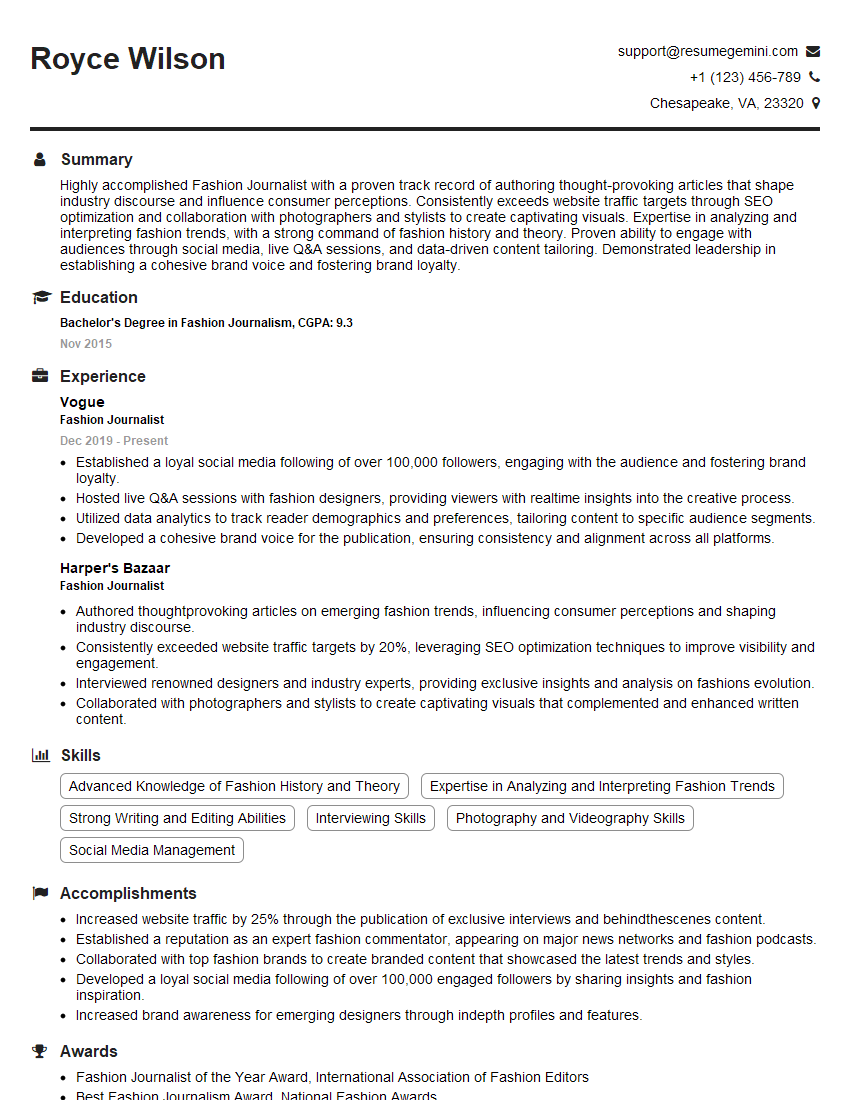
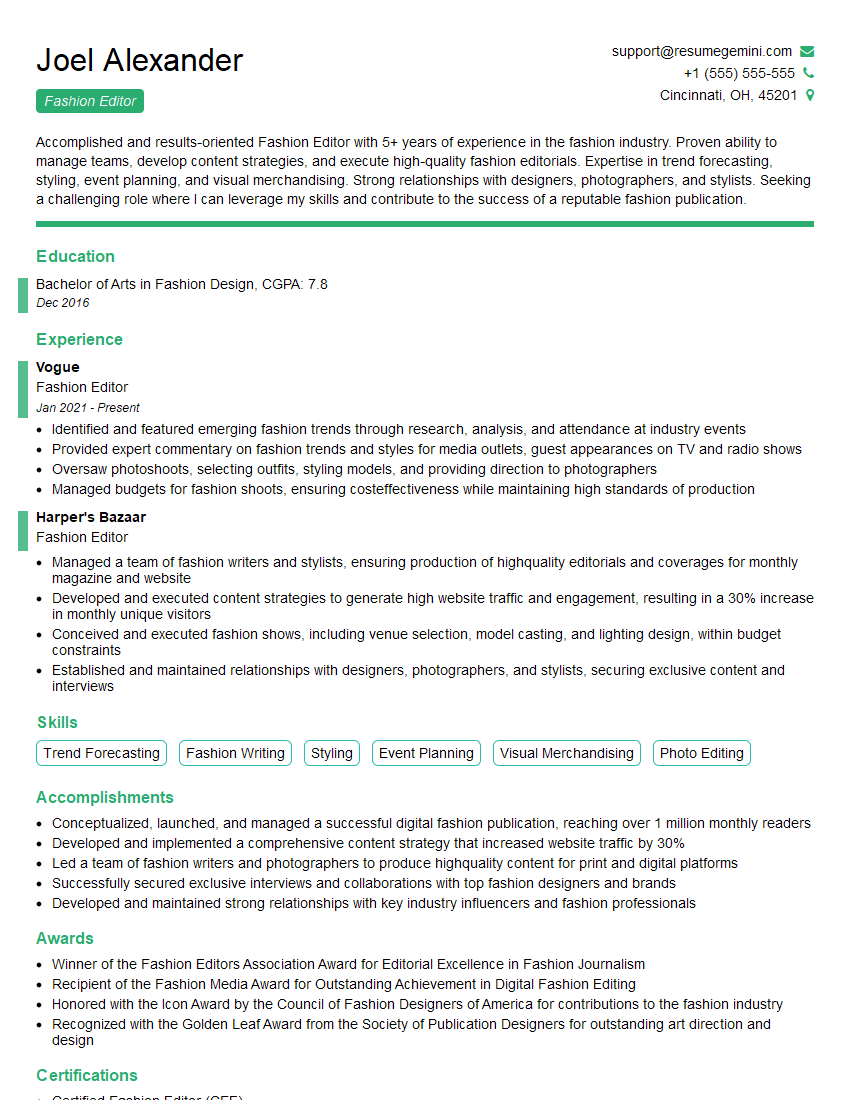
Mastering Fashion Writing and Editing opens doors to exciting careers in magazines, blogs, e-commerce, public relations, and more! A strong portfolio is crucial, but so is a compelling resume that showcases your skills and experience effectively. Building an ATS-friendly resume is essential for getting your application noticed by recruiters and hiring managers. To help you create a standout resume that highlights your unique qualifications, we recommend using ResumeGemini. ResumeGemini provides a user-friendly platform and helpful resources to ensure your resume is professional, impactful, and optimized for applicant tracking systems. Examples of resumes tailored for Fashion Writing and Editing roles are available to inspire your own creation.
Explore more articles
Users Rating of Our Blogs
Share Your Experience
We value your feedback! Please rate our content and share your thoughts (optional).
What Readers Say About Our Blog
Very informative content, great job.
good