Are you ready to stand out in your next interview? Understanding and preparing for Fiber Laser Technology interview questions is a game-changer. In this blog, we’ve compiled key questions and expert advice to help you showcase your skills with confidence and precision. Let’s get started on your journey to acing the interview.
Questions Asked in Fiber Laser Technology Interview
Q 1. Explain the principle of stimulated emission in fiber lasers.
Stimulated emission is the fundamental principle behind laser operation, including fiber lasers. Imagine a singer perfectly in tune, causing other singers around them to sing the same note at the same time, amplifying the sound. Similarly, in a fiber laser, a photon (light particle) of a specific energy interacts with an excited atom (the ‘singer’) within the fiber’s doped core. This interaction causes the atom to release another photon identical to the first – same wavelength, phase, and direction – thereby amplifying the light. This process repeats countless times as the photons travel down the fiber, creating a powerful, coherent beam.
More technically, the incoming photon interacts with an atom in an excited energy state. This interaction causes the atom to transition to a lower energy state and emit a second photon identical to the first. This is in contrast to spontaneous emission, where photons are emitted randomly in different directions and wavelengths.
Q 2. Describe the different types of fiber lasers (e.g., Yb, Er, Tm doped).
Fiber lasers are primarily classified by the rare-earth ion used as a dopant in the optical fiber’s core. This dopant determines the laser’s operating wavelength and applications.
- Yb (Ytterbium)-doped fiber lasers: These are very popular due to their high efficiency and broad range of applications. They typically operate around 1030-1060 nm, finding use in material processing, marking, and telecommunications. Think of them as the ‘workhorses’ of the fiber laser industry.
- Er (Erbium)-doped fiber lasers: These lasers operate around 1550 nm, a wavelength crucial for optical fiber communications. Their ability to transmit data over long distances makes them vital in telecommunications networks.
- Tm (Thulium)-doped fiber lasers: These lasers typically operate in the 2 μm region and are finding increased use in medical applications (e.g., laser surgery), as well as industrial material processing. Their longer wavelength allows for deeper tissue penetration.
Beyond these, other dopants exist, but these three represent the most prevalent types in commercial applications. The choice of dopant depends on the specific wavelength and power requirements of the intended application.
Q 3. What are the advantages and disadvantages of fiber lasers compared to other laser types?
Fiber lasers possess several advantages over other laser types, such as gas or solid-state lasers:
- High efficiency: Fiber lasers boast significantly higher efficiency in converting electrical energy into laser light, leading to lower operating costs.
- Compact size and ruggedness: Their fiber-based design allows for compact and robust systems, ideal for integration into various applications and environments.
- Excellent beam quality: They typically produce high-quality beams with low divergence, crucial for precision applications.
- Scalability: Fiber lasers can be easily scaled to higher powers by simply increasing the length of the fiber.
However, they also have some drawbacks:
- Power limitations (currently): While scalability is good, the maximum achievable power is still lower compared to some high-power solid-state lasers, although this gap is continuously closing.
- Sensitivity to bending and strain: Improper handling can affect the laser’s performance.
- Cost: While efficiency reduces overall operating costs, the initial cost can be higher compared to some simpler laser types.
Q 4. Explain the concept of mode-locking in fiber lasers.
Mode-locking is a technique used to generate ultrashort pulses of light from a laser. Imagine a group of runners starting a race simultaneously. In mode-locking, all the different ‘modes’ or frequencies of light within the laser cavity are forced to oscillate in phase, like the runners in unison. This constructive interference produces a short, intense pulse of light.
Several methods achieve mode-locking, including active mode-locking (using an external modulator) and passive mode-locking (using a saturable absorber within the cavity). The result is a train of ultrashort pulses with repetition rates determined by the cavity length. These ultrashort pulses have applications in high-speed optical communication, precision machining, and scientific research.
Q 5. How does the numerical aperture (NA) of the fiber affect laser performance?
Numerical aperture (NA) is a measure of a fiber’s light-gathering ability. A higher NA means the fiber can accept and guide light from a wider range of angles. In fiber lasers, NA affects several aspects of performance:
- Mode confinement: A higher NA leads to a larger mode area within the fiber, potentially reducing the intensity of the light within the core, potentially leading to lower gain and increased nonlinear effects.
- Power handling capability: A larger mode area (higher NA) can increase the power-handling capacity of the fiber, preventing damage from high intensities.
- Beam quality: The relationship between NA and beam quality is complex. Higher NA can potentially lead to a less collimated beam unless carefully managed.
Therefore, the optimal NA depends on the specific laser design and application. Balancing mode confinement, power handling, and beam quality is crucial when designing fiber lasers.
Q 6. Describe the different methods for Q-switching in fiber lasers.
Q-switching is a technique to generate high-energy, short pulses of light. Think of it as storing energy in a spring and then releasing it suddenly. In Q-switching, the laser’s gain is built up while the cavity losses are high (low Q-factor), preventing lasing. Then, the losses are suddenly reduced (high Q-factor), resulting in a rapid release of stored energy as a short, high-power pulse.
Several methods achieve Q-switching in fiber lasers:
- Acousto-optic Q-switching: Uses an acoustic wave to modulate the refractive index of a material, changing the optical losses in the cavity.
- Electro-optic Q-switching: Employs an electro-optic crystal to control the polarization of light, thus controlling the losses in the cavity.
- Saturable absorber Q-switching: Uses a material whose absorption decreases with increasing light intensity. This acts as a fast optical switch.
The choice of method depends on factors like pulse duration, repetition rate, and power requirements.
Q 7. Explain the role of optical isolators in fiber laser systems.
Optical isolators are crucial components in fiber laser systems. They allow light to pass in only one direction, preventing unwanted reflections from propagating back into the laser cavity. These reflections can cause instability, damage to optical components, or even destruction of the laser.
Imagine a one-way street: the light can travel down the ‘street’ (fiber), but any reflection attempting to travel back is stopped. Reflections back into the laser cavity can interfere with the lasing process, leading to fluctuations in power, pulse shape, or even complete laser failure. Optical isolators protect the laser from these detrimental effects, ensuring stable and reliable operation.
Q 8. What are the common causes of fiber laser instability?
Fiber laser instability, manifesting as fluctuations in output power, beam quality, or wavelength, stems from several sources. Think of it like a delicate balancing act; disrupt the balance, and the laser’s performance suffers.
- Pump power fluctuations: Variations in the pump laser’s power directly impact the gain medium, leading to unstable output. Imagine trying to inflate a balloon unevenly – you’ll get an irregular shape.
- Temperature variations: Temperature changes affect the refractive index of the fiber and the gain medium, causing shifts in the laser’s characteristics. This is like trying to play a musical instrument in a very hot or cold room – the instrument will likely go out of tune.
- Feedback from external reflections: Reflections from optical components or the environment can create interference, leading to instability. This is similar to having echoes in a concert hall that muddle the sound.
- Mechanical vibrations: External vibrations can affect the alignment of optical components within the laser cavity, disrupting its operation. Imagine trying to hit a precise target while standing on a shaky platform.
- Nonlinear effects: At high power levels, nonlinear effects like stimulated Brillouin scattering (SBS) and stimulated Raman scattering (SRS) can lead to power instability and even damage the fiber. This is like trying to push more current through a wire than it can handle – it will overheat.
Addressing instability often involves careful temperature control, minimizing reflections with anti-reflection coatings, robust mechanical design, and potentially using techniques like spectral filtering to manage nonlinear effects.
Q 9. How do you measure the beam quality (M²) of a fiber laser?
Measuring the beam quality, quantified by the M² factor (beam propagation ratio), involves determining the beam’s divergence and waist diameter. A lower M² value indicates a higher beam quality, closer to the ideal Gaussian beam. Think of it like shooting a laser pointer: a low M² beam will stay focused and small over a longer distance.
The measurement process typically employs a beam profiler. This device captures the intensity profile of the beam at various distances from the laser output. Software then analyzes the data to calculate the M² factor. Different methods exist, including using a scanning slit or a CCD camera, but the principle remains the same – measuring the beam’s expansion and comparing it to a theoretical Gaussian beam.
For example, a fiber laser with an M² of 1.1 is considered to have very good beam quality, whereas an M² of 2.0 or higher may indicate issues that need to be addressed, potentially related to fiber quality or laser design.
Q 10. Describe different methods for controlling the output power of a fiber laser.
Controlling the output power of a fiber laser is crucial for many applications. Several methods are available:
- Pump power control: The simplest method involves adjusting the power of the pump laser diode. This is analogous to adjusting the volume knob on a stereo.
- Intracavity loss modulation: This technique involves introducing variable losses within the laser cavity, such as using an acousto-optic modulator (AOM) or a variable attenuator. An AOM acts like a light switch, rapidly modulating the intensity of the light within the cavity.
- Polarization control: In some fiber laser designs, polarization control can be used to adjust the output power. Think of it like adjusting the aperture on a camera lens.
- Q-switching: This technique allows for the generation of high-energy pulses. Instead of continuous output, the laser cavity builds up energy, then rapidly releases it as a high-power pulse. This is like charging a capacitor and then releasing the energy rapidly.
The choice of method depends on factors such as the required speed of power adjustment, the desired power range, and the overall system complexity.
Q 11. Explain the concept of thermal lensing in fiber lasers and how it is mitigated.
Thermal lensing arises from the heat generated within the gain fiber due to the absorption of pump light. This heat creates a radial temperature gradient, which in turn modifies the refractive index of the fiber, acting like a lens. This ‘lens’ is undesirable and can affect beam quality and laser performance. Imagine looking through a heat-distorted window – the image is blurry and distorted.
Mitigation strategies focus on reducing the temperature gradient. These include:
- Improved heat sinking: Using fibers with better heat conductivity or employing efficient cooling systems helps dissipate heat more effectively.
- Optimized pump design: Careful management of the pump light distribution within the fiber reduces the localized heating and thus the thermal lensing effect.
- Active thermal compensation: Sophisticated systems might actively compensate for the thermal lensing using adaptive optics or by adjusting other cavity parameters.
Proper thermal management is crucial for maintaining stable high-power operation and good beam quality.
Q 12. How does the fiber length affect laser performance?
Fiber length significantly impacts laser performance. A longer fiber generally provides higher gain, leading to lower lasing thresholds and potentially higher output powers. However, there are trade-offs:
- Increased losses: Longer fibers lead to greater propagation losses, reducing the efficiency and output power. This is like having a longer hose for water – more water is lost due to friction.
- Nonlinear effects: The probability of nonlinear effects like SBS and SRS increases with fiber length, potentially leading to instability and output power limitations. This is like exceeding the capacity of a data pipe.
- Mode competition: In long fibers, higher-order modes can be excited, negatively impacting beam quality. Imagine many different wavelengths of light struggling to get through the fiber.
Optimal fiber length is determined by a careful balance between gain and losses, considering the desired power level, beam quality requirements, and the avoidance of significant nonlinear effects. For high-power lasers, shorter fibers are often preferred to minimize nonlinear effects.
Q 13. Describe the different types of fiber laser cavities.
Fiber laser cavities can be broadly classified into several types:
- Fabry-Perot cavity: This is the simplest type, consisting of two reflectors (mirrors) at the ends of the fiber. It’s like a simple resonant tube for sound waves.
- Ring cavity: Light travels in a loop within the fiber, often incorporating multiple components such as isolators and wavelength selective elements. This configuration offers benefits such as unidirectional operation and improved stability.
- Linear cavity with an external cavity: This architecture combines the fiber laser with an external cavity formed by mirrors or other optical components. This allows for greater flexibility in controlling the laser’s characteristics. Think of it as adding a sophisticated soundbox to improve the quality of a musical instrument.
- Master oscillator power amplifier (MOPA): This setup separates the laser’s oscillator (generating the light) from its amplifier (boosting its power), providing improved beam quality and increased power capabilities. It’s like using a preamplifier and a power amplifier in an audio system.
The choice of cavity design depends on the specific application and the desired laser performance characteristics such as power, beam quality, wavelength stability, and pulse characteristics.
Q 14. Explain the process of wavelength stabilization in fiber lasers.
Wavelength stabilization is crucial for many applications requiring precise wavelength control. Several methods are employed:
- Use of Bragg gratings: Fiber Bragg gratings (FBGs) are periodic variations in the refractive index of the fiber that reflect a specific wavelength, providing a narrow spectral filter and highly stable wavelength selection. Imagine a sieve only allowing specific sized particles to pass through.
- External cavity control: Similar to controlling cavity length in a Fabry-Perot laser, this method allows fine-tuning of the laser’s wavelength by adjusting the length or parameters of the external cavity. This is like tuning a guitar string to produce a precise musical note.
- Temperature control: Precise temperature control of the fiber laser using thermoelectric coolers helps maintain the desired wavelength by minimizing thermal-induced wavelength shifts. It’s like maintaining a constant temperature for precise electronic circuitry.
- Feedback systems: Closed-loop feedback systems employing wavelength monitoring components (e.g., wavemeters) and actuators adjust the laser parameters to maintain the desired wavelength. Think of this as using a thermostat to maintain a constant temperature.
The optimal stabilization method depends on the required wavelength stability, cost considerations, and the overall system complexity.
Q 15. What are the safety precautions when working with fiber lasers?
Working with fiber lasers demands stringent safety protocols due to the intense, invisible infrared radiation they emit. Direct exposure can cause severe eye damage and skin burns. Here’s a breakdown of key precautions:
- Eye Protection: Always wear laser safety eyewear rated for the specific laser wavelength and power. This is paramount, as even brief exposure can lead to irreversible vision loss. The eyewear should be checked regularly for damage.
- Enclosure and Beam Path Control: Fiber lasers should be housed in enclosures that prevent accidental exposure. The beam path should be carefully planned to minimize the risk of stray reflections or unintentional exposure. Interlocks on the enclosure ensure the laser shuts down if the enclosure is opened.
- Proper Training: All personnel working with fiber lasers must receive thorough training on laser safety procedures, operation, and emergency response. This training should cover both theoretical knowledge and hands-on practice.
- Laser Safety Officer (LSO): Larger facilities often employ a Laser Safety Officer to oversee laser operations, conduct risk assessments, and ensure compliance with safety regulations.
- Emergency Procedures: Develop and regularly review emergency response plans that detail actions to take in case of accidents or malfunctions. This includes knowing the location of safety equipment like fire extinguishers and emergency shut-off switches.
- Housekeeping: Maintain a clean and organized work area to prevent accidents and ensure easy access to safety equipment.
Remember, laser safety is not a suggestion – it’s a critical aspect of responsible laser operation. A single lapse in safety can have devastating consequences.
Career Expert Tips:
- Ace those interviews! Prepare effectively by reviewing the Top 50 Most Common Interview Questions on ResumeGemini.
- Navigate your job search with confidence! Explore a wide range of Career Tips on ResumeGemini. Learn about common challenges and recommendations to overcome them.
- Craft the perfect resume! Master the Art of Resume Writing with ResumeGemini’s guide. Showcase your unique qualifications and achievements effectively.
- Don’t miss out on holiday savings! Build your dream resume with ResumeGemini’s ATS optimized templates.
Q 16. Describe the different applications of fiber lasers in materials processing.
Fiber lasers have revolutionized materials processing across various industries due to their high efficiency, excellent beam quality, and compact size. Key applications include:
- Cutting: Fiber lasers excel at cutting various materials, including metals (stainless steel, aluminum, titanium), plastics, and ceramics. Their precise beam allows for intricate cuts with minimal heat-affected zones.
- Welding: Deep penetration welding of metals is a major application. The high power density allows for efficient joining of materials with minimal distortion.
- Marking: Fiber lasers are widely used for marking components with serial numbers, logos, or other identification information. They offer high precision and can mark a variety of materials.
- Drilling: Fiber lasers enable the creation of high-precision holes in diverse materials, crucial for applications like micro-machining and aerospace components.
- Surface Treatment: Processes like cladding, ablation, and texturing are possible, offering improved surface properties like hardness, corrosion resistance, and lubricity. This is used extensively in medical device manufacturing.
- Additive Manufacturing (3D Printing): Emerging applications involve using fiber lasers as the heat source in selective laser melting (SLM) and other 3D printing processes.
The choice of fiber laser parameters (wavelength, power, pulse duration) dictates the specific process and material interaction. For instance, shorter pulses are preferred for delicate micro-machining operations, while longer pulses are better suited for deep penetration welding.
Q 17. How do you diagnose and troubleshoot common fiber laser issues?
Diagnosing and troubleshooting fiber laser issues requires a systematic approach. The process typically involves:
- Visual Inspection: Begin by carefully examining the entire system, checking for any visible damage to optical components (fibers, lenses, couplers), loose connections, or signs of overheating.
- Power Measurement: Measure the output power of the laser using a power meter to ensure it’s within the expected range. A significant drop in power indicates a problem.
- Beam Profile Analysis: Examine the beam profile using a beam profiler to detect any anomalies like astigmatism or mode instability which can affect processing quality.
- Optical Alignment: Misalignment of optical components can lead to reduced power or beam quality issues. Carefully check the alignment of the fiber pigtails and other components. Precise and correct alignment is crucial for optimal performance. This often requires specialized equipment.
- Fiber Condition: Inspect the fiber optic cables for any damage, contamination, or excessive bending which can introduce losses or severely degrade performance. Microscopic examination can often be required.
- Control System Diagnostics: Check the laser’s control system for error messages or unusual readings. This may involve reviewing the system’s logs and potentially contacting the manufacturer’s support team.
- Environmental Factors: Consider the influence of ambient temperature, vibrations, and dust on the laser’s performance. Extreme temperatures or excessive vibration can affect the stability and functionality of the laser.
A systematic approach coupled with careful observation is crucial in identifying the root cause. Maintaining detailed logs of system performance over time facilitates quick diagnosis of recurring issues and proactive maintenance. A well-documented history of maintenance and repairs can prevent future problems.
Q 18. Explain the role of different optical components in a fiber laser system (e.g., couplers, mirrors, lenses).
Various optical components work in concert to generate, guide, and deliver the laser beam. Here’s a look at key components:
- Fiber Couplers: These components efficiently combine or split the light signals in different optical fibers. This is crucial for combining the power from multiple laser diodes into a single fiber in some configurations.
- Mirrors: Mirrors are essential for directing the laser beam within the laser cavity (for resonant cavities). High reflectivity mirrors are critical for maintaining sufficient feedback to achieve lasing.
- Lenses: Lenses are used to shape and focus the laser beam. They are particularly important in applications requiring precise spot size control (e.g., cutting, welding, drilling).
- Optical Isolators: These components prevent unwanted reflections from propagating back towards the laser source. This safeguards the laser from damage by suppressing potentially destructive back reflections.
- Wavelength Division Multiplexers (WDMs): Used in some complex systems to combine or separate different wavelengths of light within the same fiber.
- Polarization Controllers: These components control the polarization state of the laser light which is critical in some applications to maintain optimal performance.
Each component is crucial for the overall performance of the fiber laser system, and any malfunction in these components can lead to degraded output quality.
Q 19. What are the different types of fiber laser packaging?
Fiber laser packaging varies significantly depending on the application and power level. Key types include:
- Rack-mountable systems: These are typically larger systems used in industrial settings, designed for integration into existing control systems. They offer enhanced cooling and reliability.
- Compact, air-cooled systems: Smaller, air-cooled units are suitable for benchtop applications or where space is limited. These are often found in smaller businesses or research labs.
- li>Fiber-coupled modules: These are self-contained modules offering a fiber output suitable for easy integration into various systems. They offer superior flexibility and modularity.
- Integrated systems: These systems combine the laser with the processing head and other components into a single, integrated unit.
The choice of packaging depends heavily on the application. For example, a high-power industrial laser for metal cutting would likely employ a rack-mountable system with robust cooling, while a smaller laser for marking might use a compact, air-cooled unit.
Q 20. Describe the process of aligning a fiber laser system.
Aligning a fiber laser system is a delicate and critical procedure requiring precision and specialized tools. The process generally involves:
- Preparing the System: Ensure all components are securely mounted and connected. Power to the laser should be OFF during alignment.
- Initial Alignment: Roughly align the optical components using visual inspection and adjusting the mounts. This initial alignment ensures that light can propagate through the system.
- Fine Adjustment: Use precision adjustment mechanisms and power meters to fine-tune the alignment, optimizing the output power and beam quality. This step often involves iterative adjustments.
- Power Optimization: Monitor the output power and optimize the alignment to maximize the power delivered to the work piece. This is crucial for efficient material processing.
- Beam Profile Analysis: After alignment, analyze the beam profile using a beam profiler to verify the beam quality and detect any aberrations.
- Documentation: Record the alignment parameters (position of components, etc.) for future reference and troubleshooting. This avoids repeating extensive work should the alignment drift.
Precise alignment is essential for maximizing the laser’s efficiency and minimizing potential damage to optical components. Specialized alignment tools and techniques are often employed to achieve optimal results. Alignment is not a single event, but rather an iterative process, ensuring the system stays in optimal condition over time.
Q 21. Explain different techniques for generating ultrashort pulses from fiber lasers.
Generating ultrashort pulses from fiber lasers requires specialized techniques to overcome limitations of traditional continuous-wave (CW) operation. Key methods include:
- Mode-locking: This technique involves synchronizing the phases of multiple longitudinal modes within the laser cavity, creating a train of ultrashort pulses. Common mode-locking techniques include additive pulse mode-locking (APM), Kerr-lens mode-locking (KLM), and saturable absorber mode-locking (SAM).
- Q-switching: This method involves modulating the gain or loss within the laser cavity to produce high-energy pulses at a lower repetition rate. This typically isn’t used for ultrashort pulses, but for longer pulses of higher energy.
- Pulse shaping techniques: Advanced methods involve actively shaping the temporal profile of the laser pulses, resulting in customized pulse characteristics. This can use spectral filtering techniques in combination with other pulse generation methods.
The choice of technique depends on the desired pulse duration, energy, and repetition rate. For example, KLM is often used to generate femtosecond pulses, while Q-switching produces longer pulses (nanoseconds) with higher energy. Pulse shaping techniques are applied to create pulses with specialized temporal profiles for specific applications.
Q 22. How do you optimize the performance of a fiber laser for a specific application?
Optimizing a fiber laser for a specific application involves a multifaceted approach, focusing on maximizing the laser’s relevant characteristics while minimizing undesirable effects. It’s like fine-tuning a musical instrument – you need to adjust various parameters to achieve the desired sound.
For example, in material processing, you might prioritize high power and beam quality for efficient cutting or welding. This would involve optimizing the pump power, the fiber design (core diameter, numerical aperture), and potentially incorporating active stabilization techniques to maintain beam quality.
- Pump Power Adjustment: Increasing pump power increases output power, but excessive power can lead to nonlinear effects and damage. Finding the optimal balance is crucial.
- Fiber Selection: Different fiber types (e.g., single-mode, large-mode-area) offer trade-offs between power handling capability and beam quality. The right fiber is vital to the application.
- Active Q-switching or Mode-locking: These techniques can be used to generate pulses for applications requiring high peak power, such as micromachining.
- Beam Delivery System Optimization: Proper beam shaping and focusing lenses are essential for achieving the desired spot size and intensity at the workpiece.
In sensing applications, on the other hand, noise reduction and spectral purity might be paramount. This would involve careful control of the laser cavity and the use of narrowband filters.
Q 23. What are the key parameters used to characterize a fiber laser?
Key parameters characterizing a fiber laser include:
- Wavelength: The specific color of the emitted light, determined by the gain medium and cavity design. Different wavelengths are suitable for different applications (e.g., 1064 nm for material processing, 1550 nm for telecommunications).
- Output Power: The amount of optical power emitted by the laser, usually measured in watts (W). Higher power is generally needed for applications requiring higher material processing speeds or longer range.
- Beam Quality (M2): A measure of how close the beam is to an ideal Gaussian beam. A lower M2 value indicates better beam quality, resulting in tighter focus and more precise material processing.
- Spectral Width: The range of wavelengths present in the laser output. A narrower spectral width is generally preferred for many applications, but can limit the achievable output power.
- Beam pointing stability: How consistently the laser beam points in the same direction. This is important for applications requiring precise alignment.
- Pulse characteristics (for pulsed lasers): Pulse duration, repetition rate, and peak power are crucial for pulsed laser applications.
- Polarization state: Describes the orientation of the light’s electric field vector. Maintaining a consistent polarization is vital in some applications such as interferometry.
Q 24. Discuss the advancements in high-power fiber laser technology.
Advancements in high-power fiber laser technology are rapidly pushing the boundaries of what’s possible. This progress is driven by the demand for more efficient and powerful laser sources in diverse fields like manufacturing, medicine, and defense.
- Large Mode Area (LMA) Fibers: These fibers allow for higher power handling by reducing the intensity of light within the fiber core, thus mitigating nonlinear effects.
- Improved Fiber Materials: Development of novel rare-earth doped glasses with enhanced gain and thermal conductivity improves laser efficiency and power scalability.
- Advanced Cooling Techniques: Efficient heat removal is essential for high-power lasers. Innovative cooling techniques, such as microchannel cooling and liquid cooling systems, are being developed.
- Combined beam combining: Techniques like coherent beam combining allow combining the output of multiple fiber lasers to generate exceptionally high power outputs.
- Nonlinearity management: New approaches, including advanced fiber designs and signal processing techniques, are being used to mitigate or even exploit nonlinear effects to improve performance.
These advancements are leading to higher power, improved beam quality, greater efficiency, and enhanced reliability in high-power fiber lasers, opening up new possibilities for applications demanding extreme precision and processing capabilities.
Q 25. How do you design a fiber laser system for a specific wavelength?
Designing a fiber laser for a specific wavelength requires careful selection of the gain medium and precise control of the laser cavity. It’s akin to tuning a radio to a specific station – you need to adjust the components to resonate at the desired frequency.
The most common approach involves using a rare-earth-doped fiber as the gain medium. Different rare-earth ions (e.g., ytterbium, erbium, thulium) emit light at different wavelengths. For example, Ytterbium-doped fibers are commonly used for 1 μm emission, while erbium-doped fibers are used for 1.5 μm emission.
- Gain Medium Selection: The choice of rare-earth ion dictates the fundamental emission wavelength.
- Fiber Length: Optimizing the length of the doped fiber ensures efficient amplification of the desired wavelength.
- Cavity Design: The physical design of the laser cavity (including mirrors, Bragg gratings, and other optical components) determines the lasing wavelength and the spectral characteristics of the output beam. Bragg gratings, for instance, act as wavelength-selective filters.
- Wavelength-selective components: Additional optical components such as filters or etalons can be incorporated into the cavity for increased spectral purity.
The precise control over the cavity design allows for fine-tuning the lasing wavelength to meet specific application requirements. For instance, you might use a specific wavelength that is highly absorbed by a particular material to maximize efficiency in laser cutting or marking.
Q 26. What are the limitations of fiber lasers?
While fiber lasers offer numerous advantages, they also possess limitations:
- Nonlinear Effects at High Powers: At high power levels, nonlinear effects like stimulated Raman scattering and stimulated Brillouin scattering can degrade beam quality and reduce efficiency. These are particularly challenging in high-power applications.
- Limited Output Power (compared to some other laser types): Although high-power fiber lasers exist, scaling to extremely high power levels can be more challenging compared to certain other laser technologies. This is an ongoing area of development.
- Sensitivity to Environmental Factors: Fiber lasers can be affected by changes in temperature and vibrations which may cause output power fluctuations and instability.
- Cost: High-power fiber lasers, especially those with advanced features, can be expensive, particularly compared to lower power alternatives.
- Wavelength Limitations: While a wide range of wavelengths is accessible, generating certain wavelengths efficiently might still pose challenges. The available gain media dictates the wavelengths.
Q 27. Explain the concept of nonlinear effects in fiber lasers.
Nonlinear effects in fiber lasers occur when the intensity of the light within the fiber core becomes high enough to alter the refractive index of the fiber material. This can lead to a variety of undesirable effects, impacting the performance and stability of the laser.
Think of it like trying to send a powerful current through a thin wire – at high power, the wire might overheat and change its properties. Similarly, high light intensity in a fiber can change its optical properties.
- Stimulated Raman Scattering (SRS): The light’s energy transfers to lower-energy photons, leading to a shift in the laser’s wavelength and power reduction in the main laser line.
- Stimulated Brillouin Scattering (SBS): This involves the interaction of light with acoustic waves within the fiber, causing backscattering and potentially damaging the laser.
- Self-Phase Modulation (SPM): The laser pulse’s phase is changed due to the intensity dependence of the refractive index, leading to spectral broadening and pulse distortion.
- Four-Wave Mixing (FWM): Interaction between multiple wavelengths creates new wavelengths, impacting the spectral purity of the laser output.
Mitigation strategies for nonlinear effects include using large-mode-area fibers, optimizing pulse shapes, and using techniques such as spectral filtering.
Q 28. Describe the impact of environmental factors (temperature, vibrations) on fiber laser performance.
Environmental factors like temperature and vibrations significantly affect fiber laser performance. Maintaining a stable environment is crucial for reliable operation.
- Temperature: Temperature variations affect the refractive index of the fiber and the gain of the laser medium. This can lead to shifts in the laser’s wavelength, output power fluctuations, and even damage to the fiber if temperature changes are severe. Therefore, temperature stabilization is often necessary, particularly for high-power lasers.
- Vibrations: Vibrations can cause the laser cavity to become misaligned, leading to instability in beam pointing, output power, and beam quality. Vibration isolation measures, like placing the laser on a vibration-dampening platform, are often used to improve stability.
To illustrate, imagine a precisely tuned musical instrument. Changes in temperature will alter the pitch and tone, and vibrations will affect the stability of the sound. Similarly, temperature and vibration control are critical for maintaining the performance of fiber lasers.
Key Topics to Learn for Fiber Laser Technology Interview
- Fundamentals of Laser Physics: Understanding stimulated emission, population inversion, and laser gain mechanisms in fiber lasers.
- Fiber Laser Design and Components: Knowledge of different fiber types (e.g., single-mode, multi-mode, photonic crystal fibers), gain media, pump sources, and cavity designs.
- Laser Beam Characteristics: Familiarity with beam quality (M2), mode structure, polarization, and coherence properties.
- Nonlinear Effects in Fiber Lasers: Understanding and mitigating issues such as stimulated Raman scattering, four-wave mixing, and self-phase modulation.
- Practical Applications: Experience or knowledge of applications in materials processing (cutting, welding, marking), telecommunications, medical devices, and scientific instrumentation.
- Fiber Laser Operation and Control: Understanding laser parameters (power, wavelength, pulse duration), control systems, and safety protocols.
- Maintenance and Troubleshooting: Experience with diagnosing and resolving common issues related to fiber laser systems.
- Advanced Concepts (depending on experience level): Explore topics such as mode-locked lasers, Q-switched lasers, and advanced laser beam shaping techniques.
- Problem-Solving Approach: Demonstrate the ability to approach technical challenges systematically, using a combination of theoretical understanding and practical experience.
Next Steps
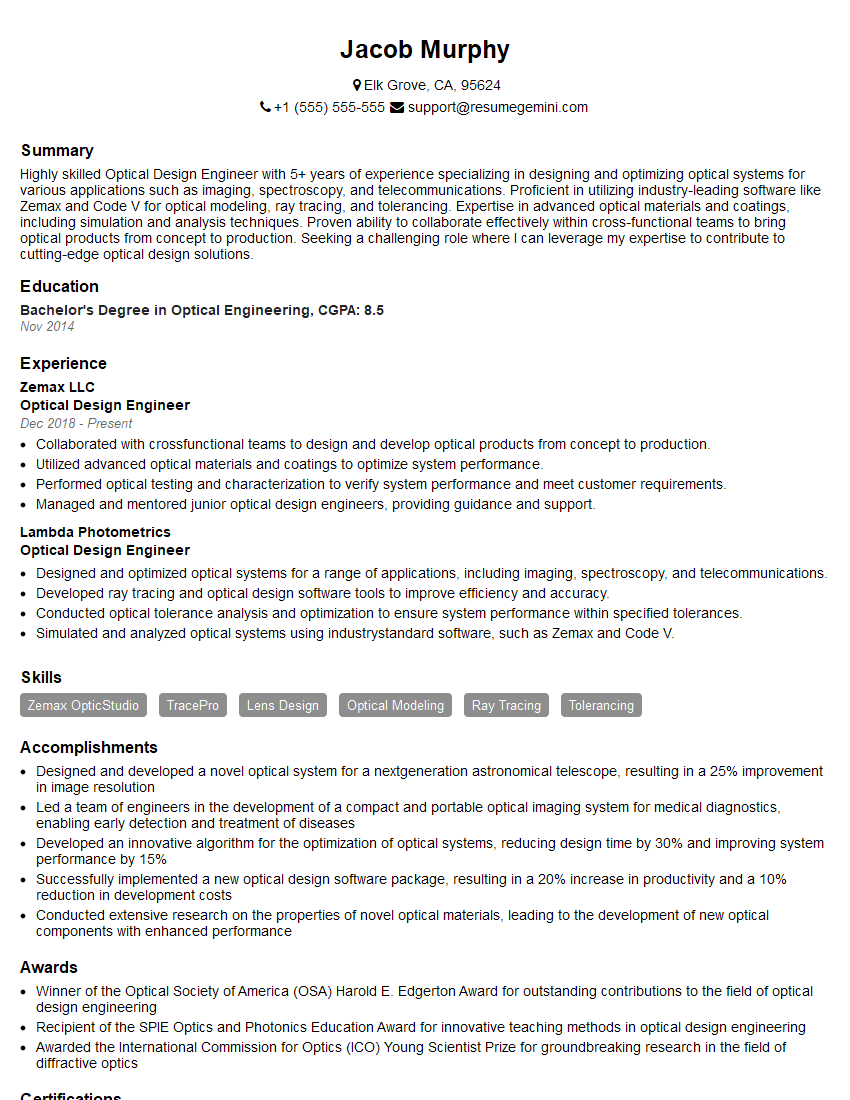
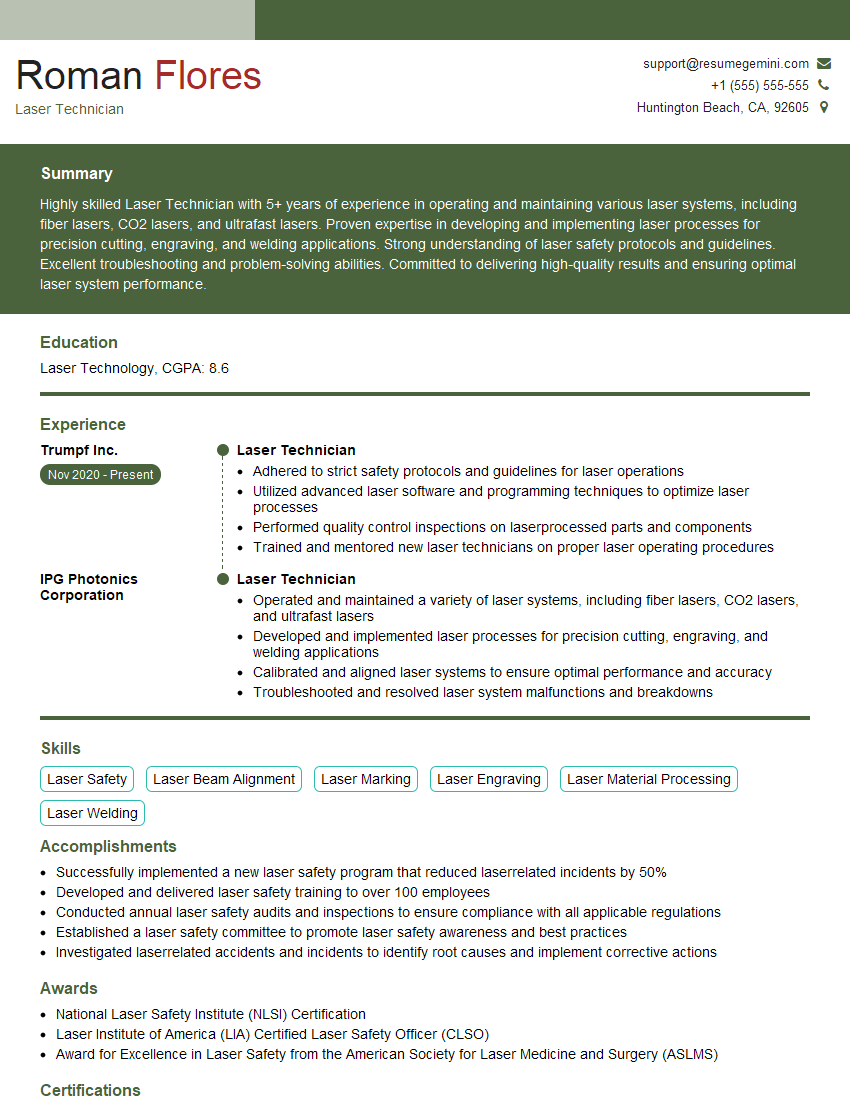
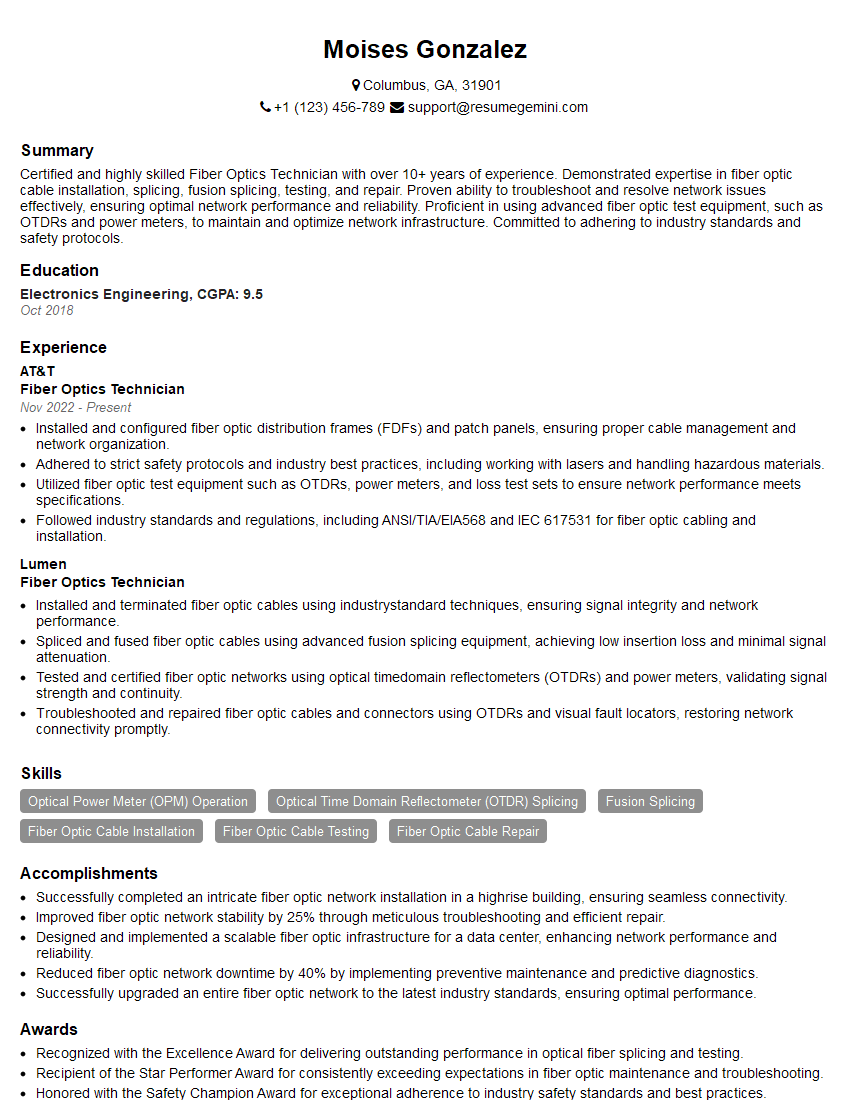
Mastering Fiber Laser Technology opens doors to exciting and rewarding career opportunities in a rapidly growing field. To maximize your job prospects, creating a strong, ATS-friendly resume is crucial. ResumeGemini is a trusted resource that can help you build a professional and impactful resume tailored to your specific skills and experience. Take advantage of the opportunity to craft a resume that showcases your expertise in Fiber Laser Technology effectively. Examples of resumes tailored to Fiber Laser Technology are available to help you get started.
Explore more articles
Users Rating of Our Blogs
Share Your Experience
We value your feedback! Please rate our content and share your thoughts (optional).
What Readers Say About Our Blog
Very informative content, great job.
good