Every successful interview starts with knowing what to expect. In this blog, we’ll take you through the top Fiber Optic Fabrication interview questions, breaking them down with expert tips to help you deliver impactful answers. Step into your next interview fully prepared and ready to succeed.
Questions Asked in Fiber Optic Fabrication Interview
Q 1. Explain the difference between single-mode and multi-mode fiber optic cables.
The core difference between single-mode and multi-mode fiber optic cables lies in their core size and the number of light paths they support. Think of it like comparing a single-lane highway to a multi-lane highway.
Single-mode fiber has a very small core diameter (around 8-10 microns), allowing only one path for light to travel. This means the light signal travels in a straight line with minimal modal dispersion (light spreading), resulting in much lower signal attenuation and higher bandwidth over longer distances. This makes it ideal for long-haul telecommunications and high-speed data transmission.
Multi-mode fiber, on the other hand, has a larger core diameter (typically 50 or 62.5 microns), allowing multiple light paths to propagate simultaneously. These different paths, or modes, travel at slightly different speeds, leading to modal dispersion and signal degradation over distance. While multi-mode fiber is less expensive and easier to work with, its bandwidth is lower than single-mode, and it’s better suited for shorter distance applications like local area networks (LANs) or building connections.
- Single-mode: Smaller core, higher bandwidth, longer distances, more expensive
- Multi-mode: Larger core, lower bandwidth, shorter distances, less expensive
Q 2. Describe the process of fusion splicing fiber optic cables.
Fusion splicing is a precise method of permanently joining two fiber optic cables. It uses heat to melt the ends of the fibers together, creating a strong and low-loss connection. Imagine it like welding two metal rods together, but at a microscopic level.
The process generally involves these steps:
- Fiber Preparation: The fiber ends are carefully cleaved (precisely cut) using a cleaver to achieve a perfectly perpendicular surface. Any imperfection will lead to increased losses.
- Clamping and Alignment: The cleaved fibers are precisely aligned using a fusion splicer’s alignment mechanism. The splicer uses high-precision optics and algorithms to ensure accurate alignment within microns.
- Fusion: An electric arc is generated between the fiber ends to melt the glass and fuse them together. The splicer automatically controls the arc’s intensity and duration to create a strong, homogeneous joint.
- Cooling and Verification: The fused splice is allowed to cool, and then its quality is verified by the splicer. The splicer measures the optical loss (attenuation) of the splice, ensuring it meets industry standards. Any excessive loss indicates a problem, requiring the process to be repeated.
Fusion splicing creates a highly reliable and consistent connection, nearly as good as a continuous length of fiber. This is crucial for maintaining signal integrity in optical networks.
Q 3. What are the common causes of fiber optic cable attenuation?
Attenuation, or signal loss, in fiber optic cables is a gradual reduction in the optical power of the light signal as it travels along the fiber. Several factors contribute to this:
- Absorption: Certain wavelengths of light are absorbed by the fiber’s material, converting optical energy into heat. This is influenced by the fiber’s composition and impurities.
- Scattering: Light is scattered in different directions due to imperfections in the fiber’s structure (e.g., variations in the refractive index, micro-bends). This scattering causes energy loss.
- Bending Losses: Excessive bending of the fiber, especially sharp bends, can lead to significant signal loss. Macrobends (large-radius bends) are less problematic than microbends (tiny, irregular bends).
- Connector Losses: Connectors introduce signal loss due to imperfect alignment, air gaps, and reflections. These losses are particularly noticeable and should be minimized.
- Splice Losses: Even with fusion splicing, some minimal loss occurs at the splice point due to imperfect fusion.
Minimizing attenuation is crucial for long-haul communication to ensure a strong signal arrives at the destination. Careful fiber selection, proper installation, and high-quality connectors are essential.
Q 4. How do you test fiber optic cables for continuity and loss?
Testing fiber optic cables for continuity and loss involves specialized equipment, primarily an Optical Time-Domain Reflectometer (OTDR) and an Optical Power Meter (OPM).
OTDR: This device sends light pulses down the fiber and measures the time it takes for the reflected light to return. This allows us to identify breaks, splices, connectors, and measure the attenuation (loss) along the entire cable length. Think of it as an ultrasound for fiber optics – it creates a visual representation of the fiber’s condition.
OPM: An OPM measures the optical power at various points along the fiber. This is primarily used to measure the signal power at the near-end (source) and far-end (receiver) to determine the total loss. OPMs can confirm that the light is reaching the end of the cable but can’t tell where the losses are located along the way.
The testing process typically involves:
- Connecting the OTDR to one end of the fiber.
- Running a test and interpreting the trace (visual representation from the OTDR) to identify any faults or loss points.
- Using an OPM at both the transmitting and receiving ends to measure overall power levels.
These tools are essential for ensuring the integrity and performance of fiber optic links in networks.
Q 5. What safety precautions should be taken when working with fiber optic cables?
Working with fiber optic cables requires adherence to strict safety precautions because of potential hazards:
- Eye Safety: The most significant hazard is the intense, invisible infrared light emitted by some fiber optic equipment. Direct exposure can cause severe eye damage, potentially leading to blindness. Always use appropriate safety eyewear designed for fiber optics work (laser safety glasses).
- Sharp Fibers: Cleaved fiber ends are extremely sharp and can easily cause cuts. Handle fibers carefully and use appropriate tools.
- Electrostatic Discharge (ESD): Fiber optic components are sensitive to static electricity, which can damage them. Use ESD mats and grounding straps to prevent electrostatic discharge.
- Working at Heights: If working on aerial fiber optic cables, ensure proper fall protection measures and safety equipment are in place.
- Proper Training: All personnel should undergo proper training on handling fiber optic cables and equipment before undertaking any work.
Safety protocols are paramount in fiber optic installations and maintenance to prevent injuries and equipment damage. Ignoring them could result in potentially severe consequences.
Q 6. Explain the different types of fiber optic connectors.
Several types of fiber optic connectors are used, each with its own advantages and disadvantages. The choice depends on the application and performance requirements.
- SC (Subscriber Connector): A common, reliable connector with a push-pull mechanism and a ceramic ferrule.
- FC (Fiber Connector): A threaded connector offering excellent stability and repeatability, often used in more demanding environments.
- LC (Lucent Connector): A smaller, more compact connector gaining popularity due to its space-saving design and high density.
- ST (Straight Tip): A bayonet-style connector with a simple push-and-twist mechanism, generally less reliable than SC or FC.
- MT-RJ (Mechanical Transfer Registered Jack): A duplex connector (two fibers in one connector) providing high density.
Each connector type has specific features and levels of precision affecting insertion loss and reliability. Choosing the correct connector type is crucial for optimal network performance. Compatibility among connectors is important for seamless integration.
Q 7. Describe the process of terminating fiber optic cables.
Terminating fiber optic cables involves preparing the fiber end, inserting it into a connector, and ensuring a clean, low-loss connection.
The process generally involves:
- Fiber Preparation: This includes cleaning and cleaving the fiber to a precise perpendicular end-face using a cleaver. The quality of this preparation significantly impacts the quality of the termination.
- Connector Preparation: The chosen connector (e.g., SC, LC, FC) needs to be prepared. This usually includes inserting a ferrule, an important precision component, into the connector body.
- Epoxy Insertion: A small amount of epoxy is carefully placed into the connector ferrule to secure the fiber. The epoxy must be the correct type, carefully dispensed, and allowed to fully cure.
- Fiber Insertion and Polishing: The carefully prepared fiber is inserted into the ferrule and epoxy, ensuring proper alignment. Once the epoxy cures, the end is polished using precision polishing equipment to achieve a smooth, reflective surface. Any imperfections on the polished end will significantly affect the loss.
- Testing: After the termination is complete, it’s essential to test for insertion loss using an OPM to ensure it meets acceptable levels. Excessive loss indicates a problem that needs addressing.
Proper termination is essential for reliable fiber optic connections; poor termination can lead to significant signal loss and network instability.
Q 8. What are the different types of fiber optic cable damage and how are they repaired?
Fiber optic cable damage can manifest in several ways, broadly categorized as physical damage and environmental damage.
- Macrobends: These are large-radius bends exceeding the minimum bend radius specified for the cable type. They significantly increase attenuation and can even cause complete signal loss. Think of it like kinking a garden hose – the water flow is severely restricted or stopped. Repair involves carefully straightening the bend or replacing the affected section.
- Microbends: These are tiny, localized bends that occur at the microscopic level, often due to compression or improper handling. They cause increased attenuation, more subtle than macrobends. Repair typically involves replacing the affected section, as microbends are difficult to pinpoint and correct.
- Cuts and Abrasions: These are direct physical damages causing fiber breakage or weakening. These are easily spotted and require splicing or replacing the damaged segment.
- Connector damage: Damage to the fiber optic connectors, like scratches or misalignment, lead to poor signal transmission. Repair involves cleaning, polishing, or replacing the connectors.
- Water ingress: Water entering the cable jacket damages the fibers and reduces signal quality. This requires identifying the point of ingress, sealing the leak, and potentially replacing the affected section of the cable.
Repair strategies depend on the type and severity of damage. Minor connector damage can be addressed with cleaning and polishing, while severe cuts require splicing using fusion splicers or mechanical splices. For extensive damage, cable replacement is necessary.
Q 9. How do you identify different types of fiber optic cable by their markings?
Fiber optic cable markings provide crucial information for identification. These markings typically include:
- Manufacturer’s name or logo: Clearly identifies the manufacturer of the cable.
- Cable type: Indicates the fiber type (e.g., single-mode, multi-mode), construction (e.g., loose-tube, tight-buffered), and other specifications.
- Fiber count: Specifies the number of individual fibers within the cable.
- Date of manufacture: Often helps in tracking cable age and potential degradation.
- Other specifications: These might include the cable’s diameter, jacket material, and other relevant information.
For example, a marking might look like this: 'XYZ Corp. SMF-28-12F-2023-10-27', which suggests that this cable is manufactured by XYZ Corp., is single-mode fiber (SMF), has 12 fibers, was manufactured on October 27, 2023, and has other specifications (28 might refer to a particular diameter or buffer). It’s crucial to consult the manufacturer’s documentation for a complete understanding of the marking conventions.
Q 10. Explain the importance of proper cable management in fiber optic installations.
Proper cable management in fiber optic installations is critical for several reasons:
- Preventing damage: Organized cables are less prone to physical damage like bending, crushing, or abrasion. Think of it like neatly storing your clothes; you’re less likely to wrinkle or damage them.
- Improving performance: Proper management minimizes signal loss and ensures optimal performance. Excessive bends or kinks can introduce attenuation, just like kinks in a water hose.
- Facilitating maintenance: Organized cabling simplifies troubleshooting, repairs, and future upgrades. Imagine trying to fix a tangled mess of wires vs. a neatly labeled and organized system.
- Enhancing safety: Good cable management reduces tripping hazards and prevents accidents.
- Future scalability: A well-planned fiber optic infrastructure accommodates future expansion and growth without compromising performance.
Techniques like using cable trays, labels, and proper termination practices are essential for efficient cable management. Failure to manage cables effectively can lead to significant downtime, repair costs, and performance degradation.
Q 11. What is OTDR and how is it used in fiber optic testing?
An Optical Time-Domain Reflectometer (OTDR) is a sophisticated instrument used to test and characterize fiber optic cables. It works by sending light pulses into the fiber and measuring the amount of light reflected back at different points along the cable.
This reflected light provides information about:
- Fiber length: The time it takes for the light pulse to travel to a point and return indicates the distance to that point.
- Fiber attenuation: The strength of the returned signal indicates the amount of light loss along the fiber, helping identify potential problems.
- Splices and connectors: The OTDR detects these points as distinct reflections in the trace, allowing for evaluation of their quality.
- Fiber breaks or faults: A sudden drop in the returned signal indicates a break or fault in the fiber.
Essentially, the OTDR creates a visual representation of the fiber optic cable, allowing technicians to identify and locate potential issues, ensuring proper cable installation and performance. Imagine it as an X-ray for fiber optic cables, revealing any hidden problems.
Q 12. What are the different types of fiber optic measurement equipment?
Several types of fiber optic measurement equipment are used for different testing purposes:
- Optical Power Meters (OPMs): These instruments measure the optical power levels at various points in the network, helping determine signal strength and losses.
- OTDRs (Optical Time-Domain Reflectometers): As explained previously, these are used to characterize the entire fiber link, locating faults and measuring attenuation.
- Optical Spectrum Analyzers (OSAs): OSAs measure the optical spectrum of a light source, identifying wavelength and bandwidth information, crucial for analyzing the spectral characteristics of the signal.
- Light Sources: These provide the light signal for testing, with different wavelengths depending on the application.
- Fiber Optic Visual Fault Locators (VFLs): VFLs use a visible red light to trace the fiber path, helping identify physical damage or bends.
The choice of equipment depends on the specific testing task, ranging from simple power measurements to comprehensive network analysis. Each instrument plays a vital role in ensuring the quality and performance of a fiber optic network.
Q 13. How do you troubleshoot a fiber optic network?
Troubleshooting a fiber optic network involves a systematic approach:
- Identify the problem: Determine the symptoms, such as complete signal loss, intermittent connectivity, or poor signal quality.
- Isolate the affected area: Use network maps and documentation to pinpoint the affected segment of the network. VFLs can also be helpful in visually tracing the cables.
- Check the connections: Examine the connectors for damage or misalignment. Clean or replace connectors as needed.
- Use testing equipment: Employ OPMs, OTDRs, and other tools to measure power levels and identify potential faults along the fiber.
- Inspect the cable for physical damage: Look for any bends, cuts, or other forms of physical damage that might be causing attenuation or signal loss.
- Check the equipment: Make sure that the transmitters, receivers, and other network devices are functioning correctly. This might involve testing these devices with known good fibers.
- Verify power levels: Confirm that power levels are within acceptable ranges at various points in the network.
Troubleshooting often involves a combination of these steps, requiring a good understanding of fiber optics principles and experience in using specialized testing equipment. The systematic approach helps efficiently identify and resolve the issue.
Q 14. What are the common problems encountered during fiber optic cable installation?
Common problems during fiber optic cable installation include:
- Microbends and macrobends: Improper handling and cabling can introduce these bends, leading to signal attenuation.
- Connector damage: Incorrect termination, improper cleaning, or physical damage to the connectors results in poor connection and signal loss.
- Fiber breakage: Careless handling or improper routing can lead to fiber breakage, requiring splicing or cable replacement.
- Water ingress: Improper sealing or damage to the cable jacket allows water to enter the cable, leading to corrosion and signal degradation.
- Incorrect cable routing: Failure to follow proper routing practices can lead to stress on the fibers, bends, and potential damage.
- Poor cable management: Lack of organization makes troubleshooting and maintenance difficult, and may lead to accidental damage.
- Incorrect fusion splicing: Faulty splicing leads to signal loss and reduced network performance. This requires skill and experience.
Preventing these problems requires careful planning, proper training, meticulous execution, and the use of appropriate tools and equipment. Proper preparation and adherence to best practices are crucial to ensure a successful and reliable fiber optic installation.
Q 15. Explain the concept of fiber optic wavelength and its importance.
Fiber optic wavelength refers to the distance between successive crests of a light wave traveling through the optical fiber. It’s measured in nanometers (nm). The importance of wavelength lies in its direct relationship to the fiber’s performance and application. Different wavelengths are better suited for different tasks and fiber types.
For example, single-mode fibers, used for long-distance high-bandwidth communication, typically operate around 1310 nm and 1550 nm. These wavelengths experience minimal attenuation (signal loss) over long distances. Multi-mode fibers, often used for shorter distances like within a building, can operate at wavelengths like 850 nm, but experience higher attenuation at longer distances. Choosing the correct wavelength is critical for optimizing data transmission speed, distance, and overall system efficiency. Think of it like choosing the right gear on a bicycle – the wrong gear will make your journey inefficient.
Career Expert Tips:
- Ace those interviews! Prepare effectively by reviewing the Top 50 Most Common Interview Questions on ResumeGemini.
- Navigate your job search with confidence! Explore a wide range of Career Tips on ResumeGemini. Learn about common challenges and recommendations to overcome them.
- Craft the perfect resume! Master the Art of Resume Writing with ResumeGemini’s guide. Showcase your unique qualifications and achievements effectively.
- Don’t miss out on holiday savings! Build your dream resume with ResumeGemini’s ATS optimized templates.
Q 16. Describe the different types of fiber optic cable jackets and their applications.
Fiber optic cable jackets serve as the outer protection layer, safeguarding the delicate glass fibers within from environmental damage. Several types exist, each with specific applications:
- Polyvinyl Chloride (PVC): This common, cost-effective jacket is suitable for indoor use. However, it’s less resistant to harsh chemicals and temperature extremes.
- High-Density Polyethylene (HDPE): A more robust jacket than PVC, offering better resistance to abrasion and chemicals, making it suitable for outdoor or underground installations.
- Low-Smoke Zero-Halogen (LSZH): Primarily used in environments where fire safety is paramount (e.g., data centers, public buildings). These jackets produce minimal smoke and toxic fumes when burned, enhancing safety during emergencies.
- Thermoplastic Elastomer (TPE): Provides excellent flexibility and resistance to impact and environmental factors, making it ideal for applications requiring frequent bending or movement.
The choice of jacket depends heavily on the deployment environment and specific performance requirements. For instance, an outdoor cable buried underground would necessitate an HDPE or a robust LSZH jacket to withstand environmental stress, while an indoor cable in a controlled environment might only require PVC.
Q 17. What is the role of cleavers and how do you use them?
Fiber optic cleavers are precision tools used to create a perfectly perpendicular cleave on the end of an optical fiber. A clean, perpendicular end face is crucial for optimal light transmission and low signal loss at fiber connectors. Improper cleaving leads to increased signal attenuation and connector failure.
To use a cleaver, first, carefully insert the fiber into the cleaver’s holding mechanism, ensuring it’s securely positioned. Then, activate the cleaver’s blade (usually through a lever or button). The blade precisely fractures the fiber, creating a mirror-like finish. After cleaving, inspect the end face under a microscope to verify the quality of the cleave. A poorly cleaved fiber will have a jagged or angled end face, significantly impacting connection quality. Think of it like sharpening a pencil; a sharp, clean point maximizes performance, whereas a blunt or broken point makes writing difficult.
Q 18. What are the different methods of cleaning fiber optic connectors?
Maintaining clean fiber optic connectors is essential for reliable signal transmission. Several methods exist, each with varying degrees of effectiveness:
- Dry Cleaning with a Fiber Optic Cleaning Pen/Brush: A quick and effective method for removing dust and debris. This involves gently swabbing the connector’s ferrule using the cleaning pen.
- Wet Cleaning with Isopropyl Alcohol (IPA) and Swabs/Wipes: For more stubborn contamination, IPA wipes are used to thoroughly clean the ferrule. Ensure the IPA is high purity (e.g., 99.9%) to avoid leaving residue. Always use a new swab for each connector and discard properly.
- Specialized Cleaning Cartridges/Cleansers: These pre-packaged cartridges provide a clean and consistent cleaning process for connectors, offering a convenient way to maintain cleanliness in professional environments.
The method of cleaning depends on the level of contamination. Regular cleaning with a cleaning pen helps prevent significant contamination, while wet cleaning using IPA is employed only when needed. Improper cleaning techniques can damage the ferrule, leading to connector failure.
Q 19. How do you determine the proper bending radius for fiber optic cables?
The bending radius of a fiber optic cable refers to the minimum radius at which the cable can be bent without causing damage to the fibers inside. Exceeding the minimum bending radius can lead to micro-bending, introducing losses and impacting signal quality. Each fiber optic cable type has a specified minimum bending radius, usually indicated on the cable jacket or specification sheet.
Determining the proper bending radius involves consulting the manufacturer’s specifications for the particular cable in use. For instance, a cable designed for tight spaces might have a smaller minimum bending radius than a cable intended for long-distance transmission. Improper bending can permanently damage the fiber, so always adhere to manufacturer guidelines. Think of it like bending a paperclip – too much bending and it breaks, but a gentle curve is safe.
Q 20. Explain the importance of proper grounding in fiber optic installations.
Proper grounding in fiber optic installations is crucial for protecting equipment and personnel from electrical surges and static electricity. While fiber optic cables themselves don’t conduct electricity, the equipment used in the installation (e.g., patch panels, connectors, and transmission equipment) may be susceptible to electrical surges.
Grounding provides a low-impedance path for stray electrical currents, preventing them from damaging sensitive electronics. This is especially important in environments with lightning storms or other sources of electrical interference. Failing to provide adequate grounding can lead to equipment failure, data loss, and even safety hazards. It is a critical safety and system reliability measure, and proper grounding techniques should always be followed as per industry best practices.
Q 21. What are the differences between mechanical splicing and fusion splicing?
Both mechanical splicing and fusion splicing are methods for joining two fiber optic cables, but they differ significantly in their approach and results:
- Mechanical Splicing: This method uses a mechanical connector to join the fibers. It’s faster and generally less expensive than fusion splicing but tends to offer lower performance and reliability. Mechanical splices often exhibit higher insertion loss and are more susceptible to environmental changes.
- Fusion Splicing: This method uses an electric arc to melt and fuse the ends of two fibers, creating a seamless, permanent joint. Fusion splicing provides superior performance with lower insertion loss and higher reliability, but it’s slower, more expensive, and requires specialized equipment. It also produces a more durable and robust connection less prone to environmental degradation.
The choice between mechanical and fusion splicing depends on factors such as budget, performance requirements, and the environment. High-performance networks and long-haul applications generally prefer fusion splicing, while mechanical splicing might be suitable for temporary connections or less demanding applications.
Q 22. Describe the different types of fiber optic losses (e.g., insertion loss, reflection loss).
Fiber optic losses represent the reduction in optical power as light travels through the fiber. Several types exist, each with different causes and implications.
- Insertion Loss: This is the loss of signal power when a component, like a connector or splice, is inserted into the optical path. Think of it like a partially opened faucet – some water (light) is lost. It’s caused by reflections, scattering, and absorption at the interface. Minimizing insertion loss is crucial for maintaining signal strength across the network.
- Reflection Loss: Occurs when light is reflected back toward the source due to impedance mismatches at fiber joints or connectors. This is similar to a mirror reflecting a portion of the light. Fresnel reflection, at the interface between two media with different refractive indices, is a significant contributor. High reflection loss can lead to signal degradation and even damage to optical transmitters.
- Attenuation Loss: This is a gradual power loss as light propagates along the fiber. It arises from material absorption (the fiber absorbing some light), Rayleigh scattering (light scattering off microscopic imperfections in the glass), and bending loss (loss due to the fiber not being perfectly straight). This is like a slow leak in a water pipe, steadily reducing the water flow.
- Macrobending Loss: This is a significant loss caused by sharp bends in the fiber. The light escapes the core if the bend radius is too small. Think of bending a garden hose too sharply; the water flow is significantly reduced or completely blocked.
Understanding these loss mechanisms is fundamental in designing, installing, and maintaining efficient fiber optic networks. Minimizing these losses ensures reliable data transmission over long distances.
Q 23. What is the role of a fusion splicer’s arc settings and how do they affect the splice?
A fusion splicer uses an electric arc to melt and fuse the ends of two optical fibers together, creating a seamless connection. The arc settings, including current, time, and pressure, are critical for a successful splice.
- Current: This controls the intensity of the arc. Too low, and the fibers won’t fuse properly; too high, and you risk damaging the fibers or causing excessive material loss.
- Time: Determines how long the arc is applied. A shorter time might result in an incomplete fusion, while a longer time can lead to excessive melting and weakened splice points.
- Pressure: Maintains alignment between the fibers during the fusion process. Insufficient pressure leads to poor alignment and increased loss; excessive pressure can crush or damage the fibers.
The ideal settings depend on the fiber type and diameter. Experienced technicians adjust these parameters based on their observations of the fusion process and the quality of the splice. Incorrect settings result in high splice loss, which negatively impacts the network performance. Many modern splicers have automated functions that help optimize these settings.
Q 24. How do you interpret OTDR results to identify faults in a fiber optic cable?
An Optical Time-Domain Reflectometer (OTDR) measures the amount of light reflected back from points along a fiber. By analyzing the OTDR trace, we can identify faults and imperfections.
The trace displays distance along the x-axis and power level (in dB) along the y-axis. Key features to interpret are:
- Fresnel Reflections: Sharp spikes indicate abrupt changes in refractive index, commonly at connectors or splices. The height of the spike indicates the reflection loss.
- Attenuation Slope: A gradual downward slope indicates fiber attenuation due to material absorption and scattering. A steeper slope implies higher loss.
- Loss Events: Sharp dips or significant deviations from the expected attenuation slope usually indicate faults like microbends, cracks, or breaks. The location of these dips shows the distance of the fault from the OTDR unit.
- Event Loss:The loss at a specific point like a splice or connector.
By comparing the OTDR trace against the known specifications of the fiber optic link, we can pinpoint the location and type of fault. For instance, a significant loss event near the middle of the trace, followed by no signal beyond that point, strongly indicates a fiber break. This allows for targeted repair and efficient troubleshooting.
Q 25. What are some common fiber optic connector types (e.g., SC, LC, ST)?
Many fiber optic connector types exist, each designed for different applications and offering unique advantages and disadvantages. Here are some common examples:
- SC (Subscriber Connector): A push-pull connector known for its reliability and widespread use. It’s a relatively large connector and not as space-efficient as others.
- LC (Lucent Connector): A smaller, more compact connector preferred in high-density applications, like data centers, saving space in patch panels.
- ST (Straight Tip): A bayonet-style connector offering quick connect/disconnect capabilities, but it’s less prevalent than SC and LC now.
- FC (Ferrule Connector): A screw-on connector known for excellent stability and low insertion loss. It is used in more demanding applications where high precision is necessary.
- MT-RJ (Multi-fiber RJ): A connector that houses two fibers and has a similar form factor to the RJ-45 connector used for ethernet. It’s used in applications where compact size is crucial.
The choice of connector depends on factors like cost, density requirements, application environment (indoor versus outdoor), and desired performance levels. Compatibility between connectors is crucial for seamless network connectivity.
Q 26. Describe the process of using a power meter to measure optical power.
A power meter measures the optical power level in a fiber optic link, expressed in decibels (dBm or mW). The process is straightforward but requires careful attention to detail.
- Connect the power meter: The power meter typically has a connector (usually SC, LC, or FC) that needs to be carefully connected to the fiber under test.
- Select the appropriate wavelength: Ensure the power meter is set to the correct wavelength (e.g., 1310 nm or 1550 nm) matching the light source used in the link.
- Take a reading: Turn on the power meter and allow it to stabilize. The display will show the optical power level.
- Record the measurement: Note the power level. Multiple readings may be taken for greater accuracy, considering fluctuation.
- Calibrate regularly: Power meters need regular calibration to ensure accuracy.
Power meters are essential for testing the optical power levels at various points in a fiber optic network, helping identify losses, troubleshoot problems, and ensure consistent performance. Accurate power measurements are crucial for maintaining a functional optical communication system.
Q 27. How do you handle and manage fiber optic cable waste responsibly?
Responsible management of fiber optic cable waste is crucial for environmental and safety reasons. It involves several steps:
- Proper Disposal: Fiber optic cables should not be disposed of in regular trash. Many recycling centers accept fiber optic cables for proper processing and reclamation of materials.
- Avoid Cross-Contamination: During removal and disposal, prevent fiber ends from being damaged to avoid any risk of injury from the fiber ends.
- Hazardous Material Handling: Some cable jackets contain materials requiring special handling according to local regulations. Identify these materials before disposal.
- Recycling Programs: Seek out and use certified recycling programs specializing in electronics and telecommunications waste. This ensures responsible material recycling and minimization of environmental impact.
- Internal Processes: Establish procedures within an organization to minimize waste during installations, including careful planning to reduce excess cable lengths.
Following these practices ensures responsible environmental stewardship and reduces the impact of discarded fiber optic cables on our ecosystems. It’s vital to check local and national guidelines for specific requirements.
Q 28. What experience do you have with different types of fiber optic cable installation techniques (e.g., aerial, underground, indoor)?
I possess extensive experience with various fiber optic cable installation techniques tailored to different environments. My experience includes:
- Aerial Installation: I’ve worked on projects involving stringing fiber optic cables along existing power lines or dedicated aerial pathways. This requires understanding of appropriate cable types, specialized hardware (like clamps and grips), safety procedures (e.g., working at heights), and weather considerations.
- Underground Installation: I’ve been involved in trenching, laying duct work, and pulling fiber cables underground. This necessitates knowledge of ground conditions, proper trenching techniques, cable protection methods (e.g., duct systems and cable armoring), and adherence to safety regulations to prevent damage to utility lines.
- Indoor Installation: I have experience installing fiber optic cables in buildings, including running cables within walls, ceilings, and under raised floors. This requires understanding of building codes, fire safety regulations, and using appropriate cable management techniques for structured cabling systems.
Each installation method presents unique challenges and requires specific expertise. My experience spans various techniques, including microduct installations, which are suitable for high-density deployments, and hand-hole installations. I am proficient in using various tools and equipment, always emphasizing safety and best practices during each stage of the installation process.
Key Topics to Learn for Fiber Optic Fabrication Interview
- Fiber Drawing and Preform Fabrication: Understand the process of drawing optical fibers from preforms, including the role of temperature, tension, and coating application. Consider the different types of preforms and their impact on fiber properties.
- Fiber Coating and Jacketing: Learn about the different types of coatings and jacketing materials used to protect the fiber and their influence on fiber strength, durability, and performance in various environments. Explore practical applications, like choosing the right coating for underwater cables versus terrestrial applications.
- Optical Fiber Testing and Measurement: Master the techniques used to measure key fiber parameters like attenuation, dispersion, and refractive index. Understand the importance of these measurements for ensuring fiber quality and performance. Explore different testing equipment and methodologies.
- Splicing and Connection Techniques: Familiarize yourself with different fiber splicing methods (fusion splicing, mechanical splicing) and the equipment involved. Understand the importance of minimizing splice loss and ensuring reliable connections.
- Fiber Optic Cable Manufacturing: Explore the processes involved in manufacturing different types of fiber optic cables, including loose tube, ribbon, and tight buffered designs. Understand the factors influencing cable design choices and performance.
- Troubleshooting and Quality Control: Develop your problem-solving skills related to identifying and resolving issues during fiber fabrication. This includes understanding common defects, their causes, and potential solutions. Familiarize yourself with quality control procedures and standards.
- Fiber Optic Cable Design and Applications: Explore the diverse applications of fiber optic cables in telecommunications, data centers, sensor networks, and other industries. Understanding the specific requirements for different applications is crucial.
Next Steps
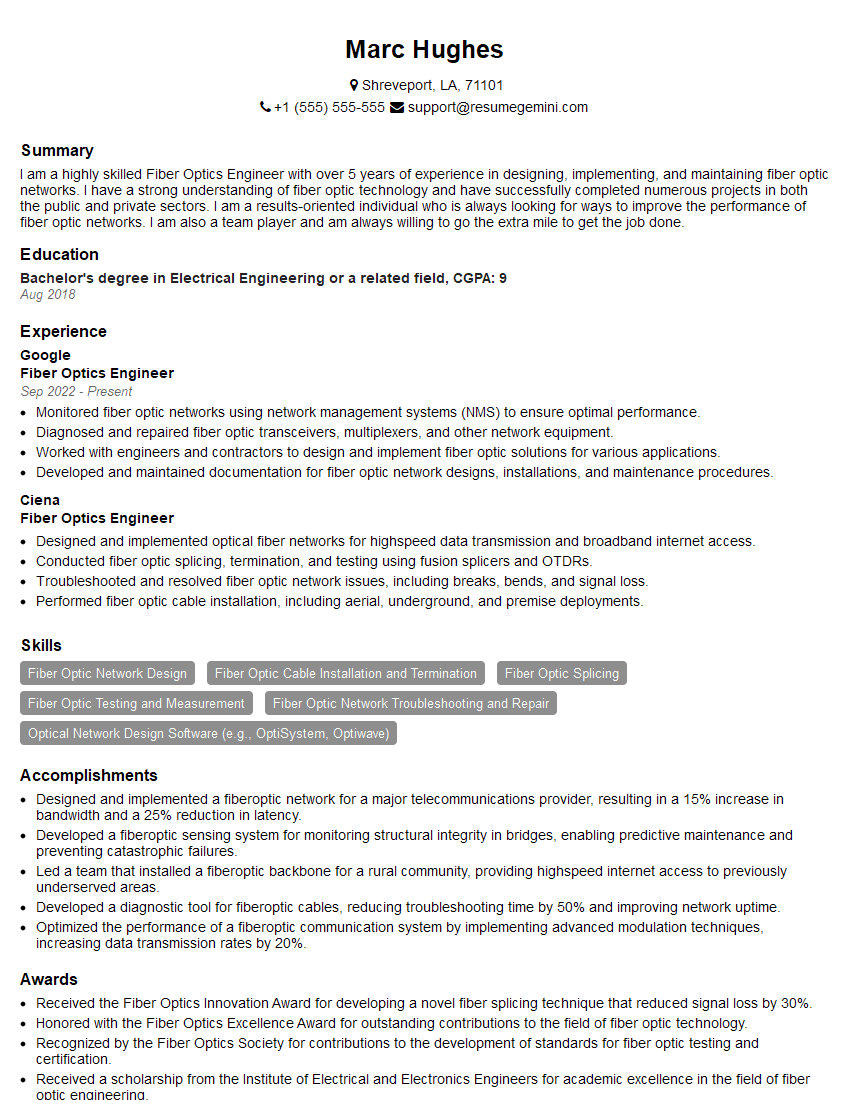
Mastering Fiber Optic Fabrication opens doors to exciting and rewarding careers in a rapidly growing field. The demand for skilled professionals in this area is high, making it a strategic choice for career growth. To maximize your job prospects, creating a strong, ATS-friendly resume is essential. ResumeGemini is a trusted resource to help you build a professional and impactful resume that highlights your skills and experience effectively. Examples of resumes tailored to Fiber Optic Fabrication are available to guide you. Invest time in crafting a compelling resume – it’s your first impression with potential employers.


Explore more articles
Users Rating of Our Blogs
Share Your Experience
We value your feedback! Please rate our content and share your thoughts (optional).
What Readers Say About Our Blog
Very informative content, great job.
good