Unlock your full potential by mastering the most common Fiber Optic Telecommunication Systems interview questions. This blog offers a deep dive into the critical topics, ensuring you’re not only prepared to answer but to excel. With these insights, you’ll approach your interview with clarity and confidence.
Questions Asked in Fiber Optic Telecommunication Systems Interview
Q 1. Explain the advantages of fiber optic communication over traditional copper-based systems.
Fiber optic communication offers significant advantages over traditional copper-based systems primarily due to its higher bandwidth capacity, longer transmission distances, and superior security. Think of it like this: copper is a narrow, easily congested highway, while fiber optics is a massive, multi-lane superhighway.
- Higher Bandwidth: Fiber optics can transmit significantly more data at much faster speeds than copper cables. This is because light signals, used in fiber optics, can carry much more information than electrical signals in copper. This is crucial for applications like high-definition video streaming and large data transfers.
- Longer Transmission Distances: Light signals in fiber experience far less attenuation (signal loss) than electrical signals in copper, allowing for transmission over much greater distances without the need for repeaters. This reduces infrastructure costs and complexity, especially in long-haul telecommunications.
- Immunity to Electromagnetic Interference (EMI): Unlike copper, fiber optic cables are not susceptible to EMI, which can cause signal degradation and data loss. This makes them ideal for use in environments with high levels of electromagnetic noise, such as industrial settings or near high-voltage power lines.
- Enhanced Security: Tapping into a fiber optic cable without detection is extremely difficult, making it a more secure option for transmitting sensitive data compared to copper cables.
For example, imagine deploying a network for a large city. Fiber optics would allow the seamless delivery of high-speed internet to numerous homes and businesses over a vast area, something that would be prohibitively expensive and complex with copper.
Q 2. Describe the different types of fiber optic cables and their applications.
Fiber optic cables come in various types, each suited for different applications. The key differences lie in their core composition and cladding materials, influencing their performance characteristics.
- Single-Mode Fiber (SMF): This type uses a very small core diameter, allowing only one mode of light to propagate. This results in low signal dispersion and enables long-distance, high-bandwidth transmission. Think of it like a single-lane highway optimized for speed.
- Multi-Mode Fiber (MMF): Multi-mode fiber has a larger core diameter, allowing multiple modes of light to propagate. This leads to higher signal dispersion, limiting transmission distances and bandwidth compared to SMF. It’s like a multi-lane highway, but with more traffic congestion reducing overall speed.
- Single-Mode Fiber with Dispersion-Shifting (DSF): This type of fiber compensates for chromatic dispersion – the spreading of light pulses due to different wavelengths traveling at slightly different speeds. It’s like having a highway with special lanes to manage traffic flow efficiently.
- Multi-Mode Fiber with graded-index profile (GI): The refractive index of the core gradually decreases from the center to the cladding, minimizing modal dispersion in MMF. Think of it as carefully designed lanes in a multi-lane highway, reducing congestion and improving speed.
SMF is typically used in long-haul telecommunications and high-bandwidth applications, while MMF is commonly used in shorter-distance applications like local area networks (LANs) or building infrastructure due to its lower cost.
Q 3. What are the common causes of signal attenuation in fiber optic systems?
Signal attenuation in fiber optic systems refers to the loss of optical power as the light signal travels through the fiber. Several factors contribute to this:
- Absorption: The fiber material itself absorbs some of the light energy. This is influenced by the fiber’s composition and the wavelength of the light.
- Scattering: Microscopic imperfections and impurities within the fiber cause light to scatter in different directions, reducing the power in the forward direction. This is particularly problematic in multi-mode fibers.
- Bending Losses: Sharp bends in the fiber cable increase scattering and can cause significant power loss. The tighter the bend, the greater the loss.
- Connectors and Splices: Imperfect connections between fiber optic cables introduce additional losses due to reflections, misalignments, and air gaps.
- Environmental Factors: Temperature fluctuations, pressure changes, and humidity can also affect attenuation.
Minimizing attenuation is crucial for ensuring reliable long-distance communication. Careful cable design, proper installation techniques, and high-quality connectors and splices are essential.
Q 4. How does a fiber optic splicer work, and what are the critical considerations for splicing?
A fiber optic splicer precisely aligns and fuses two fiber optic strands together, creating a seamless connection. The process typically involves:
- Fiber Preparation: Careful cleaning and stripping of the fiber’s protective coating to expose the optical fiber core is crucial.
- Cleaving: The fiber is precisely cleaved (broken) to create a perfectly flat and perpendicular end face, using a specialized cleaver for maximum light transmission.
- Aligning: The two cleaved fiber ends are accurately aligned using a precise mechanism, ensuring minimal misalignment.
- Fusion: An electric arc is used to melt and fuse the two fiber ends together, creating a strong and permanent bond.
Critical Considerations for Splicing:
- Precise Alignment: Even minor misalignment can lead to significant power loss.
- Cleanliness: Dust or debris can affect the quality of the splice.
- Fusion Quality: An improperly fused splice can be weak and prone to failure.
- Splice Loss Measurement: An OTDR (Optical Time-Domain Reflectometry) is typically used to measure the loss introduced by the splice.
Improper splicing can result in signal degradation, data loss, and ultimately, system failure. It’s essential for technicians to be highly skilled and use high-quality equipment.
Q 5. Explain the concept of Optical Time-Domain Reflectometry (OTDR) and its use in fiber optic testing.
Optical Time-Domain Reflectometry (OTDR) is a powerful tool used for testing and troubleshooting fiber optic cables. It works by sending short pulses of light into the fiber and analyzing the reflected light signals. The time it takes for the light to reflect back, along with the intensity of the reflected signal, provides information about the fiber’s characteristics and any faults along its length.
OTDR Applications:
- Fault Location: OTDR can pinpoint the location of breaks, bends, or other faults in the fiber.
- Attenuation Measurement: It can measure the amount of signal loss along the fiber, which can help identify weak points or aging fiber.
- Splice and Connector Loss: OTDR can measure the loss introduced by splices and connectors.
- Fiber Identification: It helps identify the type of fiber used.
Imagine a scenario where a network experiences a sudden outage. An OTDR can be used to quickly pinpoint the exact location of the fault, allowing for rapid repair and minimizing downtime. It’s an indispensable tool for maintaining the integrity of fiber optic networks.
Q 6. What are the different types of fiber optic connectors, and what are their characteristics?
Fiber optic connectors provide the means to physically connect two optical fibers together, allowing light signals to pass efficiently between them. Different types of connectors offer various advantages and disadvantages depending on the application.
- SC (Subscriber Connector): A simple and widely used connector with a push-pull mechanism. It’s relatively inexpensive and robust but can be susceptible to dust and debris.
- FC (Ferrule Connector): A threaded connector offering excellent precision and repeatability. It’s durable and less prone to dust contamination, favored in precision applications.
- LC (Lucent Connector): A smaller and more compact connector suitable for high-density applications. Its small size makes it ideal for space-constrained environments.
- ST (Straight Tip): An older connector with a bayonet-style coupling. While relatively robust, it’s less common than newer connector types.
- MT-RJ: A multi-fiber connector allowing for multiple fibers within a single connector body, significantly reducing the amount of physical space needed.
The choice of connector depends on various factors including the application, cost considerations, space availability, and desired level of performance. Careful connector selection and proper cleaning are vital for ensuring reliable optical connections.
Q 7. Describe the different types of optical amplification techniques used in fiber optic communication.
Optical amplification is crucial for overcoming signal attenuation in long-haul fiber optic systems. Several techniques are employed:
- Erbium-doped Fiber Amplifiers (EDFAs): These are the most widely used optical amplifiers. They use erbium-doped fiber to amplify light signals across a specific wavelength range, primarily the C and L bands (around 1550 nm). Imagine EDFAs as powerful repeater stations along the fiber optic highway, boosting the signal to maintain its strength over long distances.
- Raman Amplifiers: These amplifiers use stimulated Raman scattering to amplify the signal. They offer a broader amplification bandwidth compared to EDFAs and can be used in distributed configurations along the fiber, reducing the need for discrete amplifier locations.
- Semiconductor Optical Amplifiers (SOAs): These amplifiers use semiconductor materials to amplify optical signals. They are generally smaller and cheaper than EDFAs but have lower output power and can be more susceptible to noise.
The choice of amplification technique depends on factors such as the desired bandwidth, transmission distance, cost, and noise requirements. In many long-haul systems, a combination of EDFAs and other techniques is often used to optimize performance.
Q 8. What are the key performance indicators (KPIs) used to evaluate the performance of a fiber optic network?
Key Performance Indicators (KPIs) for fiber optic networks are crucial for assessing their health, efficiency, and overall performance. They’re broadly categorized into parameters related to signal quality, network availability, and operational efficiency.
Bit Error Rate (BER): This measures the frequency of errors in the transmitted data. A lower BER indicates better signal quality. A BER of 10-9 or lower is typically considered acceptable for high-quality data transmission.
Optical Signal-to-Noise Ratio (OSNR): This signifies the ratio of the optical signal power to the noise power. A higher OSNR indicates a cleaner signal, less susceptible to errors. Sufficient OSNR is vital for long-haul transmission.
Attenuation: This represents the loss of signal strength as it travels through the fiber. It’s typically measured in decibels per kilometer (dB/km). Excessive attenuation necessitates signal amplification.
Return Loss: This measures the amount of light reflected back towards the source. High return loss can cause instability and signal degradation. Minimizing reflections through proper connectorization is critical.
Network Availability: This indicates the percentage of time the network is operational. High availability is a top priority for mission-critical applications, often exceeding 99.999% uptime (five nines).
Mean Time Between Failures (MTBF): This measures the average time between failures in the network components. A higher MTBF indicates more reliable equipment.
Mean Time To Repair (MTTR): This is the average time taken to repair a network failure. A lower MTTR is desirable for faster service restoration.
Regular monitoring of these KPIs is essential for proactive maintenance, identifying potential issues before they impact service, and ensuring optimal network performance.
Q 9. Explain the principles of wavelength division multiplexing (WDM).
Wavelength Division Multiplexing (WDM) is a technology that allows multiple optical signals (different wavelengths of light) to be transmitted simultaneously over a single optical fiber. Think of it like a highway with multiple lanes, each carrying different traffic (data) at the same time. This drastically increases the capacity of the fiber optic cable.
The principle lies in using different wavelengths of light within the optical fiber’s transmission window. Each wavelength carries an independent data stream. This is achieved using specialized components such as multiplexing and demultiplexing devices. Multiplexers combine the individual wavelengths into a single fiber, and demultiplexers separate them at the receiving end.
There are two main types of WDM:
Coarse WDM (CWDM): Uses a wider spacing between wavelengths, making it simpler and less expensive but with lower channel density.
Dense WDM (DWDM): Employs narrower wavelength spacing, allowing for a significantly larger number of channels and higher overall capacity, but requires more sophisticated equipment.
WDM is fundamental to modern high-capacity long-haul and metropolitan fiber optic networks, enabling efficient use of fiber infrastructure and supporting the ever-growing demand for bandwidth.
Q 10. Describe the various types of optical transceivers and their applications.
Optical transceivers are the crucial interfaces that convert electrical signals to optical signals (transmitting) and vice versa (receiving). They are the ‘eyes’ of the fiber optic network. Various types exist, categorized by their form factor, data rate, and wavelength.
SFP (Small Form-factor Pluggable): Compact, hot-swappable transceivers commonly used in data centers and enterprise networks. Various SFP types exist supporting different speeds and wavelengths (e.g., SFP-1G, SFP+, SFP28).
SFP+ (Enhanced Small Form-factor Pluggable): Offers higher data rates compared to SFP, often supporting 10 Gigabit Ethernet.
XFP (10 Gigabit Small Form-factor Pluggable): Another high-speed transceiver supporting up to 10 Gbps, often used in high-performance networks.
QSFP (Quad Small Form-factor Pluggable): Supports multiple channels, often used for 40 Gigabit Ethernet and beyond. A QSFP28 supports 100 Gbps, offering exceptional bandwidth.
CFP (C form-factor Pluggable): Larger than SFP, used for 100 Gbps and higher data rates, commonly used in high-capacity long-haul networks.
The application of each type depends on the network requirements. For instance, SFPs might be suitable for lower-speed LAN connections, while QSFP28 or CFPs are necessary for high-speed data centers or long-haul communication.
Q 11. What are the safety precautions you must take while working with fiber optic cables?
Working with fiber optic cables requires strict adherence to safety protocols to avoid eye injuries and other hazards.
Eye Protection: Always wear appropriate laser safety eyewear designed to protect against the specific wavelengths used in your system. Never look directly into the end of a fiber optic cable, even if it appears dark. Even low-power lasers can cause irreversible eye damage.
Cable Handling: Handle fibers carefully to avoid sharp edges that could cause cuts. Use proper tools for stripping and cleaning fibers.
Fiber Cleaving: Use cleavers designed for fiber optics to create a smooth end face. Improper cleaving can result in poor connection and signal degradation.
Connectorization: Use appropriate tools and techniques for proper connector termination. Faulty connectors can create reflective surfaces that result in high return loss.
Work Area: Maintain a clean and well-lit work area to avoid accidental cuts or damage to the fibers.
Laser Safety Training: Receive formal training on laser safety procedures before working with fiber optic systems involving lasers.
Neglecting these precautions can lead to serious injury. Always follow manufacturer’s instructions and established safety guidelines.
Q 12. Explain the concept of chromatic dispersion and its impact on fiber optic systems.
Chromatic dispersion is a phenomenon in fiber optic communication where different wavelengths of light travel at slightly different speeds within the fiber. This leads to pulse broadening and ultimately limits the transmission distance and data rate. Imagine a group of runners (different wavelengths) running a race on a track with slightly different terrains. Some runners will reach the finish line faster than others, causing the group to spread out.
There are two main types:
Material Dispersion: This results from the dependence of the refractive index of the fiber material on the wavelength of light. Different wavelengths experience different refractive indices leading to speed differences.
Waveguide Dispersion: This arises from the geometry of the fiber’s core and cladding. Different wavelengths propagate at different speeds due to the variation in the waveguide structure.
Chromatic dispersion causes intersymbol interference (ISI), where pulses from adjacent bits overlap, making it difficult to distinguish individual bits. This limits the bandwidth and transmission distance of the system. Techniques like Dispersion Compensating Fibers (DCF) and advanced modulation formats mitigate the effects of chromatic dispersion.
Q 13. How does polarization mode dispersion (PMD) affect fiber optic transmission?
Polarization Mode Dispersion (PMD) occurs when different polarization states of light travel at different speeds within the optical fiber. Think of polarized sunglasses; they allow light of a specific polarization to pass through. In a fiber, imperfections in the fiber’s structure cause different polarization modes to travel at varying speeds, leading to pulse broadening and distortion.
This is particularly problematic because unlike chromatic dispersion, PMD is random and varies with time and temperature. This makes it harder to predict and compensate for. It can lead to signal degradation and increased bit error rates, especially in long-haul systems.
Mitigation techniques include the use of polarization-maintaining fibers, polarization-diversity receivers, and advanced signal processing techniques.
Q 14. What are the different types of fiber optic testing equipment?
Fiber optic testing equipment is essential for maintaining the integrity and performance of fiber optic networks. These tools provide critical information about the quality of the fiber, connections, and the overall signal strength.
Optical Power Meters (OPMs): These measure the power level of an optical signal at various points in the network, helping to identify attenuation and signal loss.
Optical Time-Domain Reflectometers (OTDRs): These instruments send pulses of light into the fiber and analyze the reflected light to identify faults, breaks, and connector quality within the fiber. They can pinpoint the location of problems along the cable.
Optical Spectrum Analyzers (OSAs): These are used to analyze the wavelengths present in an optical signal. They are crucial in WDM systems for identifying individual wavelengths and verifying their power levels.
Fiber Identifiers: These tools are used to identify the type of fiber and verify its integrity.
Visual Fault Locators (VFLs): These devices inject light into the fiber, making it possible to visually inspect the fiber for bends, breaks, and other physical damage.
The choice of testing equipment depends on the specific needs of the network and the type of testing required. Regular testing using these tools is vital for ensuring reliable and high-performance fiber optic networks.
Q 15. Explain the process of troubleshooting a fiber optic network failure.
Troubleshooting a fiber optic network failure involves a systematic approach, much like detective work. We need to pinpoint the exact location and cause of the disruption. The process typically begins with identifying the symptoms – is the entire network down, or just a portion? Are there specific services affected?
Next, I’d utilize optical power meters and OTDRs (Optical Time Domain Reflectometers). An OTDR sends light pulses down the fiber and analyzes the reflections, revealing breaks, splices, and connector issues. Power meters measure the optical signal strength at various points, helping to isolate the problem area. For example, a significant power drop between two points indicates a potential fault within that segment.
- Visual Inspection: Carefully examine the physical connections, looking for damage to cables, connectors, or equipment.
- Testing with OTDR: This identifies the location of faults (breaks, macrobends, connector issues).
- Power Meter Measurements: Measures the signal strength at different points to pinpoint signal loss locations.
- Network Management System (NMS) Data: NMS usually provides alarm notifications and network health statistics.
- Troubleshooting at the Patch Panel: Often problems lie here. Visual check and testing of individual connections is critical.
Once the problem area is located, I’d proceed with the appropriate repair or replacement. This might involve splicing broken fibers, cleaning or replacing connectors, or even replacing damaged cable sections. Thorough testing after repairs is essential to ensure the network is fully restored and functioning optimally.
Career Expert Tips:
- Ace those interviews! Prepare effectively by reviewing the Top 50 Most Common Interview Questions on ResumeGemini.
- Navigate your job search with confidence! Explore a wide range of Career Tips on ResumeGemini. Learn about common challenges and recommendations to overcome them.
- Craft the perfect resume! Master the Art of Resume Writing with ResumeGemini’s guide. Showcase your unique qualifications and achievements effectively.
- Don’t miss out on holiday savings! Build your dream resume with ResumeGemini’s ATS optimized templates.
Q 16. How would you design a fiber optic network for a large building or campus?
Designing a fiber optic network for a large building or campus requires careful planning and consideration of several factors, including the building’s layout, the number of users, the required bandwidth, and future scalability. I’d begin with a thorough site survey to map out potential cable routes and identify any obstacles.
The design would likely utilize a star topology, with a central distribution point (often a main distribution frame or MDF) connecting to various intermediate distribution frames (IDFs) located throughout the building. This allows for efficient management and easier troubleshooting.
Fiber type selection (single-mode for long distances and high bandwidth, multi-mode for shorter distances) is critical, as is careful cable routing to minimize bends and potential signal loss. A redundant design, incorporating multiple paths between key locations, would ensure high availability and resilience against failures.
Capacity planning is also vital. The design must account for current needs and project future growth, often overprovisioning to accommodate future expansion without requiring extensive re-cabling. Detailed documentation of the network design, including cable routes, fiber types, and connection points, is crucial for future maintenance and troubleshooting.
Example: A large university campus might utilize a ring topology to provide redundancy, with different buildings connected via fiber rings to allow for multiple paths and increased resilience.Q 17. Describe your experience with different types of fiber optic installation techniques.
My experience encompasses a variety of fiber optic installation techniques. I’ve worked with both aerial and underground installations.
- Aerial Installations: This involves suspending fiber optic cables from poles or towers, often using specialized clips and hardware. Careful consideration is needed to protect the cables from weather conditions and potential damage. Ensuring proper strain relief at termination points is crucial.
- Underground Installations: This requires using protective conduits to shield cables from environmental factors and potential damage. Proper trenching, cable laying techniques, and backfilling are essential. We often use microducting for easier cable pulling and future expansions.
- Indoor Installations: This involves running cables through walls, ceilings, and floors. Careful planning is needed to avoid disruptive construction and ensure proper cable management within the building. We use cable trays and pathways to organize and protect the cables.
- Building Entrance/Exit: Proper sealing and protection at the building entrance and exits are critical to prevent water ingress and damage.
I’m proficient in using various tools for these installations, including cable pullers, fusion splicers, and testing equipment. Safety is always paramount – following all relevant safety procedures and using appropriate personal protective equipment (PPE) is essential.
Q 18. What is the difference between single-mode and multi-mode fiber?
The core difference lies in the core size and the light propagation characteristics. Single-mode fiber has a much smaller core diameter (around 9 microns) compared to multi-mode fiber (50/125 microns or 62.5/125 microns). This smaller core in single-mode fiber allows only one mode of light propagation, resulting in less signal attenuation and higher bandwidth over longer distances.
Single-Mode Fiber: Ideal for long-haul applications, high-bandwidth networks, and long distances (tens or hundreds of kilometers). Uses a single light path and is less susceptible to modal dispersion.
Multi-Mode Fiber: Suitable for shorter distances (up to 2 kilometers) and lower bandwidth applications. Allows multiple light paths, leading to more signal dispersion and attenuation over long distances.
Think of it like this: A single-lane highway (single-mode) allows for faster speeds and less congestion over long distances, while a multi-lane highway (multi-mode) is great for shorter trips but can get congested with increased traffic.
Q 19. Explain the concept of optical power budget and its importance in fiber optic system design.
The optical power budget is the difference between the transmitted optical power and the minimum received power needed for reliable signal reception. It represents the total power loss allowed in a fiber optic system, accounting for attenuation in the fiber, connector losses, and splice losses.
It’s crucial in fiber optic system design because it ensures sufficient signal strength reaches the receiver. A properly calculated budget prevents signal degradation and ensures reliable communication. If the power budget is exceeded, resulting in excessive losses, the signal will be too weak to be properly interpreted by the receiver, leading to errors and system failures.
Calculating the power budget involves considering various factors: the transmitter power, receiver sensitivity, fiber attenuation, connector losses, and splice losses. Each component contributes to the overall loss, and the budget must accommodate these losses to guarantee a reliable signal at the receiver. For instance, longer distances require a higher power budget due to increased fiber attenuation.
Q 20. Describe the different types of fiber optic connectors and their applications.
Several fiber optic connectors are commonly used, each with its strengths and applications:
- SC (Subscriber Connector): A popular connector known for its push-pull design and simple mechanical construction. Widely used in various applications.
- FC (Ferrule Connector): Features a threaded coupling mechanism for secure connections, often preferred in applications requiring high reliability and stability.
- LC (Lucent Connector): A smaller and more compact connector, increasingly favored for high-density applications. Its compact size enables higher port density.
- ST (Straight Tip Connector): A bayonet-style connector, offering easy insertion and removal. Although once popular, its use has diminished with newer connectors’ emergence.
- MT-RJ (Multiple-fiber RJ): Connects multiple fibers in a single connector, allowing for efficient space saving.
The choice of connector depends on factors such as application requirements (long-haul vs. short-haul), environmental conditions, and cost considerations. For example, in a data center, LC connectors are often favored due to their small size and high density, whereas SC connectors might be preferred in outside plant applications due to their robust construction.
Q 21. How do you ensure the quality of the fiber optic cable during installation?
Ensuring the quality of fiber optic cable during installation is paramount for a reliable network. This involves several steps:
- Careful Handling: Avoid excessive bending or twisting of the cables which could cause microbends and signal degradation. Use proper cable handling techniques.
- Proper Storage: Store cables in a dry, clean environment, protecting them from moisture and extreme temperatures.
- Visual Inspection: Inspect the cable for any damage before, during, and after installation. Look for scratches, cuts, or other physical damage.
- Cleanliness: Maintaining cleanliness is crucial. Contamination at connectors can significantly affect signal transmission. Use appropriate cleaning tools before connecting fibers.
- Testing and Certification: OTDR testing and optical loss testing after installation to ensure the cable meets specifications.
- Splice Quality: If splicing is required, use a proper fusion splicer to create high-quality splices. Visual inspection and testing of splices are essential.
- Documentation: Maintain detailed records of cable routes, splice locations, and testing results.
By adhering to these procedures, I can significantly reduce the risk of failures, ensuring a high-quality fiber optic installation that will provide reliable performance for years to come.
Q 22. What are the different types of fiber optic losses and how to mitigate them?
Fiber optic losses are the reduction in the optical signal’s power as it travels through the fiber. These losses can significantly impact the performance and range of a fiber optic system. There are several types, primarily:
- Attenuation: This is the gradual weakening of the signal due to absorption and scattering of light within the fiber. Absorption occurs when the fiber material absorbs some of the light’s energy, while scattering happens when light is deflected from its path due to imperfections in the fiber’s structure or impurities. This is the most common type of loss and is usually expressed in decibels per kilometer (dB/km).
- Bending Losses: Excessive bending of the fiber can introduce significant losses. Sharp bends can cause light to leak out of the fiber core. Macrobending refers to large-scale bends, while microbending is caused by microscopic irregularities in the fiber’s structure or pressure on the cable.
- Splice Losses: These losses occur at the connection points (splices) between different fiber optic segments. Imperfect alignment or air gaps between the fibers lead to light leakage and signal loss. Careful fusion splicing minimizes these losses.
- Connector Losses: Similar to splice losses, these occur at the connection between the fiber and other equipment (e.g., transceivers). Poor connector quality and misalignment are the primary causes.
Mitigation Strategies:
- Choosing the right fiber type: Single-mode fibers generally have lower attenuation than multi-mode fibers, especially over longer distances.
- Careful cable handling and installation: Avoiding sharp bends and excessive stress during installation is crucial to minimize bending losses.
- Precise splicing and connectorization: Proper training and high-quality equipment are essential for minimizing splice and connector losses. Fusion splicing is generally preferred over mechanical splicing for its low loss.
- Optical amplifiers: These devices amplify the optical signal to compensate for attenuation losses, enabling longer transmission distances.
- Regular maintenance and testing: Periodic testing and inspection of the fiber optic link can help detect and address potential problems before they significantly impact performance.
For example, in a long-haul submarine cable system, minimizing attenuation is paramount. This necessitates using high-quality single-mode fiber, precise splicing techniques, and strategically placed optical amplifiers.
Q 23. Explain the concept of bit error rate (BER) in fiber optic communications.
Bit error rate (BER) is a crucial performance metric in fiber optic communications. It represents the ratio of the number of bits received in error to the total number of bits transmitted. A lower BER indicates better system performance and higher data integrity.
Think of it like this: Imagine sending a message across a river using stones representing bits. Some stones might be lost or misinterpreted during transmission. The BER would be the number of misinterpreted stones divided by the total number of stones thrown. A low BER means most stones arrive safely and accurately, while a high BER means the message is likely to be corrupted.
BER is usually expressed as a probability, for instance, 10-9, which means one bit error for every billion bits transmitted. Acceptable BER levels depend on the application; demanding applications like high-definition video streaming require exceptionally low BERs (e.g., below 10-12).
Several factors contribute to a high BER, including: attenuation, noise (e.g., thermal noise, shot noise), dispersion, and non-linear effects. Monitoring BER allows for timely identification of issues and helps ensure data reliability.
Q 24. What is the role of an optical amplifier in a long-haul fiber optic system?
Optical amplifiers are essential components in long-haul fiber optic systems, acting as repeaters that boost the optical signal’s power without converting it to an electrical signal first. This is crucial because optical-electrical-optical (OEO) conversion introduces noise and limits transmission distances.
In a long-haul system spanning hundreds or thousands of kilometers, the optical signal weakens significantly due to attenuation. Optical amplifiers, typically erbium-doped fiber amplifiers (EDFAs), strategically placed along the fiber path, counteract this attenuation by amplifying the optical signal directly. This allows for longer transmission reaches with minimal signal degradation.
EDFAs work by stimulating emission of photons within the erbium-doped fiber using a pump laser. This amplifies the signal passing through the fiber. The amplified signal continues along the fiber until another amplifier is needed. This process avoids the limitations and signal degradation of OEO conversion methods used in traditional repeater systems.
Imagine a relay race: The optical signal is like the baton, and the optical amplifiers are like the runners who refresh the runner’s energy (signal strength) without stopping the race (data transmission).
Q 25. What are the challenges of deploying fiber optic cables in different environments (e.g., underground, aerial)?
Deploying fiber optic cables in different environments presents unique challenges.
- Underground Deployment: Challenges include:
- Excavation and trenching: This can be time-consuming, expensive, and disruptive, especially in urban areas. Careful planning and efficient trenching techniques are essential.
- Ground conditions: Rocky or waterlogged soil can make trenching difficult and increase the risk of cable damage. Specialized equipment and techniques may be needed.
- Rodent damage: Rodents can gnaw on the cable, causing significant damage and service disruptions. Protective conduits or cable jackets can mitigate this risk.
- Environmental concerns: Minimizing the environmental impact during excavation and cable laying is crucial.
- Aerial Deployment: Challenges include:
- Weather conditions: High winds, ice, and snow can damage the cables or make installation difficult. Sturdy cable support structures and weather-resistant cable jackets are crucial.
- Accessibility: Reaching remote or challenging terrain can be difficult and expensive. Helicopters or other specialized equipment may be needed.
- Security concerns: Aerial cables are vulnerable to theft or vandalism. Proper security measures are necessary to protect the cables.
- Visual impact: The visual impact of aerial cables on the landscape needs to be considered and minimized.
Careful planning, specialized equipment, and adherence to safety standards are crucial for successful fiber optic cable deployment in any environment.
Q 26. Describe your experience with different fiber optic network management systems.
Throughout my career, I’ve worked with various fiber optic network management systems (NMS), ranging from vendor-specific solutions to open-source platforms. My experience includes using NMS for tasks such as:
- Performance monitoring: Tracking key performance indicators (KPIs) like BER, optical signal-to-noise ratio (OSNR), and attenuation to ensure the network’s health and identify potential issues.
- Fault management: Locating and troubleshooting faults using the NMS’s alarm management and diagnostic capabilities. This often involves analyzing optical parameters and tracing the fault to a specific location on the network.
- Configuration management: Managing the configuration of network devices like optical amplifiers, multiplexers, and switches. This ensures consistent network operation and simplifies maintenance.
- Inventory management: Maintaining a detailed inventory of all network components, their locations, and their specifications.
- Security management: Implementing security measures to protect the network from unauthorized access and cyber threats. This involves access control, encryption, and intrusion detection.
I’m proficient in using both command-line interfaces and graphical user interfaces for NMS, and I’m familiar with various protocols like SNMP, Telnet, and SSH used for network management. I also have experience working with different NMS databases and creating custom reports to analyze network performance and identify trends.
For example, in one project, I utilized an NMS to detect a recurring pattern of high BER in a specific segment of a long-haul network. By analyzing the data provided by the NMS, I was able to pinpoint a faulty optical amplifier causing the problem, resulting in timely repairs and preventing potential service disruptions.
Q 27. What are your thoughts on the future trends in fiber optic communication technology?
The future of fiber optic communication technology is bright, with several exciting trends on the horizon:
- Increased Bandwidth: The demand for higher bandwidth is constantly growing, driven by the increasing adoption of high-bandwidth applications like 4K/8K video streaming and cloud computing. This trend will continue to push innovation in fiber optic technologies, leading to the development of new fiber types and transmission techniques that can support even higher data rates.
- Software-Defined Networking (SDN) and Network Function Virtualization (NFV): SDN and NFV are transforming the way networks are designed, managed, and operated. These technologies will allow for greater flexibility, scalability, and automation in fiber optic networks.
- Space Division Multiplexing (SDM): SDM allows multiple signals to be transmitted over a single fiber using different spatial modes. This technique has the potential to significantly increase the capacity of existing fiber optic infrastructure.
- Coherent Optical Transmission: Advanced modulation formats and digital signal processing techniques are improving the efficiency and spectral efficiency of optical transmission systems. Coherent optical technology plays a vital role in increasing the capacity and reach of long-haul fiber optic links.
- Integration with other technologies: Fiber optics are increasingly being integrated with other technologies like 5G and satellite communications to create hybrid networks that provide seamless connectivity.
I believe that the combination of these trends will lead to a dramatic increase in the capacity and reach of fiber optic networks, creating a foundation for future advancements in communication and information technology.
Key Topics to Learn for Fiber Optic Telecommunication Systems Interview
- Optical Fiber Principles: Understanding light propagation, modal dispersion, chromatic dispersion, and attenuation in optical fibers. Practical application: Analyzing signal degradation over different fiber types and lengths.
- Optical Sources and Detectors: Familiarize yourself with the characteristics and operation of lasers (e.g., Fabry-Perot, DFB) and photodetectors (e.g., PIN, APD). Practical application: Choosing appropriate components for specific system requirements (e.g., data rate, distance).
- Optical Amplifiers: Study the principles and applications of Erbium-doped fiber amplifiers (EDFAs) and Raman amplifiers. Practical application: Designing long-haul optical communication systems.
- Optical Transmission Systems: Gain a deep understanding of WDM (Wavelength-Division Multiplexing), DWDM (Dense WDM), and their applications in modern networks. Practical application: Optimizing network capacity and bandwidth utilization.
- Optical Network Components: Become familiar with key components such as optical splitters, couplers, multiplexers, and demultiplexers. Practical application: Troubleshooting network issues and optimizing system performance.
- Optical Network Architectures: Explore different network topologies (e.g., ring, mesh, star) and their suitability for various applications. Practical application: Designing and implementing robust and scalable optical networks.
- Network Management and Monitoring: Understanding techniques for monitoring optical network performance, including optical signal-to-noise ratio (OSNR) and bit error rate (BER). Practical application: Proactive identification and resolution of network faults.
- Fiber Optic Cable Installation and Splicing: Understanding the practical aspects of fiber optic cable deployment and connection techniques. Practical application: Ensuring the integrity and reliability of optical links.
- Troubleshooting and Maintenance: Develop problem-solving skills to identify and resolve issues in fiber optic systems. Practical application: Diagnosing faults using OTDR (Optical Time Domain Reflectometer) and other testing equipment.
Next Steps
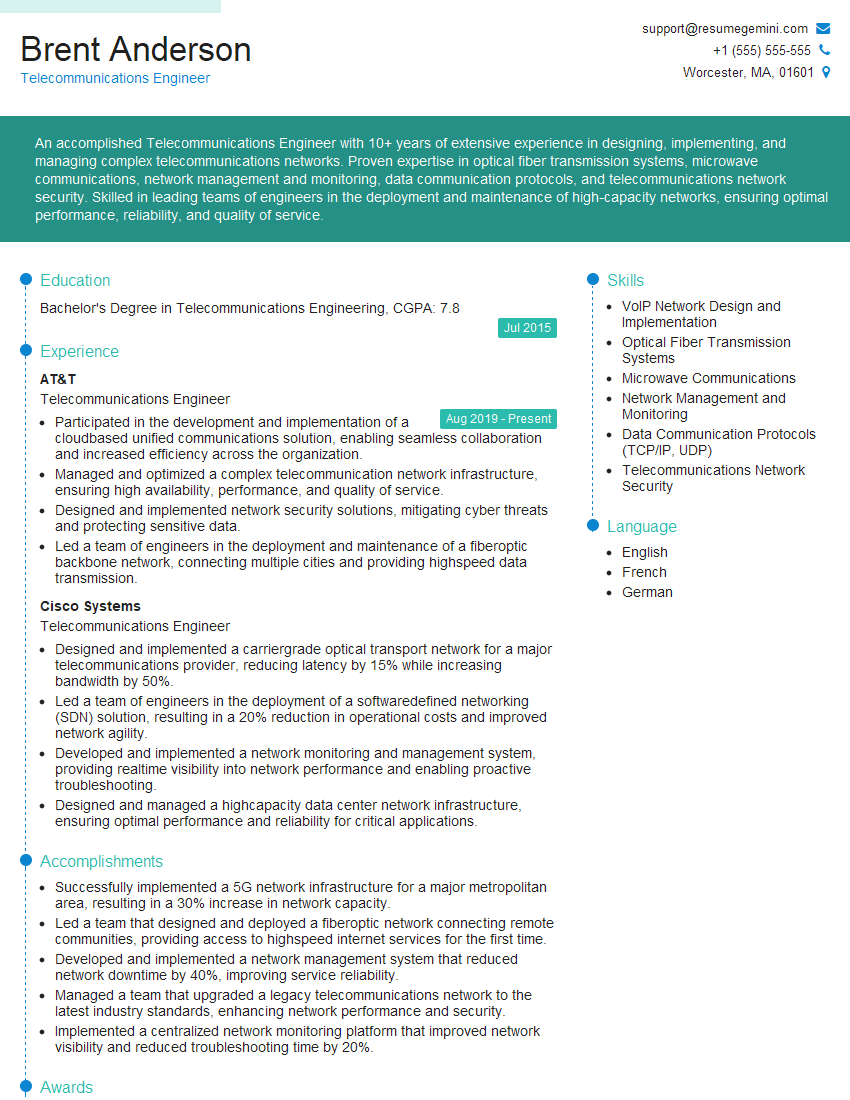
Mastering Fiber Optic Telecommunication Systems opens doors to exciting and rewarding careers in a rapidly growing industry. A strong understanding of these technologies is highly valued by employers, leading to greater job opportunities and career advancement. To significantly enhance your job prospects, it’s crucial to create an ATS-friendly resume that effectively highlights your skills and experience. ResumeGemini is a trusted resource that can help you build a professional and impactful resume tailored to the specific requirements of the Fiber Optic Telecommunication Systems field. Examples of resumes tailored to this industry are available to help you get started.

Explore more articles
Users Rating of Our Blogs
Share Your Experience
We value your feedback! Please rate our content and share your thoughts (optional).
What Readers Say About Our Blog
Very informative content, great job.
good