Interviews are more than just a Q&A session—they’re a chance to prove your worth. This blog dives into essential Fire Control and Target Acquisition interview questions and expert tips to help you align your answers with what hiring managers are looking for. Start preparing to shine!
Questions Asked in Fire Control and Target Acquisition Interview
Q 1. Explain the difference between active and passive targeting systems.
Active and passive targeting systems differ fundamentally in how they detect and acquire targets. Think of it like this: active systems are like shining a flashlight to find something in the dark, while passive systems are like using your night vision to see what’s already emitting light.
Active targeting systems emit energy (e.g., radar, laser) to illuminate the target and then receive the reflected energy to determine its location, range, and velocity. Radar systems, for example, transmit radio waves; the reflected waves are analyzed to generate a target’s characteristics. This provides a clear picture even in adverse weather, but it also reveals the system’s position to the enemy.
Passive targeting systems rely on detecting energy naturally emitted or reflected by the target, such as infrared (heat) radiation or radio waves. Infrared sensors, commonly used in night vision, detect the heat signature of a target. This method is stealthy – you’re not broadcasting your position – but it can be affected by environmental factors like weather and camouflage.
In essence, active systems offer superior range and performance in many conditions, but at the cost of revealing one’s position. Passive systems are stealthier but generally have limitations in range and accuracy.
Q 2. Describe the process of target acquisition from sensor detection to weapon engagement.
Target acquisition is a multi-stage process, starting with sensor detection and culminating in weapon engagement. It’s a systematic approach involving several critical steps.
- Sensor Detection: Sensors (radar, infrared, electro-optical) detect potential targets within their range and field of view. Think of it as the initial ‘sighting’ of something.
- Target Identification: The detected signal is analyzed to determine if it is a genuine target or just clutter (e.g., trees, buildings). This involves analyzing size, shape, movement, and other characteristics to confirm the target’s identity.
- Target Location: Precise coordinates (range, bearing, elevation) of the target are determined. Techniques like triangulation or radar range-finding are used.
- Target Tracking: Once located, the target’s movement is continuously tracked to predict its future position. This is crucial for accurate weapon engagement.
- Weapon Solution: The fire control system calculates the necessary weapon parameters (aiming angles, firing time) to hit the moving target, compensating for factors like wind, gravity, and target motion.
- Weapon Engagement: The weapon is fired based on the calculated solution. This includes trigger pull (or launch) and the weapon’s guidance system taking over to ensure accuracy.
The entire process is often automated and happens within fractions of a second in modern systems, but human intervention may be required for complex scenarios or final authorization.
Q 3. What are the key components of a fire control system?
A fire control system is the brain of a weapon system, ensuring accurate and effective targeting and engagement. Key components include:
- Sensors: These acquire information about the target (e.g., radar, infrared, laser rangefinder). Think of these as the eyes and ears of the system.
- Computer: The central processing unit that processes sensor data, calculates the weapon solution, and controls actuators.
- Actuators: These adjust the weapon’s aiming mechanism (e.g., gun mounts, missile launchers) to the calculated solution. They’re the ‘muscles’ of the system.
- Weapon: The actual weapon system (e.g., gun, missile, rocket launcher) employed to engage the target.
- User Interface: The display and control devices that allow the operator to interact with the system and monitor the engagement process.
A modern fire control system also incorporates advanced algorithms for target tracking, prediction, and automatic engagement, significantly enhancing its accuracy and effectiveness.
Q 4. Explain the concept of ‘kill probability’ and its significance.
Kill probability (Pk) is a statistical measure representing the likelihood of successfully destroying or neutralizing a target with a single weapon shot or engagement. It’s a critical metric in weapon system design and operational analysis.
Pk considers various factors such as the weapon’s accuracy, the target’s vulnerability, and environmental conditions. For example, a high-explosive round might have a lower Pk against a heavily armored target compared to a shaped-charge warhead. Similarly, adverse weather can decrease Pk.
The significance of Pk lies in its influence on strategic planning and resource allocation. Higher Pk implies fewer weapons are needed to achieve a desired level of target destruction, saving costs and resources. It is a key factor considered during weapon system selection and mission planning. A system with a higher Pk is preferred, all other factors being equal.
Q 5. How do environmental factors (weather, terrain) affect target acquisition and fire control?
Environmental factors significantly impact target acquisition and fire control. Think of trying to hit a target in a blizzard versus a clear sunny day – it’s a completely different ballgame.
- Weather: Fog, rain, snow, and dust reduce sensor visibility, obscuring the target and degrading sensor performance. Strong winds affect projectile trajectory, requiring corrections in fire control calculations.
- Terrain: Mountains, valleys, and forests can obstruct sensor lines of sight, preventing target detection or creating false targets due to reflections. Terrain also influences projectile flight paths, making precise calculations more complex.
Fire control systems incorporate algorithms to compensate for environmental effects as much as possible. For example, radar systems use sophisticated signal processing to filter out clutter and improve target detection in adverse weather, while ballistic calculators adjust for wind and terrain elevation. However, severe conditions always pose significant challenges.
Q 6. Describe different types of fire control algorithms and their applications.
Several fire control algorithms are used, each tailored to specific applications and weapon systems.
- Proportional Navigation (PN): Commonly used in missile guidance, PN calculates steering commands based on the relative velocity between the missile and the target. It’s effective against maneuvering targets.
- Lead Angle Calculation: For guns firing projectiles with a significant flight time, lead angle calculations predict the future position of a moving target to compensate for the time it takes for the projectile to reach the target.
- Kalman Filtering: This advanced algorithm uses statistical methods to estimate the target’s state (position, velocity) by integrating sensor data and dynamic models. It’s robust against noisy sensor data and effective in tracking targets with erratic movements.
- Predictive Algorithms: These algorithms use past target trajectories to predict future positions, especially valuable for maneuvering targets and those difficult to continuously track.
The choice of algorithm depends on the weapon system, target characteristics, and the available sensor data. Many modern fire control systems employ a combination of algorithms to maximize accuracy and robustness.
Q 7. Explain the role of sensor fusion in improving target acquisition accuracy.
Sensor fusion is the process of combining data from multiple sensors to obtain a more accurate and comprehensive understanding of the target and its environment. Think of it like having multiple witnesses describing the same event – combining their accounts provides a more accurate picture than any single account alone.
In target acquisition, sensor fusion significantly improves accuracy by:
- Reducing Uncertainty: Combining data from different sensors reduces errors and uncertainties associated with individual sensors. For example, combining radar range data with infrared imagery provides more reliable target location and identification.
- Improving Target Discrimination: By integrating information from various sensors (e.g., radar, infrared, electro-optical), the system can more effectively discriminate between true targets and clutter, improving identification and reducing false alarms.
- Enabling All-Weather Capability: Fusion allows systems to function effectively even in challenging environmental conditions. Radar data can compensate for limited optical visibility in fog or rain.
Sensor fusion is crucial in modern fire control systems, enabling more accurate target acquisition, tracking, and engagement, particularly in complex and demanding operational scenarios.
Q 8. What are the limitations of different targeting sensors (e.g., radar, electro-optical)?
Targeting sensors, crucial for fire control, each have strengths and weaknesses. Let’s examine radar and electro-optical (EO) systems.
Radar excels in all-weather operation, detecting targets at long ranges, even through smoke or fog. However, its resolution can be relatively low, making precise target identification challenging. Radar is also susceptible to jamming and clutter – unwanted reflections from the environment, like rain or mountains, can mask the target signal. Think of trying to hear a whisper in a crowded room; the radar’s ‘whisper’ (the target’s signal) might be drowned out by the ‘crowd’ (clutter).
Electro-optical (EO) sensors, including thermal imagers and cameras, offer high-resolution imagery for excellent target identification. They’re particularly effective at short to medium ranges and can distinguish details like vehicle type or troop formations. However, EO systems are strongly affected by weather conditions like fog, rain, or darkness. They also often have a limited range compared to radar.
Consider a scenario: during a nighttime operation, EO sensors might be useless in thick fog, while radar could still detect a distant armored column, although identifying specific vehicle types would be difficult. A combined approach, using both radar for initial detection and EO for detailed identification, represents a robust solution.
Q 9. How does GPS technology impact target acquisition and fire control?
GPS technology revolutionized target acquisition and fire control by providing accurate real-time location data. Before widespread GPS adoption, determining precise target coordinates often involved complex surveying and triangulation. Now, GPS enables weapons systems to receive their own location and the location of the target with remarkable precision.
This accuracy improves targeting by simplifying calculations for projectile trajectory and compensating for external factors like wind and projectile drift. Imagine firing an artillery shell: GPS provides the system with the precise coordinates of both the gun and the target, allowing for highly accurate fire adjustments and minimizing the number of rounds needed to achieve a hit.
Further, GPS allows for networked targeting. Multiple platforms, such as UAVs and ground units, can share target data in real-time, improving situational awareness and coordinating attacks. This collaborative targeting dramatically increases effectiveness and reduces friendly fire incidents.
Q 10. Discuss the importance of data link communication in a fire control system.
Data link communication is the nervous system of a modern fire control system, enabling the seamless flow of information between various components and platforms. It’s essential for coordinating actions, sharing intelligence, and ensuring that everyone has the same picture of the battlefield.
Consider a scenario involving a naval engagement: The ship’s radar detects an enemy vessel. This information is transmitted via data link to the fire control system which then calculates the targeting solution. Simultaneously, information about the ship’s own position and motion, as well as environmental data, is fed into the system via the data link. The calculated firing solution is then transmitted back to the weapon system, leading to an accurate shot. Beyond that, the system might also feed the targeting data to other platforms (air support, friendly vessels), improving coordinated fire.
The importance of reliable data link communication cannot be overstated. Loss or corruption of data during transmission can significantly degrade the accuracy and effectiveness of the fire control system leading to missed shots, wasted resources, and potentially serious risks to friendly forces.
Q 11. Explain the concept of predictive aiming and its applications.
Predictive aiming accounts for the movement of both the weapon system and the target to improve accuracy. It’s not just about aiming at the current location of the target; it’s about predicting where the target will be by the time the projectile arrives. This is crucial for engaging moving targets, especially fast-moving ones like aircraft or vehicles.
To achieve predictive aiming, the system must estimate the target’s speed, direction, and acceleration. This data is often obtained from tracking sensors like radar or EO systems. Using complex algorithms, the fire control computer calculates a lead angle, essentially anticipating the target’s future position. Imagine throwing a ball to someone running; you don’t throw it directly at their current position, but rather where they will be when the ball reaches them. Predictive aiming applies this same principle but with significantly more complex calculations.
Applications include anti-aircraft artillery, anti-missile defense systems, and even some advanced tank fire control systems. The accuracy gains are particularly significant when engaging targets at long ranges or when the target has high maneuverability.
Q 12. Describe different types of aiming mechanisms (e.g., direct lay, indirect fire).
Aiming mechanisms are broadly classified into direct lay and indirect fire, each suited for different scenarios.
Direct lay involves directly pointing the weapon at the target, like aiming a rifle. The line of sight from the weapon to the target is essentially the trajectory of the projectile. This method is simple and effective for short-range engagements, but limited for longer ranges due to factors like projectile drop and environmental conditions. Think of a sniper; they use direct lay to precisely engage targets.
Indirect fire uses a separate aiming point not directly aligned with the target. This is common with artillery pieces and mortars. The projectile follows a ballistic arc, and the aiming point considers factors like projectile trajectory, elevation, and wind, often relying on sophisticated fire control computers to calculate the correct firing angles. Indirect fire is essential for engaging targets beyond direct line-of-sight or when the shooter needs to conceal their position.
Q 13. How do you address issues of target identification and friend-or-foe (IFF) recognition?
Target identification and friend-or-foe (IFF) recognition are critical for minimizing friendly fire incidents and ensuring effective engagement. Incorrect target identification can have catastrophic consequences.
Several methods are used: Electro-optical sensors with high resolution can visually identify targets by shape, size, and markings. Radar can use signal characteristics to differentiate between different types of objects. IFF systems transmit coded signals that identify the friendly status of a target. This allows a weapon system to distinguish between a friendly aircraft and a hostile one.
However, these systems are not foolproof. Sophisticated adversaries might attempt to mask their identity, and environmental conditions can interfere with sensor performance. Therefore, a multi-layered approach is essential, combining multiple sensor inputs and data sources. Human oversight in the loop is crucial to validate automatic identification, to check for confirmation before firing.
Q 14. What are the safety mechanisms built into fire control systems?
Safety mechanisms in fire control systems are paramount to prevent accidental or unauthorized firing. Multiple layers of safety are integrated to minimize the risk of friendly fire or accidental weapon discharge.
These typically include: Mechanical safties, such as physical blocks that prevent weapon firing until disengaged. Electrical safties, using circuit breakers and interlocks to ensure power is correctly applied. Software safties, such as range checks and firing limits embedded in the fire control computer. Human-in-the-loop confirmations, where multiple operators need to approve firing commands. Emergency shutdown mechanisms to halt operation if a malfunction is detected.
Imagine a tank fire control system. Multiple checks and confirmations are needed before firing, including confirmation of target identification, verification of firing parameters, and the engagement of safety devices. This multi-layered approach drastically reduces the probability of an accidental discharge or inappropriate targeting.
Q 15. Explain the importance of system redundancy and fault tolerance in fire control systems.
System redundancy and fault tolerance are paramount in fire control systems because a failure can have catastrophic consequences. Imagine a warship in combat – a malfunction in the fire control system could mean the difference between success and disaster. Therefore, we design these systems with multiple layers of protection to ensure continued operation even if components fail.
- Redundancy: This involves having duplicate components or systems. For example, we might have two independent computers running the same fire control software. If one fails, the other takes over seamlessly. This is often referred to as a ‘hot swappable’ architecture.
- Fault Tolerance: This goes beyond redundancy and includes mechanisms to detect, isolate, and recover from errors. This might involve sophisticated error-checking codes, self-diagnostic routines, and automatic fail-safe mechanisms. A good example is having a backup power source to maintain operation even during a power outage.
In practice, this means incorporating multiple sensors, processors, actuators, and communication pathways. If one sensor fails to provide accurate data, the system can rely on others. This robust design minimizes the impact of single points of failure and improves the system’s overall reliability and survivability.
Career Expert Tips:
- Ace those interviews! Prepare effectively by reviewing the Top 50 Most Common Interview Questions on ResumeGemini.
- Navigate your job search with confidence! Explore a wide range of Career Tips on ResumeGemini. Learn about common challenges and recommendations to overcome them.
- Craft the perfect resume! Master the Art of Resume Writing with ResumeGemini’s guide. Showcase your unique qualifications and achievements effectively.
- Don’t miss out on holiday savings! Build your dream resume with ResumeGemini’s ATS optimized templates.
Q 16. How do you calibrate and maintain fire control systems?
Calibrating and maintaining fire control systems is a rigorous process that requires specialized tools and expertise. It’s not just about keeping the system running; it’s about ensuring its accuracy and precision, which are essential for effective targeting.
- Calibration: This involves precisely aligning sensors and actuators to match their outputs to known standards. This often includes laser alignment, gyrocompass calibration, and ballistic coefficient verification. We use specialized equipment and procedures, often traceable to national or international standards. For example, we might use a theodolite to accurately measure the elevation and azimuth of a weapon system, comparing the measured values to the system’s reported values.
- Maintenance: This is a preventative maintenance routine that includes regular checks of all components, cleaning, lubrication, and replacement of worn-out parts. Preventive maintenance significantly reduces the risk of failures and extends the lifespan of the system. We meticulously document all maintenance activities, ensuring a complete history of system performance and interventions.
Regular testing, using both simulated and live-fire exercises, is crucial to validate the system’s performance and identify any potential issues before they become critical. This process involves meticulous record-keeping and analysis to track system performance over time and anticipate potential future problems. We use sophisticated diagnostic software to identify problems and pinpoint their locations, making maintenance and repair more efficient.
Q 17. Describe your experience with different types of weapon systems and their integration with fire control.
My experience spans a variety of weapon systems, from naval gun systems to air defense missile launchers. Effective integration requires a deep understanding of each weapon’s unique characteristics and limitations.
- Naval Gun Systems: I’ve worked extensively with 5-inch and larger naval guns, focusing on the integration of advanced fire control computers and algorithms to improve accuracy and rate of fire. This involved coordinating with different sensor systems, like radar and optical tracking, to provide accurate target solutions.
- Air Defense Missile Launchers: I’ve been involved in the integration of fire control systems with surface-to-air missiles, including the sophisticated algorithms required for predicting target trajectories and calculating optimal launch parameters. This demanded a deep understanding of missile aerodynamics and trajectory prediction.
- Precision-Guided Munitions: My experience also encompasses the integration of fire control with precision-guided munitions (PGMs), demanding high levels of accuracy and real-time data processing for effective engagement.
The key to successful integration lies in a thorough understanding of the interface specifications between the weapon system and the fire control computer. This involves careful consideration of data formats, communication protocols, and safety mechanisms.
Q 18. What software and programming languages are you proficient in regarding fire control systems?
My software proficiency is critical to my role. I’m highly proficient in several languages and software packages relevant to fire control systems:
- C++: A mainstay for real-time embedded systems due to its speed and efficiency. I’ve used it extensively to develop algorithms for target tracking, trajectory prediction, and weapon control.
- Ada: Often used in high-integrity systems due to its strong typing and support for concurrency, making it ideal for ensuring the reliable operation of fire control systems.
- MATLAB/Simulink: I use these extensively for modeling, simulation, and rapid prototyping of fire control algorithms. This allows us to test and refine algorithms before implementation in the actual system.
- Python: Useful for data analysis, visualization, and automating tasks related to testing and evaluation.
Beyond specific languages, my expertise includes experience with real-time operating systems (RTOS), such as VxWorks and QNX, which are crucial for the deterministic behavior demanded by fire control applications. I’m also familiar with various database systems for managing sensor data and target information.
Q 19. Explain your experience with modeling and simulation of fire control systems.
Modeling and simulation are indispensable tools for designing, testing, and evaluating fire control systems. It allows us to explore various scenarios and system configurations without the cost and risk of real-world testing.
My experience includes developing high-fidelity simulations using tools like MATLAB/Simulink and specialized software packages. These simulations incorporate detailed models of sensors, weapons, targets, and the environment. For example, we can simulate the effects of weather conditions (wind, rain, visibility) on sensor performance and weapon accuracy.
These simulations are invaluable for:
- Algorithm Development and Testing: We can test algorithms under various conditions, identify weaknesses, and refine performance before implementation in hardware.
- System Design Optimization: Simulations help explore trade-offs between different design choices, allowing us to optimize system performance and cost-effectiveness.
- Training and Operator Proficiency: We use simulations to train operators in the use of the fire control system, exposing them to various scenarios in a safe and controlled environment.
A key aspect of my work is validating the accuracy of these simulations by comparing the simulation results with real-world test data. This iterative process ensures that the models accurately reflect the behavior of the actual system.
Q 20. Describe your experience with testing and evaluation of fire control systems.
Testing and evaluation are critical for ensuring the effectiveness and reliability of fire control systems. This involves a multifaceted approach, combining various methods and environments.
- Unit Testing: Individual components and modules are tested independently to verify their functionality and performance.
- Integration Testing: Different components are integrated and tested together to ensure they work correctly as a system.
- System Testing: The complete fire control system is tested in a simulated or real-world environment to assess its overall performance and reliability.
- Environmental Testing: The system’s robustness is assessed under various environmental conditions, including extreme temperatures, humidity, and vibration.
- Live-Fire Testing: This involves actual firing of weapons to validate the system’s accuracy and effectiveness under real-world conditions. This is performed under strict safety protocols and requires extensive planning and coordination.
Data analysis is critical to understand test results. We use statistical methods and data visualization techniques to identify trends, anomalies, and potential areas for improvement. Detailed test reports are generated that document the results of the testing and any recommendations for system modifications or improvements.
Q 21. How do you handle conflicting target priorities in a fire control system?
Handling conflicting target priorities is a critical aspect of fire control system design. In a complex scenario, multiple targets may present themselves, each with varying degrees of threat and importance. The system needs to make intelligent decisions about which targets to engage first.
Several algorithms and strategies are employed to resolve these conflicts:
- Prioritization Algorithms: These algorithms assign priorities to targets based on various factors, such as threat level, value of the target, and the system’s capabilities. Factors like range, bearing, speed and type of target all influence prioritization. A simple example might be prioritizing enemy aircraft over ground targets.
- Threat Assessment: Advanced systems use sophisticated algorithms to assess the threat posed by each target, considering factors like its weaponry, speed, trajectory, and proximity to friendly forces.
- Engagement Sequencing: Once priorities are assigned, the system determines the optimal sequence of engagements to maximize effectiveness and minimize risk. This might involve engaging high-threat targets first or employing a more strategic sequence that considers potential cascading effects.
- Human-in-the-Loop: In many systems, the human operator retains ultimate control and can override the system’s automatic prioritization. This is crucial in situations where the automated system might not fully capture the complexity of the tactical situation.
The design of the prioritization mechanism is a key consideration, requiring careful trade-offs between automation and human control. The aim is to develop a system that is both effective in autonomously handling routine situations and responsive enough to allow human intervention when necessary.
Q 22. Explain your experience with different types of targeting data (e.g., radar data, imagery).
My experience encompasses a wide range of targeting data, including radar data, electro-optical (EO) imagery, and even data fused from multiple sources. Radar data provides range, bearing, and velocity information, crucial for predicting target movement. I’ve worked extensively with processing raw radar returns to filter noise, identify targets, and track them accurately. For example, I’ve utilized Kalman filtering techniques to smooth noisy radar tracks and improve target prediction accuracy. EO imagery, on the other hand, provides visual information about the target and its surroundings. This is invaluable for target identification and classification, particularly when dealing with difficult-to-detect targets or when needing to differentiate between friend and foe. My work has involved image processing techniques like edge detection and feature extraction to identify and locate targets within complex imagery. Fusing these different data types, through data fusion algorithms, allows for a more robust and complete understanding of the target situation, leading to more effective targeting solutions. This often involves dealing with inconsistencies across data sources, a challenge I’ll address in a later question.
Q 23. Describe your experience with real-time data processing in a fire control context.
Real-time data processing in fire control is paramount, demanding efficient algorithms and powerful hardware. The latency between data acquisition and weapon launch must be minimized to ensure accuracy and effectiveness, particularly against moving targets. I have experience with developing and implementing algorithms for real-time target tracking, prediction, and weapon solution generation. This involves handling large volumes of data from multiple sensors simultaneously, prioritizing information, and performing complex calculations within strict time constraints. For example, I’ve worked on systems that utilize parallel processing techniques and optimized code to ensure sub-millisecond processing times for critical targeting calculations. In one project, we successfully reduced processing time by 40% through code optimization and the implementation of a more efficient data structure, significantly improving the responsiveness of the fire control system.
Q 24. How do you manage data errors and inconsistencies in target acquisition?
Data errors and inconsistencies are inevitable in target acquisition. My approach involves a multi-layered strategy for managing them. Firstly, robust data validation checks are implemented at each stage of the process, flagging outliers or inconsistencies. These checks might involve comparing data from multiple sensors, analyzing data plausibility based on known physical constraints, or using statistical methods to detect anomalies. Secondly, data fusion techniques help reconcile discrepancies between different data sources. This often involves weighting data based on its reliability and accuracy, and using algorithms to estimate the most likely target state despite conflicting information. For instance, we might use a Bayesian approach to update target position estimates based on sensor readings while considering uncertainty in each measurement. Thirdly, a feedback loop is critical. Post-engagement analysis is essential to identify and correct any systematic errors or biases that might have led to inaccurate targeting. This involves analyzing the performance of the system, identifying areas for improvement, and refining algorithms and parameters based on real-world data. Think of it like a self-learning system, constantly improving its accuracy over time.
Q 25. Explain your understanding of different coordinate systems used in targeting and fire control.
Understanding coordinate systems is fundamental to fire control. Different systems are used for various purposes, and accurate transformations between them are crucial. The most common include geodetic coordinates (latitude, longitude, and altitude), which define a location on the Earth’s surface; Cartesian coordinates (X, Y, Z), which represent a point in three-dimensional space; and weapon-centric coordinates, which define positions relative to the weapon’s location and orientation. I’m proficient in converting between these systems, ensuring accurate target location regardless of the sensor’s or weapon’s coordinate frame. This involves applying mathematical transformations, accounting for the Earth’s curvature, and considering factors like sensor platform movement and weapon aiming errors. Incorrect coordinate transformations can lead to significant targeting errors, underscoring the critical nature of accurate conversions. For instance, a small error in converting from geodetic to Cartesian coordinates can result in a considerable miss distance, especially at long ranges.
Q 26. How do you ensure the cybersecurity of a fire control system?
Cybersecurity is a critical concern in fire control systems, as a compromise could have devastating consequences. My approach involves a multi-layered defense strategy. Firstly, secure network protocols are essential to protect communication between system components. This includes using encryption, authentication, and access control mechanisms to prevent unauthorized access. Secondly, regular security audits and penetration testing identify vulnerabilities and ensure the system’s resilience to cyberattacks. This might involve simulating attacks to test the system’s ability to withstand malicious activity. Thirdly, robust software development practices are employed to minimize vulnerabilities within the codebase. This includes secure coding techniques, regular code reviews, and rigorous testing to detect and eliminate security flaws. Finally, physical security measures are in place to protect the system’s hardware from unauthorized access and tampering. A layered approach, combining network security, software security, and physical security, is the most effective method to protect the integrity and availability of a fire control system.
Q 27. Describe your experience working with human-machine interfaces (HMIs) in fire control systems.
I’ve worked extensively with HMIs in fire control systems, focusing on creating intuitive and efficient interfaces for operators. This involves designing displays that present critical information clearly and concisely, minimizing cognitive load under pressure. I’ve been involved in the selection of appropriate display technologies, considering factors such as resolution, brightness, and ergonomics to ensure optimal readability in various environmental conditions. The design process also incorporates user feedback through usability testing to identify areas for improvement and ensure the interface meets the operational needs of the users. For example, in one project, we redesigned the HMI to reduce the number of steps required to engage a target by 30%, improving situational awareness and reaction time. Designing effective HMIs is not just about aesthetics; it’s about ensuring that the system’s capabilities can be effectively leveraged by the operator under demanding conditions.
Q 28. What are some of the ethical considerations related to the use of fire control systems?
Ethical considerations in fire control are paramount. The potential for unintended harm requires careful consideration of factors like collateral damage, discrimination, and accountability. Minimizing collateral damage involves designing systems with sophisticated targeting algorithms that accurately identify and discriminate between targets and civilians. This requires advanced sensor technology and sophisticated algorithms to distinguish between combatants and non-combatants. Transparency and accountability are also essential. Clear lines of responsibility and decision-making must be established, ensuring that the use of force is justified and adheres to international law. Furthermore, constant review of algorithmic biases is crucial, ensuring that the system does not discriminate against particular groups or populations. The ethical implications extend beyond technology, demanding a deep consideration of the human element and the broader societal impacts of these powerful systems.
Key Topics to Learn for Fire Control and Target Acquisition Interview
- Fundamentals of Fire Control Systems: Understanding the theoretical underpinnings of different fire control systems, including their components and operational principles. This includes sensor integration, data processing, and algorithms.
- Target Acquisition Techniques: Explore various methods for target detection, identification, and tracking. Consider the limitations and advantages of each technique in different operational environments.
- Weapon System Integration: Learn how fire control systems interface with different weapon platforms and the implications of this integration on accuracy and effectiveness. Consider the role of ammunition selection and ballistic calculations.
- Ballistics and Trajectory Prediction: Master the principles of projectile motion, considering factors like wind, gravity, and target movement. Understanding how these factors are incorporated into fire control calculations is crucial.
- Error Analysis and Compensation: Explore methods for identifying and mitigating sources of error in fire control systems. This involves understanding the impact of sensor noise, environmental conditions, and system limitations.
- Human-Machine Interface (HMI): Examine the design and usability of fire control systems from an operator’s perspective. Consider how system design impacts situational awareness and decision-making.
- System Maintenance and Troubleshooting: Understanding the practical aspects of maintaining and troubleshooting fire control systems is important, demonstrating your awareness of real-world operational considerations.
- Advanced Concepts (as applicable to the specific role): Depending on the seniority of the position, you may want to research advanced topics such as artificial intelligence in target acquisition, network-centric warfare, or specific sensor technologies.
Next Steps
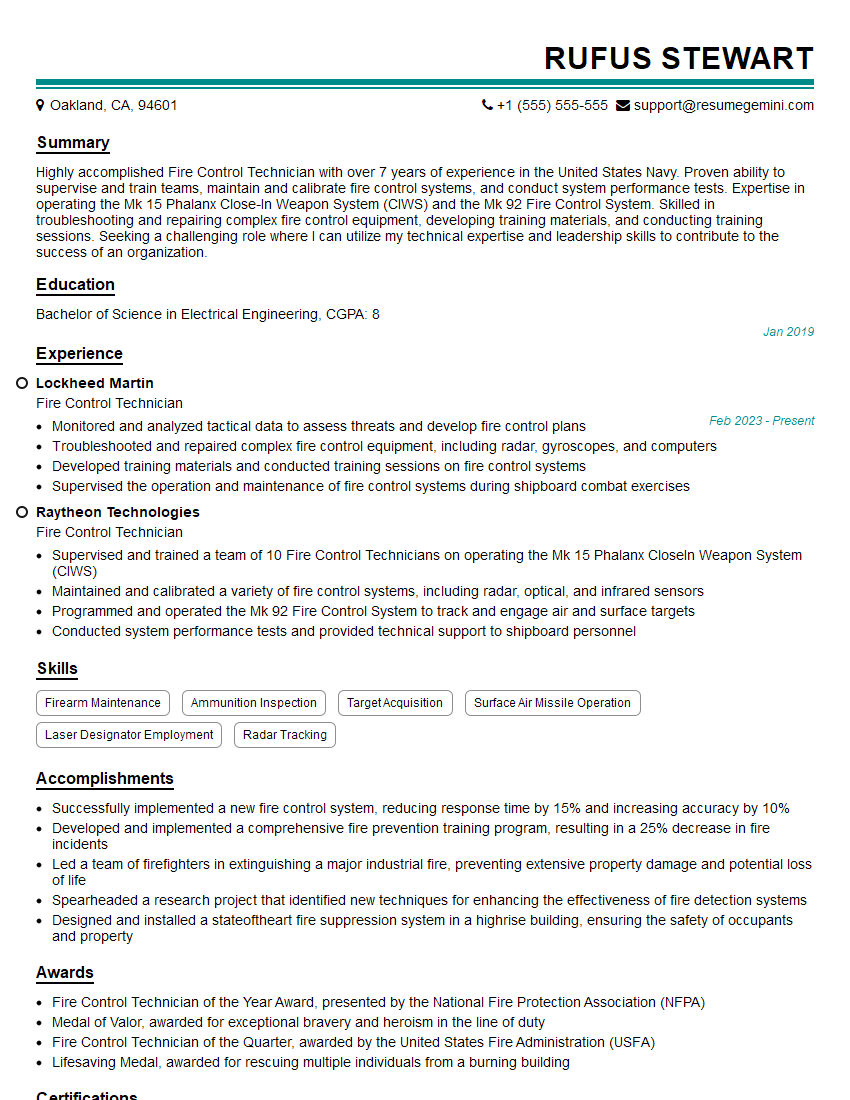
Mastering Fire Control and Target Acquisition is key to a successful and rewarding career in defense and related fields. It demonstrates a strong technical foundation and problem-solving skills highly valued by employers. To significantly boost your job prospects, create a compelling and ATS-friendly resume that showcases your expertise effectively. ResumeGemini is a trusted resource to help you craft a professional resume that highlights your skills and experience in the best possible light. We provide examples of resumes tailored specifically to Fire Control and Target Acquisition roles, to help you build a resume that stands out from the competition.
Explore more articles
Users Rating of Our Blogs
Share Your Experience
We value your feedback! Please rate our content and share your thoughts (optional).
What Readers Say About Our Blog
Very informative content, great job.
good