The thought of an interview can be nerve-wracking, but the right preparation can make all the difference. Explore this comprehensive guide to Fire Direction Control interview questions and gain the confidence you need to showcase your abilities and secure the role.
Questions Asked in Fire Direction Control Interview
Q 1. Explain the process of conducting a fire mission.
Conducting a fire mission involves a precise, coordinated process to deliver accurate and effective fire support. It begins with a request for fire from a Forward Observer (FO) or other requesting element, detailing the target’s location, type, and desired effect. The Fire Direction Center (FDC) then receives this request, validates the information, and computes the firing data. This data includes the target’s grid coordinates, the type of ammunition to be used, the number of rounds, and the firing angle. This data is then transmitted to the firing unit, which adjusts their weapons to match the provided parameters. After firing, the FDC evaluates the results, often via feedback from the FO, and adjusts fire as needed to achieve the desired effect. This iterative process of data input, calculation, transmission, firing, and adjustment ensures accuracy and effectiveness.
Imagine it like baking a cake: the recipe (fire mission request) is sent to the baker (FDC), who meticulously measures ingredients (firing data) before baking (firing). The baker might need to adjust the baking time (adjust fire) based on how the cake is browning (FO feedback).
Q 2. Describe the different types of fire missions.
Fire missions are categorized based on the desired effect and method of engagement. Some common types include:
- Suppression: Aims to temporarily neutralize enemy fire, disrupting their operations without necessarily destroying their positions. Think of it as momentarily blinding the enemy.
- Destruction: Focused on eliminating the target completely, requiring accurate fire and often multiple rounds.
- Neutralization: Similar to destruction but less focused on complete annihilation, aiming to render the target ineffective.
- Interdiction: Targeting enemy movement along a specific route or area, usually to disrupt supply lines or reinforcements.
- Harassment: Using small-scale fire to distract, annoy, and wear down the enemy, often at night or when they are in a vulnerable position.
- Illumination: Employing illuminating rounds to light up a target area for observation or targeting at night.
The selection of the appropriate mission type depends on the tactical situation, the available assets, and the overall objectives.
Q 3. What are the key elements of a fire support plan?
A comprehensive Fire Support Plan (FSP) is the backbone of effective fire support coordination. Key elements include:
- Target List: A prioritized list of targets, including their location, type, priority, and desired effect.
- Assault Support Plan: Details the fire support requirements during the main assault, ensuring close coordination between maneuver and fires.
- Target Acquisition Plan: Outlines how targets will be identified and located, often involving reconnaissance and surveillance assets.
- Fire Support Coordination Measures (FSCM): Establish boundaries, restrictions, and rules of engagement to prevent fratricide and ensure effective fire support.
- Communication Plan: Defines the communication methods and procedures for exchanging information between FOs, FDCs, and firing units.
- Contingency Plans: Account for potential issues such as equipment failure, communication breakdown, and unexpected enemy actions.
Think of the FSP as a detailed battle plan specifically for fire support, ensuring all elements are coordinated and ready for action.
Q 4. How do you adjust fire for range and deflection?
Adjusting fire for range and deflection involves making corrections to the firing solution based on the observed fall of shot (where the rounds land compared to the intended target). Range adjustments are made by altering the weapon’s elevation, while deflection adjustments change its azimuth (direction). These adjustments are based on the errors observed after initial firing. For example, if rounds fall short, range is increased; if rounds fall to the left, deflection is adjusted right.
Imagine throwing darts. If your darts consistently land to the right of the bullseye, you adjust your aim slightly to the left. Similarly, in fire direction, we adjust the weapon’s aim based on where the rounds are landing.
These adjustments are often made using a process of trial and error, with each adjustment refining the accuracy until the desired effect is achieved. Modern systems often utilize sophisticated algorithms to calculate and automate these corrections.
Q 5. Explain the concept of bracketing fire.
Bracketing fire is a method used to locate and engage a target whose precise location is unknown. It involves firing two or more rounds to establish a known area containing the target. One round lands short and the other lands over the target. Subsequent rounds are placed between these initial rounds, gradually reducing the area of uncertainty until the target is engaged.
Think of it like searching for a lost object in a room. You might initially search two opposite corners. Then you narrow your search to the space between them. Bracketing fire works in a similar manner, systemically narrowing the area until the target is located.
Q 6. What are the limitations of various fire support assets?
The limitations of fire support assets vary significantly. For example:
- Mortars: Have a limited range and accuracy compared to artillery, and are vulnerable to counter-battery fire.
- Artillery: Can achieve greater ranges and accuracy than mortars, but they require more time to set up and are larger targets.
- Rocket Artillery: Provides a high volume of fire over a wide area, but accuracy can be lower than artillery, and they have a shorter lifespan.
- Naval Gunfire: Offers long-range precision fire, but the ships may have limited availability and maneuverability.
- Air Support: Can provide quick response and precision strikes, but often depends on weather conditions and requires careful coordination to prevent fratricide.
Understanding these limitations is critical in selecting the appropriate asset and establishing realistic expectations for the fire mission’s effectiveness.
Q 7. Describe the role of Forward Observers (FOs) in fire direction.
Forward Observers (FOs) are the eyes and ears of the fire support system, operating forward with the maneuver elements. Their crucial role includes:
- Target Acquisition: Identifying and locating enemy targets, providing detailed information to the FDC.
- Target Designation: Accurately designating the target’s location using grid coordinates or other referencing methods.
- Adjusting Fire: Observing the impact of rounds and providing feedback to the FDC to make necessary adjustments for accuracy.
- Liaison: Coordinating with maneuver units to ensure fire support effectively supports their operations.
- Battle Damage Assessment (BDA): Evaluating the effectiveness of the fire mission and reporting the results.
Think of the FO as the quarterback, calling plays (fire mission requests) based on the field conditions (enemy positions), guiding the team (FDC and firing units) towards a victory (successful target engagement).
Q 8. How do meteorological conditions affect fire missions?
Meteorological conditions, such as wind speed and direction, temperature, humidity, and precipitation, significantly impact the accuracy and effectiveness of fire missions. These factors affect projectile trajectory, potentially causing deviations from the intended target.
For instance, a strong headwind will slow down a projectile, causing it to fall short of its target, while a tailwind will have the opposite effect. Similarly, air density, influenced by temperature and humidity, affects the projectile’s drag and therefore its range and accuracy. Rain or snow can obscure visibility, making target acquisition difficult, and can also affect the stability of the projectile in flight.
Fire Direction Centers (FDCs) utilize meteorological data obtained from various sources, including weather stations and sensors, to compensate for these effects. Sophisticated ballistic computers within the FDC incorporate this data into the firing solution, adjusting the firing parameters (e.g., elevation, azimuth) to ensure accurate projectile delivery. Without accurate meteorological data, the risk of misses and collateral damage significantly increases.
Q 9. How do you ensure effective communication during a fire mission?
Effective communication is paramount during a fire mission, ensuring seamless coordination between various elements involved – the forward observer (FO), the FDC, and the firing unit. Clear, concise, and unambiguous communication prevents errors and ensures the timely execution of fire missions.
We primarily rely on secure radio communication channels using standardized terminology and formats. This ensures there’s no confusion about coordinates, target type, and the type of fire requested (e.g., suppressive, precision). We use predefined communication protocols, similar to checklists in aviation, to minimize the chance of misinterpretations. Regular communication checks verify the signal strength and clarity, ensuring the chain of communication remains intact. Each message is confirmed by the receiver, using standard acknowledgment signals. This is like sending a ‘read receipt’ for every important piece of information. In addition, digital communication systems such as networked fire control systems can provide real-time data updates to all parties involved. This reduces reliance on individual radio communications, bolstering redundancy and reducing the chance of critical failures. Finally, rigorous training on communication procedures is essential to ensure all personnel understand and adhere to established protocols.
Q 10. What are the safety procedures for conducting fire missions?
Safety is the top priority in any fire mission. Our safety procedures encompass several layers, beginning with thorough mission planning and risk assessment. This includes analyzing potential hazards – both friendly and enemy forces – and establishing safety margins around the target area.
- Pre-mission checks: We meticulously verify weapon systems, communication equipment, and meteorological data accuracy before commencing the mission.
- Clearance procedures: Before firing, we establish communications with neighboring units to ensure there’s no friendly fire risk. This often involves coordinating with air support and other ground units.
- Target confirmation: We employ strict target confirmation procedures to minimize the chance of engaging unintended targets. This could include multiple confirmations by different observers.
- Post-mission assessment: After the mission, we conduct a thorough post-mission analysis to identify any potential safety issues and learn from the experience.
- Emergency procedures: Detailed emergency procedures are in place to deal with malfunctions, unexpected situations, or casualties.
These rigorous procedures aren’t just rules; they’re ingrained habits, critical for the safety of both our personnel and civilians in the operational area. A single lapse in safety protocols can have devastating consequences.
Q 11. Explain the importance of target acquisition in fire support.
Target acquisition is the process of locating and identifying a target for engagement. It’s the foundational element of effective fire support, without which all other efforts are futile. Accurate target acquisition ensures that the fire mission is correctly targeted, maximizing its effectiveness and minimizing collateral damage.
In the field, this often involves a combination of methods such as visual observation, aerial reconnaissance, electronic sensors (e.g., radar, drones), and intelligence reports. The quality of target acquisition directly impacts the accuracy of the fire mission. Poorly acquired targets may lead to missed shots, wasted ammunition, or, worse, civilian casualties. Conversely, precise target acquisition allows for more effective and precise targeting, optimizing the employment of our assets. For instance, identifying the precise coordinates of an enemy emplacement allows for highly accurate strikes, neutralizing the threat with minimal resources and minimizing the risk of collateral damage.
Q 12. How do you handle unexpected situations during a fire mission?
Unexpected situations are inherent in fire missions. Our response depends on the nature of the unexpected event, but a structured approach is always employed. This involves rapidly assessing the situation, implementing contingency plans, and adapting to the circumstances.
For example, if a malfunction occurs with the weapon system, the established procedure is to immediately cease fire, initiate troubleshooting, and, if necessary, switch to a backup system. If the target moves unexpectedly, the FDC recalculates the firing solution based on updated information, using real-time data if available. If friendly forces unexpectedly enter the target area, the engagement is immediately halted to prevent friendly fire. Communication remains paramount during these unexpected events; keeping all parties informed of the situation and the steps being taken is crucial. Regular training and simulations help our team prepare for these scenarios and effectively respond under pressure. We also routinely review past missions to identify lessons learned and continuously improve our response mechanisms.
Q 13. Describe your experience with different fire control systems.
Throughout my career, I’ve worked with several fire control systems, ranging from legacy analog systems to modern, fully digital networked systems. Early systems were largely manual, requiring extensive calculations and adjustments. The accuracy and speed were naturally limited. However, these older systems instilled a deep understanding of the fundamental ballistic principles.
Modern digital systems, on the other hand, are significantly more advanced, incorporating sophisticated algorithms and real-time data processing. These systems automate many of the manual calculations, improving accuracy and speed considerably. They integrate with various sensors and communication systems, enabling rapid target acquisition and adjustments for meteorological changes. For example, I’ve worked with systems that automatically compensate for wind drift and other atmospheric conditions, enhancing precision. The transition from analog to digital systems reflects the evolution in fire direction control towards greater efficiency, accuracy, and responsiveness.
Q 14. Explain the concept of suppressive fire.
Suppressive fire is a type of fire used to reduce the enemy’s ability to effectively engage friendly forces. It’s not necessarily aimed at causing direct casualties; instead, it aims to suppress enemy movements and actions. Think of it like creating a smokescreen, but with bullets or explosives, forcing the enemy to take cover and reducing their ability to accurately shoot back.
Suppressive fire is often employed as a supporting tactic during an assault or advance. It involves firing a large volume of fire over a specific area to pin down the enemy. This is not about pinpoint accuracy but about overwhelming the enemy with the sheer volume of fire. It can also be used to protect friendly forces during maneuvers or while they are setting up defensive positions. The effectiveness of suppressive fire depends greatly on its intensity and the volume of fire used. However, it’s crucial to use it judiciously and avoid unnecessarily wasting ammunition. It’s about the effect it creates, not necessarily the number of rounds fired.
Q 15. What are the different types of ammunition used in fire missions?
The type of ammunition used in fire missions depends heavily on the target, the desired effect, and the weapon system employed. We’re not just talking about bullets here; we’re talking about a wide range of munitions with varying characteristics.
- High-Explosive (HE): This is the workhorse. HE rounds are designed to detonate upon impact, creating a blast and fragmentation effect. They’re effective against personnel, lightly armored vehicles, and fortifications.
- High-Explosive Incendiary (HEI): HEI rounds combine the blast and fragmentation of HE with an incendiary component, making them particularly effective against flammable materials and targets.
- Smoke: Smoke rounds generate a dense cloud to obscure vision, providing cover for friendly forces or screening movement.
- Illumination: These rounds flare brightly to illuminate a target area at night, enabling accurate targeting and observation.
- White Phosphorus (WP): WP rounds produce a burning cloud of white phosphorus, effective against personnel and as a marker.
- Precision-Guided Munitions (PGMs): PGMs are guided by various systems (laser, GPS, etc.) to ensure accuracy at longer ranges. Examples include laser-guided bombs and GPS-guided artillery shells. Their accuracy minimizes collateral damage.
Choosing the right ammunition is crucial for mission success. For instance, using HE against a hardened bunker would be ineffective, while PGMs would be a much better choice. Selecting the right ammunition is a critical step in the fire planning process.
Career Expert Tips:
- Ace those interviews! Prepare effectively by reviewing the Top 50 Most Common Interview Questions on ResumeGemini.
- Navigate your job search with confidence! Explore a wide range of Career Tips on ResumeGemini. Learn about common challenges and recommendations to overcome them.
- Craft the perfect resume! Master the Art of Resume Writing with ResumeGemini’s guide. Showcase your unique qualifications and achievements effectively.
- Don’t miss out on holiday savings! Build your dream resume with ResumeGemini’s ATS optimized templates.
Q 16. How do you calculate time of flight for different projectiles?
Calculating time of flight (TOF) for different projectiles isn’t a simple formula; it’s complex and depends on many factors. A simplified calculation would use basic physics, but real-world scenarios involve more variables.
The fundamental physics involve considering gravity, air resistance (drag), and the initial velocity of the projectile. However, wind speed and direction, air density, and the projectile’s spin (affecting stability and drag) all significantly impact TOF. Most modern Fire Direction Centers (FDCs) use sophisticated ballistic calculators, often part of a larger digital fire control system, which take all these factors into account.
A simplified equation ignoring air resistance is:
TOF = 2 * Vy / gWhere:
TOF= Time of FlightVy= Initial vertical velocityg= Acceleration due to gravity
However, this equation is only accurate for short ranges and ignores many crucial real-world factors. Sophisticated models use iterative numerical methods or pre-computed ballistic tables stored within the fire control system to compensate for these variables. This allows for accurate prediction of impact even at extended ranges.
Q 17. Explain the concept of area fire.
Area fire is the delivery of munitions onto a designated area rather than a precise point target. It’s used when the exact location of the enemy is unknown but their general location is known, or when suppressing a wide area is required. Think of it like throwing a wide net rather than aiming for a single fish.
Area fire is often employed against concentrations of troops, disrupting enemy operations, or denying an enemy access to a specific area. The size of the area targeted depends on the type of weapon system used, the ammunition chosen (e.g., larger area with cluster munitions), and the desired effect.
Careful consideration of potential collateral damage is essential when planning area fire. It is crucial to assess the risk to civilians and friendly forces within the target area. This frequently involves careful target selection and the use of appropriate munitions to minimize unintended consequences.
Q 18. What are the different types of targeting coordinates?
Targeting coordinates are the location data used to direct fire onto the target. Several types exist, each with strengths and weaknesses:
- Grid Coordinates (Military Grid Reference System – MGRS): These are commonly used, providing a precise location on a map projection. They’re highly accurate for long-range fire missions, especially in conjunction with digital mapping systems.
- Polar Coordinates: These define a location by its distance and bearing from a known point. Think of it like giving directions: ‘5 kilometers, 30 degrees east of north’. While simpler in concept, accuracy can be affected by measurement errors and ground features.
- Geo-Coordinates (Latitude/Longitude): Using latitude and longitude is another common approach, especially when working with GPS-enabled systems. These provide a universally applicable location, useful for coordinating with assets across large distances.
- Shifting Coordinates: These coordinates are often used when the exact coordinates of a target is not known or to account for the inaccuracy of previous inputs. Often used to shift fire to a new estimated location in the case of a miss.
The choice of coordinate system depends on the situation, available equipment, and the precision required for the mission. In modern fire control, often all three are used in conjunction to maximize accuracy and maintain consistency.
Q 19. How do you integrate fire support with maneuver units?
Integrating fire support with maneuver units is absolutely critical for successful military operations. It’s a delicate dance requiring seamless communication, precise targeting, and a shared understanding of the battlefield situation.
This integration involves several key elements:
- Close coordination: Fire support planners work closely with maneuver unit commanders to understand their objectives, timelines, and potential risks.
- Real-time communication: Effective communication channels are crucial to relay target information, adjust fire plans, and manage collateral damage risk.
- Joint operations centers: In complex operations, joint operations centers facilitate seamless coordination between maneuver units and supporting fire assets.
- Forward observers (FOs): FOs are typically embedded with maneuver units, providing real-time intelligence and target acquisition. They are the eyes on the ground, providing critical information for fire adjustments.
- Digital systems: Modern digital fire control systems and battlefield management systems facilitate rapid information sharing and reduce the likelihood of errors.
Successfully integrating fire support significantly enhances the effectiveness of maneuver units, increasing their survivability and improving the chances of mission success. It’s a testament to the strength of effective joint military operations.
Q 20. Describe your experience with digital fire control systems.
My experience with digital fire control systems spans several years, encompassing both operational and maintenance roles. I’ve worked with systems such as [mention specific system names if appropriate, e.g., AFATDS, other relevant systems], gaining significant proficiency in their operation, data management, and troubleshooting.
These systems are revolutionary, vastly improving accuracy, speed, and overall efficiency compared to legacy analog systems. The ability to process vast amounts of data, including terrain information, meteorological data, and even real-time imagery, allows for unprecedented precision in fire missions. I’ve been involved in both live fire exercises and real-world operations utilizing these systems. My experience covers aspects such as:
- Target acquisition and processing: Receiving and integrating target data from various sources.
- Ballistic calculations: Utilizing sophisticated algorithms to determine optimal firing solutions.
- Data management and maintenance: Ensuring data accuracy and integrity, conducting system maintenance, and troubleshooting issues.
- Communication systems: Working with various communication networks to exchange data with other units and systems.
I’m confident in my ability to operate, maintain, and troubleshoot these systems effectively, ensuring accurate and timely fire support.
Q 21. Explain the concept of close air support coordination.
Close air support (CAS) coordination is the process of integrating air assets to provide direct fire support to friendly ground forces engaged in close combat. It’s a complex operation requiring precision, communication, and a high degree of trust between air and ground elements.
Successful CAS coordination relies on:
- Clear communication: Establishing secure and reliable communication links between air and ground units is paramount.
- Precise target location: Ground units must provide accurate target locations, often using MGRS coordinates or other methods.
- Battle damage assessment (BDA): After the air strike, ground units must assess the effectiveness of the strike to guide further actions.
- Joint terminal attack controllers (JTACs): JTACs are specially trained personnel who control and direct air strikes, ensuring accuracy and minimizing collateral damage. They are integral to this coordination.
- De-confliction: To avoid friendly fire incidents, CAS coordination includes careful planning and execution, making sure friendly forces are not in the target zone.
CAS coordination involves many complex variables including airspace control, weather conditions, and the specific capabilities of the air assets involved. The coordination process follows strict procedures to ensure that these powerful assets are used efficiently and safely, maximizing their effectiveness in support of ground troops.
Q 22. What are the legal and ethical considerations for conducting fire missions?
Legal and ethical considerations in fire missions are paramount. They encompass adherence to the rules of engagement (ROE), the law of armed conflict (LOAC), and maintaining civilian casualty avoidance as the highest priority. This involves careful target selection, confirmation of targets, and minimizing collateral damage. We must ensure that all actions comply with international humanitarian law and our nation’s laws.
For example, before engaging a target, we must meticulously verify its identity and legitimacy, ruling out civilian presence or protected structures. This often involves using multiple intelligence sources and employing strict verification protocols. Failure to adhere to these guidelines can lead to severe legal and ethical ramifications, including disciplinary action, war crimes charges, and damage to international relations.
Furthermore, ethical considerations include maintaining a high standard of professional conduct and accountability. This includes clear communication, accurate reporting, and a thorough understanding of the potential consequences of our actions.
Q 23. How do you ensure the accuracy of fire missions?
Accuracy in fire missions is critical for mission success and minimizing harm. We achieve this through a multi-layered approach encompassing precise target location, accurate weapon system calibration, and meticulous meteorological data integration. This begins with utilizing advanced surveying techniques and multiple geolocation sources to ensure the target’s coordinates are exact.
We then calibrate our weapons systems regularly, conducting thorough checks on all components to ensure optimal performance. Factors like atmospheric pressure, temperature, and wind speed significantly affect projectile trajectory; thus, integrating accurate meteorological data into our fire control calculations is essential. Modern fire control systems automatically incorporate these variables for precise calculations.
Moreover, we employ various methods for confirmation of target engagement. This can include post-strike reconnaissance, using aerial imagery or drone footage to assess the effectiveness and impact of the strike. This feedback loop allows for adjustments to subsequent missions and continuous improvement of accuracy.
Q 24. Describe your experience with different types of maps and navigation tools.
My experience with maps and navigation tools is extensive, ranging from traditional topographic maps to advanced digital systems. I am proficient in using various map projections, understanding grid coordinates (e.g., UTM, MGRS), and interpreting terrain features. I’ve used a variety of tools including hand-held GPS devices, digital terrain elevation data (DTED), and sophisticated Geographic Information Systems (GIS) software.
For instance, I have utilized topographic maps for planning missions in areas with limited digital data, relying on contour lines and map symbols for accurate terrain assessment. Conversely, I’ve integrated DTED into fire control systems for precise elevation data input in complex terrain.
I am also experienced with integrating different navigation tools to create a robust picture. For example, I’ve cross-referenced GPS data with compass bearings and visual observations to overcome GPS signal loss in challenging environments, maintaining accuracy and situational awareness.
Q 25. How do you maintain fire control equipment?
Maintaining fire control equipment involves a rigorous preventative maintenance program, coupled with immediate corrective actions for any identified faults. This includes regular inspections, cleaning, lubrication, and functional tests. We adhere to strict manufacturer guidelines and implement established operational procedures.
For example, we conduct daily checks of all fire control instruments, verifying functionality and calibration. This includes optical alignment, power checks, data connectivity, and software updates. For more complex components, we perform scheduled maintenance at designated intervals, often involving specialized tools and trained technicians. Any malfunction is immediately reported and addressed following the established troubleshooting protocol, ensuring equipment readiness.
Detailed logs are kept to track all maintenance activities, ensuring transparency and providing valuable data for predicting potential problems and optimizing the maintenance schedule.
Q 26. Explain the importance of training in fire direction control.
Training is crucial for fire direction control, ensuring personnel are proficient in handling complex systems, adhering to safety protocols, and making critical decisions under pressure. Our training program comprises classroom instruction, hands-on simulations, and extensive field exercises.
Classroom training focuses on theoretical knowledge, covering topics like ballistics, meteorology, map reading, and communication protocols. We use advanced simulators to recreate realistic fire mission scenarios, enabling trainees to practice complex calculations and procedures in a controlled environment. These simulations enhance decision-making skills and refine techniques.
Field exercises reinforce this training, providing practical experience in diverse environments and scenarios. They allow trainees to hone their skills in teamwork, communication, and problem-solving under realistic operational conditions. Regular refresher training and advanced courses ensure personnel remain current with the latest technologies and operational procedures.
Q 27. How do you handle communication failures during a fire mission?
Communication failures during a fire mission are critical and require immediate attention. Our procedures prioritize redundancy and alternative communication methods. We utilize multiple communication systems, including radio, satellite communication, and potentially even messengers as a last resort.
If a primary communication channel fails, we immediately switch to a backup system. We also have established procedures for relaying information through alternate channels, ensuring critical information reaches its destination. We prioritize confirming receipt and understanding of any message to avoid misinterpretations.
Furthermore, we have contingency plans addressing complete communication loss, employing pre-planned actions and coordination protocols to minimize disruption and maintain situational awareness. These plans emphasize the importance of clear procedures and well-established communication chains.
Q 28. Describe your experience with joint operations involving fire support.
My experience in joint operations involving fire support is extensive. I have worked closely with various military branches and coalition partners, coordinating fire support for combined arms operations. This involves understanding the capabilities and limitations of different weapon systems and adhering to standardized procedures for joint fire support coordination.
For example, I’ve coordinated close air support missions with air force personnel, ensuring accurate target location and minimizing risk to friendly forces. Similarly, I’ve worked with artillery units from different nations, ensuring compatibility of communication systems and fire control data exchange protocols. This demands a deep understanding of interoperability challenges and a commitment to clear communication to ensure mission success.
Effective joint operations necessitate clear communication, mutual trust, and a shared understanding of objectives and procedures. We employ standardized terminology and communication protocols to minimize confusion and ensure seamless cooperation across different forces. This collaborative approach ensures the efficient and effective use of fire support in complex, multinational operations.
Key Topics to Learn for Fire Direction Control Interview
- Ballistics and Trajectory Calculations: Understand the principles governing projectile motion, including factors affecting accuracy and range. Explore practical applications like adjusting for wind, gravity, and target movement.
- Fire Control Systems and Equipment: Familiarize yourself with the operation and capabilities of various fire control systems, from basic sighting equipment to advanced computerized systems. Consider practical applications such as system troubleshooting and maintenance.
- Data Acquisition and Processing: Learn how data from various sensors (e.g., radar, laser rangefinders) is acquired, processed, and used to calculate firing solutions. Explore problem-solving approaches to handling incomplete or inaccurate data.
- Communication and Coordination: Understand the critical role of communication in a fire direction control team. Explore practical applications like effective information relay and coordination with other units.
- Mission Planning and Execution: Learn the process of planning fire missions, including target acquisition, fire control calculations, and execution. Practice problem-solving scenarios involving mission adjustments and unexpected challenges.
- Safety Procedures and Regulations: Understand and be able to articulate the importance of safety procedures and regulations related to the handling and firing of weapons systems. Explore the practical applications of these regulations in various scenarios.
- Weapon Systems and Munitions: Gain a working knowledge of the weapon systems used in fire direction control and the types of munitions employed. Explore the characteristics and capabilities of different munitions and their applications.
Next Steps
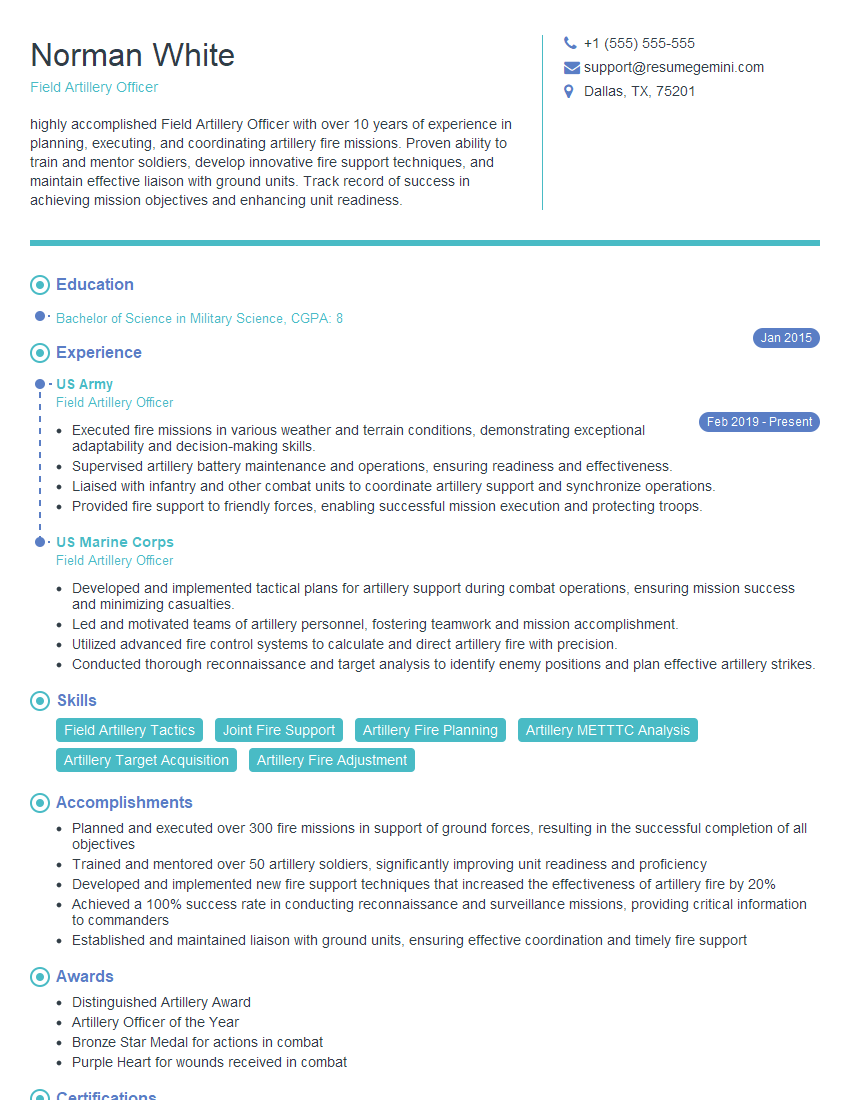
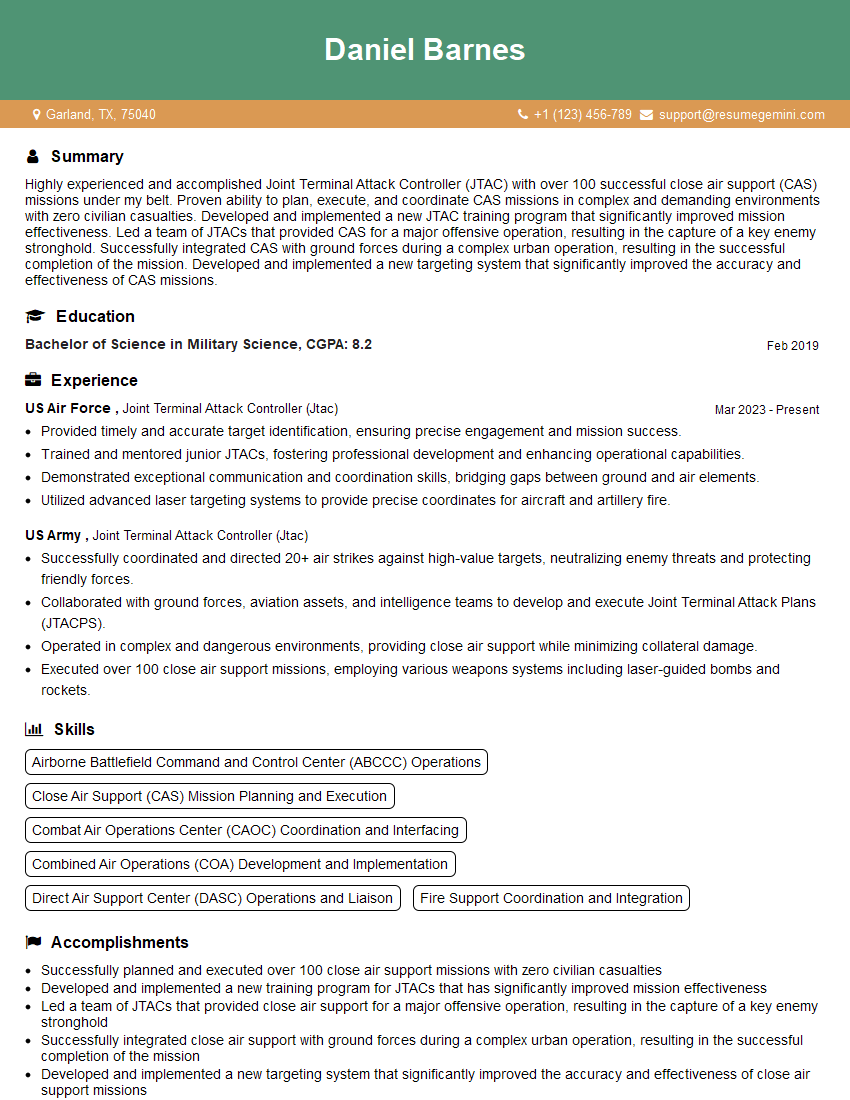
Mastering Fire Direction Control opens doors to exciting and impactful careers, offering opportunities for professional growth and contributing to critical missions. To maximize your job prospects, it’s crucial to present your skills effectively. An ATS-friendly resume is essential for getting your application noticed by recruiters. We highly recommend using ResumeGemini to build a powerful and professional resume that highlights your expertise. ResumeGemini provides examples of resumes tailored to Fire Direction Control, ensuring your application stands out from the competition.
Explore more articles
Users Rating of Our Blogs
Share Your Experience
We value your feedback! Please rate our content and share your thoughts (optional).
What Readers Say About Our Blog
Very informative content, great job.
good