Every successful interview starts with knowing what to expect. In this blog, we’ll take you through the top FireFOAM interview questions, breaking them down with expert tips to help you deliver impactful answers. Step into your next interview fully prepared and ready to succeed.
Questions Asked in FireFOAM Interview
Q 1. Explain the solver setup for a simple fire simulation using FireFOAM.
Setting up a simple fire simulation in FireFOAM involves several key steps. First, you need to define your geometry and mesh. This could be a simple room or a more complex structure, created using tools like blockMesh or snappyHexMesh. Next, you choose the appropriate solver; for many simple cases, buoyantSimpleFoam is a good starting point. This solver is suitable for simulations involving buoyancy-driven flows, which is fundamental to fire behavior.
After selecting the solver, you’ll define your boundary conditions. This is crucial as it determines how the fire interacts with its surroundings. For example, you’ll specify the inlet velocity and temperature for the fire source, and appropriate conditions like walls for the room. You’ll also need to define the initial conditions, including temperature and pressure fields within the domain.
Material properties like density, viscosity, and specific heat capacity are defined for each phase involved (air and combustion products). Finally, you select a combustion model (e.g., Eddy Dissipation Concept) and a turbulence model (e.g., k-epsilon). The entire setup is typically managed through a system folder containing files like controlDict (controlling simulation time and parameters), fvSchemes (numerical schemes), and fvSolution (solver settings).
For instance, a simple setup might involve a small rectangular room with a fire source at the bottom. blockMesh would create the mesh, and the controlDict would define simulation duration and time step. The fvSolution would specify the solver and its parameters. Defining boundary conditions properly — including temperature and velocity at the fire source and wall conditions — is vital to ensure a realistic simulation.
Q 2. Describe the different turbulence models available in FireFOAM and their suitability for fire simulations.
FireFOAM offers a variety of turbulence models, each with strengths and weaknesses. The choice depends heavily on the specific fire scenario and the desired level of detail. Common choices include:
- k-ε (k-epsilon): A two-equation model, relatively simple and computationally inexpensive. It’s suitable for many fire scenarios, particularly those with large-scale turbulent structures. However, it’s less accurate near walls and in highly strained flows.
- k-ω (k-omega): Another two-equation model that performs better near walls than k-ε. It’s often preferred for scenarios where wall effects are significant, but it can be more computationally expensive.
- LES (Large Eddy Simulation): A more advanced approach that directly resolves large-scale turbulent structures while modeling smaller scales. LES can provide more detailed and accurate results, especially for complex flows, but requires significantly higher computational resources.
- RANS (Reynolds-Averaged Navier-Stokes): The basis for k-ε and k-ω. It averages out the turbulent fluctuations, making it computationally efficient but sacrificing some accuracy. Often used when computational time is a high priority and the complex turbulent flow is not a key focus.
The selection is a trade-off between accuracy and computational cost. For a quick assessment of a large-scale fire, k-ε might suffice. For detailed analysis of the fire’s interaction with specific features, k-ω or even LES might be necessary. The choice will depend greatly on project constraints and desired level of detail.
Q 3. How do you handle boundary conditions in FireFOAM for fire simulations?
Boundary conditions are essential in FireFOAM fire simulations, defining how the fluid interacts with the surrounding environment. They are crucial for determining the fire’s spread, temperature distribution, and overall behavior. The types of boundary conditions used depend on the specific problem but typically include:
- Inlet: Specifies the temperature, velocity, and potentially turbulence parameters for the incoming air or fuel.
- Outlet: Allows for the outflow of hot gases and smoke. Often defined as a pressure outlet.
- Wall: Represents the solid boundaries of the domain, including walls, floors, and ceilings. Different wall conditions can be applied, such as adiabatic (no heat transfer), fixed temperature, or convective heat transfer.
- Symmetry: Used for cases where the geometry is symmetrical, simplifying the computational domain.
- Periodic: For simulations with repeating patterns.
For instance, a fire simulation in a room would use an inlet boundary condition to define the inflow of fresh air (oxygen), a wall boundary condition for the walls of the room (often adiabatic), and an outlet boundary condition at the top to allow the escape of combustion products. Correctly specifying these conditions is critical for obtaining realistic results; using an incorrect condition, such as using a fixed-temperature wall for a poorly insulated wall, would significantly skew results.
Q 4. What are the key differences between different combustion models in FireFOAM (e.g., Eddy Dissipation, Flamelet)?
FireFOAM provides several combustion models, each employing different approaches to model the complex chemical reactions involved in fire. Key differences between common models are:
- Eddy Dissipation Concept (EDC): A relatively simple model assuming that the chemical reactions are limited by the turbulence mixing rate. It’s computationally inexpensive but less accurate for detailed flame structure representation. It’s a good choice for preliminary simulations where the overall fire behavior is of primary interest, rather than detailed flame characteristics.
- Flamelet Generated Manifolds (FGM): A tabulated model using pre-calculated flamelet solutions. It allows for a more accurate representation of the flame structure compared to EDC, but requires pre-processing to generate the flamelet library. This is a more computationally expensive option, better suited when more precise flame behavior is crucial.
- Partially Stirred Reactor (PaSR): This model represents the combustion process using a network of perfectly stirred reactors. PaSR models are better at handling the complex chemical reactions found in various combustion scenarios but can be computationally expensive and require significant set-up.
The choice of model depends on the application and the desired level of detail. For instance, EDC would be suitable for a large-scale fire simulation where overall heat release and smoke spread are the main concerns, whereas FGM or PaSR would be more appropriate for a detailed study of a specific burner or flame structure. The complexity of the model selection has to be balanced against the computational resources available.
Q 5. Explain the importance of mesh resolution in FireFOAM simulations and how it impacts accuracy.
Mesh resolution plays a critical role in the accuracy and reliability of FireFOAM simulations. The mesh needs to be fine enough to capture the important flow features, particularly near the flame front and walls. Insufficient resolution can lead to inaccurate predictions of temperature, velocity, and species concentrations.
Consider a scenario involving a small flame near a wall. A coarse mesh may fail to resolve the steep gradients in temperature and velocity near the flame and wall, resulting in significant errors in heat transfer calculations and flame propagation prediction. On the other hand, overly fine meshes near the flame and wall, where the critical gradients are occurring, would be preferred to adequately resolve those gradients. However, a globally fine mesh can substantially increase computational cost, rendering simulations slow or even infeasible. A mesh refinement strategy that is locally fine in critical areas while coarser elsewhere is an efficient approach.
As a rule of thumb, the mesh should resolve the smallest scales of turbulence relevant to the fire dynamics. However, this is often a balance between accuracy and computational efficiency. Mesh independence studies, where the simulation is run with progressively finer meshes until the results converge, are crucial to ensure the accuracy of the simulation.
Q 6. How do you perform mesh refinement in FireFOAM?
Mesh refinement in FireFOAM can be achieved through several methods, depending on the complexity of the geometry and the desired level of refinement:
- SnappyHexMesh: A powerful meshing tool within OpenFOAM that allows for automatic mesh refinement in specific regions. This is particularly useful for complex geometries where manual meshing would be challenging. You specify refinement criteria in terms of cell size or geometric features; the tool then automatically refines the mesh in those zones.
- BlockMesh: For simpler geometries, a structured mesh can be generated using
blockMesh. Refinement can be achieved by subdividing blocks, providing finer resolution in areas of interest. While less flexible thansnappyHexMesh, it’s simpler to use for basic geometries. - Refinement during simulation (AMR): Adaptive Mesh Refinement techniques dynamically adjust the mesh resolution during the simulation based on flow features. This can be a very efficient approach as it refines only the areas that need it. However, setting up AMR can be more complex.
The choice of method depends largely on the geometry and complexity. For a simple geometry, blockMesh can suffice, while snappyHexMesh is ideal for complex geometries. AMR is more suitable when you have no way of predicting the refinement regions in advance.
Q 7. Describe the process of validating your FireFOAM simulation results.
Validating FireFOAM simulation results is crucial to ensure their accuracy and reliability. The process involves comparing the simulation outcomes to experimental data or results from other established models. This validation helps confirm the accuracy of the chosen numerical schemes, turbulence model, combustion model, and boundary conditions.
Several methods can be employed:
- Comparison with experimental data: This is the most reliable method. Ideally, you’d compare your simulation results (temperature profiles, velocity fields, heat release rates) to experimental data from a similar fire scenario. Quantifiable metrics like root-mean-square error or R-squared values can assess the agreement.
- Comparison with other simulations or models: If experimental data is unavailable or insufficient, comparison with well-established numerical models or simulations can provide a degree of validation. This should ideally include a sensitivity analysis showing how different assumptions of the models affect the result.
- Grid independence study: By performing simulations with progressively finer meshes, a grid independence study helps to ensure that the results are not significantly affected by the mesh resolution, therefore giving more confidence in the results.
- Code verification: Ensuring the code itself is correct using independent validation tools or tests.
The validation process isn’t a one-time event. It’s an iterative process involving refining the simulation setup, boundary conditions, and models to improve the agreement between simulation and reality.
Q 8. How do you handle radiative heat transfer in FireFOAM simulations?
FireFOAM handles radiative heat transfer through the use of the Discrete Ordinates Method (DOM) or the Finite Volume Method (FVM) implemented within the radiation models available. The choice depends on the complexity of the geometry and the desired accuracy. The DOM discretizes the radiative transfer equation along discrete directions, while the FVM solves the equation over control volumes. Both methods account for absorption, emission, and scattering of radiation.
For instance, in simulating a large-scale fire in a building, the DOM might be computationally too expensive. Therefore, FVM with suitable approximations like the P1 model could be employed for a reasonable trade-off between accuracy and computational cost. This would involve specifying the appropriate material properties, such as the absorption coefficient and scattering albedo, in the input file. The results then provide the radiative heat flux affecting the temperature field, a crucial factor for accurate fire modeling.
In simpler scenarios, like a small-scale pool fire, a more computationally expensive yet accurate model like the DOM might be preferred, allowing for more precise prediction of radiation effects on nearby surfaces.
Q 9. Explain the concept of soot modeling in FireFOAM.
Soot modeling in FireFOAM involves predicting the generation, transport, and consumption of soot particles within a fire simulation. This is important because soot significantly impacts the radiative heat transfer, as it strongly absorbs and emits thermal radiation. FireFOAM typically uses a two-equation model for soot, tracking soot mass fraction and soot particle number density. These equations account for soot production, oxidation (burning), aggregation (coagulation), and transport (convection and diffusion).
The soot model usually requires specifying parameters like soot yield (the amount of soot produced per unit of fuel burned) and soot oxidation rates, often obtained from experimental data or detailed chemical kinetics models. The resulting soot field provides vital information for predicting the fire’s radiative characteristics and its impact on the environment. For example, predicting the extent of smoke and radiative heat output in a wildfire becomes more precise with the inclusion of detailed soot modeling.
A common approach is to couple the soot model with the radiation model mentioned earlier, creating a highly coupled system that accounts for soot’s influence on radiative transfer and vice-versa. This intricate interaction significantly influences the overall fire dynamics.
Q 10. How do you visualize and post-process data from a FireFOAM simulation?
Post-processing FireFOAM data typically involves using ParaView, a powerful open-source visualization software. The simulation outputs, stored in various files, are loaded into ParaView. This allows for visualization of the temperature field, velocity field, species concentration (e.g., oxygen, fuel, soot), pressure, and other relevant parameters, generating images and animations to analyze simulation outcomes.
The process involves defining appropriate filters and color maps in ParaView to enhance visualization and better understand the simulation’s results. For example, isolines can be used to show temperature contours, vector plots to visualize the flow field, and slice planes to visualize internal structures. ParaView also allows for exporting images and videos for reports or publications.
Beyond ParaView, other tools like OpenFOAM’s built-in utilities such as postProcess can be used for simple data analysis like calculating average values or creating time-series data. Custom scripts can also be written using Python or other scripting languages to process data and create custom visualizations, allowing for extensive and flexible data analysis tailored to specific needs.
Q 11. What are the limitations of FireFOAM for fire simulations?
While FireFOAM is a powerful tool, it has certain limitations:
- Computational Cost: Simulating large-scale or complex fire scenarios can be computationally expensive, requiring high-performance computing resources.
- Turbulence Modeling: Accurate modeling of turbulence is crucial in fire simulations. FireFOAM’s performance depends on the chosen turbulence model, and some models may not be suitable for all scenarios. This aspect greatly influences accuracy and can be a significant source of error.
- Chemical Kinetics: While FireFOAM offers simplified chemical reaction models, detailed chemical kinetics modeling, necessary for certain fire phenomena, can be computationally prohibitive.
- Mesh Dependency: The accuracy of the simulation can be affected by the mesh resolution. Finer meshes improve accuracy but increase the computational cost. Determining the optimal mesh can be challenging and resource intensive.
- Multiphase Flows: Simulating multiphase flows, such as fire interacting with water or other liquids, can require specialized models and approaches, pushing computational demands significantly.
These limitations underscore the need for careful model selection, mesh refinement strategies, and a thorough understanding of the limitations of the chosen approach.
Q 12. Describe your experience with parallel processing in FireFOAM.
My experience with parallel processing in FireFOAM is extensive. I have worked extensively with MPI (Message Passing Interface) for distributing the computational workload across multiple processors. This is crucial for handling the large datasets and computational demands of complex fire simulations.
I’ve used tools such as mpirun to launch parallel simulations, optimizing the decomposition of the computational domain to achieve good load balancing across processors. Understanding processor communication overhead and efficiently managing data transfer between processors is critical to efficient parallel performance. Profile tools were used to identify and address bottlenecks, allowing optimization of the parallelization strategy to maximize performance.
A specific example from my professional experience involved simulating a large-scale industrial fire. By strategically employing parallel processing across 64 cores, we successfully reduced the simulation runtime from several days (with a single processor) to just a few hours, making such large-scale analysis feasible.
Q 13. How do you troubleshoot convergence issues in FireFOAM simulations?
Troubleshooting convergence issues in FireFOAM requires a systematic approach. First, I inspect the solution’s residuals to identify potential problems. High residuals indicate slow or lack of convergence. If the residuals are stagnating, the solution is not converging. The following steps are typically performed:
- Mesh Refinement: A poorly resolved mesh, especially near boundaries, can hinder convergence. Refining the mesh in critical areas often resolves this.
- Time Step Adjustment: Too large a time step can lead to instability and divergence. Reducing the time step often helps. Adaptive time stepping can be employed to automatically adjust the time step based on solution stability.
- Solver Settings: Adjusting solver parameters, such as relaxation factors and tolerances, is often necessary. Experimentation and knowledge of the chosen solvers are essential to determine suitable settings.
- Boundary Conditions: Incorrectly defined or inappropriate boundary conditions can create numerical instabilities, leading to divergence. Verifying and potentially adjusting boundary conditions is essential.
- Initial Conditions: Poorly chosen initial conditions can also impact convergence. Using more realistic initial conditions often improves convergence behavior.
- Numerical Schemes: Exploring different numerical schemes for discretization (e.g., second-order vs. first-order) can enhance stability and convergence behavior.
Careful observation of the solution and systematic adjustment of parameters based on the identified issues is key to successfully resolving convergence problems. The process often involves iterative debugging and refinement.
Q 14. Explain your experience using different solvers within FireFOAM.
My experience encompasses various solvers within FireFOAM, each suited for specific aspects of fire simulations. I’ve extensively used the buoyantSimpleFoam solver for simulating buoyant turbulent flows, commonly employed in most fire simulations due to its efficiency and applicability to a range of fire scenarios. This solver is a good starting point for many fire-related applications. For more complex scenarios requiring more detailed chemical reactions, I have worked with solvers that integrate detailed chemistry models.
For simulations involving complex geometries, such as those with numerous obstacles or intricate structures, I have utilized the buoyantBoussinesqSimpleFoam solver, which applies the Boussinesq approximation to simplify the governing equations, improving computational efficiency while retaining reasonable accuracy for many fire applications. In situations where multiphase flows are involved, such as fire suppression using water spray, I’ve used solvers like interFoam or variants that specifically account for liquid-gas interactions. The choice of solver hinges heavily on the specific physics and desired accuracy levels.
Selecting the appropriate solver requires a thorough understanding of the problem’s characteristics and the capabilities of each solver. This often involves a balance between accuracy, computational cost, and the availability of suitable models for various physics involved.
Q 15. How do you handle complex geometries in FireFOAM?
FireFOAM, like other CFD solvers, excels at handling complex geometries thanks to its meshing capabilities. We primarily utilize unstructured meshes, which are incredibly flexible and can adapt to intricate shapes. This allows for accurate representation of geometries with curved surfaces, sharp corners, and complex internal features, unlike structured meshes which are limited to simple shapes.
For instance, simulating a realistic building fire requires accurately representing the building’s internal structure, including rooms, corridors, and furniture. Unstructured meshing enables the creation of a high-resolution mesh in areas of interest, like near the fire source or obstacles, while using coarser meshes in less critical regions. This balance optimizes computational efficiency without sacrificing accuracy. Tools like snappyHexMesh, a mesh generation utility within OpenFOAM (FireFOAM’s parent framework), are crucial for this process, automatically generating high-quality meshes from CAD models. Furthermore, mesh refinement techniques allow for local adaptation during the simulation to capture transient phenomena more effectively.
In my experience, successfully handling complex geometries often involves iterative mesh refinement and careful selection of meshing parameters to balance computational cost and accuracy. This typically involves experimentation with different meshing algorithms and mesh quality metrics to ensure robustness and fidelity.
Career Expert Tips:
- Ace those interviews! Prepare effectively by reviewing the Top 50 Most Common Interview Questions on ResumeGemini.
- Navigate your job search with confidence! Explore a wide range of Career Tips on ResumeGemini. Learn about common challenges and recommendations to overcome them.
- Craft the perfect resume! Master the Art of Resume Writing with ResumeGemini’s guide. Showcase your unique qualifications and achievements effectively.
- Don’t miss out on holiday savings! Build your dream resume with ResumeGemini’s ATS optimized templates.
Q 16. Describe your experience with using different discretization schemes in FireFOAM.
Discretization schemes are fundamental to FireFOAM’s accuracy. They determine how the governing equations (Navier-Stokes, energy, species transport) are approximated on the computational mesh. My experience involves extensive use of various schemes, choosing them strategically depending on the specific characteristics of the simulation.
- Spatial Discretization: I frequently employ higher-order schemes like Gauss linear or linearUpwind for convective terms to enhance accuracy, especially in regions with steep gradients. For diffusive terms, central differencing is usually preferred for its second-order accuracy. However, for highly challenging flows, I might opt for bounded schemes, like limitedLinear, to prevent spurious oscillations.
- Temporal Discretization: Euler (first-order) and Crank-Nicolson (second-order) schemes are commonly used for temporal discretization. Euler is simpler and less computationally demanding, while Crank-Nicolson offers improved accuracy but can be more prone to instability in certain cases. The choice often depends on the desired balance between accuracy and stability.
For instance, in a simulation involving a large-scale fire spread, I might use a higher-order scheme for better resolution of the flame front propagation, but then lower the order or use explicit temporal discretization to improve solver stability and computational time.
// Example snippet showing scheme selection in FireFOAM's fvSchemes dictionary: /* ddtSchemes { default Euler; } gradSchemes { default Gauss linear; } divSchemes { div(phi,U) Gauss linear; //For velocity divergence div(phi,k) Gauss linear; //For turbulent kinetic energy (if applicable) } */ Q 17. How do you ensure the accuracy of your FireFOAM simulations?
Ensuring accuracy in FireFOAM simulations involves a multifaceted approach. It’s not just about selecting the ‘best’ discretization schemes; it requires careful consideration at every stage of the process.
- Mesh Refinement Studies: Performing mesh independence studies is critical. This involves running the simulation with progressively finer meshes until the solution converges, demonstrating that the results are not significantly affected by the mesh resolution. This helps identify the appropriate level of mesh refinement for a given problem.
- Code Verification and Validation: Verification involves checking the code’s implementation against analytical solutions or established benchmarks to identify coding errors. Validation compares simulation results to experimental data to ascertain the model’s accuracy in representing real-world phenomena. This often requires careful consideration of experimental uncertainties.
- Solution Convergence Checks: Monitoring the residuals during the iterative solution process is crucial. The residuals should decrease to acceptable levels, indicating that the solution has converged to a steady state (or a consistent temporal evolution for transient simulations). This involves careful selection of appropriate solver tolerances.
- Sensitivity Analysis: Assessing the sensitivity of the results to changes in input parameters (e.g., material properties, boundary conditions) helps to understand the uncertainty in the predictions and identify parameters that significantly influence the outcome.
In practice, a robust validation process might involve comparing the predicted temperature profiles, smoke spread, and heat flux to the experimental measurements. Any discrepancies need to be carefully analyzed to identify potential sources of error, whether in the simulation setup, mesh quality, or even the underlying physics model.
Q 18. What are the key parameters to consider when setting up a fire simulation?
Setting up a fire simulation in FireFOAM demands careful consideration of numerous parameters. These can be broadly categorized as:
- Geometry and Mesh: Accurate representation of the geometry (including obstacles) and proper mesh refinement (especially in regions with high gradients) are paramount.
- Material Properties: Accurate input of material properties for all participating substances (fuel, air, combustion products) is critical. This includes specific heat, density, thermal conductivity, and combustion characteristics. Any uncertainty in these properties will directly impact the simulation’s results.
- Boundary Conditions: Defining appropriate boundary conditions (e.g., inlet velocity, temperature, pressure, and heat flux) for the simulation domain is essential for realistic representation. This might include specifying atmospheric conditions, the fuel’s ignition temperature and heat release rate, or the building’s thermal insulation properties.
- Combustion Model: Selecting an appropriate combustion model (e.g., Eddy Dissipation Concept (EDC), Partially Stirred Reactor (PaSR), flamelet-based models) is crucial. The choice depends on the specific fire characteristics and the level of detail required. A simple model might suffice for large-scale simulations, whereas more complex models might be necessary for capturing fine-scale flame structure and detailed chemical kinetics.
- Turbulence Model: A suitable turbulence model (e.g., k-ε, k-ω SST) is needed to account for turbulent mixing in the fire. The selection depends on the Reynolds number and the flow complexity.
In essence, it’s a balancing act. Simpler models might run faster but sacrifice accuracy, while complex models demand more computational power but provide greater fidelity. Experience dictates the best compromise for the specific problem.
Q 19. Explain your experience with experimental validation of FireFOAM results.
Experimental validation is an indispensable step in ensuring the credibility of FireFOAM simulations. My experience involves comparing simulation results with data obtained from various experimental setups, such as:
- Small-scale laboratory fires: These controlled experiments provide detailed measurements of temperature, velocity, species concentration, and heat flux, which can be directly compared against the simulation’s predictions.
- Large-scale fire tests: These often involve full-scale building fires or other large-scale scenarios and typically provide less detailed data but offer crucial insights into the overall fire behavior and spread.
For example, in one project involving a compartment fire, I compared the simulated temperature profiles at various locations within the compartment with thermocouple measurements from the experiment. This comparison revealed good agreement in the overall temperature trends, but minor discrepancies highlighted areas where the model might need improvement (e.g., more accurate modeling of soot formation). Quantitative metrics like root mean square error (RMSE) were used to assess the level of agreement quantitatively. These validations allowed for refinement of the simulation inputs and model parameters, increasing confidence in the model’s predictive capabilities.
Discrepancies between simulation and experiment are common and warrant careful analysis. They often highlight areas where the model needs improvement or where further investigation of experimental uncertainties is required.
Q 20. How do you manage large datasets generated by FireFOAM simulations?
FireFOAM simulations can generate massive datasets, especially for complex geometries and extended simulation times. Managing these datasets effectively requires a systematic approach.
- Data Compression: Employing appropriate compression techniques (like using HDF5 file format) significantly reduces storage requirements without significant loss of information.
- Data Post-processing Strategies: Focus on extracting key results and creating summary statistics (e.g., time-averaged quantities, maximum values). This reduces the need for storing the entire raw dataset.
- Parallel Processing Techniques: Utilizing parallel processing during post-processing can drastically reduce the computation time required for large datasets.
- High-Performance Computing (HPC): For extremely large simulations, leveraging HPC resources is necessary. This involves distributing the computation and storage across a cluster of computers.
- Cloud Storage: Cloud-based storage solutions can provide scalable and cost-effective ways to store and manage large simulation datasets.
Often, I pre-define what data to save during the simulation. Saving only critical parameters prevents the storage of unnecessary data that won’t be analyzed in post-processing. This strategy significantly reduces the size of the dataset, ultimately lowering storage needs and post-processing time.
Q 21. What are your preferred methods for code debugging within FireFOAM?
Debugging FireFOAM simulations can be challenging due to its complexity and the parallel nature of the computations. My preferred debugging strategies include:
- Careful Code Inspection: Thorough review of the code, including input files, boundary conditions, and solver settings, often reveals errors early in the process. This includes using linters and static analysis tools to identify potential issues before running the simulation.
- Monitoring Residuals and Convergence: Non-converging solutions often hint at underlying problems in the solver setup, mesh quality, or boundary conditions. Monitoring the residuals helps pinpoint instability issues.
- Output Checks: Analyzing the simulation output (e.g., velocity fields, temperature distributions, and pressure contours) at various timesteps allows for visual identification of unphysical behaviors or anomalies.
- Debugging Tools: OpenFOAM offers tools like
foamDebugandfoamLogto help identify memory leaks or other runtime issues. These help to track memory usage and identify potential errors during parallel execution. - Printf Debugging: Inserting
Info<<statements into the solver code to print key variables at specific locations can provide valuable insights into the simulation's internal state. - Using Debuggers: Using debuggers (like gdb) for stepping through the code and inspecting variables helps to pinpoint errors in a more targeted way.
Debugging often involves a combination of these techniques. Starting with a systematic review of the code and input files and progressing to more powerful tools like debuggers if necessary, forms an efficient and effective approach.
Q 22. Explain your experience with using FireFOAM in conjunction with other software packages.
My experience with FireFOAM extends beyond its standalone capabilities. I've extensively used it in conjunction with pre- and post-processing tools like ParaView and OpenFOAM's utilities. ParaView is invaluable for visualizing the complex 3D data generated by FireFOAM, allowing for detailed analysis of temperature fields, smoke propagation, and velocity vectors. OpenFOAM's utilities like foamToVTK and postProcess facilitate efficient data manipulation and extraction before visualization. Furthermore, I've integrated FireFOAM simulations into larger workflows involving GIS software for importing building geometries and creating realistic scene representations. This integration ensures the accuracy and contextual relevance of the simulation results. For example, in one project involving a wildfire simulation, I used GIS data to accurately represent terrain elevation and vegetation density, improving the simulation's predictive power significantly.
Another instance involved using MATLAB to analyze the extensive data generated from FireFOAM simulations to identify crucial parameters influencing fire spread. This combined approach allowed for a comprehensive understanding that would not have been possible using FireFOAM alone.
Q 23. Describe your understanding of the limitations of the chosen turbulence and combustion model in a given scenario.
The choice of turbulence and combustion models significantly impacts the accuracy and reliability of FireFOAM simulations. For instance, the widely used k-epsilon turbulence model, while computationally efficient, struggles to accurately represent near-wall effects and complex flow structures in scenarios with significant recirculation zones, such as those found in building fires. This can lead to inaccurate predictions of heat transfer and smoke movement. Similarly, simplified combustion models like the eddy-dissipation concept model (EDC) are suitable for fast chemistry but may fail to capture detailed chemical kinetics crucial for specific fuel types and combustion stages.
In a scenario involving a large-scale building fire with complex geometries and potentially multiple fuels, using a simplified model like EDC might overpredict the flame speed, while k-epsilon might underestimate the heat transfer to the walls. A more sophisticated approach might involve using Large Eddy Simulation (LES) for turbulence modeling to better resolve the larger turbulent structures. Choosing a detailed chemistry combustion model like the presumed probability density function (PDF) approach would also be advantageous, although it demands significantly greater computational resources. The selection should always be driven by a careful consideration of the specific scenario's complexities, desired accuracy, and available computational resources. Sensitivity analysis is essential to understand how model choices impact the results.
Q 24. How would you approach simulating a fire in a complex building geometry using FireFOAM?
Simulating a fire in a complex building geometry using FireFOAM involves a systematic approach. First, the building geometry needs to be accurately represented, often obtained from CAD software and then converted into a mesh suitable for OpenFOAM. This might involve generating a high-quality mesh using tools like snappyHexMesh to capture the intricate details of the building structure, including doors, windows, and internal compartments. The mesh resolution is crucial – finer meshes increase accuracy but demand significantly more computational resources.
Next, the boundary conditions must be carefully defined. This includes specifying the fire source's location, size, and heat release rate, as well as defining appropriate boundary conditions for walls (e.g., adiabatic or heat flux), openings (inlet/outlet conditions), and any ventilation systems. The appropriate turbulence and combustion models must then be selected based on the expected flow and combustion characteristics. The simulation setup also needs to include setting initial conditions for temperature and species concentration within the building. Finally, the simulation is run, and the results are post-processed using ParaView or similar tools to visualize the fire's behavior and extract quantities of interest, such as temperature profiles, smoke concentrations, and heat flux to the walls. Verification and validation steps are critical throughout the entire process to ensure the reliability of the simulation.
Q 25. Describe a situation where you had to overcome a significant challenge during a FireFOAM simulation.
During a simulation of a large-scale warehouse fire, I encountered significant challenges related to mesh convergence. The complex geometry, including numerous obstacles and varying sizes of interior spaces, made it challenging to generate a high-quality mesh that satisfied both accuracy and computational feasibility. The initial mesh resulted in numerical instability and divergence of the simulation, indicating issues with mesh quality. To overcome this, I utilized OpenFOAM's mesh refinement tools strategically. Initially, I used blockMesh for simple geometries and switched to snappyHexMesh for the more intricate portions. I carefully controlled the mesh refinement level in critical areas, concentrating it near the flame front and walls to better resolve the relevant gradients while keeping it coarser in regions where details were less crucial.
This iterative process of mesh refinement, coupled with careful monitoring of the simulation's convergence behavior, ultimately led to a stable and accurate simulation. I learned the importance of systematically evaluating mesh quality, using metrics like skewness and aspect ratio, to identify problem areas and refine the mesh strategically. This iterative approach significantly improved the simulation's accuracy and stability, providing valuable insights into the warehouse's fire safety.
Q 26. What are some advanced features of FireFOAM that you are familiar with?
I'm familiar with several advanced features of FireFOAM. One significant feature is the capability to model soot formation and transport, which is crucial for predicting visibility and smoke toxicity. This involves using detailed soot models that account for nucleation, surface growth, and coagulation processes. Another advanced aspect is the ability to incorporate radiation heat transfer models, such as the discrete ordinates method (DOM), to accurately simulate the impact of radiation on temperature and combustion behavior. This is especially important in large-scale fires where radiative heat transfer plays a dominant role.
Furthermore, I have experience using advanced solution techniques like parallel processing and implicit solvers to handle large-scale simulations efficiently. Parallel processing allows distributing the computational workload across multiple processors, significantly reducing simulation time. Implicit solvers are beneficial for handling stiff equations that arise in combustion modeling. Finally, I am also familiar with using advanced boundary conditions like the Large Eddy Simulation (LES) approach which better handles turbulent flow in complex situations.
Q 27. How would you improve the efficiency of a FireFOAM simulation?
Improving the efficiency of a FireFOAM simulation can be achieved through several strategies. One crucial aspect is mesh optimization. As mentioned previously, a well-refined mesh focusing on areas of high gradients, such as near the flame front and walls, improves accuracy without unnecessary computational cost. Using adaptive mesh refinement (AMR) techniques can further optimize the mesh during the simulation by dynamically refining only the regions requiring higher resolution.
Secondly, judicious selection of numerical schemes and solvers plays a significant role. While higher-order schemes offer greater accuracy, they come with increased computational expense. A balance between accuracy and computational cost needs to be carefully considered. Employing parallel processing on high-performance computing clusters is essential for large-scale simulations. Finally, the use of more efficient combustion and turbulence models can reduce computational costs without sacrificing significant accuracy. For example, if the application doesn't demand very fine-grained detail, a simplified combustion model can be used instead of a detailed chemical kinetics model.
Q 28. What are your plans for continuing professional development in CFD and FireFOAM?
My plans for continuing professional development in CFD and FireFOAM include staying abreast of the latest advancements in numerical methods, turbulence modeling, and combustion modeling through attending conferences, workshops, and reading peer-reviewed publications. I aim to deepen my understanding of LES techniques and their application to complex fire scenarios. I also plan to explore more advanced features within FireFOAM, such as the detailed modeling of chemical kinetics and soot formation. Furthermore, I'm interested in expanding my skills in high-performance computing to handle increasingly complex simulations.
I believe continuous learning is crucial in this rapidly evolving field. By actively engaging in the CFD community and pursuing advanced training opportunities, I can maintain my expertise and contribute to the advancement of fire safety research and engineering.
Key Topics to Learn for FireFOAM Interview
- Solver Basics: Understand the fundamental solvers within FireFOAM, including their strengths, weaknesses, and appropriate applications. Consider the differences between steady-state and transient solvers.
- Meshing and Geometry: Explore different meshing techniques and their impact on simulation accuracy and computational cost. Practice creating and manipulating meshes for various geometries.
- Boundary Conditions: Master the application and implications of various boundary conditions (inlet, outlet, walls, etc.) Be prepared to discuss how different boundary conditions affect simulation results.
- Turbulence Modeling: Familiarize yourself with common turbulence models (k-epsilon, k-omega SST) and their applicability to different fire scenarios. Understand the limitations of each model.
- Combustion Modeling: Develop a strong understanding of combustion models used in FireFOAM, including their assumptions and limitations. Be ready to discuss different combustion regimes and their representation within the solver.
- Numerical Schemes: Gain a firm grasp of the numerical schemes used for discretization and their impact on solution accuracy and stability. Understand concepts like spatial and temporal discretization.
- Post-processing and Data Analysis: Practice analyzing simulation results effectively. Learn to extract meaningful data and visualize it to draw relevant conclusions.
- Code Modification and Customization: Understand the structure of the FireFOAM codebase and demonstrate your ability to modify existing solvers or create custom functions to address specific problem requirements.
- Case Setup and Troubleshooting: Develop the skills to set up and run simulations effectively. Be prepared to discuss common errors and troubleshooting techniques.
- Validation and Verification: Understand the importance of validating your simulations against experimental data or analytical solutions and verifying the accuracy of your numerical methods.
Next Steps
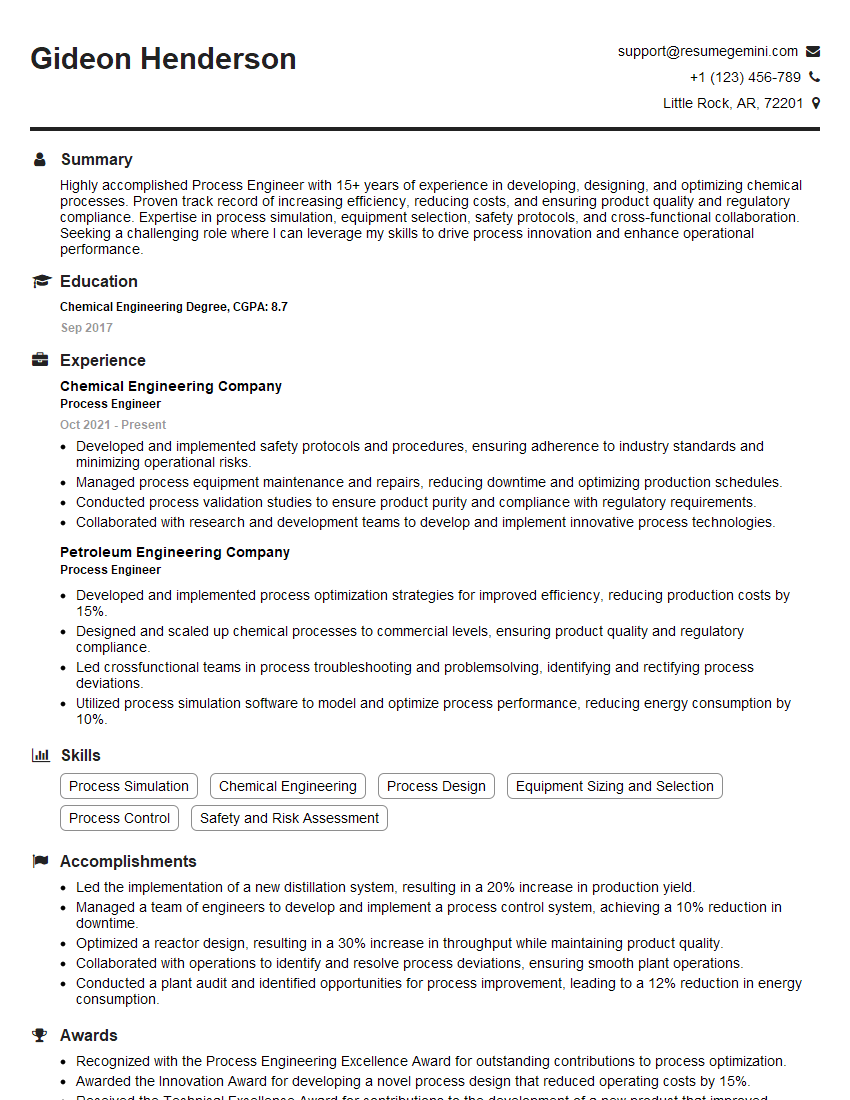
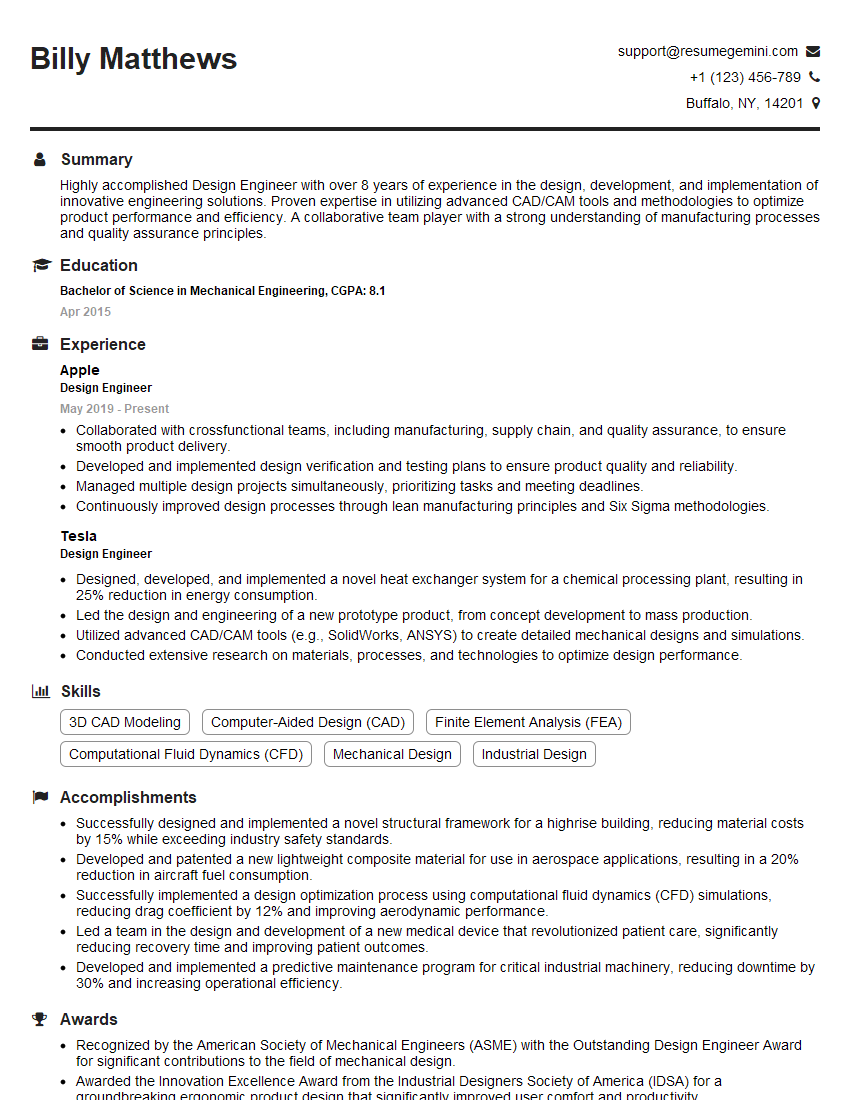
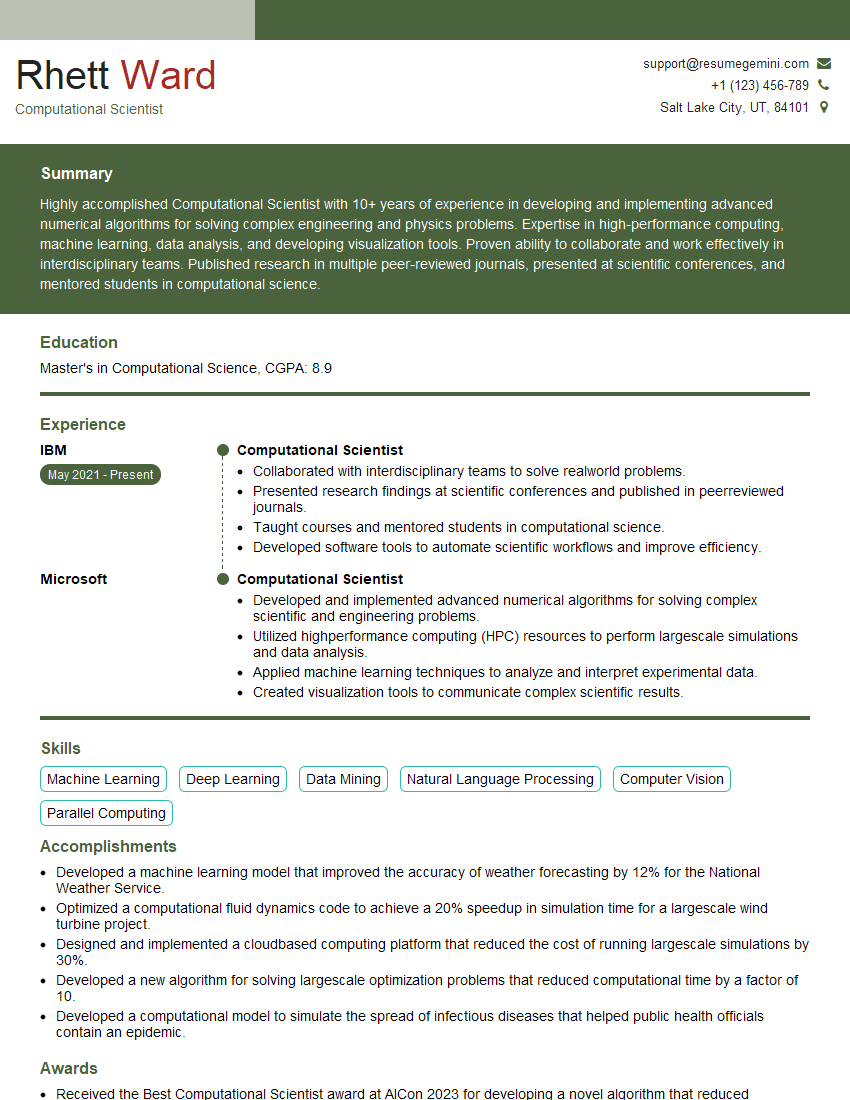
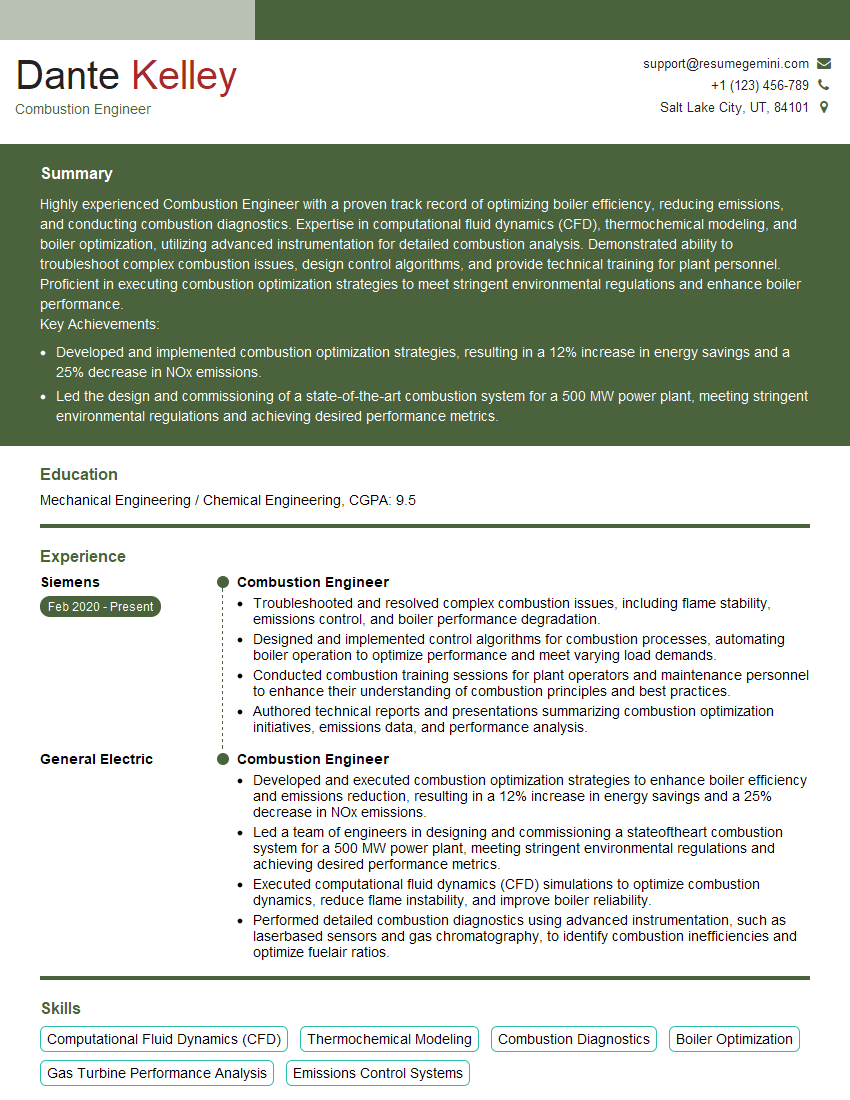
Mastering FireFOAM significantly enhances your prospects in the competitive field of Computational Fluid Dynamics (CFD) and opens doors to exciting career opportunities in research, development, and engineering. To maximize your chances of securing your ideal role, creating a strong, ATS-friendly resume is crucial. ResumeGemini is a trusted resource that can help you build a professional and impactful resume designed to catch the eye of recruiters. Examples of resumes tailored to FireFOAM expertise are available to guide you.



Explore more articles
Users Rating of Our Blogs
Share Your Experience
We value your feedback! Please rate our content and share your thoughts (optional).
What Readers Say About Our Blog
Very informative content, great job.
good