Unlock your full potential by mastering the most common Fishing Net Repair interview questions. This blog offers a deep dive into the critical topics, ensuring you’re not only prepared to answer but to excel. With these insights, you’ll approach your interview with clarity and confidence.
Questions Asked in Fishing Net Repair Interview
Q 1. What types of knots are commonly used in fishing net repair?
Several knots are crucial for fishing net repair, chosen based on the specific damage and net material. The most common include the square knot (also called a reef knot), which is simple, strong, and easy to tie, ideal for joining two lines of similar diameter. The bowline is excellent for creating a loop that won’t slip, useful when repairing tears or attaching patches. The clove hitch is quick and secure for temporary fixes or attaching tools. Finally, the fisherman’s knot is robust and reliable for joining lines of different diameters. Choosing the right knot is vital; a poorly tied knot can compromise the entire repair and lead to further damage.
- Square Knot: Best for joining similar diameter lines.
- Bowline: Creates a strong, non-slipping loop.
- Clove Hitch: Quick and secure for temporary fixes.
- Fisherman’s Knot: Joins lines of different diameters.
Q 2. Describe the different materials used in fishing net construction and their strengths/weaknesses.
Fishing nets are crafted from various materials, each with its own set of properties. Nylon is extremely popular due to its strength, durability, resistance to abrasion and rot, and relatively low cost. However, it can be prone to UV degradation over time, requiring regular inspection and potential replacement. Polyethylene (PE) offers excellent knot strength and is highly resistant to UV damage, making it suitable for long-term use. It’s usually softer than nylon, making it slightly less abrasion-resistant. High-density polyethylene (HDPE) is even tougher, resistant to impacts and abrasion, but can be less flexible. Polyester is another strong option, but it absorbs water and can become heavy when wet. The choice depends on the type of fishing, the environment (saltwater vs. freshwater), and budget considerations. For example, in rough, rocky environments, HDPE might be preferred, while for delicate fishing in calmer waters, nylon might suffice.
Q 3. How do you identify and repair common net damages like tears, holes, and broken knots?
Identifying and repairing net damage requires careful observation and the right techniques. Tears often appear as straight or jagged rips in the netting. These are usually repaired by carefully aligning the torn edges and using a series of square knots or bowlines to mend the gap. Holes can be small or large; small holes can be patched using a simple overhand knot to secure a small piece of netting. Broken knots are identified by loose or unraveling knots within the net’s structure. These should be carefully untied and retied using the correct knot for the situation, ensuring a firm and secure connection. The process involves inspecting the surrounding area for further damage before proceeding. Think of it like mending a fabric; a quick fix is sometimes not enough if there is underlying weakness.
Q 4. What tools and equipment are essential for efficient fishing net repair?
Efficient net repair demands the right tools. A sharp pair of scissors or net cutters are crucial for trimming damaged sections and preparing patches. Needles with a large eye are necessary for threading lines through the netting during repairs. Measuring tape helps ensure accurate patching. Pliers aid in tightening knots, and a sturdy work surface such as a table or board helps keep the net organized. Having a magnifying glass can be very helpful when dealing with fine netting and intricate repairs. Lastly, spare netting material and floats or weights (depending on the type of net) are always essential to have on hand.
Q 5. Explain the process of patching a large hole in a fishing net.
Patching a large hole requires a methodical approach. First, assess the hole’s size and shape. Then, cut a patch slightly larger than the hole from spare netting. Using a strong, preferably water-resistant thread, carefully sew the patch onto the net using a running stitch or other suitable stitch. Ensure the patch overlaps the edges of the hole by at least an inch to provide adequate reinforcement. Secure all edges with several knots, ensuring a firm and tight bond. Finally, inspect the repair thoroughly for any loose threads or weak points. Remember, the patch doesn’t have to be perfectly seamless; its main purpose is to restore strength and integrity to the net. A slightly larger patch is better than one that is too small.
Q 6. How do you assess the overall condition of a fishing net and determine the extent of repair needed?
Assessing a net’s condition involves a thorough visual inspection. Check for any signs of wear and tear, including holes, tears, loose knots, damaged floats or weights, or signs of UV degradation. Inspect the mesh size; inconsistent mesh sizes suggest potential problems and should be repaired. Check for any snags or tangles. Examine the lines for breakage or fraying. If significant damage is found, consider the repair costs compared to replacement. A net with extensive damage might require more effort in repairs than it is worth and replacement would be more economical.
Q 7. What safety precautions do you take when repairing fishing nets?
Safety is paramount when repairing nets. Always use sharp tools carefully to prevent cuts. Wear safety glasses to protect your eyes from flying debris. If working with old nets, be mindful of potential hazards such as sharp points or broken sections. Work in a well-lit area to ensure visibility and minimize the chance of accidents. If working near water, be aware of slipping hazards. It’s always better to be cautious and prioritize personal safety. A simple cut or injury could interrupt the entire project.
Q 8. Describe your experience with different types of fishing nets (e.g., gillnets, trawls, seines).
My experience spans a wide range of fishing nets, each with its unique challenges and repair requirements. Gillnets, for instance, are vertical panels designed to entangle fish, and their repair often involves mending individual mesh sections or replacing damaged areas. These repairs demand precision to maintain the net’s delicate structure and ensure consistent mesh size. Trawls, on the other hand, are large conical nets dragged along the seafloor, often sustaining heavy wear and tear. Repairing trawls involves patching large holes, reinforcing stressed areas, and sometimes even replacing entire sections of the net. Seines, used for encircling schools of fish, require expertise in mending tears and replacing damaged ropes. I’ve worked extensively with all three, learning to identify the specific vulnerabilities of each design and adapting my repair techniques accordingly.
For example, I once repaired a large trawl net that had been severely damaged by contact with a submerged object. This involved assessing the extent of the damage, selecting appropriate materials, and then meticulously patching the tear using specialized stitching techniques and reinforced netting to restore the net’s strength and prevent further damage.
Q 9. How do you handle repairs on nets made from different materials (e.g., nylon, polyethylene)?
Nylon and polyethylene are the most common materials for fishing nets, and their repair techniques differ slightly. Nylon, a strong and resilient material, can be mended using various knots and stitches. Polyethylene, while also durable, is more susceptible to UV degradation and can become brittle over time. Therefore, when repairing polyethylene nets, I prioritize using strong, UV-resistant thread and focus on reinforcing the repaired sections to prolong their lifespan. The choice of needle and thread is also crucial; heavy-duty needles and high-tenacity threads are a must for both types of nets. I also consider the net’s overall condition and the specific location of the damage before selecting materials.
Imagine mending a tear in a nylon gillnet versus a large hole in a polyethylene trawl net. The gillnet might only need a precise, fine repair, while the trawl would require heavier patching and possibly the integration of a net patch.
Q 10. Can you explain the importance of proper knotting techniques in net repair?
Proper knotting techniques are paramount in net repair. They dictate the strength, durability, and longevity of the repair. Using the wrong knot can lead to the repair failing under stress, potentially causing significant losses for the fisher. I’m proficient in various knotting techniques, including the double fisherman’s knot, the clinch knot, and the improved clinch knot, each suited to different applications within net repair. The strength of the knot directly impacts the net’s functionality. A poorly tied knot weakens the net, potentially leading to further damage or loss of catch.
For instance, using a correctly tied double fisherman’s knot to join two ends of a nylon rope ensures a secure connection that can withstand the immense tension of hauling a heavy net. The wrong knot, however, might slip under pressure, leading to a catastrophic net failure.
Q 11. How do you maintain your tools and equipment for net repair?
Maintaining my tools is as vital as maintaining the nets themselves. My kit includes needles of varying sizes, strong thread, net floats and sinkers, scissors, pliers, and measuring tapes. After each repair job, I clean my needles thoroughly, oil the moving parts of my pliers, and store my threads in a dry, dust-free environment. Sharp needles are essential for creating clean, strong stitches. Dull needles can damage the netting material and lead to uneven stitching. Regular cleaning prevents corrosion and ensures the longevity of the tools. This proactive maintenance minimizes downtime and maximizes the efficiency of my work.
For example, I always sharpen my needles using a needle file, ensuring they’re ready for the next repair job. I also keep my thread organized using labeled containers to ensure I have the right type and strength available at all times.
Q 12. Describe your experience working with specialized net repair tools.
My experience encompasses a range of specialized tools, including net-making needles with large eyes for thicker threads, specialized pliers for crimping and tightening, and various types of splicing tools for joining ropes. I also use specialized knotting tools that can assist in tying complex knots quickly and efficiently. These tools allow for precision and efficiency, reducing repair time and enhancing the quality of the repair. I regularly inspect and maintain these specialized tools to ensure peak performance. Each tool plays a critical role in restoring the net to its original functionality. For instance, a net-making needle enables me to stitch through heavy-duty materials with ease, while specialized pliers provide the necessary leverage to create secure connections.
Recently, I started using a portable knotting tool, which significantly sped up my repair process and improved my knot consistency. This investment enhanced my efficiency and reduced fatigue.
Q 13. How do you ensure the repaired net maintains its original strength and functionality?
Ensuring the repaired net maintains its original strength and functionality involves several key steps. First, a meticulous assessment of the damage is crucial to determine the appropriate repair method. This involves examining the material’s integrity, the extent of the damage, and the overall condition of the net. Second, I carefully select high-quality materials that match the original net’s properties. Third, I employ precise stitching techniques to guarantee a strong, durable repair. Finally, I conduct a thorough inspection of the finished repair, testing the mended area for strength and ensuring it won’t unravel under stress. This multi-step process ensures the net’s integrity is restored, preventing future damage and ensuring its continued effectiveness.
For a trawl net, I would reinforce the repair with additional netting material and potentially incorporate a patch, thus exceeding the original strength of the area. This preventative measure helps prevent the repair from failing prematurely.
Q 14. What are the common causes of net damage and how can they be prevented?
Common causes of net damage include abrasion from rough seabed or obstacles, entanglement with debris or other fishing gear, UV degradation, and accidental damage during hauling or handling. Prevention strategies encompass careful handling of the net, regular inspections for signs of wear and tear, using protective coatings to reduce UV damage, and choosing appropriate net materials for the specific fishing environment. Avoiding known hazardous areas can also minimize the risk of damage. Regular maintenance, including cleaning and mending minor repairs promptly, can significantly extend the net’s lifespan.
For example, I’ve seen many nets damaged due to contact with sharp rocks on the seafloor. To prevent this, I recommend using a more abrasion-resistant net material or employing protective sleeves in high-risk areas.
Q 15. How do you handle repairs in various weather conditions?
Repairing fishing nets in various weather conditions requires adaptability and careful planning. Safety is paramount. I always prioritize my safety and the safety of my team above all else. For example, in heavy rain, I’d use a waterproof tarp to protect both the net and my tools, ensuring visibility and preventing slips. Strong winds necessitate finding a sheltered area, perhaps using sandbags to secure the net and prevent it from blowing away. In extremely cold temperatures, I use insulated gloves and warm layers to maintain dexterity and prevent hypothermia. Working in extreme heat requires frequent breaks and plenty of water to stay hydrated. Each weather condition demands a unique approach, dictated by the safety protocols and modifications necessary to ensure the repair is done efficiently and safely.
Career Expert Tips:
- Ace those interviews! Prepare effectively by reviewing the Top 50 Most Common Interview Questions on ResumeGemini.
- Navigate your job search with confidence! Explore a wide range of Career Tips on ResumeGemini. Learn about common challenges and recommendations to overcome them.
- Craft the perfect resume! Master the Art of Resume Writing with ResumeGemini’s guide. Showcase your unique qualifications and achievements effectively.
- Don’t miss out on holiday savings! Build your dream resume with ResumeGemini’s ATS optimized templates.
Q 16. What is your experience with different types of net splicing techniques?
Net splicing is fundamental to my work, and I’m proficient in several techniques. The most common is the ‘knotless splice’, where the ends of the two ropes are overlapped and interwoven without any knots, resulting in a smooth, strong join that minimizes drag in the water. I also use the ‘double-knot splice,’ a more robust technique suitable for high-stress areas of the net. The specific technique chosen depends on the type of net, the material (e.g., nylon, polyethylene), and the location of the damage. For instance, a knotless splice is ideal for delicate areas, while a double-knot splice might be preferred for mending a heavily used section of a trawling net. I’ve also worked with specialized techniques for working with braided ropes and synthetic materials, ensuring optimal strength and durability in the repair.
Q 17. How would you troubleshoot a consistently damaged section of a net?
Troubleshooting a consistently damaged section requires a systematic approach. First, I carefully inspect the area, noting the type of damage—is it abrasion, tearing, or knot failure? Then, I consider the fishing location and methods. Is it a rocky seabed causing abrasion? Are there sharp objects snagging the net? Is the net being used incorrectly, causing undue stress on a particular section? For instance, a consistently damaged area near the cod end of a trawl net might indicate an issue with the net’s construction or the way it’s hauled. Understanding the cause is key; a simple repair might not solve the problem if the underlying cause remains. After identifying the root cause, I’ll implement appropriate preventative measures, maybe modifying the netting material, adding protective layers, or changing fishing practices.
Q 18. Describe your experience with net inspection and quality control procedures.
Net inspection and quality control are integral to my work. Before any repairs, I thoroughly examine the entire net, checking for damage, wear and tear, and potential weaknesses. I use a combination of visual inspection and tactile examination to identify problems. My inspections involve checking for fraying, broken strands, damaged knots, and any signs of deterioration from exposure to UV light or seawater. I document all findings, noting the location and severity of any damage, using standardized forms or photographic records for traceability. This rigorous inspection process ensures that repairs are effective and that the net remains in optimal fishing condition. This proactive approach helps minimize future damage and maximizes the net’s lifespan and effectiveness.
Q 19. How do you prioritize repairs based on urgency and the impact on fishing operations?
Prioritizing repairs is crucial for maintaining fishing operations. I prioritize repairs based on their impact on the net’s functionality and the urgency of the situation. A large tear in the main body of the net, affecting its ability to catch fish, would take precedence over a small hole in a less critical area. Time sensitivity is also crucial; a net with major damage needs immediate repair to prevent further damage and significant economic loss. I use a risk assessment framework, considering both the severity and the urgency of each repair. This approach ensures that essential repairs are completed promptly, minimizing downtime and maximizing fishing efficiency.
Q 20. Explain your knowledge of different types of net mesh sizes and their applications.
Mesh size is critical in fishing net design and functionality. It determines the size of the fish that can be caught and is crucial for selectivity (catching target species and minimizing bycatch). Smaller mesh sizes are used for catching smaller fish, while larger mesh sizes are for larger fish. The mesh size is measured in millimeters or inches, representing the distance between opposite knots. Different types of nets—gillnets, trawl nets, seine nets—often utilize different mesh sizes according to their intended use and target species. For example, a gillnet used for catching salmon might have a much larger mesh size than a net designed to catch sardines. I possess a thorough understanding of different mesh sizes and their applications to ensure that repairs maintain the integrity and selectivity of each net.
Q 21. What is your experience with working on different sizes and types of fishing vessels?
My experience encompasses working on a wide range of fishing vessels, from small inshore fishing boats to larger trawlers and seiners. The size of the vessel impacts the scale and complexity of the repair operations. On smaller vessels, repairs are often conducted on-board, with limited space and equipment. Larger vessels may have dedicated workshops or specialized personnel to assist with repairs. However, the principles of net repair remain the same regardless of the size of the vessel. My adaptability allows me to efficiently execute repairs in diverse environments and utilize different equipment and resources as needed. I’m comfortable handling repairs on various vessels, demonstrating the versatility crucial in this line of work.
Q 22. What is your proficiency in using different types of sewing machines for net repair?
My proficiency with sewing machines for net repair is extensive. I’m comfortable operating various types, from basic single-needle machines ideal for delicate repairs to heavy-duty industrial models necessary for mending large, robust nets. I understand the nuances of each machine – stitch length, tension, and needle selection – and can adapt my approach based on the net material (nylon, polyethylene, etc.) and the extent of the damage. For example, a smaller, lighter machine is perfect for repairing fine-mesh nets used for catching smaller fish, while a robust industrial model is a necessity when working on large trawls. I also understand the importance of regular maintenance on these machines to ensure consistent and high-quality repairs.
- Single-needle machines: Best for precision work on smaller tears and delicate nets.
- Double-needle machines: Offer increased speed and efficiency for larger repairs.
- Industrial sewing machines: Essential for heavy-duty repairs on large commercial nets, offering strength and durability.
Q 23. How do you adapt your repair techniques to different types of fish and fishing methods?
Adapting repair techniques to different types of fish and fishing methods is crucial for effective net maintenance. The type of net needed depends entirely on the target fish. For instance, a fine-mesh net is needed for smaller fish, while a larger, more robust net is necessary for larger species. The fishing method also dictates the type of repair needed. A gillnet used in stationary fishing might require repairs focused on mending holes and tears, while a trawl net used in dynamic fishing will require more attention to reinforcing areas prone to wear and tear from dragging along the seabed. I consider factors like the size and strength of the fish, the fishing environment (e.g., rocky bottom, deep sea), and the type of net used (e.g., gillnet, trawl, seine) when planning my repairs. For example, nets used in rocky areas require reinforced edges to prevent snagging and tearing.
Q 24. Can you explain your experience with working on both small scale and large scale fishing net repair projects?
My experience spans both small-scale and large-scale net repair projects. I’ve worked on individual nets for small-scale fishermen, often conducting on-site repairs to minimize downtime. This requires a flexible approach and the ability to work efficiently with limited resources. I’ve also worked on large-scale projects, such as repairing entire fleets of nets for commercial fishing operations. These projects involve coordinating teams, managing inventory, and ensuring timely completion. In one instance, I was responsible for the repair of over 50 nets for a large tuna fishing company, requiring meticulous planning and organization to meet the strict deadlines. The challenges differ significantly – small-scale repairs often involve quick, practical solutions, whereas large-scale projects necessitate comprehensive planning and resource management.
Q 25. How do you ensure that the repaired net conforms to safety regulations and industry standards?
Ensuring repaired nets conform to safety regulations and industry standards is paramount. This involves using approved materials, maintaining proper stitch density and strength, and rigorously inspecting the finished product. I adhere to all relevant guidelines set by the fishing industry and regulatory bodies. For instance, I carefully check knot strength, mesh size consistency, and overall net integrity to ensure compliance with regulations concerning bycatch reduction (avoiding unintentional capture of non-target species). Regular inspections are crucial to identify and address potential safety hazards, preventing accidents and ensuring the longevity of the net.
Q 26. Describe your approach to training others in fishing net repair techniques.
My approach to training others in fishing net repair techniques is hands-on and comprehensive. I begin by providing a foundational understanding of net construction, material properties, and common repair methods. I then progress to practical exercises, guiding trainees through various repair scenarios, from simple patching to more complex repairs. I believe in a step-by-step approach, starting with basic knot-tying and gradually building up to more intricate techniques. I emphasize the importance of safety, precision, and quality control throughout the training process. I also encourage questions and provide ongoing support to ensure trainees gain confidence and proficiency.
Q 27. What are your strategies for managing your time efficiently when handling multiple net repair requests?
Efficient time management when handling multiple net repair requests involves careful prioritization and scheduling. I assess the urgency and complexity of each request, prioritizing those with the shortest deadlines or most significant impact on fishing operations. I utilize project management tools, such as spreadsheets or digital calendars, to track progress and ensure deadlines are met. I also delegate tasks where possible and optimize workflow to streamline the repair process. Furthermore, I communicate effectively with clients to manage expectations and keep them updated on progress. This proactive approach minimizes delays and maximizes efficiency.
Q 28. How would you handle a situation where the repair materials are not readily available?
When repair materials are unavailable, I employ several strategies. First, I assess the availability of suitable substitutes. There might be alternative materials that can be used temporarily or in specific situations. If no suitable substitute exists, I explore sourcing options, contacting suppliers or exploring alternative vendors. In some cases, I might need to inform the client about the delay and propose alternative solutions. Prioritizing repairs based on the severity of damage and impact on fishing operations is crucial. Ultimately, effective communication with the client is essential to manage expectations and find the best possible solution given the constraints.
Key Topics to Learn for Fishing Net Repair Interview
- Net Materials & Properties: Understanding different net materials (nylon, polyethylene, etc.), their strengths, weaknesses, and appropriate uses in various fishing contexts. This includes knowledge of knot strength and resistance to abrasion.
- Knot Tying & Repair Techniques: Mastering various knot types used in net repair (e.g., the fisherman’s knot, the clinch knot), and demonstrating proficiency in repairing different types of damage, including tears, holes, and broken lines. Practical application includes demonstrating speed and efficiency in knot tying.
- Net Maintenance & Prevention: Identifying potential net damage before it becomes severe, understanding preventative maintenance strategies (cleaning, storage, inspection), and minimizing the need for extensive repairs. This also involves understanding the impact of environmental factors on net lifespan.
- Tools & Equipment: Familiarity with common tools used in net repair (needles, floats, sinkers, etc.) and their proper use and maintenance. This includes understanding the importance of selecting the right tool for the specific repair job.
- Troubleshooting & Problem Solving: Diagnosing complex net damage and developing effective repair strategies. This includes the ability to assess the extent of damage and determine the most efficient repair method, considering factors like time, resources, and the urgency of the repair.
- Safety Procedures: Understanding and adhering to safety protocols while handling nets, tools, and equipment. This involves awareness of potential hazards and implementing appropriate safety measures.
Next Steps
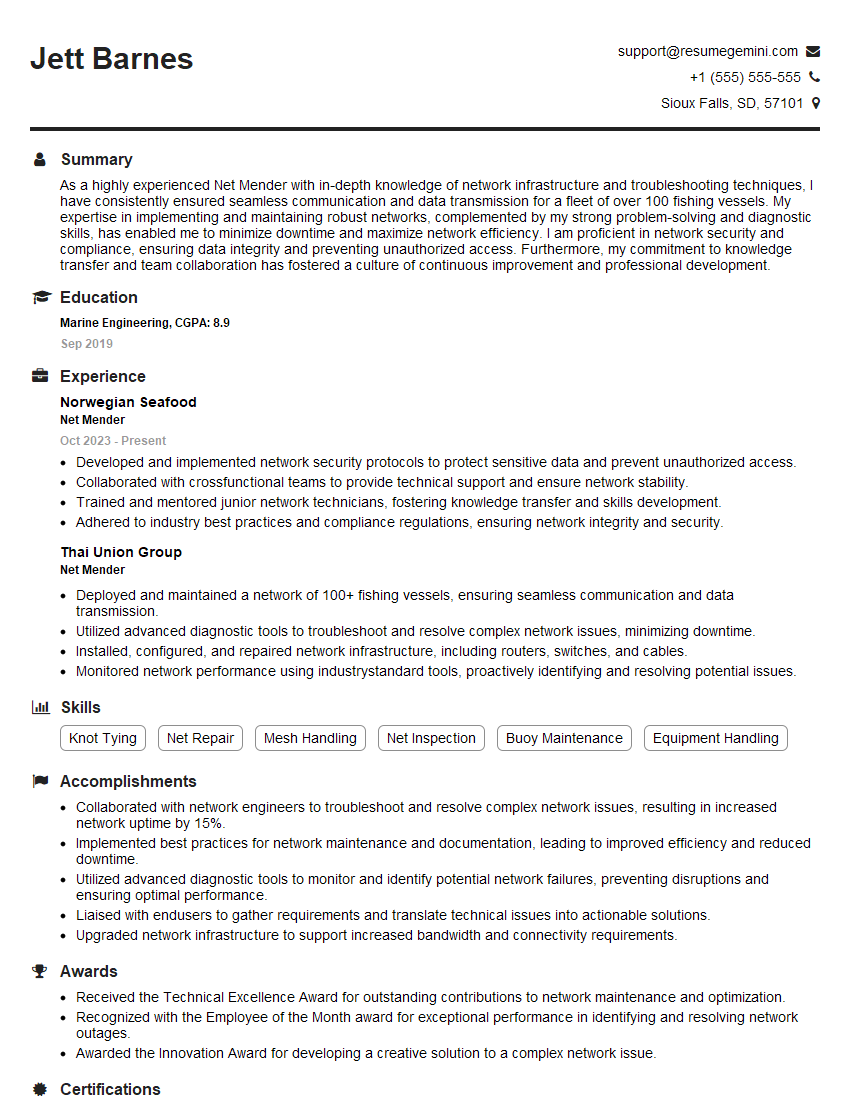
Mastering fishing net repair opens doors to a rewarding career with opportunities for growth and specialization within the fishing industry. A strong understanding of these techniques is highly valued by employers. To maximize your job prospects, it’s crucial to create an ATS-friendly resume that highlights your skills and experience effectively. ResumeGemini is a trusted resource that can help you build a professional resume that stands out. Examples of resumes tailored specifically to the Fishing Net Repair field are available to guide you. Invest time in crafting a compelling resume; it’s your first impression and a key to landing your dream job.
Explore more articles
Users Rating of Our Blogs
Share Your Experience
We value your feedback! Please rate our content and share your thoughts (optional).
What Readers Say About Our Blog
Very informative content, great job.
good