Unlock your full potential by mastering the most common Fittings and Alterations interview questions. This blog offers a deep dive into the critical topics, ensuring you’re not only prepared to answer but to excel. With these insights, you’ll approach your interview with clarity and confidence.
Questions Asked in Fittings and Alterations Interview
Q 1. Explain the process of taking body measurements for garment alterations.
Taking accurate body measurements is crucial for successful garment alterations. It’s like building a house – you need a precise blueprint! We use a flexible tape measure and follow a standardized procedure to ensure consistency and accuracy.
- Bust: Measure around the fullest part of the bust, keeping the tape measure level and parallel to the floor.
- Waist: Measure around the natural waistline, the narrowest part of your torso.
- Hips: Measure around the fullest part of the hips, keeping the tape measure parallel to the floor.
- Shoulder Width: Measure across the back from one shoulder bone to the other.
- Sleeve Length: Measure from the shoulder point (where the shoulder seam meets the neck) to the wrist bone.
- Back Width: Measure across the back, from one armhole to the other, at the widest point of the back.
- Armhole Depth: Measure from the shoulder point to the underarm, following the natural curve of the armhole.
- Garment Measurements: Equally crucial are measurements *taken from the garment itself*. This allows for a direct comparison to the body measurements and informs adjustments.
I always double-check my measurements, and I explain the process clearly to the client to build trust and ensure they understand the importance of accuracy. One memorable instance involved a client who had a very unique body shape; by meticulously measuring and documenting every detail, we achieved a perfect fit for a very challenging alteration.
Q 2. Describe different alteration techniques for adjusting sleeve length.
Adjusting sleeve length involves several techniques depending on the garment and the amount of adjustment needed. It’s a bit like tailoring a story – sometimes you add a sentence, sometimes you rewrite a paragraph.
- Let-out Seam: If the sleeve has seam allowance, we can carefully let out the existing seam to lengthen it. This is best for minor adjustments.
- Adding a Cuff: For significant lengthening, we add a cuff at the wrist. This provides a clean, professional finish and allows for greater flexibility in adjustment.
- Inserting a Panel: For more complex alterations or if the seam allowance is insufficient, we might insert a fabric panel to lengthen the sleeve. This requires careful matching of the fabric pattern and texture.
- Shortening: Shortening a sleeve is usually simpler. We carefully remove fabric from the hem or the upper arm, ensuring the seam remains balanced and the sleeve retains its original shape.
The choice of technique depends on factors such as fabric type, seam construction, and the desired final look. For delicate fabrics, we’d opt for letting out the seam or adding a cuff to minimize visible alterations. For sturdy fabrics, we have more flexibility in our approach.
Q 3. How do you handle alterations on delicate fabrics?
Working with delicate fabrics requires extra care and precision. It’s like handling a precious antique – you need a gentle touch and the right tools. We use specialized needles, such as microtex or silk needles, to prevent snagging or damage.
- Stabilizing the Fabric: We often use a lightweight interfacing or stabilizer to support the fabric during alteration to prevent stretching or distortion.
- Sharp, Fine Scissors: Precision is key, so using sharp scissors prevents fraying or uneven cuts.
- Hand-Stitching: Hand-stitching might be preferred for particularly delicate areas, as it provides greater control and reduces stress on the fabric.
- Pressing with Caution: We use a low-heat setting on the iron and a press cloth to protect the fabric from scorching.
For instance, when altering a silk blouse, I’d carefully hand-stitch any adjustments to ensure the integrity of the fabric and avoid any damage. The end result justifies the slower, more meticulous approach.
Q 4. What are the common challenges in fitting garments, and how do you address them?
Common challenges in fitting garments often stem from inconsistencies in body shape, garment construction, or even the fabric’s drape. Think of it as a puzzle – sometimes the pieces don’t quite fit together perfectly.
- Poor Fit Around the Bust/Waist/Hips: We address this by using darts, gathers, or shaping seams to adjust the garment’s silhouette and create a better fit.
- Sleeve Length/Width Issues: As described earlier, we employ several methods to adjust sleeve length and width, from simple seam adjustments to adding panels.
- Uneven Hemlines: A simple adjustment that often makes a big difference in appearance; we carefully measure and even out the hemline for a professional look.
- Fabric Drape/Hang: Certain fabrics may drape differently than anticipated, so we may need to use techniques like easing or shaping to control the drape and achieve the desired fit.
Problem-solving involves a combination of careful assessment, precise measurement, and the application of appropriate alteration techniques. Thorough communication with the client is key – explaining the process and any potential limitations helps manage expectations and ensures a positive outcome.
Q 5. Explain your experience with various types of sewing machines used in alterations.
Throughout my career, I’ve become proficient with various sewing machines tailored to different alteration tasks. It’s like having a toolbox with different specialized instruments.
- Industrial Sewing Machines: These are workhorses, perfect for heavy-duty alterations or mass production-style adjustments, offering speed and durability.
- Computerized Sewing Machines: They provide precise stitch control and programmable functions, which are advantageous for intricate alterations or consistent results.
- Sergers/Overlock Machines: These excel at finishing seams for a professional, clean look, critical for many alterations.
- Specialty Machines: I’ve also used machines designed for specific tasks, such as buttonhole attachments, blind stitch machines for hems, and even quilting machines for more complex alterations.
My proficiency with different machines allows me to select the best tool for the job, ensuring efficient and high-quality work. For instance, I’d use a serger for finishing seams on a heavy denim jacket alteration, whereas a computerized machine would be ideal for adjusting a delicate silk dress.
Q 6. How do you identify and repair common garment flaws?
Identifying and repairing garment flaws is like being a detective – you need to observe carefully and understand the root cause of the problem before you can fix it.
- Loose Seams: We reinforce these with additional stitching or a seam sealant.
- Holes/Tears: Depending on the size and location, we might darn, patch, or invisibly mend these using techniques appropriate to the fabric.
- Pilling: We carefully remove pilling using a fabric shaver or de-fuzzer.
- Stretching/Distortion: We might use techniques like blocking or pressing to restore the original shape of the garment.
- Broken Zippers/Buttons: Replacement is usually necessary; we choose appropriate replacements to match the garment’s style and color.
My approach is methodical: I first identify the problem, assess its cause, and then select the most appropriate repair technique. Experience helps me quickly determine the best course of action and anticipate potential challenges, leading to efficient and effective repairs.
Q 7. Describe your experience working with different types of closures (zippers, buttons, hooks).
Working with various closures is a significant aspect of alterations. Each closure type demands specific skills and techniques, akin to playing different musical instruments.
- Zippers: I’m adept at installing, replacing, and repairing zippers of all types – metal, plastic, invisible. I select zippers that match the garment’s fabric and style for a seamless integration.
- Buttons: I can sew on various buttons – from simple shank buttons to more intricate designs. I ensure the buttons are securely attached and appropriately spaced for proper function.
- Hooks and Eyes: These require precision placement for a secure and invisible closure. I select the right size and type of hooks and eyes based on the fabric weight and garment style.
- Snaps: I install snaps using specialized tools to create a sturdy yet discrete closure.
A memorable project involved replacing a broken invisible zipper in a wedding gown. Precision and patience were crucial; the client was thrilled with the flawless repair, highlighting the importance of attention to detail and expertise in handling different closure types.
Q 8. How do you determine the appropriate seam allowance for different alterations?
Seam allowance is the distance between the stitching line and the raw edge of the fabric. The appropriate allowance depends heavily on the type of garment, fabric weight, and the specific alteration. A standard seam allowance is 5/8 inch (1.5cm), but this can vary.
- Lightweight fabrics (silk, chiffon): A smaller seam allowance (3/8 inch or 1cm) is often preferred to prevent bulkiness and maintain drape. Too much allowance can make the seams stiff and heavy.
- Medium-weight fabrics (cotton, linen): The standard 5/8 inch (1.5cm) works well for most alterations.
- Heavyweight fabrics (denim, canvas): A larger seam allowance (¾ inch or 2cm) may be necessary for durability and strength. This helps prevent the seam from tearing under stress.
- Specific alterations: For things like taking in seams, you might work with a smaller allowance, perhaps even just ¼ inch (0.6cm), to subtly adjust the fit. Conversely, when letting out a seam, the existing seam allowance needs to be carefully considered, and you may need to incorporate additional fabric.
For example, when taking in a side seam on a pair of trousers, I’d start with a smaller seam allowance to minimize the visible alteration. On the other hand, when adding a patch to a heavily worn denim jacket, a larger seam allowance ensures durability.
Q 9. Explain your understanding of pattern adjustments for different body types.
Pattern adjustments are crucial for achieving a perfect fit on diverse body types. It involves modifying the original pattern pieces to accommodate individual measurements and body shapes. I consider factors such as shoulder slope, bust point, waist circumference, hip measurement, and overall body height.
- Full Bust Adjustment: For individuals with a larger bust, I add fullness to the front bodice pattern piece, ensuring proper balance and avoiding pulling or gaping. This usually involves adding a wedge to the pattern.
- Small Bust Adjustment: Conversely, for smaller busts, I reduce the excess fabric from the front bodice pattern to eliminate excess wrinkling.
- Full Hip Adjustment: Similar to the bust, I add fullness to the hip area of the pattern to achieve a smooth, comfortable fit. This commonly involves a swayback adjustment as well.
- High/Low Waist Adjustment: For those with a high or low waistline, I adjust the waistline position of the skirt or trouser pattern to align accurately.
- Broad Shoulders/Narrow Shoulders: Adjusting the shoulder seams is crucial for a good fit. Broad shoulders require widening the shoulder seam, while narrow shoulders necessitate a reduction.
For instance, I recently adjusted a dress pattern for a client with a full bust and a narrow waist. By adding a bust dart and reducing the waistline, I created a flattering fit. I always make a toile (a test garment) to check the adjustments before cutting into the final fabric.
Q 10. How do you assess the fit of a garment and identify areas needing alteration?
Assessing garment fit involves a methodical approach, combining visual inspection with physical checks. I start by having the client try on the garment, observing the overall silhouette and identifying any obvious issues like pulling, bunching, or gaping.
- Visual Inspection: I check for horizontal and vertical lines, looking for areas that aren’t falling straight. Curved lines often indicate a fit issue.
- Physical Checks: I use my hands to feel the garment’s fit against the body, paying attention to tension and ease. Is it too tight? Does it hang correctly? I also check the garment’s length to confirm a consistent hemline.
- Specific areas: I focus on key areas like the shoulders, bust, waist, hips, and length. Shoulder seams that are too high or low, a waistband that’s too tight, or an uneven hem are common issues I identify.
For example, if I see a significant horizontal pull across the bust, it suggests I need to increase the bust area of the pattern. If the shoulders are pulling at the back, a shoulder adjustment is needed. I meticulously note all these observations before starting any alterations.
Q 11. Describe your experience with hemming various fabrics (e.g., denim, silk, linen).
Hemming different fabrics requires a tailored approach based on their characteristics. Each fabric has unique properties affecting hem finishing techniques.
- Denim: The strength and weight of denim allow for a simple double-fold hem with a strong stitch. I often use a heavier-duty needle and thread to ensure durability.
- Silk: Due to silk’s delicate nature, I prefer a hand-rolled hem or a blind stitch for an invisible finish. This prevents bulk and maintains the silk’s luxurious drape.
- Linen: Linen can fray easily. To prevent this, I often use a serger or pinking shears to finish the raw edge before hemming. A double-fold hem or a narrow rolled hem are common techniques, depending on the desired finish and thickness.
I’ve worked with various hemming techniques, from simple machine stitches to intricate hand-stitched finishes, always selecting the method that best preserves the fabric’s integrity and enhances the garment’s aesthetic appeal. The goal is always a professional, flawless finish that is undetectable.
Q 12. How do you handle customer complaints about alterations?
Handling customer complaints requires patience, empathy, and a problem-solving approach. I listen carefully to their concerns, avoiding interrupting to fully understand their perspective.
- Active Listening: I reiterate their concerns to confirm my understanding and show I’m actively listening.
- Acknowledge the Issue: I apologize for any inconvenience caused and acknowledge their feelings without making excuses.
- Offer Solutions: I propose realistic solutions, such as a re-do, minor adjustments, or a partial refund, depending on the nature of the complaint.
- Follow Up: I follow up with the customer after the issue is resolved to ensure they’re satisfied and address any remaining concerns.
For instance, a client once complained about an uneven hemline. After listening, I re-hemmed the garment, explaining the process and ensuring the new hem was perfectly even. Following up with them ensured their satisfaction and retained their trust. Open communication and a willingness to rectify mistakes are key.
Q 13. How do you maintain a clean and organized workspace?
Maintaining a clean and organized workspace is paramount for efficiency and safety. A tidy environment minimizes distractions and prevents accidents.
- Daily Cleanup: I clear away scraps, needles, and other debris at the end of each day.
- Designated Storage: All tools, fabrics, and patterns are stored neatly in designated areas.
- Regular Organization: I regularly reorganize my workspace to ensure optimal workflow and easy access to frequently used items.
- Ironing and Pressing Station: I have a separate, well-ventilated area for ironing and pressing to avoid mixing steam with fabrics or equipment.
- Safety Measures: Safety pins and sharp objects are kept securely out of reach to prevent injury. The work area is well-lit to avoid eye strain.
I find that a systematic approach to cleanliness not only enhances my productivity but also ensures a professional and reassuring atmosphere for my clients.
Q 14. Describe your experience with different types of alteration tools and equipment.
My experience encompasses a wide range of tools and equipment essential for garment alterations. I am proficient in using both manual and power-driven tools, understanding the strengths and limitations of each.
- Sewing Machines: I’m comfortable with various sewing machine types, from basic models to industrial machines. I know how to adjust tension, stitch length, and pressure for different fabrics.
- Overlock/Serger Machines: I use sergers for clean, professional finishes on raw edges, preventing fraying and adding durability.
- Iron and Ironing Board: These are crucial for pressing seams, pleats, and creating a crisp finish.
- Shears and Scissors: I use different types of shears for various tasks – from fabric shears for cutting patterns to small embroidery scissors for delicate work.
- Measuring Tape and Ruler: Precise measurements are essential for accurate alterations.
- Seam Ripper: A valuable tool for removing stitches without damaging the fabric.
- Hand Needles: I use various hand needles for hand stitching and finishing details.
Choosing the right tool for each task is key to achieving the desired result, and I have extensive experience with a diverse array of equipment.
Q 15. Explain your process for managing multiple alteration orders simultaneously.
Managing multiple alteration orders effectively requires a systematic approach. I utilize a combination of digital and physical organization tools. Firstly, I maintain a detailed order log, either digitally using a spreadsheet or specialized software, or physically using a well-organized notebook. Each entry includes the client’s name, garment details, specific alterations requested, deadlines, and current status (e.g., ‘received’, ‘in progress’, ‘awaiting client approval’, ‘completed’).
Secondly, I prioritize tasks based on deadlines and complexity. Urgent orders are clearly marked and moved to the top of my queue. I visualize my workflow using a Kanban-style board (physical or digital) to track progress across different stages of the alteration process: receiving, measuring, cutting, sewing, pressing, and final fitting. This visual representation allows me to quickly identify potential bottlenecks and re-allocate time effectively. Finally, communication is key. I maintain regular contact with clients to provide updates and manage expectations, particularly concerning urgent orders.
For example, if I receive three orders simultaneously – a rush wedding dress alteration, a simple hem for trousers, and a complex jacket restructuring – I’d prioritize the wedding dress due to its urgency and likely higher cost and emotional significance for the client. The trousers would be next, and the jacket would follow. Consistent communication throughout the process keeps clients informed and ensures a smooth workflow.
Career Expert Tips:
- Ace those interviews! Prepare effectively by reviewing the Top 50 Most Common Interview Questions on ResumeGemini.
- Navigate your job search with confidence! Explore a wide range of Career Tips on ResumeGemini. Learn about common challenges and recommendations to overcome them.
- Craft the perfect resume! Master the Art of Resume Writing with ResumeGemini’s guide. Showcase your unique qualifications and achievements effectively.
- Don’t miss out on holiday savings! Build your dream resume with ResumeGemini’s ATS optimized templates.
Q 16. How do you prioritize urgent alterations?
Prioritizing urgent alterations hinges on clear communication and efficient workflow management. I start by establishing the urgency with the client – understanding the specific event or deadline. This allows me to accurately gauge the required turnaround time. Once I have a clear understanding of urgency, I immediately flag these orders in my system (digital or physical). This can be achieved through color-coding, highlighting, or using a specific ‘urgent’ tag. Next, I adjust my schedule to accommodate these urgent tasks, possibly rescheduling less urgent alterations to ensure timely delivery of priority orders. I often work flexible hours to meet pressing deadlines.
Transparency is crucial. I communicate the estimated completion time for urgent orders proactively, and if unforeseen delays occur, I immediately inform the client, managing their expectations accordingly. For example, if a client needs a suit altered for a same-day event, I will assess the alteration’s complexity, if possible. If the alteration is manageable within the time frame, I’ll prioritize it. If not, I will politely explain the limitations and recommend alternative solutions or adjustments.
Q 17. What safety precautions do you take when operating sewing equipment?
Safety is paramount when operating sewing equipment. My workspace is meticulously organized to prevent accidents. All needles and pins are kept in designated containers, and I never leave needles unattended in the sewing machine or on the work surface. I always ensure the sewing machine is unplugged when not in use or performing maintenance. My fingers are kept well away from the needle and presser foot at all times.
I regularly inspect all equipment for damage or wear and tear before use. Sharp tools are kept in good condition and stored safely. I use appropriate safety guards and machine covers as designed by the manufacturer. Furthermore, I adhere strictly to the manufacturer’s instructions for using the sewing machine and other equipment. If working with heavy fabrics or complex sewing tasks, I will use appropriate protective measures like gloves or safety glasses, always prioritizing safety and minimizing potential risks of injury.
Q 18. How do you ensure the accuracy of your work?
Accuracy is vital in alterations. My process begins with meticulous measurements of the garment and the client. I use measuring tapes to record precise measurements, and I always double-check my figures to avoid errors. I also utilize tracing paper or a projector system to ensure accurate pattern adjustments, especially for complex alterations. If necessary, I will create a muslin mock-up (a sample garment made of inexpensive fabric) to test the pattern adjustments before working on the actual garment. This allows me to fine-tune the design and ensure a perfect fit before committing to alterations on the client’s valuable clothing. Finally, I always conduct a final fitting to ensure the alterations are accurate and that the garment fits perfectly.
For example, when altering a dress, I wouldn’t just rely on eyeballing adjustments. I would take precise measurements of the client’s body and compare them against the dress measurements. Any discrepancies would then be carefully transferred onto the pattern, tested on the muslin if needed, and implemented only then on the finished garment.
Q 19. What are some common alterations requested for men’s and women’s clothing?
Common alterations differ slightly between men’s and women’s clothing. For women, popular requests include:
- Hemming skirts, dresses, and trousers
- Taking in or letting out seams to adjust waist, hip, or bust size
- Altering sleeve length
- Adding or removing darts or pleats
- Adjusting shoulder straps on dresses
Common alterations for men often include:
- Hemming trousers
- Taking in or letting out jacket sleeves or waist
- Altering the length of suit jackets
- Replacing buttons or zippers
- Adjusting collar sizes
These are just some common examples, and the specific alterations requested can vary depending on the individual garment and client preferences.
Q 20. Describe your experience with making alterations to formal wear (e.g., suits, dresses).
I have extensive experience altering formal wear, including suits, dresses, and other special occasion garments. This requires a high level of precision and attention to detail. When altering a suit, for instance, maintaining the original structure and drape is crucial. This requires a thorough understanding of tailoring techniques to create clean, well-fitting adjustments. I often work with high-quality fabrics requiring specialized handling and care.
Similarly, altering a formal dress requires careful consideration of the design details, fabric type, and any embellishments. For example, working with a delicate beaded gown requires extra caution and specific techniques to avoid damaging the embellishments during the alteration process. I’m adept at working with various types of formal wear fabrics and possess the necessary skills to ensure alterations maintain the original elegance and sophistication of these expensive garments. I have successfully handled multiple requests involving intricate details, such as altering a bespoke wedding dress with delicate lace or tailoring a tuxedo for a high-profile event.
Q 21. How do you adapt your techniques for altering different garment styles?
Adapting techniques for different garment styles requires a thorough understanding of garment construction and design principles. The alteration method varies significantly depending on the style. For example, altering a structured blazer requires different techniques than altering a flowing maxi dress. Structured garments often involve complex seams and interfacing that need to be carefully manipulated to maintain the original shape. Flowing garments, on the other hand, often require adjustments to the overall drape and silhouette, focusing on easing and shaping the fabric without creating unwanted creases or puckers.
My approach involves a careful assessment of the garment’s style and construction. Before starting any alterations, I carefully study the garment to understand its design elements, seam placement, and any unique features. This helps me determine the most appropriate techniques to use while minimizing the risk of damaging the garment. I adapt my tools and techniques according to the fabric type; delicate fabrics require different needles and thread than heavy-duty materials. I tailor my approach to each individual garment to ensure the alterations maintain the integrity and style of the piece.
Q 22. How do you handle situations where a garment cannot be satisfactorily altered?
Honesty and transparency are paramount when a garment can’t be altered satisfactorily. I begin by carefully assessing the limitations – is it the fabric type (e.g., delicate lace that risks damage), the garment construction (e.g., complex seams that hinder alteration), or the requested alteration itself (e.g., taking in a dress significantly beyond its current capacity)?
I explain my findings clearly to the customer, using visual aids like diagrams or photos whenever possible. For instance, if the fabric is too fragile for the requested alteration, I’ll show them the potential for tearing or stretching. I’ll explore alternative solutions if feasible, such as suggesting a different alteration or recommending professional dry cleaning to refresh the garment.
Ultimately, if a satisfactory alteration isn’t possible, I’ll clearly state that and, importantly, not proceed without their informed consent. Maintaining trust and managing expectations are key. I might suggest other tailors specializing in specific areas if appropriate. I prioritize preserving the customer relationship, even if I can’t meet their specific alteration request.
Q 23. What are your methods for communicating effectively with customers about alteration details?
Effective communication is crucial. I always start with a thorough consultation, visually inspecting the garment with the customer and discussing their desired outcome. I use simple, non-technical language, avoiding jargon. I clarify any ambiguities about the alteration, such as the exact measurements or desired effect.
I employ visual aids: I’ll sketch the alteration plan directly on the garment or use a measuring tape to demonstrate the changes. I provide realistic timelines and clearly explain potential challenges or limitations. Written confirmation, such as a brief description with a sketch and price, further ensures clarity and helps avoid misunderstandings.
Throughout the process, I encourage open communication. Regular updates, especially if there are unexpected delays or complications, keep the customer informed and build trust. A follow-up after the alteration to gather feedback is vital for improvement and satisfaction.
Q 24. Explain your understanding of different fabric types and their properties.
Understanding fabric properties is fundamental. Different fabrics react differently to alterations. For example:
- Natural Fibers (Cotton, Linen, Silk, Wool): Cotton and linen are durable and relatively easy to alter, while silk and wool require more delicate handling due to their susceptibility to stretching or damage.
- Synthetic Fibers (Polyester, Nylon, Rayon): Synthetics can be more challenging as they often stretch or fray easily during alterations. Understanding their properties is crucial to avoid distortion.
- Specialty Fabrics (Leather, Suede, Lace): These fabrics require specialized techniques. Leather and suede necessitate specific tools and careful stitching to avoid tearing. Lace needs meticulous handling to prevent damage to its delicate structure.
I consider the drape, weight, and texture of the fabric when planning alterations. A heavy wool coat requires different techniques than a lightweight silk blouse. Knowing the fabric’s composition helps determine appropriate seam allowances, stitching methods, and finishing techniques to ensure a high-quality alteration that maintains the garment’s integrity.
Q 25. How do you manage your time effectively to meet deadlines?
Effective time management is vital. I use a combination of strategies:
- Prioritization: I prioritize urgent orders and categorize them by complexity and deadline. This allows me to focus on the most time-sensitive tasks first.
- Scheduling: I maintain a detailed schedule, allotting specific time slots for different alterations. This includes buffer time to account for unexpected delays.
- Efficient Workflow: I have streamlined my workflow to minimize wasted time. This involves organizing my workspace, preparing materials in advance, and utilizing efficient sewing techniques.
- Communication: Open communication with clients about realistic deadlines prevents misunderstandings and avoids rushing the work, which can compromise quality.
I also regularly review my schedule and adjust it as needed to accommodate unexpected changes or emergencies. Maintaining a balance between efficiency and quality is crucial for meeting deadlines and maintaining a high standard of work.
Q 26. How do you stay current with the latest trends in alterations and fitting?
Staying current is crucial in this dynamic field. I utilize several methods:
- Professional Publications: I subscribe to industry magazines and online journals focusing on sewing, tailoring, and alterations. These resources provide insights into the latest techniques and trends.
- Industry Events: Attending workshops and conferences helps me network with other professionals and learn about new technologies and methods.
- Online Resources: I regularly explore online tutorials, videos, and forums for inspiration and to stay updated on the latest tools and techniques.
- Observation: Carefully observing the work of other skilled tailors, analyzing the techniques used in high-end fashion, and paying attention to details in ready-to-wear garments broadens my knowledge.
Continuous learning ensures I maintain a high level of skill and stay ahead of the curve in terms of trends and best practices.
Q 27. Describe your experience working in a fast-paced environment.
I thrive in fast-paced environments. My previous role involved handling multiple alterations simultaneously, often with tight deadlines. I’m adept at prioritizing tasks, managing my time efficiently, and remaining calm under pressure. I find the challenge stimulating and enjoy the sense of accomplishment that comes from successfully managing several projects concurrently.
My experience has honed my organizational skills and ability to adapt quickly to changing demands. I’m comfortable with interruptions and can effectively switch between tasks without sacrificing quality or accuracy. I’ve learned to prioritize and delegate when appropriate to ensure smooth operations, even in high-volume situations.
Q 28. What are your salary expectations?
My salary expectations are commensurate with my experience and skills, and are in line with the industry standard for experienced alterations specialists in this region. I’m open to discussing a competitive compensation package that reflects my contributions to the company’s success.
Key Topics to Learn for Fittings and Alterations Interview
- Understanding Garment Construction: Knowing the basic components of garments (seams, darts, facings) is crucial for effective alterations. This includes understanding different fabric types and their drape.
- Measurement Techniques: Mastering accurate body measurements and garment measurements is fundamental. Practice taking precise measurements and understanding how to translate them into alteration plans.
- Alteration Techniques: Learn various alteration methods, such as taking in seams, letting out seams, adjusting shoulder seams, altering sleeve lengths, and hemming techniques for different fabrics. Consider the impact of each technique on garment fit and appearance.
- Problem-Solving & Troubleshooting: Be prepared to discuss how you’d approach common alteration challenges, such as fitting issues, fabric manipulation, and dealing with difficult fabrics. Focus on your problem-solving process.
- Client Communication & Consultation: Explain your approach to client consultations, understanding their needs, and managing expectations. This includes the ability to clearly communicate technical details in a way that is easily understood by non-technical clients.
- Sewing Machine Operation & Maintenance: Demonstrate your knowledge of operating various types of sewing machines and maintaining them in good working order. This also includes knowledge of different stitches and their applications.
- Safety Procedures & Best Practices: Show you understand and prioritize safety protocols in a sewing environment, including proper handling of equipment and materials.
Next Steps
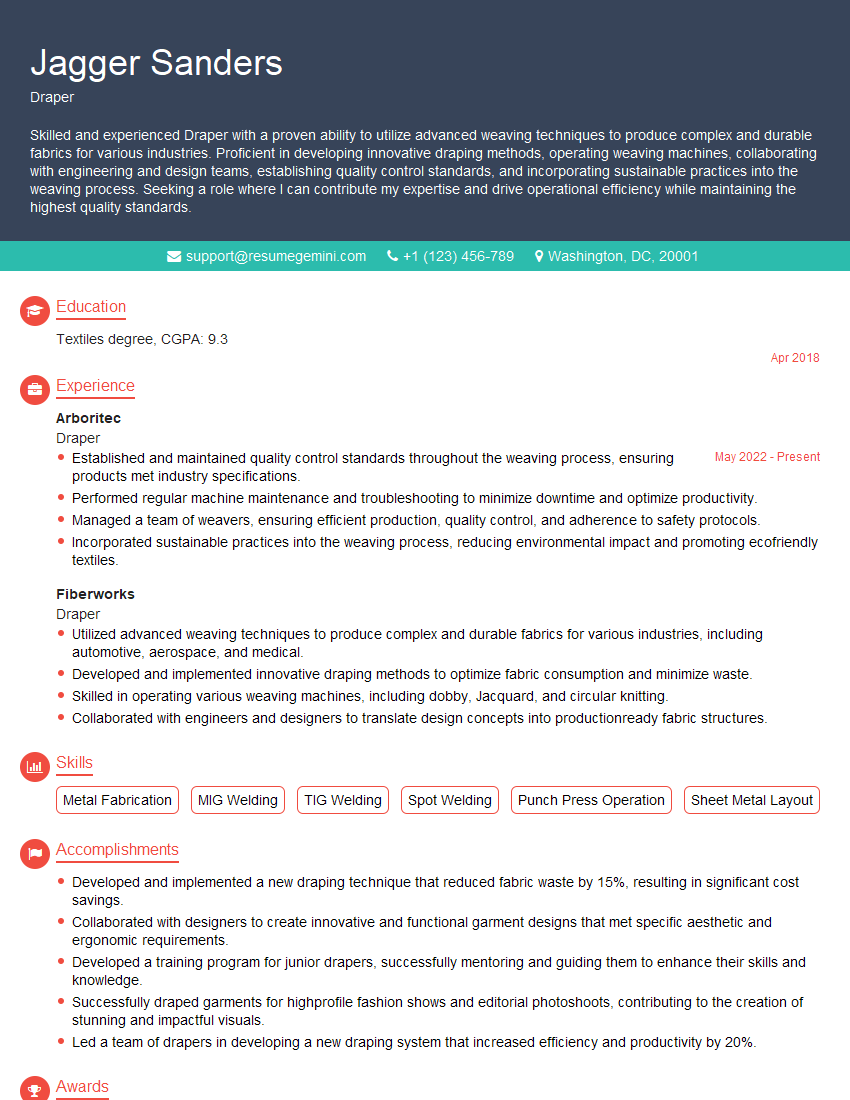
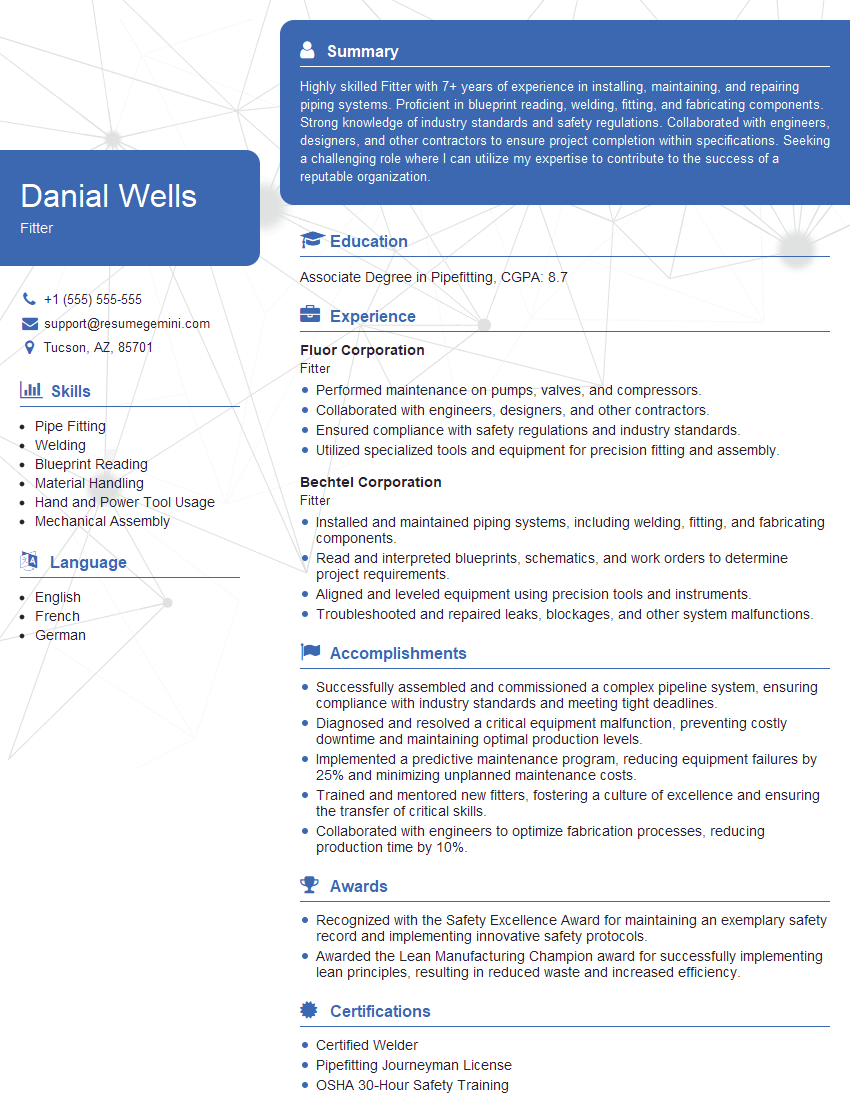
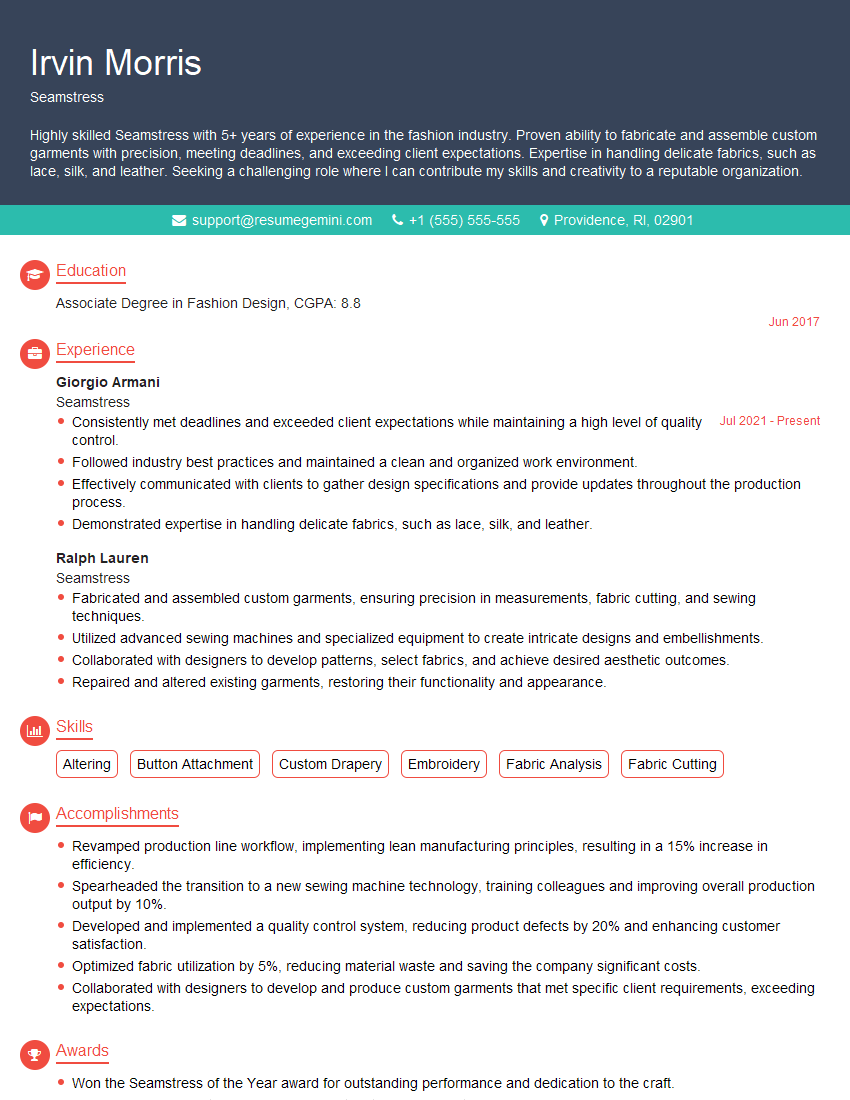
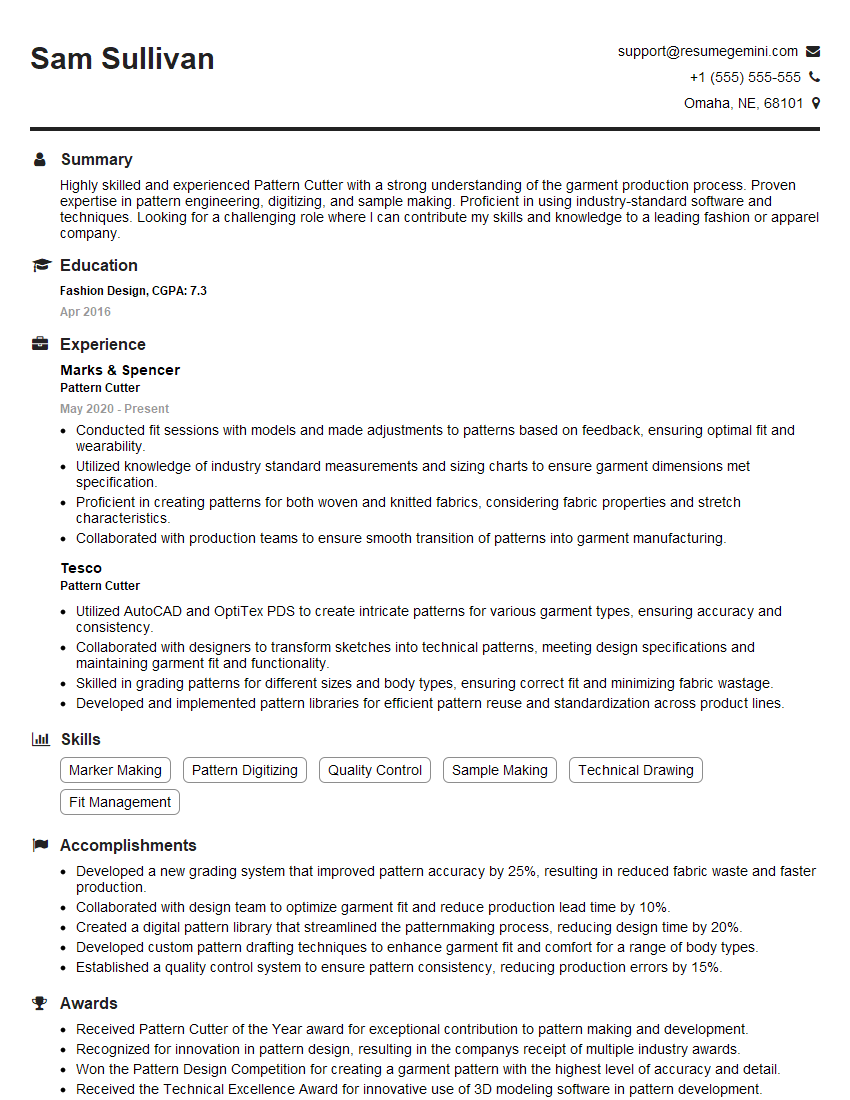
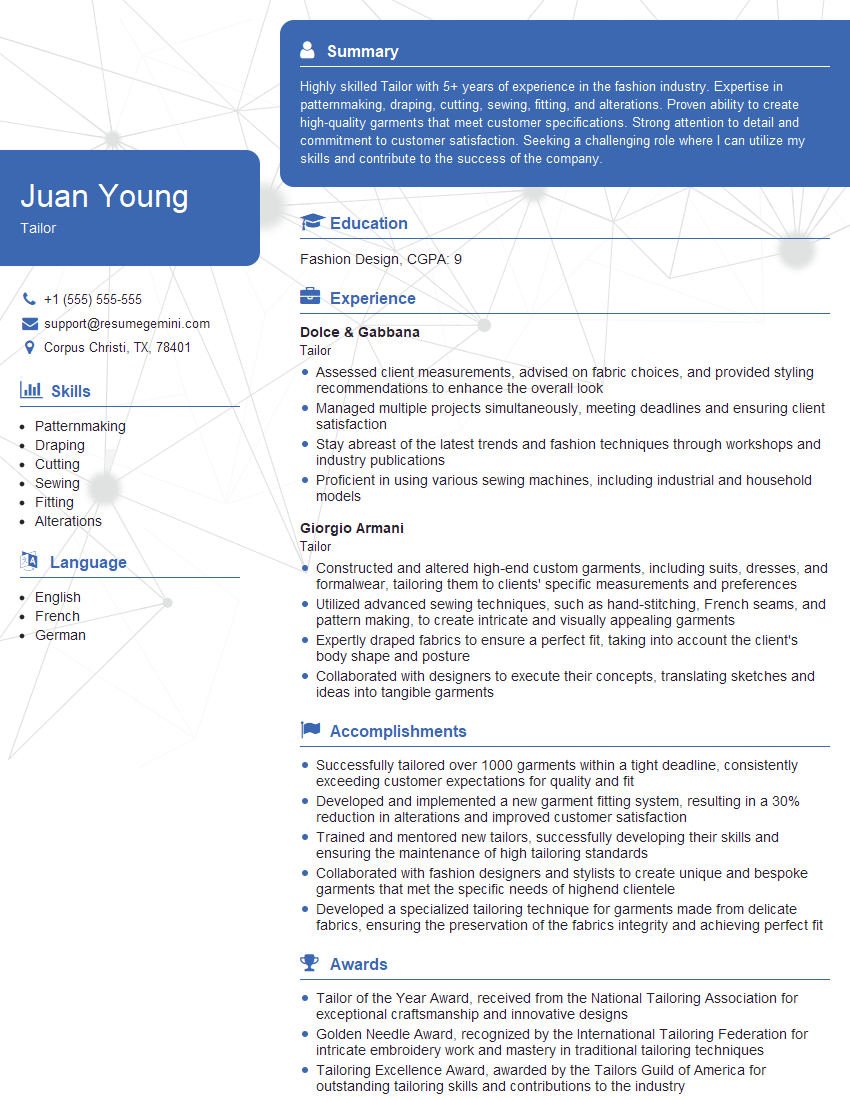
Mastering Fittings and Alterations opens doors to rewarding careers in fashion, tailoring, and custom clothing. A strong understanding of these skills is highly valued by employers and can lead to increased earning potential and career advancement. To maximize your job prospects, create a resume that showcases your expertise effectively. An ATS-friendly resume is crucial for getting noticed by recruiters. Use ResumeGemini to build a professional and impactful resume that highlights your skills and experience. ResumeGemini provides examples of resumes tailored specifically to Fittings and Alterations, helping you present yourself in the best possible light.
Explore more articles
Users Rating of Our Blogs
Share Your Experience
We value your feedback! Please rate our content and share your thoughts (optional).
What Readers Say About Our Blog
Very informative content, great job.
good