Feeling uncertain about what to expect in your upcoming interview? We’ve got you covered! This blog highlights the most important Flooring Sawing interview questions and provides actionable advice to help you stand out as the ideal candidate. Let’s pave the way for your success.
Questions Asked in Flooring Sawing Interview
Q 1. What types of saws are commonly used in flooring sawing?
Several saw types are crucial for flooring installation, each suited to different materials and cuts. The most common include:
- Circular Saws (Skilsaws): Versatile and powerful, ideal for straight cuts in hardwood, engineered wood, and some underlayment materials. They offer good speed and are relatively inexpensive.
- Mitre Saws (Chop Saws): Essential for precise angle cuts, particularly for baseboards, trim, and creating mitered joints. They provide accuracy but can be slower than circular saws.
- Jigsaw Saws: Excellent for intricate cuts and curves, particularly useful for working around obstacles or creating custom shapes in laminate flooring and underlayment.
- Handheld Reciprocating Saws (Sawsall): Useful for demolition or cutting through tough materials, although they are less precise for flooring applications. They are suitable for cutting existing flooring when renovating.
- Tile Saws (Wet Saws): Specifically designed for cutting ceramic and porcelain tiles. They use water to cool the blade and prevent chipping.
The choice of saw depends on the type of flooring, the complexity of the cut, and the overall project requirements. For instance, a simple hardwood floor installation might only require a circular saw and a miter saw, while a complex project with intricate designs might necessitate the use of a jigsaw as well.
Q 2. Describe the safety procedures you follow when operating a flooring saw.
Safety is paramount when operating any flooring saw. My standard procedure includes:
- Proper Eye Protection: Always wear safety glasses or a face shield to protect against flying debris.
- Hearing Protection: Flooring saws can be noisy; earplugs or muffs are essential.
- Dust Control: Use a dust collection system or a respirator mask, especially when cutting materials like hardwood or engineered wood that generate dust.
- Work Area Preparation: Ensure the work area is well-lit, clear of obstacles, and provides ample space to maneuver the saw.
- Secure Workpiece: Use clamps or other methods to securely hold the flooring material to prevent kickback and ensure straight cuts.
- Proper Blade Selection: Always use the correct blade type and size for the material being cut. A dull blade increases the risk of kickback.
- Firm Grip: Maintain a firm, controlled grip on the saw at all times.
- Never Force the Cut: Let the saw do the work; forcing the cut increases the risk of injury.
- Disconnect Power: Always unplug the saw before changing blades or making any adjustments.
I also regularly inspect the saw and its components for any damage or wear and tear before each use. A safe working environment is crucial for productivity and accident prevention.
Q 3. How do you calculate the amount of flooring material needed for a given project?
Calculating flooring material needs involves a few key steps:
- Measure the Area: Accurately measure the length and width of each room requiring flooring. For irregular shapes, break them down into smaller, measurable sections.
- Calculate the Square Footage: Multiply the length and width of each area to find its square footage (length x width = square footage).
- Add Up the Total Square Footage: Sum the square footage of all areas needing flooring.
- Account for Waste: Add 5-10% to the total square footage to account for cuts, mistakes, and potential damage. This percentage can increase depending on the complexity of the design or the material (e.g., more waste with intricate patterns).
- Consider Extra for Matching: For materials with patterns or grains, allow extra to ensure consistent matching across the entire floor.
- Check Manufacturer’s Recommendations: Always refer to the flooring manufacturer’s recommendations for calculating square footage needs; they may have specific guidelines.
Example: A room measuring 12ft x 10ft requires 120 sq ft of flooring. Adding 10% waste (12 sq ft) yields a total need of 132 sq ft.
Q 4. Explain the process of cutting different types of flooring materials (e.g., hardwood, laminate, tile).
Cutting different flooring materials requires specific techniques and tools:
- Hardwood: Circular saws with a fine-toothed blade are preferred for straight cuts. A miter saw is ideal for angle cuts. Always use a sharp blade to prevent splintering. Consider using a sacrificial piece of wood underneath to protect the hardwood from scratching.
- Laminate: A circular saw with a fine-toothed blade or a specialized laminate trimmer can be used. Laminate is prone to chipping, so a clean, sharp blade is crucial. Using a scoring tool beforehand helps to prevent chipping.
- Tile: A wet saw is essential for precise and clean cuts in ceramic and porcelain tiles. The water cools the blade and prevents cracking. Always use the appropriate blade for the tile type.
The correct blade selection, firm support of the material during cutting, and awareness of material-specific properties are crucial for clean and safe cuts. For instance, while a circular saw is great for hardwood, it’s unsuitable for the delicate nature of tile.
Q 5. How do you ensure accurate and precise cuts when using a flooring saw?
Achieving accurate and precise cuts requires attention to detail and the right techniques:
- Sharp Blade: A dull blade leads to inaccurate, uneven cuts and increases the risk of chipping or splintering. Replace blades regularly.
- Proper Blade Alignment: Ensure the blade is properly aligned with the cutting line, using a guide or square for reference. This is essential for straight, precise cuts.
- Secure Workpiece: Securely clamp the flooring material to prevent movement during cutting. This is particularly important for large pieces.
- Slow and Steady Cuts: Avoid rushing the cut. A slow and steady pace ensures greater precision and control.
- Use of Jigs and Guides: For repetitive or complex cuts, using jigs or guides can ensure consistent accuracy.
- Test Cuts: Always practice on a scrap piece of the flooring material to ensure you have the correct settings and technique before cutting the final piece.
For example, when cutting miter joints, accurately setting the miter saw angle is crucial for a perfect fit. Using a square to check the angle before each cut ensures accuracy.
Q 6. What are the common causes of saw blade misalignment, and how do you rectify them?
Saw blade misalignment can stem from several issues:
- Blade Loose on Arbor: The blade might be loose on the saw’s arbor (the shaft the blade spins on), causing wobbling and inaccurate cuts. Tighten the arbor nut securely (but not over-tighten).
- Bent or Damaged Blade: A bent or damaged blade will not spin true and will create uneven cuts. Replace the blade.
- Arbor Misalignment: The arbor itself might be misaligned, causing the blade to wobble. This requires professional repair or replacement.
- Incorrect Blade Installation: Incorrectly mounted blades can also lead to misalignment. Ensure the blade is seated correctly and tightly secured.
Rectification: Addressing blade misalignment begins with a thorough inspection of the blade and arbor. Tightening the arbor nut is often the initial step. If the problem persists, a bent or damaged blade requires replacement. If the problem is with the arbor itself, professional help is needed.
Q 7. How do you maintain and clean your flooring saw to ensure its longevity?
Maintaining a flooring saw extends its lifespan and ensures its performance. My maintenance routine includes:
- Regular Cleaning: After each use, remove sawdust and debris from the saw, blade, and motor housing. Use compressed air to clear out any hard-to-reach areas.
- Blade Maintenance: Regularly inspect the blade for damage, dullness, or wear. Replace blades as needed. Keep blades sharp and clean.
- Lubrication: Lubricate moving parts according to the manufacturer’s instructions. This helps prevent wear and tear.
- Storage: Store the saw in a clean, dry location to prevent rust and damage.
- Inspection: Before each use, inspect the saw for any loose parts, damage, or signs of wear.
- Professional Servicing: Schedule regular professional servicing to ensure the saw is functioning optimally and safely.
Taking care of the saw is like taking care of a car; regular maintenance ensures long-term performance and prevents costly repairs down the line.
Q 8. What are the different types of saw blades, and when would you use each?
Choosing the right saw blade is crucial for achieving clean, precise cuts in flooring. Different materials require different blades to prevent damage and ensure a professional finish. Here are some common types:
- General Purpose Blades: These are versatile blades suitable for a variety of hardwood and softwood flooring materials. They usually have a medium tooth count and are a good starting point for many projects. Think of them as your ‘all-rounder’ kitchen knife.
- Fine Tooth Blades: These blades have a higher tooth count, leading to smoother, cleaner cuts, especially important for delicate materials like engineered wood or laminate flooring. They are akin to using a paring knife for detail work.
- Coarse Tooth Blades: These have fewer, larger teeth, making them ideal for thicker materials or rougher cuts. They are excellent for cutting through plywood subflooring or very hard hardwoods, similar to using a cleaver for tougher tasks.
- Abrasive Blades: These are used for cutting materials that are too hard for traditional blades, like tile or some types of stone. They are the specialized tool for non-wood materials.
- Dado Blades: These are stackable blades used to create grooves or dadoes, frequently used for installing tongue and groove flooring. They’re the specialized tool for creating joints and recesses.
The choice depends entirely on the flooring material. For instance, I’d use a fine-tooth blade for engineered hardwood, but a coarse-tooth blade for cutting through a thick piece of plywood subfloor.
Q 9. How do you handle different flooring thicknesses and densities while cutting?
Handling different flooring thicknesses and densities requires adjusting the saw’s settings and technique. Thicker materials require more power and a slower feed rate to prevent the blade from binding or overheating. Denser materials, like certain hardwoods, also require a slower feed rate and may benefit from a sharper, more durable blade.
For example, when cutting thick oak flooring, I would lower the feed rate on my circular saw, ensuring a steady, controlled movement to avoid kickback or burning the wood. With thinner materials, such as laminate, I’d increase the feed rate slightly but remain cautious, ensuring I don’t force the blade, as this can lead to chipping or splitting. The key is to always feel the resistance of the material and adjust accordingly. Experience builds muscle memory and enables quick, accurate adjustments.
Q 10. Describe your experience with using various types of measuring tools.
Accuracy is paramount in flooring, and mastering various measuring tools is essential. My experience includes using:
- Tape Measures: For overall room measurements and individual board lengths.
- Squares: To ensure accurate 90-degree cuts, especially crucial for creating perfectly aligned joints. I always double-check my measurements with a square before making a cut.
- Speed Squares: These versatile tools are invaluable for marking angles and miter cuts, enabling the creation of intricate patterns or designs in flooring.
- Digital Measuring Tools: While traditional methods are still important, digital tools can add precision to complex layouts, especially helpful for large or intricate projects.
I’ve found that combining multiple tools, such as using a tape measure to get the overall length and then a speed square to mark angles, produces the most accurate cuts. A simple but effective method is always to measure twice and cut once.
Q 11. How do you identify and address common issues encountered while cutting flooring materials?
Common issues include blade binding, kickback, inaccurate cuts, and material damage. Here’s how I address them:
- Blade Binding: This often occurs when cutting too quickly or with a dull blade. Solution: Slow down the feed rate, replace or sharpen the blade.
- Kickback: This dangerous event happens when the blade binds and is forced back towards the user. Solutions include using a blade guard, maintaining a firm grip on the saw, and ensuring the material is securely clamped.
- Inaccurate Cuts: Caused by poor measurement or incorrect saw setup. Solutions: double-check your measurements, ensure the saw is properly aligned, and use a guide or fence when necessary. Sharpen the blade to ensure a cleaner cut.
- Material Damage: Chipping, splitting, or burning of the flooring material. Solutions: use the correct type of blade, adjust the feed rate, ensure the saw is sharp and correctly adjusted, and support the material to prevent it from sagging.
Problem-solving relies on understanding the root cause. I systematically check the blade, the saw settings, and my measuring techniques before attempting a fix.
Q 12. What are the best practices for handling and storing flooring materials?
Proper handling and storage are crucial for preserving the quality of flooring materials. Here are my best practices:
- Transportation: Flooring materials should be transported carefully to avoid damage. Use appropriate vehicles and secure the materials properly. Avoid dragging materials on the ground.
- Storage: Store materials in a clean, dry environment, away from direct sunlight or moisture. Use supports to prevent warping or sagging. Stack materials neatly and avoid excessive weight on any single stack.
- Acclimation: Before installation, allow the flooring materials to acclimate to the room’s temperature and humidity for several days, as this prevents expansion and contraction issues.
For instance, I always keep hardwood flooring in its original packaging, stored flat and level to prevent warping. I never leave it exposed to direct sunlight or extreme temperatures, which could damage it.
Q 13. How do you ensure the safety of yourself and others while operating the saw?
Safety is my top priority. I always follow these procedures:
- Personal Protective Equipment (PPE): This includes safety glasses, hearing protection, and work gloves. I would also use dust masks for certain materials.
- Secure Work Area: The area should be clear of obstructions and well-lit. Materials should be securely supported and I always ensure I have a safe and clear exit strategy.
- Proper Saw Operation: Always ensure the saw is properly adjusted and maintained, with a sharp blade that is appropriate for the material. Never operate a saw that is damaged.
- Safe Cutting Practices: Never force the cut. Maintain a firm grip on the saw, and use a push stick when necessary. Never reach over a running blade.
- Emergency Procedures: I’m familiar with emergency procedures including how to quickly stop the saw in an emergency and how to treat minor injuries.
Safety is not just about rules, it’s about creating a habit of mindfulness while working. I constantly assess my workspace and make sure my equipment and technique are conducive to a safe environment.
Q 14. Describe your experience with different flooring installation techniques.
My experience encompasses various flooring installation techniques, including:
- Nail-down Installation: Used for hardwood flooring, this method involves nailing the boards to the subfloor. I’m proficient in using various nailing tools and techniques, including pneumatic nailers and hand nailing.
- Glue-down Installation: Used for various flooring types, including hardwood, engineered wood, and laminate. This involves applying adhesive to the subfloor and pressing the flooring boards into place. I’m experienced in selecting and applying the correct adhesive for different materials.
- Floating Installation: This method is common for engineered wood and laminate flooring. The boards click together, forming a floating floor that isn’t directly attached to the subfloor. I understand the importance of using proper underlayment to ensure stability and sound dampening.
Each method requires specific tools and techniques. For example, nail-down installations require precise nailing to avoid damaging the boards, while glue-down installations necessitate appropriate adhesive and proper drying time. Floating installations demand precise board alignment and careful attention to the underlayment.
Q 15. How do you ensure that cuts are consistent in terms of size and angle?
Consistency in cuts is paramount in flooring installation for a professional finish. It ensures proper fitting and avoids costly mistakes. This is achieved through a combination of techniques and equipment.
- Using a miter saw with a precise fence: A miter saw’s fence acts as a guide, ensuring the material is always at the correct angle relative to the blade. Regularly check the fence for squareness using a combination square.
- Accurate material clamping: Firmly clamping the flooring material to the saw’s table or fence prevents movement during the cut, guaranteeing accuracy. Never rush this step; secure the material before each cut.
- Using a scoring blade or pre-scoring: For particularly hard materials, pre-scoring the cut line with a sharp utility knife helps prevent chipping or splintering. This creates a weak point for the saw blade to follow.
- Multiple passes for thicker materials: For thicker materials, making multiple passes with the saw blade rather than one deep cut reduces the chances of the blade binding or the material moving during the cut.
- Regular blade maintenance: A dull or damaged saw blade is the most common reason for inaccurate cuts. Sharpen or replace blades as needed to maintain their sharpness.
For example, when cutting hardwood flooring for a mitered corner, using the fence set to the correct angle and clamping the material securely ensures a perfect, seamless joint. Failure to do so could result in a gap or a poorly fitting piece.
Career Expert Tips:
- Ace those interviews! Prepare effectively by reviewing the Top 50 Most Common Interview Questions on ResumeGemini.
- Navigate your job search with confidence! Explore a wide range of Career Tips on ResumeGemini. Learn about common challenges and recommendations to overcome them.
- Craft the perfect resume! Master the Art of Resume Writing with ResumeGemini’s guide. Showcase your unique qualifications and achievements effectively.
- Don’t miss out on holiday savings! Build your dream resume with ResumeGemini’s ATS optimized templates.
Q 16. What types of personal protective equipment (PPE) do you use when operating a flooring saw?
Safety is paramount when operating a flooring saw. The appropriate PPE minimizes the risk of serious injury. This includes:
- Safety Glasses or Goggles: These protect your eyes from flying debris, dust, and saw blade fragments.
- Hearing Protection: Flooring saws can be quite loud. Earplugs or earmuffs are essential to prevent hearing damage over time.
- Dust Mask or Respirator: Many flooring materials create dust during cutting, some of which can be harmful. A dust mask or respirator protects your lungs.
- Work Gloves: Gloves offer hand protection from splinters and sharp edges.
- Closed-toe Shoes: These protect your feet from dropped materials or accidental contact with the saw.
- Long Sleeves and Pants: These protect exposed skin from the spinning saw blade and flying debris.
I always ensure I have all my PPE on before even turning on the saw. It’s a habit I’ve developed over years of working in the field – safety first, every time.
Q 17. How do you troubleshoot common malfunctions with the saw?
Troubleshooting a flooring saw involves a systematic approach to identify and resolve the issue. Common malfunctions and their solutions are:
- Blade Binding: This usually means the material is not clamped securely enough, the blade is dull, or the cut is too deep for a single pass. Solution: Check clamping, sharpen or replace the blade, and make multiple passes if necessary.
- Inaccurate Cuts: This could result from a misaligned fence, a dull blade, or improper material clamping. Solution: Check fence alignment, sharpen or replace the blade, and ensure proper material clamping.
- Motor Won’t Start: This could indicate a blown fuse, a tripped breaker, or a problem with the motor itself. Solution: Check fuses and breakers, and if the problem persists, contact a qualified technician.
- Saw Blade Wobble: A wobbling blade indicates a problem with the blade, arbor, or bearings. Solution: Inspect the blade for damage, check the arbor for tightness, and contact a qualified technician if necessary.
- Excessive Vibration: This could be due to loose parts or an unbalanced blade. Solution: Tighten all visible screws and bolts, and ensure the blade is properly balanced.
A methodical approach, starting with the simplest solutions, often helps resolve the problem quickly and efficiently. When in doubt, always consult the saw’s manual or a qualified technician.
Q 18. Explain the importance of regular maintenance of the flooring saw.
Regular maintenance is crucial for ensuring the saw’s longevity, accuracy, and safety. Neglecting maintenance can lead to inaccurate cuts, costly repairs, and even injury.
- Blade Cleaning and Sharpening: Remove resin buildup and sharpen dull blades regularly to maintain optimal cutting performance and reduce risk of binding.
- Lubrication: Proper lubrication of moving parts extends the life of the saw and ensures smooth operation.
- Inspection: Regularly inspect the saw for loose parts, cracks, or damage. Tighten loose screws and bolts, and address any damage immediately.
- Dust Removal: Regularly clean dust and debris from the saw’s motor, blade, and other components to prevent overheating and malfunction.
- Belt Tension: Check and adjust the belt tension if applicable to ensure proper power transfer.
A well-maintained saw is a safe saw and produces consistent, accurate cuts, saving time and material costs in the long run. Think of it like regularly servicing your car – preventative maintenance is far cheaper than emergency repairs.
Q 19. Describe your experience with different types of flooring materials.
My experience encompasses a wide range of flooring materials, each requiring a slightly different approach during sawing. This includes:
- Hardwood: Different species have varying hardness and density, requiring different blade types and cutting techniques to avoid splintering or chipping.
- Laminate: Precise cuts are essential to ensure a seamless installation, necessitating careful measurement and the use of a sharp blade to prevent chipping or damage to the laminate’s surface.
- Engineered Wood: Similar to hardwood, the precise type of engineered wood influences the chosen blade and cutting technique to minimize chipping.
- Tile: Cutting tile requires specialized tools, such as a wet saw, to prevent cracking and ensure clean cuts.
- Luxury Vinyl Plank (LVP): LVP is relatively easy to cut, but the appropriate blade and speed are needed to avoid excessive heat build-up.
The experience and adaptability gained from working with this diverse range of materials allows me to approach each job with the most appropriate tools and techniques to ensure a high-quality result.
Q 20. How do you determine the appropriate saw blade for a specific flooring material?
Selecting the correct saw blade is crucial for achieving clean, accurate cuts and preventing damage to the flooring material. The choice depends on several factors:
- Material Type: Hardwood requires a different blade than laminate or tile. Hardwood often needs a blade with carbide teeth, whereas laminate benefits from a fine-toothed blade.
- Material Thickness: Thicker materials may require a blade with a larger kerf (width of the cut) to prevent binding.
- Tooth Type and Configuration: Different tooth designs (e.g., ATB, TCG, etc.) are optimized for specific materials and cutting tasks. ATB (alternate top bevel) blades are generally good for clean cuts, while TCG (triple chip grind) is often suited to aggressive cutting.
- Blade Diameter: The blade’s diameter must be compatible with the saw.
For instance, when cutting solid oak hardwood, I’d use a carbide-tipped blade with a relatively large kerf to reduce the risk of binding. However, for laminate flooring, a fine-toothed blade minimizes chipping. Always consult the manufacturer’s recommendations for the specific flooring material.
Q 21. How do you measure and mark flooring materials for accurate cutting?
Accurate measurement and marking are critical for precise cuts. This involves:
- Using the Right Measuring Tools: Employ accurate measuring tools like a tape measure and a square to ensure precise dimensions.
- Marking Techniques: Use a pencil or marking knife to clearly mark the cut lines on the flooring material. Keep the lines straight and visible.
- Transferring Measurements: Accurately transfer measurements from the layout to the material using a square or speed square to ensure perpendicular cuts.
- Layout Planning: Plan your cuts in advance to minimize waste and ensure accurate fitting. Consider using a chalk line for longer, straight cuts.
Before making any cuts, I always double-check my measurements and markings to prevent mistakes. A simple error in measurement can lead to a significant problem down the line. Taking time for accurate measurement and marking is an investment in the overall quality and efficiency of the job.
Q 22. Describe your process for cutting intricate shapes or curves in flooring materials.
Cutting intricate shapes and curves in flooring requires precision and the right tools. For smaller, more delicate curves, a jigsaw with a fine-tooth blade is ideal. Think of it like drawing with a saw – slow, steady movements are key to avoid tearing the material. For larger curves or more complex shapes, a router with appropriate bits can be used to create smooth, precise cuts. This is like using a sculpting tool, carefully shaping the material to the desired form.
For very intricate designs, I often use a combination of techniques. I might pre-cut the general shape with a circular saw, then use a jigsaw or router to refine the curves and details. A template, created from sturdy material like hardboard, is often indispensable for ensuring accuracy and consistency, especially when multiple pieces need to be identical.
For instance, when installing a curved border around a fireplace, I would first create a template from the actual curve, then use this template to guide my cuts on each piece of flooring, ensuring a perfect fit. This approach guarantees uniformity and avoids costly mistakes.
Q 23. How do you manage waste materials generated during the sawing process?
Waste management is a crucial aspect of responsible flooring installation. My approach involves a multi-pronged strategy. Firstly, careful planning and precise measuring help minimize waste from the outset. Accurate calculations and efficient cutting techniques dramatically reduce material scraps.
Secondly, I separate different types of waste. Wood scraps are often salvaged for smaller projects or used as kindling, while other materials are disposed of according to local regulations and recycling programs. For example, some laminate flooring can be recycled, while others may need to go to a landfill.
Finally, I invest in proper waste disposal containers to keep the work area clean and organized. This prevents accidents and ensures that all waste is handled responsibly and efficiently, safeguarding the environment and contributing to a sustainable work practice.
Q 24. What are the key factors to consider when choosing a flooring saw for a specific project?
Choosing the right flooring saw depends on several key factors. The material being cut is paramount: a saw suitable for hardwood might not be appropriate for delicate tile or engineered wood. The thickness and hardness of the material dictate the blade type and motor power needed.
- Material type: Hardwood requires a robust saw with a durable blade, while softer woods may only need a less powerful model.
- Cut type: Straight cuts require a circular saw, while curves necessitate a jigsaw or router.
- Project scale: Large-scale projects benefit from powerful saws with dust extraction capabilities, while smaller jobs may only require a hand-held tool.
- Budget: The available budget determines the quality and features of the saw.
- Portability: A cordless saw is ideal for tight spaces, while corded models usually offer more power.
For example, installing hardwood flooring in a large area necessitates a powerful track saw for precise, straight cuts and efficient dust removal. In contrast, a smaller project involving intricate tile work might only require a handheld tile saw.
Q 25. How do you handle situations where a flooring piece requires multiple cuts?
Multiple cuts on a single flooring piece are common, particularly with intricate designs or when adapting to existing structures. My approach focuses on planning and precision. I always mark out all cuts clearly before making any, using a combination of measuring tools, squares, and marking pencils. This avoids making multiple, inaccurate cuts and wasting material.
The order of cuts is crucial. I prioritize cuts that won’t affect the accuracy of subsequent cuts. For instance, I usually begin with longer cuts, which provide a stable base for the shorter, more precise cuts. This ensures the integrity and precision of the final piece.
If the piece is exceptionally complex, I might even create a smaller-scale mockup to practice the cuts and refine my strategy before working on the actual flooring material. This helps avoid mistakes and ensures that the final product meets the required specifications.
Q 26. How do you address inconsistencies in flooring material dimensions?
Inconsistencies in flooring material dimensions are a common challenge. I address this by carefully inspecting each piece before cutting. Any significant variations are noted and accounted for during the layout process. Sometimes, subtle adjustments to the cutting angles are needed to ensure a tight fit. This could involve slightly shaving off material from certain edges to compensate for the variations.
In severe cases, I might have to re-evaluate the installation plan or selectively use pieces to minimize visible gaps. For example, shorter pieces might be strategically placed in areas less visible to the eye. Detailed planning and precise measurement are critical in mitigating the effects of dimensional inconsistencies. This helps to create a beautiful, seamless floor, even when working with imperfect materials.
Q 27. Describe your experience with working on large-scale flooring projects.
I have extensive experience with large-scale flooring projects, from commercial spaces to large residential homes. These projects demand meticulous planning, efficient resource management, and seamless teamwork. My approach starts with thorough site surveys and detailed measurements. Accurate material estimation and efficient logistics are critical in such ventures. This often involves collaborating with suppliers to ensure timely material delivery and minimize disruptions.
One notable project involved installing engineered hardwood flooring in a large convention center. This required careful coordination with other contractors, precise cutting to accommodate existing structures, and efficient waste management to maintain a clean and safe working environment. On-site problem-solving was crucial, and proactive communication was key to successful completion.
Q 28. Explain your approach to quality control in flooring sawing and installation.
Quality control is fundamental to my work. It begins with selecting high-quality materials and using appropriate tools. Careful measurement and precise cutting are integral to achieving a flawless installation. Regular checks throughout the process are essential to ensure that cuts are accurate, and materials are appropriately positioned. I often use a combination of measuring tools, including laser levels and digital squares, to ensure precision.
After installation, a final inspection is crucial to identify any imperfections or misalignments. This involves checking for gaps, uneven surfaces, and any potential issues with the overall aesthetics of the flooring. Addressing any minor issues promptly is key to delivering a high-quality end-product that meets both functional and aesthetic requirements. My reputation hinges on exceeding client expectations through a commitment to meticulous quality control.
Key Topics to Learn for Flooring Sawing Interview
- Safety Procedures and Regulations: Understanding and applying relevant safety protocols for operating sawing equipment, including personal protective equipment (PPE) and emergency procedures.
- Material Knowledge: Familiarity with various flooring materials (e.g., hardwood, laminate, tile), their properties, and appropriate sawing techniques for each.
- Saw Operation and Maintenance: Proficiency in operating different types of saws (e.g., circular saws, miter saws, table saws), understanding their maintenance needs, and troubleshooting common issues.
- Precision Cutting Techniques: Mastering accurate cutting techniques to minimize waste and ensure precise fits for flooring installation. This includes understanding angles, measurements, and joint types.
- Measuring and Layout: Accurately measuring spaces and creating precise layouts for efficient cutting and minimal material waste. This includes understanding different flooring patterns and their impact on cutting.
- Waste Management and Disposal: Proper handling and disposal of sawdust and other cutting byproducts, adhering to environmental regulations.
- Problem-Solving and Troubleshooting: Identifying and resolving issues related to saw operation, material handling, and cutting inaccuracies. This includes understanding the causes of common problems and implementing effective solutions.
- Quality Control: Inspecting cut pieces for accuracy and quality, ensuring they meet required specifications before installation.
Next Steps
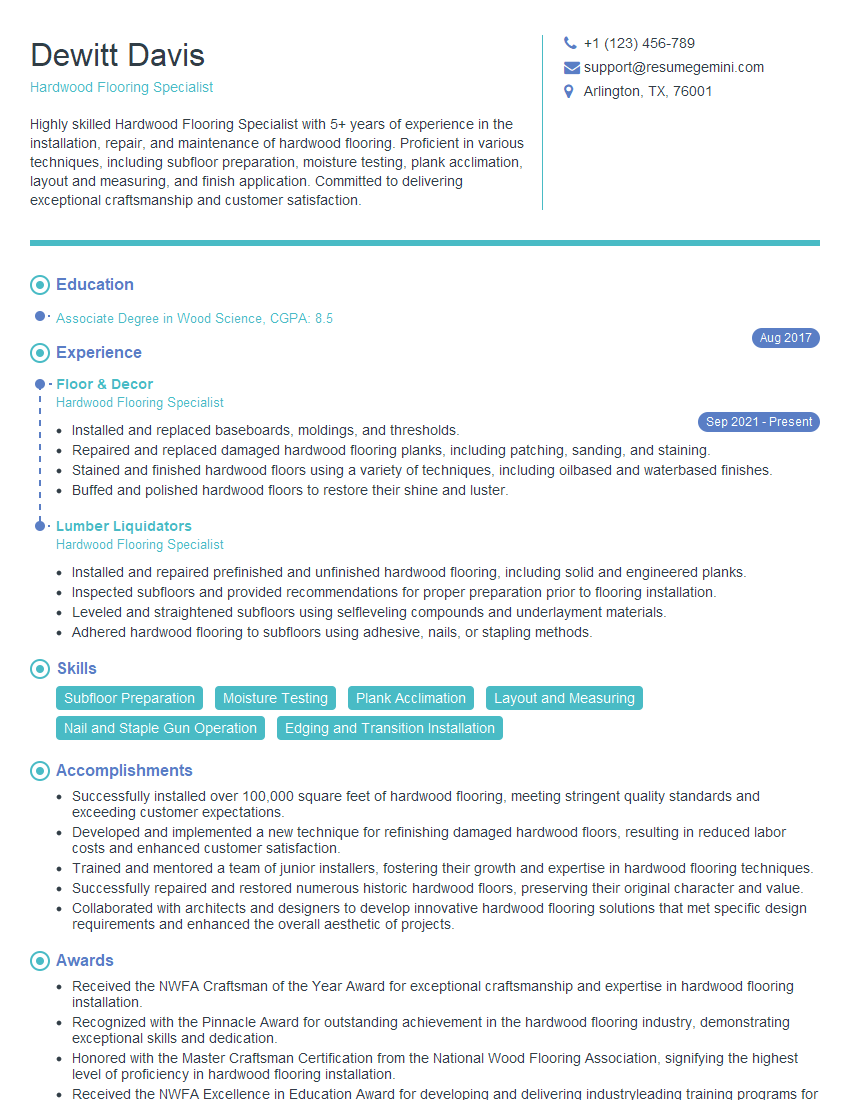
Mastering flooring sawing techniques is crucial for career advancement in the flooring industry, opening doors to higher-paying roles and increased responsibility. A strong resume is essential for showcasing your skills and experience to potential employers. To maximize your job prospects, create an ATS-friendly resume that highlights your abilities and achievements. ResumeGemini is a trusted resource that can help you build a professional and impactful resume. Examples of resumes tailored specifically to flooring sawing positions are available to guide you through the process.

Explore more articles
Users Rating of Our Blogs
Share Your Experience
We value your feedback! Please rate our content and share your thoughts (optional).
What Readers Say About Our Blog
Very informative content, great job.
good