Preparation is the key to success in any interview. In this post, we’ll explore crucial Floral Demonstration interview questions and equip you with strategies to craft impactful answers. Whether you’re a beginner or a pro, these tips will elevate your preparation.
Questions Asked in Floral Demonstration Interview
Q 1. Describe your experience in floral demonstration.
My experience in floral demonstration spans over 15 years, encompassing a wide range of settings from intimate workshops to large-scale industry events. I’ve had the privilege of teaching both beginners and experienced florists, adapting my approach to suit diverse learning styles and skill levels. My demonstrations often incorporate interactive elements, encouraging audience participation and hands-on learning. I’ve also designed and presented demonstrations for various organizations, including garden clubs, wedding planners associations, and floral design schools. My feedback consistently highlights the clarity of my instructions, the practical nature of my techniques, and the overall engaging nature of my presentations.
Q 2. What floral design styles are you most proficient in?
I’m highly proficient in several floral design styles, each offering unique aesthetics and challenges. My expertise includes:
- Classic European Style: Characterized by its elegant, symmetrical arrangements, often featuring a variety of blooms and lush greenery arranged in a structured manner. I enjoy the precision and balance inherent in this style.
- Modern Minimalist Style: This style emphasizes clean lines, simple forms, and a limited color palette. I find the challenge lies in creating impactful designs with fewer elements.
- Romantic Style: This focuses on soft, flowing lines, pastel colors, and a sense of effortless beauty, typically incorporating abundant flowers and textures.
- Avant-Garde Style: I’m particularly passionate about this style, which prioritizes creativity, experimentation, and unconventional design choices. It allows for bold statements and breaking design conventions.
I am also comfortable working with other styles and am adept at blending different approaches to achieve a truly bespoke look.
Q 3. Explain your process for creating a floral arrangement.
My process for creating a floral arrangement, and consequently demonstrating it, follows a structured yet adaptable approach:
- Conceptualization: I begin by defining the overall theme, style, and purpose of the arrangement. What is the occasion? What is the intended mood or message? This phase is crucial for visual planning.
- Material Selection: Based on the concept, I carefully select the flowers, foliage, and containers. This includes considering color palettes, textures, and the overall visual balance.
- Preparation: Flowers are conditioned (rehydrated) and stems are properly prepared – cutting at an angle to maximize water uptake. Tools and materials are gathered for easy access.
- Construction: I begin by creating a framework or foundation for the arrangement, using mechanics like floral foam or other support structures. Then, I gradually build the arrangement, following a design plan that may be symmetrical, asymmetrical, or free-form depending on the chosen style.
- Finishing Touches: Once the main structure is in place, I add accent pieces, refine the shape, and ensure a harmonious overall presentation. This is often an iterative process of refinement and adjustment.
Throughout this process, I focus on clear, concise communication, explaining each step and highlighting key techniques for the audience. I always encourage questions and interaction.
Q 4. How do you adapt your demonstration style to different audiences?
Adapting my demonstration style to different audiences is paramount for effective communication. I tailor my approach based on factors like:
- Prior Experience: Beginners require more detailed explanations and slower demonstrations, while experienced florists may appreciate more advanced techniques and creative challenges.
- Audience Size: Larger audiences require amplification and clearer visual aids. I often use larger displays and visual projectors.
- Time Constraints: I adjust the complexity and scope of the demonstration to fit the allotted time. I might focus on a single technique in a short session and a more comprehensive approach in a longer one.
- Setting: The environment influences my material choices and presentation. For instance, an outdoor demonstration might use hardier flowers and require different preparation techniques.
Ultimately, my goal is to make the demonstration engaging and relevant for everyone, regardless of their experience or background.
Q 5. What tools and materials are essential for a successful floral demonstration?
Essential tools and materials vary slightly depending on the demonstration but generally include:
- Floral Shears or Scissors: Sharp, clean cutting tools are crucial for preparing stems.
- Floral Foam (Oasis): Provides a stable base for many arrangements.
- Containers: Vases, baskets, or other vessels in various shapes and sizes.
- Floral Tape: For securing stems and creating supports.
- Wire: Useful for supporting heavier blooms or creating unique structures.
- Floral Pins: For securing materials to floral foam.
- Water Source: For keeping flowers hydrated.
- Flower Food: Extends the life of cut flowers.
- Various Flowers and Foliage: The heart of the demonstration!
In addition to these essential items, I always have backup supplies on hand to handle unforeseen issues.
Q 6. How do you maintain the freshness of flowers during a demonstration?
Maintaining flower freshness during a demonstration is critical. My strategies include:
- Proper Hydration: Flowers should be fully hydrated before the demonstration begins. This includes using flower food and ensuring stems are cut properly.
- Cool Environment: Keeping the area cool and away from direct sunlight minimizes wilting. I often use air conditioning or fans.
- Misting: Gently misting the flowers with water can temporarily revive them if they start to droop.
- Quick Work: Efficient work prevents long exposure of flowers to the air. I prepare the materials well in advance.
- Use of Flower Food: I always use flower food to prolong the vase life of cut flowers.
By combining these methods, I can ensure the flowers remain fresh and vibrant throughout the entire demonstration.
Q 7. Describe a time you had to troubleshoot a problem during a floral demonstration.
During a demonstration on asymmetrical arrangements, a crucial stem unexpectedly snapped on a particularly heavy bloom, jeopardizing the balance of the entire design. I quickly assessed the situation, explaining to the audience the importance of stem selection and proper preparation. Instead of panicking, I improvised, using floral wire to create a discreet support system, effectively preventing the rest of the arrangement from collapsing. I used this incident as a teaching opportunity, highlighting the importance of problem-solving and adaptability in floral design, and further emphasizing the need for proper stem support.
Q 8. How do you handle questions from the audience during a demonstration?
Handling audience questions during a floral demonstration is crucial for engagement and learning. I approach it with a combination of preparation and adaptability. Before the demonstration, I anticipate common questions based on the chosen topic and prepare concise, clear answers. During the demonstration, I encourage questions by pausing at natural breaks and explicitly inviting them. I actively listen to each question, repeating it to ensure understanding and to buy myself time to formulate a thoughtful response. For complex questions, I break down the answer into manageable parts, using visual aids if necessary. Sometimes, I’ll even demonstrate a small technique in response to a question. If I don’t know the answer, I’m honest about it and promise to research and follow up. This builds trust and credibility.
For example, if someone asks about a specific flower’s care, I’ll not only explain its water requirements but might also briefly show how to properly cut the stem to maximize vase life. This interactive approach ensures that the audience feels valued and actively participates in the learning process.
Q 9. What are some common mistakes to avoid when demonstrating floral design?
Common mistakes in floral demonstrations often stem from poor planning or a lack of attention to detail. One frequent error is neglecting to prepare all materials beforehand, leading to awkward pauses and disruptions in the flow. Another is failing to demonstrate proper techniques clearly. For example, simply showing the final arrangement without explaining the steps involved leaves the audience frustrated and uninformed. Overcrowding an arrangement, ignoring scale and proportion, or neglecting proper hydration techniques are all visual and practical mistakes. Using inappropriate tools for the task or forgetting to address the specific needs of different flower types (e.g., not knowing how to properly handle delicate blooms) can also detract from the demonstration.
Finally, poor time management is a significant issue. A rushed demonstration is hard to follow and often results in a less polished final product. To avoid these mistakes, meticulous planning, thorough preparation, clear step-by-step instructions, and a focus on the fundamentals of floral design are essential.
Q 10. How do you incorporate different textures and colors into your floral arrangements?
Incorporating diverse textures and colors is fundamental to creating visually striking and dynamic floral arrangements. I begin by selecting flowers and foliage with a range of textures – think smooth petals against rough bark, soft ferns contrasting with spiky thistle. The contrast adds visual interest and depth. Regarding color, I employ the color wheel as a guide, using complementary colors (opposite each other on the wheel) for high contrast, or analogous colors (next to each other) for a more harmonious feel. I also utilize the principle of color temperature – incorporating both warm (reds, oranges, yellows) and cool colors (blues, greens, purples) to create balance and avoid monotony.
For example, I might combine the smooth, velvety texture of roses with the delicate feathery texture of baby’s breath and the rough texture of eucalyptus branches. In terms of color, a vibrant red rose paired with cool-toned blue delphiniums creates a striking contrast, while a bouquet of lavender, purple, and pink flowers offers a more subtle and harmonious effect. The key is balance; too much of one texture or color can overwhelm the eye.
Q 11. Explain your understanding of floral design principles (e.g., line, form, color).
Floral design principles are the building blocks of creating successful arrangements. Line refers to the direction and flow created by the stems and blooms – whether it’s cascading, vertical, or horizontal. Form relates to the shapes and sizes of the flowers and foliage, and how they interact with each other. Think about using a variety of shapes – round, spiky, curved – to create visual interest. Color, as discussed earlier, is about using a palette that evokes a certain mood or feeling and creating balance and contrast. In addition, Space is equally important. Negative space, or the empty areas in the arrangement, is as crucial as the flowers themselves, allowing the eye to rest and appreciate the overall composition. Scale refers to the size and proportion of elements within the arrangement. Texture adds depth and interest.
Mastering these principles allows me to create arrangements that are not merely collections of flowers but aesthetically pleasing works of art.
Q 12. How do you create visually appealing focal points in your arrangements?
Creating a visually appealing focal point is paramount in any floral arrangement. This draws the viewer’s eye and provides a sense of order and balance. Typically, I use a larger, more striking flower or a cluster of similar flowers as the focal point. Its color, size, or shape should stand out from the rest of the arrangement. This could be a unique bloom, or a cluster of contrasting color. The placement of the focal point is equally crucial; it’s often positioned slightly off-center to avoid a static, symmetrical look. The surrounding elements should complement the focal point without competing for attention.
For example, in a bridal bouquet, the focal point might be a large, richly colored peony surrounded by smaller, lighter blooms. In a centerpiece, it could be a striking orchid placed slightly to the side, with other flowers and greenery arranging around it to create visual harmony.
Q 13. Describe your experience working with different types of flowers.
My experience working with different flower types is extensive. I’ve worked with everything from delicate orchids requiring specialized handling to hardy sunflowers that need robust support. Understanding the unique characteristics of each flower type is crucial. For example, roses require precise cutting to maximize vase life, while lilies need careful placement to avoid staining other flowers with pollen. Knowing how different flowers behave in terms of wilting, hydration, and longevity is essential for successful arrangement.
I also have experience working with seasonal flowers, which necessitates adaptability and creativity, since availability changes throughout the year. I’m familiar with local sourcing and how to maximize the use of lesser-known varieties. This experience extends to understanding how various types of foliage complement different flowers, adding another layer of visual and textural interest.
Q 14. How do you incorporate sustainable practices into your floral demonstrations?
Sustainability is a core value in my floral demonstrations. I emphasize the importance of using locally sourced flowers whenever possible to reduce the carbon footprint associated with transportation. I encourage the use of eco-friendly materials such as recycled containers and biodegradable floral foam alternatives (like chicken wire or oasis alternatives). I also highlight techniques that extend the life of cut flowers, minimizing waste. This includes demonstrating proper hydration techniques and storage methods, and showcasing how to repurpose flowers after a demonstration or event (e.g., composting or using them to create potpourri).
During my demonstrations, I often discuss the environmental impact of different floral choices and encourage the audience to consider sustainable practices in their own floral arrangements. This includes promoting awareness about responsible flower farming and the dangers of invasive species.
Q 15. What software or technology do you utilize for floral design planning?
While some floral designers still rely on pen and paper sketches, I leverage technology extensively for floral design planning. This involves using a combination of software and tools to enhance efficiency and precision. I primarily utilize design software such as Adobe Photoshop or Illustrator to create digital mock-ups of arrangements. This allows me to experiment with different color palettes, flower types, and arrangements before I even begin working with the actual flowers. Furthermore, I often employ 3D modeling software to visualize complex installations and large-scale designs, ensuring all elements are proportionally accurate and aesthetically pleasing. This helps avoid costly mistakes and ensures the final product aligns perfectly with the client’s vision.
For example, when planning a wedding centerpiece, I might use Photoshop to create a digital rendering showcasing the chosen flowers, their arrangement, and the overall table setting. This allows for client feedback and revisions before any actual floral work begins. This digital workflow saves time, reduces waste, and guarantees a higher level of client satisfaction.
Career Expert Tips:
- Ace those interviews! Prepare effectively by reviewing the Top 50 Most Common Interview Questions on ResumeGemini.
- Navigate your job search with confidence! Explore a wide range of Career Tips on ResumeGemini. Learn about common challenges and recommendations to overcome them.
- Craft the perfect resume! Master the Art of Resume Writing with ResumeGemini’s guide. Showcase your unique qualifications and achievements effectively.
- Don’t miss out on holiday savings! Build your dream resume with ResumeGemini’s ATS optimized templates.
Q 16. How do you manage your time effectively during a floral demonstration?
Time management during a floral demonstration is crucial. My approach involves meticulous pre-planning and a clear timeline. Before the demonstration, I create a detailed schedule, breaking down the process into manageable steps with allocated timeframes. This includes time for setup, material preparation, demonstration of techniques, Q&A, and cleanup. I also rehearse the demonstration beforehand to ensure I’m comfortable with the pace and flow. During the demonstration itself, I maintain a focused pace, clearly explaining each step while avoiding unnecessary tangents. I use visual aids, such as pre-prepared diagrams or slides, to support my explanations and keep the audience engaged. If I encounter a delay, I adjust the pacing of subsequent steps without compromising the overall quality or clarity of the demonstration. Think of it like conducting an orchestra – each instrument (step) has its place and timing for a harmonious whole.
Q 17. Describe your experience teaching floral design techniques.
I have extensive experience teaching floral design techniques to a wide range of audiences, from beginners to experienced florists. My teaching style emphasizes hands-on learning and personalized instruction. I’ve conducted workshops at various levels, starting with introductory sessions covering basic floral arrangement techniques such as the spiral and linear methods, to advanced classes focusing on specialized techniques like floral foam carving or wedding bouquet construction. I adapt my teaching approach to the skill level of the participants, ensuring everyone feels comfortable and challenged. I incorporate interactive elements, such as group activities and individual feedback, to make the learning process engaging and effective. For instance, in a beginner’s class, I might start with simple arrangements using a limited number of flowers and focus on fundamental techniques. In an advanced class, I might delve into complex designs and explore the use of diverse floral materials.
One particularly rewarding experience was conducting a series of workshops for aspiring florists who were starting their own businesses. I focused on not just the technical aspects of floral design, but also on business planning, marketing, and client management. This holistic approach helped them build sustainable careers in the floral industry.
Q 18. How do you assess the skill level of your audience and adjust accordingly?
Assessing the skill level of my audience is paramount to delivering an effective demonstration. I do this through a combination of methods. Before the demonstration, I often collect information about the attendees’ prior experience through registration forms or pre-event communication. This gives me a general understanding of their skill set. During the introductory part of the demonstration, I gauge their existing knowledge by asking open-ended questions and observing their engagement with the topic. I pay close attention to their responses and body language to identify any confusion or gaps in understanding. Based on this assessment, I adjust the pace and complexity of the demonstration. For beginners, I’ll break down techniques into smaller, more manageable steps, offering detailed explanations and demonstrations. For more experienced participants, I may introduce more advanced techniques or challenge them with creative exercises. This adaptive approach ensures that everyone, regardless of their skill level, gets the most out of the demonstration. It’s similar to tailoring a suit; one size doesn’t fit all.
Q 19. What is your approach to creating a cohesive and balanced floral arrangement?
Creating a cohesive and balanced floral arrangement involves a deep understanding of design principles. I use the ‘rule of thirds’ to guide my composition, placing focal points strategically for visual appeal. Color theory plays a crucial role, ensuring a harmonious palette. I typically start with a dominant color and introduce accent colors to create contrast and visual interest. Texture is also key; mixing different textures—smooth petals, rough foliage, delicate stems—adds depth and visual complexity to the arrangement. Beyond color and texture, shape and form are fundamental. I consider the size, shape, and direction of the stems and flowers to create balance and visual rhythm within the design. To maintain the cohesiveness, I also pay attention to the container’s shape and size and select flowers and foliage that complement the overall style and design concept. For instance, cascading designs require different flower selections and placements than tight, structured arrangements.
Furthermore, I consider the occasion and environment when designing. A wedding centerpiece will differ significantly from a funeral arrangement in its color, style, and mood. Understanding the context ensures the arrangement communicates the intended message appropriately.
Q 20. How do you handle unexpected challenges or equipment malfunctions?
Unexpected challenges are a reality in floral demonstrations. My approach is proactive and problem-solving oriented. I always have backup plans, including extra materials and tools. For instance, if a particular flower type is unavailable, I have alternative choices ready. If a tool malfunctions, I have replacements on hand. During the demonstration, if an unexpected issue arises, I calmly address it, explaining the problem to the audience and showing them how to troubleshoot or adapt. I emphasize that flexibility and resourcefulness are essential skills in floral design. Instead of letting the issue derail the demonstration, I turn it into a teaching moment, showcasing how to overcome unexpected difficulties and adapt the design. For instance, if a vase breaks, I might adapt the arrangement to a different container, explaining the design considerations and adjustments involved in the process.
Q 21. Describe your experience working in a team environment for floral demonstrations.
Teamwork is integral to successful large-scale floral demonstrations or installations. My experience collaborating with teams involves clear communication and defined roles. Before starting any collaborative project, we establish a comprehensive plan, assigning responsibilities based on each team member’s skills and experience. This might involve one person specializing in floral arrangement, another focusing on structural elements, and a third managing logistics. Open communication throughout the process is vital; we use regular meetings and updates to ensure everyone is on the same page. During the demonstration, clear signaling and teamwork are critical; effective communication minimizes errors and ensures a smooth and well-coordinated presentation. A recent event involved a large-scale floral installation for a corporate event. Our team worked seamlessly, combining our individual strengths to create a stunning and cohesive display. The collaborative process fostered creativity and allowed us to achieve a higher level of quality and efficiency than we could have achieved individually.
Q 22. What are some innovative techniques you use in your demonstrations?
In my floral demonstrations, I strive for innovation by incorporating techniques that move beyond the traditional. One example is using unconventional materials alongside flowers, such as driftwood, metallic accents, or even repurposed materials. This adds a unique textural and artistic element. Another innovative approach is incorporating storytelling into my demonstrations. I might choose flowers symbolizing a specific emotion or occasion, narrating their significance while arranging them. Finally, I experiment with different floral foam alternatives, focusing on sustainable and eco-friendly options that minimize environmental impact.
For example, recently I demonstrated a design incorporating dried pampas grass and recycled glass bottles as vases. The pampas grass provided a unique texture, while the recycled glass added an element of sustainability and visual interest, showing how seemingly disparate elements can create a cohesive and beautiful arrangement.
Q 23. How do you ensure audience engagement and participation during a demonstration?
Audience engagement is paramount. I achieve this through a multi-pronged approach. First, I start with an interactive introduction, posing questions related to floral design or their preferences. I make sure the demonstration itself is visually engaging—using vibrant colors, varied textures, and dynamic movements while arranging. Second, I encourage hands-on participation, inviting volunteers to help with tasks like stripping leaves or arranging smaller elements. This directly involves the audience and fosters a sense of ownership in the final creation. Finally, I leave ample time for Q&A at the end, encouraging questions and offering personalized advice based on their individual interests or skill levels.
For instance, during a recent workshop, I had participants vote on their preferred color palette before beginning the demonstration, making them feel actively involved in shaping the final outcome. This simple act enhanced their enjoyment and connection with the process.
Q 24. Explain your understanding of different floral arrangement styles (e.g., hand-tied, cascading).
Floral arrangement styles vary widely, each offering a unique aesthetic. Hand-tied bouquets, for example, are characterized by their natural, informal look. They involve arranging stems directly in the hand, creating a more relaxed and organic feel. Cascading arrangements, on the other hand, are dramatic and luxurious. They feature long, flowing stems that extend beyond the base of the arrangement, creating a waterfall-like effect. Other styles include linear arrangements (emphasizing vertical lines), round arrangements (symmetrical and balanced), and modern arrangements which often incorporate unconventional materials and a minimalist aesthetic.
Understanding these styles allows me to tailor my demonstrations to different occasions and preferences. A hand-tied bouquet is ideal for a casual event, while a cascading arrangement is perfect for a formal wedding or upscale event. I often incorporate elements of different styles within a single demonstration, showcasing the versatility of floral design techniques.
Q 25. How do you incorporate seasonal flowers into your demonstrations?
Seasonal flowers are crucial for creating arrangements that feel fresh, vibrant, and relevant. I research seasonal blooms extensively, ensuring my demonstrations feature flowers at their peak. Using seasonal flowers not only enhances the beauty of the arrangement but also underscores sustainability—reducing the need for long-distance transport and supporting local florists. I incorporate this awareness into my demonstrations by discussing the characteristics of seasonal flowers and showcasing their unique qualities. I also often discuss the sourcing of my materials, emphasizing ethical and environmental considerations.
For example, during the spring, I might showcase tulips and daffodils, highlighting their delicate beauty and discussing their symbolism. In autumn, I’d feature rich-colored dahlias and sunflowers, focusing on their vibrant hues and ability to create dramatic arrangements.
Q 26. Describe your experience creating floral designs for different events (weddings, corporate events, etc.).
My experience spans a wide range of events. I’ve designed floral arrangements for intimate weddings, focusing on personalized details that reflect the couple’s style. I’ve also worked on large-scale corporate events, creating impactful designs that align with the company’s branding and event theme. My approach for weddings often involves detailed consultations with clients, ensuring the floral design aligns with their vision for the day. For corporate events, I collaborate closely with event planners, understanding their budget constraints and timeline while maintaining design excellence.
One memorable project involved designing centerpieces for a corporate gala. The client wanted a design that was both elegant and sustainable. I used locally sourced flowers in a minimalist arrangement with recycled containers, resulting in a visually striking and environmentally conscious design that was well-received.
Q 27. How do you maintain professionalism and enthusiasm during a lengthy demonstration?
Maintaining professionalism and enthusiasm during a lengthy demonstration requires careful planning and energy management. First, I ensure the demonstration is well-structured, with clear segments and natural breaks. I incorporate short anecdotes or interactive elements to maintain audience engagement. Second, I thoroughly prepare beforehand, knowing the steps involved and anticipated questions. This preparation allows me to focus on interaction rather than struggling with technical aspects. Finally, I practice self-care— ensuring I’m well-rested, hydrated, and dressed comfortably to maintain energy and focus.
I also find that connecting with the audience on a personal level, sharing my passion for floral design, and showcasing my genuine enjoyment helps sustain both my own energy and the audience’s attention.
Q 28. What are your career goals related to floral demonstration?
My career goals involve expanding my reach and impact within the floral demonstration field. I aim to develop and deliver workshops and online courses to a wider audience, sharing my expertise and fostering a love of floral design. I also aspire to collaborate with more event planners and businesses, creating unique and memorable floral experiences. Ultimately, I want to build a strong reputation as a respected and innovative floral demonstrator, influencing the field through creativity, sustainability, and inclusivity.
I envision a future where my demonstrations inspire others to appreciate the artistry of floral design and its ability to enhance everyday experiences and special occasions.
Key Topics to Learn for Floral Demonstration Interview
- Design Principles: Understanding fundamental design elements like line, shape, color, texture, and space, and how they apply to floral arrangements. Practical application: Analyzing existing arrangements to identify the designer’s use of these principles.
- Floral Mechanics: Mastering techniques for preparing flowers (e.g., cleaning, hydrating, wiring), creating different types of arrangements (e.g., hand-tied bouquets, centerpiece designs), and utilizing various floral tools and supplies. Practical application: Demonstrating proficiency in different wiring techniques or creating a specific arrangement type from a provided list of materials.
- Style and Trends: Familiarity with current floral design trends and the ability to adapt designs to different styles (e.g., modern, classic, rustic). Practical application: Identifying the style of a given arrangement and explaining the design choices made.
- Color Theory and Palette Selection: Understanding color harmonies (e.g., complementary, analogous, monochromatic) and selecting appropriate color palettes to create visually appealing and balanced arrangements. Practical application: Creating a color palette for a specific event or theme.
- Flower Selection and Care: Knowledge of various flower types, their characteristics (e.g., longevity, water requirements), and the ability to select appropriate flowers for different arrangements and occasions. Practical application: Justifying the selection of specific flowers for a particular design, considering factors like bloom time and overall aesthetics.
- Presentation and Communication Skills: Articulating design choices effectively, presenting arrangements professionally, and responding to client needs or feedback. Practical application: Explaining the rationale behind your design choices to a hypothetical client.
- Troubleshooting and Problem-Solving: Identifying and addressing potential issues during the arrangement process (e.g., wilting flowers, structural problems). Practical application: Describing how you would handle a common floral arrangement challenge, such as uneven flower distribution.
Next Steps
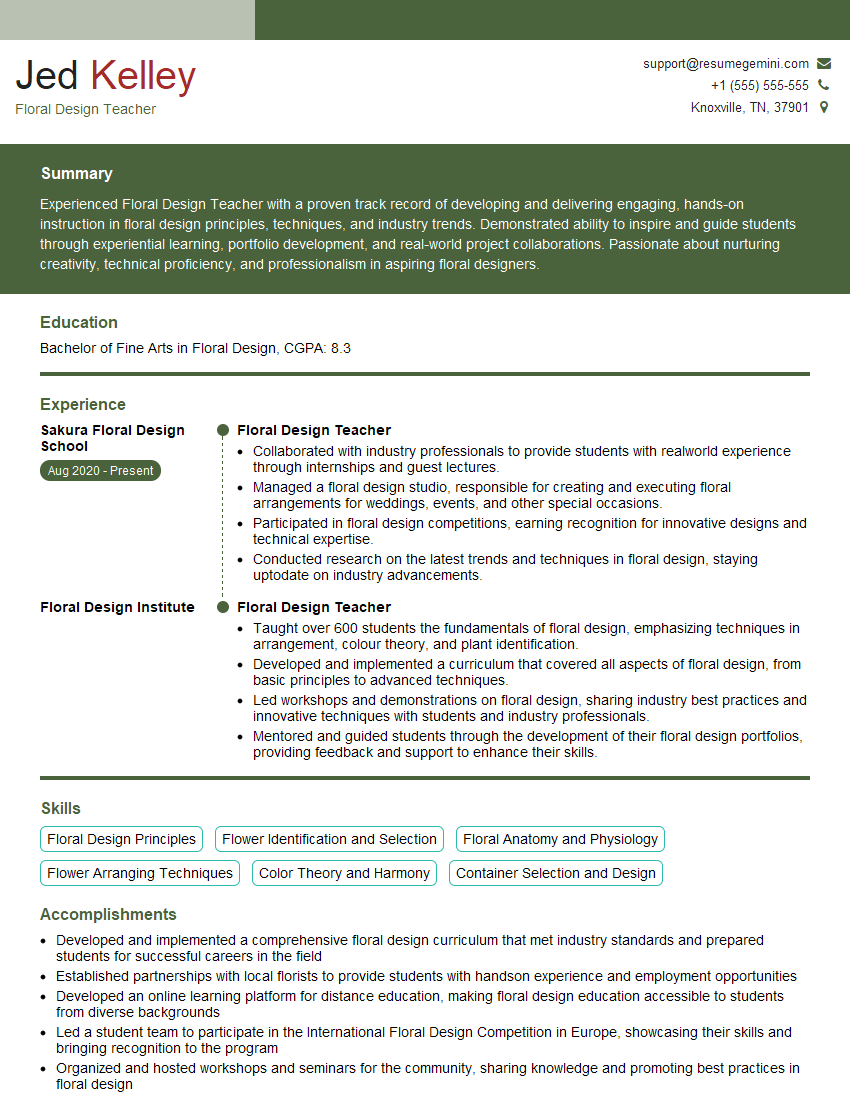
Mastering floral demonstration techniques is crucial for career advancement in the floral industry, opening doors to exciting opportunities in event planning, retail floristry, or even teaching. To significantly improve your job prospects, focus on crafting an ATS-friendly resume that highlights your skills and experience effectively. We highly recommend using ResumeGemini to build a professional and impactful resume that grabs recruiters’ attention. ResumeGemini offers a streamlined process and provides examples of resumes tailored to the Floral Demonstration field to help you get started.
Explore more articles
Users Rating of Our Blogs
Share Your Experience
We value your feedback! Please rate our content and share your thoughts (optional).
What Readers Say About Our Blog
Very informative content, great job.
good