Unlock your full potential by mastering the most common Floral Terminology interview questions. This blog offers a deep dive into the critical topics, ensuring you’re not only prepared to answer but to excel. With these insights, you’ll approach your interview with clarity and confidence.
Questions Asked in Floral Terminology Interview
Q 1. Define ‘bouquet’ and differentiate it from ‘arrangement’.
While both bouquets and arrangements involve assembling flowers, there’s a subtle yet important distinction. A bouquet is traditionally a handheld cluster of flowers, often tied together with ribbon or other decorative materials. Think of a bride’s bouquet—it’s designed to be carried and is usually more compact and organically shaped. In contrast, a floral arrangement is a broader term encompassing any decorative grouping of flowers and foliage, often placed in a vase or container. It can be larger, more elaborate, and have a more structured or stylized design, varying widely in shape and size. A bouquet is a *type* of floral arrangement, but not all arrangements are bouquets.
For example, a simple posy of roses tied with twine is a bouquet, while a large, symmetrical arrangement in a tall urn for a lobby is a floral arrangement, but not a bouquet.
Q 2. Explain the difference between ‘floral foam’ and ‘floral tape’.
Floral foam, also known as Oasis, is a water-absorbing, porous material used as a base for holding stems in floral arrangements. It provides structural support and hydration to the flowers, ensuring they stay fresh longer. It’s indispensable for creating complex arrangements where individual flower placement and stability are crucial.
Floral tape, on the other hand, is a thin, flexible, waterproof tape used for securing stems together, attaching flowers to foam, or creating temporary repairs. Unlike floral foam, it doesn’t hydrate the flowers; its primary function is to provide support and a clean, professional finish to stems. Think of it as a sort of floral ‘bandage’ or ‘glue’.
Imagine creating a cascading bridal bouquet—floral foam is necessary to build the shape, and floral tape will help bundle the stems, hold them onto the foam, and prevent loose ends from showing.
Q 3. What are the common types of floral preservatives?
Floral preservatives are crucial for extending the vase life of cut flowers. They typically contain a mixture of ingredients that provide nourishment and inhibit microbial growth. Common types include:
- Sugar solutions: Provide simple carbohydrates to feed the flowers.
- Acidifiers (e.g., citric acid): Help maintain the proper pH level for water uptake.
- Biocides (e.g., silver thiosulfate): Inhibit bacterial growth that causes wilting.
Commercial floral preservatives combine these elements in balanced formulations, often available in powder or liquid form. The specific ingredients and ratios can vary depending on the brand and target flower types. Using a proper preservative significantly extends the arrangement’s lifespan and visual appeal.
Q 4. Describe various flower arrangement styles (e.g., linear, mass, crescent).
Floral arrangement styles are diverse and dictated by occasion, aesthetics, and the designer’s vision. Here are a few examples:
- Linear: Emphasizes height and vertical lines, often featuring tall, slender flowers arranged in a straight or slightly curved configuration. It’s minimalist yet elegant.
- Mass: Creates a dense, rounded form using a profusion of flowers of the same or similar types, colors, and textures. This style aims for a lush and voluminous effect.
- Crescent: Arranges flowers in a half-moon or curved shape, offering a soft and graceful look. This style is often seen in wedding centerpieces.
- Round: Creates a symmetrical, balanced arrangement, typically compact and circular. It can create a formal and structured aesthetic.
- Triangular: Uses flowers and foliage to create a three-dimensional triangular shape, providing visual interest and depth.
Each style lends itself to different occasions and aesthetic preferences. Consider a linear arrangement for a modern wedding, a mass arrangement for a celebratory birthday, and a crescent style for a more romantic or informal setting.
Q 5. What is the significance of ‘foliage’ in floral design?
Foliage plays a vital role in floral design, going far beyond mere background filler. It provides structural support, visual texture, and enhances the overall aesthetic. Think of it as the ‘bones’ and ‘skin’ of your arrangement, framing the floral ‘muscles’.
Different types of foliage offer diverse textures—from delicate ferns to bold monstera leaves—which add depth and visual interest to the design. They create visual transitions between flowers, help to balance the arrangement’s color palette, and even contribute to its overall fragrance. The strategic use of foliage can dramatically impact the overall feel and perception of an arrangement.
Q 6. Explain the concept of ‘focal point’ in a floral arrangement.
The focal point in a floral arrangement is the area that first catches the eye and anchors the overall design. It’s usually the most prominent element, whether it’s a single large flower, a cluster of striking blooms, or a unique piece of decorative material. The focal point guides the viewer’s gaze and creates a sense of visual hierarchy within the arrangement.
The focal point might be emphasized by using a contrasting color, unique texture, or by simply placing it strategically in the arrangement’s center or highest point. The creation of a successful focal point ensures the arrangement has a clear sense of direction and purpose. Without a focal point, the arrangement can appear chaotic and lack visual cohesion.
Q 7. How do you choose appropriate flowers for a specific occasion (e.g., wedding, funeral)?
Choosing appropriate flowers for a specific occasion is crucial for conveying the right message and creating an appropriate atmosphere. The symbolism associated with flowers and color psychology play a significant role.
- Weddings: Often feature white or pastel-colored flowers like roses, lilies, and hydrangeas, symbolizing purity, love, and new beginnings. Specific flower choices can vary based on personal preference and cultural traditions.
- Funerals: Usually involve flowers with somber colors like white, purple, or dark red, often including lilies, chrysanthemums, and gladioli. These colors represent sympathy, remembrance, and respect for the deceased.
Beyond the occasion, consider factors like the recipient’s personality, the venue, and the season. For instance, bright, cheerful flowers might suit a birthday celebration, while more delicate blooms would be suitable for a romantic dinner. Knowledge of flower meanings and color symbolism allows you to craft arrangements that are not only visually appealing but also emotionally resonant.
Q 8. What are the best practices for handling and storing cut flowers?
Proper handling and storage of cut flowers are crucial for extending their vase life and maintaining their beauty. Think of it like caring for a delicate living organism – they need the right conditions to thrive!
Immediate Processing: Upon receiving flowers, recut stems underwater at a 45-degree angle to prevent air bubbles from blocking water uptake. This is especially important for woody stemmed flowers.
Hydration: Use a clean vase and fill it with lukewarm water. Add a floral preservative; these solutions contain sugars and biocides that nourish and protect the flowers against bacterial growth. Avoid using tap water if it’s high in chlorine or other impurities.
Proper Placement: Keep flowers away from direct sunlight, heat sources (like radiators or fruit bowls – ethylene gas emitted by ripening fruit accelerates wilting), and drafts. A cool, shaded location is ideal.
Regular Maintenance: Remove any leaves below the waterline to prevent bacterial growth. Change the water and recut stems every 1-2 days. This simple act significantly increases vase life.
Flower Food: Floral preservatives are essential. They provide the flowers with necessary nutrients and help maintain water pH levels which impact water absorption.
Q 9. Name five different flower types and their typical uses in arrangements.
Flowers offer incredible versatility in arrangements, with each type contributing unique texture, color, and form. Here are five examples:
Roses: Classic and elegant, roses are used in everything from romantic bouquets to formal arrangements. Their diverse color palette and various bloom shapes allow for a great deal of creative expression.
Lilies (Oriental or Asiatic): These add height, drama, and fragrance to arrangements. Asiatic lilies are generally hardier than Oriental lilies. Their large, showy flowers are statement pieces.
Hydrangeas: Their large, mophead blooms bring a lush, textural element. Perfect for both modern and rustic styles, they can anchor an arrangement.
Tulips: These graceful flowers lend a vibrant pop of color and elegance, particularly in spring-themed designs. Their delicate stems add a sense of movement.
Carnations: These are budget-friendly and durable flowers. Their ruffled petals and wide range of colors make them suitable for various occasions and arrangement styles.
Q 10. Explain the process of conditioning cut flowers.
Conditioning cut flowers is a crucial step to prolong their life. It involves preparing the flowers for proper hydration and preventing premature wilting. Think of it as giving them a revitalizing spa treatment!
Recutting Stems: Make a fresh, angled cut underwater to minimize air bubble formation and facilitate water absorption.
Removing Foliage: Remove any leaves that will fall below the waterline in the vase. Submerged leaves decay quickly, causing bacterial growth and shortening vase life.
Hydrating: Place the flowers in a clean bucket or vase filled with lukewarm water containing a floral preservative. This solution provides essential nutrients and helps maintain the optimal pH for water uptake.
Initial Conditioning (optional but helpful): For some flowers, a process called ‘flooding’ is helpful. This involves placing the flowers in a deep bucket of water for several hours (or overnight) to fully rehydrate them before arranging. This is particularly beneficial for flowers that have been in transit for a long time.
Flower Food: Using a commercial flower food is crucial. It nourishes the flowers and maintains a healthy environment, preventing bacterial growth.
Q 11. Describe different techniques for wiring flowers.
Wiring flowers is a technique used to add support and shape to delicate blooms or stems. It’s like giving them a tiny, floral exoskeleton! There are primarily two methods:
Floral Wire Insertion: A piece of floral wire is inserted through the stem, usually near the base, to provide structural support. This is commonly used for heavy blooms or those with weak stems (e.g., roses, lilies).
Wiring with Tape: A piece of floral wire is wrapped around the stem using floral tape. This method is gentler and helps to blend the wire into the stem, and is suitable for delicate flowers.
Technique: For insertion, a small hole is made in the stem using a tool or even just a sharp knife. The wire is carefully inserted until it reaches the required depth. Floral tape is then used to secure the wire to the stem. For the wrapping method, the wire is wrapped around the stem, and then floral tape is wound around the wire and stem to provide a secure and aesthetically pleasing finish. Practice is key to mastering the correct insertion depth and tape wrapping to avoid damaging the flower.
Q 12. What are the common tools used in floral design?
Floral design requires a range of tools to ensure accuracy, efficiency, and precision in creating beautiful arrangements. These tools can be broadly categorized as follows:
Cutting Tools: Floral shears, knives (floral knives are preferred for their sharpness and precision), and pruning shears are used to prepare the stems.
Wiring Tools: Wire cutters and wire pickers for preparing and inserting the floral wire.
Measuring and Arranging Tools: Rulers, tape measures, floral foam, and various types of vases and containers to hold the arrangement.
Other Tools: Floral tape (to secure wires, stems, and materials), ribbon and other decorative elements.
Q 13. Explain the concept of ‘color wheel’ and its use in floral design.
The color wheel is a fundamental tool in floral design. It’s a circular representation of colors, showing how they relate to each other. Understanding color relationships helps create visually appealing and harmonious arrangements. Think of it as a color recipe book for your floral creations!
The color wheel is based on three primary colors (red, yellow, blue), three secondary colors (orange, green, violet – made by mixing two primaries), and six tertiary colors (red-orange, yellow-orange, yellow-green, blue-green, blue-violet, red-violet). The wheel is divided into warm colors (reds, oranges, yellows) and cool colors (blues, greens, violets).
Color Schemes in Floral Design:
Monochromatic: Uses different shades and tints of a single color (e.g., various shades of pink).
Analogous: Uses colors that are next to each other on the wheel (e.g., blues, blue-greens, greens).
Complementary: Uses colors opposite each other on the wheel (e.g., red and green, blue and orange). These create high contrast and energy.
Triadic: Uses three colors equally spaced on the wheel (e.g., red, yellow, blue). These offer a vibrant and balanced palette.
Q 14. How do you create visual balance in a floral arrangement?
Visual balance in floral design refers to the pleasing arrangement of elements within an arrangement. It’s about creating a sense of equilibrium that prevents the design from feeling lopsided or top-heavy. Think of it as balancing a see-saw – you need equal weight on both sides to maintain equilibrium.
Techniques for Achieving Balance:
Symmetrical Balance: A mirror image of elements on either side of a central axis. This creates a formal and structured arrangement.
Asymmetrical Balance: Achieved through a visual balance of contrasting elements. It uses elements of varying size, shape, and color to create a sense of balance without mirroring. This is often seen in more informal, modern arrangements.
Radial Balance: Elements radiate outwards from a central point. This creates a dynamic and eye-catching arrangement.
Visual Weight: Larger, brighter, or more textured flowers tend to have a heavier visual weight than smaller or more delicate ones. Placement is key for balancing visual weight.
Experimentation and an eye for detail are key to creating well-balanced floral arrangements. Practice and a good understanding of color theory and visual weight will help you develop this skill.
Q 15. What are the principles of good floral design?
Good floral design hinges on several key principles, working together to create a visually appealing and harmonious arrangement. Think of it like composing a beautiful piece of music – each element plays a crucial role.
- Balance: This refers to the visual weight distribution within the arrangement. Symmetrical balance is formal and even, like a mirror image, while asymmetrical balance is more informal, achieving equilibrium through contrasting elements of different sizes and textures. Imagine a tall, spiky flower balanced by a cluster of smaller, rounder blooms.
- Proportion: The relationship between the size of the container, the flowers, and the overall arrangement is critical. The flowers shouldn’t overwhelm the vase, nor should the vase dwarf the flowers. It’s about creating a sense of scale and harmony.
- Scale: This relates to the size of the individual flowers and the overall arrangement in relation to their surroundings. A large arrangement might overwhelm a small coffee table, while a tiny arrangement would be lost on a large dining table.
- Rhythm: This creates movement and visual interest through repetition, progression, or transition of elements, like using repeated colors or shapes or gradually changing flower heights.
- Harmony: This is the overall unity and coherence of the design. Achieving harmony involves thoughtful selection of colors, textures, and forms that complement each other. Imagine using a palette of analogous colors or combining smooth and textured blooms.
- Emphasis: This is the focal point of the arrangement – the element that draws the eye first. This can be a single, striking bloom or a cluster of particularly vibrant flowers.
By understanding and applying these principles, florists can create arrangements that are not only visually stunning but also evoke emotion and tell a story.
Career Expert Tips:
- Ace those interviews! Prepare effectively by reviewing the Top 50 Most Common Interview Questions on ResumeGemini.
- Navigate your job search with confidence! Explore a wide range of Career Tips on ResumeGemini. Learn about common challenges and recommendations to overcome them.
- Craft the perfect resume! Master the Art of Resume Writing with ResumeGemini’s guide. Showcase your unique qualifications and achievements effectively.
- Don’t miss out on holiday savings! Build your dream resume with ResumeGemini’s ATS optimized templates.
Q 16. Describe different types of floral containers.
Floral containers are as diverse as the flowers themselves! The choice significantly influences the overall design and style of the arrangement.
- Vases: These come in countless shapes, sizes, and materials – from classic glass to modern ceramic, rustic metal, or even repurposed containers. The vase’s shape dictates the style of arrangement that best suits it; a tall, narrow vase might suit a linear design, while a wide, shallow bowl could accommodate a low, spreading arrangement.
- Urns and Baskets: Urns offer a more formal and traditional look, often used for larger, elaborate arrangements. Baskets, on the other hand, can create a rustic or informal feel, lending themselves to designs that spill over the sides.
- Teacups and Other Novelties: Small, unique containers like teacups, vintage tins, or even antique shoes can be used to create charming and whimsical arrangements, adding a touch of personality.
- Modern Vessels: Contemporary designs feature minimalist shapes, unusual materials like concrete or metal, and often incorporate unexpected textures to showcase the flowers.
Choosing the right container involves considering the overall style, the type of flowers, and the setting where the arrangement will be displayed. A simple daisy arrangement in a rustic basket is vastly different from a formal rose bouquet in a crystal vase.
Q 17. Explain the use of ‘filler flowers’ and ‘line flowers’.
Filler flowers and line flowers are crucial components in creating well-rounded and visually appealing arrangements. They add depth, texture, and visual interest.
- Filler Flowers: These are smaller flowers or foliage that fill in spaces and gaps between the main focal flowers. They add volume and texture, softening the overall look and providing a sense of continuity. Examples include baby’s breath, statice, and solidago. They are like the supporting cast in a play, enhancing the overall performance of the main characters (focal flowers).
- Line Flowers: These are tall, slender flowers or foliage used to create structure, height, and a sense of movement within the arrangement. They often define the shape and outline of the design. Examples include delphiniums, gladioli, and various grasses. Think of them as the architectural elements of the floral design, providing the backbone and framework.
Together, filler and line flowers create a balanced and harmonious arrangement. The fillers soften harsh lines and add visual interest while the line flowers provide structure and direction. They are like the supporting chords in a melody, adding richness and complexity to the main tune.
Q 18. What are some common floral pests and diseases, and how are they controlled?
Floral pests and diseases can significantly impact the health and longevity of your arrangements and plants. Early detection and appropriate control measures are essential.
- Common Pests: Aphids, spider mites, whiteflies, and thrips are common culprits. They suck sap from plants, causing wilting, discoloration, and stunted growth. Control involves using insecticidal soaps, neem oil, or biological controls.
- Common Diseases: Botrytis (gray mold), powdery mildew, and various fungal diseases can affect flowers. These often manifest as spots, wilting, or decay. Control strategies include ensuring good air circulation, avoiding overhead watering, and using fungicides.
Control Strategies: Prevention is key. This includes starting with healthy plants, providing proper watering and fertilization, and maintaining good sanitation in your workspace and garden. Always quarantine new plants before introducing them to existing collections. Regular inspection for pests and diseases is crucial for early detection and timely intervention.
Q 19. Explain the difference between annuals and perennials in floral design.
Annuals and perennials differ significantly in their lifespan and thus, their application in floral design.
- Annuals: These plants complete their entire life cycle – from germination to seed production – within a single growing season. They provide a burst of color and blooms for a short period. Examples include zinnias, petunias, and sunflowers. Their short lifespan makes them ideal for temporary arrangements and seasonal displays.
- Perennials: These plants live for more than two years, returning year after year. They often have a longer bloom period than annuals and can add structure and longevity to a garden or landscape. Examples include roses, daylilies, and hostas. In floral arrangements, perennials can provide interesting foliage and flowers that last longer.
The choice between annuals and perennials in floral design depends on the desired effect, the duration of the arrangement, and the overall aesthetic. Annuals offer vibrant color for short-term displays, while perennials add depth and longevity to arrangements or garden designs.
Q 20. How do you create a cohesive and aesthetically pleasing floral arrangement?
Creating a cohesive and aesthetically pleasing floral arrangement requires careful planning and execution. Think of it as painting a picture with flowers.
- Define the Style and Occasion: Consider the overall feeling you want to evoke – romantic, modern, rustic, etc. This will guide your choices of flowers, colors, and container.
- Choose a Color Palette: Select colors that complement each other and align with the desired style. Monochromatic schemes use variations of a single color, while analogous schemes utilize colors next to each other on the color wheel. Complementary schemes use colors opposite each other on the wheel for a more vibrant look.
- Select Flowers and Foliage: Consider texture, shape, size, and bloom stage. Mix different flower types and foliage to add visual interest and depth. Include line flowers, filler flowers, and focal flowers.
- Prepare the Container and Flowers: Clean and prepare your chosen container. Condition the flowers by removing lower leaves and recutting stems before arranging.
- Arrange the Flowers: Start with the main focal flowers, placing them strategically. Then add line flowers for structure, followed by filler flowers to fill in gaps. Adjust until you achieve a balanced and aesthetically pleasing arrangement.
- Refine and Finish: Step back and assess the overall design. Make any adjustments to balance and shape. Add finishing touches, such as ribbon or decorative elements, if appropriate.
Remember to consider the overall setting and the scale of the arrangement. A small, delicate arrangement may be perfect for a bedside table, while a larger, bolder arrangement might suit a grand entrance hall.
Q 21. Describe different types of floral arrangements based on their shape (e.g., round, triangular, asymmetrical).
Floral arrangements can be categorized by their overall shape, each conveying a different feeling and aesthetic.
- Round Arrangements: These are classic and symmetrical, creating a sense of completeness and harmony. They often feature a circular or dome-like shape, achieved through careful layering of flowers of varying heights.
- Triangular Arrangements: These arrangements use a triangular base, with the tallest flowers forming the apex. This creates a sense of height and drama, ideal for more formal settings.
- Asymmetrical Arrangements: These are informal and dynamic, featuring a sense of movement and spontaneity. They lack strict symmetry, balancing different elements of size, texture, and color to achieve visual equilibrium. This style offers a modern and artistic appeal.
- Crescent Arrangements: These arrangements follow a curved line, often used for garlands, table runners, or to enhance the shape of a curved space.
- Linear Arrangements: These arrangements emphasize vertical lines and heights, using long, slender flowers and foliage to create a feeling of elegance and sophistication.
The choice of arrangement shape depends on personal preference, the occasion, and the setting. A round arrangement might suit a wedding, while an asymmetrical arrangement could be perfect for a modern home.
Q 22. What is the importance of proper sanitation in floral arrangements?
Proper sanitation in floral arrangements is paramount for extending the vase life of flowers and preventing the spread of diseases. Think of it like hygiene for your floral creations. Neglecting sanitation can lead to rapid decay and wilting, impacting both the aesthetic appeal and the longevity of your arrangements.
- Cleaning Tools and Surfaces: Always begin by thoroughly cleaning your work surfaces, vases, and floral tools (knives, shears, etc.) with a diluted bleach solution (typically one part bleach to nine parts water) or a commercial floral disinfectant. This removes any bacteria or fungi that could contaminate your flowers.
- Removing Damaged Foliage: Before arranging, meticulously remove any damaged or decaying leaves below the waterline in your vase. These submerged leaves will quickly decompose, creating bacteria that accelerates the wilting process. It’s like removing the rotten parts of a fruit to prevent it from spoiling the rest.
- Using Clean Water: Always use clean, cool water in your vases and change it regularly, ideally every one to two days. Adding a floral preservative solution to the water helps control bacterial growth and provides essential nutrients to the flowers.
- Proper Storage: Store cut flowers in a cool, dark place away from direct sunlight or heat sources, which can dehydrate them and promote decay.
By adhering to strict sanitation protocols, you’re not just ensuring the beauty of your arrangements but also extending their lifespan and making your work more sustainable.
Q 23. How do you assess the freshness and quality of cut flowers?
Assessing the freshness and quality of cut flowers requires a keen eye and a delicate touch. It’s like being a floral detective, looking for clues that indicate quality and longevity.
- Petal Firmness and Color: Look for firm, tightly closed buds (for flowers that open) or fully opened blooms with vibrant colors, free of blemishes or discoloration. Wilting, drooping, or bruised petals are signs of poor quality.
- Stem Strength and Flexibility: The stems should be firm and flexible, not brittle or easily broken. A strong stem indicates the flower’s ability to absorb water and remain upright.
- Leaf Condition: Examine the leaves for blemishes, discoloration, or wilting. Healthy leaves are firm, evenly colored, and free of pests or diseases.
- Hydration: Check the stem ends for any signs of dehydration. Freshly cut stems should be moist and show good turgor (firmness). Dry, shriveled stems indicate the flower is already dehydrated.
- Aroma: In some instances, the aroma can provide a hint of freshness. A strong, pleasant scent usually suggests good quality, while a weak or unpleasant smell might suggest decay.
By carefully evaluating these aspects, you can confidently select high-quality flowers that will create stunning arrangements and last longer.
Q 24. Explain different flower preservation techniques (e.g., drying, pressing).
Flower preservation techniques allow you to enjoy the beauty of your blooms long after they’ve been cut, whether it’s for creating lasting keepsakes or using them in crafts. Each method has its unique advantages and limitations.
- Air Drying: This is a simple method involving hanging flowers upside down in a cool, dark, dry place with good air circulation. It’s great for preserving delicate flowers and creating a natural look but can be time-consuming and may result in some color fading.
- Pressing: Flowers are placed between sheets of absorbent paper (like newspaper or blotter paper) inside heavy books or a flower press. This method flattens the flowers, preserving their shape and color, ideal for creating pressed flower art, cards, or bookmarks. However, it changes the flower’s three-dimensional form.
- Freezing: This method involves freezing flowers in water or glycerin to maintain their shape and color for future use. It’s particularly useful for preserving larger flowers or arrangements for longer periods. However, it needs specific freezing techniques to avoid ice crystal damage.
- Glycerin Preservation: Soaking flowers in a glycerin solution replaces the flowers’ water content with glycerin, preventing desiccation and preserving flexibility. The color may darken slightly, but the preserved flower retains its shape.
- Silicon Gel Preservation: This method uses silica gel, a desiccant, to quickly and effectively absorb moisture from the flowers. It’s excellent for preserving the color and shape of flowers, but it can be expensive.
The best preservation technique depends on the type of flower, desired outcome, and available resources.
Q 25. How do you work with different flower textures and colors to create visual interest?
Working with different flower textures and colors is essential for creating visually interesting floral arrangements. It’s like painting with flowers, using their diverse characteristics to create a captivating masterpiece.
Color: I employ the color wheel to create harmonious or contrasting palettes. For example, a monochromatic scheme (using variations of one color) provides elegance, while a complementary scheme (using colors opposite each other on the color wheel) creates vibrancy. Consider the emotional impact of colors – reds and oranges evoke energy, while blues and purples are calming.
Texture: I combine contrasting textures to add depth and visual interest. Smooth petals of roses contrasted with the spiky texture of statice, for instance, create a compelling visual effect. Consider incorporating other elements like foliage with different textures – rough bark, delicate ferns, or waxy leaves.
Shape and Form: The shapes and forms of flowers also influence the overall aesthetic. Combining rounded flowers with long, linear ones provides balance and visual flow. Tall and upright flowers can be balanced with lower spreading flowers to create harmony and visual interest.
I always strive to create a sense of rhythm and balance within the arrangement, considering not just the individual elements but their relationship to each other within the overall composition.
Q 26. What are your strategies for managing inventory in a floral shop?
Effective inventory management is crucial for a successful floral shop. It’s about knowing what you have, when you need it, and how to keep it fresh and ready for use.
- Regular Stock Counts: Conduct regular physical stock counts to accurately track inventory levels. This helps to anticipate shortages and plan for future orders.
- FIFO (First-In, First-Out): Use the FIFO method to ensure that older flowers are used before newer ones, minimizing waste and spoilage. Think of it like managing your refrigerator – you use the older items first.
- Supplier Relationships: Develop strong relationships with reliable suppliers who can provide consistent quality and timely delivery. This guarantees availability of needed items.
- Order Management System: Implement a system (either software or a spreadsheet) for tracking orders, expected delivery dates, and stock levels. This system helps prevent overstocking and understocking.
- Seasonal Planning: Anticipate seasonal demand fluctuations and adjust your ordering accordingly. Some flowers are more popular during specific times of the year.
- Waste Management: Develop a plan for managing waste, including composting or recycling where possible. Minimize losses through careful selection and preservation.
By combining accurate tracking, thoughtful planning, and strong supplier relationships, you ensure a smooth workflow and prevent stockouts or spoilage.
Q 27. Explain how you would handle a difficult customer or a challenging floral order?
Handling difficult customers or challenging orders requires patience, empathy, and problem-solving skills. It’s about turning a potentially negative situation into a positive experience.
Difficult Customers: I start by actively listening to their concerns, acknowledging their feelings, and attempting to understand their perspective. I then offer solutions tailored to their specific needs, explaining the possibilities and limitations clearly and honestly. Offering alternative solutions and compromises often helps reach a mutually agreeable outcome. Remember, a calm and professional demeanor goes a long way in diffusing tension.
Challenging Orders: For complex orders, I engage the client in a detailed consultation to fully understand their vision, budget, and timeline. I might provide sketches or visual aids to clarify the design. If the order presents logistical or creative challenges, I offer realistic suggestions and alternatives while still striving to meet their expectations as closely as possible. Open communication throughout the process minimizes misunderstandings and ensures client satisfaction.
Ultimately, my goal is to build rapport with clients, exceeding their expectations whenever possible. Even when faced with difficulty, a positive and proactive approach leads to successful outcomes and strengthens client relationships.
Q 28. Describe your experience with various floral design software or technology.
I have extensive experience using various floral design software and technology to enhance my efficiency and creativity. This technology extends my design capabilities beyond what I could accomplish manually.
- Floral design software: I am proficient in using programs like [mention specific software, e.g., Floracad, etc.] which allow me to create detailed designs, visualize arrangements from different angles, and calculate material costs. This software significantly streamlines the design process and helps in accurate costing.
- Point of Sale (POS) systems: I’m experienced in using POS systems to manage orders, track inventory, and process payments efficiently. This ensures accuracy and reduces potential errors.
- Digital Marketing and Social Media: I use social media platforms and online marketing tools to showcase my work, engage with potential clients, and build my brand. This digital presence expands my reach and boosts business.
- Online Ordering Systems: Familiarity with online ordering platforms allows customers convenient access to services, enabling remote consultations and design choices.
By leveraging these technological tools, I can create more efficient, accurate, and engaging floral experiences for my clients.
Key Topics to Learn for Your Floral Terminology Interview
- Floral Anatomy and Morphology: Understand the structure of flowers, including sepals, petals, stamens, and pistils. Know how to identify different flower types and their characteristics.
- Flower Arrangement Techniques: Master the principles of design, including line, form, color, texture, and scale. Be prepared to discuss various arrangement styles and their applications (e.g., hand-tied bouquets, floral foam arrangements).
- Floral Design Styles and History: Familiarize yourself with different periods and artistic movements in floral design, their signature styles, and influential designers. This demonstrates a broader understanding of the field.
- Floral Preservation and Care: Understand the methods used to extend the lifespan of cut flowers, including proper handling, hydration, and storage techniques. Be able to discuss common issues and solutions related to flower longevity.
- Floral Terminology Specific to Wholesale and Retail: Learn the language used in the industry – from understanding order specifications to discussing pricing and sourcing. Know terms related to variety, grade, and condition of flowers.
- Sustainability and Ethical Sourcing in Floristry: Demonstrate your awareness of environmentally conscious practices and ethical sourcing of flowers. This is increasingly important in the industry.
- Problem-Solving in Floral Design: Be ready to discuss how you would troubleshoot common issues, such as wilting flowers, damaged blooms, or logistical challenges in event floral design.
Next Steps
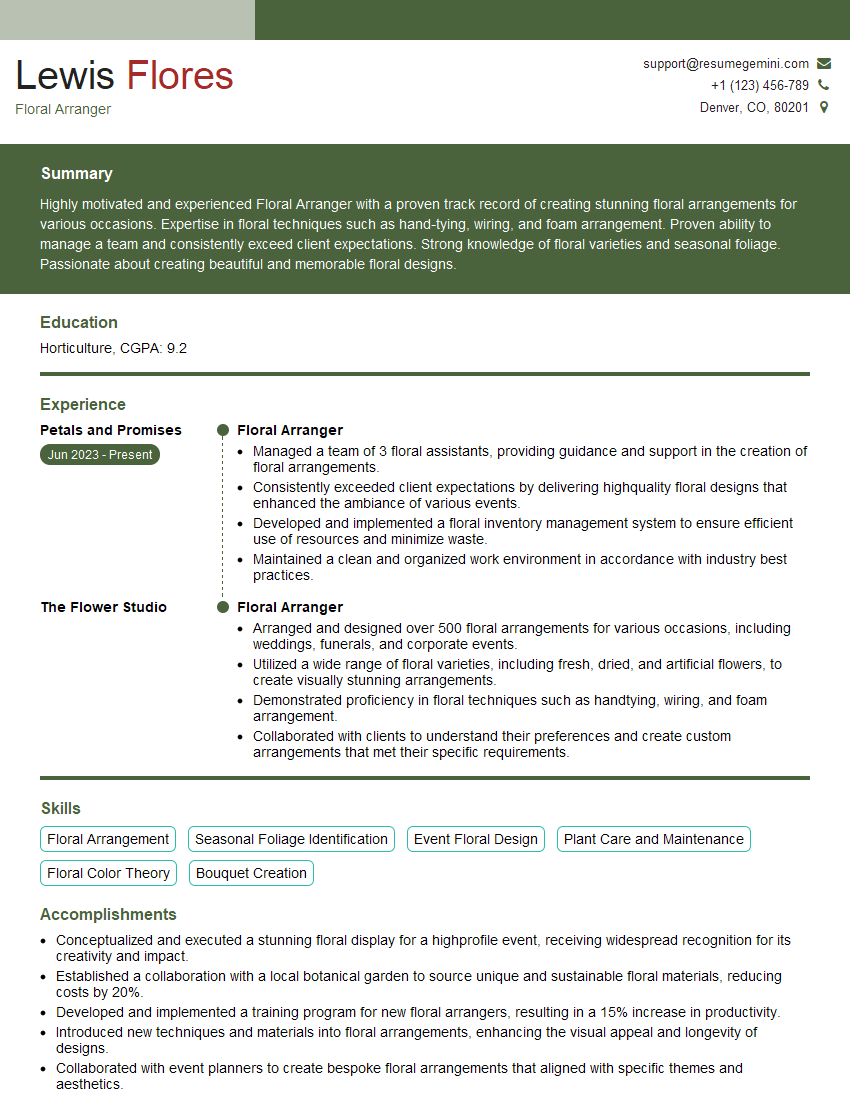
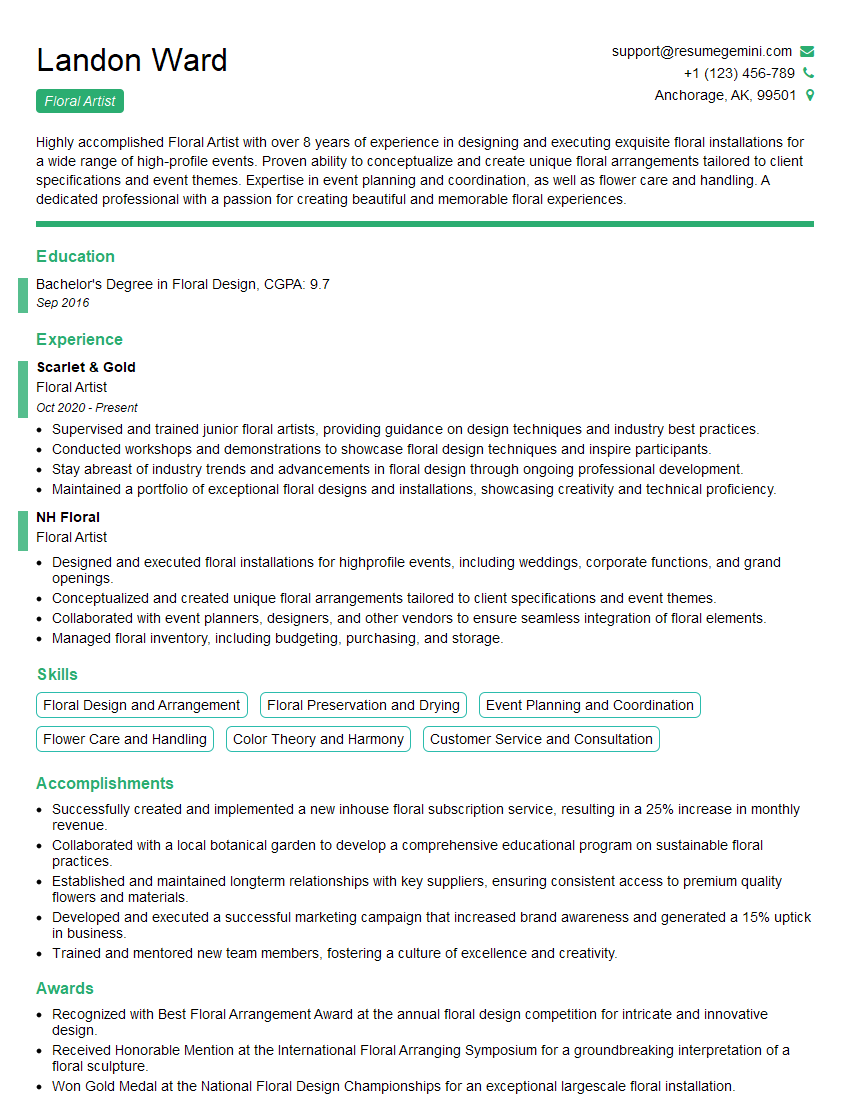
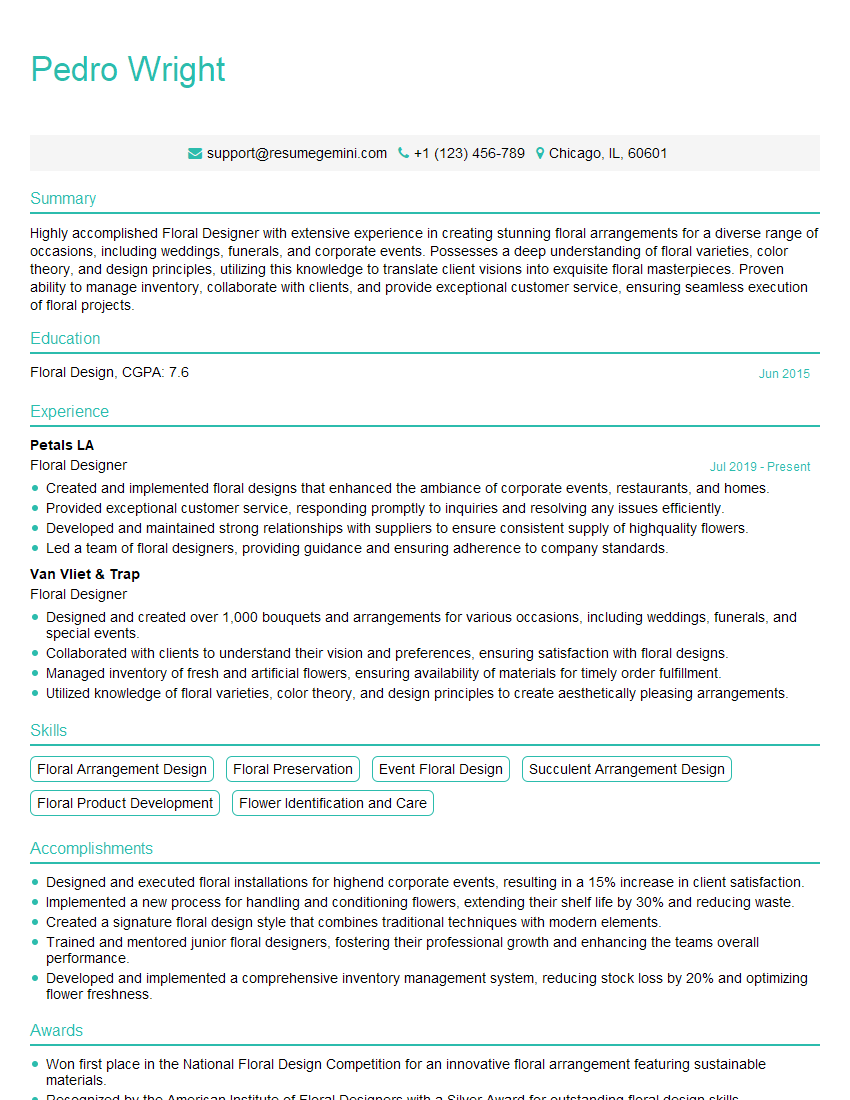
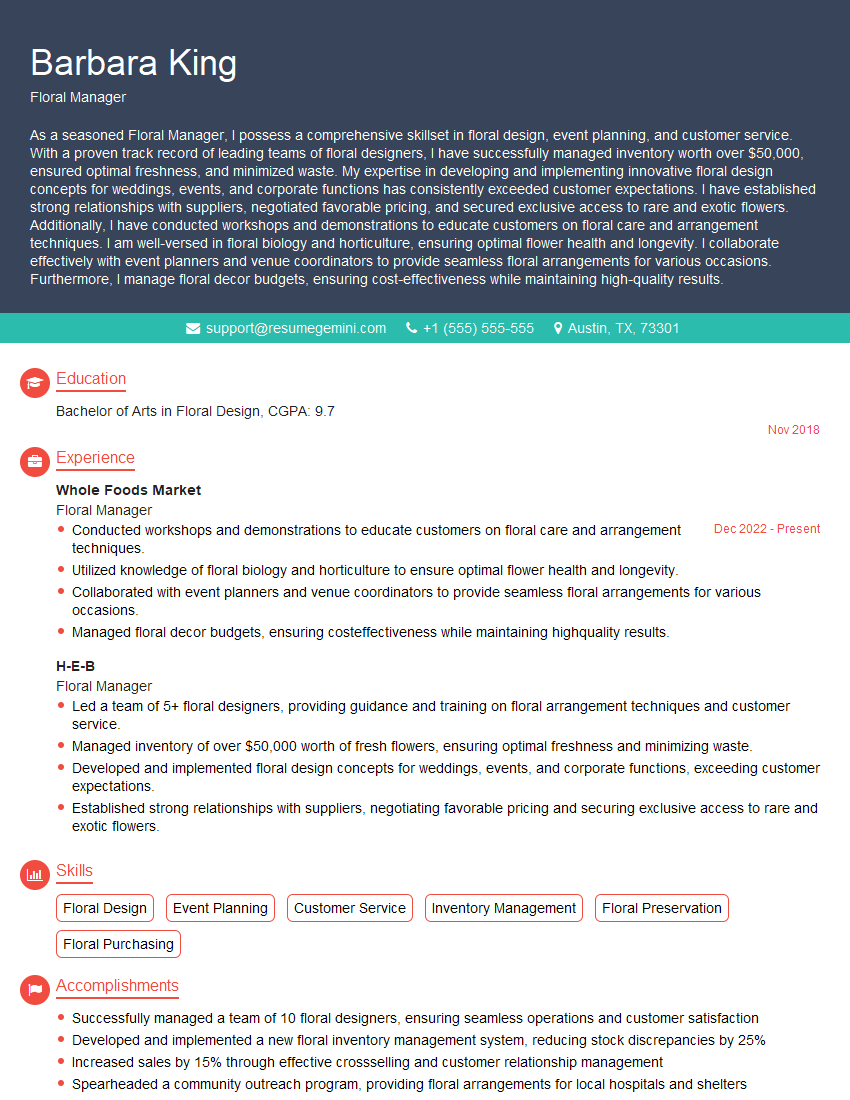
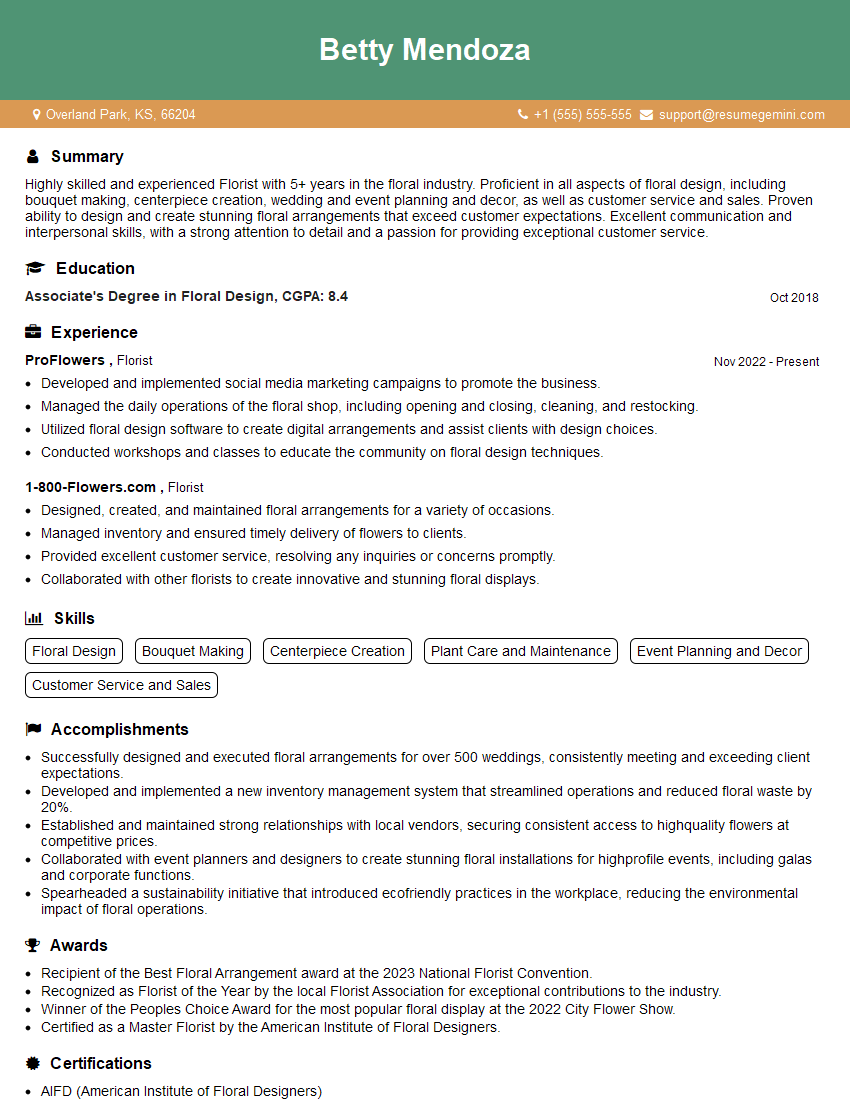
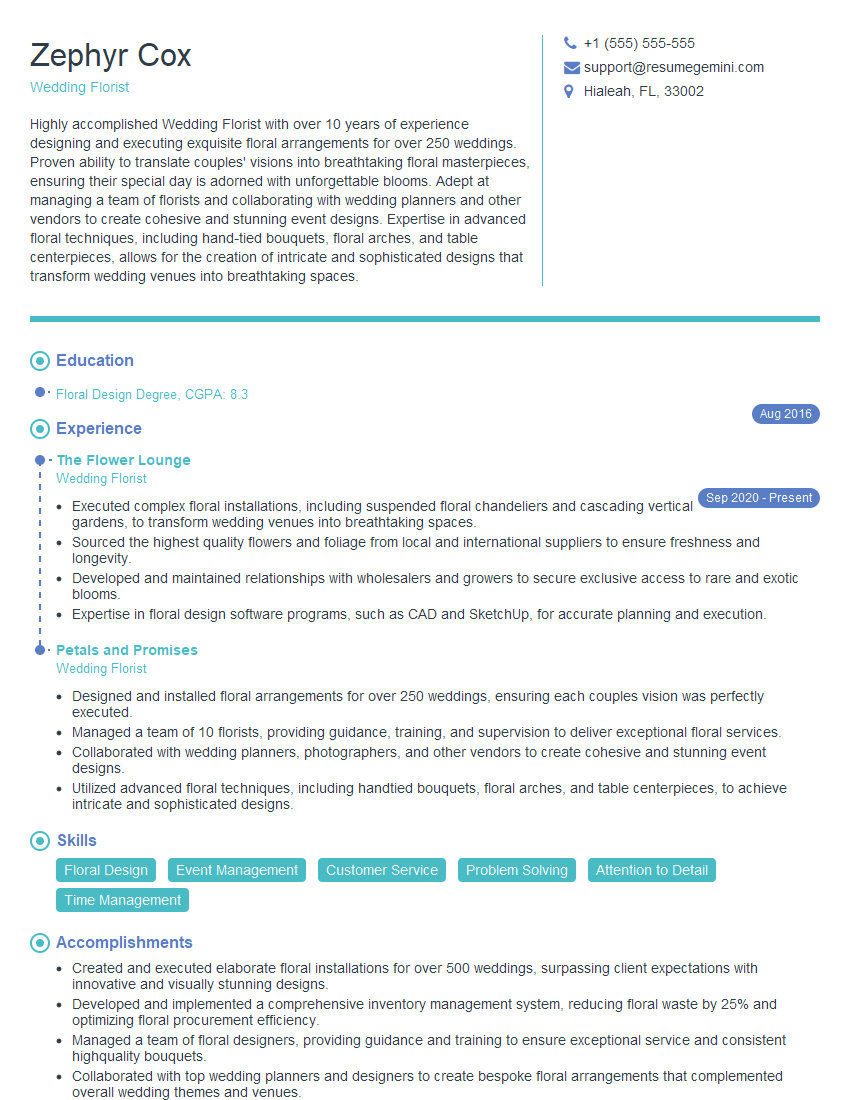
Mastering floral terminology is crucial for career advancement in the dynamic world of floristry. A strong understanding of these concepts will significantly improve your communication skills and allow you to excel in your chosen role. To boost your job prospects, creating an ATS-friendly resume is essential. ResumeGemini is a trusted resource that can help you build a professional and effective resume that showcases your skills and experience. We provide examples of resumes tailored to the Floral Terminology field to guide you through the process.
Explore more articles
Users Rating of Our Blogs
Share Your Experience
We value your feedback! Please rate our content and share your thoughts (optional).
What Readers Say About Our Blog
Very informative content, great job.
good