Unlock your full potential by mastering the most common Forensic Sketching interview questions. This blog offers a deep dive into the critical topics, ensuring you’re not only prepared to answer but to excel. With these insights, you’ll approach your interview with clarity and confidence.
Questions Asked in Forensic Sketching Interview
Q 1. Explain the process of creating a composite sketch from witness descriptions.
Creating a composite sketch involves a collaborative process between the artist and the witness. It’s like sculpting a face from verbal clay. We start with a structured interview, guiding the witness through facial features systematically. This isn’t a free-for-all description; we use specific anatomical terms and reference points to ensure accuracy. For instance, instead of ‘big nose,’ we might ask about the nose’s width at the bridge, the shape of the nostrils, and the presence of any bumps or indentations.
The process typically follows these steps:
- Initial Interview: Gathering general information about the suspect (age, race, gender).
- Feature-by-Feature Approach: Focusing on individual features like hairline, forehead, eyebrows, eyes, nose, mouth, chin, and ears, working from general shapes to finer details. We use standardized facial feature charts as a guide.
- Sketching Process: Starting with a basic outline and gradually refining each feature based on the witness’s feedback. This is iterative; we repeatedly show the sketch to the witness for adjustments.
- Refinement and Finalization: This involves adding details such as hair, clothing, and any distinguishing marks. The final sketch is reviewed by the witness for final approval.
Throughout the process, it’s crucial to build rapport with the witness to ensure they feel comfortable and can accurately recall details. Sometimes, a witness might struggle with describing specific features, requiring careful prompting and patience.
Q 2. Describe different techniques used in forensic sketching (e.g., traditional, digital).
Forensic sketching employs various techniques, each with its strengths and weaknesses.
- Traditional Sketching: This involves using graphite pencils, charcoal, and other drawing tools on paper. It offers a tactile experience and allows for subtle nuances in shading and texture, but it’s time-consuming and requires a high level of artistic skill. It’s less easily reproducible, a factor sometimes considered in court.
- Digital Sketching: Software like Adobe Photoshop or other digital art programs allows for greater control over the sketch, easier correction, and quick reproduction of the image. Features like layers and undo functions are invaluable. Color can be added and adjustments made rapidly, enhancing detail and precision. However, it may require a steeper learning curve compared to traditional techniques.
- Photo-Based Sketching: While not strictly ‘sketching,’ incorporating photos into the process is becoming increasingly common. We may use photographs of similar facial features and hairstyles to aid in refining a sketch. For example, we might show images of different ear shapes when helping a witness describe the suspect’s ears, making the process more intuitive.
Often, a blend of techniques is employed. I, for instance, frequently begin with a traditional sketch, capturing the essence of the description, and then refine it digitally to add details and achieve a clean, reproducible final product.
Q 3. What software programs are you proficient in for forensic sketching?
My proficiency extends to several software programs commonly used in forensic sketching. I’m highly skilled in Adobe Photoshop, which offers extensive tools for creating detailed and accurate sketches. Its layer functionality and brush controls allow for precise adjustments and a wide range of stylistic choices. I also utilize Adobe Illustrator for vector-based sketches, primarily for creating clean line art and precise outlines that are easily scalable. Additionally, I have experience with other digital art programs such as Procreate and Corel Painter.
Q 4. How do you handle inconsistencies or conflicting witness descriptions?
Inconsistencies and conflicting descriptions are a common challenge in forensic sketching. It’s critical to remember that eyewitness accounts are subjective and affected by factors like stress, lighting, and the witness’s own biases. We don’t aim to simply ‘average’ conflicting details; rather, we employ a thoughtful, analytical approach. This may include:
- Further Interviewing: Returning to the witnesses to clarify ambiguous descriptions or address contradictions. Open-ended questions can help elicit more specific details.
- Prioritizing Reliable Information: Assessing the reliability of each witness based on factors such as their proximity to the event, clarity of observation, and consistency in previous statements. Some details might be deemed more reliable based on evidence.
- Creating Multiple Sketches: In cases with significant discrepancies, producing multiple sketches representing different versions of the description might be necessary. This presents a range of possibilities rather than one possibly inaccurate conclusion.
- Focusing on Core Features: Prioritizing the most consistent and reliable details, even if some aspects remain ambiguous.
Ultimately, the goal is to create a sketch that represents the most likely appearance of the suspect, while acknowledging the limitations of eyewitness testimony. We always present the sketch as a representation, not an absolute truth.
Q 5. Explain the importance of accurate proportions and perspective in forensic sketching.
Accurate proportions and perspective are paramount in forensic sketching. A sketch that distorts facial features or lacks spatial accuracy can mislead investigators. Imagine trying to identify someone from a photograph that’s dramatically skewed! It’s essentially useless. Therefore:
- Proportions: We utilize established guidelines for facial proportions, such as the ‘rule of thirds’ or other anthropometric data (measurements of the human body). This helps ensure that the eyes, nose, and mouth are correctly positioned relative to one another and maintain realistic sizes.
- Perspective: The angle from which the witness observed the suspect influences the perspective in the sketch. This should be considered during sketching to provide a more accurate representation of the individual’s features. For example, a view from below will cause the nose and forehead to appear larger.
Mastering these aspects requires rigorous training and practice. I constantly refine my skills by studying anatomy and practicing from life, ensuring that my sketches maintain an accurate and reliable depiction.
Q 6. How do you maintain the integrity of evidence while creating a sketch?
Maintaining the integrity of evidence is crucial. The sketch itself is considered evidence, and it must be handled with care to avoid any accusations of tampering or alteration. This involves:
- Detailed Documentation: Maintaining a detailed record of the sketching process, including the date, time, names of witnesses, and any notes or revisions. This documentation ensures the sketch’s provenance and reliability.
- Chain of Custody: Ensuring a clear chain of custody for the sketch, tracking who has handled it and when. This might involve using numbered evidence bags or a secure digital storage system.
- Avoiding Alterations: Any changes made to the sketch are documented meticulously, making it clear how the final version emerged. I always indicate such alterations on the sketch itself or alongside the documented notes.
- Preservation: Storing the original sketch in a secure location to preserve its condition and protect it from damage or degradation. This often involves archival-quality materials for traditional sketches and reliable backup systems for digital versions.
Adherence to these procedures is not just about legal compliance; it’s about ensuring the sketch retains its value as a reliable piece of evidence. A compromised sketch undermines the entire investigative process.
Q 7. Describe your experience working with law enforcement agencies.
I’ve had the privilege of working with several law enforcement agencies over the past [Number] years, collaborating on a wide range of cases, from robberies and assaults to kidnappings and homicides. My experience spans assisting with both active investigations and cold cases. In my work with the [Agency Name, e.g., Metropolitan Police Department], for instance, I was integral in creating a composite sketch that led to the arrest of a serial burglar. The witness was initially hesitant and struggled to provide details, but through patient interviewing and careful sketching techniques, we produced an image that was recognized and led to a successful identification.
Collaboration is key. I work closely with detectives, understanding their needs and translating witness descriptions into visual representations that can aid in the identification of suspects. This involves not only creating sketches but also understanding the limitations of the information available and conveying any uncertainty or ambiguity in the final product. Maintaining open communication and a focus on evidence-based practices is paramount in this role. My contributions have, on multiple occasions, resulted in successful identifications, leading to the resolution of various cases.
Q 8. How do you adapt your sketching style to different types of cases (e.g., assault, robbery)?
My sketching style adapts to the specifics of each case. In an assault case, the focus might be on capturing subtle details of facial injuries or clothing – perhaps a torn shirt or a specific type of bruise. The sketch would prioritize accuracy and meticulous detail, even if the overall image isn’t complete. For a robbery, the priority might shift to capturing the suspect’s overall build, clothing, and any distinguishing features like tattoos or scars. The sketch could be more impressionistic, focusing on identifying characteristics rather than minute details. For instance, in an assault case, I might spend more time on the victim’s face, focusing on accurate representation of lacerations, while in a robbery, I might prioritize the suspect’s overall attire and build, especially if witnesses describe a distinct gait or posture. The context drives the approach.
Q 9. What are the ethical considerations involved in forensic sketching?
Ethical considerations in forensic sketching are paramount. Accuracy is the cornerstone; any sketch presented as evidence must be a truthful representation of the witness’s recollection or the physical evidence. Avoiding bias is crucial. I must remain objective, even when working under pressure, not letting personal assumptions or preconceived notions influence the sketch. Confidentiality is also essential; all details of a case remain strictly confidential, adhering to legal and professional guidelines. For example, if a witness provides contradictory information, I have a duty to represent the ambiguities within the sketch, rather than trying to force a unified image which might misrepresent the actual evidence. Similarly, any sketch needs to be clearly labeled, dated, and documented to maintain an unbroken chain of custody.
Q 10. How do you deal with pressure and time constraints during a case?
Pressure and time constraints are inherent in forensic sketching. I manage this through meticulous planning and efficient execution. Before starting, I gather all available information – witness statements, photos, crime scene measurements – to formulate a strategy. I prioritize the most critical information, focusing on the key identifying characteristics. Instead of striving for perfection in every detail, I prioritize a clear and accurate representation of the essential features. For instance, if I’m short on time, I might create a quick composite sketch first to prioritize facial features then add details as time allows. The experience of years spent under such pressure helps me remain calm and focused, allowing the methodical application of my skills.
Q 11. Explain your understanding of facial features and their variations.
Understanding facial features is fundamental. I study the interplay between bone structure, soft tissue, and musculature, paying close attention to variations in shapes, sizes, and proportions. For example, the subtle differences in eye shape (almond, round, etc.), nose shape (aquiline, snub, etc.), and ear shape are crucial. Moreover, I understand the impact of age, ethnicity, and individual variations on these features. I often use anatomical reference material alongside witness descriptions to ensure the features in my sketch are both realistic and consistent with anatomical structures. This detailed understanding allows me to build a composite image using a combination of these diverse features, thereby improving the accuracy and the recognition rate.
Q 12. Describe your knowledge of different lighting techniques and their impact on sketches.
Lighting significantly impacts sketches. I understand how different lighting conditions affect shadows, highlights, and the overall appearance of a person or object. Harsh light can create strong shadows that obscure details, while soft light might render a person unrecognizable. I use shading and value techniques to represent light and shadow accurately, recreating the lighting conditions present at the crime scene using photo references. For example, I might use lighter tones for areas of high light, and darker tones for areas in shadow, capturing not just the facial features but also the surrounding environment’s impact on the overall illumination to maintain realism.
Q 13. How do you incorporate evidence (e.g., photos, measurements) into your sketches?
Evidence integration is critical. Photos provide crucial detail, allowing me to capture precise dimensions, angles, and the overall appearance of the subject. Measurements ensure accuracy in proportions, particularly in reconstructing the scene. I use these elements as guides, ensuring the sketch remains consistent with the documented evidence. For instance, if photographs show a specific type of clothing, I would accurately depict that. If measurements indicate a certain height or width, I incorporate those into the drawing, verifying accuracy against the physical or photographic record. This detailed approach enhances the sketch’s reliability and credibility.
Q 14. Explain your process for creating a facial reconstruction from skeletal remains.
Facial reconstruction from skeletal remains is a complex process involving multiple steps. First, I study the skull, identifying key features like the nasal opening, brow ridges, and orbital sockets. Using anatomical charts and statistical data representing soft tissue thickness, I build a layer of clay over the skull representing the muscles, fat, and skin that would have been present in the individual. Then I refine the features to match age, sex, and ancestry of the individual, using both anthropological data and potentially witness testimonies when available. This process requires significant knowledge of human anatomy, anthropology, and artistic skill to create a realistic and potentially recognizable face from minimal information. This is a collaborative process often involving a team of forensic anthropologists, and the iterative process of modeling, comparison, and refinement requires precision and a deep understanding of human variability.
Q 15. What are the limitations of forensic sketching?
Forensic sketching, while invaluable, has inherent limitations. One major constraint is the inherent subjectivity of witness memory. Eyewitnesses may remember details differently, or their perceptions might be affected by factors like stress, lighting conditions, or the passage of time. This leads to variations in descriptions and resulting sketches.
Another limitation is the artist’s skill and interpretation. Even with detailed descriptions, different artists may render features differently, leading to subtle or significant discrepancies between sketches. Furthermore, the two-dimensional nature of a sketch struggles to accurately capture the three-dimensional reality of a crime scene or a person’s features. Finally, technological advancements like photogrammetry and 3D modeling offer superior levels of detail and accuracy, often overshadowing the limitations of traditional hand-drawn sketches in certain contexts.
Career Expert Tips:
- Ace those interviews! Prepare effectively by reviewing the Top 50 Most Common Interview Questions on ResumeGemini.
- Navigate your job search with confidence! Explore a wide range of Career Tips on ResumeGemini. Learn about common challenges and recommendations to overcome them.
- Craft the perfect resume! Master the Art of Resume Writing with ResumeGemini’s guide. Showcase your unique qualifications and achievements effectively.
- Don’t miss out on holiday savings! Build your dream resume with ResumeGemini’s ATS optimized templates.
Q 16. How do you ensure the accuracy and clarity of your sketches?
Ensuring accuracy and clarity in forensic sketching involves a multi-step process. First, I meticulously gather information from witnesses, prioritizing consistent details. I use a combination of open-ended and specific questions to avoid influencing their responses. I often create a series of sketches, refining each iteration based on feedback from the witness.
Second, I employ precise drawing techniques, focusing on accurate proportions, perspective, and the rendering of key features. I always cross-reference my sketches with any available photographic evidence to ensure consistency and accuracy of features and the overall scene. Third, I maintain detailed notes documenting all the witness testimonies, observations, and alterations made to the sketches. This transparent approach ensures that the process is verifiable and the final sketch’s origins are clearly documented. Finally, I often consult with colleagues for a second opinion to identify any potential biases or errors.
Q 17. How do you handle situations where witness memory is unreliable?
Unreliable witness memory is a significant challenge. I address this by employing several strategies. I begin by creating a relaxed and non-judgmental environment to encourage the witness to provide the fullest possible account of the event. I use techniques like cognitive interviewing, which aims to stimulate recall by using different cues and perspectives. This allows me to collect a wider range of details, even if some parts are less certain.
I clearly distinguish between reliable and uncertain details in the sketch itself or in my accompanying notes. This involves utilizing shading, line weight, or annotations to indicate varying degrees of witness certainty. Moreover, I may create multiple sketches, each representing a possible interpretation based on the varying levels of witness recall. This transparent method acknowledges the uncertainty and presents various potential scenarios to investigators.
Q 18. Explain your experience with courtroom testimony and presenting your work.
I have extensive experience providing courtroom testimony and presenting my forensic sketches. Preparation is key. I meticulously review the case file, my sketches, and witness statements to ensure my understanding is thorough and my answers are precise. I present my work in a clear and concise manner, avoiding technical jargon unless absolutely necessary and clearly defining any specialized terms. I use visual aids, such as large-format prints of my sketches, to enhance understanding for the jury.
During testimony, I maintain composure and answer questions directly and honestly. If I am unsure about something, I will state it clearly instead of guessing. The focus is always on presenting the facts objectively, highlighting the limitations of the sketch while emphasizing the information it does accurately convey. Honesty and transparency in both my process and testimony are fundamental to maintaining credibility.
Q 19. Describe your understanding of different types of photographic evidence and their use in sketching.
Understanding different types of photographic evidence is critical. Crime scene photos, for example, provide crucial context – location, lighting, and overall scene layout – invaluable for establishing the accurate spatial relationships between objects in the sketch. Mug shots provide facial features and their proportions that are essential to a likeness in suspect identification sketches. Surveillance camera footage, while often lower resolution, provides additional details about attire, gait and potential identifying features. Photographic evidence needs to be evaluated for clarity, perspective, and potential distortions before integration.
I use this photographic evidence as a reference during the sketching process. I might trace specific features from photographs to ensure accuracy, or use them to corroborate information obtained from witness statements. However, I always acknowledge the potential limitations of photographic evidence, such as lighting, camera angles, and resolution, which may not perfectly reflect reality. Careful consideration of such factors helps to prevent skewed representation in the forensic sketch.
Q 20. How do you maintain confidentiality in forensic sketching?
Confidentiality is paramount. I strictly adhere to all relevant legal and ethical guidelines. This includes securely storing all case files, sketches, and witness statements, utilizing encrypted storage and access controls. I only discuss case details with authorized personnel and never disclose information to unauthorized individuals. I fully understand and comply with all relevant data protection regulations and client confidentiality agreements.
Furthermore, when presenting sketches in court or to law enforcement, I take steps to redact or obscure any identifying information of individuals who are not directly involved in the case, to further protect the privacy of those uninvolved.
Q 21. Explain your knowledge of anatomical structures and their application in sketching.
A strong understanding of anatomical structures is fundamental to creating accurate and reliable forensic sketches, particularly when focusing on facial features or body structure. I understand the proportions, relationships, and variations within facial features such as eye spacing, nose shape, and ear placement. This knowledge allows me to create a realistic likeness even with limited information.
My knowledge of skeletal structure informs my representation of body posture and build. This is particularly important in cases where only partial remains are available or in situations where witness descriptions are limited. Understanding muscle structure adds to the realism of the sketch. It helps in creating a credible portrayal of a person’s physique and contributes to the overall accuracy and believability of my work. Consistent study of anatomy is essential to maintain and improve accuracy.
Q 22. Describe your experience with using different sketching mediums (e.g., pencils, charcoal).
My experience with various sketching mediums is extensive, encompassing pencils, charcoal, and even digital tools. Pencils offer precision and versatility, ideal for capturing fine details like facial features. I often use a range of grades, from a hard 2H for light sketching and initial outlines to a soft 6B for deep shadows and texture. Charcoal, on the other hand, provides a richer, more expressive tone, particularly useful for rendering hair and clothing textures. The smudgeability of charcoal allows for quick transitions between light and dark, adding depth and dynamism to the sketch. For example, in a case involving a suspect described as having a rugged beard, charcoal would be my preferred choice to capture the texture and shading effectively. The ability to blend and smudge allows for a more realistic representation than a pencil could achieve.
I’ve also incorporated digital tools into my workflow, using software like Adobe Photoshop to refine sketches and add color if needed. This is particularly helpful when creating composite images or enhancing details from multiple witness descriptions.
Q 23. How do you manage your workload and prioritize multiple cases simultaneously?
Managing a diverse caseload requires a structured approach. I employ a system that combines prioritization based on urgency and complexity with meticulous time management. Cases with imminent deadlines, such as those involving missing persons or urgent investigations, naturally take precedence. I use a digital task management system, where each case has its own dedicated folder with a detailed timeline, including witness interviews, sketching sessions, and deadlines for submission. This system allows me to track my progress on multiple cases simultaneously and ensures that I remain organized and efficient.
Within each case, I prioritize tasks based on their importance to the overall sketch. For example, getting the accurate depiction of the subject’s eyes and nose might be crucial before moving onto details like clothing. Breaking down complex cases into smaller, manageable tasks helps prevent feeling overwhelmed and keeps me focused.
Q 24. What are your strategies for dealing with challenging or difficult witnesses?
Dealing with challenging witnesses requires patience, empathy, and a skillful approach. Some witnesses may be traumatized, reluctant, or have difficulty recalling details accurately. I begin by establishing rapport, creating a comfortable and non-judgmental environment. Active listening is paramount; I focus intently on what they say, both verbally and nonverbally, paying close attention to their body language and emotional state. Sometimes, a simple change in environment can help – moving from a stark interview room to a more relaxed setting can ease tension.
If a witness struggles to recall details, I use various techniques to stimulate their memory. For instance, I might show them photographs of similar items (clothing, cars etc.), or ask leading questions framed in different ways. It’s important to remember that accuracy is paramount, but the goal isn’t to pressure a witness into providing false information. In cases with severe trauma, I may work in conjunction with a psychologist or counselor to ensure the interview process is as supportive and effective as possible.
Q 25. How do you stay updated with the latest techniques and technologies in forensic sketching?
Staying current in forensic sketching requires continuous professional development. I regularly attend workshops and conferences, both nationally and internationally, to learn about advancements in techniques and technologies. These events provide opportunities to network with colleagues and share best practices. I also subscribe to relevant journals and online resources, keeping abreast of new research in facial recognition software and other related technologies.
Moreover, I actively engage in online learning platforms that offer courses in digital sketching and forensic art. This ensures I remain proficient in using the latest software and hardware, enhancing my ability to create more accurate and detailed sketches. For example, recently I completed a course on using photogrammetry to create 3D facial models from photographs, a technique that significantly improves accuracy in certain cases.
Q 26. Describe a time when you had to overcome a technical challenge in creating a sketch.
One particularly challenging case involved a witness who could only remember vague details about the suspect’s face, but recalled a distinctive scar located under the suspect’s left eye. The challenge was translating this vague description into a recognizable sketch. The witness was unable to describe the size, shape, or depth of the scar consistently.
To overcome this, I employed a multi-faceted approach. I first sketched multiple variations of the scar, experimenting with different shapes, lengths, and depths. I then used a series of photographs featuring various scar types to help the witness identify the closest match to their memory. The combination of repeated interviews, detailed discussions, and visualizing several potential versions helped us arrive at a more accurate depiction, which was ultimately instrumental in identifying the suspect.
Q 27. Explain your experience in creating sketches for different age ranges and ethnicities.
Creating accurate sketches across different age ranges and ethnicities requires a deep understanding of human anatomy and facial morphology. For younger individuals, I adjust my approach to reflect the proportional differences in facial features compared to adults. For instance, children typically have larger eyes and a smaller nose relative to their overall facial size. I also take into account the variations in facial structure related to age, such as the changes in bone structure and skin elasticity that occur with aging.
Understanding ethnic variations is crucial for accurate representation. I study the distinct facial features associated with different ethnic backgrounds, including variations in eye shape, nose width, and lip fullness. This requires extensive reference material and a conscious effort to avoid stereotypes. It’s a delicate balance between capturing the unique characteristics provided by witnesses and ensuring the sketch is not biased or inaccurate.
Q 28. How do you ensure the admissibility of your sketches in court?
Ensuring the admissibility of my sketches in court requires maintaining a meticulous chain of custody and documenting every step of the process. This begins with obtaining a written statement from the witness outlining their description. This statement, along with the sketch itself, forms part of the official case record. Every modification made to the sketch is documented to ensure transparency and accountability. The use of high-quality materials and careful preservation of the original sketch are also critical aspects of maintaining its admissibility.
Moreover, my testimony in court involves explaining the process I used to create the sketch, highlighting the evidence used (witness statements, photographs, etc.), and emphasizing the limitations of the sketch as a form of representation. This detailed account allows the jury to understand both the strengths and weaknesses of the evidence and assess its reliability in the context of the case.
Key Topics to Learn for Forensic Sketching Interview
- Facial Reconstruction Techniques: Understanding various methods like clay modeling, 2D and 3D computer-aided design, and their applications in reconstructing faces from skeletal remains or fragmented evidence.
- Sketching from Witness Testimony: Mastering techniques to accurately translate verbal descriptions into visual representations, considering factors like memory distortion and individual biases.
- Perspective and Proportion: Developing a strong understanding of perspective drawing and accurate representation of facial features and body proportions to create realistic and identifiable sketches.
- Light and Shadow: Applying knowledge of light sources and shadowing to create depth and realism in sketches, enhancing the overall impact and accuracy.
- Forensic Photography and its Integration: Understanding the relationship between photography and sketching, using photographic evidence to aid and enhance the accuracy of sketches.
- Software Proficiency: Demonstrating familiarity with relevant software used in forensic sketching, including digital illustration tools and 3D modeling programs.
- Case Study Analysis: Preparing examples of successful case studies, illustrating your problem-solving skills and ability to effectively utilize sketching techniques in different scenarios.
- Ethical Considerations: Understanding and articulating the ethical responsibilities involved in forensic sketching, including maintaining the integrity of evidence and presenting unbiased representations.
- Challenges and Limitations: Being able to discuss the inherent limitations of forensic sketching and how to mitigate potential inaccuracies or misinterpretations.
Next Steps
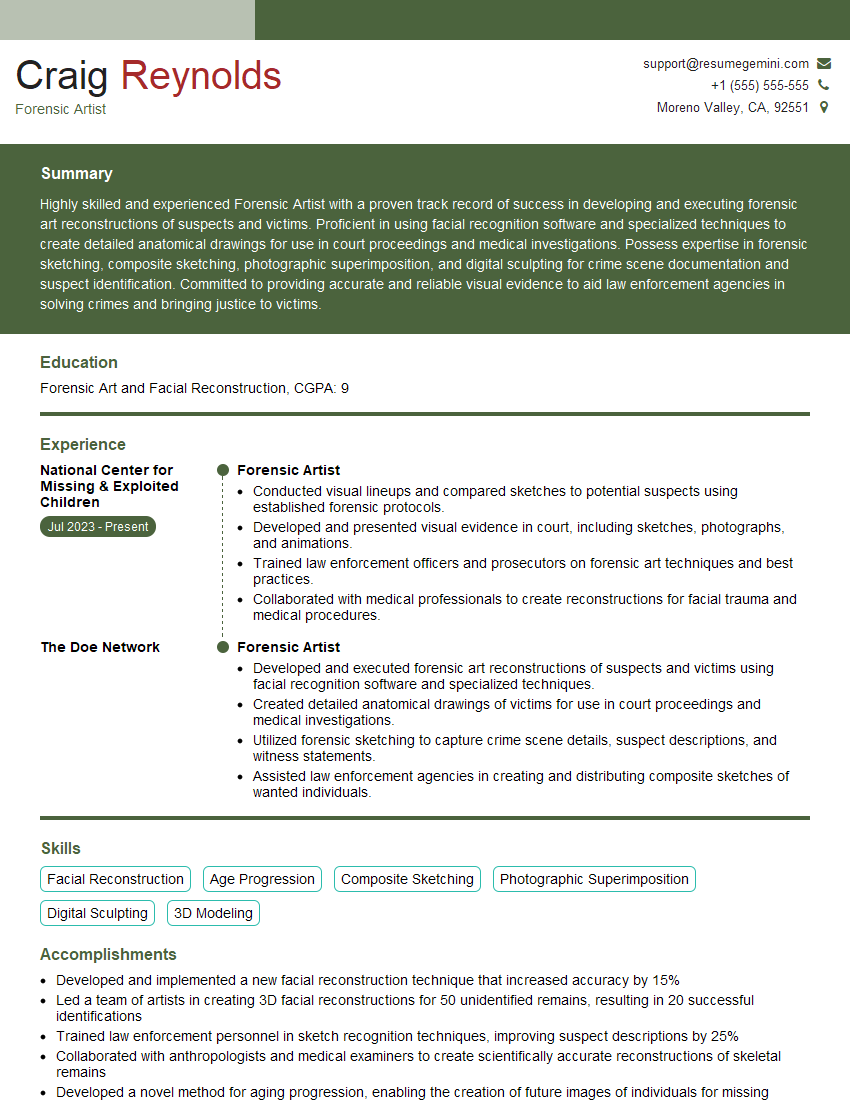
Mastering forensic sketching opens doors to a rewarding career in law enforcement, investigation, and even academia. To significantly boost your job prospects, invest time in creating a compelling, ATS-friendly resume that showcases your skills and experience effectively. ResumeGemini is a trusted resource that can help you build a professional resume that stands out. They offer examples of resumes tailored specifically to forensic sketching professionals, giving you a head start in crafting a document that highlights your unique qualifications and experience. Take the next step in your career journey – build a winning resume today.
Explore more articles
Users Rating of Our Blogs
Share Your Experience
We value your feedback! Please rate our content and share your thoughts (optional).
What Readers Say About Our Blog
Very informative content, great job.
good