Cracking a skill-specific interview, like one for Forestry Maps, requires understanding the nuances of the role. In this blog, we present the questions you’re most likely to encounter, along with insights into how to answer them effectively. Let’s ensure you’re ready to make a strong impression.
Questions Asked in Forestry Maps Interview
Q 1. Explain the different types of forestry maps and their applications.
Forestry maps are crucial tools for managing and understanding forest resources. They come in various types, each serving a specific purpose. Think of them as different lenses revealing different aspects of the forest.
- Stand maps: These maps delineate individual forest stands based on factors like tree species, age, density, and site quality. Imagine them as a detailed inventory of different ‘neighborhoods’ within the forest. Applications include timber harvesting planning, silvicultural treatments, and assessing forest productivity.
- Topographic maps: These maps show the elevation and terrain of the forest area. They’re like a three-dimensional snapshot, essential for understanding drainage patterns, slope stability, and road accessibility. Their applications range from planning forest roads and trails to assessing erosion risk and wildfire behavior.
- Ownership maps: These maps define the boundaries of land ownership within the forest. They’re crucial for resolving land disputes and managing access rights. Think of these as a legal document visualizing the forest’s property lines.
- Habitat maps: These maps show the distribution of different habitats within the forest, identifying areas important for specific plant and animal species. These are critical for conservation planning and biodiversity monitoring, highlighting areas of ecological significance.
- Forest inventory maps: These maps integrate data from various sources to provide a comprehensive overview of forest resources, including tree species, volume, biomass, and other attributes. They’re the most comprehensive type, aggregating data from other map types to give a holistic view of the forest’s resources.
The choice of map type depends heavily on the specific management objectives. For example, a timber company might prioritize stand maps for harvesting planning, while a conservation organization might focus on habitat maps to guide protection efforts.
Q 2. Describe your experience with GIS software used in forestry mapping.
My experience with GIS software in forestry mapping spans over 10 years. I’m proficient in ArcGIS, QGIS, and ERDAS IMAGINE. I’ve used these tools extensively for various tasks, from georeferencing aerial photos and satellite imagery to creating and analyzing spatial data layers. For instance, in a recent project involving a large-scale forest inventory, I used ArcGIS to process LiDAR data to generate a highly accurate digital elevation model (DEM), which was then used to create detailed canopy height models and subsequently estimate timber volume.
In another project, I utilized QGIS’ open-source capabilities to analyze the spatial distribution of invasive species. By overlaying layers of vegetation indices derived from satellite imagery with species occurrence data, I was able to predict the spread of the invasive species, providing invaluable information for management decisions.
Beyond basic mapping, I’ve utilized spatial statistical and analytical tools within these platforms to perform tasks such as creating buffer zones around sensitive habitats and running suitability analyses for specific tree species.
Q 3. How do you ensure accuracy in forestry map creation and data collection?
Accuracy in forestry map creation hinges on meticulous data collection and rigorous quality control at every stage. We employ a multi-pronged approach:
- Ground truthing: This involves physically visiting the forest and collecting data points to verify the accuracy of remotely sensed data. Imagine it as a ‘reality check’ against the satellite or aerial imagery.
- Using multiple data sources: Integrating data from different sources (e.g., aerial photography, LiDAR, field measurements) provides redundancy and improves accuracy. It’s like having multiple witnesses to confirm the same story.
- Proper georeferencing and projection: Ensuring that all data is accurately referenced to a coordinate system is crucial. Think of this as establishing a precise address for every point in the forest.
- Regular calibration and maintenance of equipment: This ensures consistent and reliable data acquisition. Just like regular servicing of a car ensures efficient operation.
- Quality control checks: Regular checks and validation at different stages of the mapping process are crucial to identify and correct errors early on. It’s similar to proofreading a document before publication.
These steps, when implemented diligently, minimize errors and improve the reliability of forestry maps, making them robust tools for decision-making.
Q 4. What are the common sources of error in forestry mapping, and how do you mitigate them?
Forestry mapping is susceptible to various errors. Identifying and mitigating these is critical.
- Errors in GPS data: Signal blockage by dense canopy can lead to inaccurate GPS coordinates. We use differential GPS (DGPS) and multiple readings to minimize this.
- Remote sensing limitations: Cloud cover, atmospheric conditions, and sensor limitations can affect the quality of imagery, leading to misclassification of vegetation. We use multi-temporal imagery and advanced image processing techniques to address these.
- Errors in field data collection: Human error in measuring tree height, diameter, or species identification can impact accuracy. We use standardized protocols and cross-checking to reduce such errors.
- Data processing errors: Incorrect georeferencing, image classification errors, and errors in data analysis can all affect accuracy. Thorough quality control checks and validation throughout the process help in identifying these.
Mitigation involves using robust equipment, well-defined protocols, comprehensive quality control, and a combination of data sources to cross-validate information. For example, we might compare remotely sensed data with ground-truth measurements to identify and correct discrepancies.
Q 5. Explain the process of creating a forest inventory map using remote sensing data.
Creating a forest inventory map using remote sensing data is a multi-step process.
- Data Acquisition: This involves acquiring appropriate remote sensing data, such as high-resolution satellite imagery or LiDAR data. The choice of data depends on the required level of detail and budget.
- Pre-processing: Raw remote sensing data needs to be pre-processed to correct geometric distortions, atmospheric effects, and other artifacts. This stage ensures that the data is ready for analysis.
- Image Classification: This involves classifying pixels in the imagery into different land cover classes, such as tree species, age classes, or density. Techniques like supervised or unsupervised classification are used.
- Data Extraction: Once classified, relevant data is extracted, such as tree height, crown diameter, and biomass. This might involve using object-based image analysis (OBIA) techniques.
- Ground Truthing: Field measurements are used to validate the accuracy of the classification and data extraction. This is crucial for calibrating models and improving accuracy.
- Map Production: Finally, a forest inventory map is created, incorporating the extracted data and ground-truth information. This map visually represents the spatial distribution and characteristics of forest resources.
For example, we might use LiDAR data to estimate tree heights and crown sizes, then integrate this with satellite imagery to classify tree species. This integrated approach leads to a comprehensive and accurate forest inventory map.
Q 6. How do you interpret topographic data in relation to forest management practices?
Topographic data is intrinsically linked to forest management practices. Understanding the terrain is crucial for making informed decisions.
- Slope and aspect: Steep slopes can hinder access for harvesting or planting, while aspect influences sunlight exposure and moisture availability, impacting tree growth and species selection. Imagine trying to plant trees on a very steep slope – it’s difficult and costly.
- Elevation: Elevation influences temperature and precipitation patterns, affecting vegetation zones and species distribution. Higher elevations usually have different species than lower ones.
- Drainage patterns: Understanding drainage helps in planning roads and infrastructure, minimizing erosion, and managing water resources. Proper drainage is key to preventing waterlogging, which can harm trees.
- Soil depth and type: Topographic features often influence soil properties. Knowing this allows for targeted site preparation and species selection based on soil suitability.
In essence, topographic data provides a crucial context for planning all forestry operations, from road construction and silvicultural treatments to fire management and watershed protection. Ignoring topography would lead to inefficient and potentially destructive practices.
Q 7. Describe your experience with GPS and its role in forestry mapping.
GPS is an indispensable tool in modern forestry mapping. It provides the geographical coordinates for various data points, forming the backbone of geospatial datasets.
- Location Tracking: GPS enables precise location tracking during field surveys, ensuring accurate recording of tree measurements, sample plot locations, and boundary delineation. It’s like having a precise ‘address’ for every data point.
- Navigation: GPS guides field crews through the forest, improving efficiency and reducing the time spent navigating complex terrain. It’s significantly more efficient than traditional methods.
- Data Integration: GPS coordinates are essential for integrating various data sources into a GIS, linking ground measurements to remote sensing data. This ensures that field observations have an accurate geographic location.
- Accuracy Enhancement: DGPS and other techniques enhance the accuracy of GPS readings, reducing positional errors. The increased accuracy translates to better map precision.
In practice, I use GPS devices extensively for collecting field data, creating precise boundaries, and navigating across rugged terrain. The resulting accuracy improvements greatly enhance the quality and reliability of the forestry maps I produce. We utilize both handheld GPS devices and GPS enabled data loggers for improved efficiency and data management.
Q 8. How do you handle discrepancies between field data and map data?
Discrepancies between field data and map data are inevitable in forestry mapping due to various factors like measurement errors, changes in forest conditions since the last survey, and differences in data collection methodologies. Handling these discrepancies requires a systematic approach.
My strategy involves first identifying the source of the discrepancy. This might involve comparing GPS coordinates, reviewing field notes for potential errors, or examining the map’s metadata for potential limitations. For instance, if field data shows a higher density of trees than the map, I’d investigate whether the map reflects older data, or if the discrepancy is localized to a specific area, suggesting a need for a ground truthing exercise.
Next, I prioritize the data based on its reliability. Generally, recent, ground-truthed field data holds more weight. I then integrate the data using Geographic Information Systems (GIS) software, often employing techniques like spatial analysis to identify zones of conflict and apply appropriate adjustments to the map. Finally, I document all adjustments made and their rationale, ensuring transparency and maintainability. The goal is to produce a map that reflects the best available knowledge.
Q 9. Explain your knowledge of various map projections and their suitability for forestry applications.
Map projections are crucial in forestry as they transform the 3D Earth’s surface onto a 2D map, introducing unavoidable distortions. My experience encompasses various projections, each suitable for specific applications:
- Universal Transverse Mercator (UTM): Excellent for areas spanning limited longitudes, minimizing distortion in distances and shapes. Ideal for large-scale forest inventories, especially in areas with east-west orientation.
- Albers Equal-Area Conic: Preserves area accurately, crucial for calculations of forest volume and biomass. A preferred projection for regional assessments where area preservation is paramount, potentially sacrificing minimal shape distortion.
- Lambert Conformal Conic: Minimizes shape distortion, useful for applications needing precise angles and directions, such as planning logging roads or tracking wildlife movements.
- State Plane Coordinate System: State-specific projections minimizing distortion within individual states. Often a practical choice for smaller-scale projects within a state.
Choosing the right projection depends heavily on the project’s scope, objectives, and the desired level of accuracy. I always justify the projection choice in the map metadata.
Q 10. How do you incorporate LiDAR data into forestry maps?
LiDAR (Light Detection and Ranging) data revolutionizes forestry mapping by providing highly accurate 3D representations of the forest canopy and terrain. I integrate LiDAR data into forestry maps through a multi-step process.
First, I preprocess the LiDAR data to filter out noise and artifacts. Then, using GIS software, I generate a digital elevation model (DEM) representing the ground surface and a canopy height model (CHM) showing tree heights. These models provide crucial information for various analyses.
For example, the CHM can be used to delineate forest stands based on canopy height, facilitating stratified sampling for ground surveys. The DEM helps in determining slope and aspect, which can influence tree growth and management practices. Furthermore, I can extract tree locations and crown characteristics from LiDAR data to create detailed tree maps. Finally, the results are integrated with other spatial data layers, like roads and ownership boundaries, for a comprehensive forestry map.
Q 11. Describe your experience with forest mensuration techniques and their integration into mapping.
Forest mensuration techniques are essential for quantifying forest resources and integrating that information into maps. My experience spans various techniques, including:
- Diameter at Breast Height (DBH) measurements: Used to estimate tree volume and biomass. This field data is georeferenced and incorporated into the map to create density maps or individual tree-level maps.
- Point sampling: Efficient method to estimate forest attributes using statistical sampling. The location of sample points is recorded and linked to attributes like basal area and volume, creating spatially explicit data for mapping.
- Plot sampling: Involves establishing fixed-area plots where all trees are measured. This detailed data is invaluable for mapping forest structure and composition.
- Tree height measurements: Using instruments like hypsometers, these measurements are crucial for volume estimation and creating height maps.
These techniques are integrated into GIS to create thematic maps, for instance, displaying variations in basal area, tree density, or biomass across the forest. The integration process usually involves creating attribute tables linked to spatial data, enabling spatial analysis and visualization.
Q 12. How do you ensure the accessibility and usability of forestry maps for various stakeholders?
Accessibility and usability are paramount. I ensure this through several approaches:
- Using open standards: Creating maps in formats like GeoTIFF or shapefiles that are universally compatible with various GIS software.
- User-friendly design: Employing clear symbology, a well-structured legend, and intuitive layout to facilitate map interpretation by non-experts.
- Multiple formats: Providing maps in both static (e.g., PDF) and interactive (e.g., web map) formats catering to diverse needs.
- Metadata: Including detailed metadata describing the map’s content, creation process, limitations, and data sources.
- Data sharing: Using online platforms or repositories for sharing the map data, facilitating collaboration and access.
For instance, a web map with interactive layers allowing stakeholders to easily explore different forest attributes would ensure accessibility for a wide audience, including forest managers, researchers, and the public.
Q 13. How familiar are you with different map symbology and design principles?
Map symbology and design are crucial for effective communication. My knowledge includes:
- Selecting appropriate symbols: Choosing symbols that clearly represent the data’s attribute, for example, using different colours to represent different tree species or using graduated circles to show variations in tree density.
- Color palettes: Utilizing color palettes that are both visually appealing and perceptually distinct to avoid confusion.
- Scale and resolution: Choosing the appropriate scale and resolution depending on the map’s purpose and the level of detail required.
- Typography: Using legible fonts to ensure that labels and text are easily readable.
- Legend design: Creating a clear and concise legend explaining the symbology and providing essential contextual information.
I strive to create maps that are not only informative but also aesthetically pleasing and effective in conveying the information.
Q 14. How do you manage large datasets for forestry mapping projects?
Managing large datasets in forestry mapping projects requires efficient strategies. My approach includes:
- Database management systems (DBMS): Utilizing a DBMS such as PostgreSQL/PostGIS to store and manage spatial data efficiently.
- Cloud computing: Leveraging cloud-based storage and processing services (like AWS or Google Cloud) to handle large datasets and distribute computational tasks.
- Data compression techniques: Employing appropriate compression methods to reduce storage space and improve data transfer speeds.
- Data tiling: Dividing large datasets into smaller, manageable tiles to enhance processing speed and improve visualization performance.
- Data pre-processing: Performing necessary cleaning, transformation, and error correction steps before analysis to ensure data quality.
Employing these strategies ensures that I can effectively manage and process even the largest datasets, ultimately creating accurate and informative forestry maps.
Q 15. What software proficiency do you possess in GIS and relevant forestry applications?
My GIS software proficiency encompasses a wide range of tools crucial for forestry applications. I’m highly proficient in ArcGIS Pro, including its spatial analysis, geoprocessing, and 3D visualization capabilities. I’m also experienced with QGIS, a powerful open-source alternative, offering flexibility and cost-effectiveness for various projects. Beyond these core platforms, I’m adept at using specialized forestry extensions like the Spatial Analyst extension in ArcGIS for tasks such as terrain analysis and habitat modeling. My expertise further extends to programming languages like Python, allowing me to automate tasks, customize workflows, and conduct advanced spatial analysis using libraries such as NumPy and GDAL. Finally, I’m familiar with remote sensing software like ERDAS IMAGINE for processing satellite imagery and extracting forest-related information. This comprehensive skill set ensures I can handle diverse mapping and analysis needs within the forestry sector.
Career Expert Tips:
- Ace those interviews! Prepare effectively by reviewing the Top 50 Most Common Interview Questions on ResumeGemini.
- Navigate your job search with confidence! Explore a wide range of Career Tips on ResumeGemini. Learn about common challenges and recommendations to overcome them.
- Craft the perfect resume! Master the Art of Resume Writing with ResumeGemini’s guide. Showcase your unique qualifications and achievements effectively.
- Don’t miss out on holiday savings! Build your dream resume with ResumeGemini’s ATS optimized templates.
Q 16. How would you use forestry maps to assess forest health and identify areas needing treatment?
Forestry maps are invaluable for assessing forest health. Think of them as a detailed health report for an entire forest. I’d use them in a multi-step process. First, I’d overlay various datasets, like satellite imagery (to detect changes in canopy cover or signs of disease), LiDAR data (for detailed 3D forest structure analysis), and field survey data (ground-truthing observations). For example, analyzing near-infrared reflectance in satellite imagery can highlight stressed vegetation. Secondly, I’d perform spatial analysis techniques, like calculating indices such as the Normalized Difference Vegetation Index (NDVI) to quantify vegetation health across the map. Areas with abnormally low NDVI values would flag potential issues. Then, I would utilize geoprocessing tools to identify spatially contiguous areas with consistently low health indicators. Finally, I would use these maps to prioritize areas needing treatment, perhaps focusing on sections with high disease risk or significant canopy loss, ensuring efficient allocation of resources for interventions like selective logging, reforestation, or pest control.
Q 17. How do you assess the suitability of land for various forestry activities using maps?
Assessing land suitability involves integrating multiple map layers representing various factors. Imagine building a house – you need to consider the foundation (soil type), the structure (slope), and utilities (water access). Similarly, for forestry, I’d overlay maps of soil type, slope, aspect (direction the slope faces), elevation, proximity to water sources, and existing infrastructure (roads for logging). Each layer would be assigned suitability scores based on the specific forestry activity. For example, steep slopes might be unsuitable for heavy machinery, while specific soil types are better for particular tree species. I’d then use spatial analysis tools like weighted overlay or suitability modeling to combine these layers, generating a final map showing areas with high, medium, and low suitability for the chosen activity. This ensures that activities are planned in areas that maximize success and minimize environmental impact.
Q 18. Explain your understanding of spatial analysis techniques relevant to forestry.
My understanding of spatial analysis techniques is extensive. I routinely employ techniques like overlay analysis (combining different map layers), buffer analysis (creating zones around features), proximity analysis (measuring distances between features), network analysis (modeling movement across a network of roads or rivers), and interpolation (estimating values at unsampled locations). In forestry, these are crucial. For instance, buffer analysis helps determine areas affected by logging or wildfires, while network analysis optimizes logging routes minimizing environmental damage. I also use advanced techniques such as kriging (for precise spatial interpolation of forest parameters) and geostatistics (analyzing spatial autocorrelation and variability of forest attributes). These techniques help in accurate prediction and modeling across the landscape, providing vital information for forest management decisions.
Q 19. How would you incorporate climate change data into forestry maps and planning?
Incorporating climate change data is critical for long-term forest planning. I’d integrate climate projections, such as changes in temperature, precipitation patterns, and extreme weather events (droughts, floods), into forestry maps using various methods. This could involve overlaying projected climate zones onto existing forest cover maps, identifying areas at high risk of drought or increased fire susceptibility. I might also use species distribution models to predict how the ranges of different tree species might shift with changing climate conditions. This would help us plan for species migration, assisted migration programs (relocating trees to more suitable locations), and adaptation strategies for preserving biodiversity and forest health under a changing climate. The goal is to create dynamic, future-oriented maps reflecting climate vulnerability and informing proactive management strategies.
Q 20. Describe your experience in creating and updating digital forest maps.
My experience in creating and updating digital forest maps is substantial. I’ve worked on numerous projects involving data acquisition (using aerial photography, LiDAR, and field surveys), georeferencing, image processing, and map creation using GIS software. I follow a structured workflow. Initially, I gather data from multiple sources and ensure its accuracy and consistency. I then perform rigorous quality control checks throughout the process. The creation of the map involves classifying land cover using techniques like supervised or unsupervised classification, depending on data availability and project needs. Updates involve incorporating new data and adjusting existing information. For instance, changes in forest cover due to logging or wildfire are regularly incorporated using remote sensing data and field verification. I also employ version control systems to track changes and maintain data integrity throughout the map’s lifecycle.
Q 21. How do you incorporate public land use information into forestry maps?
Incorporating public land use information is crucial for responsible forest management. This typically involves obtaining data from government agencies or open-data portals, Data might include protected areas, designated recreational zones, and private land ownership boundaries. I integrate this data into forestry maps as thematic layers, overlaying it onto forest cover maps and other relevant information. This helps identify areas where forestry activities might conflict with public use or environmental regulations. For example, a proposed logging area overlapping a protected habitat would trigger a review of the plan. This integration ensures compliance with regulations, minimizes conflicts, and promotes sustainable forest management practices that balance economic needs with environmental protection and public access.
Q 22. How do you manage version control and collaboration for forestry mapping projects?
Version control and collaboration are paramount in forestry mapping projects, where multiple teams might contribute to a single map over extended periods. We employ a robust system using Git, a distributed version control system. Each team member works on a local copy of the map data (often stored as geospatial files like shapefiles or GeoPackage), making changes independently. When ready, they commit their changes to a central repository (like GitHub or GitLab), along with descriptive commit messages detailing their modifications. This allows for tracking changes, reverting to previous versions if needed, and merging contributions from multiple users. Furthermore, we use collaborative platforms like ArcGIS Online or QGIS Server to allow simultaneous editing and visualization of map data in a controlled environment, ensuring everyone works with the most up-to-date information. Conflict resolution tools built into the Git system or the collaborative platforms help seamlessly manage any overlapping edits.
For instance, imagine one team is updating forest cover types based on recent aerial surveys, while another is adding newly surveyed roads. Both teams can work concurrently without interfering with each other’s work, and the version control system helps merge their changes efficiently at the end, avoiding data loss or inconsistencies. We meticulously document our workflow, ensuring clarity for all team members and stakeholders.
Q 23. Explain your experience with data visualization techniques for presenting forestry map data.
Data visualization is crucial for effectively communicating forestry map data. We use a variety of techniques tailored to the audience and the specific information being conveyed. For example, choropleth maps (using color shading to represent data variations across geographic areas) are excellent for displaying forest density, tree species composition, or carbon sequestration potential. Isoline maps are effective for representing continuous variables like elevation or slope, aiding in terrain analysis and habitat suitability modeling. We leverage interactive web maps using tools like Leaflet or OpenLayers to allow users to explore data dynamically, zooming in/out, querying specific areas, and generating reports.
Furthermore, we incorporate other visualization elements such as charts and graphs to summarise key findings from the map data. For instance, a bar chart summarizing the total area of each tree species represented on the map provides a clear overview of forest composition. We also use 3D visualization techniques, particularly with LiDAR data, to create realistic digital elevation models (DEMs) and forest canopy models, enabling comprehensive landscape analysis and assessment of potential hazards like forest fires or landslides. The choice of visualization technique always prioritizes clarity, accuracy, and ease of interpretation for the intended audience. We avoid overcrowding the visuals with unnecessary details.
Q 24. How do you handle the legal and regulatory aspects of forestry mapping?
Legal and regulatory aspects of forestry mapping are critical and often vary based on location and jurisdiction. We meticulously adhere to all relevant laws and regulations related to land ownership, data privacy, and environmental protection. This includes obtaining necessary permits for data collection (e.g., aerial surveys, ground-truthing), respecting intellectual property rights, and ensuring compliance with data security standards. We work closely with legal counsel and relevant government agencies to navigate the complexities of land rights, environmental regulations, and data sharing agreements.
For example, in a project involving indigenous lands, we collaborate directly with the relevant communities to obtain their informed consent and incorporate their traditional ecological knowledge into the mapping process. We also follow stringent protocols for data anonymization and security to protect sensitive information. Our approach prioritizes transparency and ethical conduct, ensuring all mapping activities are legally sound and environmentally responsible.
Q 25. Describe your understanding of the limitations of different mapping technologies.
Different mapping technologies have their strengths and limitations. For instance, while satellite imagery provides broad-scale coverage and is cost-effective for large areas, its resolution might be insufficient for detailed inventory of individual trees. Aerial photography offers higher resolution but can be more expensive and time-consuming. LiDAR (Light Detection and Ranging) provides highly accurate 3D data, ideal for generating detailed forest canopy models, but its cost can be prohibitive for large-scale projects. GPS technology is essential for ground-truthing but susceptible to errors due to signal interference or atmospheric conditions. Each technology has a specific niche and the choice depends on the project’s scope, budget, and required accuracy.
For example, in a large-scale forest monitoring project focusing on deforestation rates, satellite imagery might suffice. However, for a detailed assessment of a particular forest stand for timber harvesting planning, LiDAR data combined with high-resolution aerial photography would be more suitable. Understanding these limitations allows us to select the most appropriate technology for each task, ensuring we obtain accurate and relevant data within budget constraints.
Q 26. How do you maintain the integrity and accuracy of forestry map data over time?
Maintaining the integrity and accuracy of forestry map data over time requires a multi-pronged approach. Regular updates are crucial, incorporating new data from aerial surveys, satellite imagery, and field observations. We use a robust quality control (QC) process throughout the mapping workflow, involving checks at each stage, from data acquisition to final map production. This includes validating the accuracy of geographic coordinates, checking for data inconsistencies, and verifying data against ground-truth measurements. A metadata system meticulously documents the source, date, and methods used for each data layer, enabling traceability and facilitating future updates.
Moreover, we use change detection techniques to monitor changes in forest cover over time, comparing data from different time periods to identify areas of deforestation, forest regrowth, or changes in tree species composition. This allows for timely updates and assists in effective forest management. We also incorporate data from other sources, such as climate data and weather patterns, to better understand the factors affecting forest health and growth, further refining the accuracy of the maps over time.
Q 27. Explain how you would integrate forestry maps with other relevant spatial data.
Integrating forestry maps with other relevant spatial data significantly enhances their value and utility. We routinely integrate forestry data with datasets on soil type, topography, hydrology, climate, and infrastructure (roads, power lines). This integration allows for more comprehensive analysis of forest ecosystems and helps in decision-making related to forest management, conservation, and sustainable development.
For example, overlaying a forestry map with a soil map helps in understanding the relationship between soil conditions and tree growth, informing site-specific management strategies. Similarly, integrating hydrological data helps in assessing the impact of forestry activities on water resources. By leveraging GIS software and spatial analysis techniques, we can perform various analyses like suitability modeling for specific tree species, risk assessments for forest fires or landslides, and optimization of transportation networks for logging activities. This integrated approach enables us to create more robust and insightful maps that support evidence-based decision making.
Key Topics to Learn for Forestry Maps Interview
- Map Projections and Coordinate Systems: Understanding different map projections (e.g., UTM, Lambert Conformal Conic) and their implications for accuracy and analysis in forestry applications.
- Data Acquisition and Processing: Familiarize yourself with methods of acquiring forestry data (e.g., LiDAR, aerial photography, field surveys) and processing techniques for creating accurate maps.
- Geographic Information Systems (GIS) Software: Gain proficiency in using GIS software (e.g., ArcGIS, QGIS) to manipulate, analyze, and visualize forestry data. Practice creating maps, performing spatial analyses, and managing geospatial datasets.
- Forest Inventory and Mensuration: Learn how forestry maps are used for inventory purposes, including measuring tree attributes (diameter, height, volume) and estimating forest biomass.
- Forest Management Planning: Understand how maps are integral to forest management planning, including road design, timber harvesting planning, and wildlife habitat management.
- Data Interpretation and Visualization: Practice interpreting forestry map data to identify patterns, trends, and anomalies. Develop skills in creating clear and effective map visualizations for diverse audiences.
- Spatial Analysis Techniques: Explore various spatial analysis techniques applicable to forestry data, such as buffer analysis, overlay analysis, and proximity analysis.
- Accuracy Assessment and Error Analysis: Understand methods for assessing the accuracy of forestry maps and identifying sources of error in data acquisition and processing.
Next Steps
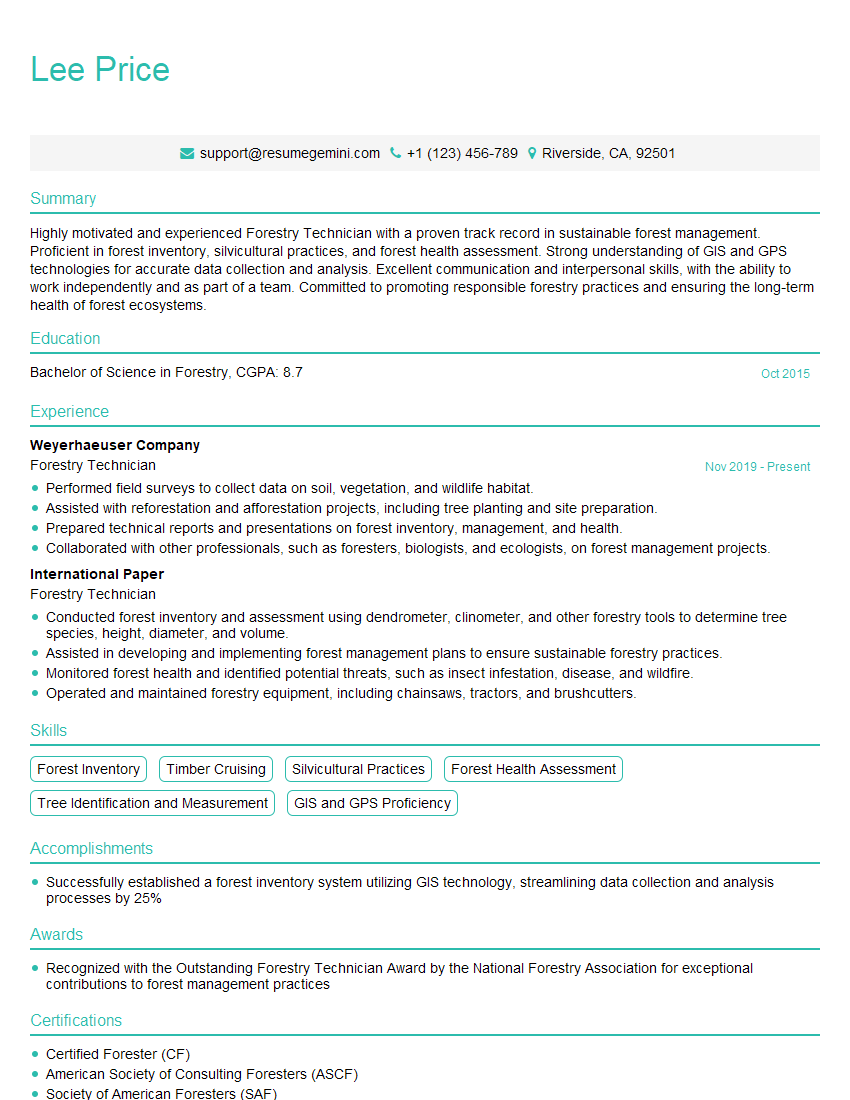
Mastering Forestry Maps is crucial for career advancement in the forestry and environmental sectors, opening doors to exciting roles with increasing responsibility and higher earning potential. A strong resume is your key to unlocking these opportunities. To maximize your chances, create an ATS-friendly resume that effectively highlights your skills and experience. We recommend using ResumeGemini, a trusted resource that helps you build professional and impactful resumes. Examples of resumes tailored to Forestry Maps roles are available to help guide you.
Explore more articles
Users Rating of Our Blogs
Share Your Experience
We value your feedback! Please rate our content and share your thoughts (optional).
What Readers Say About Our Blog
Very informative content, great job.
good