Cracking a skill-specific interview, like one for Fuel Cell Technologies, requires understanding the nuances of the role. In this blog, we present the questions you’re most likely to encounter, along with insights into how to answer them effectively. Let’s ensure you’re ready to make a strong impression.
Questions Asked in Fuel Cell Technologies Interview
Q 1. Explain the basic principles of operation of a Proton Exchange Membrane (PEM) fuel cell.
A Proton Exchange Membrane (PEM) fuel cell operates on the principle of electrochemical energy conversion. Think of it like a battery that continuously replenishes its charge. Hydrogen gas is fed to the anode (negative electrode), where a catalyst (typically platinum) splits the hydrogen molecules into protons (H+) and electrons (e-). The protons pass through a special membrane, the proton exchange membrane (PEM), which is selectively permeable only to protons. The electrons, meanwhile, are forced to travel through an external circuit, creating an electric current – this is the electricity we harvest! At the cathode (positive electrode), oxygen reacts with the protons and electrons from the circuit, producing water as a byproduct. This whole process happens without combustion, resulting in a clean and efficient energy conversion.
In simpler terms: Hydrogen is split into protons and electrons. Protons go through a membrane; electrons travel through a wire (generating electricity). Oxygen combines with protons and electrons to form water. It’s elegant and efficient.
Q 2. Describe the difference between PEMFCs, SOFCs, and DMFCs.
PEMFCs (Proton Exchange Membrane Fuel Cells), SOFCs (Solid Oxide Fuel Cells), and DMFCs (Direct Methanol Fuel Cells) are all types of fuel cells, but they differ significantly in their operating temperatures and electrolytes:
- PEMFCs: Operate at relatively low temperatures (around 80°C), using a polymer membrane as the electrolyte. They are known for their high power density and fast start-up times, making them suitable for automotive and portable applications. However, they typically require high-purity hydrogen fuel.
- SOFCs: Operate at very high temperatures (600-1000°C), employing a solid ceramic oxide as the electrolyte. Their high operating temperature allows for the use of a wider range of fuels, including natural gas, and they exhibit high efficiency. However, the high temperatures require robust materials and longer start-up times, limiting their use in some applications.
- DMFCs: Operate at intermediate temperatures (60-120°C), utilizing a liquid electrolyte to directly oxidize methanol fuel. They offer the advantage of using liquid fuel, which is easier to store and transport than hydrogen. However, their power density is generally lower compared to PEMFCs, and methanol crossover (methanol leaking through the membrane) can reduce efficiency.
Think of it this way: PEMFCs are like sprinters – fast and powerful. SOFCs are like marathon runners – efficient but slow to start. DMFCs are somewhere in between, offering convenience but at the cost of some performance.
Q 3. What are the key challenges in scaling up fuel cell production?
Scaling up fuel cell production faces several significant challenges:
- Cost Reduction: The cost of materials, particularly the platinum group metals (PGMs) used as catalysts, remains a significant hurdle. Research is focusing on developing non-PGM catalysts and improving manufacturing processes to reduce costs.
- Durability and Lifetime: Fuel cells need to withstand long-term operation without significant performance degradation. Issues like membrane degradation, catalyst poisoning, and electrode corrosion need to be addressed to extend their lifespan.
- Mass Production Techniques: Developing efficient and scalable manufacturing processes for fuel cell components is crucial. This involves optimizing techniques like electrode coating, membrane fabrication, and stack assembly.
- Material Availability and Supply Chain: Ensuring the reliable supply of high-quality materials is essential for consistent production. This necessitates collaborations across the value chain and developing alternative material sources.
- Standardization and Quality Control: Establishing industry standards for fuel cell components and testing procedures is critical for ensuring consistent quality and performance across different manufacturers.
Overcoming these challenges requires a multidisciplinary approach involving materials science, chemical engineering, and manufacturing expertise.
Q 4. How does the fuel cell stack design affect overall system performance?
Fuel cell stack design significantly impacts overall system performance. Key design aspects include:
- Number of Cells: Increasing the number of cells in a stack increases the overall voltage output. However, this also increases the size and complexity of the system.
- Cell Interconnect Design: The design of the interconnects, which connect individual cells electrically and distribute reactants, impacts the current distribution and pressure drop within the stack.
- Flow Field Design: The design of the flow fields, which direct the flow of reactants (hydrogen and oxygen) over the electrodes, influences reactant utilization and mass transport. Poor design can lead to uneven reactant distribution and reduced performance.
- Thermal Management: Effective thermal management is crucial to maintain optimal operating temperature and prevent overheating. This often involves incorporating cooling systems into the stack design.
- Gaskets and Seals: Robust and leak-proof gaskets and seals are essential to prevent gas leaks and maintain the integrity of the stack.
A well-designed stack maximizes power output, minimizes pressure drops, ensures uniform reactant distribution, and facilitates efficient thermal management, all contributing to improved overall system performance and longevity.
Q 5. Explain the concept of fuel cell polarization curves and their significance.
Fuel cell polarization curves graphically represent the relationship between the cell voltage and current density. They are crucial for understanding and diagnosing fuel cell performance. The curve typically shows three distinct regions:
- Activation Polarization: At low current densities, the voltage loss is mainly due to the activation energy required for the electrochemical reactions at the electrodes. This is like overcoming initial inertia.
- Ohmic Polarization: At intermediate current densities, voltage loss is primarily caused by the resistance of the electrolyte and other components in the fuel cell. Think of it as resistance in a wire.
- Concentration Polarization: At high current densities, the voltage loss is due to the limitation of reactant transport to the electrodes. This is like a traffic jam – reactants can’t get to where they’re needed fast enough.
By analyzing the polarization curve, engineers can identify the dominant loss mechanisms and optimize the fuel cell design or operating conditions to improve performance. For example, a steep slope in the ohmic polarization region suggests high internal resistance, prompting investigation of the electrolyte or interconnect design.
Q 6. Describe different types of fuel cell catalysts and their advantages/disadvantages.
Fuel cell catalysts play a vital role in accelerating the electrochemical reactions at the electrodes. Different types of catalysts exist, each with its own advantages and disadvantages:
- Platinum (Pt): The most commonly used catalyst for PEMFCs, due to its high activity for both the hydrogen oxidation reaction (HOR) at the anode and the oxygen reduction reaction (ORR) at the cathode. However, platinum is expensive and susceptible to poisoning by impurities in the fuel.
- Platinum Alloys (Pt-based): Alloys of platinum with other metals (e.g., Pt-Ru, Pt-Co) can improve catalyst performance and durability compared to pure platinum. They often exhibit higher tolerance to CO poisoning, a common issue in fuel cells.
- Non-PGM Catalysts: Research is actively pursuing non-platinum group metal (non-PGM) catalysts as a cost-effective alternative. Materials like metal oxides, carbides, and nitrides are being explored, but their activity and durability often fall short of platinum-based catalysts.
The choice of catalyst depends on factors such as cost, activity, selectivity, and durability. For example, while platinum offers high performance, its cost drives the search for viable non-PGM alternatives.
Q 7. What are the common methods for diagnosing and troubleshooting fuel cell performance issues?
Diagnosing and troubleshooting fuel cell performance issues involves a systematic approach:
- Performance Measurements: Start by measuring key performance indicators (KPIs) like voltage, current, power, and gas flows. Deviations from expected values pinpoint potential problems.
- Polarization Curve Analysis: Analyze the polarization curves to identify the dominant loss mechanisms (activation, ohmic, concentration). This guides troubleshooting efforts.
- Electrochemical Impedance Spectroscopy (EIS): EIS provides insights into the internal resistances and charge transfer processes within the fuel cell. It helps diagnose problems related to the membrane, electrodes, or interconnects.
- Visual Inspection: Inspect the fuel cell components for physical damage, such as cracks in the membrane or corrosion on the electrodes. This often reveals obvious problems.
- Gas Analysis: Analyzing the composition of the inlet and outlet gases can reveal issues with fuel utilization, oxygen transport, or gas leaks.
Troubleshooting involves a systematic process of elimination. For example, if the polarization curve shows significant ohmic polarization, you might investigate the membrane hydration or interconnect resistance. If concentration polarization dominates, focus on optimizing gas flow and reactant distribution.
Q 8. Discuss the role of membrane electrode assemblies (MEAs) in fuel cell operation.
The Membrane Electrode Assembly (MEA) is the heart of a fuel cell, where the electrochemical reactions happen. Think of it as the cell’s ‘sandwich,’ composed of a proton exchange membrane (PEM) sandwiched between two catalyst layers (CLs) – one anode and one cathode. The PEM acts as a selective barrier, allowing only protons (H+) to pass through, while blocking electrons. The CLs, typically made of platinum nanoparticles supported on a high-surface-area carbon material, catalyze the oxidation of hydrogen at the anode and the reduction of oxygen at the cathode.
At the anode, hydrogen is oxidized, releasing electrons and protons: 2H₂ → 4H⁺ + 4e⁻. The electrons flow through an external circuit, generating electricity. The protons pass through the PEM to the cathode. At the cathode, oxygen reacts with the protons and electrons to produce water: O₂ + 4H⁺ + 4e⁻ → 2H₂O. The efficiency of this process heavily depends on the MEA’s properties, including the thickness and conductivity of the PEM, the catalyst loading and activity, and the contact resistance between the different layers. A well-designed MEA is crucial for maximizing power output and minimizing losses.
For instance, a thicker PEM offers better impermeability to gases but reduces proton conductivity, affecting performance. Similarly, a higher platinum loading increases catalytic activity but adds cost. Optimizing the MEA design is an ongoing research focus, exploring alternative materials and manufacturing techniques to improve performance and durability.
Q 9. How do you address water management challenges in PEM fuel cells?
Water management is critical in PEM fuel cells, as water is both a product and a necessary reactant. Too much water leads to flooding, hindering reactant transport and reducing performance. Too little water leads to membrane dehydration, decreasing proton conductivity and potentially damaging the membrane. We address this challenge through a multi-pronged approach:
- Careful Design: Optimizing the flow field design in the bipolar plates (channels and land patterns) influences water distribution and removal. Proper design ensures effective water removal without drying out the membrane.
- Backpressure Control: Adjusting the pressure at the outlet of the cathode can help manage water removal. Higher backpressure can assist in removing excess water, while lower backpressure can help retain sufficient hydration.
- Humidification: Controlling the humidity of the reactant gases (hydrogen and oxygen) is crucial. Appropriate humidification prevents membrane dehydration, ensuring optimal proton conductivity.
- Membrane Selection: Using a membrane with good water retention capabilities helps to mitigate issues related to membrane drying.
- Active Water Removal Techniques: In some advanced systems, active water removal mechanisms such as micro-pumps or capillary systems are integrated into the fuel cell design to address challenging water management situations.
For example, in automotive applications, where rapid changes in power demand occur, robust water management is crucial to maintain stable performance and prevent flooding during acceleration.
Q 10. Explain the impact of temperature and pressure on fuel cell efficiency.
Temperature and pressure significantly affect fuel cell efficiency. Increasing the temperature generally enhances reaction kinetics, leading to higher power output and faster reaction rates. However, high temperatures can also lead to membrane dehydration and degradation, requiring a balance. For PEM fuel cells, the optimal operating temperature is typically between 60°C and 80°C.
Pressure plays a key role in reactant gas solubility and transport. Higher pressures increase the partial pressures of the reactant gases (hydrogen and oxygen), leading to higher concentrations near the catalyst surface and subsequently, improved fuel cell performance. However, high pressures also increase the risk of gas crossover, leading to reduced efficiency. The ideal operating pressure is a compromise between performance gains and potential adverse effects.
Imagine it like cooking: higher temperatures cook food faster, but too high a temperature can burn it. Similarly, higher pressure can improve fuel cell performance, but too much pressure can have detrimental effects. Therefore, carefully controlling temperature and pressure is crucial for optimizing fuel cell operation.
Q 11. What are the different types of fuel cell balance of plant (BoP) components?
The Balance of Plant (BoP) components are crucial for supporting the fuel cell stack’s operation. They are the ‘supporting cast’ to the ‘star’ – the fuel cell stack. Key BoP components include:
- Air/Oxygen Supply System: This component supplies oxygen or air to the cathode. It includes air compressors, filters, and possibly humidifiers.
- Hydrogen Supply System: This component manages the hydrogen supply to the anode, incorporating storage tanks, regulators, and potentially purifiers to remove contaminants.
- Thermal Management System: This is vital for regulating the fuel cell’s temperature within the optimal range, typically using coolant loops and heat exchangers.
- Power Electronics: This part handles power conditioning, including voltage and current regulation, to interface with the fuel cell stack and the load.
- Water Management System: This component manages the water produced at the cathode, including removal, collection, and disposal.
- Control System: This system monitors and controls all BoP components, ensuring optimal fuel cell operation and safety.
For instance, in a stationary fuel cell power system, the BoP might include large hydrogen storage tanks and a sophisticated control system for managing grid integration.
Q 12. How do you ensure the durability and longevity of a fuel cell system?
Ensuring the durability and longevity of fuel cell systems is a key challenge. Several strategies are employed:
- Material Selection: Choosing durable and corrosion-resistant materials for the MEA and BoP components is essential. Research focuses on developing more robust and stable catalysts and membranes.
- Optimized Operating Conditions: Maintaining stable temperature and pressure within optimal ranges helps prevent premature degradation.
- Contaminant Control: Minimizing exposure to contaminants such as CO and sulfur compounds, which can poison the catalysts, is crucial. This often involves employing filters and purifiers within the BoP.
- Careful System Design: The fuel cell system design itself can affect its durability. Avoiding high stress points and incorporating effective thermal and water management are key aspects.
- Regular Maintenance: Regular maintenance, including cleaning and inspection, helps prolong the fuel cell’s lifespan. This might involve replacing components like the MEA after a certain operating time.
For example, in a fuel cell electric vehicle, durability is paramount. Extensive testing and rigorous quality control measures are employed to ensure long-term reliability and meet the demanding requirements of automotive applications.
Q 13. Discuss the various methods for hydrogen storage and delivery in fuel cell applications.
Hydrogen storage and delivery are crucial aspects of fuel cell applications. Methods vary depending on the application (stationary, portable, automotive).
- Compressed Gas Storage: High-pressure tanks store hydrogen as a compressed gas. This is widely used in automotive applications, but the high pressures require robust tank designs.
- Cryogenic Liquid Storage: Storing hydrogen in liquid form at very low temperatures (-253°C) significantly increases storage density. This method is suitable for larger-scale applications but requires energy-intensive liquefaction and specialized cryogenic tanks.
- Metal Hydride Storage: Hydrogen is stored by absorbing it into a metal hydride material. This offers a relatively high storage density, but the materials can be expensive and have limited cycle life.
- Chemical Hydrides: Hydrogen is stored chemically bound in a material, offering high storage density but requiring energy for the release of hydrogen.
- Delivery Infrastructure: For widespread adoption, a robust hydrogen refueling infrastructure is necessary, including production, storage, transportation, and dispensing.
The choice of storage method depends on factors like energy density, cost, safety, and the application’s specific requirements. For instance, a portable fuel cell device might use compressed gas storage, whereas a stationary power plant might utilize cryogenic storage due to the larger volumes of hydrogen needed.
Q 14. Describe your experience with fuel cell testing and characterization techniques.
My experience encompasses a wide range of fuel cell testing and characterization techniques, essential for evaluating their performance and durability. These techniques include:
- Polarization Curves: Measuring the fuel cell’s voltage-current characteristics to determine its maximum power output and assess its performance under various operating conditions. This is a fundamental test to evaluate fuel cell efficiency.
- Electrochemical Impedance Spectroscopy (EIS): Analyzing the fuel cell’s impedance response to identify the sources of losses, such as ohmic resistance, charge transfer resistance, and mass transport limitations. EIS helps diagnose performance issues and pinpoint areas for improvement.
- Gas Chromatography (GC): Measuring the composition of the reactant and product gases to determine the fuel utilization efficiency and detect potential leaks or crossover of gases.
- Durability Testing: Subjecting the fuel cell to accelerated stress tests (e.g., potential cycling, load cycling) to evaluate its long-term stability and determine its lifespan under realistic operating conditions.
- Microscopic Characterization: Employing techniques like scanning electron microscopy (SEM) and transmission electron microscopy (TEM) to analyze the MEA’s microstructure and assess the catalyst layer’s morphology, and identify degradation mechanisms.
For example, in a recent project, I used EIS to identify a high charge transfer resistance at the cathode, which was subsequently addressed through catalyst optimization. This systematic approach involving a range of testing and characterization techniques ensures a comprehensive understanding of fuel cell behavior and performance.
Q 15. What are the safety considerations associated with fuel cell operation and handling?
Safety is paramount in fuel cell operation. The primary concerns revolve around the fuels used and the byproducts generated. Hydrogen, a common fuel, is highly flammable and requires careful handling to prevent leaks and explosions. Proper ventilation is crucial to avoid the accumulation of hydrogen, and leak detection systems are essential safety components. Furthermore, some fuel cell types utilize corrosive electrolytes, such as strong acids or alkalis. These require robust containment to prevent spills and exposure. Safety protocols should include regular inspections, maintenance, and training for personnel on emergency procedures. For example, in a stationary fuel cell system, a comprehensive safety shutdown system is critical, automatically halting operation in case of leaks or other anomalies. In automotive applications, robust tank design and safety systems are needed to prevent hydrogen leaks in case of collisions.
- Hydrogen Leaks: Implementing leak detection systems and ventilation strategies.
- Electrolyte Management: Using robust containment and handling procedures for corrosive electrolytes.
- Thermal Management: Preventing overheating through efficient cooling systems.
- Emergency Shutdown Systems: Implementing automatic shutdowns in case of malfunctions.
Career Expert Tips:
- Ace those interviews! Prepare effectively by reviewing the Top 50 Most Common Interview Questions on ResumeGemini.
- Navigate your job search with confidence! Explore a wide range of Career Tips on ResumeGemini. Learn about common challenges and recommendations to overcome them.
- Craft the perfect resume! Master the Art of Resume Writing with ResumeGemini’s guide. Showcase your unique qualifications and achievements effectively.
- Don’t miss out on holiday savings! Build your dream resume with ResumeGemini’s ATS optimized templates.
Q 16. How does the choice of electrolyte material influence fuel cell performance?
The electrolyte plays a pivotal role in fuel cell performance, acting as an ion conductor between the anode and cathode. Different electrolytes impact conductivity, operating temperature, and overall efficiency. For instance, Polymer Electrolyte Membrane (PEM) fuel cells use a solid polymer membrane, typically Nafion, which facilitates proton conduction at relatively low temperatures (80-100°C). These are efficient and relatively easy to manage but can be sensitive to dehydration. Alkaline fuel cells (AFCs) use liquid alkaline electrolytes (e.g., potassium hydroxide) which exhibit high ionic conductivity but are susceptible to CO2 contamination. Solid Oxide Fuel Cells (SOFCs) employ ceramic electrolytes (e.g., yttria-stabilized zirconia) allowing operation at high temperatures (600-1000°C), leading to high efficiency but slower start-up times and increased material challenges. The choice of electrolyte is a complex trade-off between performance, cost, durability, and operating conditions.
- PEMFCs: High efficiency at low temperatures, but sensitive to dehydration.
- AFCs: High ionic conductivity, but susceptible to CO2 contamination.
- SOFCs: High efficiency at high temperatures, but complex manufacturing and slow start-up.
Q 17. Explain the concept of fuel cell degradation mechanisms.
Fuel cell degradation is a gradual decline in performance over time, primarily due to several mechanisms. One key factor is catalyst degradation, where the active catalyst material (often platinum) can lose its effectiveness due to poisoning (e.g., by CO), particle agglomeration, or dissolution. Membrane degradation is another crucial aspect, especially in PEMFCs. The membrane can degrade through chemical attack by radicals, dehydration, or mechanical stress, leading to increased permeability and reduced ionic conductivity. Other factors include electrode corrosion, flooding (liquid water accumulation), and carbon support corrosion. Understanding these mechanisms is vital for extending fuel cell lifespan. This often involves meticulous material selection, precise operating conditions, and innovative designs to mitigate degradation.
- Catalyst Degradation: Platinum poisoning, particle growth, dissolution.
- Membrane Degradation: Chemical attack, dehydration, mechanical stress.
- Electrode Degradation: Corrosion, flooding.
Q 18. Discuss the environmental impact of fuel cell technology compared to other energy sources.
Fuel cells offer a significantly cleaner energy solution compared to fossil fuel combustion. They produce primarily water vapor as a byproduct, with minimal greenhouse gas emissions, thus reducing the carbon footprint. However, the environmental impact isn’t entirely benign. The manufacturing process of fuel cells can involve materials with environmental consequences, and the production and transportation of hydrogen fuel can also have associated emissions. Depending on the hydrogen production method (e.g., electrolysis powered by renewable sources vs. steam methane reforming), the overall environmental benefits can vary considerably. Compared to internal combustion engines, fuel cells offer a substantial reduction in air pollutants. A comprehensive lifecycle assessment is necessary to fully evaluate the environmental impact of fuel cell systems, considering the complete process from material extraction to end-of-life disposal.
Q 19. What are the different types of fuel cell applications (e.g., automotive, stationary power)?
Fuel cell applications span various sectors. In the automotive sector, fuel cells power electric vehicles, offering extended range and faster refueling compared to battery-electric vehicles. They’re also used in stationary power generation for backup power systems, residential applications, and distributed generation, providing a reliable and clean power source. Portable applications include fuel cells for laptops, cell phones, and military equipment. In addition, fuel cells find application in aerospace and marine industries as auxiliary power units or even primary power sources, offering high power density and reduced emissions.
- Automotive: Electric vehicles, hybrid vehicles.
- Stationary Power: Backup power, residential power, distributed generation.
- Portable Applications: Laptops, cell phones, military equipment.
- Aerospace & Marine: Auxiliary power units, primary power sources.
Q 20. Describe your experience with fuel cell modeling and simulation software.
I have extensive experience using various fuel cell modeling and simulation software packages, including COMSOL Multiphysics, ANSYS Fluent, and OpenFOAM. My expertise extends to building and validating models for different fuel cell types, encompassing electrochemical reactions, mass transport, heat transfer, and fluid dynamics. I’ve used these tools to optimize fuel cell design, predict performance under various operating conditions, and investigate degradation mechanisms. For example, I used COMSOL to model the water management in a PEM fuel cell, identifying optimal channel designs for efficient water removal and minimizing flooding. My experience also includes validating simulation results with experimental data, allowing for fine-tuning of models and improved predictive capabilities. This iterative process of model development, validation, and refinement is crucial for effective fuel cell design and optimization.
Q 21. Explain the role of electrocatalysis in fuel cell performance.
Electrocatalysis is the heart of fuel cell operation, accelerating the electrochemical reactions at the anode and cathode electrodes. Efficient electrocatalysts significantly impact the overall performance and efficiency of the fuel cell. The electrocatalyst’s primary role is to reduce the activation energy needed for the electrochemical reactions, increasing reaction rates and reducing overpotentials (voltage losses). Platinum is a widely used electrocatalyst, particularly in PEMFCs for the oxygen reduction reaction (ORR) at the cathode and hydrogen oxidation reaction (HOR) at the anode. However, its high cost and limited abundance necessitate research into alternative, more cost-effective electrocatalysts, such as non-platinum group metals (non-PGMs) or metal oxides. The optimization of electrocatalyst properties, including size, morphology, and composition, is crucial for improving fuel cell performance and durability. For instance, the design of porous electrodes with a high surface area allows for efficient catalyst utilization. The research and development of improved electrocatalysts remain a key focus in fuel cell technology.
Q 22. How would you design a fuel cell system for a specific application (e.g., portable power, electric vehicle)?
Designing a fuel cell system hinges on the application’s specific needs. For a portable power source, like a backup generator, priorities include size, weight, and efficiency at lower power outputs. In contrast, an electric vehicle (EV) demands high power density, rapid response times, and durability to withstand demanding operating conditions. Let’s break down the design process:
- Application Analysis: We begin by meticulously defining the power requirements (wattage, voltage), operational duration, and environmental conditions. For a portable device, this might be 100W for 5 hours, operating in a temperature range of 0-40°C. For an EV, it might be 100kW with the need for rapid acceleration and a range of 300 miles.
- Fuel Cell Selection: The choice of fuel cell technology depends on factors such as power requirements, fuel type availability, and cost. Proton Exchange Membrane (PEM) fuel cells are ideal for portable devices due to their high power density and fast start-up times. For EVs, PEM or Solid Oxide Fuel Cells (SOFCs) could be viable, depending on specific performance targets and cost considerations. SOFCs offer higher efficiency but require higher operating temperatures.
- System Components: A complete fuel cell system includes not only the fuel cell stack itself but also crucial ancillary components. This includes fuel storage and delivery, air supply, water management (removing excess water produced during the reaction), thermal management (controlling operating temperature), and power electronics (DC-DC converters for voltage regulation).
- System Integration: The components are integrated into a system that meets size, weight, and performance requirements. This often involves iterative design, simulations, and prototyping. For portable devices, miniaturization and lightweight materials are crucial. For EVs, integration with the vehicle’s powertrain is critical.
- Testing and Validation: Rigorous testing under various conditions is essential to ensure the system meets its design specifications and is reliable and safe. This involves endurance tests, environmental tests, and safety evaluations.
For example, a portable device might use a miniature PEM fuel cell stack powered by a small methanol cartridge. The system could incorporate passive water management and efficient thermal control using heat sinks. In contrast, an EV system might employ a larger PEM or SOFC stack integrated with a high-pressure hydrogen tank and a sophisticated thermal management system involving liquid cooling.
Q 23. What are the current limitations and future research directions in fuel cell technology?
Fuel cell technology faces several limitations, driving ongoing research. Key challenges include:
- Cost: The high cost of fuel cell components, particularly the catalyst (often platinum), remains a major barrier to widespread adoption. Research focuses on developing less expensive catalyst materials and manufacturing techniques.
- Durability and Longevity: Fuel cells can degrade over time due to factors like catalyst poisoning, membrane degradation, and chemical reactions. Research is aimed at improving the durability of fuel cell components, extending their operational lifespan, and enhancing their resistance to contaminants.
- Fuel Availability and Infrastructure: The widespread adoption of hydrogen fuel cell vehicles, for instance, necessitates a robust hydrogen refueling infrastructure, which is currently underdeveloped. Research in this area includes developing efficient and safe hydrogen production, storage, and transportation methods.
- Operating Conditions: Some fuel cell types, such as SOFCs, operate at high temperatures, demanding effective thermal management systems. Other types may suffer from low performance at low temperatures or in the presence of contaminants. Research includes developing fuel cells with broader operating windows and enhanced tolerance to impurities.
- Water Management: Effective water management is crucial for fuel cell performance. Excess water can flood the cell, while insufficient water can lead to membrane dehydration. Research concentrates on optimizing water transport and developing robust water management systems.
Future research directions include exploring alternative catalyst materials (e.g., non-platinum group metals), improving membrane materials, developing more efficient fuel processing techniques, creating advanced control algorithms for optimal operation, and establishing a broader hydrogen infrastructure.
Q 24. Discuss the economics of fuel cell technology and its competitiveness with other energy sources.
The economics of fuel cell technology are complex and depend on factors such as the specific application, fuel cell type, fuel cost, and scale of production. Currently, fuel cells are often more expensive than competing technologies like internal combustion engines or lithium-ion batteries, especially for smaller-scale applications. However, the cost is declining with advancements in materials science and manufacturing processes.
Fuel cells offer potential long-term cost advantages due to their high efficiency, especially in stationary power generation. They can utilize various fuels, including renewable sources like hydrogen produced from electrolysis. The overall lifecycle cost, considering fuel efficiency and reduced emissions, can make them competitive, particularly in applications where clean energy is prioritized.
Compared to other energy sources, fuel cells have a competitive edge in areas like stationary power generation where high efficiency and low emissions are critical. Their competitiveness in the transportation sector (electric vehicles) is improving but still faces challenges in terms of cost and infrastructure.
The competitiveness of fuel cell technology is improving as technology advances and economies of scale are achieved. Government incentives and supportive policies can also play a critical role in accelerating adoption and making fuel cells more economically viable.
Q 25. Describe your experience with different fuel processing techniques.
My experience encompasses several fuel processing techniques, vital for converting various fuels into hydrogen-rich streams suitable for fuel cells. These techniques are crucial because fuel cells typically operate on pure hydrogen, and the starting fuel often needs reforming.
- Steam Methane Reforming (SMR): This is a widely used technique for producing hydrogen from natural gas. It involves reacting methane with steam at high temperatures and pressures in the presence of a catalyst. I’ve worked extensively on optimizing SMR processes to enhance hydrogen yield and minimize unwanted byproducts like carbon monoxide.
- Partial Oxidation Reforming (POR): This technique uses a limited amount of oxygen to partially oxidize the fuel, producing hydrogen and carbon monoxide. It’s advantageous for fuels with high carbon content, but managing the carbon monoxide content is crucial for downstream fuel cell operation. My research included developing advanced catalysts and process control strategies to minimize CO levels.
- Autothermal Reforming (ATR): ATR combines SMR and POR, offering advantages in terms of energy efficiency and flexibility. I have experience in designing and testing ATR systems, focusing on achieving optimal reactant ratios and minimizing catalyst deactivation.
- Electrochemical Reforming: This approach uses electrochemical processes to reform fuels, often at lower temperatures than thermal reforming methods. This has benefits for some applications, reducing energy consumption and potential emissions. I’ve explored the use of electrochemical reforming for producing hydrogen from liquid fuels such as methanol.
My work includes both experimental studies, involving designing and testing reforming reactors and characterizing catalyst performance, and computational modeling to optimize process conditions and predict reactor behavior.
Q 26. How do you handle data analysis and interpretation in fuel cell research?
Data analysis and interpretation are integral to fuel cell research. We use a multifaceted approach, combining experimental data with modeling and simulation.
- Data Acquisition: We employ various instruments to gather data during fuel cell testing, including electrochemical impedance spectroscopy (EIS), gas chromatography (GC), mass spectrometry (MS), and various sensors to measure temperature, pressure, and flow rates. Data is often automatically logged and stored using dedicated software.
- Data Preprocessing: Raw data often requires preprocessing to remove noise and outliers. This might involve filtering techniques, smoothing algorithms, and error correction methods.
- Statistical Analysis: Statistical methods are applied to determine trends, correlations, and significant differences in the data. This might include regression analysis, ANOVA, and hypothesis testing to determine the significance of experimental results.
- Modeling and Simulation: Computational models are employed to simulate fuel cell performance and predict the effect of design parameters. This involves solving complex electrochemical and transport equations and comparing the results with experimental data. Examples of software used include COMSOL Multiphysics and ANSYS.
- Visualization: Data is visualized using graphs, charts, and other visual aids to facilitate interpretation and communication of results. This often involves specialized software.
For example, we might use EIS to analyze the electrochemical impedance of a fuel cell, revealing information about the different processes within the cell. This data is then interpreted to identify potential limitations and inform strategies for optimization. We might use statistical methods to evaluate the effect of different catalyst materials on fuel cell performance, and model outputs help guide design decisions and predict long-term behavior.
Q 27. What are the potential benefits and drawbacks of using different fuel sources in fuel cells?
The choice of fuel source significantly impacts fuel cell performance, economics, and environmental impact.
- Hydrogen (H₂): Hydrogen offers the highest energy density and produces only water as a byproduct, making it an ideal fuel from an environmental standpoint. However, hydrogen production and storage pose challenges, with current methods often relying on fossil fuels or requiring significant energy input for electrolysis.
- Methanol (CH₃OH): Methanol is a liquid fuel, offering easier storage and transportation than hydrogen. It can be reformed directly in a fuel cell or used in direct methanol fuel cells (DMFCs). However, methanol reforming can produce carbon monoxide, which can poison fuel cell catalysts. DMFCs suffer from lower efficiency and methanol crossover issues.
- Natural Gas (CH₄): Natural gas is abundant and relatively inexpensive, but its use in fuel cells requires reforming to produce hydrogen, which increases system complexity and CO emissions.
- Ammonia (NH₃): Ammonia is a promising fuel source due to its high hydrogen content and ease of storage and transportation. However, ammonia reforming technology needs further development to achieve high efficiency and low emissions.
- Biofuels: Biofuels, derived from biomass, offer a renewable fuel option but require careful consideration of sustainability and lifecycle emissions.
Benefits of various fuels include readily available infrastructure (natural gas), high energy density (hydrogen), and liquid-state handling (methanol). Drawbacks include greenhouse gas emissions (natural gas), catalyst poisoning (methanol), and the need for reforming processes (natural gas and ammonia). The selection of the optimal fuel depends on a trade-off analysis considering factors like availability, cost, environmental impact, and fuel cell system design.
Key Topics to Learn for Fuel Cell Technologies Interview
- Fundamentals of Electrochemical Processes: Understand the underlying principles of redox reactions, electrode kinetics, and electrochemical thermodynamics as they apply to fuel cells.
- Types of Fuel Cells: Become familiar with the different types of fuel cells (PEMFC, SOFC, AFC, etc.), their operating principles, advantages, and limitations. Compare and contrast their performance characteristics and suitability for various applications.
- Fuel Cell Components and Materials: Gain a thorough understanding of the key components (electrodes, electrolytes, membranes, bipolar plates) and the materials science aspects influencing their performance and durability. This includes considerations of material selection, processing, and degradation mechanisms.
- Fuel Cell System Design and Integration: Explore the engineering challenges involved in designing and integrating fuel cells into complete systems, including fuel processing, thermal management, and power conditioning.
- Practical Applications: Research real-world applications of fuel cell technology, such as stationary power generation, transportation (e.g., fuel cell vehicles), portable power devices, and their role in renewable energy systems.
- Performance Evaluation and Testing: Understand the methods used to characterize fuel cell performance, including polarization curves, impedance spectroscopy, and durability testing. Be prepared to discuss the interpretation of these results.
- Problem-Solving Approaches: Practice identifying and troubleshooting common issues in fuel cell operation, such as fuel starvation, flooding, and degradation mechanisms. Develop your ability to analyze problems and propose solutions based on your understanding of the underlying principles.
- Emerging Trends and Future Directions: Stay updated on the latest advancements in fuel cell technology, including research on new materials, improved designs, and emerging applications.
Next Steps
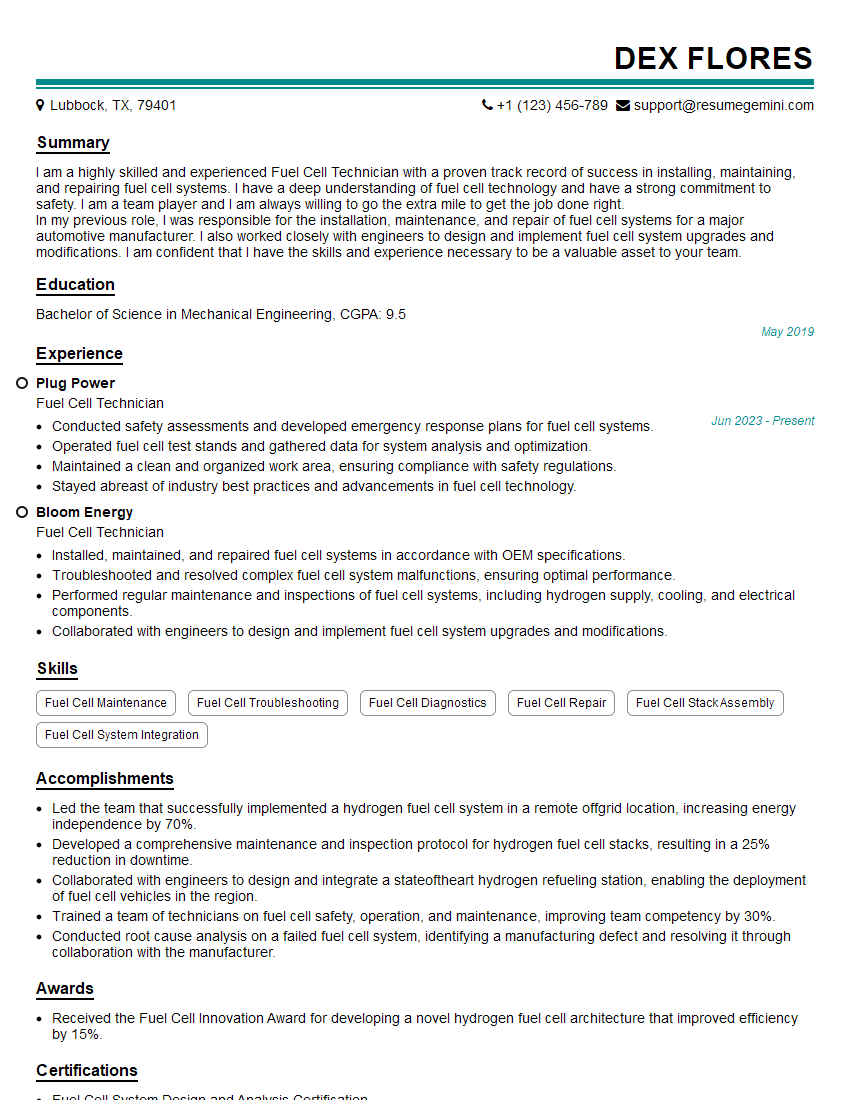
Mastering Fuel Cell Technologies opens doors to exciting and impactful careers in a rapidly growing field. To maximize your job prospects, it’s crucial to present your skills and experience effectively. Creating an ATS-friendly resume is essential for getting your application noticed by recruiters and hiring managers. We strongly recommend using ResumeGemini to build a professional and impactful resume that highlights your expertise in Fuel Cell Technologies. ResumeGemini provides tools and resources to help you craft a compelling narrative, and examples of resumes tailored to Fuel Cell Technologies are available to guide you.

Explore more articles
Users Rating of Our Blogs
Share Your Experience
We value your feedback! Please rate our content and share your thoughts (optional).
What Readers Say About Our Blog
Very informative content, great job.
good