Interviews are more than just a Q&A session—they’re a chance to prove your worth. This blog dives into essential Furniture Inventory Management interview questions and expert tips to help you align your answers with what hiring managers are looking for. Start preparing to shine!
Questions Asked in Furniture Inventory Management Interview
Q 1. Explain the cycle counting method for furniture inventory.
Cycle counting is a more efficient inventory management method than a full physical inventory count. Instead of counting everything at once, it involves counting a small portion of your inventory regularly. This allows for continuous monitoring and early detection of discrepancies.
For furniture, this might mean counting all sofas in a specific section of the warehouse on Monday, all dining tables on Wednesday, and all chairs on Friday. This systematic approach minimizes disruption to operations and provides a more accurate real-time inventory picture.
The frequency of counting each section depends on factors like item value, sales velocity, and historical accuracy. High-value items or frequently sold pieces would be counted more often. For example, popular modern sofas might be counted weekly, while less-in-demand antique chairs might be counted monthly. This targeted approach ensures that the most crucial items are monitored closely. A well-designed cycle counting schedule minimizes errors and maintains an up-to-date inventory.
Q 2. Describe your experience with different inventory valuation methods (FIFO, LIFO, weighted average).
Inventory valuation methods determine the cost of goods sold and the value of remaining inventory. I have extensive experience with FIFO (First-In, First-Out), LIFO (Last-In, First-Out), and weighted-average methods.
- FIFO: Assumes the oldest items are sold first. In the furniture context, this means the oldest sofa model purchased is the first one sold. This method is preferable in industries where products can expire or become obsolete, but it’s less relevant for most furniture, unless there’s a significant design change.
- LIFO: Assumes the newest items are sold first. This is less common for furniture due to the nature of inventory where items don’t spoil or degrade quickly. The newer furniture isn’t necessarily the first to be sold.
- Weighted-Average: Calculates a weighted average cost for all items of the same type. This method simplifies cost accounting for furniture with slight variations but doesn’t reflect the actual cost of individual items. For example, If I purchase 10 chairs at $100 each and later 10 at $110, the weighted average cost would be $105 per chair.
The choice of method depends on the specific business needs and accounting regulations. For furniture, FIFO often provides a more realistic representation of the cost of goods sold.
Q 3. How do you handle discrepancies between physical inventory and system records?
Discrepancies between physical inventory and system records are inevitable, but they need to be addressed promptly and systematically. My approach involves a multi-step process:
- Investigation: Identify the nature and extent of the discrepancy. Is it a single item, a product category, or a widespread issue? Detailed records of the physical count are crucial.
- Root Cause Analysis: Determine why the discrepancy occurred. Common causes include data entry errors, theft, damage, misplacement, or inaccurate stock transfers. Is the problem related to the counting process itself? Perhaps training is needed.
- Corrective Actions: Adjust the inventory system records to reflect the physical count. This may involve creating adjustments or writing off damaged or missing items. Addressing the root cause is crucial to prevent future discrepancies.
- Documentation: Maintain detailed records of the discrepancy, the investigation, the corrective actions taken, and any preventive measures implemented.
For example, if a discrepancy reveals a shortage of a particular type of chair, we would investigate whether it’s due to theft, damage, mislabeling, or a data entry error. Once the cause is identified, we would take corrective actions and implement measures to avoid a similar situation in the future (e.g., improving security or refining inventory management processes).
Q 4. What software have you used for furniture inventory management (e.g., ERP systems)?
I’ve worked extensively with several enterprise resource planning (ERP) systems, including SAP, Oracle NetSuite, and Microsoft Dynamics 365. These systems provide comprehensive inventory management capabilities, including tracking, forecasting, and reporting. I’m also proficient with dedicated inventory management software solutions such as Fishbowl Inventory and Cin7.
My experience with these systems extends to implementing and optimizing them for furniture inventory management, customizing them to manage different product types (sofas, chairs, tables, etc.) and tracking their unique attributes (e.g., fabric type, dimensions, finish). I’m comfortable training staff on the use of these systems and providing ongoing support.
Q 5. How do you optimize warehouse space for furniture storage?
Optimizing warehouse space for furniture is crucial for efficiency and cost reduction. My approach involves several strategies:
- Efficient Layout: Organize the warehouse based on product type, size, and frequency of access. High-demand items should be easily accessible. Consider dedicated areas for different furniture categories. This requires analyzing sales data to inform the layout.
- Vertical Space Utilization: Use vertical space effectively with racking systems, allowing for multiple levels of storage. This is particularly important for bulky items.
- Proper Slotting: Assign specific locations for each item type and size to minimize searching and retrieval time. This ensures fast picking and packing.
- Space Planning Software: Employ warehouse management system (WMS) software or dedicated space planning software to visualize and optimize the layout. These tools can simulate various scenarios and identify the most efficient layout.
- Regular Audits: Conduct regular audits of the warehouse to identify inefficiencies and adjust the layout or processes as needed. This ensures the space remains optimized over time.
For example, in one project, by implementing a new warehouse layout and using high-bay racking, we increased storage capacity by 40%, while improving order fulfillment times by 20%. This involved careful analysis of sales data and careful slotting of items.
Q 6. Describe your experience with barcode scanning and RFID technology in inventory management.
Barcode scanning and RFID (Radio-Frequency Identification) are essential technologies for efficient furniture inventory management. I have extensive experience with both.
- Barcode Scanning: Barcode scanners provide a quick and accurate way to track individual items during receiving, putaway, picking, and shipping. Barcodes on furniture items (or their packaging) enable quick identification and update of inventory counts in real time. However, requires line-of-sight.
- RFID: RFID tags offer a more advanced solution. These tags can be read without line-of-sight, allowing for real-time tracking of multiple items simultaneously. This is especially beneficial for managing larger items or high-volume warehouses. RFID is better for tracking furniture as it moves through the warehouse and supply chain, but can be more expensive to implement.
In previous roles, I’ve led the implementation of both barcode and RFID systems, integrating them with inventory management software to improve accuracy and efficiency. The choice between the two depends on the scale of operation, budget, and the need for real-time, line-of-sight-independent tracking.
Q 7. What metrics do you track to assess the effectiveness of your inventory management strategies?
To assess the effectiveness of inventory management strategies, I track several key metrics:
- Inventory Turnover Rate: Measures how many times inventory is sold and replaced over a period. A higher turnover rate indicates efficient inventory management.
- Inventory Accuracy: Represents the percentage of inventory items counted accurately. This highlights the accuracy of stocktaking methods and data management.
- Order Fulfillment Rate: The percentage of orders fulfilled on time and in full. This indicates the overall efficiency of the warehousing and order processing systems.
- Carrying Costs: The total cost associated with holding inventory (storage, insurance, obsolescence, etc.). Lower carrying costs are indicative of good inventory management.
- Stockout Rate: The frequency of running out of stock for particular items. High stockout rates indicate potential inefficiencies or inaccurate demand forecasting.
- Space Utilization Rate: This measures how efficiently warehouse space is used. Maximizing this improves efficiency and reduces costs.
By monitoring these metrics regularly, I can identify areas for improvement and optimize inventory management strategies to enhance efficiency and profitability.
Q 8. How do you manage damaged or obsolete furniture items?
Managing damaged or obsolete furniture involves a multi-step process focused on minimizing losses and maintaining inventory accuracy. First, we rigorously inspect items for damage during routine stock checks and after returns. Damaged items are categorized: repairable, salvageable (parts), or completely unusable. Repairable items are sent for repair, with costs tracked and compared to replacement value. If repair is cost-prohibitive, we consider salvaging usable parts. Completely unusable items are disposed of responsibly, often through partnerships with recycling facilities or charities. Obsolete items, those no longer in demand due to changes in style or technology, are marked down significantly for quick sale, or, if unsold, donated or responsibly disposed of. We maintain a detailed record of each item’s status, disposal method, and associated costs. This data helps inform future purchasing decisions and minimizes waste.
Example: A damaged sofa might have a torn cushion. If the repair cost is less than 20% of the sofa’s value, we’ll repair it. However, if the frame is also damaged, making the repair expensive, we might salvage the good cushions for use in other projects and dispose of the frame.
Q 9. Explain your process for receiving and inspecting incoming furniture shipments.
Receiving and inspecting incoming furniture shipments is critical for maintaining inventory accuracy and product quality. Upon arrival, we verify the shipment against the purchase order, checking quantity and condition of packaging. Next, a thorough inspection takes place, meticulously checking each item for damage (scratches, dents, broken parts), defects in workmanship, and any discrepancies from the order specifications. We use a standardized checklist to ensure consistency. Any discrepancies are documented with photos and reported to the vendor immediately. Once approved, items are tagged with unique identifiers, and their location is updated in our inventory management system. This process not only safeguards against damaged goods but also provides a strong audit trail.
Example: If a shipment of 100 chairs arrives, and two are visibly damaged, we’ll photograph the damage, note it on the receiving document, and contact the supplier for a replacement or credit. The 98 undamaged chairs are then processed into inventory.
Q 10. How do you ensure accurate and timely order fulfillment for furniture?
Accurate and timely order fulfillment hinges on a well-organized warehouse, efficient order processing, and robust inventory management software. Our system uses real-time inventory tracking to ensure items are available before order confirmation. Orders are picked using a streamlined process – often using a warehouse management system (WMS) that optimizes routes and minimizes travel time. Items are checked against the order details during picking and packing, reducing errors. Shipping labels are generated automatically, and tracking information is updated in real time, providing customers with visibility into their order’s progress. Regular audits of the order fulfillment process identify bottlenecks and areas for improvement.
Example: Our WMS might direct a picker to collect items in a specific order to minimize walking distance, increasing efficiency. Automated email updates keep customers informed about shipping status.
Q 11. How do you handle inventory shrinkage and theft?
Inventory shrinkage (loss not due to sales) and theft are significant concerns that we address through a combination of preventative measures and detective controls. Preventative measures include secure warehouse facilities with restricted access, CCTV surveillance, regular cycle counting, and employee training on loss prevention. Detective controls involve analyzing inventory discrepancies, investigating variances between physical counts and system records, and reviewing security footage. We also use technology such as RFID tags to track items throughout the warehouse, making it more difficult to steal or misplace items. Regular internal audits ensure the effectiveness of our procedures and identify potential weaknesses.
Example: Discrepancies in inventory reports might trigger an investigation, checking security footage to identify potential theft. RFID tags provide real-time location data, potentially alerting us to unauthorized movement of items.
Q 12. What is your experience with forecasting furniture demand?
Forecasting furniture demand is crucial for optimizing inventory levels and avoiding stockouts or overstocking. We use a variety of techniques, including historical sales data analysis, trend forecasting, seasonal adjustments, and external market research. We consider factors such as economic conditions, design trends, promotional campaigns, and competitor activity. Quantitative methods like time series analysis and statistical forecasting models are employed, supplemented by qualitative insights from sales teams and market experts. The forecasts are regularly reviewed and adjusted based on actual sales data and market changes.
Example: We might observe a strong correlation between sales of a particular chair style and the time of year (higher sales during the holiday season). This information is incorporated into our demand forecast.
Q 13. Explain your understanding of safety stock and its application in furniture inventory.
Safety stock is the extra inventory held to buffer against unexpected demand surges, supplier delays, or production issues. In furniture inventory, safety stock is vital to prevent stockouts of popular items, especially during peak seasons. The level of safety stock is determined by considering factors such as lead time (time from ordering to receiving), demand variability, and the cost of stockouts (lost sales, customer dissatisfaction). We employ sophisticated inventory models, often incorporating statistical analysis, to calculate the optimal safety stock level for each item. Maintaining appropriate safety stock balances the cost of holding extra inventory with the risk of running out.
Example: If a particular sofa style typically sells 50 units per month with a high demand variability, we might hold an additional 20 units (safety stock) to protect against potential short-term demand spikes.
Q 14. Describe your process for managing furniture returns.
Managing furniture returns involves a structured process that ensures efficient processing, quality assessment, and minimizes losses. Upon receiving a return, we inspect the item for damage beyond normal wear and tear. Returns are categorized as: returnable (full refund), repairable (partial refund/reselling after repair), or non-returnable (due to damage or violation of return policy). The condition of the returned item is carefully documented, including photos. If the item is deemed returnable, the customer is refunded according to our return policy. Repairable items are processed for repair, and non-returnable items are disposed of responsibly. Accurate tracking of returns helps identify potential issues with products or customer service, allowing us to address them proactively.
Example: A customer returns a slightly scratched dining table. If the scratch is minor, we might repair it and resell it as a ‘slightly imperfect’ item at a discounted price. If the damage is significant, it may be deemed non-returnable.
Q 15. How do you utilize data analysis to improve furniture inventory management?
Data analysis is crucial for optimizing furniture inventory management. It allows us to move beyond gut feelings and make data-driven decisions. I leverage various analytical techniques to gain valuable insights.
Sales Trend Analysis: I analyze historical sales data to predict future demand. For example, by identifying seasonal spikes in sofa sales, we can proactively adjust stock levels to avoid shortages or excessive surplus.
Inventory Turnover Rate: Calculating the turnover rate (how quickly inventory is sold) helps identify slow-moving items. A low turnover rate might indicate a need for price reductions, marketing campaigns, or even discontinuation of the product. For instance, if antique-style chairs have a consistently low turnover, we might consider repositioning them or offering them as part of a bundle deal.
ABC Analysis (explained further in answer 7): This method categorizes inventory based on value and consumption. By focusing on high-value (A) items, we can implement tighter controls and ensure their availability. For example, high-end dining sets would fall under category A, requiring meticulous tracking and forecasting.
Demand Forecasting: I use statistical models and machine learning algorithms to predict future demand, accounting for seasonality, trends, and external factors (economic conditions, new product launches). This allows for proactive ordering and prevents stockouts.
By combining these methods, I create a comprehensive picture of inventory performance, enabling informed decisions about ordering, pricing, and product lifecycle management.
Career Expert Tips:
- Ace those interviews! Prepare effectively by reviewing the Top 50 Most Common Interview Questions on ResumeGemini.
- Navigate your job search with confidence! Explore a wide range of Career Tips on ResumeGemini. Learn about common challenges and recommendations to overcome them.
- Craft the perfect resume! Master the Art of Resume Writing with ResumeGemini’s guide. Showcase your unique qualifications and achievements effectively.
- Don’t miss out on holiday savings! Build your dream resume with ResumeGemini’s ATS optimized templates.
Q 16. What are the key challenges in managing furniture inventory, and how have you addressed them?
Managing furniture inventory presents several unique challenges. Furniture is bulky, requiring significant storage space, and is susceptible to damage during storage and handling. Further, its often high value and varied styles contribute to complexity.
Space Constraints: Warehousing costs are significant. To address this, I’ve implemented strategies like optimizing warehouse layout, using vertical storage solutions, and exploring third-party logistics (3PL) partnerships for overflow storage.
Damage and Obsolescence: Furniture is prone to damage. Implementing robust handling procedures, regular stock checks, and proper packaging mitigates this risk. We also analyze sales trends to identify potential obsolescence and adjust purchasing accordingly.
High Value Items: The high value of many furniture pieces necessitates robust security measures, including inventory tracking systems with access controls and insurance.
Varied Styles and Customization: Managing numerous SKUs (stock keeping units) across different styles, colors, and materials requires a sophisticated inventory management system. We use a system that tracks all attributes to ensure accurate records.
Addressing these challenges requires a multifaceted approach combining technological solutions, efficient processes, and proactive risk management.
Q 17. How do you collaborate with other departments (e.g., sales, purchasing) to optimize inventory levels?
Collaboration is key to optimizing inventory levels. I work closely with sales and purchasing teams using several strategies:
Sales Forecasting Collaboration: Regular meetings with the sales team provide insights into expected demand, upcoming promotions, and customer preferences. This allows us to adjust inventory levels proactively.
Real-time Data Sharing: We use integrated systems that provide real-time visibility into inventory levels to sales and purchasing. This avoids surprises and allows for timely adjustments.
Joint Inventory Reviews: Periodic inventory reviews involving sales, purchasing, and inventory management ensure alignment on strategies and identification of potential issues.
Purchasing Collaboration: I collaborate with purchasing to negotiate favorable lead times with suppliers. Understanding lead times is crucial for accurate forecasting and avoiding stockouts.
Open communication and shared goals are essential for effective collaboration, ensuring that inventory decisions align with overall business objectives.
Q 18. How do you prioritize inventory tasks in a high-pressure environment?
Prioritizing tasks in a high-pressure environment requires a structured approach. I use a combination of techniques:
Urgency/Importance Matrix: I categorize tasks based on urgency and importance, focusing first on high-urgency, high-importance tasks (e.g., addressing immediate stockouts).
Prioritization Software: Using project management software helps track tasks, deadlines, and progress, enabling efficient task management.
Delegation: When possible, I delegate tasks to free up time for high-priority items.
Regular Review and Adjustment: I regularly review priorities to ensure that they align with changing circumstances and business needs.
Remaining calm under pressure, maintaining clear communication, and leveraging tools and techniques allows me to efficiently handle a high volume of tasks.
Q 19. Describe your experience with implementing inventory management best practices.
I have implemented several inventory management best practices, including:
Implementing an Inventory Management System (IMS): Transitioning from a manual system to a sophisticated IMS significantly improved accuracy, reduced errors, and provided real-time visibility into inventory levels.
Cycle Counting: Regular cycle counting, instead of annual physical inventory, ensures ongoing accuracy and early detection of discrepancies.
Lean Inventory Principles: Adopting lean inventory principles, such as minimizing waste and optimizing storage, has resulted in significant cost savings and improved efficiency.
Demand Forecasting Techniques: Using sophisticated forecasting models has improved accuracy in predicting future demand and reduced the risk of stockouts or overstocking.
Regular Reporting and Analysis: Generating regular reports on key inventory metrics, such as turnover rate and carrying costs, enables data-driven decision-making and continuous improvement.
By consistently applying these best practices, I’ve helped optimize inventory levels, reduce costs, and improve overall operational efficiency.
Q 20. How do you maintain accurate records of furniture inventory?
Maintaining accurate inventory records is critical. I use a combination of methods:
Barcode/RFID Tracking: Using barcode or RFID tags allows for accurate tracking of items throughout the entire lifecycle, from receiving to shipping.
Inventory Management System (IMS): A robust IMS is the backbone of our record-keeping. It integrates with our POS system, providing real-time updates on inventory levels.
Regular Cycle Counting: Regular physical counts of inventory items, focusing on high-value or fast-moving items, ensure accuracy and identify discrepancies early.
Data Reconciliation: Regularly reconciling data between the IMS, purchasing orders, and sales transactions maintains data integrity.
Regular Audits: Periodic audits of the entire inventory process help identify areas for improvement and maintain accuracy.
A combination of technological solutions, well-defined processes, and regular checks ensures the highest level of accuracy in our inventory records.
Q 21. Explain your understanding of the ABC analysis for inventory management.
ABC analysis is a critical inventory management technique that categorizes inventory items based on their value and consumption. It helps prioritize management efforts by focusing on the most valuable items.
Category A: These are high-value, low-volume items that account for a significant portion of the total inventory value. They require close monitoring, accurate forecasting, and stringent control measures. For example, a limited-edition designer sofa would fall into this category.
Category B: These are medium-value, medium-volume items. They require moderate control and monitoring. A standard range of dining chairs would likely be in this category.
Category C: These are low-value, high-volume items that account for a smaller portion of the total inventory value. They require less stringent control measures. Basic throw pillows or small accessories would likely fall here.
By categorizing items, we allocate resources effectively. We dedicate more attention to managing A items, optimizing their ordering, storage, and security. This ensures high-value items are always available while minimizing the resources dedicated to C items.
Q 22. How do you handle seasonal fluctuations in furniture demand?
Managing seasonal fluctuations in furniture demand requires a proactive, data-driven approach. We start by analyzing historical sales data to identify peak and off-peak seasons. This allows us to forecast demand accurately. For example, we know that patio furniture sales spike during spring and summer. Based on this, we adjust our inventory levels accordingly. During the off-season, we might offer discounts to clear out excess inventory and make space for new collections. We also leverage predictive analytics to refine our forecasting models, incorporating external factors like economic trends and weather patterns. For instance, an unusually warm winter might unexpectedly boost sales of outdoor furniture, and our system will flag this early on. We also utilize a just-in-time inventory system for high-demand seasonal items. This minimizes storage costs while ensuring enough stock to meet the seasonal surge.
- Forecasting: Utilizing historical data and predictive analytics.
- Promotional Strategies: Offering discounts to clear excess stock.
- Just-in-Time Inventory: Minimizing storage costs for seasonal items.
Q 23. What strategies do you use to minimize storage costs for furniture?
Minimizing storage costs for furniture is crucial for profitability. We employ several strategies, including optimizing warehouse space using efficient storage solutions like vertical racking and high-bay storage for bulky items. We also carefully consider warehouse location – choosing a facility that is strategically located to minimize transportation costs and offer competitive pricing. Regular inventory optimization helps us identify slow-moving items, allowing for targeted promotions or strategic disposal. We also utilize inventory management software to track storage costs in detail, allowing us to identify areas for improvement and negotiate better rates with our storage provider. Finally, we regularly audit our inventory to ensure we aren’t paying for more storage space than necessary.
- Efficient Storage Solutions: Vertical racking, high-bay storage.
- Strategic Warehouse Location: Minimizing transportation costs.
- Inventory Optimization: Identifying and addressing slow-moving items.
- Software Tracking: Monitoring and analyzing storage costs.
Q 24. Describe your experience with inventory audits.
Inventory audits are a cornerstone of our operations. We conduct regular cycle counts, verifying physical inventory against our system records. This involves a team systematically checking a portion of the warehouse inventory on a rotating basis. This approach minimizes disruption and allows for faster identification of discrepancies. Annually, we perform a full physical inventory count to ensure complete accuracy. We use barcode scanning technology to streamline the process, reducing human error and accelerating the audit. Any discrepancies are immediately investigated, and corrective actions, such as adjusting system records or investigating potential loss or damage, are taken. The results of our audits are meticulously documented, and the data is used to improve our inventory management processes.
- Cycle Counts: Regular checks of inventory subsets.
- Full Physical Inventory: Annual comprehensive count.
- Barcode Scanning: Automating data collection.
- Discrepancy Investigation: Addressing errors promptly.
Q 25. How do you ensure compliance with inventory regulations and standards?
Compliance with inventory regulations and standards is paramount. We maintain detailed records of all furniture received, stored, and shipped, adhering to industry best practices and local regulations. This includes tracking product origins and ensuring compliance with any relevant import/export regulations. We are regularly updated on changing legislation and standards, adapting our practices to reflect the latest requirements. For example, we meticulously track the disposal of hazardous materials, ensuring proper and environmentally sound recycling procedures. We conduct regular internal audits to ensure our systems and practices are compliant. Our commitment to compliance is reflected in our internal policies and procedures.
- Record Keeping: Detailed records of furniture lifecycle.
- Regulatory Updates: Continuous monitoring of changing laws.
- Hazardous Material Management: Safe and environmentally responsible disposal.
- Internal Audits: Regular checks to ensure compliance.
Q 26. How do you adapt your inventory management approach to different types of furniture?
Our inventory management approach is adaptable to different furniture types. For example, we manage high-volume, low-cost items like basic chairs differently than we manage low-volume, high-cost items like custom-made sofas. High-volume items benefit from efficient warehousing and just-in-time inventory strategies to minimize holding costs. Low-volume, high-cost items require more meticulous tracking and potentially specialized storage conditions, such as climate-controlled areas for delicate finishes. We also consider the size and fragility of furniture items when determining optimal storage locations and handling procedures. Our software allows us to create customized parameters for each furniture category, enabling us to tailor our approach to the specific needs of each product.
- High-Volume, Low-Cost: Efficient warehousing and just-in-time inventory.
- Low-Volume, High-Cost: Meticulous tracking and specialized storage.
- Size and Fragility: Tailored handling and storage procedures.
- Software Customization: Setting parameters for each furniture type.
Q 27. Explain your process for resolving inventory-related discrepancies with suppliers.
Resolving inventory discrepancies with suppliers is a collaborative process. When a discrepancy is identified, we first meticulously review our own records, verifying receiving documentation and comparing it against our inventory system. We then contact the supplier, providing clear and concise documentation of the discrepancy. Open communication is key; we work with the supplier to jointly investigate the issue, determining the root cause – whether it’s a shipping error, incorrect labeling, or a counting mistake. Depending on the nature of the discrepancy, we may agree on a resolution, such as a credit, replacement items, or a price adjustment. We maintain detailed records of all communication and resolutions, ensuring transparency and accountability. Our goal is to maintain positive supplier relationships while maintaining inventory accuracy.
- Record Review: Verifying our own records.
- Supplier Communication: Clear and concise documentation.
- Joint Investigation: Collaborative root cause analysis.
- Resolution Agreement: Credit, replacement, or price adjustment.
- Record Keeping: Detailed documentation of communication and resolution.
Q 28. How would you deal with a sudden increase in furniture orders?
Responding to a sudden surge in furniture orders requires a rapid and organized response. First, we’ll immediately assess the nature and scale of the increase to understand the demand and pinpoint any potential bottlenecks. Then, we will rapidly evaluate our existing inventory levels and production capacity to determine what we can immediately fulfill. For items in short supply, we’ll explore options like expediting production, securing additional inventory from our suppliers, and potentially utilizing third-party logistics providers to meet demand. We’ll keep customers informed about order fulfillment timelines and will proactively communicate potential delays. Transparency with customers is crucial in maintaining positive relationships during periods of high demand. We will also use this experience to refine our forecasting models and contingency plans for future events.
- Demand Assessment: Understanding the nature and scale of the increase.
- Inventory and Production Evaluation: Determining immediate fulfillment capabilities.
- Capacity Expansion: Expediting production, securing additional inventory.
- Third-Party Logistics: Leveraging external resources.
- Customer Communication: Maintaining transparency and managing expectations.
- Model Refinement: Enhancing future forecasting and contingency plans.
Key Topics to Learn for Furniture Inventory Management Interview
- Inventory Tracking Methods: Understanding and comparing different inventory tracking systems (e.g., FIFO, LIFO, weighted average cost) and their implications for profitability and reporting.
- Cycle Counting and Inventory Audits: Mastering the principles and practical execution of cycle counting to minimize discrepancies and ensure data accuracy. Learn how to conduct thorough inventory audits and identify areas for improvement.
- Warehouse Management Systems (WMS): Familiarity with WMS software and its role in optimizing inventory processes, including receiving, put-away, picking, packing, and shipping. Be prepared to discuss your experience with different WMS platforms or your aptitude for learning new systems.
- Inventory Control and Optimization: Develop a strong understanding of techniques to minimize stockouts, reduce excess inventory, and manage slow-moving items. Practice applying these techniques to real-world scenarios.
- Data Analysis and Reporting: Learn how to analyze inventory data to identify trends, predict future demand, and make data-driven decisions to improve efficiency and profitability. Be prepared to discuss different reporting methods and key performance indicators (KPIs).
- Demand Forecasting and Planning: Understand the methods used to predict future demand for furniture based on historical sales data, market trends, and seasonal factors. Discuss different forecasting models and their strengths and weaknesses.
- Inventory Management Software: Showcase your understanding of various software applications used for inventory management, emphasizing their functionalities and benefits for streamlining operations.
- Problem-Solving and Decision-Making: Practice tackling common inventory management challenges, such as managing damaged goods, resolving discrepancies, and optimizing storage space. Be prepared to articulate your problem-solving approach.
Next Steps
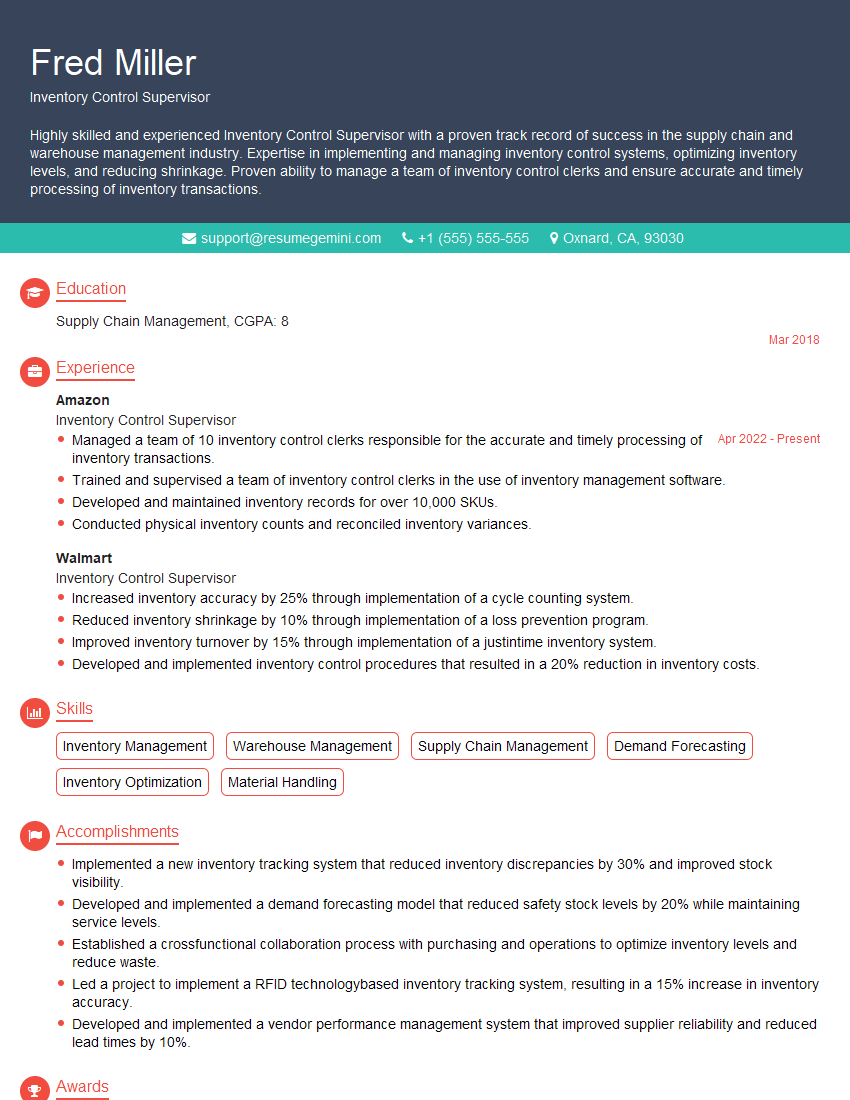
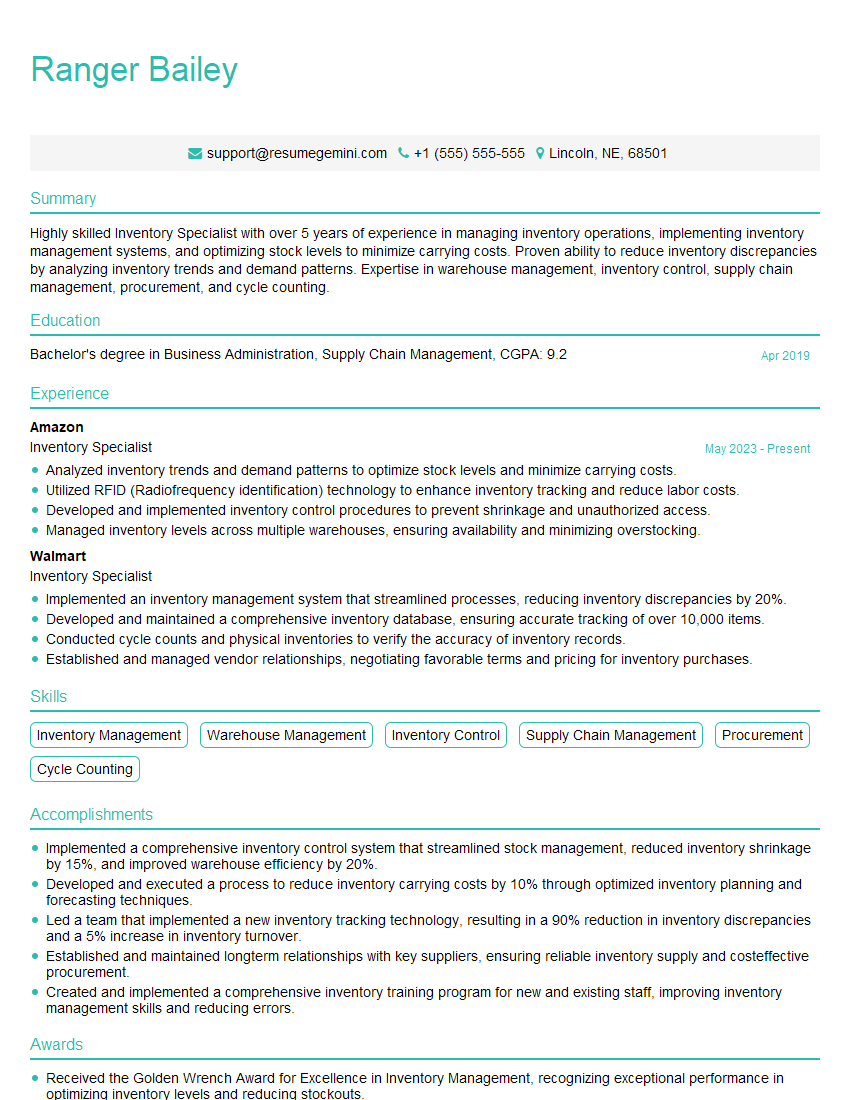
Mastering Furniture Inventory Management opens doors to rewarding career opportunities in logistics, operations, and supply chain management. To maximize your chances of landing your dream job, crafting a compelling and ATS-friendly resume is crucial. ResumeGemini is a trusted resource to help you build a professional resume that showcases your skills and experience effectively. We provide examples of resumes tailored to Furniture Inventory Management to guide you in creating a winning application. Invest time in building a strong resume – it’s your first impression with potential employers.
Explore more articles
Users Rating of Our Blogs
Share Your Experience
We value your feedback! Please rate our content and share your thoughts (optional).
What Readers Say About Our Blog
Very informative content, great job.
good