Interviews are more than just a Q&A session—they’re a chance to prove your worth. This blog dives into essential Furniture Reassembly interview questions and expert tips to help you align your answers with what hiring managers are looking for. Start preparing to shine!
Questions Asked in Furniture Reassembly Interview
Q 1. What types of tools are essential for furniture reassembly?
The right tools are crucial for efficient and safe furniture reassembly. Think of it like having the right ingredients for a recipe – you can’t make a delicious meal without them! My essential toolkit includes:
- Screwdrivers: A variety of Phillips head and flathead screwdrivers in different sizes. I always have both standard and magnetic-tip screwdrivers for those hard-to-reach spots.
- Wrench Set: Metric and standard wrenches are essential for dealing with various nut and bolt sizes. I prefer a combination wrench set for versatility.
- Hammer: A claw hammer is useful for driving in nails or gently tapping parts into place.
- Pliers: Needle-nose and slip-joint pliers are invaluable for gripping small parts or loosening stubborn screws.
- Measuring Tape and Pencil: Accuracy is paramount; these help ensure correct placement of components.
- Level: Essential for ensuring shelves and other components are perfectly aligned to prevent instability.
- Safety Glasses: Protecting your eyes is non-negotiable, as splinters and small pieces can fly during assembly.
Occasionally, I might need specialized tools depending on the furniture piece, like an Allen wrench set or a ratchet.
Q 2. Describe your experience with different types of furniture assembly hardware.
Over the years, I’ve worked with a wide range of furniture assembly hardware. Understanding the different types is key to successful reassembly. Here are some common examples:
- Cam Locks and Dowels: These are common in flat-pack furniture. Cam locks use a cam and bolt to join two pieces, while dowels are cylindrical wooden or plastic pins used for alignment.
- Nuts and Bolts: These are used for more robust connections, often found in higher-end furniture pieces. I often encounter different thread types (metric and imperial) and head styles (hex, button, etc.).
- Screws: Wood screws, self-tapping screws, and confirmat screws all have their place. Understanding their strengths and applications is essential. Confirmat screws, for example, offer excellent strength in joining thicker wood panels.
- Metal Connectors: These are often used in metal furniture, or as reinforcements in wooden pieces. Types vary considerably, so familiarizing myself with the unique connection method is critical.
One memorable challenge involved a piece with stripped cam locks. I had to carefully drill them out and use alternative fasteners to secure the joint – a testament to the importance of understanding different hardware types and possessing problem-solving skills.
Q 3. How do you handle missing or damaged parts during furniture assembly?
Missing or damaged parts are frustrating but a common occurrence. My approach is methodical and focused on finding solutions:
- Thorough Inspection: I carefully examine all components and the instructions to identify exactly what’s missing or damaged.
- Contacting the Manufacturer or Retailer: This is often the best option for replacements. I document everything clearly – the model number, the missing/damaged part, and images if possible.
- Creative Solutions (when replacement is not immediately available): If a replacement part isn’t readily available, I might explore temporary fixes like using a similar-sized screw or dowel, or employing wood filler for minor damage. However, I always clearly communicate any such temporary solutions to the client.
- Alternative Design Adaptations: In some rare cases, with the client’s approval, I might propose slight adjustments to the design to accommodate missing parts, emphasizing that the modified result might not be exactly as originally intended.
Transparency with the client is always paramount; I explain the options clearly and make sure they are comfortable with the chosen solution before proceeding.
Q 4. Explain your process for identifying and resolving assembly issues.
Identifying and resolving assembly issues is a crucial skill. My process is as follows:
- Careful Review of Instructions: I always start by carefully reading the assembly instructions and studying the diagrams. Many problems can be avoided simply by understanding the intended assembly sequence.
- Systematic Assembly: I follow a step-by-step approach, ensuring each component is correctly placed and secured before moving on to the next.
- Regular Checks for Alignment: I use a level and measuring tape throughout the assembly to ensure everything is square and aligned correctly.
- Problem Identification and Troubleshooting: If issues arise, I analyze the problem systematically. Is a part damaged? Is it incorrectly placed? Are there sufficient screws or other fasteners? I refer back to the instructions and use logic to determine the solution.
- Seeking External Resources: If all else fails, I might consult online forums, manufacturer websites, or even fellow professionals to find solutions to more complex issues.
Often, a seemingly insurmountable problem turns out to be a simple oversight or a minor misinterpretation of the instructions. Patience and systematic troubleshooting are key.
Q 5. How do you ensure the safety and stability of assembled furniture?
Safety and stability are top priorities. I employ several strategies to ensure the furniture is assembled correctly and safely:
- Proper Fastener Usage: I always use the correct type and number of screws, bolts, and other fasteners, ensuring they are tightened to the recommended torque. Over-tightening can damage the wood, while under-tightening compromises stability.
- Accurate Alignment: Using a level and measuring tape to ensure all components are properly aligned prevents warping, instability, and potential tipping hazards.
- Weight Distribution: I consider the weight of the furniture and how it will be used, ensuring a stable base and proper support for all components.
- Wall Anchors (when necessary): For taller or heavier pieces, I often recommend using wall anchors to secure the furniture to the wall, preventing tipping accidents.
- Post-Assembly Inspection: I always perform a final inspection after assembly to check for any loose parts, wobbly components, or other potential safety issues.
By following these steps, I ensure the assembled furniture is not only aesthetically pleasing but also structurally sound and safe for use.
Q 6. What is your experience with different types of wood and materials?
My experience encompasses a variety of woods and materials, each with its unique characteristics and assembly requirements:
- Solid Wood: This includes hardwoods like oak, maple, and cherry, and softer woods like pine. Solid wood requires different approaches depending on the wood’s hardness and grain pattern. Pre-drilling pilot holes is crucial to avoid splitting the wood.
- Plywood and MDF: These engineered wood products are widely used in furniture construction. They’re generally easier to work with than solid wood, but can be more prone to damage if fasteners aren’t carefully placed.
- Particleboard and Laminate: These are commonly found in flat-pack furniture. They’re less durable than solid wood or plywood but are cost-effective. Care must be taken to avoid stripping screw holes.
- Metal: I have experience assembling metal furniture, requiring a different set of tools and techniques. Metal components often involve bolts, nuts, and sometimes welding (though I don’t perform welding myself).
- Glass and Fabric: While not directly involved in structural assembly, I’m experienced in working with glass and fabric components to finish off the assembled piece, ensuring proper placement and security.
Understanding the properties of each material is essential for choosing the appropriate fasteners and assembly techniques. For instance, using the wrong type of screw on particleboard can easily result in stripped holes.
Q 7. Describe your experience working with instructions and assembly diagrams.
Instructions and assembly diagrams are the roadmaps for successful furniture reassembly. My experience spans various styles and clarity levels:
- Interpreting Diagrams: I’m proficient in interpreting both 2D and 3D diagrams, identifying components, and understanding assembly sequences.
- Navigating Ambiguous Instructions: Sometimes instructions are unclear or incomplete. In such cases, I rely on my experience and problem-solving skills to work through the ambiguities. I might utilize online resources to look for similar products or contact the manufacturer if necessary.
- Managing Multiple Instruction Sets: Occasionally, furniture might involve instructions from different sources (e.g., multiple sections for different modules). I’m adept at organizing and managing these instructions to avoid confusion.
- Adapting to Different Styles: I’ve worked with instructions ranging from simple step-by-step guides to complex, detailed manuals with numerous diagrams and technical specifications. I readily adapt to different styles to efficiently complete the assembly.
My experience has taught me that even the clearest instructions might occasionally need interpretation, and a flexible mindset combined with problem-solving is essential for success.
Q 8. How do you manage your time effectively during large-scale assembly projects?
Effective time management on large-scale assembly projects hinges on meticulous planning and execution. Think of it like orchestrating a symphony – each instrument (task) needs to play its part at the right time.
- Detailed Project Breakdown: Before I begin, I create a comprehensive checklist detailing every step, from unpacking and identifying parts to the final assembly and quality check. This allows me to visualize the entire process and allocate time accordingly.
- Prioritization Matrix: I prioritize tasks based on their dependencies. For instance, assembling the frame usually precedes attaching drawers. A simple visual matrix can help me track this.
- Time Blocking: I allocate specific time blocks for each stage, factoring in potential delays. This prevents tasks from overlapping and ensures a steady workflow. For example, I might allocate 2 hours for assembling the main structure and 1 hour for installing the hardware.
- Regular Check-ins: Throughout the project, I conduct regular check-ins to monitor progress and make necessary adjustments. This helps identify and mitigate any unforeseen issues quickly.
For example, in a recent project involving assembling 20 identical office desks, I divided the assembly into four stages: unpacking (30 mins), frame assembly (1.5 hrs), drawer installation (45 mins) and final checks (30 mins). This helped me complete all 20 desks within the estimated timeframe.
Q 9. How do you prioritize tasks when assembling multiple pieces of furniture simultaneously?
Prioritizing tasks when assembling multiple furniture pieces simultaneously requires a strategic approach. Imagine juggling multiple balls – you need to keep them all in the air without dropping any.
- Dependency Chart: I create a dependency chart, visually mapping out the tasks and their interrelationships. This helps identify tasks that can be done concurrently and those that need to be completed in sequence.
- Urgency and Importance: I use an urgency-importance matrix. Urgent and important tasks (e.g., a client’s urgent order) take precedence. Less urgent tasks might be postponed.
- Batching Similar Tasks: I group similar tasks together to streamline the process. For example, I’ll assemble all the chair frames before moving on to attaching the seats.
- Resource Allocation: I consider the resources needed for each task (tools, materials). This ensures efficient use of my time and prevents bottlenecks.
For instance, if I’m assembling three different types of furniture – a bookcase, a table, and a chair – I’d first complete all the steps requiring the same tool (e.g., using a screwdriver to assemble all the parts requiring screws) before switching to another tool.
Q 10. What is your experience with using power tools for furniture assembly?
My experience with power tools in furniture assembly is extensive and focuses on safety and precision. I am proficient in using various tools, including drills, sanders, and circular saws – always adhering to safety guidelines.
- Drill Presses: Essential for creating precise pilot holes for screws, preventing wood from splitting.
- Sanders: Used for smoothing surfaces after assembly or for refinishing existing pieces. Different grit levels are crucial for varying degrees of smoothness.
- Circular Saws: Used for precise cutting when assembling or modifying furniture, only when necessary and with extreme caution.
I always prioritize safety. This includes wearing appropriate safety gear (eye protection, hearing protection, dust masks) and ensuring the tools are in good working order before use. I regularly inspect and maintain my tools to ensure optimum performance and safety. For example, before using a circular saw, I always check the blade’s sharpness and make sure the safety guard is properly in place.
Q 11. Describe your process for inspecting finished furniture for quality and defects.
Inspecting finished furniture involves a systematic approach to ensure quality and identify any defects. Think of it as a final performance review before the furniture takes center stage.
- Visual Inspection: A thorough visual check for scratches, dents, misaligned parts, or any imperfections in the finish.
- Functionality Test: I test all moving parts (drawers, doors, hinges) to ensure they function smoothly and without any issues.
- Stability Check: I check the overall stability of the furniture piece to ensure it’s sturdy and won’t wobble or easily tip over.
- Hardware Check: Verify all hardware (screws, bolts, knobs) are securely fastened and in place.
For instance, after assembling a wardrobe, I’d meticulously check the alignment of the doors, ensure the drawers glide smoothly, and confirm the overall stability by gently rocking the wardrobe. Any defects are immediately documented and addressed.
Q 12. How do you handle customer complaints or concerns regarding furniture assembly?
Handling customer complaints or concerns requires patience, empathy, and a problem-solving approach. Think of it as damage control – minimizing negative impact and restoring customer trust.
- Active Listening: I begin by actively listening to the customer’s concerns, ensuring I understand their perspective completely.
- Problem Identification: I carefully assess the issue, identifying its root cause. Is it a faulty part? An assembly error? Or something else?
- Solution Proposal: Based on my assessment, I propose a suitable solution – which might involve repair, replacement, or a partial refund.
- Follow-up: After resolving the issue, I follow up with the customer to ensure they’re satisfied and that the problem has been fully addressed.
For example, if a customer complains about a wobbly table leg, I would first inspect the leg and the assembly, identify the cause (perhaps a loose screw or a damaged part), and then either tighten the screw or replace the damaged part. I always keep the customer informed throughout the process.
Q 13. Describe your experience working independently versus as part of a team.
I’m comfortable working both independently and as part of a team. Each approach has its strengths.
- Independent Work: When working independently, I rely on my organizational skills and self-discipline. I can concentrate deeply and maintain a focused approach, which is beneficial for intricate projects requiring precision.
- Teamwork: Teamwork allows for specialization and efficiency. Different team members can handle specific tasks, accelerating the overall project completion. It also provides an opportunity for knowledge sharing and collaborative problem-solving.
In a recent project involving a large-scale office refurbishment, I worked as part of a team, where each of us was responsible for a different area. This allowed for a faster turnaround time. However, for detailed and delicate furniture restoration, I prefer to work independently to ensure the highest level of quality and attention to detail.
Q 14. What is your experience with different types of furniture styles (e.g., modern, traditional)?
My experience encompasses a wide range of furniture styles, from traditional to modern and contemporary designs. Each style presents unique challenges and demands a different approach to assembly.
- Traditional: Traditional furniture often involves intricate joinery techniques, requiring a deep understanding of woodworking principles and tools.
- Modern: Modern furniture tends to be more minimalist, with clean lines and often using simpler assembly techniques, often relying on metal hardware and cam locks.
- Contemporary: Contemporary designs are frequently innovative, integrating various materials and requiring adaptability in assembly methods.
For example, assembling a traditional Victorian-style dresser would require different skills and tools than assembling a modern IKEA flat-pack bookcase. Understanding the nuances of each style ensures I can accurately and efficiently handle any assembly task.
Q 15. How do you maintain a clean and organized workspace during assembly?
Maintaining a clean and organized workspace is paramount for efficient and safe furniture reassembly. Think of it like a surgeon preparing for an operation – a cluttered space increases the risk of errors and accidents.
- Designated Zones: I always establish specific areas for tools, hardware, parts, and completed components. This prevents mix-ups and keeps everything within easy reach.
- Regular Cleanup: I clean up as I go, discarding packaging materials immediately and storing used tools in their designated spots. This prevents clutter from building up and allows me to maintain focus.
- Part Organization: Before even starting, I lay out all the parts and hardware according to the assembly instructions. I often use small containers or trays to keep screws, bolts, and other small pieces separated to prevent loss or confusion. This is especially critical with kits containing hundreds of pieces!
- Protective Covering: To protect the work surface and the furniture itself, I use drop cloths or cardboard. This minimizes scratches and keeps the area clean during the assembly process.
For example, during a recent assembly of a complex bookcase, I used a large cardboard sheet to protect the floor and separate smaller trays for different sized screws. This ensured a smooth and efficient assembly process.
Career Expert Tips:
- Ace those interviews! Prepare effectively by reviewing the Top 50 Most Common Interview Questions on ResumeGemini.
- Navigate your job search with confidence! Explore a wide range of Career Tips on ResumeGemini. Learn about common challenges and recommendations to overcome them.
- Craft the perfect resume! Master the Art of Resume Writing with ResumeGemini’s guide. Showcase your unique qualifications and achievements effectively.
- Don’t miss out on holiday savings! Build your dream resume with ResumeGemini’s ATS optimized templates.
Q 16. What safety precautions do you take during furniture assembly?
Safety is my top priority. Ignoring safety protocols can lead to injuries, property damage, and delays. I always prioritize safety by following these precautions:
- Proper Lifting Techniques: I always bend my knees and lift with my legs, never my back, especially when handling heavy components. This prevents strain and back injuries.
- Protective Gear: Safety glasses are essential to protect my eyes from flying debris, and gloves prevent splinters and scratches. For particularly delicate work, I might use a dust mask.
- Tool Safety: I ensure all tools are in good working condition and use them according to their instructions. Power tools are used with caution and always with appropriate safety equipment. For example, I always unplug power tools before adjusting settings or cleaning them.
- Stable Workspace: I always work on a level, stable surface to prevent accidental drops or tipping of furniture during assembly. I also ensure adequate lighting to prevent eye strain.
- Awareness of Surroundings: I maintain awareness of my surroundings to prevent collisions or tripping hazards. I make sure to have adequate space around me.
A memorable instance involved assembling a large, heavy dining table. By carefully using a hand truck to move the table top and following proper lifting techniques, I prevented any injuries and completed the job efficiently.
Q 17. How do you handle unexpected challenges or problems during assembly?
Unexpected challenges are part and parcel of furniture reassembly. My approach is methodical and problem-solving oriented.
- Careful Examination: I carefully examine the instructions and components for any inconsistencies or missing parts. If there’s a discrepancy, I review the instructions multiple times before attempting to proceed.
- Resourcefulness: If a part is damaged or missing, I attempt to find a creative solution, such as utilizing available materials or contacting the manufacturer for a replacement. For example, I’ve successfully used wood filler to repair small damages before painting.
- Troubleshooting: I might refer to online forums or manuals for solutions to common assembly problems. I can quickly identify the problem, whether its a wrongly placed component or a missing screw.
- Documentation: I meticulously document any unexpected issues, including solutions and workarounds. This helps in streamlining future assembly projects.
Once, I encountered a mislabeled part during a wardrobe assembly. By carefully reviewing the instructions and comparing the parts with the diagram, I identified the error and corrected the issue smoothly. This experience taught me to always double-check and anticipate potential issues.
Q 18. Describe your experience with specialized furniture assembly techniques.
My experience encompasses a wide range of specialized techniques. I am proficient in assembling various furniture types, from simple flat-pack furniture to intricate antique pieces requiring detailed knowledge of joinery and restoration techniques.
- Cam Locks and Dowels: I’m experienced with common fastening mechanisms such as cam locks, dowels, and various types of screws and bolts. Understanding the nuances of each method ensures efficient assembly and a sturdy final product.
- Specialized Tools: I use a range of tools, including impact drivers, electric screwdrivers, and specialized woodworking tools, based on the needs of the assembly project.
- Antique Furniture Restoration: While not strictly assembly, my skillset includes working with antique furniture, requiring knowledge of traditional joinery techniques, wood repair, and finishing.
- Custom Furniture Assembly: I’ve tackled custom-built furniture projects, demanding a higher level of precision and attention to detail, often involving working from blueprints or sketches.
For instance, I recently assembled a custom-made entertainment center that required precise alignment and adjustment of shelves using specialized joinery methods. The result was a sturdy and aesthetically pleasing piece of furniture.
Q 19. How do you ensure the proper alignment and functionality of assembled furniture components?
Ensuring proper alignment and functionality requires a systematic approach and attention to detail. It’s like building with LEGOs – each piece needs to fit perfectly to create a stable structure.
- Step-by-Step Assembly: I meticulously follow the assembly instructions, taking my time with each step to ensure all components are correctly aligned and secured.
- Visual Inspection: After each step, I visually inspect the alignment of components, making sure there are no gaps or misalignments. I check for squareness and evenness using a measuring tape and level.
- Testing Functionality: I test the functionality of the furniture, such as drawers, doors, or hinges, to confirm smooth operation and stability.
- Tightening Connections: I ensure all connections are properly tightened, but avoid over-tightening, which can cause damage. I use the appropriate torque for different types of screws and fasteners.
For example, during the assembly of a chair, I carefully aligned the legs to ensure perfect balance and stability. I then tested the chair’s strength and stability to confirm it met the intended functionality.
Q 20. What is your experience with working from blueprints or technical drawings?
I’m adept at working from blueprints and technical drawings. These documents are crucial for assembling complex or custom furniture. This requires a high level of spatial reasoning and attention to detail.
- Blueprint Interpretation: I can interpret different types of blueprints, including orthographic projections, isometric drawings, and exploded views. Understanding these representations is key to accurately assembling the furniture.
- Measurement Accuracy: I utilize measuring tools like rulers, tape measures, and squares to ensure precise measurements when assembling from blueprints. Accuracy in measurements minimizes errors and ensures the final product meets specifications.
- Material Identification: I can accurately identify different materials specified on the blueprint and choose appropriate tools and techniques for their assembly.
- Adaptability: I can adapt to different blueprint styles and notations. Some blueprints might be highly detailed, while others might rely more on sketches and annotations; adaptability is crucial.
For example, I successfully assembled a custom-designed bookshelf from detailed blueprints which required careful measurements and precise alignment of complex joinery.
Q 21. How do you troubleshoot common furniture assembly problems?
Troubleshooting is a crucial part of furniture reassembly. I approach this systematically to identify the root cause of the problem.
- Identify the Problem: I carefully examine the assembled furniture to pinpoint the exact issue, such as a wobbly leg, a jammed drawer, or a misaligned door.
- Review Instructions: I refer back to the assembly instructions to check for errors in my assembly process.
- Check Fasteners: I inspect all screws, bolts, and other fasteners to ensure they are properly tightened and secured. Loose fasteners are a frequent source of problems.
- Component Alignment: I re-examine the alignment of all components, making sure that they are correctly positioned and securely fastened. Misaligned components can cause a variety of problems.
- Seek External Resources: If the problem persists, I consult online resources, manuals, or forums to find solutions. These resources often provide valuable insights into common assembly issues.
A recent example involved a wobbly table leg. By carefully checking the assembly instructions, I found I had incorrectly inserted one of the dowels. Once corrected, the table was stable.
Q 22. What is your experience with different types of furniture finishes?
My experience encompasses a wide range of furniture finishes, from the simplest lacquer to complex hand-rubbed stains. Understanding finishes is crucial because they dictate the appropriate tools and techniques for assembly and repair. For instance, a delicate veneer requires gentler handling than a robust melamine finish. I’m familiar with various types including:
- Lacquer: A fast-drying, durable finish, often used on mass-produced furniture. Requires careful application to avoid runs or imperfections.
- Stain: Penetrates the wood to enhance its natural color. Different stains produce varied tones and finishes, impacting how the assembled piece looks.
- Polyurethane: A protective topcoat that offers excellent durability and scratch resistance. Comes in various sheens, from matte to high-gloss.
- Melamine: A durable plastic laminate commonly found on particleboard. Requires careful handling during assembly to avoid chipping or scratching.
- Veneer: A thin layer of wood glued to a less expensive substrate. Requires extra care during assembly and cleaning to prevent damage.
My experience allows me to assess the finish, understand its vulnerabilities, and adapt my assembly techniques accordingly, preventing damage and ensuring a professional outcome.
Q 23. How familiar are you with different types of furniture joints (e.g., dowel, mortise and tenon)?
I’m very familiar with a variety of furniture joints. Understanding joint types is fundamental to successful furniture assembly and repair. A misidentified or improperly handled joint can lead to instability or failure. Some common types I regularly work with include:
- Dowel Joints: Simple, relatively strong joints formed using dowel pins. I understand the importance of accurate alignment for a robust connection.
- Mortise and Tenon Joints: A classic joinery technique where a tenon (a projection) fits into a mortise (a hole). This joint is very strong and aesthetically pleasing, requiring precise measurements and fitting.
- Biscuit Joints: Use thin, oval-shaped biscuits to join pieces of wood together. These are often used for cabinet construction and require a biscuit joiner for accurate placement.
- Pocket Hole Joints: Use angled screw holes drilled into the edge of the wood. This is a strong, relatively fast method, ideally suited for less visible joints.
- Cam Locks: A simple and strong mechanical fastening method, often used in flat-pack furniture. Requires careful alignment.
My experience allows me to identify the type of joint, determine its integrity, and efficiently utilize appropriate techniques for assembly or repair. For example, I know to use wood glue and clamps for dowel joints to enhance strength and stability.
Q 24. Describe your process for dealing with damaged packaging during furniture delivery and assembly.
Damaged packaging is a common challenge. My process involves a methodical approach to minimize damage and ensure a successful assembly:
- Inspection: Upon delivery, I thoroughly inspect the packaging for any signs of damage, noting any dents, tears, or missing components. I photograph the damage and document it. This documentation serves as evidence in case of any claims.
- Inventory Check: I carefully compare the contents against the packing list, ensuring all parts are present and accounted for. Missing parts are immediately reported.
- Careful Unpacking: I use appropriate tools, like box cutters and screwdrivers, to open the packaging carefully, avoiding any damage to the furniture components.
- Damage Assessment: I examine the furniture pieces for any signs of damage caused during transit. If I find damage, I again take photos and contact the relevant party (customer or supplier) immediately.
- Damage Mitigation: If the damage is minor and repairable, I may attempt to repair it myself (with the customer’s consent), utilizing appropriate techniques and materials. Otherwise, I document the damage clearly and contact the relevant party to arrange replacement parts or a return.
Through this process, I minimize potential problems and ensure a smooth assembly process despite damaged packaging. A clear, documented process protects both me and my client.
Q 25. How do you maintain and care for your tools?
Maintaining my tools is paramount to my work. Dull or damaged tools can lead to inaccurate assembly, damage to the furniture, and even injury. My maintenance routine includes:
- Cleaning: After each use, I thoroughly clean my tools, removing sawdust, glue, and debris. This prevents corrosion and ensures they function correctly.
- Sharpening: I regularly sharpen my blades, such as those on my screwdrivers and utility knives, using appropriate sharpening tools or taking them to a professional sharpening service.
- Lubrication: I lubricate moving parts, like those on my drill or impact driver, according to the manufacturer’s instructions.
- Storage: I store my tools in a designated area, keeping them organized and protected from damage or moisture. This prolongs their lifespan and makes them easy to locate.
- Regular Inspection: I regularly inspect my tools for wear and tear, replacing or repairing damaged components as needed.
This meticulous maintenance ensures that my tools are always in optimal condition, enabling me to work efficiently and safely, delivering high-quality results.
Q 26. How do you manage your workload and meet deadlines for furniture assembly projects?
Managing my workload and meeting deadlines involves a combination of planning, organization, and efficient time management. I utilize the following strategies:
- Detailed Scheduling: I create a detailed schedule for each project, breaking down the assembly process into manageable tasks and allocating specific timeframes for each. This allows for efficient time management.
- Prioritization: I prioritize tasks based on their urgency and importance, ensuring that critical tasks are completed on time. I use tools like project management software to stay organized.
- Realistic Estimates: I provide clients with realistic estimates based on the complexity of the project and my past experience. This helps prevent delays and manages expectations.
- Communication: I maintain clear and open communication with my clients, keeping them updated on the project’s progress and addressing any concerns promptly. This fosters trust and avoids misunderstandings.
- Contingency Planning: I build in some buffer time for unexpected delays or issues that may arise during the assembly process. This allows for flexibility and minimizes the risk of missing deadlines.
By combining these strategies, I consistently deliver high-quality work while adhering to project deadlines.
Q 27. What are your strengths and weaknesses related to furniture assembly?
My strengths lie in my meticulous attention to detail, my problem-solving abilities, and my efficiency in furniture assembly. I take pride in delivering high-quality work and am able to quickly assess and resolve issues that may arise during the assembly process. For instance, I recently encountered a problem with misaligned drawer slides on a complex chest of drawers. By carefully analyzing the issue, identifying the root cause, and using my precision tools, I managed to realign the slides and fix the problem, ensuring the drawers functioned smoothly.
My main area for improvement is delegating tasks on larger projects, often preferring to handle every aspect personally to ensure the highest quality standards. I’m actively working on improving my delegation skills to enhance my efficiency and workflow on larger, more complex projects. I am confident in my ability to balance my meticulous nature with efficient delegation techniques.
Q 28. How would you describe your problem-solving approach in a furniture assembly scenario?
My problem-solving approach in furniture assembly is systematic and methodical. I follow these steps:
- Identify the Problem: Carefully examine the situation to pinpoint the exact problem. This might involve checking instructions, comparing pieces to diagrams, or identifying damaged or missing parts.
- Gather Information: Collect all relevant information, such as assembly instructions, the available parts, and any tools needed.
- Analyze the Problem: Determine the cause of the problem. This step requires critical thinking, considering various possibilities.
- Develop Solutions: Brainstorm possible solutions based on the information gathered and the nature of the problem. This might involve consulting manuals, diagrams, or online resources.
- Test and Implement: Carefully implement the chosen solution. Testing is critical to ensure it fixes the problem without creating new ones.
- Evaluate the Outcome: Once the solution is implemented, check if it is successful and if there are any further adjustments needed. Documentation of the problem and its solution is vital.
This structured process ensures that I efficiently address any assembly challenges, preventing errors and ensuring a flawless end result. I approach each problem with creativity and a systematic approach, drawing upon my broad experience to identify the most efficient and effective solutions.
Key Topics to Learn for Furniture Reassembly Interview
- Understanding Furniture Construction: Familiarize yourself with common materials (wood, particleboard, metal), joinery techniques (dowels, screws, cam locks), and different furniture types (armoires, desks, chairs).
- Tools and Equipment: Demonstrate knowledge of essential tools like screwdrivers (various types), wrenches, hammers, levelers, and potentially power tools (if applicable to the role). Be prepared to discuss safety procedures related to their use.
- Reading Assembly Instructions: Explain your approach to interpreting diagrams, following step-by-step instructions, and identifying potential discrepancies or missing parts. Highlight your ability to troubleshoot and problem-solve.
- Troubleshooting and Repair: Discuss your experience in identifying common assembly issues (e.g., stripped screws, misaligned parts), and explain your strategies for resolving them efficiently and effectively. Mention any experience with minor repairs.
- Time Management and Efficiency: Explain how you prioritize tasks, manage your workflow, and ensure timely completion of furniture assembly projects. Showcase your ability to work both independently and as part of a team (if applicable).
- Customer Service (if applicable): If the role involves interacting with customers, emphasize your communication skills, ability to handle difficult situations, and commitment to providing excellent service.
Next Steps
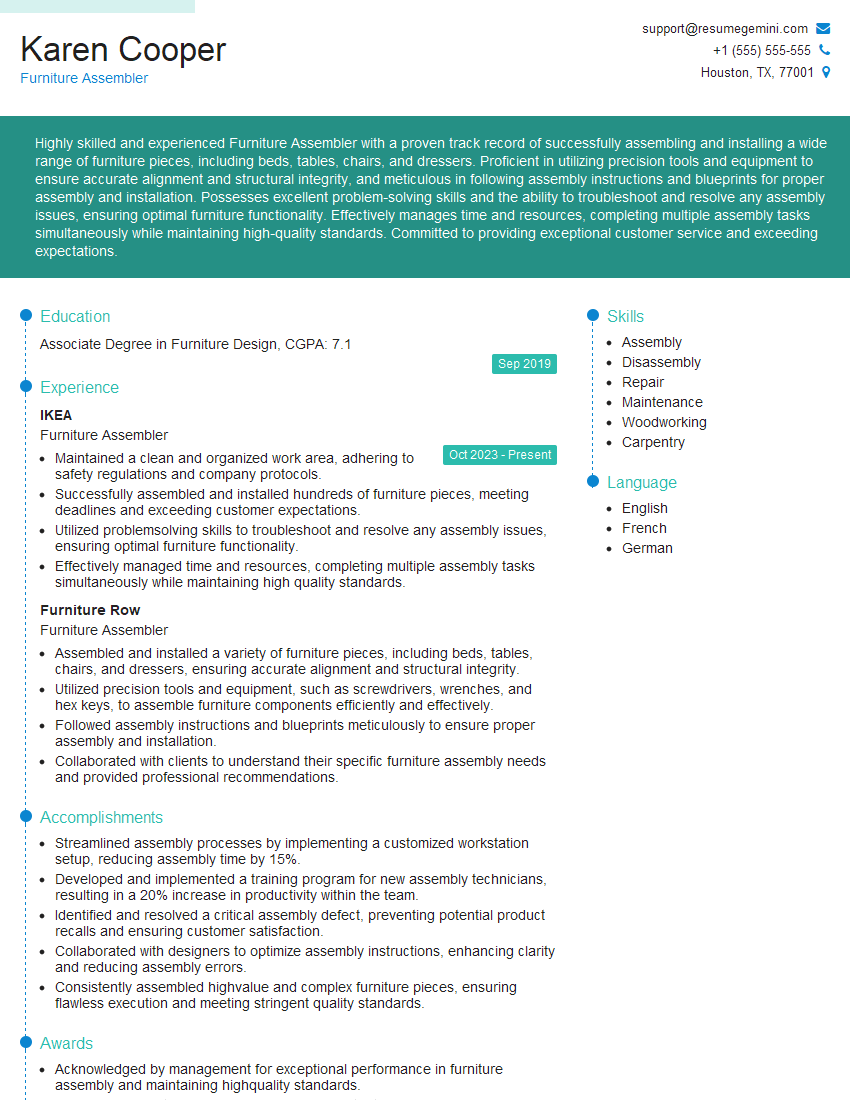
Mastering furniture reassembly opens doors to diverse opportunities in home improvement, retail, logistics, and more. A strong foundation in this skill is highly valuable in today’s market. To maximize your job prospects, create an ATS-friendly resume that highlights your abilities and experience. We strongly recommend using ResumeGemini to build a professional and impactful resume that showcases your skills effectively. ResumeGemini provides examples of resumes tailored to Furniture Reassembly to guide you in creating a winning application. Invest the time – it’s an investment in your career.
Explore more articles
Users Rating of Our Blogs
Share Your Experience
We value your feedback! Please rate our content and share your thoughts (optional).
What Readers Say About Our Blog
Very informative content, great job.
good