Interviews are more than just a Q&A session—they’re a chance to prove your worth. This blog dives into essential Gemstone Knowledge interview questions and expert tips to help you align your answers with what hiring managers are looking for. Start preparing to shine!
Questions Asked in Gemstone Knowledge Interview
Q 1. Explain the Mohs Hardness Scale and its significance in gemology.
The Mohs Hardness Scale is a relative measure of mineral scratch resistance. It ranks minerals from 1 to 10, with 1 being the softest (talc) and 10 being the hardest (diamond). A mineral with a higher Mohs hardness can scratch a mineral with a lower hardness. It’s crucial in gemology because it helps identify gemstones, assess their durability, and guide appropriate cleaning and care. For example, a gemstone with a Mohs hardness of 7 (like quartz) is relatively durable for everyday wear, while a softer gemstone like opal (Mohs hardness of 5.5-6.5) requires more careful handling to avoid scratches.
In practice, a gemologist might use a hardness test to distinguish between similar-looking gemstones. If a stone is scratched by a steel knife (hardness ~5.5), we know it’s softer than that. This simple test can significantly narrow down the possibilities.
Q 2. Describe the four Cs of diamond grading.
The ‘Four Cs’ – Cut, Clarity, Carat, and Color – are the internationally recognized standards for evaluating the quality of a diamond. They provide a standardized framework for comparing and grading diamonds.
Cut: This refers to how well a diamond’s facets interact with light, affecting its brilliance, fire, and scintillation. An excellent cut maximizes light return, making the diamond sparkle more.
Clarity: This assesses the presence of inclusions (internal flaws) and blemishes (external flaws) within the diamond. Flawless diamonds are rare and highly valuable. The fewer the inclusions and blemishes, the higher the clarity grade.
Carat: This is a measure of the diamond’s weight, with one carat equaling 200 milligrams. Larger diamonds, especially those with exceptional clarity and color, command higher prices.
Color: This evaluates how colorless a diamond is. The closer a diamond is to being completely colorless, the higher its color grade and value. Colorless diamonds are graded on an alphabetical scale, with D being the highest (colorless) and Z being the lowest (slightly colored).
Understanding the four Cs allows buyers to make informed decisions, comparing diamonds objectively based on their quality characteristics. A diamond with excellent cut and high clarity might command a premium price even if it’s slightly smaller than another.
Q 3. Differentiate between natural and synthetic gemstones.
Natural gemstones are formed through geological processes over millions of years within the Earth’s crust. Synthetic gemstones, on the other hand, are created in laboratories under controlled conditions, mimicking the chemical composition and crystal structure of their natural counterparts. The key difference lies in their origin: one is naturally occurring, while the other is man-made.
While synthetics often possess similar optical properties to their natural counterparts, there can be subtle differences in inclusions, growth patterns, and trace element compositions that allow experts to distinguish them. For example, natural emeralds often contain inclusions of other minerals, while synthetic emeralds might exhibit more uniform, characteristic growth patterns.
It’s important to note that the ethical and legal implications differ significantly. While synthetics are perfectly acceptable and often more affordable, consumers have a right to know what they’re purchasing, and truthful labeling is crucial.
Q 4. How do you identify a gemstone using a refractometer?
A refractometer measures the refractive index (RI) of a gemstone, a fundamental optical property. The RI describes how much light slows down when passing through the gemstone. Each gemstone has a characteristic RI range. To use a refractometer, a drop of refractive index liquid is placed on the prism, the gemstone is gently pressed onto the liquid, and light is passed through it. The reading, expressed as a decimal number, provides the gemstone’s RI. By comparing this value to known RI ranges for different gemstones, we can narrow down possibilities.
For example, if the RI is around 1.54, this could indicate quartz. However, one RI measurement is rarely conclusive, and further tests are necessary. For materials with strong birefringence, a range of values might be observed.
Q 5. What are common gemstone treatments and their detection methods?
Many gemstones undergo treatments to enhance their color, clarity, or durability. Common treatments include heating, irradiation, dyeing, and filling.
Heating: This process can alter a gemstone’s color. For example, amethyst can be heated to change its color to citrine.
Irradiation: Exposure to radiation can change a gemstone’s color. This is often used to enhance the color of topaz or quartz.
Dyeing: This treatment adds color to porous gemstones such as turquoise or howlite.
Filling: Fractures in gemstones like emeralds may be filled with resins or oils to improve their appearance.
Detection methods vary depending on the treatment. Specialized instruments like spectroscopes, microscopes, and UV lamps are used to identify treatments. Experienced gemologists can detect many treatments by observing characteristic patterns and inclusions under magnification.
Disclosure of treatments is essential for ethical gem dealing, protecting both consumers and traders from misunderstandings about the true nature of the gemstone.
Q 6. Explain the concept of birefringence and its application in gemstone identification.
Birefringence is the optical property of a gemstone where light is split into two rays when passing through it. This happens because the gemstone’s crystal structure has different refractive indices in different directions. The difference between these two indices is the birefringence value. Gemstones exhibiting birefringence are called doubly refractive.
A polariscope is the primary instrument for detecting birefringence. When a doubly refractive gemstone is placed between two polarizing filters, it shows characteristic patterns as the light is split and recombined. The intensity of the pattern depends on the strength of birefringence. This property is extremely helpful in gem identification, as many gemstones have distinct birefringence values.
For example, calcite has high birefringence, leading to a strong double image when viewed through it. Knowing this helps distinguish calcite from other similar-looking materials.
Q 7. What are the key characteristics used to distinguish ruby from spinel?
Rubies and spinels are both red gemstones, often confused with each other. However, they possess distinct properties that allow for differentiation.
Chemical Composition: Ruby is a variety of corundum (Al2O3) with chromium causing its red color, while spinel is a magnesium aluminum oxide (MgAl2O4).
Hardness: Ruby, being corundum, has a Mohs hardness of 9, making it exceptionally hard. Spinel has a Mohs hardness of 8.
Refractive Index: Ruby’s refractive index is typically higher than spinel’s.
Specific Gravity: Ruby generally has a higher specific gravity than spinel.
Fluorescence: Under UV light, rubies often show distinct fluorescence patterns.
Inclusions: Inclusions differ significantly. Rubies often show rutile needles (silk), while spinel inclusions are often less distinctive.
A gemologist uses a combination of these characteristics, including optical properties (RI, birefringence), hardness testing, and microscopic examination of inclusions, to distinguish a ruby from a spinel.
Q 8. Describe the different types of inclusions found in gemstones and their significance.
Inclusions are essentially internal flaws or imperfections within a gemstone. Think of them as ‘birthmarks’ that tell a story of the gemstone’s formation. They can significantly impact a gemstone’s value and are a key aspect of its identification. Different types of inclusions provide clues about the gemstone’s origin and growth environment.
- Solid Inclusions: These are tiny crystals or mineral fragments trapped within the gemstone during its growth. For example, a ruby might contain tiny crystals of rutile (titanium oxide), creating a star effect in certain orientations (asterism). The presence and nature of these solids can be helpful in identifying the geographic source.
- Liquid Inclusions: These are small pockets of liquid trapped within the gemstone. They often appear as bubbles or negative crystals. The composition of the liquid can offer valuable insights into the formation process.
- Gaseous Inclusions: These are cavities containing gas, often appearing as bubbles. Similar to liquid inclusions, the presence and characteristics of gas inclusions can help identify a stone’s origin.
- Two-Phase and Three-Phase Inclusions: These combine liquid, gas, and sometimes even solid inclusions within a single cavity.
- Negative Crystals: These are cavities formed when a crystal doesn’t fully grow, leaving an empty space shaped like a crystal. These are quite common and often indicate rapid crystal growth.
The significance of inclusions lies in their ability to help gemologists determine a stone’s authenticity, origin, and treatment history. While some inclusions are desirable (like the rutile needles in star sapphires), others can significantly detract from a stone’s value if they impact its clarity or durability.
Q 9. How do you assess the clarity of a gemstone?
Clarity assessment in gemstones refers to the degree to which a gemstone is free from inclusions and blemishes. It’s a crucial factor determining a gem’s value and is assessed using standardized scales. The most common scale is the GIA clarity grading system for diamonds, but other scales exist for colored gemstones. This assessment requires magnification, typically using a 10x loupe.
The process involves carefully examining the gemstone under magnification to identify and evaluate the size, nature, number, and position of inclusions and blemishes. These features are classified into different categories based on their visibility to the naked eye and their impact on the overall appearance of the gemstone. For instance, a stone with many easily visible inclusions will receive a lower clarity grade compared to one with few or tiny inclusions that are difficult to see without magnification.
Imagine looking at a clear lake. A lake with no debris or rocks is analogous to a flawless gemstone, while a lake with visible rocks and sediment represents a gemstone with lower clarity. The clarity grading system provides a standardized way to describe this ‘cleanliness’ of the gemstone.
Q 10. Explain the difference between fluorescence and phosphorescence in gemstones.
Both fluorescence and phosphorescence are phenomena where gemstones emit light after being exposed to an external energy source, but they differ in how long the emission lasts.
- Fluorescence: This is the emission of light during the time a gemstone is exposed to an external energy source, usually ultraviolet (UV) light. The gemstone absorbs the UV light and immediately re-emits it at a longer wavelength, typically visible light. The effect stops immediately when the UV source is removed. Think of it like a light switch: The light is on only while the switch is on.
- Phosphorescence: This is the emission of light *after* the external energy source (again, often UV) has been removed. The gemstone continues to glow for a period of time, depending on the gem material and the intensity of the exposure. This ‘afterglow’ can range from fractions of a second to several minutes. It’s like a glow stick that continues to shine even after you shake it.
Both fluorescence and phosphorescence can be seen in various gemstones, and the color and intensity of the emitted light are characteristics that can aid in identification. While fluorescence is quite common, phosphorescence is less prevalent.
Q 11. What is specific gravity and how is it measured in gemstones?
Specific gravity (SG) is the ratio of the weight of a gemstone to the weight of an equal volume of water. It’s a crucial property used for gemstone identification because each gemstone species has a characteristic specific gravity. Measuring it helps differentiate between similar-looking gemstones.
The most common method is the hydrostatic weighing method. This involves:
- Weighing the gemstone in air (Weight A).
- Suspending the gemstone in water using a fine thread attached to a balance (Weight B).
- Calculating the specific gravity using the formula:
Specific Gravity = Weight A / (Weight A - Weight B)
The principle is based on Archimedes’ principle of buoyancy – an object immersed in a fluid experiences an upward force equal to the weight of the fluid displaced. The difference in weight between the gemstone in air and in water represents the weight of water displaced, allowing us to determine the volume and thus the specific gravity.
For example, a diamond has a specific gravity around 3.52, while quartz is around 2.65. This significant difference allows gemologists to quickly distinguish between the two using this simple test.
Q 12. What are the key factors affecting the value of a gemstone?
The value of a gemstone is determined by a complex interplay of factors, often referred to as the ‘four Cs’ (for diamonds) and expanded upon for other gems. These factors include:
- Cut: The skill of the cutter significantly impacts a gemstone’s brilliance, fire, and overall beauty. A well-cut stone maximizes its light return.
- Clarity: As discussed earlier, the absence of inclusions and blemishes directly impacts value. Flawless stones command premium prices.
- Color: The intensity, saturation, and tone of a gemstone’s color are paramount. For instance, intense, vivid colors are generally more valuable than pale or dull ones.
- Carat Weight: Larger gemstones, particularly above a certain size, are usually more valuable due to their rarity.
- Rarity: The scarcity of a particular gemstone, variety, or color strongly influences its value. Extremely rare stones can fetch astronomical prices.
- Treatment: Treatments like heating, irradiation, or filling can enhance a gemstone’s color or clarity, but disclosure of such treatments is crucial, as untreated gems often command higher values.
- Fashion Trends: Current market trends and popular colors also influence a gem’s desirability and price.
Consider two rubies of similar size and clarity: One with a vibrant pigeon-blood red color and the other with a paler tone. The pigeon-blood ruby will command a significantly higher price due to its superior color.
Q 13. How do you determine the origin of a gemstone?
Determining the origin of a gemstone is a complex process that often requires expertise and sophisticated techniques. It’s not just about the country of origin, but often a specific mine or region. Several methods are used:
- Inclusions: The type, abundance, and characteristics of inclusions can often be indicative of the geological environment in which the stone formed. Specific mineral inclusions act like ‘fingerprints’ of particular localities.
- Chemical Composition: Trace element analysis using techniques such as laser ablation inductively coupled plasma mass spectrometry (LA-ICP-MS) can reveal subtle differences in chemical composition that can pinpoint the origin.
- Spectroscopic Analysis: Techniques like UV-Vis spectroscopy or infrared (IR) spectroscopy can reveal specific absorption bands in the gemstone’s spectrum, which can help identify its origin.
- Geographic Databases: Databases of known gemstone deposits and their characteristic properties are utilized to compare a sample’s characteristics against known localities.
Imagine a detective using clues found at a crime scene to locate the perpetrator. Similarly, gemologists use the ‘clues’ present in a gemstone—its inclusions, chemical composition, and other characteristics—to trace its origin back to its source.
Q 14. Describe the different cutting styles for gemstones.
Gemstone cutting styles aim to maximize the gemstone’s beauty and brilliance by optimizing its interaction with light. The choice of cut depends on the gemstone’s properties (e.g., refractive index, color, and clarity) and the desired effect.
- Brilliant Cut: This is a symmetrical cut with many facets designed to maximize brilliance and fire. It’s most commonly used for diamonds but can be applied to other gems.
- Step Cut: This cut features parallel facets arranged in steps, resulting in a more geometric and less fiery appearance compared to the brilliant cut. It’s often used for gemstones with less brilliance.
- Emerald Cut: A rectangular or square cut with a stepped pavilion and a table, giving a classic and elegant look, particularly suitable for gemstones with good clarity.
- Oval Cut: A modified brilliant cut that’s elongated and oval-shaped.
- Princess Cut: A square or rectangular cut with a brilliant-cut style that maximizes brilliance and fire.
- Cabochon Cut: A polished, smooth, dome-shaped cut without facets. It’s typically used for opaque or translucent gemstones that don’t exhibit significant brilliance when faceted.
- Rose Cut: A historical cut featuring a flat base and multiple triangular facets converging towards a central point on the top.
Each cut style has its unique characteristics and aesthetics, leading to different visual effects. For example, a brilliant-cut diamond maximizes its fire and brilliance, while an emerald cut emphasizes clarity and elegance.
Q 15. Explain the role of a dichroscope in gemstone identification.
A dichroscope is a simple yet invaluable tool for gemstone identification, particularly useful in detecting pleochroism. Pleochroism refers to a gemstone’s ability to exhibit different colors when viewed from different directions. The dichroscope utilizes a calcite crystal to split the light passing through a gemstone, allowing the observer to see the different absorption colors simultaneously.
How it works: You simply place the gemstone against the viewing end of the dichroscope and look through the eyepiece. If the gemstone exhibits pleochroism, you’ll see two distinct colors. The number and intensity of these colors can help distinguish different gemstones. For example, emerald often shows a strong pleochroism with distinct blue-green and green tones, while ruby typically shows only a slight variation.
Practical Application: A dichroscope is a quick and non-destructive method used by gemologists during initial gemstone assessment. It helps narrow down the possibilities when identifying a gemstone and can be crucial in separating similar-looking stones. Imagine trying to differentiate between a green tourmaline and an emerald – the dichroscope can quickly reveal the presence of distinct pleochroism in the emerald, assisting in accurate identification.
Career Expert Tips:
- Ace those interviews! Prepare effectively by reviewing the Top 50 Most Common Interview Questions on ResumeGemini.
- Navigate your job search with confidence! Explore a wide range of Career Tips on ResumeGemini. Learn about common challenges and recommendations to overcome them.
- Craft the perfect resume! Master the Art of Resume Writing with ResumeGemini’s guide. Showcase your unique qualifications and achievements effectively.
- Don’t miss out on holiday savings! Build your dream resume with ResumeGemini’s ATS optimized templates.
Q 16. What are the ethical considerations in the gemstone industry?
Ethical considerations in the gemstone industry are paramount, encompassing environmental sustainability, labor practices, and transparency throughout the supply chain. Unethical practices can severely damage both the industry’s reputation and the environment.
- Environmental Impact: Mining practices often cause habitat destruction and water pollution. Ethical gemstone sourcing prioritizes methods that minimize environmental damage, such as responsible mining practices and recycling of materials.
- Labor Practices: Many gemstones are mined in developing countries where workers often face unsafe conditions, low wages, and child labor. Ethical sourcing demands fair labor practices, ensuring safe working conditions and fair compensation for miners.
- Transparency and Traceability: Transparency is key. Ethical companies strive for full traceability of their gemstones, from mine to market. This allows consumers to verify the origin of their gemstones and ensure ethical sourcing. Certifications and labeling are crucial aspects of this.
- Conflict Gemstones: The industry must actively combat the trade of conflict gemstones, which are mined in war zones and used to finance armed conflicts. Strict regulations and due diligence are crucial here.
Practical Application: Gemstone buyers should prioritize purchasing from reputable dealers who adhere to ethical sourcing principles and provide documentation to support their claims. Supporting certifications like the Kimberley Process Certification Scheme (for diamonds) helps ensure conflict-free gemstones.
Q 17. How do you assess the color saturation of a gemstone?
Color saturation, or intensity, describes the richness and vividness of a gemstone’s color. It’s a crucial factor in determining a gemstone’s overall value. High saturation means a vibrant, intense color, while low saturation means a paler, less intense color.
Assessment Methods: Gemologists assess color saturation using a combination of techniques:
- Visual Comparison: Experienced gemologists compare the gemstone’s color to standardized color charts or master stones, judging its intensity relative to these references.
- Spectrophotometry: This sophisticated method uses instruments to measure the precise wavelengths and intensity of light absorbed and reflected by the gemstone, providing an objective measurement of saturation.
Practical Application: Understanding color saturation is critical for grading gemstones. A ruby with high color saturation (a deep, rich red) will command a higher price than a similarly sized ruby with low saturation (a pale, pinkish red). Consumers should be aware that color saturation is a key factor impacting a gemstone’s price and desirability.
Q 18. What are the common types of gemstone enhancements?
Many gemstones undergo enhancements to improve their clarity, color, or brilliance. While some enhancements are considered acceptable, full disclosure to the buyer is crucial. Common enhancement types include:
- Heating: Heating is a common treatment used to improve color or clarity. Sapphires, for example, are often heated to enhance their blue color. This is generally accepted as long as it’s disclosed.
- Irradiation: Exposure to radiation can alter a gemstone’s color. This is used frequently with topaz and quartz. Again, proper disclosure is essential.
- Filling: Fractures and fissures in gemstones, particularly emeralds, are often filled with oils, resins, or other materials to improve clarity. This significantly impacts durability and needs to be explicitly stated.
- Dyeing: Some porous gemstones can be dyed to enhance their color. This is often done with treated turquoise and certain types of jade.
- Coating: A thin layer of material can be applied to enhance luster or color. This is not very durable.
Practical Application: Gemstone buyers should always ask about any treatments a gemstone may have undergone. Reputable dealers will provide a detailed description of any enhancements. Understanding these treatments helps consumers make informed purchasing decisions and avoid potentially misleading representations.
Q 19. Describe the process of gem grading and certification.
Gem grading and certification involve a rigorous process to assess a gemstone’s quality based on established criteria. Reputable laboratories employ skilled gemologists to evaluate various characteristics, culminating in a report outlining the stone’s properties.
The Process:
- Visual Examination: Gemologists examine the gemstone under magnification to assess its color, clarity, cut, and overall appearance.
- Instrumental Testing: Advanced instruments like spectroscopes and refractometers are used to determine the gemstone’s refractive index, specific gravity, and other optical properties.
- Grading Standards: Grading follows established scales and criteria. For example, diamond grading uses the 4Cs (cut, clarity, color, carat weight), while other gemstones use similar yet different systems based on their individual characteristics.
- Report Generation: The laboratory issues a detailed report that includes a description of the gemstone’s characteristics, its grading, and any treatments or enhancements. This report is crucial for authentication and provides buyers with confidence.
Practical Application: Gem certification provides an independent verification of a gemstone’s quality, protecting both buyers and sellers. It acts as a third-party guarantee of authenticity and eliminates discrepancies. A certified gemstone commands a higher value and offers consumers assurance of their purchase.
Q 20. What are the challenges in identifying treated gemstones?
Identifying treated gemstones can be challenging because many treatments are designed to be subtle and difficult to detect. Sophisticated techniques are often needed to differentiate between natural and treated gemstones.
Challenges:
- Subtle Treatments: Some treatments cause only minor changes in the gemstone’s appearance, making detection difficult even for experienced gemologists.
- Advanced Techniques: Many modern treatments are highly sophisticated, requiring specialized equipment and expertise to identify.
- Lack of Disclosure: Untreated gemstones are often valued more highly; therefore, treatments are sometimes not disclosed, presenting an ethical challenge.
- Similar Appearance: Treated gemstones can closely mimic the appearance of natural stones, complicating the identification process.
Strategies: Gemologists use a variety of techniques including microscopic examination, spectroscopy, and other advanced analytical methods to detect subtle signs of treatment, such as microscopic evidence of filling or alteration of spectral characteristics.
Practical Application: Consumers should seek out reputable dealers and certified gemstones to minimize the risk of purchasing treated gemstones without proper disclosure. Knowing the common types of treatments and their detection methods can empower buyers to make informed purchasing decisions.
Q 21. How do you distinguish between different types of emeralds?
Emeralds exhibit significant variations in their origin, leading to differences in color, clarity, and inclusion patterns. Distinguishing between different types of emeralds often requires a combination of visual examination and advanced gemological testing.
Key Distinctions:
- Origin: Emeralds from different regions (e.g., Colombia, Zambia, Brazil) tend to have distinct characteristics. Colombian emeralds are often known for their vibrant green color and unique inclusion patterns, while Zambian emeralds may exhibit a more bluish-green hue.
- Color: The intensity and shade of green can vary significantly. Some emeralds have a strong, vivid green, while others might be more yellowish or bluish-green.
- Clarity and Inclusions: The presence, type, and distribution of inclusions (internal features) are important distinguishing factors. Certain inclusion patterns are characteristic of specific emerald sources.
- Treatment: Many emeralds are treated to improve clarity by filling fissures. The type of filling (oil, resin) and the extent of filling can vary.
Identification Methods: Gemologists use various methods including microscopic examination, spectroscopy, and gemological testing (e.g., determining refractive index, specific gravity) to determine the origin, treatment, and quality of emeralds. This combination helps accurately distinguish between different types.
Practical Application: Understanding the different types of emeralds and their characteristics allows for informed purchasing decisions. A detailed gemological report will generally specify the origin, treatments, and other characteristics of an emerald, helping consumers assess its value and quality.
Q 22. Explain the use of a Chelsea filter in gemology.
A Chelsea filter is a simple but invaluable tool in gemology used to differentiate between diamonds and their simulants, particularly colorless stones. It’s a thin, colored filter, typically a deep orange-red, that transmits light in a specific way. When placed over a gemstone, it helps to reveal subtle differences in the absorption and transmission of light.
How it works: Diamonds viewed through a Chelsea filter will appear essentially unchanged or might show a slight, faint pinkish hue. Many diamond simulants, however, will appear distinctly colored. For example, colorless cubic zirconia will often appear purplish or greenish.
Practical Application: Gemologists use the Chelsea filter as a quick and effective preliminary test to determine if a colorless stone is likely a diamond or a possible imitation. It’s crucial to remember that the filter isn’t conclusive proof, but it acts as a powerful screening tool. Further tests are needed for definitive identification.
Q 23. What are the major gemstone producing countries?
Several countries are major players in the global gemstone market. The landscape is constantly shifting due to geopolitical factors and discoveries, but some consistent leaders include:
- Myanmar (Burma): Famous for its rubies, sapphires, and jadeite.
- Sri Lanka: A historic source of a wide variety of gemstones, including sapphires, rubies, and spinels.
- India: A significant source of colored gemstones, diamonds, and pearls, with a long history of gemstone cutting and polishing.
- Thailand: Known for its expertise in gemstone cutting and treatment, and also produces some gemstones domestically.
- Madagascar: A rapidly growing source for diverse gemstones, especially sapphires.
- Mozambique: Gaining prominence for its rubies.
- Tanzania: A significant producer of tanzanite and other colored gemstones.
- Brazil: Historically significant for a wide array of gemstones, including tourmaline and amethyst.
- Australia: A major source of opals and other gemstones.
It’s important to note that many countries contribute to the market, and ethical sourcing and responsible mining practices are crucial considerations in the gemstone trade.
Q 24. Describe the different types of optical phenomena in gemstones.
Optical phenomena in gemstones are fascinating visual effects caused by the interaction of light with the stone’s internal structure. These phenomena enhance the beauty and value of certain gemstones.
- Asterism (Star Effect): A star-like effect created by the reflection of light from needle-like inclusions arranged in a specific pattern. Star sapphires and star rubies are classic examples.
- Chatoyancy (Cat’s Eye Effect): A band of light that appears to move across the surface of the stone as it is rotated. This effect is caused by fibrous or parallel inclusions.
- Play-of-Color (Opal): The vibrant shift in color exhibited by opals, caused by the diffraction of light within the stone’s microstructure.
- Labradorescence: A colorful, shimmering effect observed in labradorite, due to the interference of light within its layered crystal structure.
- Adularescence: A soft, milky-white sheen observed in moonstone, caused by the scattering of light within the stone’s structure.
- Fluorescence: The emission of visible light by a gemstone under ultraviolet (UV) light. Many gemstones exhibit fluorescence, which can be useful in identification.
- Phosphorescence: Similar to fluorescence but the emission of light continues after the UV light source is removed.
Identifying these phenomena requires careful observation under various lighting conditions, sometimes with specialized equipment.
Q 25. What are the common types of gemstone imitations?
Gemstone imitations are designed to look like natural or treated gemstones but are made of different materials. These imitations can range from inexpensive synthetics to cleverly disguised glass or plastic.
- Glass: Often used to imitate various gemstones, particularly diamonds and emeralds. It can be colored and treated to resemble natural stones but lacks the hardness and brilliance of genuine gemstones.
- Cubic Zirconia (CZ): A very popular and effective simulant for diamonds. It’s very hard and has high refractive index, but lacks the dispersion and internal characteristics of a diamond.
- Synthetic Gemstones (e.g., synthetic corundum, synthetic spinel): These are lab-grown gemstones with the same chemical composition as their natural counterparts. They can be visually indistinguishable from the natural stones but have different origins and values.
- Plastic/Resin: Used to create inexpensive imitations, usually easily identifiable through low hardness and refractive index.
- Doublets and Triplets: These are made by combining a thin layer of a desirable gemstone (often a thin slice of a precious stone) with other materials (like glass or plastic) to enhance appearance.
Advanced testing techniques and gemological knowledge are essential for distinguishing between genuine and imitation gemstones.
Q 26. How do you assess the symmetry of a cut gemstone?
Assessing the symmetry of a cut gemstone is crucial for evaluating its beauty and value. Symmetry refers to how well the proportions and facets match each other across the stone’s girdle (the widest part).
Methods for Assessment:
- Visual Inspection: Holding the stone under even light and observing from various angles is the most common method. Look for variations in the size and shape of facets, and how they align with each other. Uneven facets or misaligned proportions indicate poor symmetry.
- Magnification: Using a gemological loupe or microscope can help to identify subtle imperfections in symmetry that might be missed with the naked eye.
- Measuring Instruments: For precise assessments, instruments such as a caliper can be used to measure facet angles and dimensions to check for deviations from ideal symmetry.
Grading: Gemstone grading systems, such as the GIA system for diamonds, assign grades to symmetry based on the degree of regularity and alignment of the facets. Excellent symmetry is highly sought after as it enhances the stone’s brilliance and sparkle.
Q 27. What are the health and safety concerns related to working with gemstones?
Working with gemstones involves certain health and safety concerns that require careful attention.
- Dust inhalation: Cutting, polishing, and faceting gemstones can generate fine dust particles which, when inhaled, can be harmful to the respiratory system. Using appropriate respiratory protection, such as respirators, is essential.
- Eye injuries: Sharp edges, splinters, and flying debris during gemstone processing can lead to eye injuries. Safety glasses or goggles should always be worn.
- Skin irritation: Some gemstones or their treatments can cause skin irritation or allergic reactions. Gloves should be used when handling gemstones, especially untreated ones.
- Toxicity: Certain gemstone treatments may involve the use of chemicals that are toxic. Proper ventilation and handling procedures are critical. Working with beryllium-containing gemstones requires extreme precautions.
- Ergonomic concerns: Gem cutting and polishing can involve repetitive movements and awkward postures, leading to musculoskeletal disorders. Proper posture, taking breaks, and using ergonomic tools can help to mitigate this.
Proper safety training and the use of appropriate safety equipment are crucial for minimizing risks associated with working with gemstones.
Q 28. Explain the concept of pleochroism and its application in gemstone identification.
Pleochroism is the property of some gemstones to show different colors when viewed from different directions. This phenomenon is caused by the absorption of light of specific wavelengths depending on the crystallographic orientation.
Mechanism: Anisotropic crystals (crystals with properties that vary with direction) exhibit pleochroism. The arrangement of atoms within the crystal structure affects the absorption of light, resulting in different color appearances depending on the viewing angle. Think of it like looking through a polarizing filter: The color changes as you rotate it.
Application in Gemstone Identification: Pleochroism is a valuable diagnostic tool for gem identification. For instance, alexandrite famously exhibits a color change from green in daylight to red under incandescent light; this color change is a form of pleochroism. Other gemstones show pleochroism as distinct color variations when viewed along different crystal axes (e.g., corundum showing different shades of red or blue). Using a dichroscope—a simple instrument that allows you to view a stone along two perpendicular directions—is a standard gemological procedure to observe pleochroism.
Example: Tanzanite exhibits strong trichroism (showing three distinct colors), a helpful feature for its identification. By observing its pleochroism, gemologists can distinguish it from other blue gemstones.
Key Topics to Learn for Gemstone Knowledge Interview
Success in your Gemstone Knowledge interview hinges on a strong understanding of its core components. Focus your preparation on these key areas to showcase your expertise and problem-solving abilities.
- Data Modeling & Database Design: Understand relational database concepts, normalization techniques, and how to design efficient and scalable databases for Gemstone Knowledge applications. Consider practical scenarios involving data relationships and query optimization.
- Gemstone Knowledge APIs and Integrations: Familiarize yourself with the various APIs offered by Gemstone Knowledge and how they can be integrated into different systems. Explore practical use cases and potential challenges in API integration.
- Data Analysis and Reporting: Master the techniques for extracting meaningful insights from Gemstone Knowledge data. Practice creating effective visualizations and reports to communicate findings clearly. Consider different analytical approaches and their applications.
- Security and Access Control within Gemstone Knowledge: Understand the security implications of working with Gemstone Knowledge data and the various mechanisms for controlling access and permissions. Explore best practices for securing sensitive information.
- Troubleshooting and Problem-Solving: Develop your ability to diagnose and resolve issues related to Gemstone Knowledge. Practice identifying potential error scenarios and formulating effective solutions. Consider various debugging techniques.
- Workflow Automation & Process Optimization: Explore how Gemstone Knowledge can be leveraged to streamline workflows and improve efficiency. Understand best practices for automation within the Gemstone Knowledge ecosystem.
Next Steps
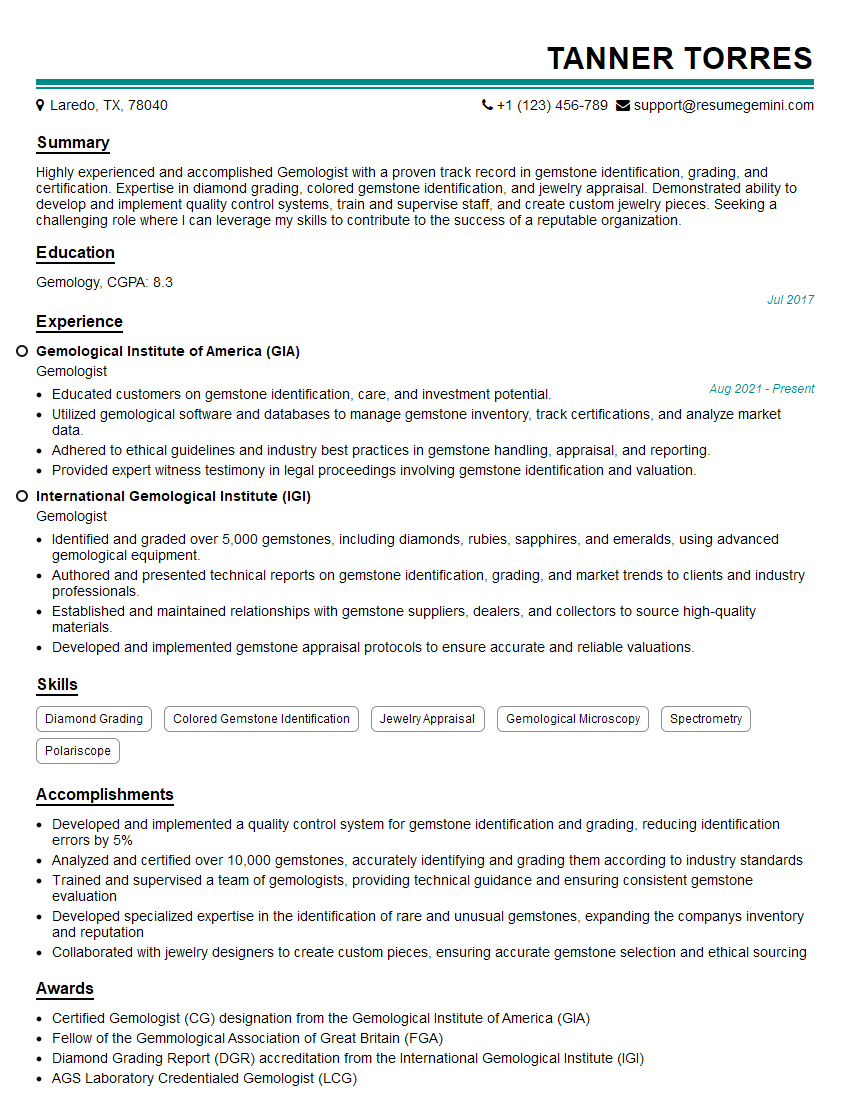
Mastering Gemstone Knowledge opens doors to exciting career opportunities and positions you for significant professional growth. A strong understanding of these concepts demonstrates your technical expertise and problem-solving skills, making you a highly desirable candidate. To further enhance your job prospects, focus on creating an ATS-friendly resume that effectively highlights your skills and experience. We highly recommend using ResumeGemini, a trusted resource, to build a professional and impactful resume. Examples of resumes tailored to Gemstone Knowledge are available to guide you.

Explore more articles
Users Rating of Our Blogs
Share Your Experience
We value your feedback! Please rate our content and share your thoughts (optional).
What Readers Say About Our Blog
Very informative content, great job.
good