Feeling uncertain about what to expect in your upcoming interview? We’ve got you covered! This blog highlights the most important GIS for Terrapin Conservation interview questions and provides actionable advice to help you stand out as the ideal candidate. Let’s pave the way for your success.
Questions Asked in GIS for Terrapin Conservation Interview
Q 1. Explain your experience with ArcGIS Pro or QGIS.
My experience with both ArcGIS Pro and QGIS is extensive, spanning over seven years. I’m highly proficient in both platforms, leveraging their strengths depending on the project’s needs. ArcGIS Pro, with its robust geoprocessing tools and advanced 3D capabilities, is my go-to for larger, more complex projects requiring intricate analysis and data management. For instance, I recently used ArcGIS Pro to build a comprehensive geodatabase for a large-scale biodiversity monitoring project, integrating data from various sources, including GPS trackers and remote sensing imagery. On the other hand, QGIS’s open-source nature and its user-friendly interface make it ideal for quick tasks, data exploration, and projects with tighter budgets. I often use QGIS for rapid prototyping and initial data visualization before moving to ArcGIS Pro for final production.
I’m comfortable with all aspects of both platforms, including data import/export, geoprocessing, spatial analysis tools, map creation and layout, and data management.
Q 2. Describe your proficiency in geospatial data analysis techniques.
My geospatial data analysis skills encompass a broad range of techniques. I’m proficient in spatial overlay analysis (e.g., intersection, union, erase), proximity analysis (e.g., buffer creation, nearest neighbor analysis), network analysis (e.g., finding optimal routes for conservation patrols), and raster analysis (e.g., classifying land cover from satellite imagery). I’m adept at using these techniques to address complex conservation challenges. For example, I recently used spatial overlay analysis to identify areas of habitat overlap between endangered species and proposed development projects, helping inform mitigation strategies. My experience also includes using spatial autocorrelation analysis to detect patterns in species distribution data, potentially revealing critical habitats.
Q 3. How familiar are you with remote sensing data (e.g., Landsat, Sentinel)?
I have significant experience working with remote sensing data, primarily Landsat and Sentinel imagery. I’m familiar with various preprocessing steps, including atmospheric correction, geometric correction, and orthorectification, using tools like ENVI and ERDAS IMAGINE. I regularly use this data for land cover classification, change detection, habitat monitoring, and assessing the impacts of climate change on ecosystems. For instance, in a recent project, I used Sentinel-2 imagery to map deforestation rates in the Amazon rainforest, providing crucial data for conservation efforts. My proficiency extends to extracting spectral indices like NDVI (Normalized Difference Vegetation Index) and NDWI (Normalized Difference Water Index) to analyze vegetation health and water resources.
Q 4. What are your skills in spatial statistics and data modeling?
My skills in spatial statistics and data modeling are strong. I regularly utilize techniques like point pattern analysis, spatial regression (e.g., geographically weighted regression), and spatial autocorrelation analysis to understand spatial relationships and patterns in ecological data. I’m also experienced in using various statistical software packages, such as R and Python (with libraries like geopandas and spdep), for advanced spatial statistical modeling. I’ve applied these techniques to projects analyzing species distribution modeling, predicting habitat suitability, and assessing the effectiveness of conservation interventions. For example, I developed a species distribution model for an endangered bird species using Maxent, incorporating environmental variables from remote sensing data and field surveys.
Q 5. Explain your experience with geodatabase design and management.
I have extensive experience in geodatabase design and management, adhering to best practices for data organization, structure, and integrity. I’m proficient in designing and implementing geodatabases in both file and enterprise formats, ensuring data consistency and efficient access. This includes defining feature classes, establishing relationships between tables, implementing attribute domains, and enforcing data integrity rules. I’ve led the development of geodatabases for multiple conservation projects, ensuring data quality and facilitating collaboration among team members. For example, I designed a comprehensive geodatabase for a large-scale ecological monitoring program, incorporating data from various sources and allowing for efficient data querying and analysis. My approach ensures data accessibility, maintainability, and scalability.
Q 6. How would you approach analyzing habitat fragmentation using GIS?
Analyzing habitat fragmentation using GIS involves a multi-step process. First, I would obtain high-resolution land cover data (e.g., from aerial photography or satellite imagery), ideally with detailed information on vegetation types and land use. Second, I would use image classification and segmentation techniques to identify and classify different habitat patches. Third, I would calculate fragmentation metrics such as patch size, shape complexity (e.g., perimeter-area ratio), edge density, and connectivity using spatial analysis tools within ArcGIS Pro or QGIS. These metrics quantify the degree of fragmentation. Finally, I would create maps visualizing the fragmented landscape and the calculated metrics to illustrate the extent and impact of fragmentation. These visualizations would be vital for guiding conservation planning and restoration efforts. For example, identifying key areas for habitat restoration or corridor creation to improve connectivity and promote biodiversity.
Q 7. Describe your experience with creating maps and visualizations for conservation purposes.
I have extensive experience creating maps and visualizations tailored for conservation purposes. My goal is to create clear, informative, and compelling visuals that effectively communicate complex spatial data to diverse audiences. This involves selecting appropriate map projections, symbology, and layout elements to enhance readability and understanding. I frequently use ArcGIS Pro and QGIS for map creation, incorporating high-quality imagery, labels, legends, and scale bars. For example, I recently produced a series of maps illustrating the impact of climate change on protected areas, effectively showcasing projected habitat loss and potential range shifts of key species. The maps were instrumental in securing funding for conservation measures. In addition to static maps, I also create interactive web maps and dashboards using ArcGIS Online and other web mapping technologies, making the data readily accessible and user-friendly.
Q 8. How would you use GIS to assess the impact of climate change on a specific ecosystem?
Assessing the impact of climate change on an ecosystem using GIS involves integrating various climate change projections with ecological data. Think of it like creating a detailed forecast for a specific region’s wildlife.
First, I’d acquire climate change projections, such as changes in temperature, precipitation, and sea level rise, often available from sources like the IPCC or government agencies. This data is typically in raster format, showing variations across the landscape. Then, I’d overlay this data with existing ecosystem data such as vegetation maps, species distribution maps, and soil type information (often vector data). This allows us to see how changes in climate will directly affect these habitats.
For example, I could model the potential shift in the suitable habitat for a specific endangered species by overlaying projected temperature increases with the species’ current range. This helps determine which areas may become unsuitable and which new areas might become suitable. Further analysis can involve modelling changes in habitat connectivity, assessing increased risk of wildfires through changes in drought indices, or predicting sea level encroachment on coastal wetlands.
Finally, I’d use GIS tools to create visualizations, such as maps and charts, to communicate the findings effectively to stakeholders. This might include animated maps showing the progression of change over time, allowing for better understanding and informed decision-making for conservation strategies.
Q 9. What is your experience with GPS data collection and processing?
My experience with GPS data collection and processing is extensive. At Terrapin Conservation, we frequently use GPS devices, both handheld and those integrated into drones, for fieldwork. We collect data on everything from vegetation plots to wildlife sightings to trail locations. Imagine trying to track the migration of a bird species – GPS is essential for precisely mapping their movements.
Data processing involves cleaning and preparing the GPS data for analysis in a GIS. This involves dealing with issues such as erroneous readings, applying coordinate transformations (WGS84 to UTM, for example), and identifying outliers. I’m proficient in using software like ArcGIS Pro and QGIS to import, edit, and manage these datasets. I frequently use post-processing techniques to improve accuracy and filter out noise. The result is high-quality spatial data that we can integrate with other datasets for a comprehensive understanding of the landscape.
Q 10. Explain your understanding of different map projections and coordinate systems.
Map projections are essentially ways of representing the 3D surface of the Earth on a 2D map. Different projections distort various properties of the Earth, such as area, shape, distance, and direction. Understanding this is critical because the choice of projection significantly impacts the accuracy of spatial analysis.
For instance, the Mercator projection, commonly used for navigation, accurately represents direction but significantly distorts area at higher latitudes (Greenland appears much larger than it actually is relative to Africa). The Albers Equal-Area projection, on the other hand, maintains accurate area representation but distorts shape. The choice depends on the project’s needs; if you are analyzing area-based data, such as habitat fragmentation, an equal-area projection is essential.
Coordinate systems define the location of points on the Earth using latitude and longitude (geographic coordinates) or Cartesian coordinates (projected coordinates). Defining the appropriate coordinate system is crucial; if two datasets have different coordinate systems, they cannot be directly overlaid. Using the wrong projection and coordinate system can lead to significant errors in spatial analysis. A common example is using UTM zone 17N for a project covering both UTM zone 16N and 17N which will introduce inaccuracies.
Q 11. How would you perform spatial overlay analysis (e.g., intersection, union)?
Spatial overlay analysis is a powerful GIS technique for combining two or more spatial datasets to reveal new information. Imagine having maps of forest cover and soil types; overlaying these allows us to see what types of forests exist on which soils. This is essential for land management and conservation planning.
Intersection creates a new layer containing only the areas where the input layers overlap. For example, intersecting a map of protected areas with a map of potential development zones highlights the areas needing conservation prioritization. Union, on the other hand, combines all areas from the input layers, creating a new layer representing the complete extent of all features. This is useful for creating comprehensive land cover maps.
The process typically involves selecting the relevant layers in the GIS software (like ArcGIS or QGIS), choosing the appropriate overlay operation (intersect or union), and specifying the output parameters. The result is a new layer representing the result of the spatial operation, which is then used for further analysis and mapping.
Q 12. Describe your experience with raster and vector data formats.
Raster data is a grid of cells, each with a value representing a particular attribute. Think of it as a digital image – each pixel has a color value. Examples include satellite imagery, elevation models, and climate data. Processing raster data often involves techniques like image classification and analysis to interpret land cover or measure change over time.
Vector data, on the other hand, represents spatial information as points, lines, and polygons. Think of a map showing roads (lines), buildings (polygons), and locations of rare plants (points). Vector data is ideal for storing discrete objects, offering precise geometric representation. Vector data is often preferred for data describing distinct features because it allows efficient management and precise querying.
I am proficient in working with both formats. The choice of data format depends on the project requirements. Raster is best for continuous data while vector is suited for discrete features. Sometimes, it’s even necessary to convert between these formats depending on the analytical techniques needed.
Q 13. How do you ensure data accuracy and quality in a GIS project?
Data accuracy and quality are paramount in GIS projects. Inaccurate data leads to flawed conclusions and poor decision-making, which is unacceptable in conservation efforts. For instance, an inaccurate vegetation map could lead to inadequate habitat protection.
My approach starts with rigorous data sourcing. We use trusted sources for base data, always checking the metadata for quality information, including the accuracy of measurements and the source of data. We perform quality checks at each stage of the process, from data collection to analysis. This involves visual inspection of maps, checking data consistency, and comparing data against field observations. We also use automated checks such as error detection tools available in GIS software to identify and address anomalies.
Data validation techniques, like comparing our datasets with other reliable datasets, are crucial. For example, we might compare our habitat maps with those produced by another organization to look for discrepancies and assess the overall accuracy. Proper documentation of the data sources, processing steps, and limitations is crucial for transparency and reproducibility.
Q 14. What is your experience with spatial interpolation techniques?
Spatial interpolation is the process of estimating values at unsampled locations based on known values at nearby locations. Imagine having temperature readings from a few weather stations; interpolation helps us estimate the temperature at other points in the region. This is essential when dealing with incomplete datasets or when wanting to produce continuous surfaces.
I’m experienced with various interpolation techniques, including Inverse Distance Weighting (IDW), Kriging, and Spline interpolation. The choice of method depends on the data characteristics and the desired level of smoothness. For example, IDW is simple but can be sensitive to outliers, while Kriging provides more sophisticated modeling, accounting for spatial autocorrelation. Spline interpolation is useful for creating smooth surfaces, such as elevation models.
Understanding the strengths and weaknesses of each technique is crucial. We carefully evaluate the results and select the most appropriate method for the particular application. Proper validation is performed using existing data to determine how accurate our interpolated data are, using metrics like the root mean squared error (RMSE).
Q 15. How familiar are you with utilizing GIS for conservation planning and decision-making?
GIS is absolutely fundamental to my work in conservation. At Terrapin Conservation, we leverage GIS daily for everything from identifying critical habitat to planning restoration projects and monitoring conservation efforts. My familiarity isn’t just theoretical; it’s deeply embedded in my practical experience. I’ve used GIS to analyze spatial data to inform decisions regarding land acquisition, habitat connectivity, species distribution modeling, and impact assessments of development projects. For example, I recently used ArcGIS Pro to overlay protected area boundaries with predicted climate change impacts to identify areas requiring urgent conservation attention.
Career Expert Tips:
- Ace those interviews! Prepare effectively by reviewing the Top 50 Most Common Interview Questions on ResumeGemini.
- Navigate your job search with confidence! Explore a wide range of Career Tips on ResumeGemini. Learn about common challenges and recommendations to overcome them.
- Craft the perfect resume! Master the Art of Resume Writing with ResumeGemini’s guide. Showcase your unique qualifications and achievements effectively.
- Don’t miss out on holiday savings! Build your dream resume with ResumeGemini’s ATS optimized templates.
Q 16. Describe your experience with working with large datasets in GIS.
Working with large datasets is commonplace in conservation GIS. I’ve routinely handled datasets encompassing hundreds of gigabytes of remotely sensed imagery, LiDAR data, and species occurrence records. Efficient processing is crucial, and my approach involves a multi-faceted strategy: Firstly, I employ techniques like data subsetting and spatial indexing to improve query performance. Secondly, I utilize cloud-based platforms like Google Earth Engine to process vast datasets remotely, avoiding the limitations of local computing power. Finally, I leverage the power of parallel processing within GIS software to handle computationally intensive tasks like raster calculations and spatial analysis. For instance, I recently processed a 1TB LiDAR dataset to generate a high-resolution digital elevation model for a large watershed, identifying areas prone to erosion and informing river restoration planning.
Q 17. Explain your understanding of georeferencing and image rectification.
Georeferencing is the process of assigning geographic coordinates (latitude and longitude) to points on an image or map that doesn’t initially have them. Image rectification is then the process of correcting geometric distortions in that image, ensuring that it aligns accurately with a known coordinate system. Think of it like straightening a slightly crooked photograph. For instance, a scanned historical map might need georeferencing by aligning it to a modern basemap using known control points. After georeferencing, rectification corrects for scaling, rotation, and other distortions, making the historical map suitable for overlaying with modern data for historical change analysis. We frequently use this process at Terrapin to integrate historical aerial photographs with current satellite imagery to track habitat changes over time.
Q 18. How would you use GIS to monitor biodiversity?
GIS is invaluable for biodiversity monitoring. I’d use a combination of techniques: Species distribution modeling (SDM) uses occurrence data and environmental variables to predict the likely distribution of species, allowing for identification of key habitats. This can be coupled with remote sensing data (satellite imagery and aerial photography) to monitor habitat changes over time and assess the impacts of threats such as deforestation or habitat fragmentation. Citizen science data, when georeferenced, can augment the monitoring efforts. For example, I used SDM to model the distribution of a threatened bird species, identifying areas crucial for conservation based on habitat suitability. We then used time-series satellite imagery to monitor habitat loss in those key areas. The combined approach provides a comprehensive overview of the species’ status and informs targeted conservation interventions.
Q 19. Describe your experience in presenting geospatial data and analysis to a non-technical audience.
Communicating complex geospatial information to non-technical audiences requires clear and concise visualization. I employ various strategies: I avoid jargon and use clear, simple language. I create visually appealing maps and charts using intuitive software like ArcGIS StoryMaps, Tableau, and Power BI. Data is presented narratively, focusing on the key findings and their implications, using relatable analogies to help them understand the concepts. I emphasize the ‘so what’—connecting the spatial analysis to practical conservation outcomes and their impact on people and the environment. For instance, when presenting results on a proposed development project’s impact on a wildlife corridor, I used easily understandable maps to showcase the potential habitat loss and its implications for local biodiversity, effectively conveying the importance of mitigation efforts.
Q 20. What experience do you have in programming languages relevant to GIS (e.g., Python)?
Python is an essential tool in my GIS workflow. I use libraries like geopandas for geospatial data manipulation, rasterio for raster processing, and scikit-learn for machine learning applications in conservation. For example, I’ve written Python scripts to automate geoprocessing tasks such as batch processing of satellite imagery, calculating landscape metrics, and generating customized maps. My scripting skills allow me to streamline workflows, improve efficiency, and handle large-scale analyses that would be difficult or impossible using only graphical user interfaces.
# Example Python code snippet for calculating landscape metrics using rasterio and geopandas import rasterio import geopandas as gpd # ...code to process raster and vector data...Q 21. Explain your understanding of spatial autocorrelation.
Spatial autocorrelation refers to the degree to which nearby locations are similar. In simpler terms, it measures whether things clustered together in space are more similar than things farther apart. High spatial autocorrelation means that nearby locations are strongly correlated—for example, if deforestation is occurring in one area, it’s likely happening in neighboring areas as well. Understanding spatial autocorrelation is crucial in statistical analysis because ignoring it can lead to inaccurate results. For instance, if we’re analyzing the spread of an invasive species and fail to account for spatial autocorrelation, we might incorrectly estimate the effect of environmental variables due to the inherent clustering of the species. We use spatial statistics like Moran’s I to detect and address spatial autocorrelation when analyzing conservation data, making our analyses robust and reliable.
Q 22. How would you use GIS to identify suitable areas for habitat restoration?
Identifying suitable areas for habitat restoration using GIS involves a multi-step process that leverages various spatial data layers. Think of it like assembling a puzzle where each piece represents crucial environmental information.
- Step 1: Data Acquisition and Preparation: We start by gathering relevant data layers, such as land cover maps (showing forests, wetlands, etc.), soil type maps, elevation data, proximity to existing protected areas, and hydrological data (rivers, streams).
- Step 2: Defining Restoration Goals and Criteria: We work closely with stakeholders to define the specific goals – are we restoring wetlands, forests, or grasslands? What species are we targeting? This helps determine the selection criteria for suitable areas.
- Step 3: Spatial Analysis: Using GIS software (like ArcGIS or QGIS), we perform spatial analysis to identify areas that meet the criteria. For example, we can use overlay analysis to identify areas with suitable soil types and land cover, and proximity analysis to prioritize locations near existing habitat corridors. We might also use tools to assess factors like slope, aspect, and solar radiation to predict habitat suitability.
- Step 4: Suitability Mapping and Prioritization: The results of the spatial analysis are compiled into a suitability map, which visually ranks potential restoration sites. Prioritization often considers factors like cost-effectiveness, land ownership, accessibility, and potential threats.
- Step 5: Validation and Refinement: Field surveys and expert knowledge are crucial to validate the GIS-based suitability assessment and refine the selection of restoration sites. This ground-truthing helps ensure that the model accurately reflects real-world conditions.
For instance, at Terrapin Conservation, we recently used this approach to identify optimal locations for oyster reef restoration in the Chesapeake Bay. By overlaying salinity maps, substrate data, and water depth information, we pinpointed areas with high potential for successful reef establishment.
Q 23. Describe your experience with participatory GIS approaches.
Participatory GIS (PGIS) is a powerful approach that empowers local communities to actively participate in the mapping and analysis of their environment. It’s about collaboration, not just data crunching.
My experience with PGIS includes working with indigenous communities in the Amazon rainforest to map traditional land use and resource management practices. We used mobile GIS apps and participatory mapping workshops to collect data on forest resources, water sources, and areas of cultural significance. This information was then integrated into a GIS database to support their land claims and conservation efforts. The process fosters trust and ensures that locally relevant knowledge informs conservation decisions.
Another example involved a coastal community facing erosion. We utilized PGIS to map vulnerability hotspots, incorporating local knowledge on historical erosion patterns and traditional coastal defenses. This led to a more effective and community-owned coastal management plan.
Q 24. How do you stay up-to-date with advancements in GIS technology and conservation techniques?
Staying current in GIS and conservation requires a multifaceted approach. It’s a constantly evolving field!
- Professional Development: I regularly attend conferences (like Esri User Conferences) and workshops focusing on advancements in GIS software and applications in conservation.
- Online Resources: I actively follow leading journals, blogs, and online communities focused on GIS and conservation science (such as Conservation GIS). This keeps me updated on new techniques and research.
- Networking: Maintaining connections with colleagues in the field through professional organizations and online platforms allows for the exchange of information and best practices.
- Self-learning: I dedicate time to explore new GIS software features and tools through online courses and tutorials. This helps improve my technical skills and adapt to emerging technologies.
For example, I recently completed an online course on deep learning applications in conservation, enabling me to leverage AI for habitat modeling and species detection.
Q 25. What is your experience with cloud-based GIS platforms (e.g., ArcGIS Online)?
I have extensive experience with cloud-based GIS platforms, primarily ArcGIS Online. It’s a powerful tool for collaborative work and data sharing, especially useful for large-scale conservation projects.
My experience includes:
- Creating and managing geodatabases in the cloud: I’ve used ArcGIS Online to store, manage, and share large datasets with collaborators across different locations and organizations.
- Developing web maps and applications: I have created interactive web maps and dashboards to visualize conservation data and share information with stakeholders.
- Utilizing cloud-based spatial analysis tools: ArcGIS Online provides access to various geoprocessing tools, which I use for tasks such as habitat suitability modeling and impact assessment.
- Collaborating through online platforms: ArcGIS Online facilitates teamwork through shared projects, allowing multiple users to contribute to mapping and analysis efforts simultaneously.
For example, at Terrapin Conservation, we used ArcGIS Online to create a web map that tracked the spread of invasive species, allowing for efficient monitoring and management across a large region.
Q 26. How would you use GIS to model species distribution?
Species distribution modeling (SDM) uses GIS to predict the geographic locations where a species is likely to occur. It’s like creating a habitat suitability map tailored for a specific species.
The process typically involves these steps:
- Data Gathering: Collect occurrence data (locations where the species has been observed), environmental variables (climate, topography, land cover), and potentially, remotely sensed imagery.
- Data Preparation: Clean and preprocess the data, ensuring accuracy and consistency. This often involves spatial referencing and data transformation.
- Model Selection: Choose an appropriate SDM model (e.g., MaxEnt, GARP, Bioclim) depending on the data and the research question.
- Model Calibration and Validation: Train the model using a subset of the occurrence data and validate its accuracy using independent data. This ensures the model’s predictive power.
- Prediction: Apply the calibrated model to environmental data to predict the potential distribution of the species across a study area.
- Model Evaluation: Evaluate the model’s performance and uncertainty using various metrics. This helps assess the reliability of the predictions.
For example, we recently used MaxEnt to model the potential distribution of an endangered bird species in response to climate change. This helped identify areas where conservation efforts should be prioritized.
Q 27. Describe your experience with using GIS in environmental impact assessments.
GIS plays a crucial role in environmental impact assessments (EIAs) by providing a spatial framework for analyzing the potential impacts of projects on the environment.
My experience includes:
- Mapping project footprints and affected areas: Using GIS, we can precisely map the location and extent of proposed projects (e.g., roads, pipelines, power plants), allowing us to assess their overlap with environmentally sensitive areas.
- Analyzing proximity to sensitive habitats and species: GIS allows us to determine the distance between the project and critical habitats, identifying potential impacts on endangered species or protected areas.
- Assessing cumulative impacts: GIS helps visualize and analyze the cumulative effects of multiple projects in a region, providing a comprehensive understanding of potential environmental stress.
- Modeling potential impacts: GIS can be used to model the spread of pollutants, noise, or other environmental impacts, helping us predict the scale and extent of potential damage.
- Creating impact maps and reports: GIS facilitates the production of visually informative maps and reports that communicate the potential impacts to stakeholders and decision-makers.
For instance, in a recent EIA for a proposed wind farm, we used GIS to map the potential impact on bird migration routes and bat habitats, providing critical information for mitigating environmental risks.
Q 28. What are your skills in data visualization and cartographic design for effective communication?
Effective communication is paramount in conservation. My skills in data visualization and cartographic design are crucial for conveying complex spatial information clearly and engagingly to diverse audiences.
My expertise includes:
- Creating visually appealing maps: I can design maps that effectively communicate spatial patterns and relationships using appropriate symbology, color schemes, and labels.
- Selecting suitable map projections: I understand the importance of choosing appropriate projections for various applications and audiences to avoid distortion and ensure accuracy.
- Developing interactive web maps and dashboards: I have experience creating web-based map applications that allow users to explore data and analyze information interactively.
- Integrating diverse data sources: I can effectively integrate data from various sources (e.g., satellite imagery, field surveys, statistical data) into visually compelling and informative maps and visualizations.
- Using infographics and other visual aids: I understand how to use infographics and other visual communication techniques to supplement maps and explain complex concepts simply.
For example, in a report on deforestation, I created a series of animated maps showcasing the changes in forest cover over time, making the impact readily apparent to policymakers and the public.
Key Topics to Learn for GIS for Terrapin Conservation Interview
- Spatial Data Handling & Analysis: Understanding various spatial data formats (shapefiles, geodatabases, rasters), data projections, and coordinate systems crucial for conservation mapping and analysis.
- Conservation Planning & Modeling: Applying GIS for habitat suitability modeling, species distribution modeling, and protected area design, considering factors like habitat fragmentation and connectivity.
- Remote Sensing & Image Analysis: Utilizing satellite imagery and aerial photography for monitoring habitat change, deforestation, and assessing conservation efforts’ effectiveness.
- Geospatial Data Visualization & Communication: Creating clear and compelling maps, charts, and reports to effectively communicate conservation findings to diverse audiences, including stakeholders and policymakers.
- GPS & Field Data Collection: Understanding the use of GPS technology for accurate data collection in the field, including data accuracy and error management.
- GIS Software Proficiency (e.g., ArcGIS, QGIS): Demonstrating practical skills in data manipulation, analysis, and visualization within relevant GIS software is essential.
- Data Management & Quality Control: Implementing robust data management strategies to ensure data accuracy, consistency, and accessibility for long-term conservation projects.
- Problem-Solving & Critical Thinking: Applying GIS techniques to address real-world conservation challenges, demonstrating analytical skills and creative solutions.
Next Steps
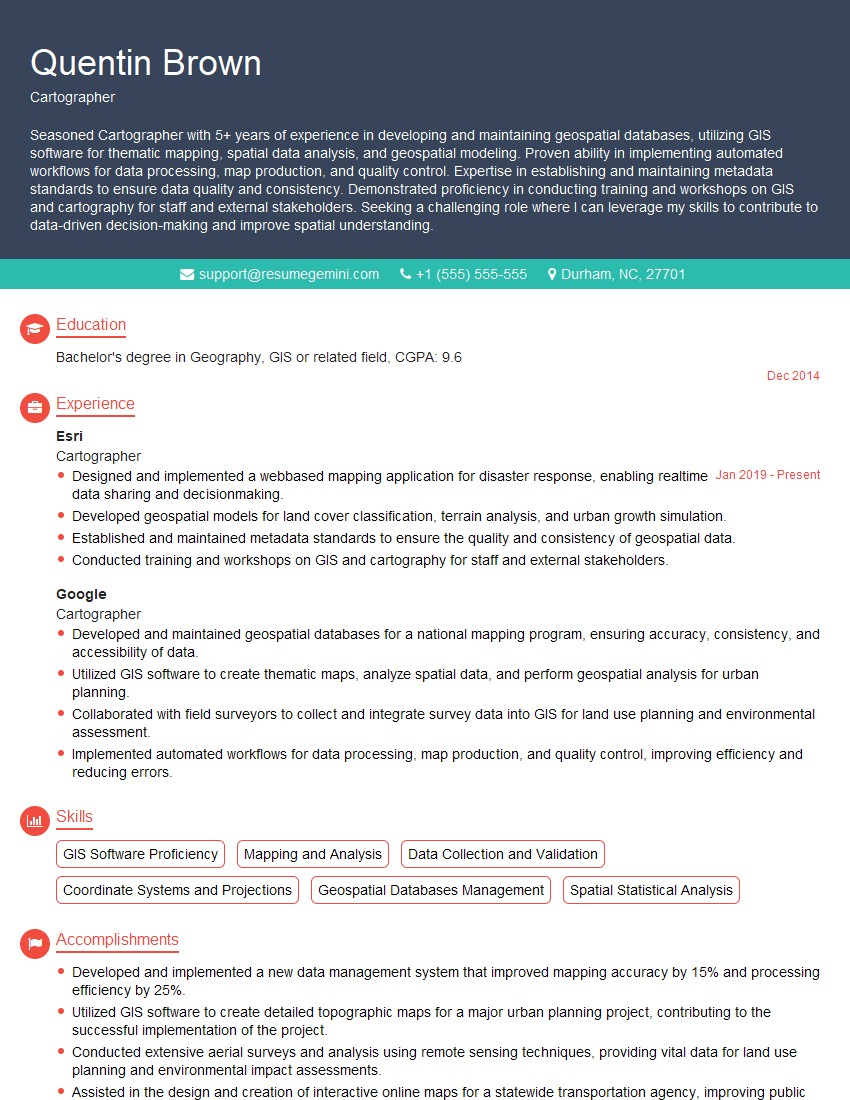
Mastering GIS for Terrapin Conservation significantly enhances your career prospects in the environmental field, opening doors to impactful roles in conservation planning, ecological research, and environmental management. A strong, ATS-friendly resume is key to getting your application noticed. To create a compelling resume that highlights your GIS skills and experience effectively, consider using ResumeGemini. ResumeGemini offers a user-friendly platform and provides examples of resumes tailored to GIS for Terrapin Conservation to guide you in creating a professional document that showcases your qualifications.
Explore more articles
Users Rating of Our Blogs
Share Your Experience
We value your feedback! Please rate our content and share your thoughts (optional).
What Readers Say About Our Blog
Very informative content, great job.
good