Cracking a skill-specific interview, like one for Glass Inspection, requires understanding the nuances of the role. In this blog, we present the questions you’re most likely to encounter, along with insights into how to answer them effectively. Let’s ensure you’re ready to make a strong impression.
Questions Asked in Glass Inspection Interview
Q 1. Explain the different types of glass defects you are familiar with.
Glass defects can be broadly categorized into several types, each impacting the quality and functionality of the glass product. These defects often arise during the manufacturing process, impacting the glass’s appearance, strength, and overall performance. Let’s explore some common ones:
- Surface Defects: These are visible imperfections on the glass surface. Examples include scratches, digs (small chips), stones (small pieces of refractory material embedded in the glass), bubbles (air pockets trapped within the glass), and inclusions (foreign materials like small pieces of metal or other contaminants).
- Dimensional Defects: These relate to the size and shape of the glass. Examples include variations in thickness (non-uniformity), waviness (undulations in the glass surface), bowing (curvature across the glass sheet), and camber (curvature across the width of a sheet).
- Internal Defects: These are imperfections found within the glass itself, often invisible to the naked eye, and detectable through specialized techniques. Examples include cords (striae—lines or streaks of different refractive index within the glass), stones (as mentioned above, but specifically those internally embedded), and seeds (small, spherical inclusions).
- Optical Defects: These affect the clarity and transmission of light through the glass. Examples include haze (a cloudy appearance), striae (again, but emphasizing the optical distortion they cause), and color variations (uneven color distribution across the glass sheet).
The severity of a defect depends on its type, size, location, and the intended application of the glass. A small scratch might be acceptable in a low-visibility application, while the same scratch could be a critical failure for high-precision optical components.
Q 2. Describe your experience with various glass inspection methods.
My experience encompasses a range of glass inspection methods, both manual and automated. I’m proficient in visual inspection, using magnification tools to detect surface and minor internal defects. I’ve also extensively used automated optical inspection (AOI) systems that employ high-resolution cameras and sophisticated image processing algorithms to rapidly and accurately detect defects at a much higher volume than manual methods. These AOI systems often incorporate measurement tools that provide precise data on the size and location of defects. Furthermore, I have experience with non-destructive testing techniques like laser scanning for dimensional analysis and polarized light microscopy for analyzing internal stress and strain in the glass.
For example, in a recent project inspecting automotive glass, we used a combination of visual inspection for checking surface quality and AOI to identify subtle dimensional inconsistencies that could impact the vehicle’s aerodynamics. This combined approach ensures thorough quality control while minimizing human error and improving efficiency.
Q 3. How do you identify and classify glass defects according to industry standards?
Identifying and classifying glass defects involves adhering to industry-specific standards and specifications. For example, automotive glass will have different standards than those for architectural or pharmaceutical applications. These standards often define acceptable defect limits and may include detailed images and descriptions of different defect types.
The process typically involves:
- Visual Inspection: Carefully examining the glass for any visible imperfections, using magnification tools when necessary.
- Measurement: Using calibrated tools such as micrometers, calipers, or optical measuring instruments to quantify the size and depth of defects.
- Classification: Assigning each identified defect to a specific category based on the established standards. For instance, a small scratch might be classified as a ‘minor surface defect,’ while a large crack would be a ‘critical defect.’ This classification may involve using defect codes or numerical ratings defined in the standards.
- Documentation: Thoroughly documenting all findings, including the defect type, location, size, and classification. This is often done using detailed reports and digital images. This aids in tracking defects, analyzing trends and implementing process improvements.
For example, the automotive industry often employs specific standards like ISO 2636 for glass strength and quality.
Q 4. What are the common causes of glass defects in the manufacturing process?
Glass defects often stem from various issues in the manufacturing process. Understanding these causes is critical for implementing preventative measures:
- Raw Materials: Impurities in the raw materials (sand, soda ash, limestone) can lead to inclusions, stones, or other internal defects.
- Melting Process: Inadequate melting temperature, insufficient stirring, or contamination during melting can introduce bubbles, cords, or stones.
- Forming Process: Improper forming techniques, such as insufficient cooling or uneven pressure, can cause dimensional defects like waviness, bowing, or variations in thickness. Additionally, improper handling during the forming process can lead to scratches or digs.
- Annealing Process: Inadequate annealing (controlled cooling) can result in internal stresses, leading to increased fragility and potential for cracking under stress.
- Handling and Storage: Scratches and other surface damage can occur during handling, transportation, or storage if proper precautions aren’t taken.
Identifying the root cause of a defect often involves analyzing samples from various stages of the manufacturing process to isolate the point of failure. This may require collaboration with engineers and other manufacturing personnel to comprehensively address the issue.
Q 5. How do you ensure accurate and consistent measurements during glass inspection?
Ensuring accurate and consistent measurements is paramount in glass inspection. This is achieved through a combination of best practices and utilization of precise tools and techniques:
- Calibration: Regular calibration of all measuring instruments (e.g., micrometers, calipers, optical comparators) is crucial to maintain accuracy and traceability. Calibration certificates should be maintained and readily available.
- Standardized Procedures: Following standardized procedures for measurement, ensuring consistent methods are used across all inspections. This includes detailing the measurement points and techniques to be used.
- Environmental Control: Maintaining a stable environment (temperature, humidity) during inspection minimizes variations that could affect measurement accuracy.
- Multiple Measurements: Taking multiple measurements at different locations to ensure representative data is obtained, particularly when checking for dimensional variations.
- Data Recording: Accurate and detailed recording of measurement data, including date, time, inspector identification, and instrument used. This data will be useful for analysis and trending.
By implementing these practices, the chance of errors or inconsistencies is greatly reduced, improving the reliability of the inspection process and consequently the quality of the final product.
Q 6. What tools and equipment are commonly used in glass inspection?
Glass inspection utilizes a variety of tools and equipment, depending on the specific type of glass and the nature of the inspection. Some common tools include:
- Magnifiers: Handheld magnifiers, illuminated magnifiers, and stereo microscopes provide magnified views to detect surface and minor internal defects.
- Micrometers and Calipers: Used for precise measurement of glass thickness and other dimensional parameters.
- Optical Comparators: Allow for accurate measurement and comparison of glass dimensions against specified tolerances.
- Automated Optical Inspection (AOI) Systems: High-speed, automated systems equipped with cameras and sophisticated software to detect and classify defects. These systems significantly increase throughput and accuracy compared to manual methods.
- Laser Scanners: Employ laser technology to scan the surface of the glass, providing highly accurate dimensional measurements and detecting irregularities.
- Polarized Light Microscopes: Used to detect internal stresses and strain within the glass, often revealing subtle defects not visible to the naked eye.
- Thickness Gauges: Instruments used to measure glass thickness at various points across the glass sheet.
The specific equipment selection depends on factors like the type of glass being inspected, the level of precision required, and the inspection volume.
Q 7. Describe your experience using optical measuring instruments for glass inspection.
My experience with optical measuring instruments is extensive. I’ve used various instruments, including optical comparators, laser scanners, and interferometers, to perform precise measurements of glass dimensions and surface characteristics. Optical comparators are invaluable for comparing the actual dimensions of the glass against specified tolerances. I’ve also utilized laser scanners to acquire detailed 3D surface profiles, allowing for the detection of subtle variations and surface defects. This technology provides very precise measurements of the entire surface, making it very helpful for large glass panels.
For example, during the inspection of precision optical lenses, we used an interferometer to assess surface flatness and detect any deviations from the ideal shape. The interferometer’s ability to measure surface irregularities at the nanometer scale was critical in ensuring the lenses met the stringent quality requirements. This approach allowed for the detection of even minute imperfections, which can significantly influence the lenses’ optical performance. These instruments are crucial for precise measurements required in the production of high-quality glass components used in various demanding applications.
Q 8. How do you document and report your findings during a glass inspection?
Documenting and reporting glass inspection findings requires a systematic approach to ensure accuracy and clarity. My process typically involves a combination of visual inspection, detailed checklists, and photographic evidence.
- Visual Inspection: I meticulously examine each glass piece for defects, noting their location, type, and severity. I use standardized terminology to describe defects (e.g., scratches, chips, bubbles, etc.).
- Checklists: Pre-designed checklists ensure consistency and completeness. These checklists specify the inspection criteria for different glass types and applications. I mark the checklist with the observed defects and their severity, using a standardized rating scale (e.g., 1-5, with 5 being the most severe).
- Photography: High-quality photographs of defects are crucial. I use a camera with sufficient resolution to clearly capture the defect’s size, shape, and location. Each photo is labeled with relevant information (date, time, location, glass type, defect description, etc.).
- Reporting: A comprehensive report summarizes all findings. This report includes the checklist, photographs, a summary of the defects, and recommendations for corrective actions (if necessary). Reports are often generated using specialized software for clearer presentation and easier data analysis.
For example, I once inspected a batch of laminated glass for a high-rise building. I found a small but noticeable imperfection in one pane. I documented this by carefully photographing the area, noting its location in the checklist and detailing its description (a hairline scratch approximately 5 mm long) in the report. This thorough documentation allowed the manufacturer to address the issue promptly and prevent costly rework later.
Q 9. Explain your experience with different types of glass (e.g., tempered, laminated, float).
My experience encompasses a wide range of glass types, each with its own unique properties and inspection requirements.
- Float Glass: This is the most common type, known for its flatness and smooth surface. Inspection focuses on surface imperfections (scratches, ripples, etc.), thickness uniformity, and dimensional accuracy.
- Tempered Glass: This safety glass is heat-treated to increase strength. Inspection is more stringent due to the risk of spontaneous breakage. I check for stress patterns (using polarized light if necessary), surface defects, and conformance to relevant safety standards (e.g., breakage resistance).
- Laminated Glass: This consists of two or more layers of glass bonded together with a polymer interlayer. Inspection involves checking the adhesion between layers, the clarity of the interlayer, and the absence of bubbles or delamination. I also ensure compliance with standards concerning strength and impact resistance.
During my time at [Previous Company Name], I was involved in a large-scale project involving curved tempered glass for a museum. This required extensive knowledge of tempering techniques and the potential for stress-related fractures. I used specialized inspection tools, including a polariscope, to detect stress points and ensure the safety of the installation.
Q 10. How do you handle discrepancies or disagreements regarding glass quality assessments?
Discrepancies in glass quality assessments are addressed through a collaborative and objective approach.
- Review of Evidence: The first step involves a thorough review of all available evidence, including the inspector’s report, photographs, and any relevant test data. If the discrepancy is due to subjective interpretation of a defect, a more senior inspector will provide a second opinion.
- Calibration Checks: If there’s reason to doubt the accuracy of the measurement tools, we perform calibration checks to ensure equipment is working correctly. This step is especially important for dimensional measurements.
- Use of Standards: I refer to established industry standards and specifications to ensure that our assessments are consistent and objective. This helps avoid bias and personal interpretations.
- Documentation and Communication: All discrepancies and their resolutions are documented in detail. This helps to avoid future disagreements and improve the inspection process over time. Clear communication between all parties involved is vital in resolving disagreements effectively.
In one instance, I had a disagreement with a manufacturer regarding the acceptable level of surface imperfections on a batch of float glass. By referencing industry standards and conducting repeat measurements, we reached a consensus based on objective evidence, leading to a revised quality agreement.
Q 11. Describe your process for verifying the dimensional accuracy of glass products.
Verifying the dimensional accuracy of glass products typically involves the use of precision measuring instruments and a thorough measurement procedure.
- Measurement Tools: I use calibrated tools like steel rulers, calipers, and laser measuring devices depending on the required accuracy and the dimensions being measured. Regular calibration is crucial for maintaining accuracy.
- Measurement Points: For each glass piece, multiple measurements are taken at strategic points to account for variations across the surface. For example, when measuring the length and width of a rectangular sheet of glass, I take measurements at several points along each edge.
- Data Recording: All measurements are meticulously recorded, along with the date, time, and location. Data is typically stored electronically in a spreadsheet or database for easier analysis.
- Statistical Analysis: Sometimes statistical analysis is performed on large batches of glass to determine the average dimensions and their variation. This approach is common when checking for consistency in glass production.
Imagine verifying the dimensions of a large window pane intended for a skyscraper. To ensure dimensional accuracy, I would take multiple measurements at various points across the pane’s length and width using a laser measurement tool. These measurements are then checked against the specifications, and any discrepancies are carefully documented.
Q 12. What are the safety regulations and precautions you follow during glass inspection?
Safety is paramount in glass inspection. My procedures always prioritize safety by following these precautions:
- Personal Protective Equipment (PPE): I always wear appropriate PPE, including safety glasses, gloves, and sturdy shoes. For certain applications, face shields and cut-resistant clothing might be necessary.
- Safe Handling Techniques: Glass sheets should be handled carefully to avoid chipping or breakage. I use appropriate lifting techniques and equipment when necessary. I never attempt to handle broken glass without proper protective gear.
- Work Area Safety: The inspection area must be clean and well-lit, with adequate space to maneuver around the glass. All tools and materials are stored properly to prevent tripping hazards.
- Awareness of Hazards: I am always aware of potential hazards associated with glass handling, including sharp edges, breakage, and falling debris. I avoid unnecessary risks and adhere to all safety regulations.
- Emergency Procedures: I’m familiar with emergency procedures in case of an accident, such as knowing the location of first-aid kits and how to report injuries.
For instance, when inspecting a large stack of glass sheets, I always ensure the stack is stable and secured to prevent accidental collapse. I would also use a designated cart with appropriate lifting mechanisms for safe transportation and positioning of the glass during the inspection process.
Q 13. How do you identify and mitigate potential risks associated with glass defects?
Identifying and mitigating risks associated with glass defects is a critical part of the inspection process. My approach involves the following steps:
- Defect Identification: Thorough visual inspection is the first step to identifying defects such as cracks, scratches, bubbles, inclusions, and deviations in thickness or dimensions. Specialized tools like microscopes or polariscopes may be used to detect subtle defects.
- Risk Assessment: After identifying defects, I assess the potential risks associated with each defect. This assessment considers the type of glass, the application, and the severity of the defect. A minor scratch on a decorative glass panel is far less risky than a significant crack in a safety-critical window.
- Mitigation Strategies: Mitigation strategies depend on the assessed risks. Minor defects may be deemed acceptable depending on the application, while more severe defects require remediation or rejection of the glass component.
- Documentation and Reporting: All identified defects, the risk assessment, and the mitigation strategies are thoroughly documented in the inspection report. This ensures transparency and traceability of the assessment and the decision-making process.
For example, finding a small bubble in a piece of architectural glass may only warrant documentation. However, discovering a crack in a tempered glass intended for a shower enclosure would necessitate immediate rejection and a report outlining the safety hazard to prevent potential injury.
Q 14. What experience do you have with statistical process control (SPC) in glass manufacturing?
My experience with statistical process control (SPC) in glass manufacturing involves using SPC techniques to monitor and improve production processes.
- Data Collection: SPC starts with the collection of relevant data, such as measurements of glass thickness, surface quality, and dimensional accuracy. This data is often collected automatically using sensors in modern glass production lines.
- Control Charts: Control charts, such as X-bar and R charts, are used to graphically represent the data and detect any trends or patterns that may indicate out-of-control processes. These charts visually display the mean and variability of measurements over time.
- Process Capability Analysis: Process capability analysis determines whether a manufacturing process is capable of meeting the specified requirements for glass quality. This helps evaluate the overall effectiveness of production processes.
- Process Improvement: SPC provides insights into the sources of variation and helps identify opportunities for process improvement. By understanding the underlying causes of variation, manufacturers can take steps to enhance consistency and quality.
At [Previous Company Name], I worked with the production team to implement SPC for monitoring glass thickness variation. By analyzing control charts, we identified a recurring pattern of higher thickness variability during night shifts. Further investigation revealed a problem with the cooling system, leading to improved control and consistent thickness.
Q 15. How do you maintain accurate and up-to-date records for glass inspections?
Maintaining accurate and up-to-date records in glass inspection is crucial for ensuring quality control and traceability. We employ a multi-layered approach. First, we utilize a dedicated, robust database system – often a customized solution integrated with our inspection equipment – to record all inspection data digitally. This includes detailed information about each glass pane: its identification number, dimensions, type of glass, date of manufacture, inspection date, and most importantly, a comprehensive record of any defects found.
Second, we utilize standardized reporting templates. These templates ensure consistency and allow for easy analysis and comparison across different batches and time periods. They include fields for defect types (e.g., scratches, chips, bubbles), their location, severity (scored on a predefined scale), and accompanying images or videos. A clear photographic record is invaluable, especially for complex or unusual defects.
Finally, regular audits and data backups are essential to maintain data integrity. We perform both internal audits to verify data accuracy and external audits to ensure compliance with relevant ISO standards. We use cloud-based backup systems to prevent data loss and ensure disaster recovery. This meticulous record-keeping system is essential for identifying trends, improving our inspection processes, and ensuring accountability.
Career Expert Tips:
- Ace those interviews! Prepare effectively by reviewing the Top 50 Most Common Interview Questions on ResumeGemini.
- Navigate your job search with confidence! Explore a wide range of Career Tips on ResumeGemini. Learn about common challenges and recommendations to overcome them.
- Craft the perfect resume! Master the Art of Resume Writing with ResumeGemini’s guide. Showcase your unique qualifications and achievements effectively.
- Don’t miss out on holiday savings! Build your dream resume with ResumeGemini’s ATS optimized templates.
Q 16. Explain your experience with different types of glass testing (e.g., impact resistance, strength).
My experience encompasses a wide range of glass testing methodologies. For impact resistance, we use standardized tests like the Charpy impact test or Izod impact test, adapting the methodology depending on the glass type (e.g., tempered, laminated). These tests quantify the energy absorbed by the glass before fracturing, giving us critical data on its resilience to impacts. For strength testing, we conduct flexural strength tests, applying controlled bending loads to determine the glass’s ability to withstand stress. We also perform compressive strength tests, particularly for thicker glass types.
Beyond these standard tests, I have experience with more specialized testing, including testing for chemical resistance (exposure to various chemicals to check for etching or degradation), thermal shock resistance (rapid temperature changes to evaluate potential cracking), and scratch resistance (using standardized scratch testing instruments). The specific test chosen depends heavily on the intended application of the glass. For example, automotive glass requires rigorous impact and thermal shock testing, while architectural glass might prioritize scratch and chemical resistance. The results from these tests are meticulously documented and used to ensure that the glass meets the required specifications.
Q 17. How do you prioritize different types of defects based on their severity?
Defect prioritization is critical for efficient and effective glass inspection. We use a system that combines severity levels with potential safety implications. We typically categorize defects using a severity scale (e.g., critical, major, minor).
- Critical defects are those that compromise the structural integrity or safety of the glass product. Examples include large cracks, significant chips in safety glass, or deviations from specified dimensions in load-bearing applications. These require immediate attention and often lead to rejection of the affected product.
- Major defects are those that significantly affect the aesthetic quality or functionality of the glass, but don’t necessarily pose a safety risk. These could include noticeable scratches, bubbles, or discolorations. The decision to accept or reject these depends on customer specifications and tolerance levels.
- Minor defects are small imperfections that have minimal impact on either safety or aesthetics. These may be acceptable depending on the application and customer tolerance.
This system allows us to efficiently focus our efforts on addressing the most critical issues first, ensuring safety and meeting quality standards.
Q 18. Describe a time you had to resolve a conflict related to glass quality.
In one instance, a client disputed the rejection of a large batch of architectural glass due to minor surface scratches that were deemed major by our inspection team. They argued that these flaws were within acceptable limits and that rejection would cause significant delays and costs for their project. I addressed this conflict by presenting a clear and detailed report showing all the evidence from the inspection, including photographic documentation. I also explained the rationale behind our classification of the defects, highlighting the potential long-term impact of seemingly minor surface imperfections (e.g., accelerated degradation under certain conditions).
The key to resolving the conflict was open communication and a collaborative approach. We showed the client our inspection protocol and allowed them to review the inspection data. We eventually agreed on a compromise solution where a portion of the batch was reworked, and the rest was accepted with a minor price adjustment. This experience taught me the importance of clear documentation, open communication, and finding a mutually beneficial resolution, even in potentially contentious situations.
Q 19. Explain your proficiency in using specific software for quality control and data analysis.
I’m proficient in several software packages used for quality control and data analysis in the glass inspection industry. I’m experienced with statistical process control (SPC) software like Minitab, which helps identify trends and anomalies in inspection data, enabling proactive adjustments to manufacturing processes. I’m also adept at using database management systems (DBMS) such as SQL Server or MySQL to effectively manage and analyze the large volumes of data generated during glass inspections. Furthermore, I’m comfortable working with image analysis software – both dedicated systems for glass inspection and general-purpose image processing tools – for automated defect detection and classification.
For example, I used Minitab to analyze the results of a series of impact tests on a new type of tempered glass. By plotting the data on control charts, we were able to identify inconsistencies that weren’t apparent during visual inspection. This led to a refinement in the manufacturing process and improved the consistency of the product’s impact resistance. My proficiency in these tools allows for efficient data analysis, problem solving, and continuous improvement in our glass inspection process.
Q 20. How familiar are you with ISO standards related to glass quality and inspection?
I am very familiar with the relevant ISO standards related to glass quality and inspection, particularly ISO 9001 (Quality Management Systems), ISO 14001 (Environmental Management Systems) and specific standards related to the testing and characterization of glass products depending on their applications (e.g., automotive glass, architectural glass, container glass). I understand the requirements for documentation, traceability, and calibration procedures outlined in these standards. In my previous role, I was actively involved in ensuring our processes aligned with ISO 9001 requirements, and played a key role in several internal audits to verify our compliance.
My knowledge of these standards extends to understanding the specific requirements for different types of glass and their relevant test methods. This understanding ensures that our inspection procedures are not only thorough and accurate, but also fully compliant with industry best practices and legal requirements.
Q 21. What is your experience with different inspection technologies, such as automated visual inspection systems?
I have extensive experience with various inspection technologies, including automated visual inspection (AVI) systems. These systems typically utilize high-resolution cameras and sophisticated image processing algorithms to detect defects that might be missed during manual inspections. I’ve worked with several AVI systems, each with unique capabilities. Some specialize in detecting surface defects like scratches and bubbles, while others are designed to identify internal flaws or measure dimensions with high precision. These systems significantly improve efficiency and consistency in glass inspection, especially for high-volume production lines.
However, I recognize the limitations of AVI systems. While they are very effective at identifying certain types of defects, they might not be as adept at detecting subtle flaws or unusual defects that fall outside their programmed parameters. Therefore, I believe that a combination of automated and manual inspection techniques – often referred to as a hybrid approach – provides the most comprehensive and reliable quality control. Human expertise remains crucial for interpreting ambiguous results and handling unusual situations that require subjective judgment.
Q 22. Describe your experience with different types of glass coating and how to inspect them.
Glass coatings significantly impact a product’s performance and aesthetics. My experience encompasses various types, including low-E coatings (for energy efficiency), self-cleaning coatings (like TiO2), and anti-reflective coatings. Inspecting these involves a multi-faceted approach.
- Visual Inspection: This is the first step, using strong, diffuse lighting to check for uniformity of the coating, any streaks, pinholes, or discoloration. I often use a magnifier for closer examination, particularly for microscopic defects.
- Thickness Measurement: The coating thickness is critical for performance. I utilize techniques like UV-Vis spectrophotometry or ellipsometry to measure the thickness precisely, comparing results to the manufacturer’s specifications.
- Performance Testing: Depending on the coating type, specific performance tests are conducted. For low-E coatings, this might involve measuring solar heat gain coefficient (SHGC) and U-value. For self-cleaning coatings, I would assess hydrophilicity and photocatalytic activity. Specialized equipment is used for these tests.
- Microscopic Analysis: For advanced inspection, I leverage microscopy to identify any minute defects invisible to the naked eye, including pinholes, scratches, or variations in coating density. This is particularly crucial for high-precision applications.
For example, during an inspection of a batch of architectural glass with a low-E coating, I discovered a slight variation in coating thickness across several panes. This could lead to inconsistencies in energy performance. Using spectrophotometry, I confirmed the variation, and subsequently, the affected panes were flagged for rework.
Q 23. How do you assess the surface quality of glass, including scratches and blemishes?
Assessing surface quality is paramount. My methodology combines visual inspection with advanced techniques.
- Visual Examination: I inspect the glass under various lighting conditions, including direct sunlight and controlled, diffuse lighting, to detect scratches, digs, embedded particles, and other blemishes. A dark background can improve visibility of defects.
- Microscopic Examination: A microscope, ideally with a digital camera for recording, allows for detailed analysis of scratches (depth, width, length) and the nature of any blemishes. This facilitates classification of defects according to severity.
- Automated Optical Inspection (AOI): For high-volume production, AOI systems are invaluable. These systems rapidly scan the glass surface, identifying and classifying defects with high accuracy. The data generated can be used for statistical process control (SPC).
- Laser Scanning: This advanced method creates a 3D profile of the glass surface, enabling the precise measurement of even subtle imperfections, like microscopic waves or irregularities.
Imagine inspecting a large piece of float glass for a high-end application. Visual inspection alone might miss tiny scratches. Using a high-powered microscope, however, can reveal these subtle defects, ensuring the glass meets the required standards for clarity and optical quality.
Q 24. How do you ensure the integrity of laminated glass during inspection?
Laminated glass integrity is crucial for safety and performance. My inspection process focuses on several key aspects.
- Visual Inspection: Checking for any delamination – separation of the glass layers – is critical. This is done under various lighting conditions and angles, looking for bubbles, voids, or changes in reflectivity.
- Ultraviolet (UV) Light Inspection: UV light can reveal delamination even if not readily visible to the naked eye. Small imperfections or air bubbles can absorb the UV light differently.
- Interlayer Examination: The interlayer (typically PVB or SentryGlas) should be uniform and free from inclusions or irregularities. Microscopic examination can help reveal subtle defects within the interlayer itself.
- Mechanical Testing: In some cases, destructive or non-destructive testing is employed to assess the bond strength between the glass layers. This can involve procedures like tensile strength testing or ultrasonic testing.
For instance, during an inspection of a laminated windscreen, I detected a slight delamination along an edge using UV light. This was invisible under normal lighting and would have led to potential structural weakness. This highlights the importance of using diverse inspection techniques.
Q 25. Explain your understanding of glass annealing and its relevance to quality control.
Annealing is a critical heat treatment process that reduces internal stresses in glass, improving its strength and durability. It’s essential for quality control because improperly annealed glass is prone to breakage under stress.
In my work, I ensure that the annealing process has been correctly carried out by reviewing the annealing schedule and examining the glass for any signs of residual stress. This may involve:
- Polarized Light Examination: Residual stress in glass can cause birefringence, which can be detected using polarized light. The presence of visible patterns under polarized light indicates improper annealing.
- Stress Measurement using Optical techniques: More sophisticated techniques like photoelasticity or optical strain measurement can quantitatively determine the level of residual stress.
- Review of Manufacturing Records: Checking the annealing temperature and time parameters against the manufacturer’s specifications is important for verifying the process’s effectiveness. A deviation from these parameters can compromise the integrity of the final product.
For example, during an inspection of a batch of tempered glass, I detected signs of residual stress using polarized light. This indicated that the annealing process hadn’t been properly executed, leading to the rejection of the batch to prevent potential safety hazards.
Q 26. How do you ensure the accuracy of your inspection reports?
Accuracy in inspection reports is paramount. My approach incorporates several strategies.
- Detailed Documentation: Every inspection step, including methodology, equipment used, observed defects, and their location, is meticulously documented using clear, standardized forms and photographic evidence.
- Calibration of Equipment: All measuring and testing equipment (microscopes, spectrophotometers, etc.) are regularly calibrated and maintained according to established protocols to ensure their accuracy and reliability.
- Use of Checklists and Standards: Inspection follows pre-defined checklists and adheres to relevant industry standards (e.g., ISO, ASTM) to maintain consistency and minimize bias.
- Peer Review: For critical inspections, a peer review process is implemented, where another qualified inspector verifies the findings and the accuracy of the report.
- Statistical Analysis: Where appropriate, statistical analysis of inspection data is used to identify trends and patterns, helping improve the overall quality control process.
By using these methods, I ensure the reports are clear, unbiased, and defensible. The information provided enables informed decisions on product quality and compliance.
Q 27. How do you adapt your inspection methods to different types of glass products?
Adaptability is crucial given the diversity of glass products. My approach adjusts to the specific requirements of each product type.
- Glass Type: Inspection methods differ depending on whether the glass is float, tempered, laminated, borosilicate, etc. Each type has its own unique properties and potential defects.
- Application: The intended use (architectural, automotive, scientific) influences the inspection stringency. A high-precision optical component demands a much more rigorous inspection than a simple window pane.
- Thickness and Size: The size and thickness of the glass dictate the appropriate equipment and techniques. Inspecting a large, thick sheet of glass requires different methods than inspecting a tiny, precision-made lens.
- Coating and Treatments: The presence of coatings (low-E, self-cleaning) demands specialized inspection methods to assess the coating’s uniformity, thickness, and performance.
For instance, inspecting a small, high-precision lens for a camera requires microscopic examination and interferometry to detect even minute surface irregularities that might affect optical quality. Meanwhile, a larger architectural glass panel might primarily require a visual inspection and assessment for larger flaws like cracks or bubbles.
Q 28. Describe your experience working within a team environment during glass inspection.
Teamwork is fundamental in glass inspection, particularly for complex projects or high-volume production lines. My experience involves:
- Collaboration and Communication: Effective communication with colleagues, production staff, and engineers is crucial to identify issues promptly and find solutions collaboratively.
- Sharing Expertise: I regularly share my knowledge and insights with team members, contributing to a shared understanding of best practices and problem-solving techniques.
- Training and Mentoring: I have actively participated in training junior inspectors, guiding them on proper procedures and interpreting inspection results.
- Contributory Role: My role involves contributing to the overall quality control strategies within the team, including process improvement initiatives aimed at reducing defects and enhancing efficiency.
For example, during a particularly challenging inspection of a large-scale construction project, our team worked together seamlessly, coordinating our expertise to efficiently identify and resolve issues, ensuring the glass met the stringent requirements for the project. This collaborative approach ensured a successful and timely project completion.
Key Topics to Learn for Glass Inspection Interview
- Visual Inspection Techniques: Understanding different methods for detecting defects (e.g., visual acuity tests, magnification tools, specialized lighting). Practical application includes describing your experience with various inspection techniques and their effectiveness.
- Defect Classification and Reporting: Learning to accurately identify and categorize common glass defects (e.g., scratches, chips, bubbles, inclusions). Practical application involves detailing your ability to document defects consistently and thoroughly using standardized reporting methods.
- Quality Control Standards and Procedures: Familiarizing yourself with industry standards (e.g., ISO, ANSI) and company-specific quality control protocols. Practical application: Describing your experience adhering to quality control procedures and your approach to maintaining consistent quality.
- Measurement and Calibration: Understanding the use of measuring tools and the importance of calibration for accurate inspection. Practical application: Explaining your experience with various measurement tools and your understanding of calibration procedures to ensure accuracy.
- Problem-Solving and Troubleshooting: Developing strategies for identifying the root cause of recurring defects and implementing corrective actions. Practical application: Providing examples of situations where you identified and solved a quality control problem.
- Safety Procedures and Regulations: Understanding and adhering to all safety regulations and protocols related to glass handling and inspection. Practical application: Demonstrating your knowledge of safe work practices and your commitment to workplace safety.
- Understanding Glass Manufacturing Processes (Optional): While not always required, a basic understanding of how glass is manufactured can be beneficial for some roles. This provides context for understanding common defects and their origins.
Next Steps
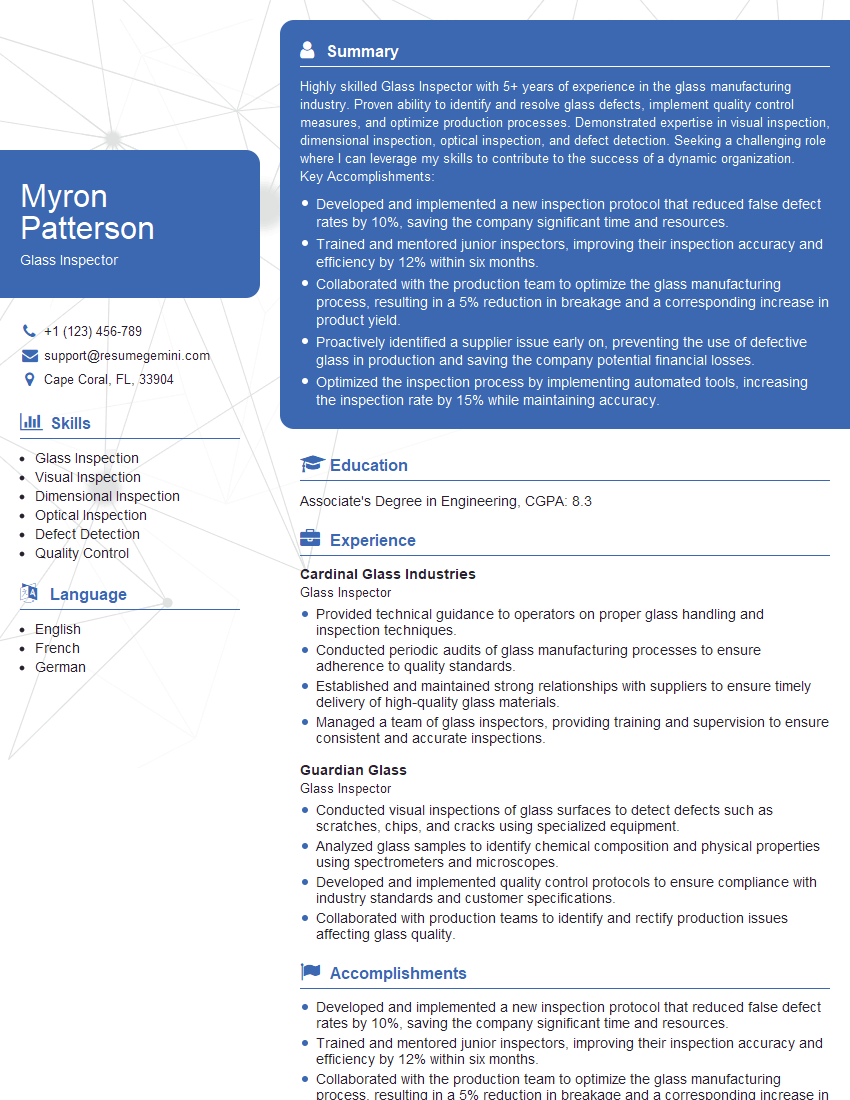
Mastering glass inspection opens doors to exciting career opportunities in manufacturing, quality assurance, and related fields. Building a strong foundation in these key areas will significantly enhance your interview performance and overall career prospects. To maximize your chances of landing your dream job, it’s crucial to create an ATS-friendly resume that highlights your skills and experience effectively. ResumeGemini is a trusted resource for building professional resumes that get noticed. We provide examples of resumes tailored to the Glass Inspection field to help you create a compelling application that showcases your expertise.
Explore more articles
Users Rating of Our Blogs
Share Your Experience
We value your feedback! Please rate our content and share your thoughts (optional).
What Readers Say About Our Blog
Very informative content, great job.
good