The thought of an interview can be nerve-wracking, but the right preparation can make all the difference. Explore this comprehensive guide to Global Harmonized System of Classification and Labelling of Chemicals (GHS) interview questions and gain the confidence you need to showcase your abilities and secure the role.
Questions Asked in Global Harmonized System of Classification and Labelling of Chemicals (GHS) Interview
Q 1. Explain the key differences between the Globally Harmonized System of Classification and Labelling of Chemicals (GHS) and previous chemical classification systems.
The Globally Harmonized System of Classification and Labelling of Chemicals (GHS) represents a significant advancement over previous, often disparate, national chemical classification systems. Before GHS, each country had its own unique criteria for classifying and labeling chemicals, leading to confusion and inconsistencies in international trade and hazard communication. Imagine trying to understand safety information on a chemical product from five different countries – each with its own symbols, phrases, and hazard categories! This was the reality before GHS.
GHS offers a unified, internationally recognized system. Key differences include:
- Standardized Hazard Classification: GHS provides globally consistent criteria for classifying chemicals based on their inherent hazards, eliminating the inconsistencies of the past.
- Harmonized Hazard Communication Elements: It uses standardized pictograms, signal words, hazard statements, and precautionary statements, making it easier to understand chemical risks regardless of origin.
- Improved Data Consistency: GHS aims to reduce ambiguity and ensure consistent hazard communication across borders, facilitating safer handling and use of chemicals worldwide.
- Enhanced Safety Data Sheets (SDS): GHS mandates a standardized 16-section format for SDSs, improving the accessibility and comparability of safety information.
In essence, GHS promotes better global communication of chemical hazards, improving workplace safety and protecting human health and the environment.
Q 2. Describe the hazard classes and categories within the GHS.
The GHS organizes chemical hazards into various hazard classes and categories. Think of it as a detailed catalog of potential dangers, each with its specific characteristics. Here are some key examples:
- Physical Hazards: These relate to the physical properties of a substance that pose a risk, including:
- Explosives: Substances that can explode under certain conditions.
- Flammable Gases, Liquids, and Solids: Substances that can easily ignite and burn.
- Oxidizers: Substances that can cause or enhance combustion.
- Self-Reactive Substances: Substances that can undergo dangerous reactions without external stimuli.
- Pyrophoric Liquids and Solids: Substances that can ignite spontaneously in air.
- Self-Heating Substances: Substances that can increase in temperature under certain conditions.
- Substances that Desensitize Explosives: Substances that reduce the sensitivity of explosives.
- Organic Peroxides: Organic compounds containing the peroxide group, often unstable and prone to explosion.
- Corrosive to Metals: Substances that can attack metals.
- Health Hazards: These hazards involve the potential of a chemical to harm human health, including:
- Acute Toxicity: Immediate or short-term harmful effects.
- Skin Corrosion/Irritation: Damaging effects to skin.
- Serious Eye Damage/Irritation: Damaging effects to eyes.
- Respiratory or Skin Sensitization: Allergic reactions.
- Germ Cell Mutagenicity: Damage to reproductive cells.
- Carcinogenicity: Causing cancer.
- Reproductive Toxicity: Harmful effects on reproductive organs or functions.
- STOT-single exposure: Single exposure causing organ damage.
- STOT-repeated exposure: Repeated exposure causing organ damage.
- Aspiration Hazard: Harmful effects when inhaled into the lungs.
- Environmental Hazards: These describe the potential of a chemical to harm the environment. The GHS addresses environmental hazards through specific classification criteria related to aquatic toxicity.
Each hazard class is further subdivided into categories reflecting the degree of hazard (e.g., Category 1 being the most severe, and Category 4 the least severe within a given hazard class).
Q 3. What are the different signal words used in GHS labeling, and what do they signify?
The GHS uses signal words on labels to immediately convey the level of hazard. Think of them as warning flags, indicating the severity of the potential risk. There are two signal words:
- Danger: Indicates a high degree of hazard. This signal word is used for chemicals with the most severe hazards.
- Warning: Indicates a moderate degree of hazard. This is used for chemicals presenting less severe but still significant hazards.
The signal word is prominently displayed on the label and immediately alerts the user to the potential danger. For instance, a bottle labeled ‘Danger’ will demand more caution and protective measures compared to a bottle labeled ‘Warning’.
Q 4. Explain the purpose and components of a Safety Data Sheet (SDS) according to GHS.
The Safety Data Sheet (SDS), according to GHS, is a comprehensive document providing detailed information on the hazards of a chemical and how to handle it safely. It’s like an instruction manual for safe chemical handling. The GHS mandates a standardized 16-section format:
- Section 1: Identification: Product identifier, supplier details, emergency contact information.
- Section 2: Hazard Identification: Hazard classification, signal words, hazard statements, precautionary statements.
- Section 3: Composition/Information on Ingredients: Chemical composition and concentration of hazardous ingredients.
- Section 4: First-aid measures: Recommended first aid procedures.
- Section 5: Fire-fighting measures: Suitable extinguishing agents, specific hazards.
- Section 6: Accidental release measures: Steps to take in case of accidental spills.
- Section 7: Handling and storage: Safe handling practices and storage conditions.
- Section 8: Exposure controls/personal protection: Measures to protect workers from exposure.
- Section 9: Physical and chemical properties: Physical and chemical characteristics of the substance.
- Section 10: Stability and reactivity: Stability and reactivity information.
- Section 11: Toxicological information: Health effects of exposure.
- Section 12: Ecological information: Environmental effects of the substance.
- Section 13: Disposal considerations: Safe disposal procedures.
- Section 14: Transport information: Transportation regulations and requirements.
- Section 15: Regulatory information: Relevant regulations and legislation.
- Section 16: Other information: Additional relevant information.
Each section provides crucial information for ensuring safe use, storage, handling, and disposal of chemicals. This standardized format ensures consistency and ease of understanding across different countries and industries.
Q 5. How does the GHS address the classification of mixtures?
The GHS provides a detailed framework for classifying mixtures – products made of two or more substances. It’s not as simple as averaging the hazards of individual components. Instead, the GHS uses a mixture classification approach that considers the overall hazard profile of the mixture, considering factors like:
- Additive effects: Where the combined effect of the individual components is simply the sum of their individual hazards.
- Synergistic effects: Where the combined effect is greater than the sum of individual components – a 1+1=3 scenario.
- Antagonistic effects: Where the combined effect is less than the sum of individual components.
The classification of a mixture depends on the hazard classifications of its individual components and their concentrations. Specific rules and methods are outlined in the GHS to determine the appropriate hazard classification for the mixture as a whole. Specialized software and expertise are often needed to perform these calculations accurately.
Q 6. What are the criteria for classifying a chemical as a carcinogen under GHS?
Classifying a chemical as a carcinogen under GHS requires robust scientific evidence demonstrating its cancer-causing potential. The criteria generally involve evaluating evidence from various sources, including:
- Human epidemiological studies: Studies of human populations exposed to the chemical showing a statistically significant increase in cancer rates.
- Animal studies: Experiments on animals demonstrating cancer development after exposure to the chemical.
- Mechanistic studies: Investigations into the biological mechanisms by which the chemical might cause cancer.
The evaluation of this evidence follows specific guidelines and thresholds defined within the GHS. The strength and weight of evidence are crucial in determining the final classification as a Category 1A (confirmed human carcinogen), Category 1B (probable human carcinogen), or Category 2 (suspected human carcinogen), with Category 1A representing the highest level of carcinogenic concern.
Q 7. Describe the process of assigning hazard statements and precautionary statements.
Hazard statements and precautionary statements are essential components of GHS labeling and SDS. They provide specific information about the hazards of a chemical and recommended measures to mitigate those hazards. Think of hazard statements as describing ‘what’ the hazard is and precautionary statements as outlining ‘how’ to prevent or minimize it.
Hazard statements describe the nature of the hazard. They are chosen based on the chemical’s hazard classification. For example, ‘Causes serious eye irritation’ or ‘May cause cancer’.
Precautionary statements provide recommendations on how to safely handle, use, store, and dispose of the chemical. They are grouped into several categories:
- Prevention: Measures to prevent exposure (e.g., ‘Obtain special instructions before use’).
- Response: Actions to take in case of exposure (e.g., ‘IF IN EYES: Rinse cautiously with water for several minutes’).
- Storage: Recommendations for safe storage (e.g., ‘Store locked up’).
- Disposal: Safe disposal procedures (e.g., ‘Dispose of contents/container in accordance with local/regional/national/international regulations’).
Both hazard and precautionary statements are selected from a standardized list provided in the GHS, ensuring consistency and clarity in hazard communication. The appropriate statements are assigned based on the specific hazard classification of the chemical.
Q 8. What are the requirements for GHS compliant labeling?
GHS compliant labeling is crucial for ensuring worker safety and environmental protection. It requires a standardized approach to communicating the hazards associated with a chemical product. The label must include several key elements, all clearly visible and legible.
- Product Identifier: A unique name or number for the chemical. Think of it as the chemical’s ‘official name’ that allows for easy identification.
- Signal Word: This indicates the severity of the hazard – either ‘Danger’ (high severity) or ‘Warning’ (moderate severity). It’s like a headline alerting you to the level of risk.
- Pictograms: Standardized symbols depicting specific hazard classes (discussed further in the next question). These are like visual warnings, universally understood.
- Hazard Statements: Concise descriptions of the nature and degree of the hazards. This provides a more detailed description of the pictograms.
- Precautionary Statements: Instructions on how to prevent or minimize exposure to the hazards. This section tells you how to stay safe.
- Supplier Identification: Contact information for the manufacturer or supplier. In case of an emergency or question, you know who to contact.
For example, a bottle of concentrated sulfuric acid would have a ‘Danger’ signal word, a corrosive pictogram, hazard statements describing its corrosive nature and potential for severe burns, and precautionary statements advising on protective clothing and handling procedures.
Q 9. Explain the importance of pictograms in GHS labeling.
Pictograms are the visual cornerstones of GHS labeling. They are standardized symbols that instantly communicate the type of hazard present. Their universal design transcends language barriers, making them essential for international chemical safety. Imagine trying to decipher warnings in a language you don’t understand – pictograms remove that obstacle.
Each pictogram represents a specific hazard class, such as flammability, toxicity, or corrosivity. Their use makes hazard identification quick and easy. A flame pictogram immediately alerts someone to the flammability of a substance, whereas a skull and crossbones instantly signifies acute toxicity. This immediate recognition allows workers and consumers to react appropriately and safely.
The effectiveness of pictograms lies in their simplicity and immediate impact. They are much more quickly and easily grasped than text-only warnings, improving overall communication of chemical hazards.
Q 10. How does the GHS address physical hazards?
The GHS classifies physical hazards based on the inherent properties of a chemical that could cause harm through physical processes like explosion, fire, or release of energy. This classification system is critical for preventing accidents and ensuring safe handling.
- Explosives: Substances or mixtures that can undergo a rapid exothermic reaction.
- Flammable Gases, Liquids, Solids, and Aerosols: Substances that can easily ignite and burn.
- Oxidizers: Substances that can cause or enhance combustion of other materials.
- Self-Reactive Substances and Mixtures: Substances that can undergo a strongly exothermic decomposition.
- Pyrophoric Liquids and Solids: Substances that ignite spontaneously in air.
- Self-Heating Substances and Mixtures: Substances that can self-heat to dangerous temperatures.
- Substances and Mixtures which, in contact with water, emit flammable gases: Substances that react with water to produce flammable gases.
- Corrosive substances and mixtures: Substances that can destroy living tissue or materials through chemical reactions.
For instance, a label on a highly flammable solvent would clearly indicate its flammability hazard through both a pictogram and hazard statements, specifying things like flash point and ignition temperature.
Q 11. How does the GHS address health hazards?
The GHS addresses health hazards by classifying chemicals based on their potential to cause harm to human health through various routes of exposure (inhalation, skin contact, ingestion). This classification system utilizes various hazard categories to effectively communicate the potential dangers.
- Acute Toxicity: The potential for a chemical to cause immediate harm after a single exposure.
- Skin Corrosion/Irritation: The potential for a chemical to cause damage to the skin.
- Serious Eye Damage/Eye Irritation: The potential for a chemical to cause damage to the eyes.
- Respiratory or Skin Sensitization: The potential for a chemical to cause allergic reactions.
- Germ Cell Mutagenicity: The potential for a chemical to cause damage to genetic material.
- Carcinogenicity: The potential for a chemical to cause cancer.
- Reproductive Toxicity: The potential for a chemical to cause harm to reproductive organs or offspring.
- Specific Target Organ Toxicity – Single Exposure: The potential for a chemical to cause damage to specific organs after a single exposure.
- Specific Target Organ Toxicity – Repeated Exposure: The potential for a chemical to cause damage to specific organs after repeated exposures.
- Aspiration Hazard: The potential for a chemical to cause lung damage if aspirated (inhaled into the lungs).
For example, a chemical classified as a carcinogen would require a label indicating this hazard, including specific hazard and precautionary statements related to cancer risk.
Q 12. How does the GHS address environmental hazards?
The GHS also addresses environmental hazards, acknowledging the impact chemicals can have on the environment. This classification focuses on the potential for chemicals to harm aquatic life and the environment more broadly.
- Aquatic Toxicity: This refers to the harmful effects a chemical can have on aquatic organisms (fish, invertebrates, algae).
- Ozone Depletion: Chemicals that deplete the ozone layer are classified under this category.
For example, a pesticide that is highly toxic to aquatic organisms would be labeled with appropriate hazard statements indicating its potential harm to the aquatic environment and precautionary statements for proper disposal and prevention of environmental contamination.
Q 13. What are the responsibilities of employers regarding GHS compliance?
Employers have a critical role in ensuring GHS compliance within their workplaces. Their responsibilities include:
- Providing training: Employees must receive adequate training on the hazards associated with the chemicals they handle and how to use the GHS information on labels and safety data sheets (SDS).
- Implementing control measures: Employers must implement appropriate control measures such as engineering controls (ventilation), administrative controls (work practices), and personal protective equipment (PPE) to minimize worker exposure.
- Labeling and SDS access: Chemicals must be properly labeled according to GHS standards, and SDSs must be readily available to employees.
- Emergency preparedness: Employers must have plans and procedures in place to handle chemical spills and other emergencies.
- Keeping up to date: Employers must stay informed about changes and updates to GHS regulations.
Think of it as creating a safe and informed workplace. Failure to fulfill these responsibilities can lead to accidents, injuries, and legal repercussions.
Q 14. What are the implications of non-compliance with GHS regulations?
Non-compliance with GHS regulations carries significant implications for businesses and individuals. The consequences can range from fines and penalties to legal action and reputational damage.
- Legal penalties: Governments can impose significant fines for non-compliance, which can severely impact a company’s financial stability.
- Civil lawsuits: Employees or others who are injured due to non-compliance can file civil lawsuits seeking compensation for their injuries.
- Criminal charges: In extreme cases involving gross negligence or willful disregard for safety, criminal charges may be filed.
- Reputational damage: Non-compliance can damage a company’s reputation, leading to loss of customer trust and market share.
- Import/export restrictions: Non-compliance can hinder the ability to import or export chemicals.
GHS compliance is not merely a formality; it’s a fundamental aspect of responsible chemical handling and a key element in safeguarding worker health and the environment.
Q 15. How does the GHS approach the classification of chemicals with multiple hazards?
The GHS handles chemicals with multiple hazards by classifying them for each hazard individually. Imagine a chemical that’s both flammable and toxic. It wouldn’t receive one single classification; instead, it would be classified as flammable (with a specific hazard category) and toxic (with its own hazard category). Each hazard receives its own hazard statement, precautionary statement, and corresponding label elements. This ensures a comprehensive understanding of the risks involved. The overall classification is a summation of these individual hazard classifications, not a single combined classification. For instance, it might be classified as Flammable Liquid, Category 2 and Acute Toxicity, Category 3. The label would then reflect both hazards clearly and distinctly.
Career Expert Tips:
- Ace those interviews! Prepare effectively by reviewing the Top 50 Most Common Interview Questions on ResumeGemini.
- Navigate your job search with confidence! Explore a wide range of Career Tips on ResumeGemini. Learn about common challenges and recommendations to overcome them.
- Craft the perfect resume! Master the Art of Resume Writing with ResumeGemini’s guide. Showcase your unique qualifications and achievements effectively.
- Don’t miss out on holiday savings! Build your dream resume with ResumeGemini’s ATS optimized templates.
Q 16. Describe the role of competent authorities in GHS implementation.
Competent authorities play a crucial role in GHS implementation. They are responsible for adopting and implementing the GHS within their respective jurisdictions. This involves translating the GHS criteria into national regulations, ensuring compliance, and providing guidance to industry. They often establish national bodies for hazard classification and conduct training programs for chemical manufacturers, importers, and other stakeholders. Think of them as the ‘GHS police’ ensuring everyone plays by the rules, creating a level playing field and protecting the public. This includes activities like reviewing Safety Data Sheets (SDSs), conducting inspections, and enforcing penalties for non-compliance. They’re vital in creating a harmonized system within a country while aligning with the international GHS standards.
Q 17. What are the differences between classification and labeling in the context of GHS?
Classification and labeling are two distinct but interconnected processes under GHS. Classification is the scientific process of determining the hazards of a chemical or mixture based on available data, using standardized criteria. It’s like a diagnosis – identifying the inherent dangers. Labeling, on the other hand, is the process of communicating these identified hazards to users through pictograms, signal words (danger or warning), hazard statements, and precautionary statements on a label. This is the prescription— clearly communicating how to handle the diagnosed risks. For example, classifying a chemical as ‘acutely toxic’ is classification. Putting a skull and crossbones pictogram, a ‘danger’ signal word, a hazard statement (‘Causes death or severe health hazards if swallowed’), and precautionary statements (‘Do not breathe dust/fume/gas/mist/vapors/spray’) on the container is labeling.
Q 18. How does GHS address the issue of cut-off concentrations for mixtures?
GHS addresses cut-off concentrations for mixtures by specifying that hazards are only considered if a component is present above a specific concentration. This means that a mixture may not require classification for a particular hazard if the hazardous components are present below their designated cut-off concentrations. These cut-off concentrations are specified for various hazard classes. For instance, if a chemical is classified as carcinogenic, but in a mixture, it’s present in a concentration far below the cut-off, it wouldn’t necessarily trigger a classification for carcinogenicity for that mixture. The specific cut-off values are provided in the GHS, which vary depending on the hazard class and the specific substance. This is important to prevent unnecessary classification of mixtures with negligible hazard.
Q 19. Explain the concept of ‘down-classification’ in GHS.
Down-classification in GHS refers to the process of assigning a less hazardous classification to a chemical or mixture than would otherwise be warranted based on its inherent properties. This happens when specific mitigating measures, such as packaging or engineering controls, are incorporated to reduce the risks associated with the chemical to a significantly lower level. Think of it as a safety net. For example, a highly flammable liquid might be classified as a less hazardous category if it is packaged in a specialized container designed to prevent ignition. The important thing is that the down-classification is justified through appropriate documentation and evidence showing that the risk is effectively mitigated. This is done to reflect the actual level of hazard presented under the described conditions.
Q 20. What are the key updates in the latest GHS revisions?
Recent GHS revisions have focused on several key areas. There have been updates to classification criteria for certain hazard classes, improving accuracy and aligning with the latest scientific understanding. New hazard classes and categories have been introduced to address emerging chemical hazards and better reflect evolving safety concerns. Furthermore, there’s a greater focus on improving the clarity and consistency of hazard communication elements like hazard statements and precautionary statements. There have also been improvements to the guidance on classifying mixtures, addressing complexities in determining the hazard profiles of complex chemical mixtures and providing clearer methods to assess their toxicity. These revisions continuously refine the GHS, making it more comprehensive and effective in protecting human health and the environment.
Q 21. How does the GHS facilitate international trade of chemicals?
The GHS significantly facilitates international trade of chemicals by providing a globally harmonized system for classifying and labeling chemicals. This means that manufacturers and importers only need to comply with a single set of criteria, rather than a multitude of different national regulations. This simplifies the regulatory burden, reduces costs, and eliminates potential inconsistencies in the way chemicals are classified and labeled across borders. This fosters international cooperation and improves the safety and efficiency of the global chemical trade. In short, it creates a shared language for chemical safety, benefiting all parties involved, from manufacturers to consumers.
Q 22. How do you determine the appropriate precautionary statements for a specific chemical?
Determining the appropriate precautionary statements for a chemical is crucial for ensuring worker and consumer safety. It’s not simply a matter of picking statements at random; it’s a process driven by the chemical’s hazard classification.
First, you must accurately classify the chemical according to its hazards – flammability, health effects (acute toxicity, skin irritation, etc.), environmental hazards, etc., using the GHS criteria. Each hazard class has associated hazard statements (H-statements). These H-statements describe the nature of the hazard. For example, H226 might be assigned to a flammable liquid, stating ‘Flammable liquid and vapor’.
Once the hazard statements are identified, you select the corresponding precautionary statements (P-statements). P-statements advise on how to mitigate the hazards. These are preventative measures and response actions. For our flammable liquid example, suitable P-statements might include P210 (‘Keep away from heat/sparks/open flames/hot surfaces. – No smoking.’), P233 (‘Keep container tightly closed.’), and P370+P378 (‘In case of fire: Use … to extinguish’). The selection depends entirely on the identified hazard(s) and needs to comprehensively address how to safely handle, store, and respond to incidents involving the chemical.
The process isn’t always straightforward; often, a combination of P-statements is necessary to fully cover all aspects of safe handling. Specialized software or databases can assist with selecting the appropriate P-statements based on the assigned H-statements, but expert judgment is always required to ensure complete and accurate labelling.
Q 23. Explain the process of updating an SDS based on new information.
Updating an SDS (Safety Data Sheet) based on new information is a critical aspect of GHS compliance. New information might include results from additional testing, changes in manufacturing processes, identification of new hazards, or revisions to regulations. The process should be systematic and documented.
First, thoroughly review the new information. Does it impact the classification of the chemical? Are new hazards identified? Are there any changes to the handling procedures or recommended PPE? All relevant sections of the SDS need consideration.
Next, update the SDS accordingly. This may involve revising the hazard classification, hazard statements (H-statements), precautionary statements (P-statements), composition information, handling and storage precautions, first aid measures, or other relevant sections. Any changes must be clearly indicated (e.g., revision date, version number).
Finally, thoroughly review the updated SDS to ensure consistency and accuracy. All sections must be aligned with the changes made based on the new information. The updated SDS must then be distributed to all relevant stakeholders, including downstream users and employees. A version control system is essential to track changes and ensure everyone has access to the most current version.
Consider this example: Let’s say new toxicity data reveals a higher acute toxicity for a chemical than previously known. The SDS would need to reflect this: updating the hazard classification, adjusting the H-statements and corresponding P-statements to reflect the increased toxicity level, and revising the first-aid measures section accordingly.
Q 24. How do you ensure compliance with both GHS and specific regional regulations?
Ensuring compliance with both GHS and regional regulations often involves navigating a complex regulatory landscape. While GHS provides a globally harmonized framework, individual countries or regions frequently incorporate specific requirements. The key is a multi-faceted approach.
First, a thorough understanding of both the GHS standards and the specific regional regulations is paramount. This includes knowing the differences in hazard classification criteria, labelling requirements, and SDS formatting. This may require consulting various regulatory documents and seeking expert advice.
Second, a well-defined compliance program should be in place. This includes regular reviews of SDSs and labels to ensure they are up-to-date with both GHS and regional requirements. The program should also cover training for employees on proper handling, storage, and emergency procedures.
Third, using SDS authoring software that can automatically incorporate regional-specific regulations is vital. This software can help streamline the process, reducing the risk of errors and ensuring consistency across all documents. Finally, keeping detailed records of all compliance activities and maintaining a system for tracking updates is critical for demonstrating compliance to regulatory authorities.
For example, while GHS provides a general framework for labelling, the EU’s CLP Regulation might have additional specific labelling requirements for certain chemical categories. A company selling a product in the EU must ensure their labels conform to both GHS principles and EU-specific mandates.
Q 25. Describe a situation where you had to resolve a GHS-related compliance issue.
In a previous role, we discovered that a supplier had misclassified a chemical in their SDS. Their classification significantly understated the hazard associated with skin contact, omitting relevant H-statements and P-statements for skin sensitization. This was a serious GHS non-compliance issue because it failed to adequately inform users of the potential risk.
We first verified the supplier’s misclassification using independent data sources. Once confirmed, we formally communicated the discrepancy to the supplier, referencing specific regulations and guidelines. We provided detailed information about the correct hazard classification and the necessary amendments to their SDS, including the correct H- and P-statements.
Then we established a robust corrective action plan. We requested the supplier issue a revised SDS with the accurate information and provide evidence of their internal process changes to prevent similar errors in the future. We implemented a stricter protocol for verifying the accuracy of SDSs from all our suppliers going forward, including independent verification of hazard classifications for high-risk chemicals. This ensured not only compliance but also improved our overall chemical safety management system.
Q 26. Explain your understanding of the Globally Harmonized System of Classification and Labelling of Chemicals (GHS) and its significance in chemical safety.
The Globally Harmonized System of Classification and Labelling of Chemicals (GHS) is an internationally agreed-upon system created by the United Nations. Its primary goal is to standardize the classification and communication of chemical hazards globally. This reduces confusion, improves safety, and facilitates international trade by creating a common language for chemical safety.
The GHS is built around several key components: hazard classification (categorizing chemicals based on their inherent hazards), hazard communication (through labels and Safety Data Sheets or SDSs), and hazard communication elements (specific pictorial warnings, standardized signal words, H-statements, and P-statements).
Its significance lies in its ability to improve chemical safety worldwide. By standardizing how hazards are communicated, GHS helps prevent accidents, illnesses, and environmental damage resulting from incorrect handling or exposure to hazardous chemicals. It allows for a uniform approach to safety, making it easier for workers, consumers, and emergency responders to understand the risks associated with chemicals regardless of their origin or destination.
Q 27. How would you train employees on GHS compliance?
Training employees on GHS compliance is essential for ensuring a safe work environment. The training should be multi-faceted and tailored to the specific needs of the workforce.
The training should start with an overview of the GHS system itself – what it is, why it’s important, and its key components. This should include a clear explanation of hazard classification, hazard communication elements (pictograms, signal words, H-statements, P-statements), and the role and content of SDSs.
Next, the training should cover the specific chemicals used in the workplace. Employees should learn about the hazards associated with each chemical, the appropriate handling procedures, personal protective equipment (PPE) requirements, and emergency response procedures. Hands-on training or demonstrations can be incredibly effective here.
Finally, the training should include regular refreshers and updates to account for any changes in regulations or new chemicals introduced into the workplace. Regular quizzes or assessments help to reinforce learning and identify areas where additional training may be needed. Using interactive methods, such as case studies or scenarios, can make the training more engaging and relatable.
Q 28. What are some common challenges in implementing GHS?
Implementing GHS presents several challenges, many stemming from the sheer scale and complexity of the system. Some of the most common challenges include:
- Cost of Implementation: Updating labels, SDSs, and training materials can be expensive, particularly for companies with a large number of products or chemicals.
- Keeping Up with Updates: GHS is an evolving system; keeping abreast of changes and updates can be challenging and requires ongoing vigilance.
- Language Barriers: Ensuring consistent and accurate translation of GHS information into multiple languages can be difficult and costly.
- Training and Education: Thorough and effective training for all employees can be time-consuming and requires expertise in GHS principles.
- Integration with Existing Systems: Integrating GHS requirements with existing chemical management systems can be complex and may require significant software modifications.
- Enforcement and Consistency: Ensuring consistent enforcement and interpretation of GHS regulations across different regions can be challenging.
Overcoming these challenges requires a proactive and well-planned approach that includes allocating sufficient resources, establishing clear communication channels, and employing suitable technologies to manage the complexities of GHS implementation.
Key Topics to Learn for Global Harmonized System of Classification and Labelling of Chemicals (GHS) Interview
- Classification of Chemicals: Understanding the hazard categories within GHS, including physical hazards (flammability, explosivity), health hazards (toxicity, carcinogenicity), and environmental hazards. Learn how to determine the appropriate hazard class for various chemicals.
- Labeling Requirements: Mastering the creation of compliant GHS labels, including the signal words (danger, warning), hazard statements, precautionary statements, pictogram selection, and supplier identification information. Practice applying these elements to different chemical scenarios.
- Safety Data Sheets (SDS): Gain a thorough understanding of SDS structure and content as per GHS requirements. Focus on interpreting and utilizing the information provided within an SDS for risk assessment and safe handling procedures.
- GHS Implementation and Compliance: Familiarize yourself with the practical aspects of GHS implementation within an organization, including training programs, inventory management, and compliance auditing. Consider the challenges and best practices for ensuring ongoing compliance.
- Differences between GHS and other chemical classification systems: Understand the evolution and global harmonization efforts. Be prepared to discuss the advantages and disadvantages of a harmonized system compared to previous regional systems.
- Hazard Communication: Explore the effective communication of chemical hazards to workers and consumers. Consider different communication strategies and the importance of clear, concise, and accessible information.
- Problem-solving: Practice applying your knowledge to hypothetical scenarios. For example, consider how you would classify a new chemical, develop a compliant label, or address a non-compliance issue.
Next Steps
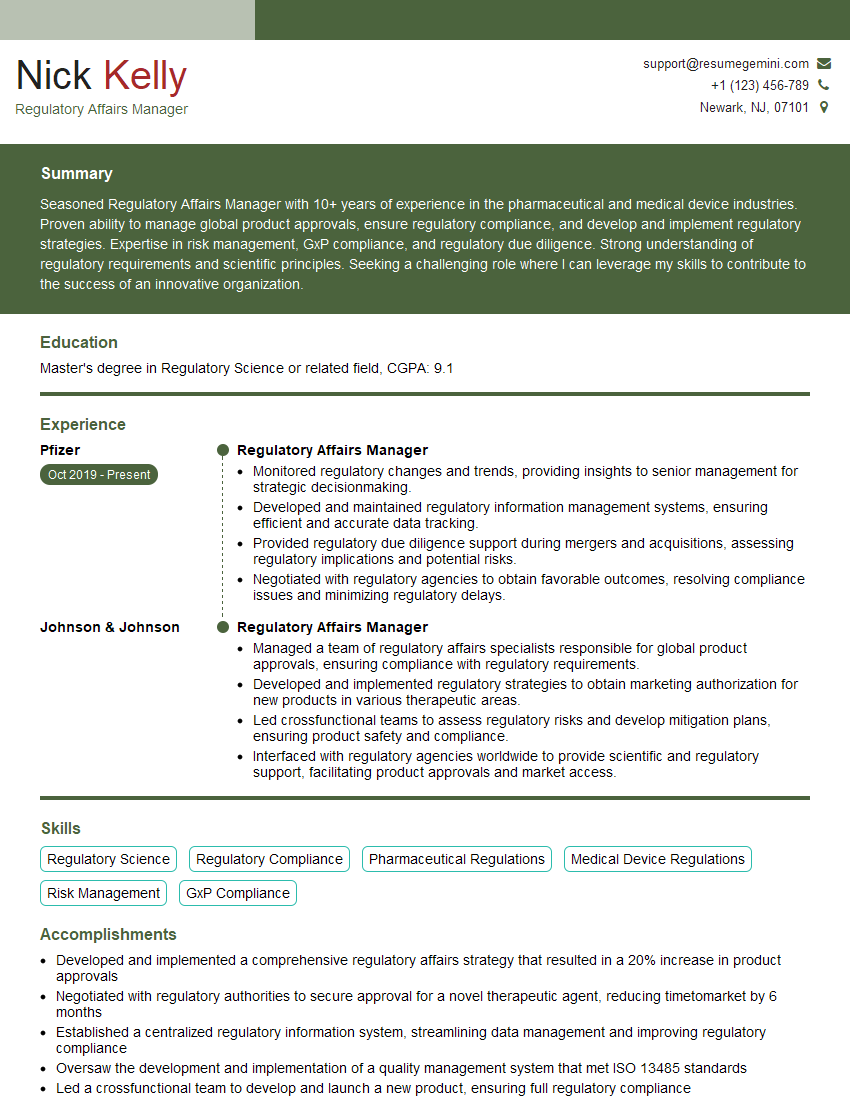
Mastering the GHS is crucial for career advancement in chemical safety, environmental health, and related fields. A strong understanding of GHS principles demonstrates a commitment to safety and compliance, making you a highly desirable candidate. To maximize your job prospects, create an ATS-friendly resume that highlights your relevant skills and experience. ResumeGemini is a trusted resource to help you build a professional and impactful resume. Examples of resumes tailored to Global Harmonized System of Classification and Labelling of Chemicals (GHS) are available to guide you.


Explore more articles
Users Rating of Our Blogs
Share Your Experience
We value your feedback! Please rate our content and share your thoughts (optional).
What Readers Say About Our Blog
Very informative content, great job.
good