The right preparation can turn an interview into an opportunity to showcase your expertise. This guide to Guitar Skills interview questions is your ultimate resource, providing key insights and tips to help you ace your responses and stand out as a top candidate.
Questions Asked in Guitar Skills Interview
Q 1. Explain the difference between major and minor scales.
The difference between major and minor scales lies primarily in the intervals between their notes. Both are seven-note scales, but the arrangement of whole and half steps (the distance between consecutive notes) differs significantly, creating contrasting moods. A major scale is characterized by a cheerful, bright sound, while a minor scale evokes a somber, melancholic feel.
A major scale is built using the formula: whole, whole, half, whole, whole, whole, half step intervals. For example, the C major scale is C-D-E-F-G-A-B-C. Notice the half steps between E-F and B-C.
A natural minor scale uses the formula: whole, half, whole, whole, half, whole, whole steps. The A natural minor scale, for instance, is A-B-C-D-E-F-G-A. The half step is between A-B and E-F. Other minor scales exist (harmonic and melodic minor) with slightly altered intervals to address certain harmonic issues, but the natural minor serves as the foundational minor scale.
Think of it like this: major is like a sunny day, while minor is like a cloudy, introspective evening. The difference in intervals creates this fundamental contrast in emotional expression.
Q 2. Describe your approach to practicing scales and arpeggios.
My approach to practicing scales and arpeggios is systematic and focuses on both technical proficiency and musicality. I avoid mindless repetition. Instead, I employ several strategies.
- Slow and Deliberate Practice: I start at a tempo slower than I can comfortably play, ensuring clean execution of each note. Gradually, I increase the tempo as accuracy improves.
- Pattern Recognition: I break down scales and arpeggios into smaller, manageable patterns, focusing on evenness, precision, and transitions between patterns. For example, with a major scale, I might practice three-note segments repeatedly before moving to the full scale.
- Intervallic Approach: I often practice scales and arpeggios by focusing on the intervals between notes rather than just playing them sequentially. This helps develop a deep understanding of the underlying harmonic structure.
- Variety in Articulation and Dynamics: I avoid playing scales and arpeggios monotonously. I incorporate different articulations like legato (smooth, connected notes) and staccato (short, detached notes), and I vary dynamics (loudness and softness) to develop a more expressive playing style.
- Application in Musical Contexts: I don’t just practice scales and arpeggios in isolation. I incorporate them into improvisations, chord progressions, and etudes to develop musical phrasing and contextual understanding.
This multifaceted approach ensures that my practice is efficient and leads to noticeable improvement in both technical skills and musical expressiveness.
Q 3. What are your preferred methods for improving your technique?
Improving guitar technique involves continuous effort and a combination of approaches. My preferred methods include:
- Targeted Exercises: I identify specific weaknesses in my technique—like weak pinky strength, sloppy vibrato, or inaccurate fretting—and then devise specific exercises to address those issues. This is highly personalized and goal-oriented.
- Metronome Work: Consistent practice with a metronome is crucial. It improves timing, accuracy, and rhythm. I start slowly and progressively increase the tempo.
- Systematic Finger Exercises: Exercises focusing on finger independence, dexterity, and strength are essential. Simple chromatic runs, spider exercises, and scale variations help build foundational strength and coordination.
- Recording and Analysis: I frequently record my playing to objectively evaluate my technique. This allows me to identify areas needing improvement and track my progress over time. Listening back critically is essential.
- Learning from Others: Observing and learning from accomplished guitarists, either in person or through videos, provides invaluable insights and inspiration. Analyzing their technique can point out areas for refinement.
It’s a continuous process; technique improvement is a journey, not a destination.
Q 4. How do you approach learning a new song on guitar?
Learning a new song on guitar is a systematic process that I break down into several stages:
- Listen and Analyze: First, I listen repeatedly to the song to understand its structure, rhythm, melody, and harmony. This helps grasp the overall feel and identify challenging sections.
- Break it Down: I dissect the song into smaller sections, focusing on one part at a time (e.g., verse, chorus, bridge). This makes learning more manageable and less overwhelming.
- Learn the Chords and Rhythm: I begin by mastering the chords used in the song, ensuring smooth transitions and accurate rhythm. Using a metronome is essential at this stage.
- Practice the Melody: Once the chords and rhythm are comfortable, I work on the melody, focusing on proper finger placement, timing, and dynamics.
- Combine and Refine: I then integrate the melody with the chords and rhythm, working on the complete sections. This process often involves repetition and refining transitions.
- Memorization (Optional): For live performance, memorizing sections improves the performance quality.
- Performance Practice: This involves playing the song multiple times without stopping and under realistic performance conditions.
Patience and persistence are key. Learning a song takes time and dedicated practice, but the process is rewarding.
Q 5. Discuss your experience with different guitar tunings.
My experience with different guitar tunings extends beyond standard tuning (EADGBe). Exploring alternative tunings opens up new sonic possibilities and facilitates easier access to certain chords or playing styles.
- Open Tunings: Open tunings (where several strings are tuned to create open chords) like Open D (DADF#AD) or Open G (DGDGBD) are particularly useful for fingerstyle and slide guitar players as they allow for simpler chord voicings and interesting drone effects.
- Drop Tunings: Drop tunings (where one string is lowered) like Drop D (DADGBe) are common in heavy metal and rock music, allowing for heavier, lower-pitched riffs and sounds.
- Alternative Tunings: Other tunings, such as DADGAD or Open A, offer unique characteristics that suit certain genres and styles. DADGAD is known for its meditative and Celtic-influenced sounds.
Choosing a suitable tuning depends on the musical context and desired effect. Experimentation is key to finding tunings that enhance one’s playing style.
Q 6. Explain your understanding of music theory, including chords, progressions and key signatures.
My understanding of music theory is foundational to my guitar playing. I have a solid grasp of chords, progressions, and key signatures.
- Chords: I understand chord construction, inversion, and voicing, and how chords function within a key. I can quickly identify and play various chord types (major, minor, dominant, diminished, augmented).
- Progressions: I understand common chord progressions (like I-IV-V-I in major keys) and how to create interesting and functional chord sequences. I can analyze progressions and identify their underlying harmonic structure.
- Key Signatures: I can easily identify key signatures (the sharps or flats at the beginning of a musical staff) and understand their implications for chord construction and scale selection. This allows me to quickly transpose songs to different keys.
- Scales and Modes: Beyond major and minor scales, I’m proficient in various modes (Ionian, Dorian, Phrygian, etc.), which provide diverse melodic and harmonic possibilities within a key. This expands my improvisational capacity.
Music theory isn’t just a theoretical framework; it’s a practical tool for understanding how music works, improving improvisation, and composing or arranging my own music. It’s deeply intertwined with my playing.
Q 7. Describe your experience with improvisation.
Improvisation is a crucial aspect of my guitar playing, and it’s something I constantly strive to improve. My approach involves a blend of technical skills, musical understanding, and creative expression.
- Scale and Mode Application: I use scales and modes relevant to the underlying harmony to create melodic phrases. Understanding how different modes and scales create different sounds and moods is crucial.
- Chord Tone Targeting: I focus on incorporating chord tones (the notes within the chord being played) into my improvisations to create a strong harmonic foundation.
- Rhythmic Variation: I vary my rhythmic patterns to avoid monotony and to create interest and groove.
- Dynamic Control: I use dynamics—adjustments in volume and intensity—to create emotional expression and shape the phrasing of my improvisation.
- Listening and Responding: When playing with others, I listen attentively to what’s happening and respond musically, creating a dialogue rather than just soloing independently.
- Practice and Ear Training: Improvisation requires constant practice and ear training. Transcribing solos, jamming with others, and consistently applying theoretical knowledge are crucial for development.
Improvisation isn’t about random note-playing; it’s a creative process built on a solid foundation of music theory and technical skills. It’s a form of musical conversation and storytelling.
Q 8. What are your strengths and weaknesses as a guitarist?
My greatest strength as a guitarist lies in my versatility and adaptability. I’m comfortable playing a wide range of styles, from intricate jazz phrasing to aggressive metal riffs, and I can quickly adapt my playing to suit different musical contexts. I’m also a strong sight-reader and possess a deep understanding of music theory, enabling me to quickly learn and interpret new material. However, my weakness is sometimes overthinking during live performances. While I’m technically proficient, I sometimes get bogged down in perfectionism, which can affect my spontaneity and flow.
Q 9. How do you handle performance anxiety?
Performance anxiety is a common challenge for musicians. I handle it through a combination of preparation and mental strategies. Thorough rehearsal is crucial – the more familiar I am with the material, the more confident I feel. I also employ mindfulness techniques like deep breathing and visualization before performances to calm my nerves. I focus on the joy of playing and connecting with the audience, rather than fixating on potential mistakes. Finally, performing regularly, starting with smaller gigs, gradually builds confidence and reduces anxiety over time.
Q 10. How do you maintain your guitar and equipment?
Maintaining my guitar and equipment is paramount. I regularly clean my guitar, using a specialized guitar polish and soft cloth to remove dust and grime. I inspect the fretboard for wear and tear and take it to a professional luthier for a setup and fret dressing as needed. I also carefully store my guitar in a hard case to protect it from damage and humidity fluctuations. My amplifier and effects pedals are also regularly checked for any issues; ensuring connections are secure, and keeping them clean and dust-free. Preventive maintenance avoids costly repairs down the road.
Q 11. What are your preferred recording techniques for guitar?
My preferred recording techniques involve a multi-microphone approach for capturing the full sonic character of the guitar. For example, I might use a dynamic microphone like a Shure SM57 close to the amp’s speaker cone to capture the raw power and aggression, and a condenser microphone like a Neumann U87 further away to capture the room ambiance and overall clarity. Experimenting with microphone placement and amp settings can dramatically alter the guitar’s tone. I also frequently use DI (direct injection) for clean, pristine tones which are easier to manipulate later in the mixing process. Digital audio workstations (DAWs) offer a vast range of post-production tools for further shaping the sound. I often use EQ, compression, and reverb plugins to fine-tune the guitar tracks.
Q 12. Describe your experience with different guitar effects pedals.
I have extensive experience with a wide variety of guitar effects pedals. I’m proficient in using overdrive and distortion pedals for adding sustain and warmth to my tone. My experience with modulation effects like chorus, flanger, and phaser allows me to add depth and texture. Delay and reverb pedals are essential for creating spacious soundscapes. I also utilize more niche effects such as fuzz, octave dividers, and pitch shifters, depending on the musical genre and desired effect. Understanding how to subtly blend these effects is key to crafting unique and expressive guitar tones. For example, using a light chorus with a subtle delay can add a shimmery texture to clean tones, while a heavy fuzz with a gated reverb creates a crushing, powerful sound.
Q 13. Explain your understanding of signal processing in guitar amplification.
Signal processing in guitar amplification is a complex but crucial aspect of shaping the guitar’s tone. It begins with the guitar’s pickup, which converts the string vibrations into an electrical signal. This signal is then sent through a chain of components, including effects pedals (if used), the amplifier’s preamp, and finally, the power amp, before reaching the speaker. The preamp shapes the fundamental character of the tone; adding gain, sculpting the EQ, and introducing clipping (overdrive/distortion). The power amp boosts the signal to a level sufficient to drive the speaker. The speaker itself adds its own coloration and harmonic distortion, influencing the final sound heard. Understanding the interaction between these components allows one to craft a specific desired tone. For instance, using a high-gain preamp with a powerful power amp and a speaker designed for handling such power will result in a thick, saturated sound, while using a clean preamp, a lower-powered amp, and a speaker known for clarity will yield a crisp, clear tone.
Q 14. What styles of music are you most proficient in?
I’m most proficient in several styles, including blues, rock, jazz, and funk. My blues playing is deeply rooted in the improvisational nature of the genre, emphasizing feeling and emotion. In rock, I excel in crafting powerful and energetic riffs, using a variety of techniques to create a diverse soundscape. My jazz playing focuses on precision, phrasing, and harmonic complexity, with an emphasis on chord voicings and melodic improvisation. My funk playing is characterized by rhythmic precision, syncopation, and tight phrasing. This diverse background allows me to blend styles effortlessly, adapting my skills to a wide variety of musical projects.
Q 15. How do you adapt your playing to different musical styles?
Adapting my guitar playing to different musical styles involves a multifaceted approach focusing on rhythmic feel, melodic phrasing, and technical execution. It’s not just about knowing the chords; it’s about embodying the style’s essence.
Rhythm: Blues demands a loose, swinging feel, often employing shuffles and syncopation. Conversely, metal requires precise, driving rhythms with heavy use of double bass drumming techniques, which I would reflect in my guitar part by using heavier distortion and fast picking patterns. Classical music emphasizes precise timing and articulation.
Melody & Phrasing: Country often uses simple, memorable melodies with a focus on bending notes and vibrato. Jazz involves complex chord changes and improvisation, requiring a strong understanding of scales, modes, and harmonic relationships. In contrast, flamenco emphasizes passionate, expressive phrasing, using techniques like rasgueado (strumming with the fingernails).
Technique: Fingerstyle techniques are crucial for folk and classical music, while heavy distortion and aggressive strumming are hallmarks of rock and metal. Each style might even demand a different guitar setup – a lighter gauge of strings for flamenco, heavier gauge for metal.
For example, when transitioning from playing a delicate acoustic ballad to a powerful electric rock riff, I would change my picking dynamics, tone settings, and even my body posture to reflect the shift in energy and style.
Career Expert Tips:
- Ace those interviews! Prepare effectively by reviewing the Top 50 Most Common Interview Questions on ResumeGemini.
- Navigate your job search with confidence! Explore a wide range of Career Tips on ResumeGemini. Learn about common challenges and recommendations to overcome them.
- Craft the perfect resume! Master the Art of Resume Writing with ResumeGemini’s guide. Showcase your unique qualifications and achievements effectively.
- Don’t miss out on holiday savings! Build your dream resume with ResumeGemini’s ATS optimized templates.
Q 16. Describe your experience collaborating with other musicians.
Collaboration is the lifeblood of music. I’ve had the pleasure of working with musicians from diverse backgrounds, each experience enriching my musical understanding.
I’ve played in a blues band where the emphasis was on spontaneous improvisation and a shared understanding of the blues language. The interplay between the guitar, bass, drums, and vocals created a dynamic, organic energy.
I’ve also participated in more structured studio sessions for pop songs, where precision and adherence to a pre-arranged arrangement were paramount. Collaboration here focused on meticulous layering of parts, and attention to detail regarding tone and dynamics to complement the other instruments and the vocalist.
Working with jazz musicians sharpened my improvisational skills and deepened my understanding of harmony and theory. The freedom and creativity within the jazz setting fostered a unique style of collaborative interplay.
In all these situations, effective communication, mutual respect, and a willingness to compromise are crucial for a successful collaborative process.
Q 17. How would you teach a beginner guitarist?
Teaching a beginner guitarist starts with building a solid foundation. It’s about instilling good habits from the beginning, making it fun, and keeping the student motivated.
Proper Posture and Hand Position: Ensuring correct posture and hand placement prevents injury and promotes efficient playing.
Basic Chords: Starting with simple, easy-to-learn chords like G, C, and D, allowing the student to experience the joy of making music early on. Focusing on clean chord changes is key.
Simple Songs: Learning easy songs they enjoy will greatly improve their motivation. Teaching them songs with repeating chord patterns allows them to focus on chord changes and rhythm.
Strumming Patterns: Introducing basic strumming patterns adds rhythmic complexity and increases the musicality of the chord progressions they are learning.
Theory Basics: Gradually introducing basic music theory concepts like major and minor scales and understanding how chords relate to scales can significantly accelerate their learning process.
I always tailor my approach to the student’s learning style and interests, ensuring the lessons are engaging and rewarding. I celebrate their successes and provide constructive feedback on areas that need improvement. I often incorporate their favorite songs to make learning more personalized.
Q 18. What teaching methods do you employ?
My teaching methodology blends structured learning with personalized guidance. I don’t believe in a one-size-fits-all approach.
Demonstration and Explanation: I demonstrate techniques and concepts clearly, providing verbal explanations that are easy to understand.
Hands-on Practice: Students engage in substantial practice time, receiving immediate feedback and corrections.
Goal Setting: We collaboratively set achievable goals, fostering a sense of accomplishment and progress.
Regular Assessments: I regularly assess the student’s progress to adjust the teaching approach accordingly.
Positive Reinforcement: Celebrating successes and offering constructive criticism promotes confidence and motivation.
Use of Technology: I utilize online resources, backing tracks, and video tutorials to enhance learning.
I adapt my methods based on the student’s individual learning style, whether they are visual, auditory, or kinesthetic learners. This personalized approach helps each student learn at their own pace and reach their full potential.
Q 19. How do you assess a student’s progress?
Assessing a student’s progress is an ongoing process, not just a final exam. I employ several methods to gauge their development.
Regular Performance Evaluations: Students perform pieces or exercises during lessons, allowing me to observe their technical skills, musicality, and understanding.
Observation of Practice Habits: I assess their consistency and attentiveness during practice sessions, addressing any challenges they face.
Understanding of Music Theory: I evaluate their grasp of fundamental music theory concepts relevant to their skill level.
Creative Expression: I encourage them to develop their individual style and musical expression.
Self-Assessment: I empower students to self-assess their progress, fostering self-awareness and responsibility.
I maintain detailed records of student progress and use this information to adapt my teaching strategy, ensuring they’re challenged appropriately and consistently moving forward.
Q 20. Describe your experience with music notation software.
I’m proficient with several music notation software packages, primarily using Sibelius and MuseScore. These tools are invaluable for composing, arranging, and sharing musical ideas.
Composition: I utilize the software to create accurate transcriptions of my musical ideas, allowing for detailed editing and refinement.
Arranging: The software facilitates arranging pieces for different ensembles, helping me experiment with instrumentation and harmonic voicings.
Sharing: I can easily share my compositions and arrangements with other musicians via digital formats, facilitating collaboration and dissemination.
For example, when composing a complex guitar piece, I use the software’s notation tools to precisely write out intricate fingerings, articulations, and dynamic markings. The ability to hear the composition played back through the software’s virtual instruments provides an essential layer of feedback during the composition process.
Q 21. What are your songwriting techniques?
My songwriting process is iterative and often starts with a single musical idea – a riff, a melody, or a chord progression. From there, the song develops organically.
Riff-Based Composition: Sometimes a compelling guitar riff forms the foundation, inspiring the melody and lyrics to follow. I’ll often experiment with different variations of the riff to find the most interesting direction.
Melody-Driven Composition: At other times, a captivating melody comes first, shaping the harmonic structure and lyrical content.
Lyrical Inspiration: Sometimes the song begins with a lyrical concept, which then inspires the music and the guitar part is developed to complement the lyrics and the overall emotional tone.
Collaboration: I frequently collaborate with other songwriters, bringing diverse perspectives and skills to the creative process.
Throughout this process, I continuously refine and revise the song, experimenting with different arrangements and instrumentation until it feels complete. It’s a journey of experimentation and discovery that results in each song having a unique identity.
Q 22. Explain your understanding of different guitar construction techniques.
Guitar construction is a fascinating blend of art and science, impacting the instrument’s tone, playability, and longevity. Different techniques influence everything from the resonance of the body to the feel of the neck.
- Body Construction: Solid-body guitars, like Stratocasters and Les Pauls, offer sustain and a wide tonal range due to their solid wood bodies. Hollow-body guitars, such as jazz guitars, provide a warmer, more resonant tone but can be prone to feedback at high volumes. Semi-hollow guitars, like the ES-335, combine aspects of both, offering a balance of sustain and resonance.
- Neck Construction: Neck construction methods significantly influence playability. Set necks (glued into the body) offer stability and sustain, while bolt-on necks (attached with screws) are generally easier to adjust and repair. Neck profiles (the shape of the neck) vary greatly, affecting comfort and playing style. Examples include C-shape, D-shape, and U-shape.
- Wood Selection: The type of wood used for the body and neck heavily impacts the guitar’s sound. Mahogany is known for its warm, rich tones, while alder is brighter and more articulate. Rosewood is prized for its smooth feel and resonant properties. The wood’s density and grain also play a crucial role.
- Bracing: Internal bracing patterns within acoustic guitars are crucial for structural integrity and tonal characteristics. X-bracing is a common pattern, but variations exist, impacting the guitar’s projection and overall resonance.
- Finish: The finish applied to the guitar impacts its tone and feel. A thick polyurethane finish can dampen the vibrations slightly, while a thinner nitrocellulose lacquer allows for more resonance.
Understanding these techniques allows luthiers (guitar makers) and repair technicians to diagnose problems, choose appropriate woods for a desired sound, and create instruments tailored to specific musical styles.
Q 23. How do you diagnose and repair common guitar issues?
Diagnosing and repairing guitar issues requires a systematic approach, combining technical knowledge with careful listening and observation. Common problems include buzzing, tuning instability, and fret wear.
- Buzzing: Buzzing can result from several causes: high action (the distance between the strings and frets), loose screws, or fret buzz. I would systematically check each component, adjusting the truss rod (to correct neck relief), adjusting the bridge saddle height to change string height (action), and checking for any loose hardware. Fret buzz often requires fret leveling, dressing, or replacement by a professional.
- Tuning Instability: Tuning problems can stem from issues with the tuning pegs, nut, or bridge. I would inspect the pegs for proper function and lubrication, check the nut slots for proper depth and alignment to ensure strings aren’t binding, and ensure the bridge is securely seated and properly intonated. Intonation involves adjusting the bridge saddles so that each string is in tune across the fretboard.
- Fret Wear: Worn frets cause fret buzz and intonation issues. I assess the wear and advise on the need for a fret dressing or replacement. This is a specialized job best left to experienced luthiers or repair technicians.
For more complex issues, like cracks in the body or neck, professional intervention is necessary. I would always prioritize maintaining a well-organized workbench and using appropriate tools to minimize the risk of further damage during the repair process.
Q 24. Describe your experience with different guitar amplification systems.
My experience encompasses a wide range of guitar amplification systems, from small practice amps to large stage rigs. The choice of amp significantly shapes the guitar’s sound.
- Tube Amps: Tube amplifiers are known for their warm, dynamic, and responsive tone. They offer natural harmonic saturation, which is sought after by many guitarists. Classic examples include Fender Twin Reverb and Marshall Plexi.
- Solid-State Amps: Solid-state amps are generally more affordable and reliable than tube amps, offering clean tones and good headroom. They can be great for clean sounds, but may lack the harmonic richness of tube amps.
- Modeling Amps: Modeling amps digitally recreate the sounds of various tube and solid-state amplifiers, offering versatility at a relatively compact size. These are great for experimenting with different tones without needing a large collection of amps.
- Amp Heads and Cabinets: High-powered setups often involve separate amp heads (the electronics) and cabinets (the speakers). This allows for greater flexibility in choosing speaker configurations and power handling capacity.
My experience involves using these systems in both studio and live settings, understanding their strengths and limitations in different contexts. Knowing how to dial in the correct EQ, gain, and effects is crucial for achieving the desired tone.
Q 25. What is your experience with different types of microphones for guitar recording?
Microphone selection is critical for capturing the nuances of a guitar’s sound. Different mics excel in different situations.
- Dynamic Microphones (e.g., Shure SM57): These are workhorses known for their durability and ability to handle high sound pressure levels. The SM57 is a classic choice for capturing the aggressive attack of a guitar amplifier’s speaker cone, often placed near the edge.
- Condenser Microphones (e.g., Neumann U87): Condenser mics offer a more detailed and nuanced sound, capturing a wider frequency range. They are particularly useful for capturing subtle nuances and often used for more refined, less aggressive sounds, perhaps further from the speaker cone.
- Ribbon Microphones (e.g., Royer R-121): Ribbon mics offer a unique, smooth, and often vintage-sounding character. They are often less sensitive to harsh frequencies and can be used to capture more of the overall ambience.
The choice of microphone depends on the desired sound, the guitar’s characteristics, and the amplifier being used. Experimentation and careful placement are essential for achieving optimal results. For example, using a ribbon mic might be ideal for a vintage hollow body, while a dynamic mic would suit a high-gain amplifier.
Q 26. What are some common challenges faced when recording guitars?
Recording guitars presents unique challenges that require careful planning and execution.
- Feedback: High-gain amplifiers and close microphone placement can lead to unwanted feedback. Careful mic placement, EQ, and amplifier settings are critical to minimizing feedback. Techniques like using directional mics to minimize room sound and applying appropriate EQ notches can also help.
- Tone Matching: Achieving consistent tone across multiple takes and tracks can be difficult. Using consistent equipment and settings, carefully monitoring levels, and using high-quality interfaces minimize discrepancies.
- Room Acoustics: The recording environment significantly impacts the guitar’s sound. Controlling room reflections, using acoustic treatment to minimize unwanted reflections, or recording in a professionally treated space are essential.
- Amplifier Emulation: Using amp simulators or plugins can add flexibility, but achieving a natural tone requires careful selection and adjustments to account for the nuances of different digital models.
Addressing these challenges involves a combination of technical expertise and artistic judgment to achieve a well-recorded, polished performance.
Q 27. How do you approach mixing and mastering guitar tracks?
Mixing and mastering guitar tracks involves shaping the sound and ensuring it sits well within the overall mix.
- Mixing: This stage focuses on EQ, compression, and effects processing to sculpt the guitar’s tone. I would start by addressing any issues with frequency clashes, using EQ to carve out space for the guitar in the mix. Compression can even out dynamics and add punch. Reverb and delay can add depth and space, but should be used subtly to avoid muddying the mix.
- Mastering: Mastering is the final stage of audio production, focusing on the overall balance and loudness of the entire recording. This may include additional EQ, compression, limiting, and stereo widening to enhance the overall sound and prepare it for distribution.
I approach mixing and mastering iteratively, carefully listening for balance, clarity, and a cohesive sound. A strong understanding of different plugins and effects is critical for achieving professional results. Careful attention to detail is essential throughout the process, and I often utilize various monitoring techniques to make sure the results translate well across various listening environments.
Q 28. Describe your experience with live sound reinforcement for guitars.
Live sound reinforcement for guitars requires a different approach than studio recording. The focus is on reliability, consistent tone, and high volume.
- Stage Monitoring: Providing the guitarist with clear and adequate stage monitoring is crucial for their performance. This might involve using in-ear monitors, wedge monitors, or a combination of both, to ensure the guitarist can hear themselves and other instruments properly.
- Amplification and PA System: The amplifier and the overall sound system must be capable of providing the necessary power and clarity at high volumes without causing feedback. Proper microphone placement, EQ, and feedback suppression techniques are crucial. This often involves experimenting with different microphone positions and utilizing feedback-reducing equipment such as noise gates.
- Signal Routing: Efficient signal routing is essential for controlling stage volume and preventing unwanted feedback. This may involve using direct inputs (DI boxes) to send a clean signal to the mixing console or using multiple microphones to achieve a desired balance.
My experience includes setting up and operating sound systems for various venues, from small clubs to large festivals. In live sound, adaptability is key; being able to troubleshoot quickly and efficiently is crucial for the success of the performance.
Key Topics to Learn for Your Guitar Skills Interview
- Music Theory Fundamentals: Understanding scales, chords, rhythm, and harmony is crucial. Practice identifying intervals and chord progressions by ear.
- Practical Application: Demonstrate your ability to apply theoretical knowledge. Be prepared to discuss how you’ve used music theory to compose, improvise, or analyze music.
- Guitar Techniques: Master various techniques like fingerpicking, strumming, alternate picking, and vibrato. Be ready to explain your preferred techniques and why you choose them.
- Ear Training & Sight-Reading: Showcase your ability to recognize melodies, intervals, and chords by ear. Demonstrate proficiency in sight-reading musical notation.
- Performance & Stage Presence: Discuss your experience performing, whether solo or in a group. Highlight your stage presence, ability to connect with an audience, and handle performance pressure.
- Genre Expertise: Highlight your proficiency in specific genres (e.g., jazz, blues, rock, classical). Explain your understanding of the stylistic nuances of your chosen genre(s).
- Problem-Solving & Adaptability: Be ready to discuss how you approach challenges in learning new musical pieces or adapting to different musical situations.
- Equipment Knowledge: Demonstrate familiarity with different types of guitars, amplifiers, effects pedals, and recording equipment. Explain your understanding of their functionalities.
Next Steps
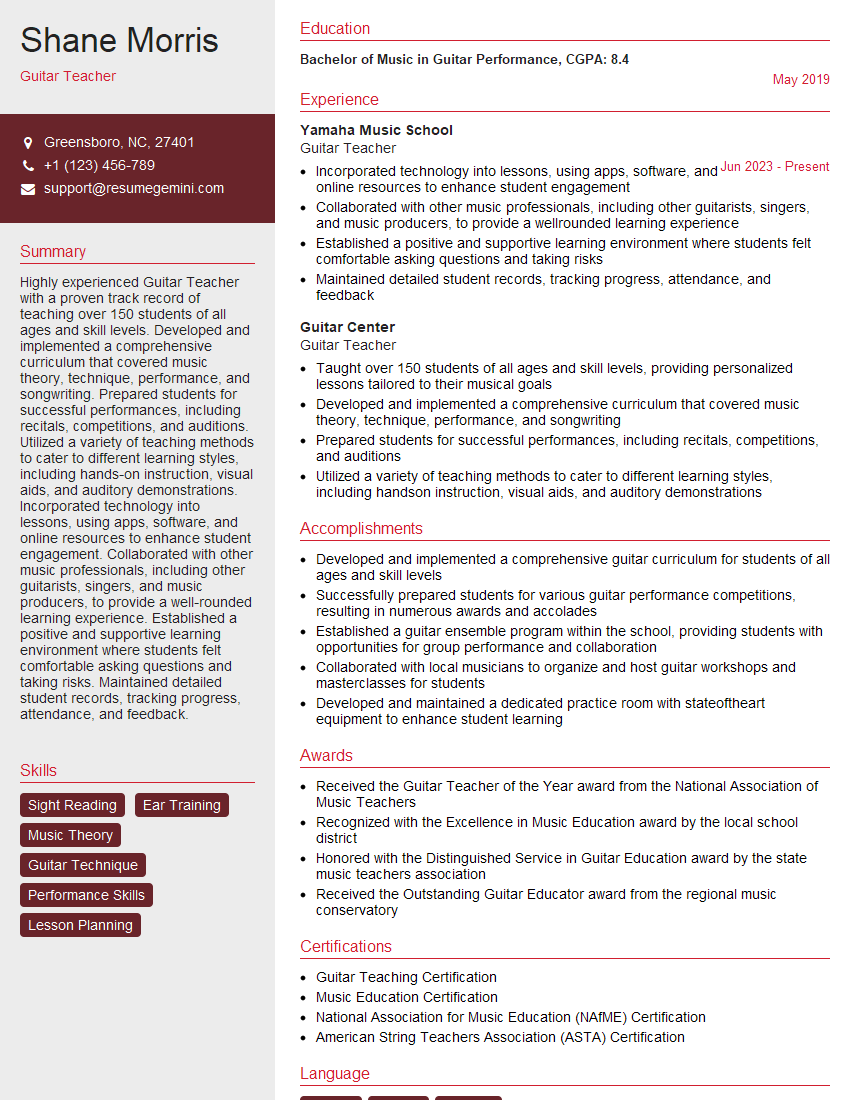
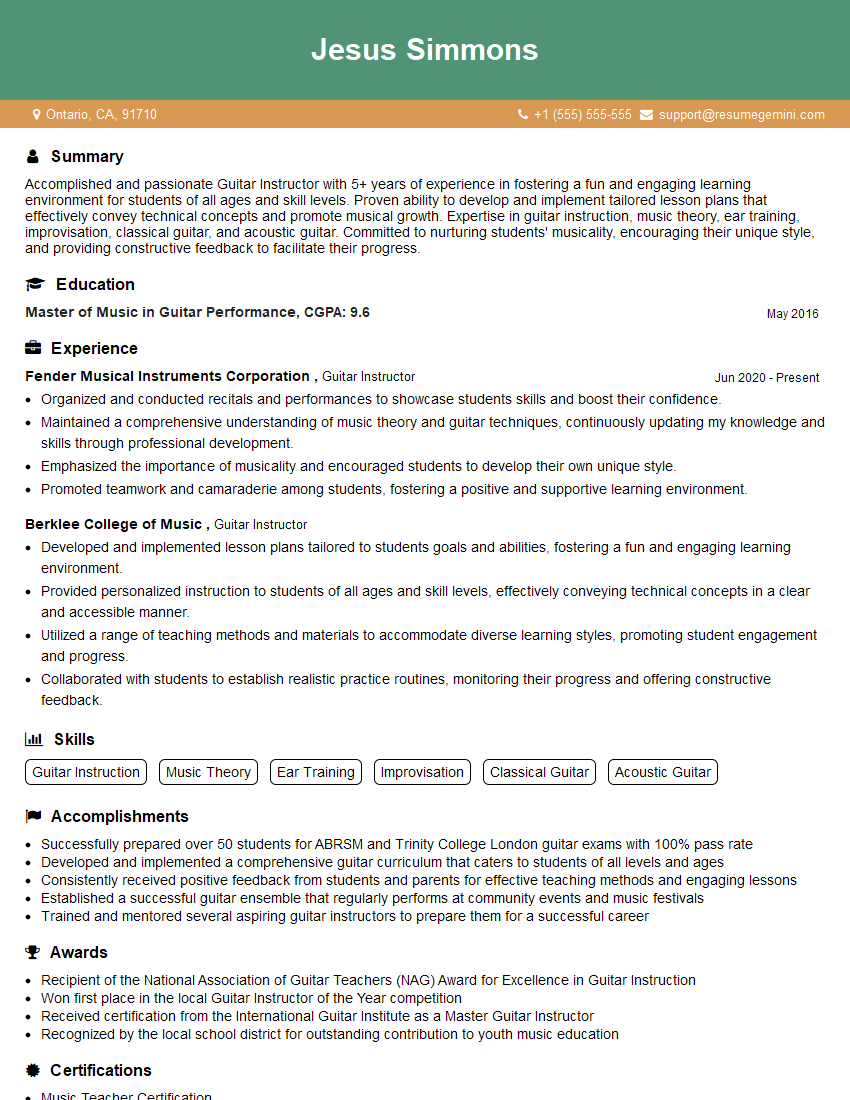
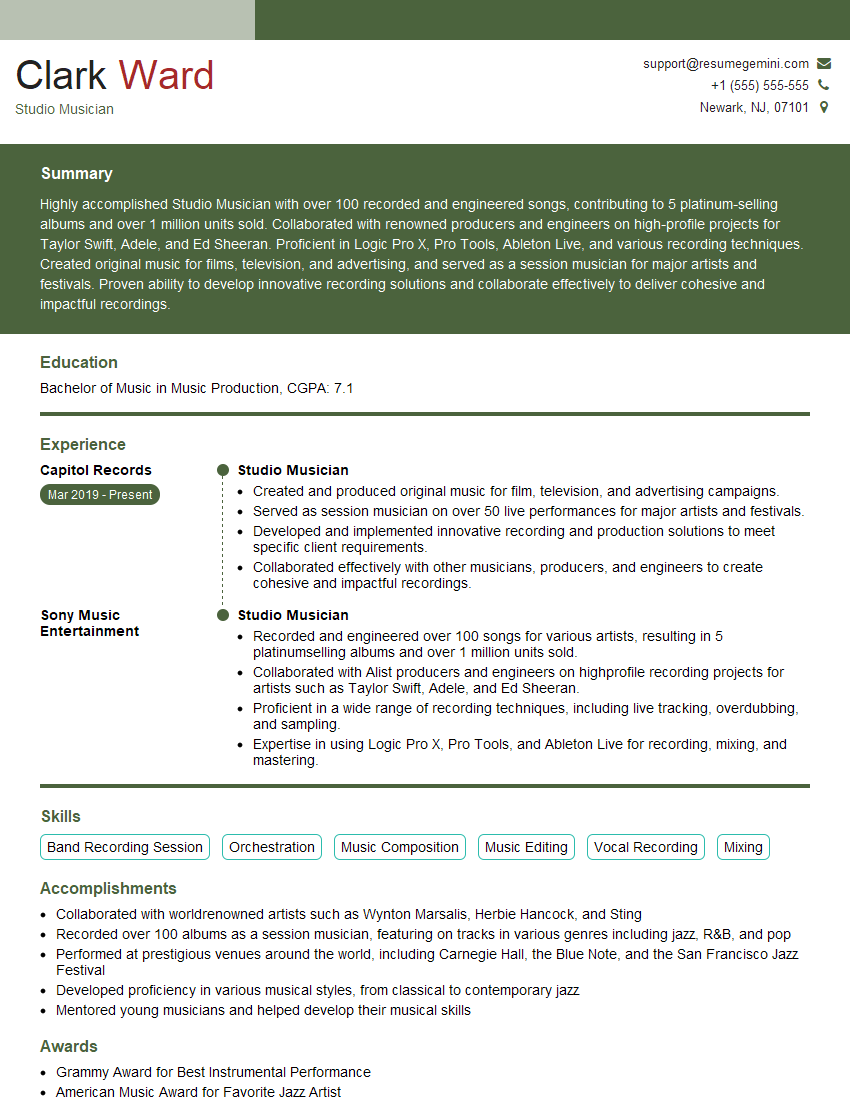
Mastering guitar skills opens doors to exciting career opportunities in music performance, teaching, composition, recording, and more. To significantly boost your job prospects, invest time in crafting a professional, ATS-friendly resume that effectively showcases your abilities. ResumeGemini is a trusted resource to help you build a powerful resume that grabs the attention of recruiters. We provide examples of resumes tailored specifically for candidates with Guitar Skills to help you get started. Take the next step towards your dream career today!
Explore more articles
Users Rating of Our Blogs
Share Your Experience
We value your feedback! Please rate our content and share your thoughts (optional).
What Readers Say About Our Blog
Very informative content, great job.
good