The right preparation can turn an interview into an opportunity to showcase your expertise. This guide to Hammering and Forging interview questions is your ultimate resource, providing key insights and tips to help you ace your responses and stand out as a top candidate.
Questions Asked in Hammering and Forging Interview
Q 1. Explain the difference between forging and casting.
Forging and casting are both metalworking processes used to create parts, but they differ significantly in their approach. Forging involves shaping metal by hammering or pressing it at a high temperature, while casting involves pouring molten metal into a mold and allowing it to solidify. Think of forging like sculpting clay – you’re shaping a solid piece. Casting is more like baking a cake – you pour liquid into a form and it sets.
Forging offers superior mechanical properties due to the grain flow aligned with the part’s shape, resulting in higher strength and durability. This is because the metal fibers are compressed and strengthened during the hammering process. Casting, on the other hand, often produces parts with weaker mechanical properties because the grain structure is less uniform. However, casting is suitable for producing complex shapes that would be difficult or impossible to forge. For example, a crankshaft is typically forged for its high strength requirements, whereas a decorative figurine might be cast for its intricate details.
Q 2. Describe the various types of hammers used in forging.
Many different hammers are used in forging, each designed for a specific purpose. The choice of hammer depends largely on the size and shape of the workpiece and the stage of the forging process.
- Hand Hammers: These come in various weights and head shapes, such as ball peen, cross peen, and straight peen hammers. The ball peen hammer is widely used for general forging, while cross and straight peen hammers provide more precise shaping control.
- Power Hammers: These mechanically powered hammers provide significantly more force and are commonly used for large-scale forging operations. Types include pneumatic hammers and steam hammers, each having different striking capabilities and applications.
- Sledge Hammers: These are large and heavy hammers, typically used for initial shaping and heavier work on larger forgings.
- Other specialized hammers: There are a wide variety of hammers with specific head shapes for specialized forging tasks such as upsetting, drawing out, or finishing.
Selecting the right hammer is critical for efficient and safe forging. Using too light a hammer will result in slow progress and excessive effort, while using one that’s too heavy can lead to accidents or damage to the workpiece.
Q 3. What are the different types of forging processes?
Forging processes are categorized based on how the metal is shaped. Here are some key methods:
- Open-die forging: This is the most basic type, where the metal is shaped between two flat dies. It’s relatively simple but limits the complexity of the final shape.
- Closed-die forging: In this process, the metal is shaped using intricately designed dies that create precise shapes. This method is ideal for mass production of parts with complex geometries.
- Impression-die forging: This is a type of closed-die forging where the shape of the final product is completely formed by the dies.
- Roll forging: The metal is shaped by passing it through a series of rollers. This is highly efficient for creating long, straight sections with uniform cross-sections.
- Upsetting: This method involves shortening and thickening a workpiece by applying compressive forces, essentially squishing it down.
- Drawing out: This is the opposite of upsetting; it involves lengthening and reducing the cross-section of a workpiece, similar to pulling taffy.
The choice of forging process depends on the desired shape, the required accuracy, and production volume.
Q 4. Explain the process of heat treating metal after forging.
Heat treating after forging is crucial for improving the mechanical properties of the metal. It involves carefully heating and cooling the forged part to alter its microstructure. The specific process depends on the metal and the desired properties.
Common heat treatments include:
- Annealing: This process softens the metal by relieving internal stresses introduced during forging. It’s often used to make subsequent machining easier.
- Normalizing: This treatment refines the grain structure, improving strength and toughness.
- Hardening: This process increases the hardness and strength of the metal by rapidly cooling it from a high temperature. It’s often followed by tempering.
- Tempering: This process reduces the brittleness of hardened steel while maintaining a significant level of hardness. It’s a crucial step after hardening.
The precise temperature and cooling rate are critical for achieving the desired results. Improper heat treatment can lead to inferior mechanical properties, or even cracking or warping of the part. Precise control and monitoring of the heat treatment process are essential for high-quality forgings.
Q 5. How do you determine the appropriate temperature for forging a specific metal?
Determining the appropriate forging temperature is critical to the success of the process. The ideal temperature is within the metal’s forging temperature range, which is specific to each metal and its alloy composition. This range is where the metal is sufficiently ductile to deform without cracking or tearing, yet still strong enough to maintain its shape.
Factors to consider:
- Metal type: Each metal has its own specific forging temperature range. For example, steel typically forges at temperatures between 2200°F and 2350°F (1200°C and 1290°C), while aluminum alloys might forge at much lower temperatures.
- Alloy composition: The presence of alloying elements affects the forging temperature. Different alloying elements can significantly shift the optimal temperature range.
- Forging process: The type of forging (e.g., open-die vs. closed-die) can influence the required temperature. Closed-die forging often requires higher temperatures due to increased friction.
- Workpiece size and shape: Larger or more complex workpieces often require higher temperatures to ensure sufficient plasticity throughout the entire workpiece.
Consult metallurgical handbooks or datasheets for precise temperature ranges for specific metals and alloys. Using a pyrometer to accurately measure the temperature of the workpiece is essential for consistent results and successful forging.
Q 6. Describe the safety precautions necessary when using a hammer and anvil.
Safety is paramount when using a hammer and anvil. Here are some crucial precautions:
- Eye protection: Always wear safety glasses or a face shield to protect against flying debris.
- Hearing protection: The noise generated by power hammers can be damaging. Ear protection is recommended, especially during prolonged use.
- Proper footwear: Wear sturdy, closed-toe shoes to protect your feet from dropped tools or accidental impacts.
- Work area setup: Ensure a clean and well-lit workspace free from clutter to prevent trips and falls. The anvil should be securely mounted.
- Hammer technique: Use a firm grip, but avoid excessive force, which could lead to injury or damage to the workpiece. Maintain a balanced stance.
- Metal temperature: Handle hot metal with tongs or appropriate tools to avoid burns. Use proper ventilation to avoid inhaling fumes.
- Dress appropriately: Wear close-fitting clothing that won’t get caught in machinery. Avoid loose jewelry or long hair that could get tangled.
- Regular inspection: Regularly inspect tools for damage or wear. Replace any damaged or worn-out equipment immediately.
Following these safety guidelines will significantly reduce the risk of accidents and injuries during forging operations.
Q 7. What are the common defects found in forged parts, and how are they prevented?
Several defects can occur during forging. Understanding their causes and prevention is essential for producing high-quality parts.
- Cracks: These can be caused by forging at too low a temperature, improper die design, or excessive strain on the metal. Proper temperature control, optimized die design, and avoiding excessive deformation will help prevent cracks.
- Lap seams: These occur when two parts of the metal fold over each other during forging. Proper die design and controlled deformation help prevent this defect.
- Surface defects: These include scratches, tears, and other imperfections. Careful handling of the workpiece and proper lubrication of the dies can minimize surface defects.
- Internal defects: These are hidden flaws such as voids or inclusions. Careful selection of raw materials and optimized forging parameters helps prevent internal defects. Proper heat treatment can also help to alleviate stresses and reduce the likelihood of defects.
- Inclusions: These are foreign particles trapped within the metal during the forging process. Using high-quality materials can significantly minimize inclusions.
Regular inspection and quality control measures are essential for detecting and preventing defects. Understanding the root cause of each defect is crucial to effectively implement corrective measures and prevent their recurrence.
Q 8. Explain the importance of proper hammer striking technique.
Proper hammer striking technique is paramount in forging for several reasons: it ensures the safety of the smith, it directly impacts the quality of the finished workpiece, and it determines the efficiency of the process. A poor technique can lead to mis-strikes, damaging the workpiece or the anvil, or even causing injury. A skilled smith uses controlled blows, striking the metal squarely and consistently to shape the material precisely.
Imagine trying to shape clay with a clumsy hand – you’d get a messy result. Similarly, haphazard hammering on metal leads to uneven shaping and potential weaknesses in the final product. The ideal technique involves maintaining a firm grip on the hammer, using your whole body for power (not just your arms), and focusing on accuracy. The force and angle of each strike should be precisely controlled to achieve the desired shaping effect.
- Controlled Force: Avoid overly forceful strikes, especially on smaller workpieces or thinner sections of metal, as this can lead to cracking or breakage.
- Accuracy of Impact: Ensure the hammer head squarely contacts the metal being worked. Off-center strikes can distort the shape or leave unwanted marks.
- Rhythm and Repetitions: Develop a rhythm to your blows, making them consistent and efficient. Multiple smaller blows are often preferable to one large blow.
Q 9. How do you select the correct type of anvil for a specific forging task?
Anvil selection is crucial for efficient and successful forging. The anvil’s size, weight, material, and shape must be appropriate for the task at hand. Larger anvils provide greater stability and allow for working with larger pieces of metal; smaller anvils are more suitable for intricate work. The hardness of the anvil is critical. Too soft, and it will deform under the hammer blows; too hard, and it could damage the workpiece. The shape of the horn and hardy hole are also considerations, depending on the specific operations required.
For example, a heavy, cast steel anvil with a large flat face and a sturdy horn is ideal for general blacksmithing tasks involving shaping and drawing out larger pieces of metal. A lighter, hardened steel anvil with a smaller face and carefully designed features might be better for more delicate work, such as making jewelry or intricate tools. A power hammer often necessitates a massive and robust anvil to withstand the substantial impact forces.
Consider the following factors:
- Weight: Heavier anvils absorb more shock and vibration.
- Material: Hardened steel is best for longevity.
- Features: Horn for bending and curving, hardy hole for tooling.
- Size: Match the anvil’s size to the workpiece’s dimensions.
Q 10. Describe the process of creating a simple hook from a metal rod using hammer and anvil.
Creating a simple hook from a metal rod using hammer and anvil involves several steps: heating, bending, shaping and finishing.
- Heat the Metal: Heat the rod in a forge to a forging temperature (cherry red). This makes it malleable and easier to shape.
- Bend the Rod: Position the end of the heated rod against the horn of the anvil. Use the hammer to bend the rod into a rough hook shape. This initial bend will set the direction of the hook.
- Shape the Hook: Now, work on refining the hook’s curve. Use the hammer and anvil to carefully shape the hook, continually checking the angle and curvature. You might use the flat face of the anvil and the hammer to flatten and refine the areas.
- Refine the Shape: After the desired shape is achieved, use the hammer to refine the hook, removing any excess material, and ensuring a smooth and even finish.
- Cool and Finish: Allow the hook to cool naturally. Once cool, you can clean any imperfections and finalize the shape through filing, grinding, or other finishing techniques.
Q 11. How do you control the grain structure of metal during forging?
Controlling the grain structure during forging is essential for achieving the desired strength and durability in the final product. Forging processes, especially those involving hammering and upsetting, can both refine and distort grain structures. Proper forging techniques minimize undesirable grain flow.
Refining the grain structure is usually accomplished by repeated heating and hammering (working) of the metal. Each heating cycle followed by deformation helps to create a finer grain structure, leading to higher strength and ductility. However, excessive working can lead to grain elongation and thus create weaknesses along the elongated grains. This is why controlling the temperature during forging is critical. Too low of a temperature means less malleability and more difficulty in working the material. Too high of a temperature leads to grain growth and potential oxidation, which weakens the metal. It’s a delicate balance.
Strategies to control grain flow include:
- Proper Heating: Heat the metal to the correct forging temperature to ensure adequate plasticity.
- Controlled Deformation: Avoid excessive deformation in a single pass; distribute the deformation over several passes.
- Avoid Overworking: Stop working the metal before grain growth becomes excessive.
- Annealing: Sometimes, an annealing process is necessary to relieve stress and refine the grain structure further.
Q 12. Explain the use of different forging dies and their applications.
Forging dies are used to create precise shapes and features in metal. They come in various designs and materials, each suited to specific applications. The choice of die material depends on the metal being forged, the required accuracy, and the number of parts needed.
Examples of forging dies and their applications include:
- Closed-die forging: Uses two matching dies to completely encase the workpiece, resulting in highly accurate parts like car parts or gears. The dies are typically made from high-strength tool steels.
- Open-die forging: Uses a single die (or no die at all) often to shape metal by hammering it. This is commonly used for large parts where complex shapes are not needed, such as shaping shafts or I-beams.
- Impression-die forging: Uses dies with cavities or impressions to shape the workpiece into a specific form. This is suitable for mass-production of parts with intricate details.
- Drop forging: Uses a hammer that drops from a height to strike the workpiece, typically in a die. Often used for high-volume production of relatively complex parts.
The material of the dies should be chosen to withstand the high temperatures and forces involved in forging, possessing exceptional wear resistance and toughness.
Q 13. How do you determine the required force for a particular forging operation?
Determining the required force for a forging operation is critical to avoid workpiece failure or damage to the equipment. Several factors influence this calculation, including the metal’s properties (strength, ductility, temperature), the desired shape change, the friction between the workpiece and dies (if used), and the forging process (e.g., open-die versus closed-die). In simpler operations, the force may be estimated based on experience and intuition, relying on the smith’s knowledge and feel.
For more complex scenarios and mass production, finite element analysis (FEA) simulations are employed. These simulations accurately model the stress and strain distribution within the workpiece, providing valuable insights into the required force. Experimental testing with force-measuring tools can also be utilized to calibrate estimates or validate FEA predictions. Accurate force determination ensures efficient forging, optimal part quality, and equipment longevity.
Q 14. Describe the maintenance procedures for forging equipment.
Proper maintenance of forging equipment is essential for safety, efficiency, and longevity. This includes regular inspections and preventative measures.
- Anvil Maintenance: Regularly inspect the anvil for cracks, chips, or damage. Repair or replace damaged sections promptly. Keep the anvil face clean and free from debris.
- Hammer Maintenance: Regularly inspect the hammer head for cracks, loose handles, or damage. Replace damaged heads or handles immediately. Keep the hammer clean and free from oil or grease.
- Forge Maintenance: Clean the forge regularly to remove ash and slag buildup. Ensure proper airflow and ventilation. Check and maintain the fuel supply system regularly.
- Die Maintenance: Clean and inspect dies regularly for damage or wear. Repair or replace damaged dies promptly. Lubricate dies as needed, considering the material and the forging process.
- Safety Precautions: Always wear appropriate safety equipment, including eye protection, hearing protection, and gloves. Ensure proper ventilation in the workspace.
A comprehensive maintenance schedule should be implemented and followed diligently to minimize downtime and maximize equipment lifespan.
Q 15. What are the common materials used in forging?
Forging utilizes a wide array of materials, primarily metals, chosen based on their desired properties in the final product. The most common materials include:
- Steel: A ubiquitous choice due to its versatility, strength, and ability to withstand high temperatures. Different grades of steel, ranging from low-carbon to high-speed steel, are selected depending on the application. For instance, a low-carbon steel might be used for a decorative item, while high-speed steel would be ideal for a high-stress tool.
- Aluminum: Lightweight and relatively easy to forge, aluminum is often preferred for aerospace and automotive applications where weight reduction is crucial. Its excellent corrosion resistance is also a significant advantage.
- Copper and its Alloys (Brass, Bronze): These materials offer excellent ductility and conductivity, making them suitable for electrical components, plumbing fixtures, and decorative elements. Bronze, particularly, is known for its durability and resistance to corrosion.
- Nickel Alloys: Used when high strength, corrosion resistance, and high-temperature capabilities are required, nickel alloys find applications in demanding environments like jet engines and chemical processing.
- Titanium Alloys: Prized for their high strength-to-weight ratio, titanium alloys are employed in aerospace, medical implants, and high-performance applications despite their challenging forging characteristics.
The choice of material is critical and heavily influences the forging process parameters, such as temperature and pressure.
Career Expert Tips:
- Ace those interviews! Prepare effectively by reviewing the Top 50 Most Common Interview Questions on ResumeGemini.
- Navigate your job search with confidence! Explore a wide range of Career Tips on ResumeGemini. Learn about common challenges and recommendations to overcome them.
- Craft the perfect resume! Master the Art of Resume Writing with ResumeGemini’s guide. Showcase your unique qualifications and achievements effectively.
- Don’t miss out on holiday savings! Build your dream resume with ResumeGemini’s ATS optimized templates.
Q 16. Explain the concept of upset forging.
Upset forging is a forging process that involves increasing the cross-sectional area of a workpiece while simultaneously reducing its length. Imagine taking a piece of metal rod and squeezing it between two dies – it becomes shorter and thicker. This is upset forging in action. The metal flows outwards laterally under compressive forces.
It’s like squeezing a tube of toothpaste; the toothpaste (metal) gets thicker and shorter as you apply pressure. This technique is commonly used to create components like bolts, nuts, and other parts with a larger cross-section than the starting material.
Example: A cylindrical bar is heated to forging temperature and placed between two dies. The dies then compress the bar, reducing its length and increasing its diameter. This process is commonly used to produce the head of a bolt.
Q 17. What is the role of lubrication in forging?
Lubrication plays a vital role in forging, acting as a critical interface between the workpiece and the forging die. It serves several key functions:
- Reduces Friction: Lubricants significantly decrease friction between the metal and the die, preventing seizing and galling (welding of the metal to the die). This allows for smoother metal flow and less wear on the dies.
- Improves Surface Finish: A well-lubricated process helps maintain the surface quality of the finished component by preventing surface imperfections caused by friction.
- Enhances Die Life: By reducing friction and wear, lubrication extends the lifespan of expensive forging dies.
- Controls Temperature: Some lubricants can aid in heat transfer, helping to maintain a consistent temperature throughout the forging process.
Common lubricants include graphite, molybdenum disulfide (MoS2), and various oil-based compounds. The choice of lubricant depends on factors like the material being forged, the forging temperature, and the type of forging equipment.
Q 18. How do you measure the dimensions of a forged part?
Measuring the dimensions of a forged part requires precision and often involves a combination of techniques. The specific method will depend on the complexity and tolerances required for the part.
- Calipers: For basic dimensions, vernier calipers or digital calipers offer accurate measurements of length, width, and thickness.
- Micrometers: Provide even higher precision measurements, especially for smaller components with tight tolerances.
- Coordinate Measuring Machines (CMMs): For intricate parts with complex geometries, CMMs offer highly accurate three-dimensional measurements. These machines are essential for quality control and ensuring the part conforms to the design specifications.
- Optical Comparators: Used to compare the forged part to a master template or drawing providing a visual check of its dimensions and shape.
Besides dimensional accuracy, surface finish and other quality characteristics should also be inspected.
Q 19. Describe the process of drawing down metal during forging.
Drawing down, also known as reduction, is a forging operation that reduces the cross-sectional area of a workpiece while simultaneously increasing its length. Imagine pulling a piece of clay to make it longer and thinner – this is analogous to drawing down metal. The metal is elongated under tensile forces.
This technique is frequently used to create shapes like bars, rods, and shafts. The process typically involves placing the heated workpiece between dies and applying force to stretch it. This stretching often results in a change in the cross-section and length of the workpiece.
Example: A square bar is heated and repeatedly hammered or drawn through dies to make a longer and thinner rectangular bar. It’s like stretching taffy.
Q 20. Explain the concept of fullering and swaging.
Fullering and swaging are both forging operations used to shape metal, but they achieve this through slightly different methods:
- Fullering: This operation creates a groove or channel in a workpiece. It’s akin to creating a depression or indentation in the metal. Fullering is often a preparatory step before other shaping operations.
- Swaging: This involves reducing the diameter of a workpiece along its length by hammering or pressing it between dies that have a progressively smaller diameter towards their ends. It’s similar to drawing down but the dies might have more complex shapes. Swaging is useful for making tapered parts or shaping intricate profiles.
Both fullering and swaging are crucial steps in the forging process, allowing for the creation of various shapes and features in the final product. They often precede other operations like drawing or upsetting to refine the part’s final form.
Q 21. What are the different types of forging hammers?
Forging hammers come in various types, each designed for different applications and scales of production. Here are some of the most common types:
- Hand Hammers: These are the simplest type, used for smaller-scale forging. They vary in weight and shape, depending on the task. From the lightweight ball-peen hammer for precision work to heavier sledgehammers for more forceful blows.
- Power Hammers: These hammers use mechanical power to deliver repeated blows with greater force and speed than hand hammers. They range from pneumatic hammers (air-powered) to steam hammers and mechanical hammers, greatly increasing forging productivity.
- Drop Hammers: These massive hammers use gravity to deliver powerful blows. A heavy weight is lifted and released onto the workpiece. Typically found in larger forging operations, they are ideal for high-volume production of larger components.
- Trip Hammers: These are a type of power hammer where the hammer blow is controlled by a trip mechanism, allowing for greater precision and control in shaping the metal.
- Hydraulic Presses: While not strictly hammers, hydraulic presses are powerful and versatile forging equipment that apply slow, steady pressure rather than repeated blows, suitable for forging large, complex parts.
The selection of the appropriate hammer depends on the size of the workpiece, the required force, and the desired level of precision.
Q 22. How do you troubleshoot common forging problems?
Troubleshooting forging problems starts with careful observation and a systematic approach. We look for clues in the finished product, the tooling used, and the process itself. Common issues include cracks, surface imperfections, dimensional inaccuracies, and internal defects.
- Cracks: These often indicate improper heating, excessive deformation, or flaws in the starting material. We’d check the heating cycle’s temperature and duration, examine the die design for sharp corners or excessive stress points, and inspect the billet for inclusions or cracks.
- Surface imperfections: These can result from poor die maintenance, insufficient lubrication, or improper forging techniques. We’d assess the die’s surface finish, check the lubrication system, and analyze the hammer blow sequence.
- Dimensional inaccuracies: Inaccuracies point towards issues with die design, forging pressure, or the forging process. We’d review the die blueprints, analyze the press’s hydraulic system, and look into possible inconsistencies in the material’s flow.
- Internal defects: These, like laps or segregations, are often a sign of problems with the raw material or improper heating. We’d employ non-destructive testing (NDT) methods like ultrasonic testing to locate and analyze these.
Essentially, it’s a process of elimination, meticulously examining each stage of the forging process to pinpoint the root cause. I’ve personally solved several cases of cracking by simply adjusting the heating profile for a specific alloy, proving that even small tweaks can make a significant difference.
Q 23. How do you ensure the quality of forged products?
Ensuring the quality of forged products requires a multi-faceted approach, from raw material selection to final inspection. It starts with rigorous quality control at each step of the process.
- Material Selection: We meticulously select materials based on their chemical composition, ensuring they meet the required specifications for the application. This helps minimize defects from the start.
- Process Control: Maintaining precise control over the heating, forging, and cooling processes is crucial. This includes monitoring temperature, pressure, and the timing of each step. Accurate parameters reduce defects and improve consistency.
- Tooling Maintenance: Regular inspection and maintenance of dies and hammers are paramount. Worn or damaged tooling leads to inferior products, and regular servicing prevents this.
- Non-Destructive Testing (NDT): Implementing NDT methods, such as ultrasonic testing, radiography, or magnetic particle inspection, is essential to detect internal flaws that might not be visible on the surface.
- Dimensional Inspection: Precise measurements and dimensional checks ensure the forged part conforms to the specified dimensions and tolerances. This often involves using coordinate measuring machines (CMMs).
For example, I once identified a consistent flaw in a batch of forged crankshafts through ultrasonic testing – a subtle crack undetectable by visual inspection. Identifying this flaw early saved significant costs and prevented potential failures in the field.
Q 24. What are the latest advancements in forging technology?
The forging industry has seen significant advancements, largely driven by the need for increased efficiency, precision, and sustainability.
- Closed-Die Forging with Advanced Die Designs: Modern closed-die forging utilizes sophisticated CAD/CAM technologies for designing dies that offer increased complexity and precision, resulting in components with tighter tolerances.
- Automation and Robotics: Automation and robotics play an increasingly vital role in optimizing forging operations, enhancing productivity and consistency while reducing human error.
- Near-Net Shape Forging: This technique reduces material waste by producing parts closer to their final shape, minimizing post-forging machining.
- Advanced Materials: The development and application of new, high-performance materials with enhanced strength, temperature resistance, and corrosion resistance have pushed the boundaries of what’s possible through forging.
- Simulation and Modeling: Computational modeling and simulations enable optimization of forging processes, predicting outcomes, and preventing defects before they occur. This greatly reduces experimental trial and error.
For instance, the use of simulation software allows us to optimize the forging process to ensure optimal grain flow and minimize internal stresses, thereby creating stronger, more durable parts.
Q 25. What are the environmental considerations in forging?
Environmental considerations in forging are increasingly important due to the industry’s energy consumption and waste generation.
- Energy Efficiency: Forging consumes significant amounts of energy, primarily for heating. Modern forging processes incorporate energy-efficient heating systems and technologies to minimize environmental impact.
- Waste Reduction: Minimizing scrap metal is a major environmental focus. Near-net shape forging helps achieve this. Recycling of scrap metal is also an essential part of sustainable forging practices.
- Emissions Control: Forging processes may produce emissions, including air pollutants. Effective emission control measures, such as using cleaner fuels and implementing air pollution control systems, are necessary.
- Water Management: Controlling water usage and preventing water pollution from quenching and cleaning processes is crucial.
- Sustainable Materials: Using recycled materials and exploring alternative materials with lower environmental impacts contributes to a more environmentally friendly process.
In my experience, implementing a closed-loop water recycling system for quenching significantly reduced our water consumption and eliminated water pollution concerns.
Q 26. Describe your experience with different metal alloys and their forging characteristics.
My experience encompasses a wide range of metal alloys, each with its unique forging characteristics.
- Carbon Steels: These are readily forged, but the carbon content influences their formability. Higher carbon steels require more careful control of temperature to avoid cracking.
- Alloy Steels: These possess improved mechanical properties but can be more challenging to forge due to their higher strength and potential for hot cracking. Precise temperature control and careful die design are essential.
- Stainless Steels: These are known for their corrosion resistance but are often more difficult to forge than carbon steels. They require higher forging temperatures and specialized tooling to prevent work hardening.
- Aluminum Alloys: These are relatively easy to forge, but their low melting point requires careful temperature control to avoid melting or excessive deformation.
- Titanium Alloys: These are challenging to forge due to their high strength, reactivity, and tendency to form oxides at high temperatures. Specialized techniques and equipment are required for forging titanium alloys.
One memorable project involved forging a complex titanium alloy component for an aerospace application. This required a detailed understanding of the material’s behavior at high temperatures, precision control of the forging process, and careful post-forging heat treatments.
Q 27. Explain the importance of safety in a forging environment.
Safety is paramount in a forging environment, given the presence of high temperatures, heavy machinery, and moving parts. A strong safety culture, thorough training, and adherence to safety protocols are non-negotiable.
- Personal Protective Equipment (PPE): The use of appropriate PPE, including safety glasses, hearing protection, heat-resistant gloves, and safety shoes, is mandatory for all personnel in the forging area.
- Machine Guarding: All forging machinery must be properly guarded to prevent accidental contact with moving parts. Regular inspection and maintenance of guards are crucial.
- Emergency Procedures: Clearly defined emergency procedures, including fire safety protocols and first-aid procedures, must be in place and regularly practiced.
- Lockout/Tagout Procedures: Strict lockout/tagout procedures must be followed when performing maintenance or repairs on any forging equipment to prevent accidental energization.
- Hot Metal Handling: Safe practices for handling hot metal, including the use of tongs and proper lifting techniques, are essential to avoid burns and injuries.
I’ve always championed a proactive safety approach, emphasizing continuous training and the importance of reporting near misses to prevent accidents. A safe working environment is not only crucial for worker well-being but also enhances productivity and efficiency.
Q 28. Describe your experience with different types of forging presses.
My experience covers a variety of forging presses, each with its strengths and limitations.
- Hydraulic Presses: These offer precise control over forging pressure and speed, making them suitable for complex shapes and high-precision forgings. They are commonly used for closed-die forging.
- Mechanical Presses: These are typically more robust and cost-effective than hydraulic presses, suitable for high-volume production of simpler parts. They provide high impact forces but offer less control over the forging process.
- Hammer Forges: These use impact forces to shape the metal and are often used for open-die forging. Hammer forging is suitable for creating large or irregularly shaped forgings but is less precise than press forging.
- Drop Hammers: These are a type of hammer forge used for smaller forgings where repeated blows are needed for shaping. They are less precise than hydraulic presses, but have very high impact forces.
- High-Speed Forging Presses: These presses can generate much higher impact forces in less time, which allows high production rates and can form very complex shapes while reducing the stress on the material.
Choosing the right press depends on several factors, including the part’s complexity, material properties, production volume, and desired precision. For example, I’ve utilized high-speed forging presses for high-volume production of automotive components, while opting for hydraulic presses for intricate aerospace parts that demand high precision.
Key Topics to Learn for Hammering and Forging Interview
- Metal Properties and Selection: Understanding the characteristics of various metals (e.g., tensile strength, ductility, malleability) and choosing the appropriate metal for a specific forging or hammering process.
- Forging Processes: Familiarize yourself with different forging techniques like open-die forging, closed-die forging, and press forging. Understand their applications and limitations.
- Hammering Techniques: Master the principles of effective hammering, including strike force, angle of impact, and heat treatment considerations.
- Tooling and Equipment: Gain knowledge of different forging hammers, presses, and ancillary equipment. Understand their maintenance and safety procedures.
- Heat Treatment: Learn about the importance of heat treatment in achieving desired mechanical properties in forged and hammered components. This includes annealing, quenching, and tempering.
- Defect Identification and Prevention: Understand common defects in forged and hammered parts (e.g., cracks, laps, folds) and methods for their prevention.
- Safety Procedures and Regulations: Demonstrate a strong understanding of safety protocols in a hammering and forging environment, including PPE and hazard mitigation.
- Quality Control and Inspection: Be prepared to discuss quality control measures used to ensure the integrity of forged and hammered products.
- Problem-solving and Troubleshooting: Practice identifying and resolving potential issues during the forging and hammering processes.
- Advanced Forging Techniques: Explore specialized forging techniques such as isothermal forging or precision forging, depending on the job requirements.
Next Steps
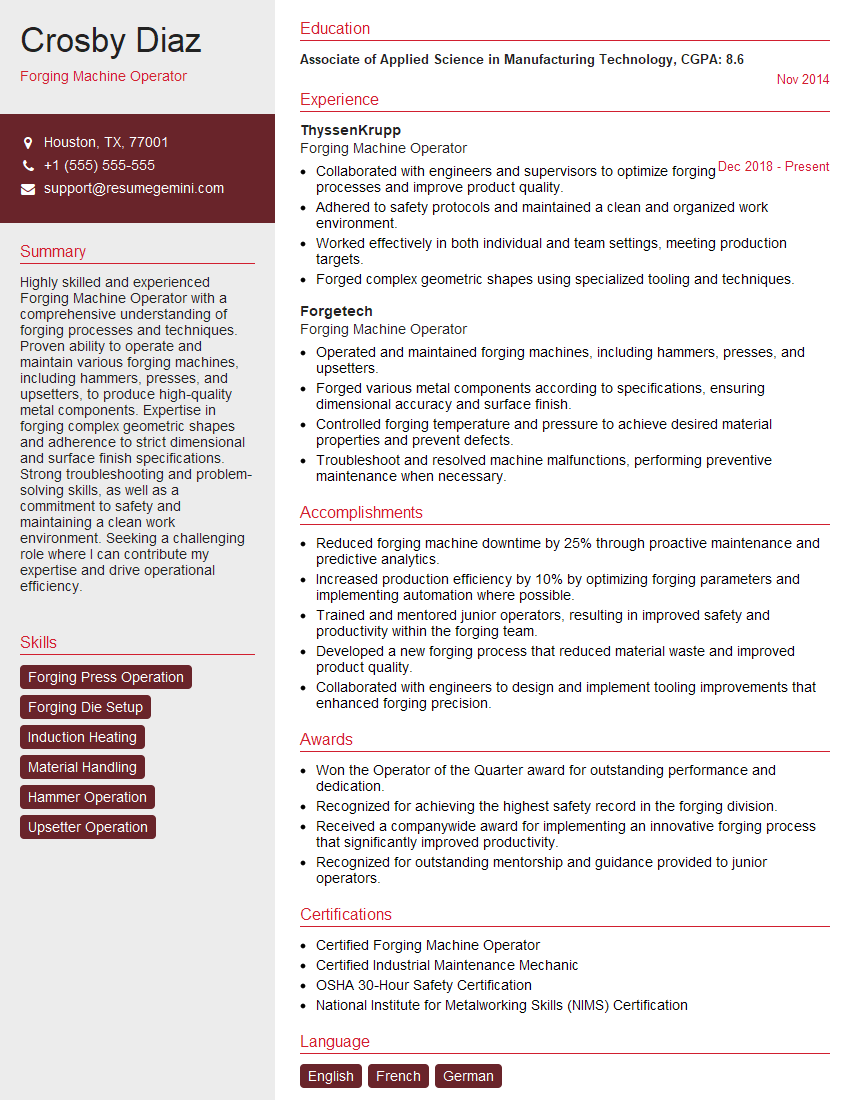
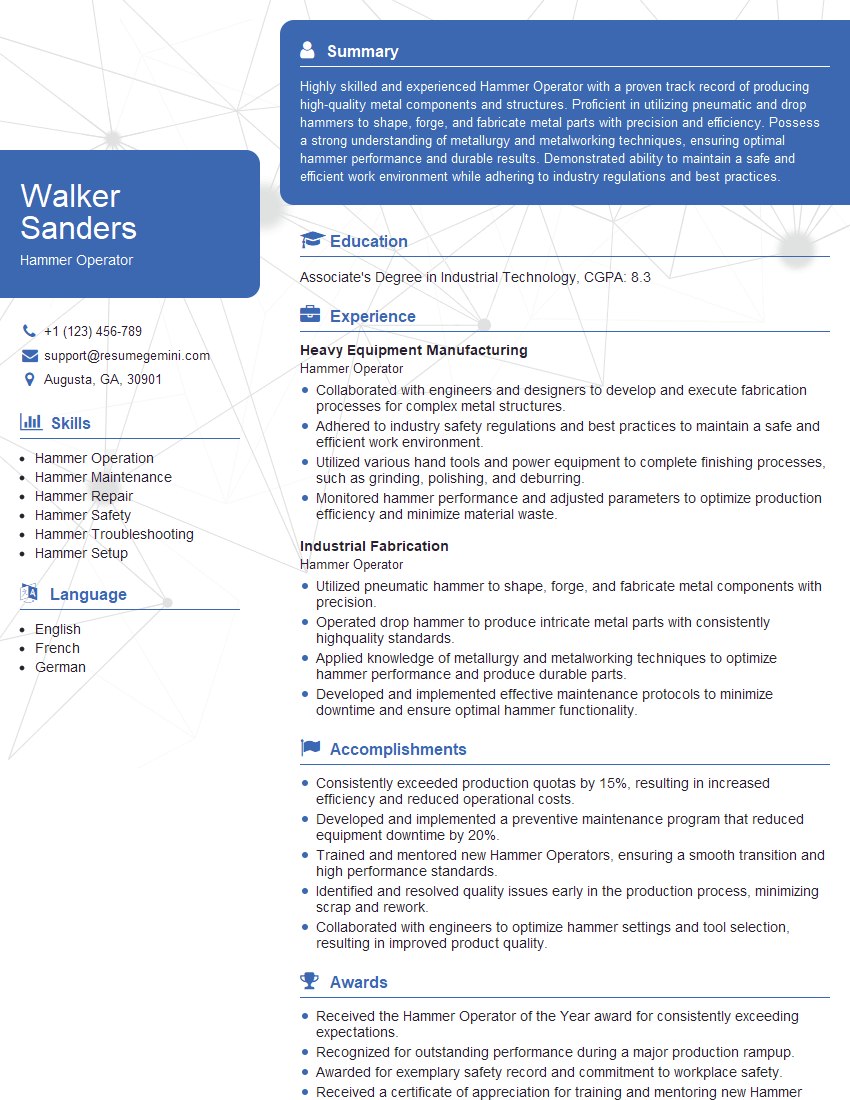
Mastering hammering and forging techniques opens doors to exciting career opportunities in manufacturing, automotive, aerospace, and other high-demand industries. To significantly improve your job prospects, focus on crafting a compelling and ATS-friendly resume that highlights your skills and experience. ResumeGemini is a trusted resource that can help you build a professional and effective resume, ensuring your application stands out. Examples of resumes tailored to the Hammering and Forging industry are available to guide you.



Explore more articles
Users Rating of Our Blogs
Share Your Experience
We value your feedback! Please rate our content and share your thoughts (optional).
What Readers Say About Our Blog
Very informative content, great job.
good