Unlock your full potential by mastering the most common Handicapping interview questions. This blog offers a deep dive into the critical topics, ensuring you’re not only prepared to answer but to excel. With these insights, you’ll approach your interview with clarity and confidence.
Questions Asked in Handicapping Interview
Q 1. Explain the concept of a ‘point spread’ in sports handicapping.
The point spread, in sports handicapping, is a number assigned by bookmakers to create a more even playing field between two competing teams. It represents the predicted margin of victory for the favored team. Essentially, it’s a handicap designed to make both sides of the bet equally attractive. For example, if Team A is playing Team B, and the point spread is -7 for Team A, it means Team A is expected to win by 7 points. If you bet on Team A, they must win by more than 7 points for your bet to win. If you bet on Team B, they can either win outright or lose by less than 7 points for your bet to be successful.
Think of it like this: it levels the playing field, making a game between a significantly stronger and weaker team more balanced in terms of wagering.
Q 2. Describe different handicapping methods for horse racing.
Handicapping horse racing involves a multifaceted approach. Several methods exist, each with its own strengths and weaknesses:
- Past Performance Analysis: This is arguably the most crucial method. It involves meticulously reviewing a horse’s previous races, noting factors like speed figures, track conditions, distance, jockey performance, and finishing positions. Looking for consistent performance is key. For example, a horse that consistently places well at a specific distance and track type is a stronger contender than a horse with erratic performance.
- Form Analysis: This focuses on a horse’s recent racing form. A horse’s performance in its last few races often serves as a reliable indicator of its current fitness level. Sharp improvements or significant declines should raise flags.
- Speed Figures: These are numerical ratings that quantify a horse’s speed and efficiency during a race. Different handicapping services calculate these figures using various formulas, but the higher the speed figure, generally, the faster the horse.
- Trainer/Jockey Analysis: The performance history of the trainer and jockey significantly influences a horse’s potential. Successful pairings tend to yield better results.
- Track Bias: Some racetracks favor certain running styles (e.g., front-runners or closers). Considering this bias is vital for accurate handicapping.
- Betting Information: Although not directly related to the horse’s capability, understanding the betting public’s perception (odds) can identify potential value bets. If the odds are higher than your analysis suggests, it might be a profitable opportunity.
Q 3. How do you interpret odds and calculate potential payouts?
Odds represent the probability of an event occurring and determine the potential payout. They are usually expressed in different formats:
- Fractional Odds (e.g., 3/1): For every $1 bet, you win $3 in profit (plus your original stake).
- Decimal Odds (e.g., 4.0): Multiply your stake by the decimal odds to determine your total return (including your stake). A $10 bet at 4.0 would return $40.
- American Odds (e.g., +200 or -200): Positive odds represent the profit you make on a $100 bet, whereas negative odds represent how much you need to bet to win $100. +200 means a $100 bet wins $200, while -200 means you need to bet $200 to win $100.
To calculate potential payouts, simply use the relevant formula based on the odds format. For example, a $50 bet on a horse with 3/1 fractional odds would result in a profit of $150 (3 x $50) plus the original $50 stake, for a total return of $200.
Q 4. What are some key factors you consider when handicapping a football game?
Handicapping a football game requires a comprehensive evaluation of various factors:
- Team Strengths and Weaknesses: A thorough analysis of both teams’ offensive and defensive capabilities, including individual player statistics and recent performances.
- Matchup Analysis: How each team’s strengths match up against their opponent’s weaknesses is crucial. Does Team A’s excellent passing game exploit Team B’s vulnerable secondary?
- Injuries: Key player injuries significantly impact a team’s performance. Absence of a star quarterback or running back can drastically alter the game’s outcome.
- Coaching Strategies: Each coach’s style and tendencies can be a valuable predictive factor. Does the coach tend to be conservative or aggressive?
- Home Field Advantage: Playing at home usually provides a psychological and sometimes even a statistical advantage.
- Weather Conditions: Extreme weather conditions like rain, snow, or high wind can significantly impact gameplay, especially impacting passing offenses.
- Momentum and Recent Form: Teams on winning streaks often exhibit higher confidence, while teams struggling might demonstrate decreased performance.
- Statistical Analysis: Looking at historical data like points per game, turnovers, yards per play can reveal insightful patterns.
Q 5. Discuss the importance of statistical analysis in sports handicapping.
Statistical analysis is the backbone of effective sports handicapping. It allows us to move beyond subjective opinions and utilize objective data for informed decisions. Tools like regression analysis, predictive modeling, and data visualization can uncover hidden trends and patterns. For example, analyzing historical data might reveal a correlation between a team’s rushing yards and their win percentage. This quantitative insight can be far more reliable than relying on gut feeling alone. Statistical analysis allows for identifying key indicators, testing hypotheses, and evaluating the effectiveness of different handicapping strategies over time. It helps refine predictions, identify value bets, and ultimately improve profitability.
Q 6. How do you identify and manage risk in sports betting?
Risk management in sports betting is paramount for long-term success. It’s not about avoiding risk entirely, but about managing it effectively:
- Bankroll Management: Never bet more than a small percentage of your total bankroll on any single wager. A common recommendation is 1-5%, depending on your risk tolerance.
- Diversification: Don’t put all your eggs in one basket. Spread your bets across various games and sports to reduce the impact of any single loss.
- Line Shopping: Compare odds from different bookmakers to find the best possible lines. Even small differences can significantly impact profitability over time.
- Setting Limits: Establish daily, weekly, and monthly betting limits to control your spending and prevent impulsive bets. Stick to your limits rigorously.
- Tracking Performance: Maintain detailed records of your bets, wins, losses, and overall ROI. This data is crucial for evaluating your strategies and identifying areas for improvement.
- Emotional Discipline: Avoid chasing losses or making bets based on emotions like anger or frustration. Stick to your well-researched and statistically sound approach.
Q 7. What software or tools do you use for handicapping?
The tools I utilize for handicapping vary depending on the sport, but generally include:
- Spreadsheets (Excel, Google Sheets): For data organization, statistical analysis, and tracking performance.
- Statistical Software (R, Python): For advanced statistical modeling and data visualization, enabling deeper analysis of large datasets.
- Sports Data Providers: Services that provide access to comprehensive historical and real-time sports data, including player statistics, game results, and odds.
- Specialized Handicapping Software: Some software packages offer pre-built models and tools tailored to specific sports, helping automate aspects of the handicapping process.
- Website and News Aggregators: For accessing up-to-date news and information related to injuries, team performance, and any other relevant factors.
The most important tool, however, remains my knowledge and experience, allowing me to interpret and apply the data effectively.
Q 8. Describe your experience with different betting markets (e.g., moneyline, over/under).
My experience spans various betting markets, each demanding a unique approach. The moneyline bet is straightforward – you simply pick the winner. Its simplicity belies the complexity of assessing the true odds. I consider factors like team form, injuries, home-field advantage, and even coaching strategies to determine the likelihood of a win. The over/under market, on the other hand, focuses on the total points scored by both teams. This requires understanding team offensive and defensive capabilities, pace of play, and even the impact of officiating. I meticulously analyze past game data to establish reasonable expectations for total points. Other markets like spreads, parlays, and prop bets also form a crucial part of my strategy, each requiring a distinct analytical approach. For instance, understanding the nuances of a point spread requires considering the relative strength of teams, not just by raw scores, but by assessing their performance under pressure or against specific opponents.
Q 9. How do you stay updated on the latest news and information relevant to handicapping?
Staying updated is crucial in handicapping. I religiously follow multiple sources. This includes dedicated sports news websites and blogs for in-depth analysis, official team websites for injury reports and roster updates, and even social media for breaking news and expert opinions. I leverage statistical databases that provide advanced metrics beyond simple wins and losses, giving me a deeper understanding of team performance. Moreover, I actively engage in sports forums and communities to gain insights from fellow handicappers and experts. Combining all these resources gives a comprehensive picture that informs my decision-making process.
Q 10. Explain your understanding of various statistical measures such as standard deviation and variance.
Standard deviation measures the dispersion of a dataset around its mean. In handicapping, it helps understand the consistency of a team’s performance. A low standard deviation signifies consistent performance, while a high standard deviation indicates unpredictable outcomes. For example, a team with a low standard deviation in points scored is more predictable in their offensive output. Variance, the square of the standard deviation, provides a similar measure but in squared units. It’s less intuitive than standard deviation but is crucial in statistical models used for advanced handicapping. I often use these measures to identify teams that are over or underperforming relative to their expected value, providing opportunities for profitable betting.
Q 11. How do you handle unexpected events or upsets in your handicapping process?
Upsets are inherent in sports. My approach involves acknowledging their possibility and incorporating it into my risk management strategy. While I strive for accurate predictions, I never bet more than a small percentage of my bankroll on any single game. I constantly review and adapt my models based on unexpected outcomes. For example, an unexpected injury to a key player might necessitate revising my projections for a specific game. Post-game analysis of upsets helps refine my model by identifying factors that were not adequately considered, like a team’s unexpected emotional response or a change in coaching strategies. It’s a continuous learning process.
Q 12. Explain your approach to developing a winning betting strategy.
A winning betting strategy is built on several pillars: disciplined bankroll management (never bet more than you can afford to lose), rigorous research and analysis (using statistical models, news analysis, and expert insights), value identification (finding bets where the implied probability is lower than your assessed probability), and consistent record-keeping (tracking performance to refine the strategy). It’s not about winning every bet, but about making sound decisions that maximize long-term profitability. I constantly adapt my strategy based on performance, market changes, and new information. It’s an iterative process requiring patience and discipline.
Q 13. Describe a time you made a successful handicapping prediction and explain your reasoning.
I successfully predicted an underdog victory in a recent NBA playoff game. My reasoning was multifaceted. While the betting lines favored the higher-seeded team, my analysis revealed a significant discrepancy. The underdog had a consistently strong defensive record against teams with similar offensive styles to their higher-seeded opponent. Additionally, I noticed the higher-seeded team had key injury concerns and displayed signs of fatigue. This combination of factors, combined with an analysis of their historical performances in similar pressure situations, pointed towards a strong upset probability. This demonstrated the value of analyzing subtle nuances beyond basic statistics and team rankings.
Q 14. How do you assess the value of a bet?
I assess bet value by comparing my own probability assessment of an outcome with the implied probability offered by the bookmaker’s odds. Let’s say a bookmaker gives odds of 2.00 (implied probability of 50%) for a team to win. If my own analysis suggests a 60% chance of that team winning, I see value in that bet. The greater the discrepancy between my assessed probability and the implied probability, the higher the value of the bet. This requires a robust model to accurately assess probabilities and a deep understanding of odds calculation. It’s important to remember that even with good value, upsets can happen, so bankroll management remains paramount.
Q 15. What is your understanding of the Kelly Criterion and its application?
The Kelly Criterion is a formula used to determine the optimal fraction of your bankroll to wager on a given bet. It’s not about maximizing wins, but maximizing long-term growth while minimizing risk of ruin. The core principle is to bet proportionally to your edge. If you have a strong edge, you bet more; if your edge is small or nonexistent, you bet less or not at all.
The formula is: f = (bp – q) / b, where:
- f = the fraction of your bankroll to bet
- b = the decimal odds of the bet (e.g., for +200 odds, b = 3)
- p = your estimated probability of winning
- q = 1 – p (your estimated probability of losing)
Example: Let’s say you’ve identified a bet with +200 odds (implied probability of winning is approximately 33.3%), and your own analysis suggests a 40% chance of winning (p = 0.4). Plugging into the formula: f = (3 * 0.4 – 0.6) / 3 = 0.2. This means you should bet 20% of your bankroll on this bet.
Important Note: The Kelly Criterion is a theoretical model. It assumes perfect knowledge of probabilities and consistent betting opportunities, which is unrealistic in sports handicapping. Many experienced handicappers use a fractional Kelly (e.g., half Kelly or quarter Kelly) to reduce risk.
Career Expert Tips:
- Ace those interviews! Prepare effectively by reviewing the Top 50 Most Common Interview Questions on ResumeGemini.
- Navigate your job search with confidence! Explore a wide range of Career Tips on ResumeGemini. Learn about common challenges and recommendations to overcome them.
- Craft the perfect resume! Master the Art of Resume Writing with ResumeGemini’s guide. Showcase your unique qualifications and achievements effectively.
- Don’t miss out on holiday savings! Build your dream resume with ResumeGemini’s ATS optimized templates.
Q 16. Discuss the ethical considerations involved in sports handicapping.
Ethical considerations in sports handicapping are crucial. The most significant is the potential for insider information or match-fixing. Using non-public information to gain an unfair advantage is unethical and, in many cases, illegal. Furthermore, promoting false or misleading information to sell picks or services is dishonest and harms the integrity of the betting ecosystem.
Transparency and honesty are paramount. Handicappers should clearly disclose their methods and track records, avoiding exaggerated claims or guarantees. Responsible gambling should also be promoted, encouraging bettors to manage their bankrolls effectively and seek help if they have gambling problems.
Maintaining the integrity of the game is our collective responsibility. This means avoiding any practices that could compromise the fairness and trustworthiness of sporting events.
Q 17. How do you manage your bankroll effectively?
Effective bankroll management is the cornerstone of long-term success in handicapping. I use a staking plan that’s directly related to my confidence level in a pick, which often incorporates the Kelly Criterion (or a fraction thereof). This prevents a single loss from significantly impacting my overall capital. I never bet more than a small percentage of my total bankroll on any single wager; typically 1-5%, depending on the confidence and the odds.
I also track my results meticulously, using a spreadsheet or dedicated software to monitor my wins, losses, and overall ROI. This data helps me to refine my strategies, identify areas for improvement, and avoid emotional decision-making. Consistent tracking promotes discipline and accountability.
Regularly reviewing my bankroll and adjusting my staking plan as needed is essential. It’s a dynamic process, not a static one. I set realistic goals and avoid chasing losses – this keeps the process sustainable and minimizes emotional pressure.
Q 18. What are the limitations of statistical models in sports handicapping?
Statistical models are valuable tools but have limitations in sports handicapping. They often rely on historical data, which might not accurately predict future outcomes. The inherent randomness of sports, along with unforeseen events (injuries, weather, coaching changes), can significantly affect results.
Overfitting is another problem. A model that fits historical data perfectly might perform poorly on new data. This happens when models become too complex and capture noise instead of signal. Furthermore, statistical models frequently struggle to accurately account for qualitative factors like team morale, player chemistry, and motivation, which often significantly impact game outcomes.
Finally, the assumption of independent events is often violated. Team performance might be influenced by previous matches, creating dependencies that simple statistical models fail to capture. A robust handicapping strategy needs to go beyond statistical models, incorporating qualitative analysis and an understanding of the context of the game.
Q 19. How do you incorporate qualitative factors into your handicapping analysis?
Qualitative factors are crucial and often overlooked. I incorporate them by carefully considering news and information that isn’t easily quantifiable. For instance, I analyze injury reports, assessing the severity and impact on the team’s overall performance.
I closely follow team news, looking for shifts in coaching strategies, team morale changes following a significant win or loss, and any off-field issues that might affect player focus. Similarly, I delve into the competitive dynamics: analyzing the historical head-to-head records, looking for trends or patterns beyond simple statistics.
I also consider factors such as home-field advantage, travel fatigue, and even weather conditions, all of which can significantly impact performance. This qualitative analysis helps to paint a more complete picture, providing valuable context and insights that purely quantitative methods might miss.
Q 20. Describe your experience with different types of betting systems.
I have experience with various betting systems, including Martingale (doubling your bet after every loss), Fibonacci (based on the Fibonacci sequence), and the fixed-betting system. However, I am skeptical of systems promising guaranteed wins. Most betting systems are based on false premises or lack the robustness to withstand the randomness inherent in sports. They often lead to large losses if a series of unexpected events occurs.
My personal approach favors a system focused on sound risk management and appropriate staking using bankroll percentage. I believe in consistent, well-informed bets placed with a clear understanding of the inherent risk, as opposed to relying on complex betting systems to overcome the house edge or the unpredictability of sports.
I’ve learned that successful handicapping is more about thoughtful decision-making, proper risk management, and long-term discipline than about the use of any particular system. The focus is on finding value, not on beating the system itself.
Q 21. How do you identify and avoid biases in your handicapping process?
Identifying and avoiding biases is essential. Confirmation bias is a common pitfall – the tendency to seek out and favor information that confirms pre-existing beliefs. I actively combat this by consciously seeking out counterarguments and alternative viewpoints. I regularly review my own reasoning processes to challenge assumptions.
Another challenge is recency bias, where recent events disproportionately influence predictions. I mitigate this by reviewing a wide range of data, including long-term performance trends, to avoid being unduly swayed by short-term fluctuations.
Finally, maintaining objectivity is key. I use rigorous data analysis to support my choices and avoid making decisions based on emotional responses or personal preferences for specific teams. This critical self-evaluation ensures my handicapping process remains as objective and data-driven as possible.
Q 22. What is your approach to long-term handicapping success?
Long-term success in handicapping isn’t about chasing quick wins; it’s about building a sustainable, data-driven system. My approach centers on three pillars: meticulous research, disciplined bankroll management, and continuous model refinement.
Meticulous Research: This involves going beyond simple statistics. I delve deep into team news, analyzing player performance trends, form fluctuations, injuries, coaching strategies, and even weather conditions. For example, I might notice a pitcher’s increased ERA in night games, a detail easily overlooked but crucial for accurate predictions.
Disciplined Bankroll Management: I use a staking plan, typically a fixed percentage of my bankroll per bet, irrespective of perceived certainty. This protects against devastating losses during inevitable losing streaks. Think of it like investing – you wouldn’t bet your entire life savings on a single stock, right?
Continuous Model Refinement: My handicapping model is constantly evolving. I track my results rigorously, identifying weaknesses and areas needing improvement. This involves adjusting weighting factors in my model based on real-world outcomes and incorporating new data sources as they become available. It’s an iterative process of learning and adaptation.
Q 23. Explain your understanding of different betting exchanges.
Betting exchanges, like Betfair or Matchbook, differ significantly from traditional bookmakers. Instead of betting against the house, you bet against other users. This creates a dynamic marketplace where odds are constantly fluctuating based on supply and demand.
Key Differences:
- Liquidity: Exchanges generally offer greater liquidity, allowing for larger bets with less impact on the odds.
- Odds: Odds are typically more competitive than those offered by traditional bookmakers, resulting in higher potential returns (though also higher risk).
- Laying Bets: Exchanges permit ‘laying’ bets, where you act as the bookmaker, setting odds and accepting bets against a particular outcome. This is a powerful tool for hedging and risk management.
- Commission: Exchanges charge a commission on winning bets, whereas traditional bookmakers have fixed overrounds built into their odds.
Understanding these nuances is crucial for exploiting arbitrage opportunities and managing risk effectively on exchanges.
Q 24. How do you use regression analysis to improve your handicapping model?
Regression analysis is a powerful statistical tool I use to identify relationships between variables and build predictive models. In sports handicapping, I use it to predict outcomes based on various factors. For instance, I might use multiple linear regression to predict a team’s score based on factors like points per game, opponent’s defensive rating, home-court advantage, and recent injuries.
Example: Score = β0 + β1*(PointsPerGame) + β2*(OpponentDefenseRating) + β3*(HomeCourtAdvantage) + β4*(InjuryFactor) + ε
Where:
Scoreis the predicted team score.β0is the intercept.β1, β2, β3, β4are regression coefficients representing the impact of each factor.εrepresents the error term.
By analyzing the coefficients, I can determine the relative importance of each factor in predicting the outcome. Regularly updating and refining this model with new data improves its predictive accuracy over time. The process involves careful feature selection and model validation to avoid overfitting.
Q 25. Describe your experience with data visualization in the context of sports betting.
Data visualization is essential for understanding complex datasets and identifying patterns that might be missed in raw data. I use various tools, such as Tableau and Python libraries like Matplotlib and Seaborn, to create charts and graphs that illuminate key trends.
Examples:
- Scatter plots: To visualize the relationship between variables like points scored and possessions.
- Line graphs: To track team performance over time, highlighting winning and losing streaks.
- Heatmaps: To display correlations between different statistical variables.
- Box plots: To compare the distributions of different team statistics.
Visualizing data allows me to quickly identify outliers, trends, and potential correlations that inform my handicapping strategies. For example, a heatmap might reveal a strong correlation between a team’s three-point shooting percentage and their overall win rate, suggesting this might be a key factor in my predictive model.
Q 26. How would you explain your handicapping methodology to someone with limited betting experience?
Imagine handicapping as detective work. We’re trying to predict the outcome of a sporting event by gathering clues and analyzing them systematically. We don’t rely on gut feelings, but on objective data and statistical analysis.
We gather information on the teams involved: their recent performances, key players’ stats, head-to-head records, injuries, home-field advantage (or lack thereof), and even coaching styles. We then weigh this information using a model that assigns different importance to each factor. Some factors might be more significant than others, depending on the sport and the teams involved.
Finally, based on the model’s output, we assess the probability of each outcome and decide whether to place a bet. It’s not about guaranteeing a win—it’s about increasing our chances of success over the long run by making informed decisions.
Q 27. What are some common mistakes to avoid in sports handicapping?
Many fall into common traps. Here are a few to avoid:
- Chasing Losses: Increasing bet size after a loss in hopes of recouping quickly – this is a surefire path to ruin.
- Ignoring Value: Placing bets without considering the true odds and potential return. A seemingly sure thing might not be a good bet if the odds don’t reflect the actual probability.
- Overconfidence: Believing you have a system that guarantees wins. Even the best models aren’t perfect, and luck always plays a role.
- Emotional Betting: Letting emotions like fandom or frustration influence betting decisions. Objectivity is paramount.
- Insufficient Research: Rushing into bets without properly researching the teams or events.
Successful handicapping requires discipline, patience, and a commitment to rigorous analysis.
Q 28. How do you deal with losing streaks?
Losing streaks are inevitable in sports betting. The key is to maintain discipline and avoid emotional reactions. I review my model to check for any systematic flaws. It’s a time for introspection, not panic. I might adjust my staking plan slightly or explore new data sources. I ensure I adhere strictly to my bankroll management strategy, and I might take a temporary break from betting to regain perspective. The most important thing is to avoid impulsive decisions fuelled by frustration.
Remember, consistency is key in the long run. A temporary setback doesn’t negate the value of a well-developed, data-driven approach.
Key Topics to Learn for a Handicapping Interview
- Statistical Analysis & Probability: Understanding distributions, regression analysis, and hypothesis testing to predict outcomes.
- Data Collection & Management: Gathering and cleaning relevant data from various sources (e.g., racing forms, past performance data), and effectively using databases or spreadsheets.
- Form Analysis & Evaluation: Interpreting and assessing the performance of athletes or competitors based on available data (speed, strength, form, etc.).
- Line/Odds Interpretation: Understanding and analyzing different betting lines, odds formats (decimal, fractional, American), and their implications for profitability.
- Risk Management & Bankroll Management: Developing and implementing strategies to manage risk and protect your capital while maximizing potential returns. This includes understanding concepts like Kelly Criterion.
- Model Building & Refinement: Creating and iteratively improving predictive models using statistical software and programming languages (e.g., R, Python). This includes evaluating model accuracy and identifying biases.
- Software & Tools Proficiency: Demonstrating familiarity with relevant software and tools used in handicapping (specific software names should be replaced with general categories).
- Ethical Considerations: Understanding and adhering to industry regulations and ethical practices related to gambling and handicapping.
Next Steps
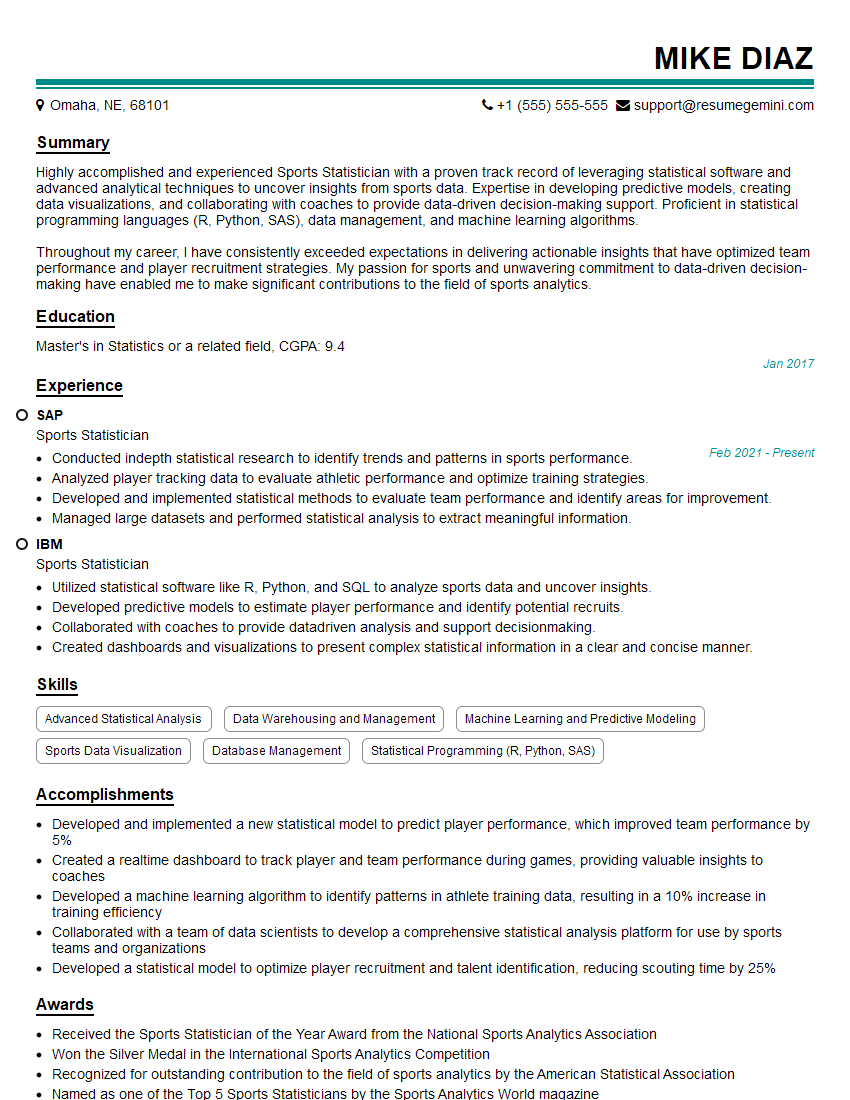
Mastering handicapping opens doors to exciting and lucrative career opportunities in the sports and entertainment industries. A strong understanding of these principles will significantly enhance your interview performance and career prospects. To further improve your chances, create an ATS-friendly resume that highlights your skills and experience effectively. ResumeGemini is a trusted resource that can help you build a professional resume tailored to the specific requirements of handicapping positions. Examples of resumes tailored to the Handicapping field are available within the ResumeGemini platform.


Explore more articles
Users Rating of Our Blogs
Share Your Experience
We value your feedback! Please rate our content and share your thoughts (optional).
What Readers Say About Our Blog
Very informative content, great job.
good