Unlock your full potential by mastering the most common High-Speed Digital and Mixed-Signal Testing interview questions. This blog offers a deep dive into the critical topics, ensuring you’re not only prepared to answer but to excel. With these insights, you’ll approach your interview with clarity and confidence.
Questions Asked in High-Speed Digital and Mixed-Signal Testing Interview
Q 1. Explain the challenges of testing high-speed digital signals.
Testing high-speed digital signals presents unique challenges due to the inherent limitations of measurement equipment and the complex behavior of signals at gigahertz frequencies. Think of it like trying to photograph a hummingbird in flight – the speed of the subject makes capturing a clear image difficult. Similarly, the rapid transitions and subtle signal distortions in high-speed data streams require sophisticated techniques.
- High Bandwidth Requirements: The test equipment itself needs to have sufficient bandwidth to accurately capture and analyze the signals. Insufficient bandwidth leads to aliasing and inaccurate measurements.
- Signal Integrity Issues: Reflections, crosstalk, and attenuation can significantly degrade the signal quality. These issues become more pronounced at higher speeds, making it crucial to control the impedance and minimize signal path lengths.
- Jitter and Noise: Random variations in signal timing (jitter) and unwanted noise can introduce errors and limit data transmission reliability. Measuring and characterizing these effects is critical.
- Complex Data Patterns: Modern high-speed interfaces use sophisticated data encoding schemes. Generating and analyzing these patterns accurately requires powerful signal generators and analyzers.
- Calibration and Accuracy: Ensuring the accuracy of the test equipment and calibration procedures is paramount. Even tiny errors can significantly impact the results.
Q 2. Describe different high-speed digital test methodologies.
Various methodologies exist for testing high-speed digital signals, each with its strengths and weaknesses. The choice depends on the specific application and required level of detail.
- Time Domain Reflectometry (TDR): TDR uses a short pulse to probe the transmission line, revealing impedance mismatches and reflections. Imagine sending a sound pulse down a pipe – reflections indicate blockages or changes in the pipe’s diameter. This is excellent for characterizing the physical channel.
- Time Domain Analysis: This directly measures the signal’s voltage over time, allowing for the identification of timing violations and signal integrity issues. It’s like recording a video of the signal’s behavior.
- Frequency Domain Analysis: This converts the signal into its frequency components, revealing the presence of unwanted noise and signal distortion. Think of it like a musical chord – analyzing its frequencies reveals its constituent notes.
- Protocol-Aware Testing: This method checks for compliance with the specific protocol standards (e.g., PCIe, SATA). It ensures that the device under test correctly implements the protocol’s specifications. It’s like checking if a car complies with all safety and emission regulations.
- Eye Diagram Analysis: This visual representation provides a comprehensive overview of the signal’s quality, including jitter, noise, and intersymbol interference (ISI). We’ll discuss this in more detail later.
Q 3. What are the key parameters to consider when characterizing high-speed serial interfaces (e.g., PCIe, SATA, USB)?
Characterizing high-speed serial interfaces requires careful consideration of several key parameters. These parameters dictate the speed, reliability, and overall performance of the interface.
- Bit Rate and Data Rate: The speed at which data is transmitted.
- Signal Amplitude and Swing: The voltage difference between the logic high and low levels.
- Rise/Fall Time: The time it takes for the signal to transition between logic levels. Faster transitions require higher bandwidth.
- Jitter: Timing variations in the signal, significantly impacting data integrity.
- Bit Error Rate (BER): The number of errors per transmitted bits, a crucial indicator of reliability.
- Eye Opening: A measure of signal quality determined from the eye diagram, related to noise margin and jitter.
- Return Loss and Insertion Loss: These parameters characterize the signal loss and reflections in the transmission line.
- Crosstalk: Unwanted coupling of signals between adjacent traces.
For example, testing a PCIe Gen 4 interface requires careful attention to its high data rates and the stringent signal integrity requirements needed to maintain its reliability.
Q 4. How do you handle signal integrity issues during high-speed testing?
Handling signal integrity issues during high-speed testing requires a multi-pronged approach, focusing on prevention and mitigation.
- Proper PCB Design: Careful layout and routing, including controlled impedance traces, proper termination, and minimizing trace lengths, is crucial in preventing signal degradation. Think of it as building a high-speed highway for the signals.
- Controlled Impedance Lines: Ensuring consistent impedance along the signal path minimizes reflections and signal distortion.
- Proper Termination: Terminating the transmission line with the correct impedance minimizes reflections at the end of the line.
- Shielding and Grounding: Reducing electromagnetic interference (EMI) and crosstalk through proper shielding and grounding practices.
- Signal Equalization: Techniques like equalization can compensate for signal attenuation and distortion.
- Pre-Emphasis and De-emphasis: Adjusting the signal’s amplitude to counteract attenuation.
- Using appropriate test equipment: Using probes and fixtures with suitable bandwidth and impedance characteristics is essential to obtain accurate measurements.
For example, using a wrong termination resistor can create significant reflections, affecting data transmission. Careful design and verification using tools like simulation software are essential.
Q 5. Explain the concept of jitter and its impact on high-speed data transmission.
Jitter is the variation in the timing of a digital signal’s transitions. Imagine a perfectly regular train schedule versus a train arriving at random intervals – the latter suffers from jitter. In high-speed data transmission, this variation in timing can introduce errors and significantly impact data reliability.
The impact of jitter depends on its magnitude and characteristics. Excessive jitter can cause bit errors, resulting in data corruption and system malfunctions. Even small amounts of jitter can reduce the available noise margin, making the system more susceptible to noise and environmental variations.
Q 6. Discuss different types of jitter and their measurement techniques.
Jitter can be broadly classified into different types, each with distinct characteristics and measurement techniques.
- Random Jitter (RJ): Unpredictable variations in timing caused by various noise sources. Think of it like wind affecting the train’s schedule slightly in unpredictable ways.
- Deterministic Jitter (DJ): Repetitive variations in timing, often caused by specific system events or periodic interference. This is more predictable, like a train stopping at regular intervals.
- Periodic Jitter (PJ): DJ with a specific frequency or pattern.
- Data-Dependent Jitter (DDJ): Timing variations related to the data pattern being transmitted. Certain data sequences may introduce more jitter than others.
Measurement techniques for jitter involve sophisticated oscilloscopes and jitter analyzers that can capture and analyze the signal’s timing variations. These instruments can decompose the jitter into its different components and quantify its impact. Specialized software often aids in the analysis and visualization of jitter measurements.
Q 7. How do you perform eye diagram analysis and interpret the results?
Eye diagram analysis is a powerful visual technique for assessing the quality of a high-speed digital signal. It’s a graphical representation of the signal’s voltage over time, superimposed for many data bit periods. Think of it like looking at multiple instances of a signal overlaid – the resulting shape resembles an eye.
Performing Eye Diagram Analysis: A high-speed oscilloscope, often with specialized jitter analysis software, is used to capture and display the eye diagram. The signal is sampled repeatedly for many bits, and the result is displayed as a superimposed waveform.
Interpreting Eye Diagram Results:
- Eye Opening: The vertical and horizontal width of the eye represents the noise margin and timing margin respectively. A larger opening indicates better signal quality and greater tolerance to noise and jitter.
- Jitter: The horizontal width of the eye is affected by jitter. Narrower eye indicates high jitter.
- Intersymbol Interference (ISI): ISI is indicated by the signal from one bit overlapping with adjacent bits. This degrades signal clarity.
- Noise: The vertical opening reflects the noise margin. Noise reduces the vertical eye opening.
By analyzing the eye diagram, engineers can quickly assess the signal’s quality, identify potential problems, and optimize the system design.
Q 8. What are the common challenges in mixed-signal testing?
Mixed-signal testing presents unique challenges due to the integration of both analog and digital circuits on a single chip. The primary difficulty lies in the inherent differences between these two domains. Digital testing is largely deterministic, relying on logic levels and binary signals. Analog testing, however, involves continuous signals and precise measurements influenced by factors like temperature, noise, and component tolerances.
- Signal Integrity: Ensuring the digital signals don’t interfere with the sensitive analog circuits and vice-versa is crucial. A small glitch in a digital signal could corrupt an analog measurement.
- Calibration and Linearity: Analog components need careful calibration to ensure accurate measurements and proper linearity across their operational range. This adds complexity to the test process.
- Test Equipment and Setup: You often need specialized test equipment capable of handling both high-speed digital and precise analog measurements simultaneously. Setting up and calibrating such a system can be quite complex.
- Correlation and Debugging: Identifying the root cause of a failure in a mixed-signal system can be more challenging than in purely digital or analog designs because failures can originate from interactions between the two domains. For example, a seemingly analog failure might be caused by a subtle digital glitch.
For instance, imagine testing a sensor interface. You’d need to test the digital communication protocol (e.g., SPI or I2C) for data integrity and timing accuracy while simultaneously verifying the analog sensor readings are within the specified tolerances and free from noise. This requires careful coordination of digital and analog test vectors and measurements.
Q 9. Explain different techniques for testing analog components in a mixed-signal environment.
Testing analog components within a mixed-signal environment demands a multifaceted approach that combines various techniques. The specific method depends on the component and its role within the system.
- DC Characterization: This involves measuring static parameters like voltage, current, and resistance to determine if the component meets its specifications under quiescent conditions. A simple multimeter is often sufficient for these basic tests.
- AC Characterization: Here, we examine frequency-dependent parameters like gain, bandwidth, and impedance. Specialized equipment like network analyzers and spectrum analyzers are essential for this type of testing.
- Functional Testing: This verifies that the analog component performs its intended function within the overall system. This might involve injecting test signals and observing the output to ensure the component meets its design specifications. This often requires custom test setups.
- Parameter Extraction: Complex analog components often require advanced methods to extract their key parameters (e.g., transistor parameters) from measurements using modeling techniques. This helps validate device models and fine-tune design parameters.
- In-circuit testing (ICT): This involves probing the analog component while it is in the circuit. This helps to understand its interactions with other components and the effects of the PCB.
For example, testing an operational amplifier (op-amp) would involve measuring its DC offset voltage, gain, bandwidth, and input impedance using appropriate test equipment. Functional testing might involve verifying its ability to amplify a specific signal with low distortion.
Q 10. How do you deal with crosstalk in high-speed digital circuits?
Crosstalk, the unwanted coupling of signals between adjacent traces or nets in high-speed digital circuits, is a significant challenge. It can lead to data corruption, timing errors, and system instability. Managing crosstalk requires a multi-pronged approach.
- Signal Integrity Analysis: Simulations using tools like SPICE or IBIS-AMI are crucial for predicting and mitigating crosstalk before the design is finalized. These simulations help optimize trace routing and component placement.
- PCB Layout Techniques: Careful PCB layout is paramount. Techniques like using differential signaling, ground planes, controlled impedance traces, and proper routing spacing minimize crosstalk. For example, keeping sensitive high-speed signals away from noisy ones reduces interference.
- Termination and Impedance Matching: Proper termination of transmission lines at both the source and receiver ends prevents reflections that can exacerbate crosstalk. Impedance matching ensures signal integrity and reduces signal distortion.
- Shielding and Guarding: In critical situations, shielding traces or using guard traces can provide additional isolation and reduce crosstalk. Shielding isolates the signal from external interference.
- Careful Component Selection: Choosing components with low crosstalk characteristics also helps reduce this issue. This includes components with low radiation and susceptibility.
For instance, in a high-speed data bus, differential signaling combined with proper termination and careful trace routing helps to minimize crosstalk. Simulation beforehand is essential to validate this.
Q 11. Describe various methods for reducing EMI/EMC in high-speed circuits.
Electromagnetic interference (EMI) and electromagnetic compatibility (EMC) are critical concerns in high-speed circuits. Excessive EMI can disrupt circuit operation and cause malfunction, while poor EMC can lead to interference with other devices. Mitigation strategies include:
- Shielding: Enclosing sensitive circuits in conductive enclosures prevents radiation of EMI and reduces susceptibility to external interference. Metal boxes are common shielding solutions.
- Filtering: Adding filters (LC, pi, etc.) to power supply and signal lines attenuates EMI signals. This helps to reduce the emission of unwanted frequencies.
- Grounding and Bonding: A well-designed grounding system with proper bonding techniques minimizes ground loops and reduces noise injection. Star ground is a commonly used method.
- Layout Optimization: Careful placement of components and traces minimizes loop areas which act as antennas. Reducing the loop area minimizes EMI radiation.
- Component Selection: Using low-EMI components can greatly reduce radiation. Components with proper shielding and EMI filters can reduce emissions.
- EMC Testing: Rigorous EMC testing, often performed in a shielded chamber, is essential to verify compliance with regulatory standards.
For example, in a high-speed clock distribution system, careful grounding and the use of EMI filters on the clock signal are crucial to prevent EMI problems and interference with other parts of the system.
Q 12. What are the common failure mechanisms in high-speed digital circuits?
High-speed digital circuits are susceptible to various failure mechanisms due to the high frequencies and fast switching speeds involved.
- Electromigration: High current densities can cause metal ions to migrate, leading to open or short circuits. This is more prevalent in fine-pitch devices.
- Hot Carrier Effect: High-energy electrons can damage the transistors, leading to performance degradation or failure. This often affects transistors with small gate lengths.
- Interconnect Failures: Stress due to thermal cycling or mechanical shock can cause interconnects to fail. This includes open circuits, shorts, and delamination.
- Latchup: Parasitic transistors in CMOS circuits can turn on unintentionally, causing a large current to flow, which can potentially damage the chip.
- ESD (Electrostatic Discharge) Damage: Static electricity can cause catastrophic damage to sensitive circuits. ESD protection is often built-in to mitigate this risk.
For example, electromigration can become a significant problem in high-speed memory chips due to the high current densities during operation. Careful design considerations, including the use of wider traces and optimized current distribution networks, are necessary to prevent it. Hot carrier effects are mitigated through appropriate transistor design and process technologies.
Q 13. Explain your experience with automated test equipment (ATE).
I have extensive experience working with various automated test equipment (ATE) systems from leading vendors like Teradyne and Advantest. My experience ranges from configuring and programming the ATE systems to developing and executing test programs for high-speed digital and mixed-signal circuits. I am proficient in using different ATE platforms and integrating them into automated test flows.
In my previous role, I was responsible for developing and maintaining test programs for a high-speed communication chip. This involved utilizing the ATE’s digital pattern generators and waveform generators to apply test stimuli to the device under test (DUT) and capturing the responses using digital and analog measurement units. I optimized the test sequences to minimize test time while ensuring high test coverage. I also worked on developing fault diagnostics to quickly identify the root cause of failures. I am familiar with various ATE architectures, including parallel and serial testing methodologies, as well as advanced features like on-chip debugging and embedded test capabilities.
Q 14. Describe your experience with different test software and programming languages (e.g., LabVIEW, Python).
I’m proficient in several test software and programming languages commonly used in high-speed digital and mixed-signal testing.
My experience with LabVIEW includes developing graphical programming code for instrument control, data acquisition, and test automation. I’ve used LabVIEW to create custom test applications for various projects, incorporating advanced features like data logging, analysis, and reporting. A recent project involved building a LabVIEW application to automate the characterization of a high-speed ADC, including calibration and data validation.
I’m also comfortable using Python for test program development and data analysis. Python’s extensive libraries, such as NumPy and SciPy, make it ideal for complex data processing and statistical analysis of test results. I have used Python to create scripts for automating test data analysis, generating reports, and visualizing test results. For example, I used Python to process terabytes of data from ATE tests and developed algorithms for efficient failure detection and reporting. I also leverage Python’s scripting capabilities for automated test setup and configuration.
Beyond LabVIEW and Python, I have experience with other languages like C++, MATLAB, and specialized ATE-specific programming languages, depending on the specific ATE platform used. My experience ensures I can adapt and utilize the most appropriate tools for any given task.
Q 15. How do you debug a failing test case in high-speed digital or mixed-signal designs?
Debugging a failing test case in high-speed digital or mixed-signal designs requires a systematic approach. It’s like detective work – you need to gather clues and follow the trail to pinpoint the culprit. The process typically involves several stages:
Reproduce the Failure: First, ensure the failing test case is consistently reproducible. This often involves checking the test setup, including the test equipment, connections, and stimulus signals. Inconsistent failures usually point to environmental issues or noise.
Analyze the Test Data: Scrutinize the captured waveforms from oscilloscopes, logic analyzers, or other test equipment. Look for anomalies like unexpected signal transitions, timing violations, voltage levels outside specifications, or unusual current draws. Comparing the failing waveforms with the expected waveforms from a golden run is invaluable.
Isolate the Failing Component: Based on the test data, try to isolate the failing component or section of the design. This may involve isolating specific blocks of the circuit with probes, using logic analyzers to pinpoint signal integrity issues, or running targeted simulations.
Inspect the Design: After narrowing down the suspect area, review the design specifications and schematics to identify potential design flaws, such as incorrect routing, timing violations, impedance mismatches, or inadequate power delivery. Consider the impact of parasitic effects, such as capacitance and inductance.
Simulate the Failure: Use simulation tools to model the failing behavior. Simulations can help to verify hypotheses and provide insights into the root cause of the failure. Spice simulations for analog/mixed-signal, and digital simulations for digital sections, are essential.
Iterate and Verify: Once you’ve identified a potential solution, implement it and retest. The iterative nature is crucial; you may need to repeat the analysis and simulation steps multiple times until the root cause is addressed. Thorough documentation throughout the process is essential.
For instance, if I encountered a failing test case involving a high-speed serial link, I might use a high-bandwidth oscilloscope to examine the signals for jitter, eye diagram quality, and signal integrity issues. Logic analyzers could help trace the data flow to find inconsistencies. If simulations suggest a clock skew problem, I might adjust the placement of buffers or routing to fix it.
Career Expert Tips:
- Ace those interviews! Prepare effectively by reviewing the Top 50 Most Common Interview Questions on ResumeGemini.
- Navigate your job search with confidence! Explore a wide range of Career Tips on ResumeGemini. Learn about common challenges and recommendations to overcome them.
- Craft the perfect resume! Master the Art of Resume Writing with ResumeGemini’s guide. Showcase your unique qualifications and achievements effectively.
- Don’t miss out on holiday savings! Build your dream resume with ResumeGemini’s ATS optimized templates.
Q 16. Explain your experience with statistical process control (SPC) in testing.
Statistical Process Control (SPC) is crucial for monitoring and improving the manufacturing process and ensuring consistent product quality. In testing, SPC involves tracking key metrics over time and using statistical methods to detect trends and variations. I’ve extensively used SPC in several projects to analyze yield, defect rates, and test times.
For example, in one project involving the manufacture of high-speed ADCs, we used control charts to monitor the conversion accuracy across different production batches. We tracked parameters such as integral non-linearity (INL) and differential non-linearity (DNL) using Shewhart charts and moving range charts. These charts helped us quickly detect any shift in the process mean or increase in variability, allowing for timely intervention to prevent widespread defects. If we noticed an out-of-control point, it triggered an investigation to pinpoint the root cause, which might have involved reviewing the calibration procedures, equipment maintenance logs, or even the raw materials.
We also employed capability analysis to assess the process’s ability to meet the specifications. By calculating Cp and Cpk indices, we could quantitatively determine how well our process performed and identify areas needing improvement.
Q 17. How do you generate test vectors for high-speed digital circuits?
Generating effective test vectors for high-speed digital circuits is crucial for thorough testing. It’s like creating a comprehensive checklist to ensure all parts of the circuit are functioning as intended. The process depends heavily on the circuit’s functionality and complexity.
Functional Test Vectors: These test vectors are derived from the circuit’s specifications and aim to verify its intended behavior. This might involve verifying arithmetic operations in a processor, checking data transfer through a memory interface, or testing the logic functionality of a specific block.
Pseudo-random Test Vectors: For more extensive testing, pseudo-random test vectors are generated using a deterministic algorithm. While seemingly random, these vectors ensure full coverage of various input combinations, increasing the chances of detecting faults.
Deterministic Test Vectors: These vectors are meticulously designed to target specific functionalities or to provoke specific error conditions. This is particularly useful when looking for a known problem. For example, it can be used to detect corner cases, such as extreme temperature conditions or when particular timing parameters are tested.
Fault Models: For testing robustness, we can use fault models, where we inject likely faults (stuck-at faults, bridging faults) into a model of the circuit to observe their effects on the output. Generating vectors to find and isolate these faults is critical.
Test Vector Generation Tools: Commercial and open-source tools are often utilized. These tools can automate vector generation, ensuring sufficient coverage and facilitating the development of targeted tests.
For instance, when testing a high-speed data converter, we might use test vectors that exercise the full range of input values, checking for linearity, accuracy, and speed.
Q 18. What is the significance of Design for Testability (DFT) techniques?
Design for Testability (DFT) techniques are essential for improving the testability of integrated circuits. They are strategies added to a design to enhance its ability to be thoroughly tested while minimizing extra cost and effort. Think of it as building a house with easy access to inspect all parts during construction and after completion.
Scan Chain: This technique allows sequential access to internal circuit nodes through a shift register, simplifying testing.
Built-In Self-Test (BIST): This adds dedicated circuitry to generate test patterns and analyze results on the chip, reducing external test equipment needs.
Boundary Scan (JTAG): This standard allows access to the chip’s pins, simplifying testing of interconnects and input/output signals.
Ad Hoc DFT Techniques: These are specific techniques targeted to the problem on hand. Often these may include test points for critical signals or easily controllable inputs.
DFT is crucial because it leads to higher fault coverage, faster test times, and lower test costs. Without DFT, testing complex designs would be significantly more challenging and expensive, especially for internal circuit nodes that are otherwise inaccessible.
Q 19. Explain your understanding of Boundary-Scan testing.
Boundary-Scan testing, also known as JTAG (Joint Test Action Group), is a standardized method to access and test the input/output pins of an integrated circuit. It’s a powerful tool because it allows us to test connections and inter-chip communication without having to probe internal nodes. Imagine it as a special access port that allows external testing tools to check the health of each pin.
It uses a serial communication protocol to control boundary scan cells on the chip. Each pin has a dedicated cell that can be configured to either pass signals through, perform diagnostics (like checking for shorts or opens), or inject test vectors. The entire boundary scan chain is controlled through a shift register. JTAG is widely used for testing PCBs (Printed Circuit Boards), verifying the interconnections between different chips and ensuring the proper functionality of the entire system. This is extremely useful in identifying failures like shorts, opens or misconnections in a complex PCB.
A common application is during board-level testing, where we use a JTAG tester to verify the connections between components, detect short circuits, and verify the correct chip placement and operation, without having to apply complex and expensive test setups. This greatly reduces the testing effort.
Q 20. Describe your familiarity with various types of oscilloscopes and their applications.
Oscilloscopes are indispensable tools for analyzing analog and mixed-signal waveforms. Different types are suited for specific tasks. I’m familiar with several, including:
Real-time Oscilloscopes: These capture waveforms as they occur, providing a live view of the signals. They are essential for high-speed signals where timing is critical. Real-time oscilloscopes with high sampling rates are particularly useful in high-speed digital designs for analyzing signal integrity and timing.
Sampling Oscilloscopes: These oscilloscopes sample signals at significantly higher rates than real-time oscilloscopes, enabling the analysis of extremely high-frequency signals. They require post-processing however as the actual waveform is reconstructed from the collected data points. They are particularly useful when examining signals with very high bandwidth.
Mixed-Signal Oscilloscopes: These combine the capabilities of analog and digital oscilloscopes, allowing simultaneous observation of both analog and digital signals. This is especially useful in mixed-signal systems where you need to correlate analog and digital events.
For example, in testing a high-speed serial interface, I’d use a real-time oscilloscope with a high bandwidth to measure the signal’s eye diagram, quantify jitter, and check for signal integrity issues. If I were characterizing a high-frequency RF circuit, a sampling oscilloscope would be necessary to capture the signal’s details. If I were debugging a mixed-signal circuit where both analog and digital data were relevant, a mixed-signal oscilloscope would be the ideal choice.
Q 21. Explain your experience with different types of probes and their impact on measurement accuracy.
The choice of probe significantly impacts measurement accuracy. Different probes have different characteristics, and using an inappropriate probe can lead to inaccurate or misleading results. I have experience using various probe types:
Passive Probes: These are simple attenuators that reduce the amplitude of the signal before it reaches the oscilloscope. They are relatively low-cost but introduce some capacitance and resistance, affecting high-frequency measurements.
Active Probes: These amplify the signal before it reaches the oscilloscope, improving signal-to-noise ratio. They have lower capacitance and improved accuracy at higher frequencies compared to passive probes. However, they require a power source.
High-bandwidth probes: Crucial for high-speed signals, these minimize the effects of probe capacitance and inductance, ensuring accurate measurement of fast edges and high-frequency components.
Current probes: These measure the current flowing through a circuit, allowing measurement of signal integrity issues related to power delivery. Useful in designs with high current transients.
Differential probes: These measure the voltage difference between two points, eliminating common-mode noise and enhancing accuracy in noisy environments. Essential when making differential measurements and rejecting noise.
For instance, when measuring a high-speed digital signal with fast rise and fall times, a passive probe might introduce significant attenuation and distortion. To accurately capture the signal’s characteristics, a high-bandwidth active probe would be necessary. Using the wrong probe might lead to incorrect interpretations about signal integrity or timing.
Q 22. How do you ensure test accuracy and repeatability?
Ensuring test accuracy and repeatability in high-speed digital and mixed-signal testing is paramount. It hinges on a multi-pronged approach focusing on calibration, environmental control, and robust test methodologies.
- Calibration: Regular calibration of all test equipment, including oscilloscopes, signal generators, and network analyzers, is crucial. This minimizes systematic errors introduced by instrument drift or inaccuracies. We use traceable calibration standards to maintain the highest level of accuracy. For instance, we calibrate our oscilloscopes annually against NIST-traceable standards.
- Environmental Control: Temperature and humidity fluctuations significantly impact test results. We maintain a controlled environment within our testing labs to minimize these variations. This includes using climate-controlled chambers for sensitive tests and carefully monitoring temperature and humidity levels during measurements.
- Test Methodologies: We employ statistically sound test plans and analyze data using appropriate statistical methods. This involves using techniques like Design of Experiments (DOE) to optimize test parameters and reduce the number of tests needed. We also implement rigorous procedures to document every step of the test process, including equipment settings and environmental conditions. This creates an audit trail for traceability and helps identify any inconsistencies. For example, we developed a custom script that automatically logs all relevant parameters to a central database during each test run.
- Automated Test Systems: Automation minimizes human error and ensures consistency across multiple test runs. We leverage automated test equipment (ATE) and custom-developed software to automate the testing process. This minimizes the chances of human error during the testing process.
By combining these strategies, we ensure high accuracy and repeatability, fostering confidence in our test results and ensuring the reliability of the devices under test.
Q 23. How do you handle thermal effects during high-speed testing?
Thermal effects are a major concern in high-speed testing, as temperature variations can significantly alter device performance, leading to inaccurate results. We mitigate these effects through several approaches:
- Temperature-Controlled Chambers: For precise control, we utilize temperature-controlled chambers to maintain a stable thermal environment during the test. This allows us to test the device’s performance across a range of temperatures and observe the impact of thermal variations. We can simulate real-world operating conditions and quantify thermal sensitivity.
- Thermal Modeling: We often employ thermal modeling techniques to predict the temperature distribution within the device under test. This helps identify potential hot spots and allows us to optimize the test setup to minimize thermal gradients. This predictive capability saves significant time and resources.
- Thermal Management Techniques: During test setup, we utilize appropriate heat sinks and cooling solutions to maintain optimal device temperatures. The choice of the cooling system is crucial; we often use liquid cooling for very high power devices.
- Statistical Analysis: We use statistical analysis to quantify the impact of temperature variations on performance. This involves performing tests at various temperatures and analyzing the data to understand the correlation between temperature and key parameters. We create temperature profiles that describe the performance across a temperature range.
By carefully managing thermal effects, we gain a deeper understanding of device performance across various operating conditions, ensuring more reliable test results and more robust designs.
Q 24. What are your experiences with different types of mixed-signal ICs?
My experience encompasses a wide range of mixed-signal ICs, including:
- High-Speed Data Converters (ADCs/DACs): Extensive experience in testing high-resolution ADCs and DACs, focusing on parameters like effective number of bits (ENOB), spurious-free dynamic range (SFDR), and total harmonic distortion (THD). I’ve worked with devices operating at sampling rates exceeding 1 Gsps.
- Power Management ICs (PMICs): I’ve worked on testing various PMICs, including those used in mobile devices and high-performance computing applications. This involved measuring parameters such as efficiency, transient response, and noise performance.
- RF Transceivers: Experience in characterizing RF transceivers, including testing parameters like sensitivity, selectivity, and linearity. I’ve utilized sophisticated RF testing equipment and techniques, including vector network analyzers and spectrum analyzers, to comprehensively characterize the transceivers across various frequency bands and modulation schemes.
- Sensor Interface ICs: I’ve been involved in testing sensor interface ICs used in applications like automotive and industrial control systems. This involved evaluating the accuracy, precision, and noise characteristics of the sensor interfaces.
My experience extends to both the testing of individual components and their integration within complete systems. I’m familiar with both production testing and characterization testing needs.
Q 25. Describe your proficiency in using various test instruments, like spectrum analyzers and network analyzers.
I’m proficient in using a variety of test instruments for high-speed digital and mixed-signal testing. My expertise includes:
- Oscilloscopes: Extensive experience with high-bandwidth oscilloscopes (up to 100 GHz), including real-time and sampling oscilloscopes, for signal integrity analysis and timing measurements. I am adept at using advanced triggering and measurement techniques like eye diagrams and jitter analysis.
- Spectrum Analyzers: Proficient in using spectrum analyzers to analyze frequency content, measure spurious emissions, and characterize noise performance. I’ve worked with both benchtop and embedded spectrum analyzers.
- Network Analyzers: I’m skilled in using vector network analyzers (VNAs) to characterize the impedance and S-parameters of high-speed circuits and components. This expertise is crucial for evaluating signal integrity and antenna performance.
- Bit Error Rate Testers (BERTs): I have experience using BERTs to assess the bit error rate performance of high-speed serial links, including various standards like PCIe and SATA. I’m proficient in setting up and interpreting BERT measurements.
- Logic Analyzers: I routinely utilize logic analyzers to examine digital signals in detail, helping to identify timing issues and logic errors.
My proficiency extends beyond basic operation; I can configure and program these instruments for complex measurements and automated test sequences. I am familiar with various software packages used to control and analyze data from these instruments.
Q 26. How do you manage large volumes of test data and analyze the results efficiently?
Managing and analyzing large volumes of test data efficiently requires a structured approach and the use of appropriate tools. Here’s how I address this challenge:
- Automated Data Acquisition: I leverage automated test systems to directly collect and store test data in a structured format (e.g., CSV, databases). This prevents manual data entry errors and speeds up data collection.
- Data Compression and Storage: For large datasets, I utilize efficient data compression techniques to reduce storage requirements and improve processing speeds. Cloud-based storage solutions are often implemented to handle massive amounts of data effectively.
- Data Analysis Software: I’m adept at using specialized software packages like MATLAB, Python (with libraries like NumPy, SciPy, Pandas), and LabVIEW for data processing, analysis, and visualization. These tools facilitate efficient data manipulation and provide functionalities for statistical analysis, signal processing, and report generation. For example, I’ve developed custom Python scripts that automatically process terabytes of data from our ATE systems.
- Data Visualization: Effective data visualization is crucial for identifying trends and drawing meaningful conclusions. I use various charting and graphing techniques to visualize the data and communicate findings effectively. For complex datasets, I use interactive visualizations and dashboards that allow exploration of the data and identification of outliers or anomalies.
This combination of automated data acquisition, optimized storage, and powerful analysis tools ensures that I can efficiently process and analyze vast quantities of test data, extracting critical information quickly and accurately.
Q 27. Describe your experience with fault isolation techniques in high-speed digital and mixed-signal circuits.
Fault isolation in high-speed digital and mixed-signal circuits requires a systematic and multi-faceted approach. My strategies include:
- Systematic Testing: I employ a structured testing approach, starting with broad tests to identify the faulty area, followed by more focused tests to pinpoint the specific component or connection. This approach helps to systematically narrow down the possibilities.
- Digital Diagnostics: For digital circuits, I leverage built-in self-test (BIST) capabilities and use logic analyzers and protocol analyzers to investigate digital signals and identify timing and logic errors. I often use boundary scan techniques (JTAG) to access internal test points.
- Mixed-Signal Diagnostics: For mixed-signal circuits, I combine digital diagnostic techniques with analog measurements to isolate faults. I use oscilloscopes, spectrum analyzers, and network analyzers to characterize analog signals and identify problems such as impedance mismatches, noise, and interference.
- Statistical Analysis: Statistical techniques help to distinguish between random errors and systematic faults. The application of Design of Experiments (DOE) can help find the root cause of intermittent problems.
- Automated Fault Diagnosis: I’ve developed automated test scripts and algorithms that analyze test data and generate detailed reports about potential fault locations, reducing the time required for fault isolation.
My experience includes using both manual and automated fault isolation techniques, adapting my approach to the specific characteristics of the device and the available test equipment. I use a combination of top-down and bottom-up approaches, using knowledge of the circuit to inform the tests and analysis.
Q 28. Explain your experience working with different standards and specifications in high-speed digital and mixed-signal systems.
Working with different standards and specifications is crucial in high-speed digital and mixed-signal systems. My experience includes:
- Serial Data Standards: Extensive experience with high-speed serial data standards such as PCIe, SATA, USB 3.x, and Ethernet, including the associated specifications for signal integrity, timing, and error correction. This includes understanding the detailed requirements for eye diagrams and jitter analysis.
- Digital Interface Standards: Proficiency in various digital interface standards including LVDS, MIPI, and others.
- Analog Standards: Familiarity with various analog standards and specifications, including those related to power management, audio signal processing, and sensor interfaces.
- EMI/EMC Compliance: Experience with EMI/EMC testing and compliance requirements, including testing methods and regulatory standards. I understand the necessity of designing and testing circuits that meet emission and susceptibility limits.
- Other Relevant Standards: Exposure to standards and specifications related to automotive (e.g., AEC-Q100), industrial (e.g., IEC 61000), and aerospace applications.
My knowledge of these standards allows me to design appropriate tests, interpret test results in the context of specifications, and ensure that devices meet the required performance standards for specific applications. This comprehensive knowledge ensures we adhere to all relevant regulatory requirements and industry best practices.
Key Topics to Learn for High-Speed Digital and Mixed-Signal Testing Interview
- High-Speed Digital Testing Fundamentals: Understanding concepts like jitter, eye diagrams, signal integrity, and timing analysis. Consider the practical application of these concepts in real-world scenarios like designing robust test plans.
- Mixed-Signal Testing Techniques: Explore the challenges of testing circuits that combine digital and analog components. Focus on techniques like ADC/DAC testing, and how to effectively combine digital and analog test methodologies.
- Test Equipment and Instrumentation: Familiarize yourself with common instruments used in high-speed testing, such as oscilloscopes, logic analyzers, and bit-error rate testers (BERTs). Understand their capabilities and limitations, and how to select the appropriate equipment for a given task.
- Test Plan Development and Execution: Learn how to develop comprehensive test plans that address all aspects of a design, including functional testing, performance testing, and stress testing. Mastering effective test execution and data analysis is crucial.
- Statistical Analysis and Data Interpretation: Develop skills in interpreting test data, identifying trends and anomalies, and using statistical methods to assess the quality and reliability of the device under test.
- Troubleshooting and Debugging: Practice identifying and resolving common issues encountered during high-speed digital and mixed-signal testing. This includes developing strategies for systematic fault isolation and diagnosis.
- Advanced Concepts (Optional): Explore advanced topics such as protocol testing (e.g., PCIe, USB, Ethernet), embedded system testing, and automated test equipment (ATE) programming, depending on the specific job requirements.
Next Steps
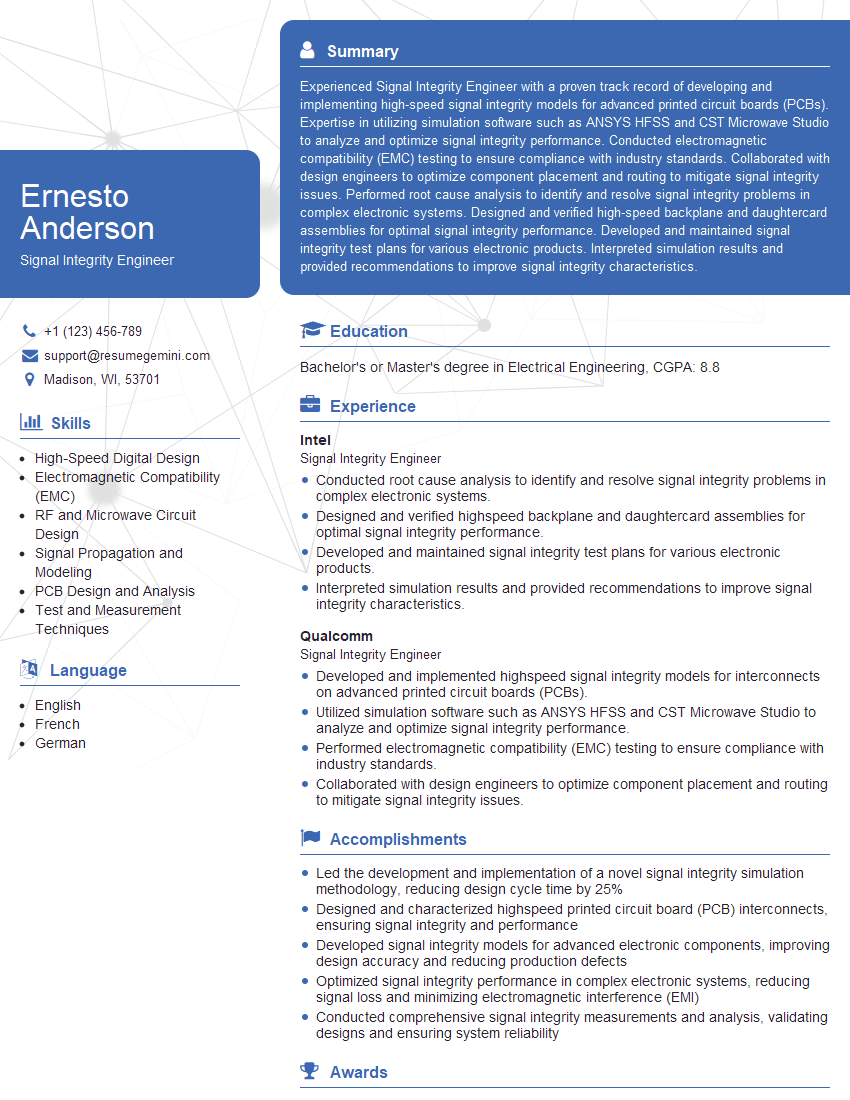
Mastering High-Speed Digital and Mixed-Signal Testing opens doors to exciting and rewarding career opportunities in the electronics industry. To maximize your chances of landing your dream job, it’s crucial to present your skills and experience effectively. Creating an ATS-friendly resume is paramount in getting your application noticed. We highly recommend leveraging ResumeGemini, a trusted resource, to build a professional and impactful resume. ResumeGemini provides examples of resumes tailored to High-Speed Digital and Mixed-Signal Testing to guide you in creating a winning application. Invest time in crafting a compelling resume that showcases your expertise – it’s your first impression!
Explore more articles
Users Rating of Our Blogs
Share Your Experience
We value your feedback! Please rate our content and share your thoughts (optional).
What Readers Say About Our Blog
Very informative content, great job.
good