The thought of an interview can be nerve-wracking, but the right preparation can make all the difference. Explore this comprehensive guide to High-Speed Flow Analysis interview questions and gain the confidence you need to showcase your abilities and secure the role.
Questions Asked in High-Speed Flow Analysis Interview
Q 1. Explain the difference between laminar and turbulent flow in high-speed regimes.
In high-speed flows, the distinction between laminar and turbulent flow becomes even more critical due to the significant impact on drag, heat transfer, and overall aerodynamic performance. Laminar flow is characterized by smooth, parallel streamlines where fluid particles move in orderly layers. Think of a smoothly flowing river. Turbulent flow, on the other hand, is chaotic, with swirling eddies and random fluctuations in velocity. Imagine a rapidly flowing, white-water river. At high speeds, the transition from laminar to turbulent flow often occurs earlier than at low speeds, primarily due to the increased Reynolds number (a dimensionless quantity representing the ratio of inertial forces to viscous forces). This transition can significantly increase drag and heat transfer to the body moving through the fluid. The precise transition point depends heavily on the geometry of the body and the flow conditions (e.g., surface roughness). For instance, a streamlined aircraft wing might maintain laminar flow over a larger portion of its surface than a blunt-nosed object which is more likely to experience early transition to turbulence.
Q 2. Describe the concept of boundary layer separation in high-speed flows.
Boundary layer separation in high-speed flows is a phenomenon where the boundary layer (the thin layer of fluid adjacent to a surface) detaches from the surface. This separation is often triggered by an adverse pressure gradient (a region where pressure increases in the flow direction). In high-speed flows, the compressibility effects further complicate this separation. As the flow slows down near separation, it can experience a significant increase in pressure, leading to the formation of shock waves which can further destabilize the boundary layer and promote separation. This separation has severe consequences, leading to increased drag, loss of lift (in aerodynamics), and increased heat transfer to the surface. A classic example is the stall of an aircraft wing at high angles of attack, where boundary layer separation causes a dramatic reduction in lift. Understanding and controlling boundary layer separation is crucial in designing high-speed vehicles to ensure efficiency and stability.
Q 3. What are the key challenges in simulating high-speed compressible flows?
Simulating high-speed compressible flows presents several key challenges:
- Shock capturing: Accurately capturing the sharp discontinuities associated with shock waves requires sophisticated numerical schemes. Standard numerical methods may produce oscillations or inaccurate solutions near shock waves.
- Computational cost: Resolving the fine-scale features of high-speed flows, especially turbulent ones, demands significant computational resources. This is because finer meshes are needed to capture smaller-scale features.
- Complex physics: High-speed flows often involve complex phenomena such as chemical reactions, nonequilibrium effects, and real-gas effects which all add to the complexity and computational cost of the simulations.
- Numerical stability: High-speed flows are prone to numerical instabilities, requiring careful selection of numerical schemes and solution strategies to ensure convergence and accuracy. This is particularly important in the presence of shocks and complex boundary conditions.
Q 4. How do you handle shock waves in CFD simulations?
Handling shock waves in CFD simulations requires specialized techniques. The most common approach involves using shock-capturing schemes, which are designed to handle the discontinuities in flow properties across shock waves without producing spurious oscillations. These schemes typically involve artificial viscosity or flux limiters. For example, the Godunov method and its variants (e.g., Roe solver, AUSM) are frequently used to capture shocks accurately. The selection of an appropriate shock-capturing scheme depends on the specific problem and desired accuracy. In some cases, mesh refinement around shock waves can also enhance accuracy but increases computational cost. Validation against experimental data or analytical solutions is crucial to assess the accuracy of shock capturing in CFD simulations.
Q 5. Explain the role of turbulence modeling in high-speed flow analysis.
Turbulence modeling plays a crucial role in high-speed flow analysis because resolving all turbulent scales directly is computationally prohibitive. Turbulence models provide a means of approximating the effects of turbulence on the mean flow without explicitly resolving all the turbulent scales. For high-speed flows, Reynolds-Averaged Navier-Stokes (RANS) models, such as the k-ε model or k-ω SST model, are commonly employed. However, these models have limitations in accurately predicting separation and transition to turbulence in high-speed flows. Large Eddy Simulation (LES) and Direct Numerical Simulation (DNS) offer higher fidelity but are significantly more computationally expensive. The choice of turbulence model depends on the specific application, available computational resources, and the desired level of accuracy. In high-speed flows, the interaction between turbulence and compressibility effects needs careful consideration when selecting the turbulence model.
Q 6. What are the common numerical methods used for solving high-speed flow problems?
Several numerical methods are used for solving high-speed flow problems. Finite volume methods (FVM) are widely employed due to their conservation properties and ability to handle complex geometries. Finite difference methods (FDM) are also used, particularly for structured grids. Finite element methods (FEM) are less common for high-speed flows but find applications in specific cases. The choice of method depends on factors such as grid type, complexity of the geometry, and desired accuracy. High-resolution schemes, such as essentially non-oscillatory (ENO) and weighted essentially non-oscillatory (WENO) schemes, are often employed to accurately capture sharp gradients and shocks without introducing oscillations. These methods are crucial for accurately simulating the complex flow features in high-speed flows.
Q 7. Describe your experience with different CFD solvers (e.g., ANSYS Fluent, OpenFOAM).
I have extensive experience with both ANSYS Fluent and OpenFOAM. In my previous role, I utilized ANSYS Fluent for numerous projects involving high-speed aerodynamics, particularly simulations of supersonic and hypersonic flows around aircraft and missiles. Fluent’s robust capabilities for handling compressible flows, shock capturing, and turbulence modeling proved invaluable. I’ve also extensively used OpenFOAM, especially for more customized simulations and for exploring new numerical techniques, thanks to its open-source nature and flexibility. For instance, I’ve developed custom solvers within OpenFOAM to incorporate advanced turbulence models and investigate specific flow phenomena. My experience spans both structured and unstructured meshing techniques in both solvers and I am comfortable with various pre- and post-processing tools. I am proficient in verifying and validating simulation results by comparing them with experimental data and theoretical predictions. My choice of solver depends on project-specific requirements, including available resources and the desired level of customization.
Q 8. How do you validate and verify your CFD results?
Validating and verifying CFD results is crucial for ensuring the accuracy and reliability of our simulations. Verification focuses on whether the code is solving the governing equations correctly, while validation assesses how well the simulation results match real-world experimental data.
Verification often involves techniques like grid convergence studies (discussed in the next question), code benchmarking against analytical solutions for simple cases, and checking for conservation of mass, momentum, and energy. For instance, we might compare our code’s solution for laminar flow over a flat plate with the well-established Blasius solution. Any discrepancies highlight potential coding errors.
Validation involves comparing simulation results against experimental data obtained from wind tunnels, flight tests, or other experimental setups. This requires careful selection of appropriate experimental data with well-defined uncertainties. We often use quantitative metrics like comparing pressure coefficients, skin friction coefficients, or flow visualizations. A good match between simulation and experiment provides confidence in the model’s accuracy for the specific conditions tested. Discrepancies necessitate investigation into potential issues, such as incorrect boundary conditions, turbulence modeling inadequacies, or limitations in the experimental data itself.
A comprehensive validation and verification process might involve a structured approach with well-defined metrics and acceptance criteria. It’s an iterative process, with findings from one stage informing improvements in the next.
Q 9. Explain the concept of grid independence in CFD simulations.
Grid independence in CFD refers to the situation where further refinement of the computational mesh (grid) no longer significantly affects the solution. In simpler terms, you’ve reached a point where making the grid finer doesn’t change your results in a meaningful way.
Imagine trying to map a coastline with a very coarse map: you’ll miss many details. As you use a finer map (finer grid), you get more detail. But at some point, the added detail becomes negligible. That’s grid independence. We achieve this by performing simulations with progressively finer grids and comparing the results. Key parameters like lift and drag coefficients, pressure distributions, and other quantities of interest are examined. If the differences between solutions from successively refined grids fall below a pre-defined tolerance (e.g., less than 1%), we consider the solution to be grid-independent. This ensures that the solution accuracy is not limited by the computational mesh. Without grid independence, our results are unreliable, as the solution is artificially dependent on the grid resolution.
A typical approach involves generating at least three grids with systematically different refinement levels (e.g., doubling the number of cells in each direction). Then, using Richardson extrapolation or similar methods, we extrapolate to estimate the grid-independent solution and quantify the error associated with the grid resolution.
Q 10. What are the limitations of RANS simulations for high-speed flows?
Reynolds-Averaged Navier-Stokes (RANS) simulations are widely used but have limitations, especially for high-speed flows. RANS models assume that turbulent fluctuations are statistically stationary and isotropic, which isn’t always true in high-speed flows, where shocks and complex flow features are common.
Limitations include:
- Inaccurate prediction of unsteady phenomena: High-speed flows often involve unsteady shocks, separation bubbles, and other transient features that RANS struggles to capture effectively due to its time-averaged nature.
- Difficulties with shock-boundary layer interaction: In high-speed flows, shock waves can interact strongly with boundary layers, generating complex flow structures. RANS models often struggle to accurately predict these interactions leading to inaccurate estimations of heat transfer and skin friction.
- Problems handling separation and reattachment: RANS models can struggle to accurately predict flow separation and reattachment points, particularly in high-speed regimes. This is crucial for aerodynamic performance prediction.
- Challenges with capturing turbulence accurately: High-speed flows involve diverse turbulence characteristics. RANS models, while computationally efficient, can exhibit significant inaccuracies in capturing the full spectrum of turbulent scales, especially in the presence of strong shocks.
These limitations often require the use of more advanced turbulence models like Large Eddy Simulation (LES) or Detached Eddy Simulation (DES), which better handle unsteady and complex flow features prevalent in high-speed aerodynamics and propulsion.
Q 11. Discuss your experience with LES or DES turbulence modeling.
I have extensive experience using both Large Eddy Simulation (LES) and Detached Eddy Simulation (DES) for high-speed flows. These methods offer significant advantages over RANS for resolving unsteady turbulent phenomena.
LES directly simulates the large energy-containing turbulent eddies, while modeling the smaller, less significant scales. This approach leads to more accurate predictions of unsteady flow features compared to RANS. However, LES is computationally expensive, particularly for large-scale simulations. I’ve used LES successfully in simulating supersonic jet noise and shock-boundary layer interactions, gaining valuable insights into unsteady flow structures.
DES combines the advantages of RANS and LES, switching between them based on the local grid resolution. In regions of resolved turbulent structures, DES behaves like LES; elsewhere, it reverts to RANS for computational efficiency. DES is a good compromise between accuracy and computational cost and I’ve found it particularly useful for simulations involving complex geometries and high Reynolds numbers, reducing the computational burden without sacrificing too much accuracy in key flow regions. For example, I successfully used DES to simulate the flow around a hypersonic vehicle, effectively capturing the complex interactions between shocks, boundary layers, and separated regions.
The choice between LES and DES depends on the specific problem, desired accuracy, and available computational resources. For extremely demanding accuracy, LES is preferred, but DES often presents a more practical and efficient solution when computational resources are limited.
Q 12. How do you handle multiphase flows in high-speed applications?
Handling multiphase flows in high-speed applications is complex, often involving high pressure, temperature gradients, and complex interfacial phenomena. The appropriate method depends on the specific characteristics of the flow.
Common approaches include:
- Eulerian-Eulerian methods: These methods treat each phase as an interpenetrating continuum. This is suitable when both phases occupy significant portions of the computational domain, such as in simulations of two-phase supersonic nozzles. The volume-of-fluid (VOF) and Eulerian multiphase models are widely used here.
- Eulerian-Lagrangian methods: These methods treat one phase (typically the dispersed phase) as discrete particles moving within a continuous phase. This approach is useful for simulating sprays, such as fuel injection in scramjets. Discrete element methods (DEM) can also be coupled with the Eulerian description of the continuous phase.
- Level-set methods: These are interface capturing methods that track the interface between phases using a level-set function. They are particularly well-suited for problems involving strong surface tension effects and topological changes, which can be important in certain high-speed multiphase flows.
The selection of the appropriate method depends on factors like the phase volume fractions, droplet size distribution, and the presence of strong interfacial forces. Accurate modeling of interphase mass, momentum, and energy transfer is crucial in capturing the flow physics correctly.
For high-speed applications, consideration of compressibility effects and shock interactions becomes essential. Specialized models are often needed to account for these phenomena.
Q 13. Explain the significance of Mach number in high-speed flow analysis.
The Mach number (M) is a dimensionless quantity representing the ratio of the flow velocity to the local speed of sound. It’s a crucial parameter in high-speed flow analysis because it dictates the flow regime and the governing equations.
Significance:
- Flow regime classification: M < 1 indicates subsonic flow (compressibility effects are negligible), M = 1 indicates sonic flow, and M > 1 indicates supersonic flow (compressibility effects are dominant). Hypersonic flow is generally defined as M > 5. The Mach number determines the type of equations (incompressible or compressible Navier-Stokes) needed to model the flow.
- Shock wave formation: Shock waves, characterized by abrupt changes in flow properties, form only in supersonic flows (M > 1). Accurate simulation of shock wave generation, propagation, and interaction is critical in high-speed aerodynamics.
- Heat transfer: Heat transfer rates significantly increase with increasing Mach number, especially in hypersonic flows, due to increased kinetic energy and viscous dissipation. Accurate prediction of heat transfer is vital for designing thermal protection systems for high-speed vehicles.
- Aerodynamic forces: Aerodynamic forces and moments are strongly influenced by Mach number. The drag coefficient, for example, increases significantly with Mach number, particularly near sonic speeds due to wave drag.
Therefore, understanding and correctly incorporating the Mach number into high-speed flow simulations is paramount for accurate prediction of flow behavior and design optimization.
Q 14. What are the common experimental techniques used to validate high-speed flow simulations?
Validating high-speed flow simulations requires sophisticated experimental techniques capable of capturing the complex flow phenomena in these regimes.
Common techniques include:
- Wind tunnels: Supersonic and hypersonic wind tunnels are used to generate high-speed flows around scaled models. Measurements of pressure, temperature, heat flux, and flow visualization techniques like schlieren and shadowgraph photography are employed to validate CFD predictions. Specialized wind tunnels are required to simulate high-enthalpy flows for hypersonic applications.
- Flight testing: Flight tests on actual vehicles are the ultimate validation, although they are expensive and resource-intensive. Measurements from onboard sensors and external instrumentation are compared against simulation results.
- Particle image velocimetry (PIV): PIV measures instantaneous velocity fields in flows. High-speed cameras are used to record the motion of particles seeded in the flow, allowing for a detailed analysis of the unsteady flow structures in high-speed flows.
- Laser Doppler velocimetry (LDV): LDV provides pointwise velocity measurements, particularly useful for determining mean and turbulent velocity profiles in boundary layers and other regions of interest. It can operate in high-speed and high-temperature environments.
- Infrared thermography: Infrared cameras measure surface temperatures, providing crucial data for validating the predicted heat transfer rates on aerodynamic surfaces. This is particularly important for high-speed vehicles where thermal management is critical.
The choice of experimental technique depends on the specific flow features of interest, the available resources, and the accuracy requirements. Careful planning and execution of experiments are essential for obtaining high-quality data for validating complex simulations.
Q 15. Describe your experience with wind tunnel testing or other experimental methods.
My experience with experimental methods, primarily wind tunnel testing, is extensive. I’ve worked on various projects involving supersonic and hypersonic flows, utilizing both continuous and intermittent wind tunnels. This includes designing and executing experiments, acquiring and processing data from various instrumentation (pressure transducers, Schlieren systems, particle image velocimetry (PIV), etc.), and ultimately correlating the results with theoretical predictions and CFD simulations. For instance, in one project involving the design of a hypersonic vehicle inlet, we used a Ludwieg tube (a type of intermittent wind tunnel) to study the shockwave interactions at Mach 6. This involved meticulously planning the test matrix, calibrating the instrumentation, and analyzing the high-speed video and pressure data to validate the CFD model. In another project, we used a low-speed wind tunnel to investigate the effects of surface roughness on boundary layer transition, using surface oil flow visualization and hot-wire anemometry.
Career Expert Tips:
- Ace those interviews! Prepare effectively by reviewing the Top 50 Most Common Interview Questions on ResumeGemini.
- Navigate your job search with confidence! Explore a wide range of Career Tips on ResumeGemini. Learn about common challenges and recommendations to overcome them.
- Craft the perfect resume! Master the Art of Resume Writing with ResumeGemini’s guide. Showcase your unique qualifications and achievements effectively.
- Don’t miss out on holiday savings! Build your dream resume with ResumeGemini’s ATS optimized templates.
Q 16. How do you interpret experimental data in the context of CFD simulations?
Interpreting experimental data in the context of CFD simulations is crucial for validation and model refinement. The process involves a careful comparison of key flow parameters obtained from both sources. For example, we might compare pressure distributions on a surface, surface shear stress, or velocity profiles at various locations. Discrepancies between the experimental data and CFD results are then analyzed to identify potential sources of error. These could stem from inaccuracies in the CFD model (turbulence model, mesh resolution, boundary conditions), experimental uncertainties (measurement errors, flow disturbances), or a combination of both. Statistical methods (e.g., least-squares fitting) can quantify the agreement between data sets. We use this information to refine the CFD model, perhaps by adjusting turbulence parameters, increasing mesh resolution in critical areas, or improving the boundary condition implementation. A successful correlation builds confidence in the accuracy and reliability of the CFD model for predicting the flow behavior under similar conditions.
Q 17. What are the key considerations for mesh generation in high-speed flows?
Mesh generation in high-speed flows is critically important because it directly impacts the accuracy and efficiency of the CFD simulation. Several key considerations must be addressed:
- Resolution in Shock Regions: High-speed flows often involve sharp shock waves and boundary layers. The mesh needs sufficient refinement (smaller cells) in these regions to accurately capture the steep gradients in flow properties. Adaptive mesh refinement (AMR) techniques are particularly useful here, dynamically adjusting mesh density based on the flow solution.
- Near-Wall Resolution: Accurate resolution of the boundary layer requires a fine mesh near solid walls (y+ considerations). The specific y+ value depends on the turbulence model used but is critical for accurate prediction of skin friction and heat transfer.
- Cell Aspect Ratio: Maintaining an appropriate cell aspect ratio (ratio of cell length in different directions) prevents numerical errors and improves solution stability. Skewed or elongated cells should be minimized.
- Mesh Smoothness: Abrupt changes in mesh density can introduce numerical errors. A smooth, gradual change in cell size across the mesh is desirable.
- Computational Cost: While high resolution is beneficial, it also significantly increases the computational cost. An optimal balance between accuracy and computational efficiency must be struck.
Q 18. Explain the importance of boundary conditions in CFD simulations of high-speed flows.
Boundary conditions play a vital role in CFD simulations of high-speed flows, defining the flow environment at the boundaries of the computational domain. Accurate boundary conditions are crucial for obtaining reliable results. In high-speed flows, appropriate boundary conditions include:
- Inlet Boundary Conditions: Specify the total pressure, total temperature, and flow direction at the inlet. These can be based on experimental measurements or theoretical estimations.
- Outlet Boundary Conditions: Define the pressure or a combination of pressure and velocity at the outlet. The choice of outlet boundary condition depends on the specific flow characteristics.
- Wall Boundary Conditions: Model the interaction between the flow and solid surfaces. This involves specifying the no-slip condition for velocity, adiabatic or isothermal conditions for temperature, and potentially roughness information to model surface effects. In high-speed flows, accurate treatment of wall heat transfer is often critical.
- Symmetry Boundary Conditions: Exploit geometric symmetry to reduce the computational domain and save computational resources. However, this requires careful consideration of whether the flow itself is truly symmetric.
Q 19. How do you handle complex geometries in high-speed flow simulations?
Handling complex geometries in high-speed flow simulations requires advanced mesh generation techniques and careful consideration of numerical methods. Common approaches include:
- Unstructured Meshing: Allows for the generation of meshes for virtually any geometry, regardless of its complexity. However, unstructured meshes often require more computational resources than structured meshes.
- Hybrid Meshing: Combines the benefits of structured and unstructured meshing, using structured meshes in simple regions and unstructured meshes in complex areas. This approach provides a good balance between accuracy and computational efficiency.
- Overset Meshing: Uses multiple, independent meshes that overlap. This is particularly useful for moving or deforming geometries, such as aircraft wings with control surfaces. The challenges lie in the interpolation schemes and data transfer between overlapping meshes.
- Body-Fitted Coordinates: Using coordinate transformations to map the complex geometry onto a simpler computational domain, often a rectangular region.
Q 20. Describe your experience with parallel computing for CFD simulations.
My experience with parallel computing for CFD simulations is extensive. High-speed flow simulations are computationally demanding, and parallelization is essential to handle the large number of cells involved. I’ve worked with various parallel computing platforms, including clusters using Message Passing Interface (MPI) and high-performance computing (HPC) systems. MPI is widely used for parallel CFD simulations, allowing the computational domain to be partitioned among multiple processors. Each processor solves the flow equations for its assigned portion of the domain, with communication between processors occurring at boundaries. Load balancing is a key consideration in MPI-based parallel simulations to ensure efficient use of computational resources. I have also used shared-memory parallel programming models such as OpenMP for smaller simulations where communication overhead is less significant. Experience with parallel debuggers and performance analysis tools such as performance counters and profiling tools are critical for optimizing performance of the parallel CFD codes. For instance, in a hypersonic flow simulation involving a complex geometry, using parallel computing reduced the simulation time from weeks to days, making feasible the investigation of a wide range of design parameters.
Q 21. What are the key differences between steady-state and unsteady-state simulations?
The key difference between steady-state and unsteady-state simulations lies in whether the flow variables (pressure, velocity, temperature, etc.) change with time.
- Steady-state simulations assume that the flow is time-independent, meaning that the flow variables reach a constant value after an initial transient period. These simulations are computationally less expensive than unsteady simulations. They are suitable when the flow is expected to be relatively constant over time, such as the flow around a fixed airfoil at a constant angle of attack.
- Unsteady-state simulations account for the time-dependence of the flow variables. They are necessary when the flow is inherently unsteady, for example, the flow around a flapping wing, or the flow in a pulsating pipe. Unsteady simulations provide a much richer understanding of the flow, especially capturing phenomena like vortex shedding, shock wave oscillations, and unsteady separation bubbles. However, unsteady simulations are computationally much more expensive than steady-state simulations because they require solving the flow equations over a sequence of time steps, consuming significantly more computational resources and time. The choice between steady-state and unsteady-state simulations depends heavily on the flow characteristics and the specific objectives of the study.
Q 22. Explain the concept of stagnation point in high-speed flow.
In high-speed flows, a stagnation point is a location where the fluid velocity relative to the body is zero. Imagine throwing a ball – at the very front, the air momentarily stops before being deflected around the ball. That point of zero velocity is the stagnation point. It’s crucial because it’s often associated with high pressure and temperature. The precise location depends heavily on the body’s shape and the flow conditions. For example, on a blunt body like a cylinder, the stagnation point is directly upstream at the leading edge. On a streamlined body like an airfoil, it’s usually near the leading edge but shifted depending on the angle of attack.
The concept is vital in aerodynamic design because the high pressure and temperature at the stagnation point can significantly influence the overall flow field and even lead to thermal stresses and structural failure in high-speed applications. Understanding its location and characteristics is essential for optimizing the design for reduced drag and improved heat management.
Q 23. Discuss the impact of heat transfer on high-speed flows.
Heat transfer plays a dominant role in high-speed flows, often influencing the flow field itself. The kinetic energy of the high-speed flow is converted into thermal energy through viscous dissipation and compression. Consider a hypersonic vehicle re-entering the atmosphere – the extreme velocity causes significant frictional heating, dramatically raising the surface temperature. This can lead to material degradation, ablation, or even catastrophic failure.
The impact is twofold: aerodynamic heating and convective heat transfer. Aerodynamic heating is generated due to the compression of air ahead of the body, whereas convective heat transfer occurs due to the transfer of heat from the hot gas boundary layer to the body’s surface. Accurately modeling these processes is vital in designing heat shields and thermal protection systems. We utilize computational fluid dynamics (CFD) and specialized methods like the energy equation within the Navier-Stokes equations to predict and mitigate the effects of heat transfer in these demanding environments.
Q 24. How do you account for real gas effects in high-speed flow simulations?
Real gas effects become increasingly important at high speeds and altitudes because air no longer behaves as an ideal gas. At these conditions, air density and pressure aren’t simply proportional to temperature, as in the ideal gas law. Instead, we need to consider the compressibility of the gas and its thermodynamic properties, such as specific heats, viscosity, and thermal conductivity, which are functions of temperature and pressure.
We incorporate these effects into our simulations using equations of state that account for real gas behavior. The most common method is to use a suitable equation of state, such as the Beattie-Bridgeman or Redlich-Kwong equation, within the CFD solver to calculate the thermodynamic properties accurately. This ensures a more realistic representation of the flow and its associated phenomena.
Ignoring real gas effects can lead to significant inaccuracies, especially at hypersonic speeds where temperatures are extremely high. For example, neglecting the effects of dissociation and ionization of air molecules would lead to an underestimation of the heat transfer to the vehicle surface.
Q 25. Describe your experience with optimization techniques in CFD.
My experience with optimization techniques in CFD is extensive, particularly within the context of high-speed flow simulations. I’ve utilized various techniques, both gradient-based and gradient-free, to optimize aerodynamic designs and minimize drag and heat transfer. Gradient-based methods, such as gradient descent or conjugate gradient, are efficient for smooth optimization problems, while gradient-free methods, like genetic algorithms or particle swarm optimization, are well-suited for complex, non-convex problems.
For instance, in a recent project involving the design of a hypersonic vehicle inlet, we employed a genetic algorithm to optimize the inlet geometry for maximum mass flow capture at a given Mach number. This involved defining an objective function representing the mass flow rate and using the genetic algorithm to explore the design space efficiently. We also regularly use design of experiments (DOE) methodologies to efficiently evaluate the design space and build surrogate models which are faster to compute than full CFD simulations.
Q 26. What software and tools are you proficient with for high-speed flow analysis?
My proficiency extends across several industry-standard software packages and tools. I’m highly experienced with ANSYS Fluent, OpenFOAM, and SU2. These solvers allow for robust simulations of high-speed flows, including turbulent flows, and provide various turbulence models (k-epsilon, k-omega SST, etc.) and specialized high-order schemes for accurate computations.
In addition to these solvers, I’m proficient in using pre- and post-processing tools like Pointwise for mesh generation and Tecplot for data visualization and analysis. My expertise also includes scripting languages like Python, which I utilize for automating tasks, creating custom solvers and post-processing workflows, and integrating with other tools for optimization and data analysis.
Q 27. Explain your approach to problem-solving in a complex high-speed flow scenario.
My approach to problem-solving in complex high-speed flow scenarios is systematic and iterative. It begins with a thorough understanding of the problem’s physics and the relevant governing equations. This involves carefully defining the boundary conditions, identifying the key parameters, and selecting appropriate turbulence models and numerical methods.
Next, I create a computational model using a suitable CFD solver, carefully validating the mesh and ensuring grid independence. I run simulations, and analyze the results using appropriate post-processing techniques. The key is iterative refinement. If the initial results don’t match expectations, I systematically investigate possible sources of error – from the mesh quality to the choice of turbulence model – and refine the model accordingly. This process often involves comparing simulations to experimental data or analytical solutions when available to ensure accuracy. This iterative approach ensures the model is both accurate and reliable.
Q 28. Describe a challenging high-speed flow problem you’ve solved and your methodology.
One particularly challenging project involved analyzing the flow over a hypersonic vehicle at a Mach number of 6. The primary challenge was accurately predicting the heat transfer to the vehicle’s leading edge, which experiences extremely high temperatures. The high temperatures necessitated the use of a real gas model that considered air dissociation and ionization effects.
Our methodology involved using a high-fidelity CFD solver (ANSYS Fluent) with a coupled solver for better convergence and accuracy. We used a high-order numerical scheme to accurately capture the shock structure and boundary layers. We employed a real-gas equation of state to account for air’s non-ideal behavior. The mesh was refined strategically near the leading edge to accurately resolve the boundary layer.
The results of our analysis were validated against experimental data from wind tunnel tests, and the agreement was within an acceptable margin of error. This project highlighted the critical interplay between solver choice, numerical methods, appropriate physical models, and mesh generation in successfully simulating complex high-speed flow scenarios. The outcome was a refined design that reduced the peak heat flux on the vehicle’s leading edge, substantially improving its thermal protection and overall performance.
Key Topics to Learn for High-Speed Flow Analysis Interview
- Fundamentals of Fluid Mechanics: Understanding core concepts like conservation of mass, momentum, and energy within high-speed flows. This includes mastering the Navier-Stokes equations and their simplifications.
- Compressible Flow Theory: Grasping the behavior of gases at high velocities, including Mach number, shock waves, and isentropic flow relations. Prepare to discuss various flow regimes (subsonic, supersonic, hypersonic).
- Boundary Layer Theory: Analyzing the behavior of fluid near solid surfaces at high speeds, including boundary layer separation, transition to turbulence, and drag reduction techniques.
- Numerical Methods for High-Speed Flows: Familiarity with computational fluid dynamics (CFD) techniques, such as finite volume, finite element, and finite difference methods, and their application to high-speed flow problems.
- Experimental Techniques: Understanding various experimental methodologies used to measure and analyze high-speed flows, including wind tunnels, schlieren imaging, and particle image velocimetry (PIV).
- Practical Applications: Be prepared to discuss real-world applications such as aerospace engineering (aircraft design, rocket propulsion), turbomachinery (gas turbines, jet engines), and high-speed transportation.
- Problem-Solving Approaches: Practice applying your knowledge to solve theoretical and practical problems related to high-speed flows. Develop your ability to simplify complex problems and identify key assumptions.
- Advanced Topics (depending on the role): Consider exploring areas like turbulence modeling, reacting flows, and multiphase flows if relevant to the specific job description.
Next Steps
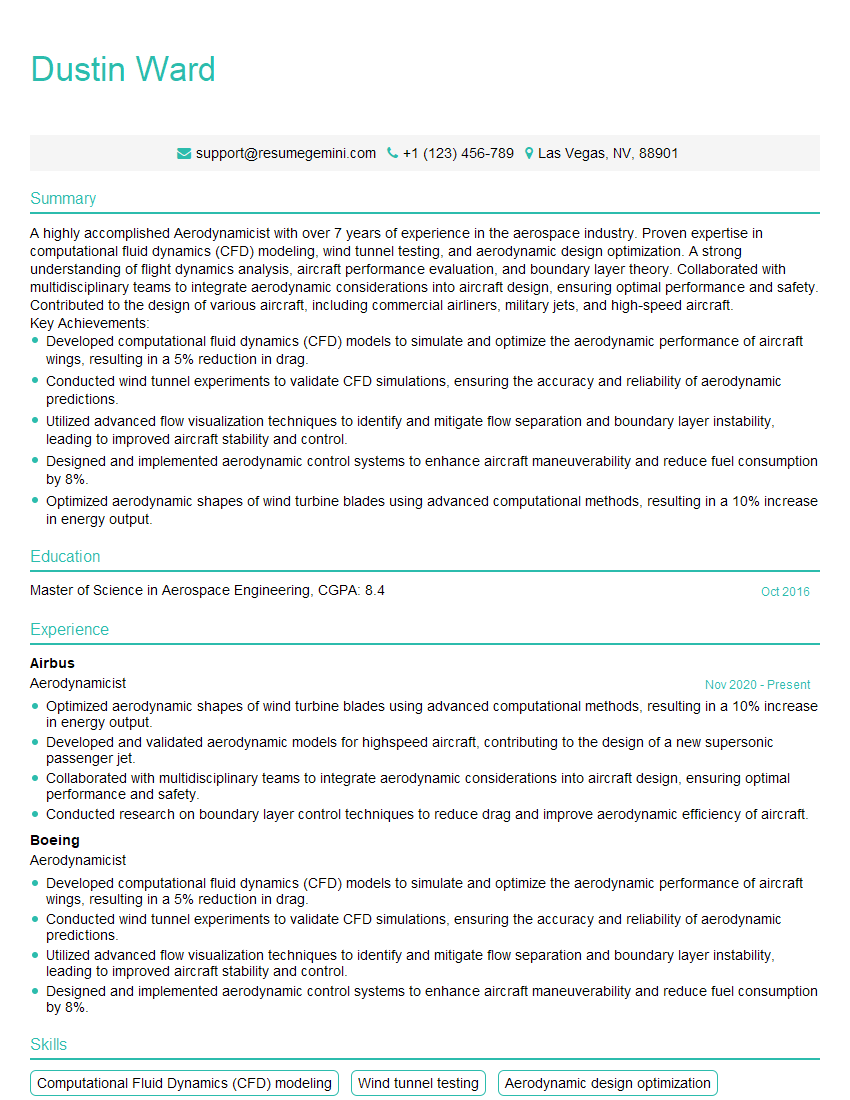
Mastering High-Speed Flow Analysis opens doors to exciting and challenging careers in various high-tech industries. A strong understanding of these concepts significantly enhances your competitiveness in the job market. To maximize your chances, create an ATS-friendly resume that highlights your skills and experience effectively. ResumeGemini is a trusted resource that can help you build a professional and impactful resume, tailored to the specific requirements of your target roles. Examples of resumes tailored to High-Speed Flow Analysis are available to help guide you.
Explore more articles
Users Rating of Our Blogs
Share Your Experience
We value your feedback! Please rate our content and share your thoughts (optional).
What Readers Say About Our Blog
Very informative content, great job.
good