Cracking a skill-specific interview, like one for HTML5, CSS3, JavaScript, requires understanding the nuances of the role. In this blog, we present the questions you’re most likely to encounter, along with insights into how to answer them effectively. Let’s ensure you’re ready to make a strong impression.
Questions Asked in HTML5, CSS3, JavaScript Interview
Q 1. Explain the difference between `==` and `===` in JavaScript.
In JavaScript, both == and === are used for comparison, but they differ significantly in how they perform the check. == is the loose equality operator, while === is the strict equality operator.
The loose equality operator (==) performs type coercion before comparison. This means it attempts to convert the operands to the same type before checking for equality. For instance, 1 == '1' evaluates to true because the string ‘1’ is coerced into the number 1 before the comparison.
The strict equality operator (===) does not perform type coercion. It checks for both value and type equality. Therefore, 1 === '1' evaluates to false because, although the values are the same, their types are different (number and string respectively).
Example:
console.log(1 == '1'); // true (loose equality - type coercion happens)
console.log(1 === '1'); // false (strict equality - no type coercion)
console.log(null == undefined); // true (loose equality - special case)
console.log(null === undefined); // false (strict equality)
In professional development, it’s best practice to always use the strict equality operator (===) to avoid unexpected behavior due to type coercion. This leads to more predictable and maintainable code.
Q 2. What are the different ways to declare a variable in JavaScript?
JavaScript offers three ways to declare variables: var, let, and const. Each has its own scope and behavior.
var: Function-scoped. If declared outside a function, it becomes globally scoped. It can be re-declared and updated within its scope.let: Block-scoped. It’s limited to the block of code (defined by curly braces{}) where it’s declared. It can be updated but not re-declared within the same scope.const: Block-scoped. Similar tolet, but the value assigned to aconstvariable cannot be reassigned after its initial declaration. It must be initialized at the time of declaration. Note that this doesn’t mean the value is immutable if it’s an object or array; it just means you can’t reassign the variable to a completely different object or array.
Example:
function example() {
  var x = 10; // function-scoped
  let y = 20; // block-scoped
  const z = 30; // block-scoped

  if (true) {
    var x = 100; // re-declaration allowed (var)
    let y = 200; // re-declaration NOT allowed (let)
    // const z = 300; // re-declaration NOT allowed (const)
  }
  console.log(x); // 100 (var: function scope)
  console.log(y); // 20 (let: block scope, outer scope value)
  console.log(z); // 30 (const: block scope)
}
example();
Modern JavaScript best practices strongly favor let and const over var due to their improved scope management and prevention of accidental reassignments, which enhances code readability and maintainability.
Q 3. Describe the concept of closures in JavaScript.
A closure in JavaScript is a function that has access to variables from its surrounding lexical environment, even after that environment has finished executing. Think of it like a function ‘remembering’ its context.
This happens because the inner function maintains a reference to the variables in its enclosing function’s scope, even after the outer function has completed its execution. This ‘closed-over’ environment persists as long as the inner function exists.
Example:
function outerFunction() {
  let outerVar = 'Hello';

  function innerFunction() {
    console.log(outerVar); // innerFunction can access outerVar
  }

  return innerFunction;
}

let myClosure = outerFunction();
myClosure(); // Output: Hello, even though outerFunction has finished
In this example, innerFunction is a closure. It ‘closes over’ the variable outerVar from outerFunction. Even after outerFunction returns, innerFunction still remembers and can access outerVar because of the closure.
Closures are fundamental to many JavaScript patterns like creating private variables and encapsulating state within modules. They are extensively used in libraries and frameworks such as React and Angular for managing component state and event handling.
Q 4. What is the difference between `let`, `const`, and `var` in JavaScript?
The differences between let, const, and var lie primarily in their scoping and mutability:
var: Function-scoped or globally scoped (if not within a function). Can be re-declared and updated within its scope.let: Block-scoped. Can be updated but not re-declared within the same scope. Useful for variables whose values might change.const: Block-scoped. Cannot be reassigned after its initial declaration. Useful for constants or values that should remain unchanged.
Example:
function scopeExample() {
  var x = 10;
  let y = 20;
  const z = 30;

  if (true) {
    var x = 100;  // Allowed, re-declaration in the same scope
    let y = 200;  // Allowed, new variable in this block
    // const z = 300; // Not allowed, cannot re-declare const
  }
  console.log(x); // 100
  console.log(y); // 20
  console.log(z); // 30
}
scopeExample();
In modern JavaScript, let and const are preferred over var due to their improved scope management and reduced risk of accidental reassignments, thus leading to more robust and maintainable code. Use const by default for values that should not change and let when a variable’s value might need to be updated.
Q 5. Explain the use of `this` keyword in JavaScript.
The this keyword in JavaScript refers to the object that is executing the current function. However, its behavior can vary depending on how the function is called (especially crucial in object-oriented programming).
- Method Invocation: When a function is called as a method of an object,
thisrefers to that object. - Function Invocation: When a function is called on its own (not as a method),
thistypically refers to the global object (windowin browsers, orundefinedin strict mode). - Constructor Invocation: When a function is called with the
newkeyword (to create a new object),thisrefers to the newly created object. - Explicit Binding (
call,apply,bind): These methods allow you to explicitly set the value ofthisregardless of how the function is called.
Example:
const myObject = {
  name: 'MyObject',
  myMethod: function() {
    console.log(this.name); // 'MyObject'
  }
};

myObject.myMethod(); // Method invocation: this refers to myObject

function myFunction() {
  console.log(this); // In non-strict mode: window; In strict mode: undefined
}

myFunction(); // Function invocation
Understanding this is essential for writing object-oriented JavaScript code and avoiding common pitfalls. Explicit binding can be useful to control the context of this, making your code easier to understand and debug.
Q 6. What are promises and how are they used in asynchronous JavaScript?
Promises are a powerful mechanism in JavaScript for handling asynchronous operations. They represent the eventual result of an asynchronous operation, which might be a success (a resolved value) or a failure (a rejected value).
Instead of using callbacks, promises provide a cleaner and more manageable way to handle asynchronous operations. They utilize the .then() method for handling successful resolutions and .catch() for handling rejections.
Example:
function asyncOperation() {
  return new Promise((resolve, reject) => {
    // Simulate an asynchronous operation
    setTimeout(() => {
      const success = Math.random() < 0.5; // 50% chance of success
      if (success) {
        resolve('Operation successful!');
      } else {
        reject('Operation failed!');
      }
    }, 1000);
  });
}

asyncOperation()
  .then(result => console.log(result)) // Handle successful resolution
  .catch(error => console.error(error)); // Handle rejection
In a professional context, promises dramatically improve the readability and maintainability of asynchronous JavaScript code, especially in projects involving multiple chained asynchronous operations (like API calls or database interactions). They help avoid the dreaded ‘callback hell’ associated with nested callbacks.
Q 7. Explain the concept of event bubbling and event capturing.
Event bubbling and event capturing are two ways in which events propagate through the DOM (Document Object Model) tree when an event occurs on an element.
Event capturing: The event travels *down* the DOM tree from the window to the target element. Event listeners attached in the capturing phase are triggered first.
Event bubbling: The event travels *up* the DOM tree from the target element to the window. Event listeners attached in the bubbling phase are triggered after the capturing phase.
Imagine a balloon popping (the event) inside a set of Russian nesting dolls (the DOM tree). In capturing, you’d hear the sound (the event listener fires) first from the outer doll, then the next, and so on down to the inner doll. Bubbling is the opposite: you’d hear the sound from the inner doll first, then the outer ones.
Example:
Suppose you have a nested structure:
<div id="outer">
  <button id="inner">Click me</button>
</div>
If you have an event listener on both the inner button and the outer div, the order of execution depends on whether you use capturing or bubbling.
const outerDiv = document.getElementById('outer');
const innerButton = document.getElementById('inner');

outerDiv.addEventListener('click', function(event) { console.log('Outer div clicked (bubbling)'); }, false); // bubbling
outerDiv.addEventListener('click', function(event) { console.log('Outer div clicked (capturing)'); }, true); // capturing
innerButton.addEventListener('click', function(event) { console.log('Inner button clicked'); });
By default, most browsers use bubbling. Understanding both capturing and bubbling is essential to write efficient and predictable event handlers, particularly in complex DOM structures. You can strategically use event capturing and bubbling to control how event handlers respond to events that might trigger multiple listeners.
Q 8. What are the different ways to handle events in JavaScript?
JavaScript offers several ways to handle events, which are actions or occurrences that happen in the browser, such as a user clicking a button or a page finishing loading. These methods allow you to make your web pages dynamic and interactive.
Inline Event Handlers: This involves directly adding an event handler attribute to an HTML element. While simple, it’s generally discouraged for larger projects due to poor code organization and maintainability. For example:
<button onclick="alert('Clicked!')">Click Me</button>Event Listeners: This is the preferred method. It’s cleaner, more organized, and allows you to attach multiple handlers to a single element. You use the
addEventListener()method. Example:const button = document.getElementById('myButton'); button.addEventListener('click', function() { alert('Clicked!'); });Here, we select the button, and when a ‘click’ event occurs, the anonymous function (or you could use a named function) is executed.
HTML Event Attributes: Similar to inline handlers, but slightly better organized because the event handling logic is separated in the JavaScript. For example:
<button id="myButton">Click Me</button>
<script>
document.getElementById('myButton').onclick = function() {
alert('Clicked!');
};
</script>
Choosing the right method depends on the complexity of your application. For small projects, HTML event attributes might suffice. However, for larger, more complex projects, event listeners are strongly recommended for their better maintainability and scalability.
Q 9. What are some common JavaScript frameworks or libraries?
The JavaScript ecosystem boasts a rich collection of frameworks and libraries, each designed to streamline web development in different ways. These tools often provide structure, reusable components, and improved efficiency.
React: A component-based library for building user interfaces (UIs). It’s known for its virtual DOM (Document Object Model), which helps optimize updates and improve performance. React is particularly popular for single-page applications (SPAs) and complex UIs.
Angular: A comprehensive framework for building large-scale applications. It provides a structured approach with features like dependency injection and data binding. Angular is often favored for enterprise-level projects.
Vue.js: A progressive framework that’s easy to learn and integrate into existing projects. It offers a gentle learning curve while still providing powerful features for building dynamic UIs.
jQuery: A widely-used library that simplifies DOM manipulation, event handling, and AJAX (Asynchronous JavaScript and XML) calls. While its popularity has decreased with the rise of modern frameworks, it remains relevant for legacy projects and quick prototyping.
Node.js: Not strictly a front-end framework, but it’s crucial for server-side JavaScript development using JavaScript on the server.
The choice of framework or library depends heavily on project requirements, team expertise, and personal preference. Each has its own strengths and weaknesses.
Q 10. Explain the difference between `document.getElementById()` and `querySelector()`.
Both document.getElementById() and querySelector() are used to select elements in the DOM, but they differ in their approach and capabilities.
document.getElementById(): This method selects an element based on its uniqueidattribute. It’s fast and efficient because it directly targets an element by its ID. If multiple elements share the same ID (which is invalid HTML), it only returns the first one encountered.querySelector(): This method uses CSS selectors to target elements. It’s far more flexible thangetElementById(). You can select elements based on their tag name, class, attributes, and more complex combinations of criteria. However, it’s slightly slower thangetElementById()as it needs to parse the selector and traverse the DOM.
Example:
Let’s say you have an HTML element with id="myElement" and class "myClass":
<div id="myElement" class="myClass">Hello</div>
To select it:
// Using getElementById
const elementById = document.getElementById('myElement');

// Using querySelector
const elementByClass = document.querySelector('.myClass'); // Selects the first element with class myClass
const elementById2 = document.querySelector('#myElement'); // Selects element by id
In summary, use getElementById() when you know the exact ID of the element, and use querySelector() for more flexible and complex selections.
Q 11. How do you handle cross-browser compatibility issues?
Cross-browser compatibility is a critical aspect of web development. Different browsers (Chrome, Firefox, Safari, Edge) may render HTML, CSS, and JavaScript differently, leading to inconsistencies in how your website looks and functions.
CSS Frameworks/Preprocessors: Frameworks like Bootstrap or preprocessors like Sass abstract away browser-specific CSS, providing a consistent styling experience across various browsers.
Feature Detection: Instead of relying on browser sniffing (detecting the browser’s name and version), feature detection checks if a specific feature exists. This ensures that your code gracefully degrades if a feature is unavailable in a particular browser, rather than failing entirely. Example: checking if
localStorageis available before using it.Polyfills: Polyfills are pieces of code that provide features not natively supported by certain older browsers. This ‘fills the gaps’ between browser capabilities, ensuring consistent functionality. For instance, a polyfill might provide
Array.prototype.includes()for older browsers lacking this method.Testing: Thorough testing across different browsers and devices is essential. Use browser developer tools to debug and ensure consistent behavior.
Transpilers: Tools like Babel can convert newer JavaScript code (like ES6+) into code compatible with older browsers. This allows you to write modern JavaScript while maintaining broad compatibility.
A robust strategy often involves a combination of these techniques. By addressing browser inconsistencies proactively, you ensure a consistent user experience for everyone, regardless of their chosen browser.
Q 12. What are some best practices for writing efficient JavaScript code?
Writing efficient JavaScript code is crucial for performance and maintainability. Here are some best practices:
Minimize DOM Manipulation: Accessing and modifying the DOM is computationally expensive. Batch DOM updates whenever possible to reduce the number of reflows and repaints.
Use Event Delegation: Attach event listeners to a parent element instead of individual child elements. This significantly reduces the number of event listeners, improving performance, especially with many child elements.
Caching: Cache frequently accessed DOM elements or data to avoid repeatedly querying the DOM or making network requests.
Avoid Global Variables: Excessive use of global variables can lead to naming conflicts and make debugging difficult. Use closures and modules to encapsulate code and variables.
Use Modern JavaScript Features: Modern features like
constandlet, arrow functions, and async/await, often improve code clarity and performance.Code Optimization: Use profiling tools to identify performance bottlenecks and optimize your code accordingly. Consider using tools like the Chrome DevTools profiler.
Asynchronous Operations: Utilize asynchronous operations (promises, async/await) to prevent blocking the main thread, thus enhancing responsiveness.
Minification and Compression: Before deployment, minify and compress your JavaScript code to reduce its size, resulting in faster downloads.
By consistently applying these best practices, you can significantly improve the performance, readability, and maintainability of your JavaScript code.
Q 13. Explain the box model in CSS.
The CSS box model is a fundamental concept defining how elements are rendered on a webpage. It describes how the width and height of an element are calculated, and how spacing between elements is managed. It’s composed of several parts:
Content: The actual content of the element (text, images, etc.).
Padding: Space between the content and the border. It’s transparent and part of the element’s box.
Border: A line surrounding the padding and content. It can have a color, width, and style.
Margin: Space outside the border, separating the element from its neighbors. It’s transparent and not part of the element’s box.
Understanding the box model is critical for accurate layout control. The total width of an element, for example, is calculated as width + padding-left + padding-right + border-left + border-right. Similarly, height is calculated with padding and border components. Margins are added *outside* the element’s box, affecting spacing between elements.
Example:
Let’s say you have a div with:
width: 100px;padding: 10px;border: 5px solid black;
The total width of the rendered element will be 100px + 10px + 10px + 5px + 5px = 130px.
Mastering the box model is essential for precise control over web page layouts.
Q 14. What are the different types of selectors in CSS?
CSS selectors are the foundation of styling web pages. They allow you to specify which HTML elements should be styled with particular CSS rules. Different types of selectors offer varying levels of specificity and power.
Type Selectors: Select elements based on their tag name (e.g.,
p,div,h1). Example:p { color: blue; }styles all paragraph elements.Class Selectors: Select elements with a specific class attribute (e.g.,
.myClass). Example:.myClass { font-size: 16px; }styles elements with the class ‘myClass’.ID Selectors: Select elements with a specific ID attribute (e.g.,
#myId). Example:#myId { background-color: red; }styles the element with ID ‘myId’. IDs should be unique on a page.Universal Selector: The asterisk (
*) selects all elements. Example:* { margin: 0; }resets margins for all elements. This selector is often used for resets or global styling.Attribute Selectors: Select elements based on their attributes. Examples:
[type="checkbox"](selects all checkboxes),[href](selects all elements with href attribute),[title*="example"](selects elements whose title attribute contains ‘example’).Pseudo-classes and Pseudo-elements: Extend selectors to target specific states (e.g.,
:hover,:active,:focus) or parts of an element (e.g.,::before,::after). Example:a:hover { text-decoration: underline; }underlines links on hover.Combinators: Combine multiple selectors to create more specific rules:
descendant combinator (space),child combinator (>),adjacent sibling combinator (+),general sibling combinator (~)
Understanding the various CSS selectors empowers you to write highly targeted and efficient stylesheets, leading to clean, well-structured, and maintainable code.
Q 15. How do you center an element both horizontally and vertically using CSS?
Centering an element both horizontally and vertically in CSS can be achieved using several techniques, depending on the context. The simplest method works best for single-line elements within a parent container with defined dimensions.
Method 1: Using Flexbox (Most common and versatile):
This method is clean, efficient, and widely supported. We set the parent container to use flexbox and then align the child element.
Centered ElementHere, display: flex enables flexbox, justify-content: center centers the item horizontally, and align-items: center centers it vertically. The height and width provide a frame of reference.
Method 2: Using Grid (For more complex layouts):
Grid is powerful for complex layouts. This approach is similar to flexbox but offers more control, especially for multi-row/column arrangements.
Centered Elementplace-items: center is a shorthand for align-items: center; justify-items: center;. Again, height and width are crucial.
Method 3: Absolute Positioning (Requires parent dimensions):
This is less preferred for its reliance on knowing the parent’s dimensions.
Centered ElementWe set the parent to position: relative, and the child to position: absolute. transform: translate(-50%, -50%) offsets the element to perfectly center it. Note this method is less flexible than Flexbox or Grid.
Career Expert Tips:
- Ace those interviews! Prepare effectively by reviewing the Top 50 Most Common Interview Questions on ResumeGemini.
- Navigate your job search with confidence! Explore a wide range of Career Tips on ResumeGemini. Learn about common challenges and recommendations to overcome them.
- Craft the perfect resume! Master the Art of Resume Writing with ResumeGemini’s guide. Showcase your unique qualifications and achievements effectively.
- Don’t miss out on holiday savings! Build your dream resume with ResumeGemini’s ATS optimized templates.
Q 16. Explain the concept of responsive web design.
Responsive web design is the approach of building websites that adapt seamlessly to different screen sizes and devices, from desktops to tablets and smartphones. The core principle is to provide an optimal viewing experience—easy reading and navigation with minimal resizing, panning, and scrolling—across a wide range of devices.
Key Techniques:
- Fluid Grids: Using percentages instead of fixed pixels for widths allows elements to scale proportionally with the screen size.
- Flexible Images: Images should scale without distorting, using the
max-width: 100%;CSS property. - Media Queries: CSS rules that apply different styles based on screen size, device orientation, or other factors. This lets you tailor the layout for specific breakpoints (e.g., small screens vs. large screens).
- Mobile-First Approach: Designing for smaller screens first and then progressively enhancing for larger screens, ensuring a baseline of good usability on all devices.
Example Media Query:
@media (max-width: 768px) { /* Styles for screens up to 768 pixels wide */ .container { width: 90%; } }This media query applies a width of 90% to the element with the class container when the screen width is 768 pixels or less.
Real-World Application: Imagine designing an e-commerce website. A responsive design ensures that customers can easily browse products and make purchases regardless of whether they are using a desktop, tablet, or phone. This significantly improves user experience and conversion rates.
Q 17. What are CSS preprocessors and why are they used?
CSS preprocessors are tools that extend the functionality of CSS by adding features that aren’t natively available in standard CSS. They act as intermediaries, allowing you to write more efficient, maintainable, and organized CSS code, which is then compiled into standard CSS that browsers can understand.
Popular Preprocessors: Sass (Syntactically Awesome Style Sheets) and Less are two of the most widely used.
Key Advantages:
- Variables: Define reusable values, making it easier to update styles consistently.
- Nesting: Organize CSS rules in a hierarchical structure, improving readability.
- Mixins: Create reusable blocks of CSS code, reducing repetition.
- Functions: Perform calculations and manipulations on CSS values.
- Inheritance: Easily extend styles from one style to another.
Example (Sass):
$primary-color: #007bff;  // Variable
  .button {    background-color: $primary-color;    padding: 10px 20px;  }
  .button-large {    @extend .button;  // Inheritance     padding: 15px 30px;  }
This Sass code defines a variable $primary-color and uses it in the .button style. The .button-large style inherits from .button using @extend, demonstrating inheritance and reusability. The preprocessor compiles this Sass into standard CSS that browsers understand. Using preprocessors significantly improves code maintainability and reduces redundancy in large projects.
Q 18. Explain the difference between inline, internal, and external CSS.
The three ways to include CSS in an HTML document offer different levels of scope and organization. The choice depends on the complexity and scale of the project.
1. Inline CSS: Styles are applied directly within an HTML element using the style attribute.
This text is blue and 16px.
This approach is generally avoided for larger projects because it makes the HTML bloated and difficult to maintain. Changes require altering the HTML code directly. It’s suitable only for very minor, one-off style adjustments.
2. Internal CSS: Styles are defined within the <head> section of an HTML document, using the <style> tag.
<head> <style> p { color: green; } </style></head>This is better for small projects or when specific styles apply only to a single page. It keeps styles within the HTML file but can become cumbersome for larger projects.
3. External CSS: Styles are defined in separate .css files, which are linked to the HTML document using the <link> tag. This is the recommended approach for most projects.
<head> <link rel="stylesheet" href="styles.css"> </head>This allows for easy reuse of styles across multiple HTML pages and promotes separation of concerns (HTML, CSS, and JavaScript). Changes are made in one location and cascade across the entire site. External CSS is the best practice for maintainability and scalability.
Q 19. What is the difference between `position: absolute` and `position: fixed`?
Both position: absolute and position: fixed remove elements from the document’s normal flow, but they differ in how they position themselves. The crucial difference lies in their positioning context.
position: absolute;
Positions the element relative to its nearest positioned ancestor (an ancestor with position: relative, absolute, fixed, or sticky). If no positioned ancestor is found, the element’s position is relative to the document body (<body>).
position: fixed;
Positions the element relative to the viewport (the browser window). The element remains in the same position even when the page is scrolled.
Example:
If you have a navigation bar you want to stay fixed at the top of the screen even while scrolling, you would use position: fixed;. If you’re positioning a tooltip relative to a specific element on the page, position: absolute; is more appropriate.
/* Fixed Navigation */ Fixed Nav/* Absolute Tooltip (needs a positioned parent)*/TooltipQ 20. What are flexbox and grid layouts and when would you use them?
Flexbox and Grid are powerful CSS layout modules that provide efficient ways to arrange items within a container, but they are best suited for different scenarios.
Flexbox:
Ideal for one-dimensional layouts (either a single row or a single column). It’s excellent for aligning items along a single axis (horizontally or vertically) and distributing space between them. Think of aligning items within a navigation bar or arranging items in a simple list.
Grid:
Best suited for two-dimensional layouts (rows and columns). It allows for precise control over the placement of items in both rows and columns, making it perfect for complex page layouts, like designing a website’s main content area with sidebars and footers.
When to Use Which:
- Use Flexbox when: You need to arrange items in a single row or column, align them easily, or distribute space between them.
- Use Grid when: You need a two-dimensional layout, you need fine-grained control over item placement, and your layout is more complex than a simple row or column.
Example (Flexbox):
Item 1 Item 2 Item 3Example (Grid):
Sidebar Main Content Right SidebarIn the Flexbox example, items are distributed with space around them. The Grid example creates a three-column layout with the middle column twice the width of the side columns.
Q 21. Explain the difference between HTML5 semantic elements and non-semantic elements.
HTML5 introduced semantic elements, which provide meaning to the content they enclose, improving accessibility and SEO. Non-semantic elements only focus on the visual presentation.
Semantic Elements:
These elements convey the purpose of the content. Examples include:
<header>: Defines a header for a document or section.<nav>: Defines a set of navigation links.<article>: Defines an independent, self-contained piece of content.<aside>: Defines content aside from the page content (like a sidebar).<section>: Defines a section in a document.<footer>: Defines a footer for a document or section.
Non-Semantic Elements:
These elements focus on how the content looks, not its meaning. Examples include:
<div>: A generic container.<span>: An inline container.
Why Semantic Elements Matter:
Using semantic elements improves:
- Accessibility: Screen readers and other assistive technologies can better understand the structure and purpose of the page.
- SEO: Search engines can better understand the content and improve search rankings.
- Maintainability: Code is more readable and easier to maintain.
Example:
Instead of using <div id="navigation"> for navigation, use <nav>. This clearly indicates the purpose of the element to both humans and machines.
Q 22. What are the different HTML5 input types?
HTML5 offers a rich variety of input types, extending far beyond the basic text field. These types enhance user experience and provide server-side validation capabilities. They ensure data integrity and improve the overall form interaction.
text: The standard text input.password: Masks input characters for security.email: Validates email addresses using a basic format check.url: Validates URLs.tel: Optimized for phone numbers.number: Allows numerical input with optional min, max, and step attributes for range specification.date,month,week,time,datetime-local: Provide date and time pickers, improving user input accuracy.range: A slider for selecting a value within a given range.color: A color picker.checkbox: A boolean selection; allows multiple selections.radio: A boolean selection; only one option can be selected from a group.file: Allows users to upload files.search: A text input specifically designed for search queries.submit: A button to submit a form.reset: Resets a form to its default values.button: A general-purpose button that can trigger custom JavaScript actions.
For example, a simple form using different input types would look like this:
Q 23. How do you create a responsive image using HTML5 and CSS?
Creating responsive images ensures that images scale appropriately to fit different screen sizes and devices, preventing distortion and maintaining visual appeal. This is achieved through a combination of HTML and CSS.
In HTML, we use the <img> tag and specify the image source. Crucially, we avoid setting fixed width and height attributes, allowing the image to adapt to its container.
In CSS, we utilize the max-width property set to 100%. This ensures the image never exceeds its container’s width, preventing horizontal overflow. We can also use the height: auto; to maintain aspect ratio when using max-width: 100%;.
<img src="image.jpg" alt="Responsive Image">img { max-width: 100%; height: auto; display: block; }This simple CSS ensures the image scales proportionally to the width of its container, automatically adjusting for various screen sizes. Consider using the picture element for even more sophisticated responsive image handling with different image sources based on device capabilities.
Q 24. Explain the role of the `
The <canvas> element is a powerful tool for dynamic, 2D drawing on a web page. It provides a blank rectangular area where you can draw shapes, text, images, and more using JavaScript. Think of it as a digital drawing board.
It’s not directly rendered by the browser; instead, JavaScript APIs like the CanvasRenderingContext2D are used to programmatically create visual elements. This makes it ideal for creating games, animations, charts, image manipulation tools, and more.
For instance, you can draw a simple rectangle using JavaScript:
<canvas id="myCanvas" width="200" height="100"><script>const canvas = document.getElementById('myCanvas');const ctx = canvas.getContext('2d');ctx.fillStyle = 'blue';ctx.fillRect(10, 10, 100, 50);</script>This code obtains the canvas context and then draws a blue rectangle at coordinates (10, 10) with a width of 100 pixels and height of 50 pixels.
Q 25. What are web workers and why are they useful?
Web Workers allow you to run JavaScript code in the background, independent of the main browser thread. This is crucial for handling computationally intensive tasks without blocking the user interface (UI) and ensuring a responsive user experience. Imagine a complex calculation or a large data processing task: Without web workers, this would freeze your browser.
They are particularly useful for:
- Background tasks: Performing long-running operations like image processing, complex calculations, or data analysis without freezing the UI.
- Parallel processing: Breaking down large tasks into smaller pieces that can be processed concurrently by multiple workers.
- Improved performance: Preventing UI blocking and improving responsiveness by offloading heavy processing to background threads.
To create a web worker, you create a separate JavaScript file (e.g., worker.js) that contains the code to be executed in the background and then create an instance of the Worker object in your main script, passing the path to the worker script as an argument.
// worker.js// ...worker code...// main.jsconst myWorker = new Worker('worker.js');myWorker.postMessage('start');myWorker.onmessage = function(e) { console.log('Message received from worker:', e.data);};Q 26. How do you handle form submissions using JavaScript?
JavaScript provides several ways to handle form submissions. The simplest approach involves preventing the default form submission behavior and handling the submission using JavaScript. More sophisticated approaches often use AJAX for asynchronous submissions.
A basic example using the submit event:
<form id="myForm"><input type="text" name="name"><button type="submit">Submit</button></form><script>const form = document.getElementById('myForm');form.addEventListener('submit', function(event) {event.preventDefault();// Prevent default form submission// Your form submission logic here, e.g., fetch API or FormData});</script>In this example, we prevent the default behavior using event.preventDefault(). Then you would typically process the form data, perhaps using the FormData API to send it to a server using fetch or an AJAX library such as jQuery’s $.ajax.
Q 27. Explain the concept of AJAX and how it is used in web development.
AJAX (Asynchronous JavaScript and XML) is a technique for updating parts of a web page without reloading the entire page. It’s essential for creating dynamic and responsive web applications.
Instead of a full page refresh, AJAX allows you to send data to the server in the background and receive updates without disrupting the user’s workflow. This approach is efficient and improves user experience. XML was originally used for data exchange, but now JSON is the more common format.
AJAX relies on the XMLHttpRequest object (or the newer fetch API) to communicate with the server. The process typically involves:
- Making an asynchronous request to a server using a specified URL.
- Sending data to the server (often in JSON format).
- Receiving a response from the server, also often in JSON.
- Updating the web page dynamically with the received data.
AJAX is widely used in applications requiring real-time updates, like chat applications, interactive maps, and auto-suggest features. The fetch API offers a cleaner and more modern approach to AJAX:
fetch('/your-url', { method: 'POST', headers: { 'Content-Type': 'application/json' }, body: JSON.stringify(data) }) .then(response => response.json()) .then(data => { // Update the page with the received data });Q 28. What are some tools and techniques for debugging JavaScript code?
Debugging JavaScript code is a critical part of web development. Fortunately, there are many tools and techniques available to help.
- Browser Developer Tools: All modern browsers (Chrome, Firefox, Safari, Edge) include powerful developer tools with built-in debuggers. These allow you to set breakpoints, step through code, inspect variables, and monitor network requests. They are your first line of defense.
- Console Logging (
console.log()): The simplest way to debug is to strategically placeconsole.log()statements in your code to display variable values or messages at various points in the execution. This helps track the flow of your code and identify issues. - Linters: Linters are tools that analyze your code for potential problems (syntax errors, style inconsistencies, potential bugs). Popular JavaScript linters include ESLint.
- Debuggers (VS Code, WebStorm): Integrated development environments (IDEs) like VS Code or WebStorm have advanced debugging features that integrate seamlessly with your development workflow. These provide features beyond the browser’s developer tools.
- Source Maps: If you’re working with minified or transpiled code (like code compiled from TypeScript or using a bundler like Webpack), source maps allow the debugger to connect your minified code back to its original source files, making debugging much easier.
Using a combination of these tools will significantly improve your debugging efficiency.
Key Topics to Learn for HTML5, CSS3, JavaScript Interviews
- HTML5 Semantics: Understanding and utilizing semantic HTML5 tags for improved accessibility and SEO. Practical application: Building structured and well-organized web pages.
- CSS3 Selectors & Styling: Mastering CSS selectors for efficient styling and the use of CSS preprocessors (e.g., Sass, Less) for maintainability. Practical application: Creating responsive and visually appealing websites.
- JavaScript Fundamentals: Solid grasp of data types, variables, operators, control flow, and functions. Practical application: Implementing dynamic and interactive website features.
- DOM Manipulation: Understanding how to interact with and modify the Document Object Model (DOM) using JavaScript. Practical application: Creating interactive user interfaces.
- Asynchronous JavaScript (AJAX & Promises): Handling asynchronous operations efficiently using AJAX and Promises for seamless user experience. Practical application: Fetching data from APIs and updating the UI without page reloads.
- JavaScript Frameworks/Libraries (Conceptual): Understanding the basic concepts and application of popular frameworks like React, Angular, or Vue.js (focus on conceptual understanding rather than in-depth coding). Practical application: Building complex, maintainable, and scalable web applications.
- Responsive Web Design Principles: Applying media queries and flexible layouts to ensure optimal viewing experience across different devices. Practical application: Creating websites that adapt seamlessly to various screen sizes.
- Version Control (Git): Understanding basic Git commands for collaboration and managing code changes. Practical application: Working effectively in team environments.
- Debugging and Problem-Solving Techniques: Developing effective strategies for identifying and resolving coding errors and unexpected behavior. Practical application: Building robust and reliable web applications.
- Testing and Best Practices: Understanding the importance of writing clean, well-documented, and testable code. Practical application: Creating high-quality and maintainable web applications.
Next Steps
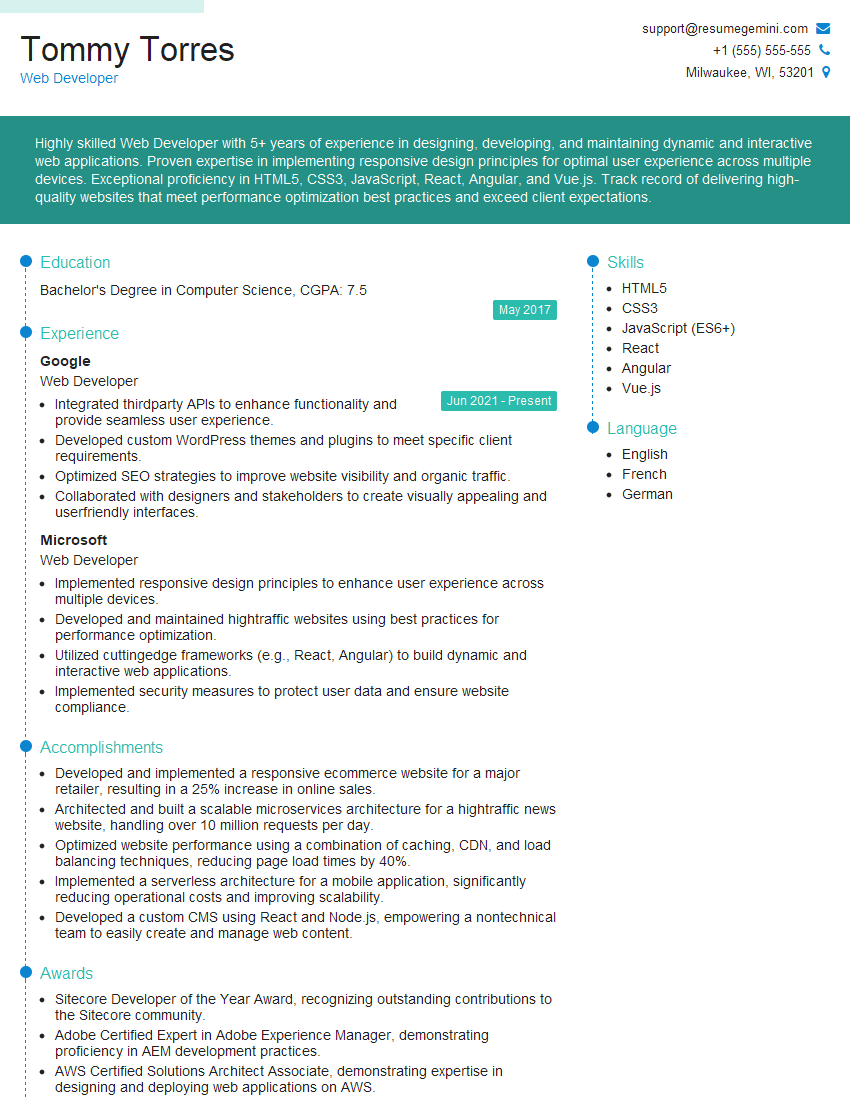
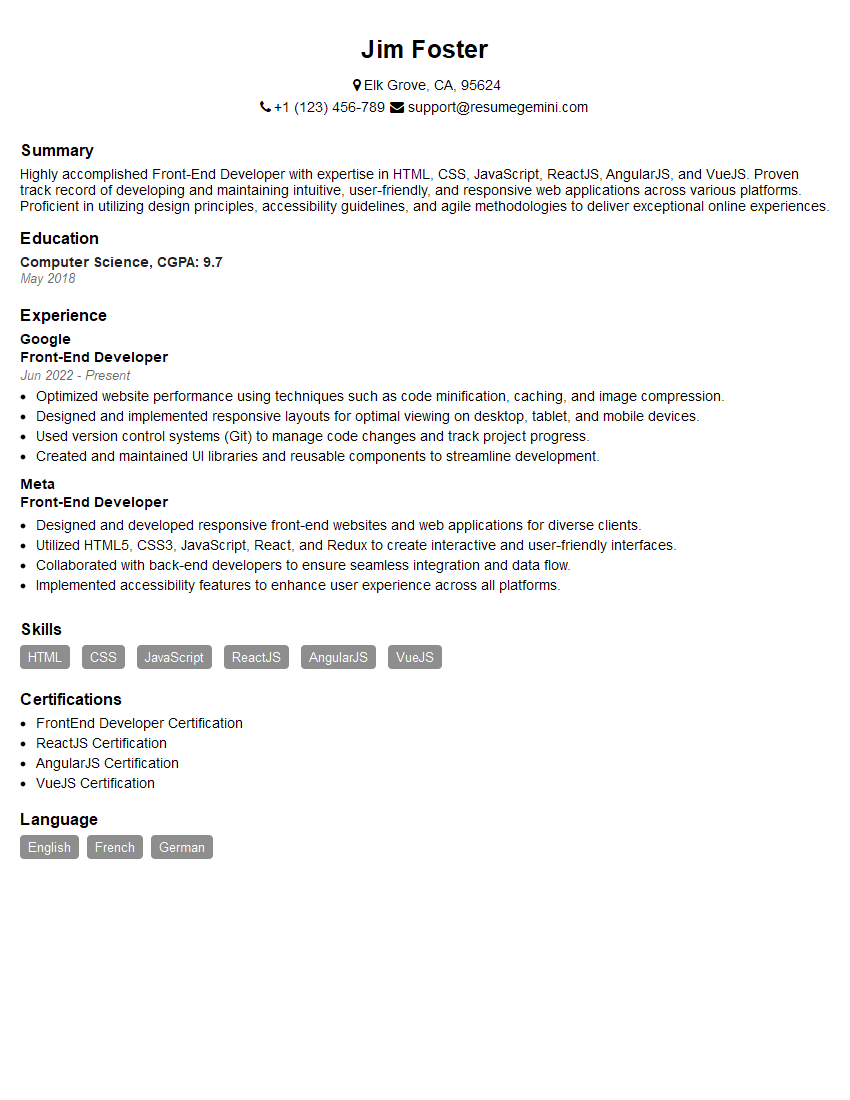
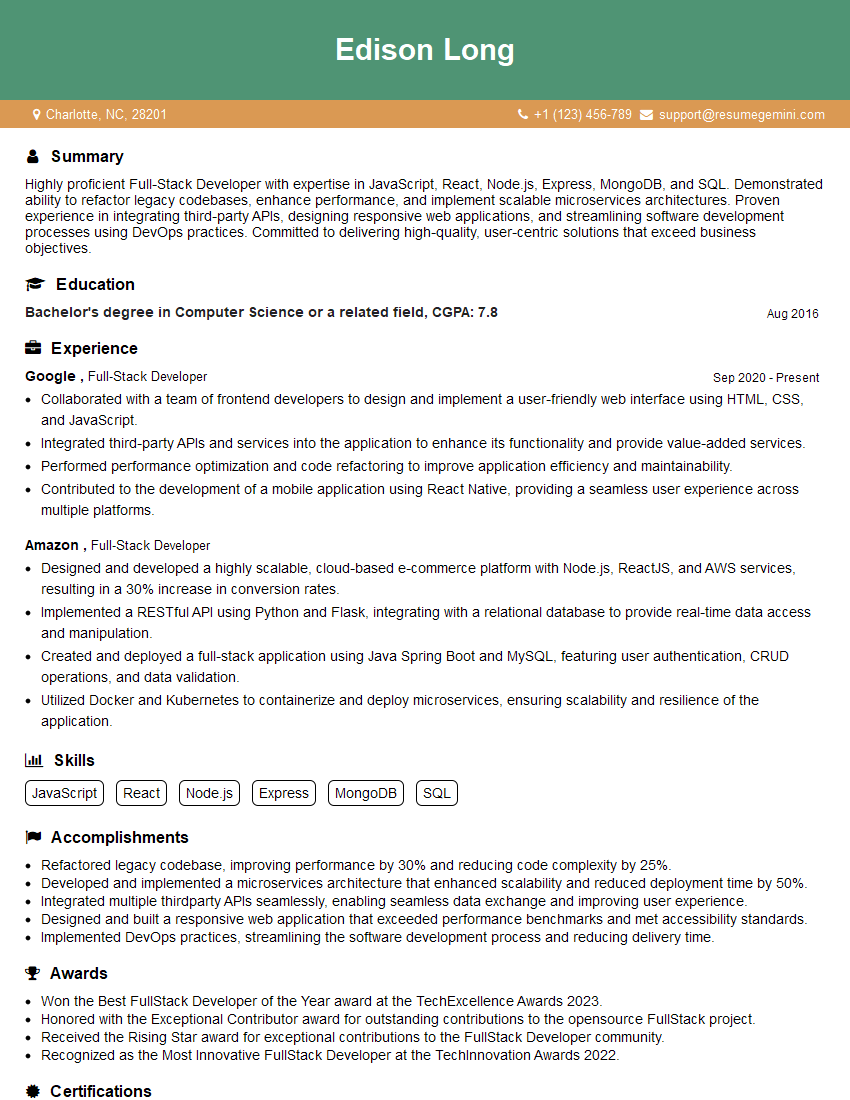
Mastering HTML5, CSS3, and JavaScript is crucial for a successful career in web development, opening doors to diverse and exciting opportunities. To maximize your job prospects, crafting an ATS-friendly resume is essential. ResumeGemini is a trusted resource to help you build a professional and impactful resume that highlights your skills and experience effectively. Examples of resumes tailored to HTML5, CSS3, and JavaScript expertise are available to guide you.
Explore more articles
Users Rating of Our Blogs
Share Your Experience
We value your feedback! Please rate our content and share your thoughts (optional).
What Readers Say About Our Blog
Hello,
we currently offer a complimentary backlink and URL indexing test for search engine optimization professionals.
You can get complimentary indexing credits to test how link discovery works in practice.
No credit card is required and there is no recurring fee.
You can find details here:
https://wikipedia-backlinks.com/indexing/
Regards
NICE RESPONSE TO Q & A
hi
The aim of this message is regarding an unclaimed deposit of a deceased nationale that bears the same name as you. You are not relate to him as there are millions of people answering the names across around the world. But i will use my position to influence the release of the deposit to you for our mutual benefit.
Respond for full details and how to claim the deposit. This is 100% risk free. Send hello to my email id: [email protected]
Luka Chachibaialuka
Hey interviewgemini.com, just wanted to follow up on my last email.
We just launched Call the Monster, an parenting app that lets you summon friendly ‘monsters’ kids actually listen to.
We’re also running a giveaway for everyone who downloads the app. Since it’s brand new, there aren’t many users yet, which means you’ve got a much better chance of winning some great prizes.
You can check it out here: https://bit.ly/callamonsterapp
Or follow us on Instagram: https://www.instagram.com/callamonsterapp
Thanks,
Ryan
CEO – Call the Monster App
Hey interviewgemini.com, I saw your website and love your approach.
I just want this to look like spam email, but want to share something important to you. We just launched Call the Monster, a parenting app that lets you summon friendly ‘monsters’ kids actually listen to.
Parents are loving it for calming chaos before bedtime. Thought you might want to try it: https://bit.ly/callamonsterapp or just follow our fun monster lore on Instagram: https://www.instagram.com/callamonsterapp
Thanks,
Ryan
CEO – Call A Monster APP
To the interviewgemini.com Owner.
Dear interviewgemini.com Webmaster!
Hi interviewgemini.com Webmaster!
Dear interviewgemini.com Webmaster!
excellent
Hello,
We found issues with your domain’s email setup that may be sending your messages to spam or blocking them completely. InboxShield Mini shows you how to fix it in minutes — no tech skills required.
Scan your domain now for details: https://inboxshield-mini.com/
— Adam @ InboxShield Mini
Reply STOP to unsubscribe
Hi, are you owner of interviewgemini.com? What if I told you I could help you find extra time in your schedule, reconnect with leads you didn’t even realize you missed, and bring in more “I want to work with you” conversations, without increasing your ad spend or hiring a full-time employee?
All with a flexible, budget-friendly service that could easily pay for itself. Sounds good?
Would it be nice to jump on a quick 10-minute call so I can show you exactly how we make this work?
Best,
Hapei
Marketing Director
Hey, I know you’re the owner of interviewgemini.com. I’ll be quick.
Fundraising for your business is tough and time-consuming. We make it easier by guaranteeing two private investor meetings each month, for six months. No demos, no pitch events – just direct introductions to active investors matched to your startup.
If youR17;re raising, this could help you build real momentum. Want me to send more info?
Hi, I represent an SEO company that specialises in getting you AI citations and higher rankings on Google. I’d like to offer you a 100% free SEO audit for your website. Would you be interested?
Hi, I represent an SEO company that specialises in getting you AI citations and higher rankings on Google. I’d like to offer you a 100% free SEO audit for your website. Would you be interested?
good